A glacial wait
for the gentian to spread
the violet slopes again

when the man-made flood came
the purple primrose closed its eye

which had known only stars
and the closer teeth of sheep
-
Cow Green
Follow me on the Fediverse
 Burn Edge@burnedge.wordpress.com@burnedge.wordpress.com
Writing about place, nature, ecology and literature, from the northeast of England
21 posts5 followersGet in touch: robgalpin at duck dot com
-
small winter poems
pin up
the sodden veil
of the day
all the dark trees
of the dene
wet through
to their roots


-
all the difficulties
of the dark months
even gorse agrees
to withhold


-
a damaged river meets another damaged river butting heads and bellowing the weir whips them on - golden plover calling over the ancient salt pans the moment pocketed -
to carry always
the garden
with you
allelopathic elder
monoecious hazel
the pond broken
and refrozen
into peaks
of white


-
gulls in
grey and rain
score their white
across the sky
how are they
there      you here


-Follow me on the Fediverse
Burn Edge@burnedge.wordpress.com@burnedge.wordpress.comWriting about place, nature, ecology and literature, from the northeast of England
21 posts5 followersFediverse Reactions
Get in touch: robgalpin at duck dot com
-
-
Full moon and dead hedge

These last few nights the moon has looked incredible through the dark trees in the allotments. Watching and recording the last, almost imperceptible, waxing over three or four nights, is something I’ve never really done before. Of course if you take a photo of the moon in the dusk, through trees, it looks like little more than an out of place street lamp, high up a phantom hill. I remember one winter taking myself for a pre-dawn walk to the top of the Wallsend Dene, where there’s an open, scrubby meadow relict, and being amazed by the extraordinarily low and yellow moon on the other side of the valley. It turned out to be the glowing Lidl logo, from the shops across the road at Battle Hill.
I spent the Christmas hols in the allotments, pollarding a large multi-stemmed grey willow which had been over-shading the area outside our plot. I can tell you that willow sits very heavily on the saw, which is surprising as the wood is lighter than both cherry and elder, which are equally hard to cut – especially if you only have a bow saw like me. I used the cuttings to build a decent-sized dead hedge as a path edging and a new home for wildlife. This had the unexpected effect of creating a kind of garden look to the area around the willow. This is part of a large triangle of trees which was once a couple of allotment plots, and which I’ve taken unofficial stewardship of. I could have left the cuttings in a pile, let the brambles grow over everything, and let it all settle slowly into the earth – and all that would have been very acceptable to the local fauna. But I always think its important to define areas as a signal to others: “this is a garden for wildlife”- not a dumping ground, for example. My plan is to spread the wild primroses here, get some more crocuses in the ground, and manage the area by scythe cutting no more than once a year. The rowan and cherry plum whips I planted here a couple of years ago will probably shoot up, now the willow is gone (it’ll be back, of course).
I find it irresistible to stay in the allotments until dusk. Our plot neighbour does too, and burns most nights in the winter. I don’t know how he has amassed so much wood he needs rid of. He’s taciturn but decent enough, and his plot is heavily fortified with corrugated iron, crowd control barriers and the like. Ours is hedged, which is much more aesthetically pleasing, but a drain on the resources of the annuals we grow, and a lot of work to keep in check. I wouldn’t be without the lurking robins, wrens and blackcaps, in any case. The only other person who turns up daily in the winter is Ronnie, who has been continuing his long job of clearing the burn of rubbish, and is also now digging out an area along the path to make some garden beds. He’s a very careful sorter of rubbish, which I greatly admire – broken glass is bucketed and recycled, wood is burned (naturally) and recovered bricks are donated to other plot holders (usually me). Unrecyclable rubbish he puts in his own home wheelie bin. The effort is incredible – every spade in the ground will bring up more, often unclassifiable detritus.
Snow has now arrived in the north-east, proper snow which sits dry and hardens to ice over a number of days. It’s been a few years. It means a pause in the allotment work, and in any case I’m back to my actual job tomorrow. Still, it won’t be long till the afternoons return, along with the snowdrops and crocuses. In garden news, my newly-dug little pond has frozen over, which I find oddly gratifying – as if its a confirmation that the pond is a real fact of the garden now. Also, a variety of co-conspirators have discovered the feeders we’ve put by our front window. From their vantage point in the garden hawthorn they dive for the fat balls, feed, and retire – one at a time. It’s a gloriously colourful group of long-tailed tits, blue tits, great tits and, oddly, a single goldfinch.

Follow me on the Fediverse
Burn Edge@burnedge.wordpress.com@burnedge.wordpress.comWriting about place, nature, ecology and literature, from the northeast of England
21 posts5 followersFediverse Reactions
Get in touch: robgalpin at duck dot com
-
-
A River Through Time
My “Times of Need” post was written for the Natural History Society of Northumbria’s “Nature’s Cure in Times of Need” project – they’ve now put it up as a blog post on their site here:
A River Through Time – Natural History Society of Northumbria
Follow me on the Fediverse
Burn Edge@burnedge.wordpress.com@burnedge.wordpress.comWriting about place, nature, ecology and literature, from the northeast of England
21 posts5 followersFediverse Reactions
Get in touch: robgalpin at duck dot com
-
-
Muckle Moss and the Black Dyke
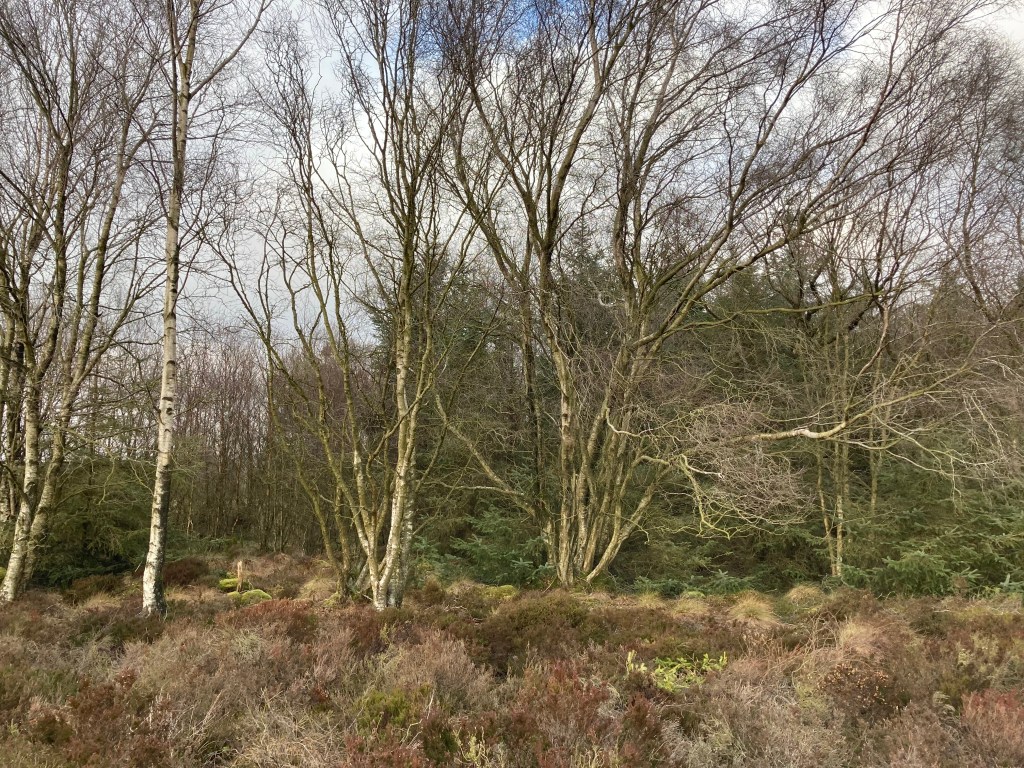
Today I walked alone along the Stanegate, the ancient frontier road just south of Hadrian’s Wall (which predates that frontier by a few decades), and on a whim – actually I’d noticed an unexpected gap in the fence – I dipped down into Muckle Moss. The Moss is a superb example of a healthy, functioning valley mire, and the only one in England formed of a series of ridges and crescent-shaped pools, a type more commonly found in Scandinavia. It’s a national nature reserve and open to the public, but you’ll not often see hikers or dog walkers on the mire itself – it’s so thoroughly, wonderfully wet.
After a brief hike up and down a wide ridge of waist-high, unforgiving heather, I began to spot patches of sphagnum mosses as the ground became soggier. I’m no longer a stranger to bog vegetation, and here on Muckle Moss you’ll find all the really good stuff – bog rosemary, cranberry, hare’s-tail cotton-grass, the insectivorous round-leaved sundew – as well as some rare sedges. Only the sphagnum and a few bits of still-leafy cranberry were in evidence this late in winter, but there were plenty of cross-leaved heath and blood-red cotton grasses to add some colour. And as I hit the truly wet ground – the black, spongy peat land – the heather gave way almost completely to sphagnum, the watery wonder moss which (along with the cotton-grass) is largely to blame for the thousands of years of deep, deep peat deposits here. I was stunned, as I always am, by the incredible colours – the lime greens to salmon pinks to ochrous reds, and everything in between – all often displayed by just one species. The effect, when you get to the really good bits – the wide and ancient bog pools – is of an alien planet in miniature, a water-world of weird growths and unearthly life. Here, the tightly packed Sphagnum capillifolium rose in wine-red mounds half a metre high, and the loose, long-leafed and fully-saturated Sphagnum cuspidatum filled the pools from their edges right to their centres. I tried to find a place to stand where the water wouldn’t come over my boot tops, and knelt to take some pics.
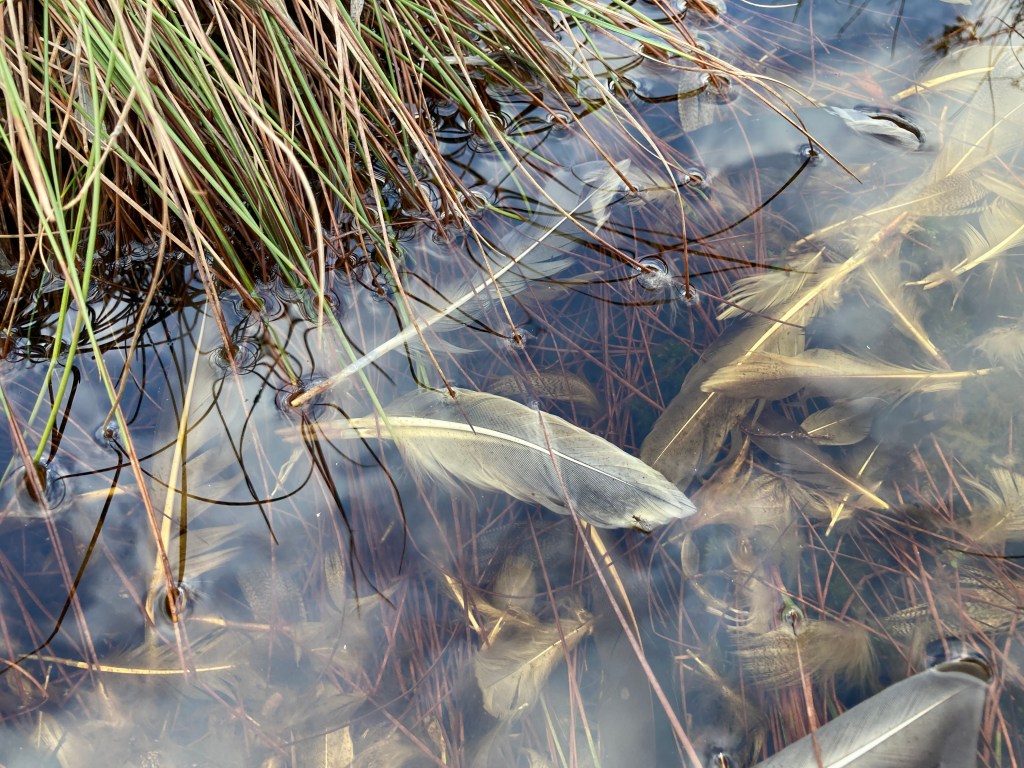
As I stood up, a fluttering whiteness caught my eye from a distance away, so I made my waterlogged way towards it, now very much regretting not packing my waterproof trousers. Even quite close it looked just like a clump of hare’s-tail cotton-grass, flowering at least three months too early. As I knelt closer, I saw that the white flowers were in fact feathers, caught at the tip of the cotton-grass stems. The stems were growing out of a pool, which held a further cache of feathers, underwater but immobile, as if held in perfectly clear jelly. Something had lost its life here, but I struggled to marry up what appeared to be jay or magpie feathers with a collection of small, delicate cream-and-grey striped ones. Perhaps two different birds had died here – but I didn’t feel like putting my hand in to move the floating feathers and reveal the corpses underneath.
Instead I made my way towards a wide drain, which in recent years has been modified with a series of dams to retain the water in the mire. The evenly-spaced line of pools this has created are filling rapidly with sphagnum – a positive sign for the health of the mire, meaning it can go on with its age-old task of building peat and storing carbon, so desperately needed now. I was particularly interested in this drain, as some old OS maps show the line of it as coincident with the “Black Dyke”, a seemingly semi-mythical* linear earthwork, and an ancient boundary – maybe even frontier – which ran north to south, and has been said, perhaps doubtfully, to stretch from the Scottish border right down to Allenheads in County Durham. Whether this really was the Black Dyke was not at all clear (it may be, as this blog suggests, that there was no need for a boundary across the bog, which acted as a natural deterrent to advancement), but I liked the idea that this ancient marker – possibly pre-Roman, maybe even older – was now the site of a very modern intervention, brought about by a desire to correct past wrongs done to the mire – draining it, cutting it, burning it. And especially, planting trees on it.
From the drain I walked west along the drier land at the edge of the plantation – a mixed wood of conifer and birch – which abuts the Stanegate, and through which it appeared the “Dyke” must have run. There’s a mute sadness to trees – broadleaf trees that is – growing on bogs. Twisted, misshapen with excrescences, and dirty with lichen and fungi, they appear tired and ill, almost as if the peat has travelled up their xylems and turned their sap sour. It’s not hard to compare this to the growth of Sitka Spruce on peat soils and bogs – they’re all over Northumberland, and they adore soggy conditions, growing tall and strong, to the delight of those who profit from the plantations. Seed dispersal from Sitka is a massive problem around the functioning blanket bogs and mires we have left, requiring many hours of volunteer effort to pull up the ever-sprouting saplings. Some had clearly been removed here, cut at the base at a couple of years old, and laid on their sides. It was a strangely sad sight. Piles of cut birch logs had also been left at some indeterminable time along the edge of the wood, but they appeared bizarrely insubstantial, half-disappearing into the peat, half-consumed by tiny grey elf-cup fungi. The plantation itself – although lacking in full-size trees – was impossibly dense, the understory layer seemingly entirely made of up of twigs and brash – though whether living or not it was hard to tell. I still wanted to find the course of the Black Dyke, and the shelter from the sun would have been, astonishingly for January, quite welcome. But this was not a wood you could saunter through.
The previous day had been even warmer. Feeling the chimerical call of spring, I’d gone at lunch to a park near the city, and sat in the unseasonal heat listening to the remains of a helium balloon trapped in a tree behind me. The sound was as a plastic bag streaming in the wind, but with a metallic crackle to the edge of it, like a worn-out LP played through a cheap amplifier. Here on the Moss the wind was gentle and had nothing to agitate; when I knelt low to the ground to inspect the sphagnum it was like being in a silent, watery world. Having spent a decent amount of wintry time on bogs and moorland, I’m used to hard winds blowing across, unchecked by trees, powerful even low to the ground – and usually accompanied by freezing horizontal rain. This peace was strange – pleasant, but in its way just as nerve-jangling as the constant snapping and crackling of the balloon.
Later on – partly dry but still somewhat boggy in appearance – I spoke to a farmer, who reckoned that the great farming cycle would turn again in ten years time – we’re paid now for the environmental benefit, he said – but by then it’ll all be back to land for food; the environment will go out the window. I thought of the Black Dyke and all the ancient and varying claims to this land; all the violence, actual and implied, and all the uses it has been put to over the millennia: the farming, the parcelling up, the profiteering. I liked the farmer’s no-nonsense amiability about it, but I couldn’t help thinking – wouldn’t it be wonderful if in ten years time we even have a choice to make about the land – a choice which hasn’t been forced on us by the dire global situation we’re creating.
*In her essay “The Marsh and the Visitor”, Alexandra Harris quotes Evelyn Waugh as being healthily sceptical of the history depicted in OS maps: “When I see Gothic lettering on the Ordnance Survey map, I set my steps in a contrary direction”.
Follow me on the Fediverse
Burn Edge@burnedge.wordpress.com@burnedge.wordpress.comWriting about place, nature, ecology and literature, from the northeast of England
21 posts5 followersGet in touch: robgalpin at duck dot com
-
Un-trashing the Willows

I held off for a few years – too busy clearing my own plot, and the spaces around it – but the trash along the length of the allotment burn has been eyeballing me as I pass for far too long. I couldn’t make it through another winter without tackling it, so this Christmas I got out my leather gloves and litter picker. The photo doesn’t do it justice – this is just a small patch; the worst of it extends right down into the willows and the burn, forming a pact with the driftwood and unassociated river-borne rubbish. I actually know who dumped at least some of the junk in the picture: a decent chap, who cycles to his allotment from a good distance away. Last summer he invited his local church leader to come and see his plot, but forgot his key to the main gate. He was so relieved and thankful when I turned up and let them in, that we indulged in an awkward hug, and I ended up joining them both for the plot tour. He inherited (like all of us) a plot full of rubbish, and in the absence of a council skip, decided to make use of the wild space between the old crack willows and the path. You can’t really blame him. The place was already full of junk, accumulated over years – what difference would his rubbish make? And what was he to do – ferry it all to the tip on his bike? Well, it’s certainly a problem. But I do know that if I were in his position, that is not the solution I would have chosen.
And what of the older trash? I began to wonder, as I piled up the ancient whisky bottles, disintegrating planters and shattered double glazing, if, when these old leavings are revealed each winter, they aren’t greeted like old friends – or at least with an unobserved familiarity; a vaguely positive shrug for some markers of old times and new seasons. Maybe I was dismantling someone’s sense of this place? Who was I to impose my aesthetics on this stretch of the river, a part of the allotment that isn’t even near to my own plot? There is certainly a sense that many people here consider it only right and proper to dispose of their rubbish on the doorstep of their plots – but is this a contempt for nature, or a naive (old-fashioned?) belief in the elasticity of the non-human world – that it can endlessly recover and absorb?
It may just be laziness. Some just don’t see rubbish, or have no strong opinion on it in any direction. Some seem unable to process and divide – differentiating between plastic and soil, glass and metal. Much of the waste here consists of bin bags of soil, contaminated with plastic straps, garden gloves, rusted padlocks… I rip them all apart and sort them. I can’t help myself. And I have an idea of my own about this place – that it’s a glorious, overgrown riparian strip right in the middle of a town. The huge crack willows drop branches and limbs at the slightest provocation – masses of wood which rots into the river. In places the ancient elders are so twisted and intertwined with the straight-shooting sycamores that it’s impossible to get near the water. This habitat is – could be – amazing. It would be a paradise for the now-rare willow tit, if any ever wandered this way. But what help is it to the birds and the insects, to clear the rubbish? My instinct tells me that trash takes away the life-force of a place, diminishes it, but how much of that is connected to my aesthetic sense of what a “wild” place should look like? How bourgeois is it, to want to sanitise a place of its human signs? Rip open one of those bin bags, or lift up an abandoned door, and you’ll find teeming hosts of very contented woodlice.
About 25 years ago I wrote a silly little haiku I’ve never forgotten:
In the ancient wood,
a coke can rusting.
Best before end: June '92
Of course, it’s the juxtaposition of the Coke can with the ancient wood which is supposed to be telling, and worthy of note. The Coke can and all it symbolises – capitalism, globalisation, rapacious pollution – versus some image of a timeless, undisturbed woodland (which, I know now, has never really existed at all). But I think the reason it still pops into my head is that a Coke can, rusting, now seems quite innocuous, almost friendly: an object that has existed for as long as I can remember – a reminder of old times, and a piece of litter that will disappear into the earth within a couple of decades. Good old 90s rubbish!
And in the city and the suburbs, when I come across the leavings of kids (burnt-out bikes; energy drink bottles) in the secret foxholes and burn-sides which are impossible to build on, it feels to me appropriate to those places, because I’ve explored them and existed in them for so long, and that’s the way they’ve always looked. The tyre fires and heaps of blackened cider cans paint a picture, an aftermath of a night before – life going on, unauthorised, in the margins. The Council should clear it all, of course they should; the corporations shouldn’t be allowed to produce rubbish that lasts forever – and they shouldn’t be allowed to market it – push it – on daft kids. But that’s all we’ve ever known: me, aged 47, and those anonymous teenagers. To what extent do we make a place – make it our own – by our droppings, regardless of their source?
Follow me on the Fediverse
Burn Edge@burnedge.wordpress.com@burnedge.wordpress.comWriting about place, nature, ecology and literature, from the northeast of England
21 posts5 followersFediverse Reactions
Get in touch: robgalpin at duck dot com
-
-
Storm Morning

I wasn’t sure we would see much of Storm Darragh here in the north-east, but in the end it seemed vigorous enough, lasting a day and a night, blowing hard across the front of our terrace, and announcing its presence in the house by repeatedly forcing open our inner door. I ventured out anxiously this morning, but we were lucky – no missing roof tiles, no flattened fences, no polytunnel damage. Next door’s perspex car port had rattled and buzzed like a faulty speedboat all night, but was still intact. And the jackdaws were up and about, joyfully riding the wind: nothing fazes them. The chickens, however, looked weary and miserable, eating dully, not acknowledging me or each other. I think it’s going to be another long winter for them.
In the allotments, the wind had whipped the last of the leaves from the willows, and all the trees were now arrayed in their long-lasting winter look. I stood outside the plot and watched the sky, full of invisible convulsions and vast movements of grey against grey. Gulls were stilled against the wind, and a plane, very high and very small, sliced a line of yellow light through the lowering expanse. The burn was high, and the worn-out nettles with their small winter leaves were flattened in swathes along the banks. But I’ve seen it higher, and it hadn’t crept very far up the garden, which has been fully submerged in the past. I was pleased also to see that the ditch I dug by our plot in spring was full of water, while the path was only lightly puddled. The edge of it seems already to have been colonised by water-loving plants like brooklime, pendulous sedge and water figwort – not introduced by me but certainly encouraged.

Water figwort (Scrophularia auriculata) The day before the storm I’d been scrounging for old tyres in an abandoned plot. They’d been left piled by the river – no doubt leaching their particles and forever chemicals into the water – for a decade or two at least. Now they can leach what’s left into the clay of my allotment, where I’m using them to build a dirt-retaining wall. To reclaim them, I had to jump across the river, cut them free of their restraining brambles and then fling them to the other side. After the first filthy fling, I made sure to empty them of their black, putrid water first. The cars they moved must have long since been scrapped, and it does feel good to make use of a tiny part of the waste the planet is filling with. I was struck by the thought that, in all the time they’ve sat, intact and unchanging by the river, the world and its weather has changed dramatically, and the storms that had been once-in-a-lifetime events are now more violent, and much more frequent.

Allotment detritus left by the burn After the storm this morning, my daughter consigned a (rather late) letter to Father Christmas to the cold ashes in the fireplace. Almost immediately, the sound of a bird travelled down the chimney – a metallic chirrup that could have been a starling, or just possibly – and somehow more excitingly – one of the parakeets that have taken up residence in the town in recent years. Whichever it was, we were both happy to take it as a sign that she’ll get everything she’s asked for.
Follow me on the Fediverse
Burn Edge@burnedge.wordpress.com@burnedge.wordpress.comWriting about place, nature, ecology and literature, from the northeast of England
21 posts5 followersGet in touch: robgalpin at duck dot com
-
Saffron and redwood

Last weekend, I found myself unexpectedly in Saffron Walden, after an attempt to head south from my childhood home of Braintree was scuppered by the inexplicable closure of the only road to Chelmsford. Instead I went north, through villages that steadily increased in mediaeval trimmings, until I passed Thaxted, where “Tudor” is dialled to eleven in every colour under the sun, and I arrived, feeling somewhat displaced and out of time, in Saffron Walden, the home of the 16th-century saffron trade. Struck immediately by the blinding-white Italianate library (the former corn market), I went straight in and soon sniffed out its coquettishly hidden Victorian reading room.
Here, a stridently ticking clock will either soothe you at your researches or drive you screaming from the premises. I could bear it, just about, because of each tick’s slightly muffled reverberation on its dying fall, which made me think of a conductor tapping their baton or a metronome in a drawing room. This is the Gibson library, a small but beautiful room replete with shining brass and waxed mahogany, housing a collection of mainly Victorian volumes free to peruse. Its founder, George Gibson, was a Quaker and a banker, as well as a renowned botanist, and epitomised the Victorian Quaker traditions of philanthropy and a cultured serious-mindedness, aligned to capitalist wealth acquisition. His Saffron Walden Bank went on to become one of the originators of the multinational Barclays Bank, and wealth is abundantly on display in Saffron Walden to this day, even if the saffron trade died out as long ago as the 18th-century.
In the modern library just outside the reading room, the Gibson collection has an adjunct of more modern additions, mainly with a literary or natural history slant. I was impressed by the display, but had the uncomfortable feeling that this part of the library was considered unusual and apart – a collection of books not normally to be found in a library, like an interesting curiosity, or a remembered, museum-like idea of what a library once was. No doubt the collection is maintained under a certain duress, subject to funding-hunts and support from local enthusiasts, perhaps following in that Victorian Quaker tradition. Those old ideas of philanthropic paternalism – education for the masses, the advancement of knowledge for knowledge’s sake – ran parallel to the march of capitalism, to the extent that they now seem to me like the jettisoned fuel tanks of the rocket we’ve sent soaring wildly into space. And we’ve just seen in America how that rocket’s doing, shorn of the pretence of mutual advancement, arcing from its apex and beginning its devastating descent.
Philanthropic Victorians had also been on my mind a couple of days before, as I walked through Reading, another destination on my itinerary of childhood haunts. Highwood, in the suburb of Woodley, is a small wood bounded by housing, the former grounds of Woodley Lodge and originally planted by Victorians as an arboretum. It’s now a fine mature wood, full of the expected oak, beech, hazel and coppiced chestnut, but populated also by some exceptional giant redwoods, the tree du jour of the Victorian collector and gentleman, which arise unexpectedly out of the thick under-canopy of holly and yew to tower over the oaks and beeches. It was here that I began to feel a sense of unease which didn’t leave me for the rest of my trip. I’d been thinking of the great consequences of actions – how those huge redwoods planted as status symbols were here now, towering above the oaks, affecting the wind and the weather, creating micro-climates, providing a vast expanse of habitat, from the deep spongy fissures of the bark, crabbed with spider webs, to the drooping tip swaying in the wind. I’d been walking in what I assumed was a single direction, towards the west, but was astonished to find myself passing the same landmark I’d recently passed, without seemingly changing direction. I began to understand that the route I was walking was circular and that I must have walked round the wood twice. I kept going, faster now and in the same direction, and – I swear this is true – I soon encountered the same landmark again… only this time I was approaching it from the opposite direction. It seemed to confirm something I’d been thinking about myself, that I have a tendency to stride forward, rashly and determinedly, ignoring the faintly nauseous feeling that I’m going the wrong way…
In Braintree a couple of days later I walked through another, even smaller wood – the woods at the centre of the White Court housing estate where we lived for a while in the 1980s. We were there when the Great Storm hit in 1986, and I was eager to see what remained of the felled beeches I hadn’t seen for 35 years. I remember the communal joy of that morning – all the kids from the estate running across the fallen trunks like a conquering army. It was one of the few times I’ve felt glad to be part of a gang. There still were fallen trees there, half sunk into the ground, but a long way off rotting away completely, and still a reassuring mass of tree to climb. I thought again of the tall redwoods and how they’d survived that night and these smaller broadleaves hadn’t. The unintended consequences of actions.
When I got home Mum reminded me of something I’d completely forgotten, if I’d ever known it at all: Dad had been a pupil of the Quaker’s Friend’s School in Saffron Walden way back in the 1940s (apparently – and quite astonishingly to me – at the same time as Diane Wynne-Jones). It was a strange reminder that I am not blamelessly set apart from the story of our civilisation and its manifestations, both terrible and (sometimes, and fewer now) wonderful.
Follow me on the Fediverse
Burn Edge@burnedge.wordpress.com@burnedge.wordpress.comWriting about place, nature, ecology and literature, from the northeast of England
21 posts5 followersGet in touch: robgalpin at duck dot com
-
Earth moving

The allotment hedges are shedding their leaves, the sunflowers are toppled and browned, and the grass hasn’t grown for a week. But this weird warmth is hanging on. And I keep getting strange tidings of spring, in the smell of the soil I’m digging by the big old bramley. It must be a memory of digging in spring – every spring? – the same muscle aches, the same unearthing of the same spoil: yellow nettle root, green tarpaulin fragments.
I’m beginning to think I have a slight mania for excavating and shifting earth. A long-standing dissatisfaction with a certain corner of the allotment, involving a great deal of standing and staring – cupping of the chin and so on – developed into a little idea to move a boundary a touch, which led very quickly (as these things always do) to a decision to excavate and remove a whole eight metre length of earth, two metres deep and two metres high – a plan which naturally had to be enacted immediately and finished within a couple of days. This large bank of earth had been – of course – previously dug and wheelbarrowed to the very spot by me, in a dimly remembered but no doubt frenzied bout of mattocking and shoveling. I’ve shifted quite a bit of earth in my time, but I’m still in the habit of vastly underestimating quantity from a visual perspective – plus time taken to dig and remove, divided by amount of exertion needed. The exertion calculation is also usually devoid of a consideration of how much can be achieved without causing yet more repetitive strain injuries and/or permanent muscle damage. But the digging must be done!

Underneath the topsoil in our plot is a vast amount of solid river clay. It’s brutal to shift, and can only be levered up in smallish sticky chunks which stubbornly resist scooping up and shovelling. I’m very fond of it! It’s impervious to the sharpest of spades, and it’s heavy: you really feel it in the forearms when you upend a wheelbarrow-full. It’s tempting to think that when you hit the clay you’ve reached the ancient bed of the allotment: a time before human cultivation, a strata laid down in the last great ice age. But there’s usually something wedged timelessly in there: a shard of glass, a bottle top, an inexplicable door handle. Still, there is a feeling of going backwards into safety, into older, more reassuring times. And it’s deeper down that you’ll unearth the real prizes: gorgeous pink pebbles, or smooth sandstone rocks for pond edging. Kathleen Jamie says in her book Cairn that “[i]t’s a while since we could turn to the natural world for reassurance, since we could map… our griefs against the consolation of the birds, the hills”, and I feel that, but I still think there’s something left, underneath: forgotten consoling layers. Or is that all illusion, weakness and a desire for escape: digging down and turning away from the insolvable problems?
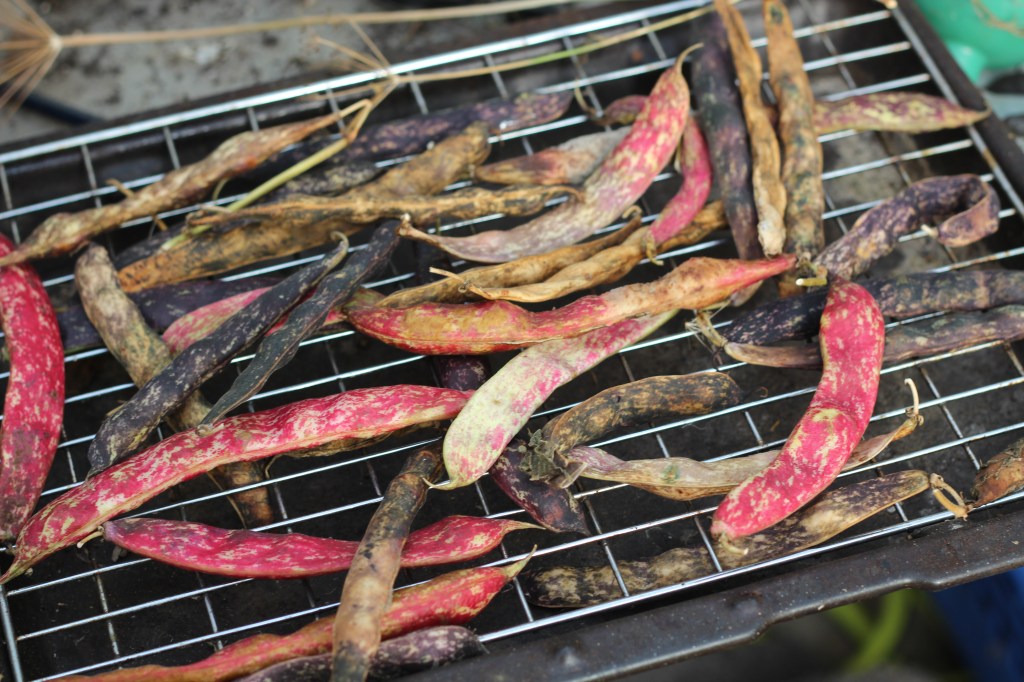
Outside the plot our mini-meadow is aging appropriately into the dying year – husks of plantain, clover and willowherb strung with the webs of a dozen fat orb-weavers. This is the yield of the clay! Along with the bagfulls of apples, the unending kale and the bean pods drying in the polytunnel. A few things to hold on to, for this season at least.
Follow me on the Fediverse
Burn Edge@burnedge.wordpress.com@burnedge.wordpress.comWriting about place, nature, ecology and literature, from the northeast of England
21 posts5 followersGet in touch: robgalpin at duck dot com
-
Walks Through the Flora of Newcastle – The Streets of Heaton

Next up in this new series sharing Newcastle’s best botanical walks, a walk through the terraces of Heaton with their eclectic neophyte flora. The post Walks Through the Flora of Newcastle – The Streets of Heaton appeared first on James Common.
Walks Through the Flora of Newcastle – The Streets of HeatonFollow me on the Fediverse
Burn Edge@burnedge.wordpress.com@burnedge.wordpress.comWriting about place, nature, ecology and literature, from the northeast of England
21 posts5 followersGet in touch: robgalpin at duck dot com


 Burn Edge