Thursday, December 4, 2014

Church of St. Benedict the Moor -- No. 344 West 53rd St


In 1868 the Second Church of the Evangelical Association of North America commissioned architects R. C. McLane & Sons to design its new church at No. 344 West 53rd Street.  The site, between Eighth and Ninth Avenues was far from the refined residential neighborhoods.  The West Side area rapidly developed in the first years following the Civil War as warehouses, slaughterhouses, factories and docks drew immigrant workers.  Quickly it would earn the moniker Hell’s Kitchen as ramshackle wooden buildings became havens of crime and street gangs terrorized railroads, businesses and residents alike.

Despite the gritty surroundings, R. C. McLane & Sons produced a highly-attractive red brick church, completed in 1869.  A modest, Victorian version of a Greek temple, it was capable of holding 350 worshipers.  The classic triangular pediment housed a circular window, and was outlined by a modillioned cornice.  The architects added depth and visual interest by the use of brick in corbels and details like the thin pilasters that flanked the tall arched openings.

The rather ungainly-named church was most often referred to simply as the Second Evangelical Church or, sometimes, the Second German Evangelical Church; a significant hint at the congregation’s makeup.  It was by the latter name that The Sun referred to it on the day after Christmas, 1883.

The evening before Sunday school teachers and children enjoyed a Christmas festival in the church.   The building was filled; the newspaper estimating that 250 of the peoples were children.  Around 9:00 someone entered and found the sexton, Otto Wolfram.  He whispered that the home of trustee Jacob Hofer was on fire.  The information passed from Wolfram to the pastor, Rev. J. F. Grob; who went to Hofer who was sitting in the choir.

“Mr. Grob told Mr. Hofer that he was wanted at home, without telling him about the fire,” reported the newspaper.  “But a woman had heard something about a fire, and shouted ‘Fire!’ and another woman ran for her children, thinking that the church was on fire.”

Panic followed as hysterical women screamed and searched for their children.  A mob rushed the entrance doors.  The pastor tried to calm the crowd.

“Sit down; there is no danger.  The fire is not here,” he shouted.  But the clamor of the women drowned out his voice.  Like an athlete jumping hurdles he used the pews to reach the doors.  He ordered the sexton, a policeman who had showed up, and some more rational members of the church to allow no one out.

The Sun said “They stopped the rush.  Some of the congregation tried to jump from the gallery.  The congregation were kept in the church until quiet was restored.”  Thanks to the minister’s actions, no one was hurt in the stampede.

A year before the Christmas night panic, Catholic priest Rev. John E. Burke had purchased the old Third Universal Society church in Greenwich Village for $38,000 and then spent an additional $1,500 in remodeling and repairing the building.  A year later, on November 18, 1883, it was dedicated as the Church of St. Benedict the Moor, founded, as reported in The World “for the benefit of the colored Catholics of New York.”

The church sat at Bleecker and Downing Streets in what was widely known as “Little Africa,” the center of Manhattan’s black population.  Many of the original residents of nearby Minetta Street had fled from the South in the 1860s.  Emancipated slaves followed, swelling the numbers.  The Church of St. Benedict the Moor, named for the 16th century African-born Franciscan friar, was the first black Catholic church in the city.  The paths of Second Evangelical and St. Benedict the Moor would cross before the century ended.

But before then, the Second Evangelical Church earned extra money by leasing a room to the Board of Education.  The minutes of the Committee of Buildings of Monday, November 30, 1896, noted “Matter of leasing a back room on the first floor in the Baptist Church, Nos. 342 and 344 West Fifty-third street, was taken up and considered, the trustees having agreed to lease the room for $200 per annum, with light, heat and services of a janitor.”

The room served as an annex to Primary School No. 50.  The arrangement lasted until Second Evangelical Church moved out in 1898.

In reporting o the celebrations of the Feast of St. Benedict the Moor on November 22, 1897, the New-York Tribune casually mentioned “The church will soon move uptown, on the West Side, being no longer convenient to the colored population of the city.  No site has as yet been selected, but several are under consideration.”


A month later the newspaper was a bit franker in its explanation of the move.  “The movement of the race from the district long occupied by it in the neighborhood of Bleecker and Thompson sts. is due to the desire of the negroes, who are largely employed as servants by well-to-do families, to live near the homes of their employers.  The landlords generally welcome them as tenants, as they are willing to pay higher rents.”

Indeed, the population of the tenement area around the Second Evangelist Church was now mostly black; while the Bleecker and Thompson Street section had filled with Italian and Irish immigrants.  On February 20, 1898 The Sun ran the headline “New Church for Negroes” and explained that the Rev. John E. Burke had purchased the 53rd Street church “heretofore occupied by the Second Church of the Evangelical Association of North America.”

Burke had paid $30,000 for the property, over $800,000 today.  The Bleecker Street building had been purchased by an Italian congregation and renamed the Church of the Madonna of Pompeii, partially offsetting the cost of the 53rd Street church.  A fair was held in Lyric Hall to raise funds for remodeling and redecorating.

The Sun noted “The new church will be, as the old one was, a headquarters for missionary work among the colored people, and not a parish church.”  A few months later the newspaper noted that the 53rd Street location was “a section of the city where the white native-born population has been predominant,” but “they moved uptown, giving way to the negroes.”  The Sun concluded, perhaps trying to dilute its rather racist report, saying “Some day, though, New York’s distinction as the most cosmopolitan city of the globe will disappear through the general amalgamation of all her foreign stock.”

The Church of St. Benedict the Moor officially opened the renovated church on May 1, 1898.  Because it was the only Catholic church that openly accepted black parishioners, Burke’s parish engulfed the entire city.  The 42-year old priest, who was assisted by another Irishman, Rev. Thomas M. O’Keefe, was ardent in his vocation.  The Evening World described him as “a zealous and indefatigable worker, and has won the esteem and love of all his parishioners.”

His work among the black community resulted in related projects, such as the Home for Colored Children, established on December 8, 1886.  Four years after moving into the 53rd Street church, Burke purchased the abutting tenement buildings at Nos. 338 and 340.  Recognizing the financial plight of so many of his parishioners, the church offered these apartments at rents based on need.  Burke apparently also lived in an apartment here, as there was no rectory.

The year 1903 was the 25th anniversary of Rev. John E. Burke’s ordination.  The mostly poor congregation presented him with a heart-felt and selfless gift.  Church members brought together their few, cherished objects of value to be used in the making of a solid gold chalice.  The New-York Tribune said “Old wedding rings, worn thin with forty or fifty years of married life; eyeglasses, watch chains, watch cases—every sort of ornament went into the smelter’s pot.

“The small-diamond cross, with a sapphire at the centre, which decorates the base, was made from a pair of old fashioned earrings.  Above it is a tiny pearl star, with an emerald at the heart of it—that was somebody’s stickpin.  Below the first series of tiny Gothic columns on the standard that supports the cup are six rounded points, each set with an amethyst cabochon, originally on in a set of buttons for a man’s waistcoat."

The congregants had obviously hired a high-end jeweler to fashion the piece.  “Around the base of the standard are vignettes of the cross, the Sacred Heart, the grape and the wheat (for the wine and bread of the sacrament).  A big oval amethyst occupies the space of the fifth vignette.  That was given by a rich white woman who wanted to help after the chalice was completed.”

While the pastors of the wealthy Catholic churches routinely spent their summers abroad or in fashionable resorts while their churches closed for the season; the Rev. John E. Burke toiled on.  Now, for the 25th anniversary of his ordination, he planned a trip to Europe—his first “vacation.”

Of course, it was not all relaxation.  In August he had an audience with Pope Pius X, who offered a special blessing “for the colored people of New York.”  It was telegraphed to New York by Rev. Burke and read from the pulpit on August 30.  If congregants were on the edge of their seats awaiting a long and personal note from the Pope, they were perhaps a bit disappointed.

“Our Holy Father, Pope Pius X., sends his affectionate blessing to the people of St. Benedict the Moor.  The Holy Father expresses a deep interest in your welfare.”


Immediately upon Burke's departure, his loving congregation had jumped into action.  On December 18, 1903 the New-York Tribune reported on a lecture by the Rev. John P. Chidwick (who had been chaplain aboard the U.S.S. Maine when it was blown up) in Carnegie Hall.  The proceeds of the lecture on “Catholicity in the Far East” “will go toward the building of a rectory for the Rev. John E. Burke,” said the newspaper.  “The building of the rectory is intended by his congregation as a surprise for him on his return.”

Burke’s “vacation” would include another audience with the Pope and a visit to the Holy Land.  Then, on the afternoon of January 8, 1904 he returned to New York on the steamer Celtic.  Waiting for him on the pier was a delegation of priests and friends who presented him with the proceeds of the series of lectures in his absence—about $2,000.

The principal method for churches to raise funds in the 19th and early 20th centuries was through church fairs.  In April 1905 one such fair was held in the hall below St. Benedict the Moor.  Numerous booths offered hand-made objects, refreshments and other items.  A “wonderful doll” had been donated to be raffled off.

The New-York Tribune, on April 28, 1905 celebrated the whites and blacks working together at the fair.  “If any one doubts that colored and white people can work side by side in harmony, at least in the cause of religion, he has but to visit the Easter Fair” at St. Benedict the Moor.  What the journalist neglected to point out was that the white women helping out worked only in booths with other white women.  But, for 1905, it was a start.

Edwardian racism tried hard to disguise itself.  The New York Charities Directory of 1916 described the church as “St. Benedict the Moor (colored), 323-344 West 53rd St.  The Church is given over entirely to serve the colored Catholics of New York City.  These people are free to attend any Catholic Church they find the most convenient, but St. Benedict’s is specially their own.”

In 1917 42-year old widow Helen Gruber came to Rev. Thomas M. O’Keefe seeking housing.  She was given three rooms at No. 340 West 53rd Street.  For three years she paid “a small rent,” according to the New York Times later, but then stopped.  Recognizing her indigence, the church allowed her to live on in a single room rent-free.

In May 1925 the 73-year old John Burke, now a Monsignor, died.  The following Sunday evening funeral services were held at St. Benedict the Moor followed by a requiem mass at St. Patrick’s Cathedral Monday morning.

Thomas M. O’Keefe was raised to monsignor and took over as pastor of St. Benedict.  Around this time Helen Gruber had begun acting strangely.  The Times reported on October 6, 1925 that “Her habits had been so eccentric…that she was thought to be of unsound mind.  Three months ago her room was forcibly entered because she had not been seen for so long.”

Helen Gruber’s eccentric habits came to a head on the morning of October 5, 1925.  Rev. John F. Curran was celebrating the 7:30 mass for about 50 parishioners when Mgr. O’Keefe entered the basement to prepare for the 8:00 mass.  As he dressed, he was unaware that Helen Gruber was hiding near the door.  He heard a woman’s voice call “Is that you, Father O’Keefe?”

He replied that it was and the voice said “I’m going to kill you.” 

As O’Keefe turned, he saw Helen Gruber brandishing a handgun.  Before he could react she shot and the bullet passed through his coat.  She shot again, missing the priest entirely as he rushed through the door onto the street.  Helen attempted to follow him, but she tripped and fell, firing yet another shot at the fleeing priest from the ground.

As the panicked Thomas O’Keefe rushed out, he startled Thomas Ward who was standing near the door.  “As Mrs. Gruber appeared, the pistol still in her hand, Ward grabbed and disarmed her.”  Police arrested her on charges of felonious assault and for violating the Sullivan Act, the 1911 gun control law requiring owners to have a permit.

In September 1929 Mgr. O’Keefe was transferred to the pastorate of the Church of St. Charles Borromeo in Harlem.  Despite the New York Charities assertion that black Catholics were free to attend any Catholic Church; one Brooklyn priest made it clear that was not the case.  About the time of O’Keefe’s transfer John L. Belford, pastor of the Roman Catholic Church of the Nativity, made the shocking announcement in the parish newsletter, The Nativity Mentor, that “if negroes became numerous in his church they would be excluded.”

In October word of the unchristian sentiments of Mgr. Belford reached Cardinal Hayes, who was about to sail for Rome.  He gave to Thomas O’Keefe the responsibility of writing a letter to Belford, explaining the Catholic Church’s stance on race.  The letter, pre-approved by the Cardinal, included the points:

“His [Mgr. Beldord’s] publication in this case does not represent the attitude nor the spirit of the Catholic Church.  It is the very opposite not only of that attitude and spirit but of the very doctrine of the Catholic Church.”

A 1929 photograph by P. L. Sperr from atop the elevated train tracks shows one of the church's tenement buildings next door.  photo from wikipedia.com

The Depression years brought with them government attempts to create work for the throngs of unemployed.  Artists were hired by the Emergency Unemployment Relief Committee and put to work creating mostly public works of art.  The Church of St. Benedict the Moor was the beneficiary of one such project for its 50th anniversary in 1933.  Fourteen painters and interior decorators created interior murals for the church.

The artwork was done by the golden jubilee mass on November 26, 1933.  The New York Times reported “The drab neighborhood under the elevated line on West Fifty-third Street witness a colorful scene as high dignitaries of the church, dressed in vestments of gold, white and crimson, marched from the rectory, opposite the West Side jail, to the newly decorated church at 4342 West Fifty-third Street.”

Even The Times could not resist using the word “Negro” repeatedly in a single sentence.  “Negro school children lined the sidewalks and waved American flags, and plume-hatted Negro members of St. Benedict's Commandery of the Knights of St. John stood at attention at the church steps as the Cardinal, attended by two small Negro pages, entered the church amidst a throng of kneeling parishioners.”

One moving aspect of the service was the presence of Amelia Ferguson “a Negro member of the church,” who sang “Come Holy Ghost.”  She had sung the same hymn 50 years earlier when the first church opened at Bleecker and Downing Streets.

In January 1959 the pastor, Rev. George Coll, was frustrated with the inaction of the city against the landlords who forced his parishioners to live in inhuman conditions.  Despite his entreaties to the Fire Department, Health Department and Buildings Department; inspectors came and went with no action.

Finally he invited reporters to take a tour of the insufferable conditions of the tenements along West 53rd Street.  “Dozens of inspectors have been here,” he said, “and still these people are freezing.  They have no water in the toilets, the pipes are leaking, the plaster is falling.  The tenants don’t know what to do.  I don’t know what to do.”

The priest predicted “I believe the building will collapse within a week unless something is done immediately.”

While the Hell’s Kitchen neighborhood along West 53rd Street was still dreadfully impoverished, its racial demographics were changing.  Black residents had moved to Harlem and the area around St. Benedict the Moor was heavily Hispanic.  In 1954 the church was reassigned to the Spanish order of Franciscans.

In 1967 the Spanish friars constructed a rectory that reflected the Spanish missionary roots.

The order still runs the church, now called the Sacred Heart of Jesus Church and mass is celebrated only in Spanish.  The block has been greatly gentrified and modern, luxury apartments have replaced many of the old tenement houses decried by George Coll half a century ago.

Through it all the handsome post-Civil War church survives in remarkable condition inside and out.  Despite its architectural integrity and its important place in black history, it has never achieved landmark status.

photographs by the author

Wednesday, December 3, 2014

The Geo. C. F. Haas House -- No. 64 E 7th Street


The Bond Street area, in the 1830s, was one of the city’s two most exclusive residential neighborhoods.  The blocks branching off Lafayette Street, from Bond Street to Astor Place, boasted some of the wealthiest citizens in New York.   High-end homes were being constructed on the east side of the Bowery, as well; such as No. 64 East 7th Street.

Construction began in 1839 and was completed the following year.   The wide red brick residence sat on a rusticated brownstone English basement.   A cast iron balcony stretched the width of the parlor floor, accessed by two floor-to-ceiling windows.

Upscale Greek Revival residences saved their ostentation for the interiors.  Here lavish parlors and dining rooms boasted exquisite mantels and plasterwork, and staircases spilled down to handsomely carved newels.   The self-effacing facades merely hinted at the wealth and station of the residents within.   But the architect of No. 64 gave a tantalizing clue to passersby in designing the entrance.  The paneled entablature sitting on the brownstone pilasters was decorated with lovely groups of nuts and berries.  The added touch signaled that the residents could afford the extra cost.


By the time the house was completed, the area was seeing an influx of German immigrants.  In 1846 the Corporation of the United German Lutheran Church purchased three lots on East 6th Street where the Evangelical Lutheran Church of St. Mark was soon built.   By the 1850s German was the most common language spoken in the Lower East Side, earning it the nickname Kleindeutchland, or Little Germany.

In 1880 the health of the church’s pastor, Rev. Hermann Raegener, began to fail.  The congregation hired 26-year old Rev. George C. F. Haas as assistant pastor.  The young minister boarded at Reverend Raegener’s home for two years until he was given the position of pastor of St. Mark’s.

It was either his promotion or his upcoming marriage to Dutch immigrant Anna Hansen that prompted him to find his own home..  For whichever reason in 1882 he moved into No. 64 East 7th Street.  The ample size of the house proved necessary when not only did George’s sister Emma and Anna’s mother, Elizabeth Hansen, move in; but when their two children were born—George in 1888 and Gertrude in 1892.

As the turn of the century approached, St. Mark’s was a vibrant congregation.  The attempt of the Germans to assimilate into the New York community at large was evidenced by its offering services in English on Sunday evenings starting in 1893.

George C. F. Haas was beloved as a pastor and leader of the German community.   Well aware that his congregation consisted not only of successful merchants and businessmen, but also impoverished immigrant families; he and the ladies of the church organized outings, bazaars and entertainments to uplift their blighted lives.

Summers in stifling tenements could be miserable.  In 1904 St. Mark’s Church chartered the side wheeler General Slocum for $350 for a day trip up the East River, across the Long Island Sound to a picnic grove on Long Island.  On June 15, more than 1,300 passengers boarded the steamer which carried a crew of 35.  Because it was a Wednesday morning and because children rode for free, the vessel was filled mostly with women and children.   Nearly the entire Haas household—George and Anna, 12-year old Gertrude, Emma Haas and Elizabeth Hanson—were on board.  Only 16-year old George stayed behind.

Unbeknownst to the party, Captain William Van Shaick had not practiced fire drills with his crew in years, as required by law.  Life preservers and fire hoses had not been inspected since the craft was constructed 13 years earlier.

The ship pushed off from the 3rd Street Pier at 9:30 a.m.  A band on board played carefree tunes and children ran about on the upper decks.  By 10:00 it was entering the treacherous Hell Gate section of the river.  It was at this point that onlookers on shore, attracted by the music, noticed smoke billowing from below decks and began gesturing wildly to those on board.

Suddenly the fire below decks reached a paint locker filled with gasoline and other flammable liquids.  Pandemonium broke out as the flames erupted on the upper decks.  Panicked passengers rushed for life jackets, most of which fell apart in their hands, the canvas fabric having rotted after years of exposure to the elements.  The cork filling in the others had granulated over time, so when mothers laced their children into the vests and tossed them overboard, they watched in utter horror as the cork absorbed the water and pulled their children under.

George Haas later recounted “At that time most of the women and children were jammed in the rear of the boat, where the band was playing.  Why the captain did not point the boat for the meadows I do not understand.  He kept on, and the fresh wind from the Sound drove the fire back through the different decks with lightning rapidity.

“In three minutes from the time the fire started all the decks were ablaze…I was in the rear of the boat with my wife and daughter.  Women were shrieking and clasping their children in their arms.  Some mothers had as many as three or four with them.  Our case seemed hopeless.  Death from fire was to be escaped only to die in the water.”

Haas told how he became separated from his family.  “With my wife and daughter I had been swept over the rail.  The fire then looked as if it would devour us the next instant.  I got my wife and daughter out on the rail, and then we went overboard.  I was in such an excited state that I don’t remember whether we were pushed over or jumped.

“When I struck the water I sank, and when I rose there were scores about me fighting to keep afloat.  One by one I saw them sink around me.  But I was powerless to do anything.  I was holding my wife and daughter up in the water as best I could, almost under the side of the boat, when someone, jumping from the rail directly above me, landed on top of us.  My hold was broken, and we all went under together.  When I came up my wife and child were gone.”

Nearby vessels rushed to try to help.  Two fire boats, at least a dozen tugboats, ferries, a police boat—over 100 in all—hurried to the scene.  George Haas was pulled aboard a tugboat.  For most it was too late.  Within a span of 15 minutes the General Slocum had burned to the waterline.

Of the 1,300 people on board, only 321 emerged from the water alive.  It was the greatest loss of life in New York City until September 11, 2001.   Around 5:00 that night George and his sister Emma returned home without their family members.  The following morning the New-York Tribune said “The pastor was prostrated last night.  Much of the time he was unconscious…With the exception of Mr. Haas’s son George, who did not go on the excursion, these two are apparently the only ones left of a large family.”

Two weeks later the funeral of 46-year old Anna Haas was held in the East 7th Street house.  The Evening World said “It was rendered doubly pathetic because the bodies of the pastor’s daughter, Gertrude, his mother-in-law, Mrs. Mary Hanson, his sister-in-law, Mrs. William Dietmore, and her son Herbert, have not been recovered.”  

“Because of the ghastly burns he received in the destruction of the Slocum, Dr. Haas sat behind a screen during the funeral services,” said the newspaper.

During the service, word came that the body of Anna’s sister, burned beyond recognition, had been identified by marks on the body.  Her coffin was hurried to the Haas house and the service became a double funeral.  Little Gertrude’s body was among the last to be identified.

A police honor guard lines the steps of the Haas house on June 17, 1904.  Two hearses, one for Anna and one for her sister, await at the curb.  photo www.encyclopedia-titanica.org

Among the telegrams and letters George Haas received were one from President Theodore Roosevelt,

Accept my profound sympathy for yourself, your church and your congregation.

and from Kaiser Wilhelm of Germany,

Being most profoundly affected by the news of the indescribably horrible catastrophe which has overtaken the Lutheran congregation, I command you to express to it my innermost feelings of sorrow.

Little by little the decimated German community moved north to the Yorkville neighborhood, abandoning Kleindeutschland where memories and grief were unbearable.  On December 13, 1913 Morris Spielberg purchased No. 64 East 7th Street.  George Haas would eventually move to Staten Island where he died on September 30, 1927.

In January 1916 Spielberg made renovations to the house.  He commissioned architects Gross & Kleinberger to remove walls and install new steel beams at a cost of about $500.  It was most likely at this time that the basement was converted to commercial purposes.


Socialism had already spread to the western world but the Russian Revolution of 1917 would be the introduction of Communism to many New Yorkers.   By 1919 the store in the basement of No. 64 East 7th Street housed a stationery store.  Behind it was a small print shop where Alexander Brailovsky ran his print shop.

Brailovsky was a Russian-born communist and he published his Russian language weekly newspaper Russky Golos (The Russian Voice) here.  The paper was closely aligned with the Communist Party of the United States and printed pro-communist and anti-capitalist articles.

On September 16, 1920 stock brokers and bankers went about their daily routine along Wall Street when, exactly at noon, a horse-drawn cart packed with 1,000 pounds of dynamite and 500 pounds of metal, chucks of iron sash weights and other shrapnel, exploded outside of the J. P. Morgan & Co. building.  There were 30 immediate fatalities and hundreds of injured.  Six more would eventually die of wounds.

Witnesses told detectives that Brailovsky was seen laughing near Wall Street half an hour later.  Two days later police entered the print shop on 7th Street and arrested Alexander Brailovsky.  He was never definitively tied to the bombing; however police deemed it the first arrest of a true radical.

The Russky Golos was eventually taken over by Theodore Bayer.  It would remain in the house, behind the retail space, until at least 1939.

By the 1960 the neighborhood was part of the trendy, beat generation area now known as the East Village.  That year John Bosson and Paul Seidenatein opened the Four Steps Coffee Gallery—a combination coffee house and art gallery—in the basement.  The short-lived business was taken over by Barron Bruchlos later that year as the Cart Wheel.  The 28-year old hippie Bruchlos not only sold coffee in his bohemian shop, he sold peyote.

The New York Times described Bruchlos as “the bearded and barefoot operator of a Greenwich Village coffee shop” and said he “has been selling the drug to beatniks and college students for 50 to 70 cents a capsule.  Some users get ‘highs’ lasting as long as thirty-six hours, he said.”

Bruchlos complained that he had been “pestered” by the Food and Drug people for about a year for selling the drug (in June that year they had seized 311 pounds and 145 capsules).  The newspaper described the drug, obtained from a cactus plant, as having “a mild intoxicating effect and sometimes produces hallucinations and visions of vivid colors.”

The beatnik’s ongoing battle with the FDA would not last much longer.  On December 6, 1960 he was found dead on the floor of the Cart Wheel.  Police thought his death was most likely of natural causes.”

Six months later Les Deux Megots opened in the space.  The Village Voice, in June 1961, announced “The Wednesday poetry readings at the 10th Street Coffee House have been moved to the Deux Megots Coffee House…All poets welcome to come and read every Wednesday, 8:30 p.m.”  Named after the Café Des Deux-Magots in Paris, it was the iconic basement coffee house of the beat generation.  At the café’s open readings, poets like Allen Ginsberg, Paul Blackburn and Peter Orlovsky read their works.

Les Deux Megots closed in February 1963.  It reopened a year later as a restaurant.  The Paradox was dedicated to the philosophy of Georges Ohsawa and his macrobiotic diet.  The room was lit by candles, tea was free, and the food was inexpensive.  Eastern spiritualism was as much a part of the place as was the food.  It attracted New Age patrons like Yoko Ono, who also worked there for a time.  Nevertheless, despite The Paradox’s focus on healthful eating, it received 15 Health Department violations in 1971.

In 2009 No. 64 east purchased by Lisa J. Fox who commissioned architect William Peterson to add a fourth floor.   The remarkably sympathetic addition matched the openings, lintels and sills and added a reproduction cornice.

A bold, beautifully grained Greek Revival mantel survives in one room.  www.blocksy.com

Throughout its remarkable life the George C. F. Haas house somehow escaped modernization.  Within its walls three important stages of East Greenwich Village history have played out.

The extremely sympathetic upper floor addition is evidenced by the subtle change in brick color.

photographs by the author

Tuesday, December 2, 2014

The 1899 Park Row Building -- 15 Park Row

photo by Nyjockboy2

As the 19th century inched closer to the 20th, New Yorkers embraced the exciting modern age that gave them the phonograph, electric lights and telegraph.  But the advances in construction, like the elevator and steel-framed construction which allowed buildings to rise ever higher, were causing some concern.

On October 8, 1896, Engineering News reported, “The rage for phenomenally high office-buildings still continues unchecked in New York city, and there seems to be at present some rivalry here as to who shall build the highest structure.”  The journal turned its attention to “the highest building thus far designed in New York city,” the Park Row Building.  Slated to replace the old International Hotel opposite the leviathan Post Office, it would rise 26 stories with two four-story towers at the corners.

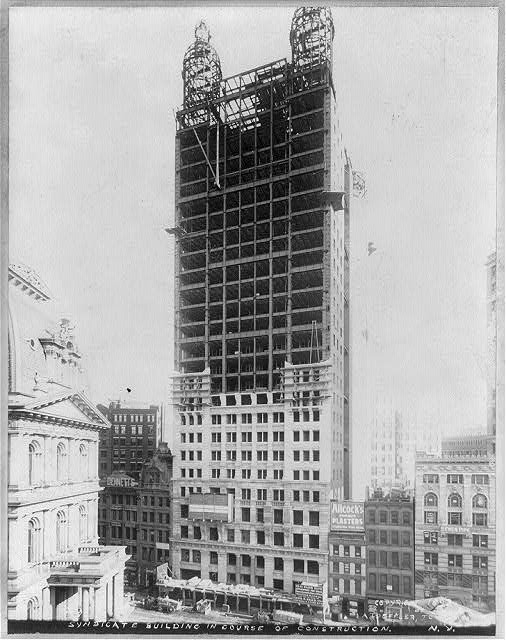
The steel frame is evident in construction photographs --photograph Library of Congress

“This will be an office building, with stores on the street floor, and a restaurant at the top,” explained the paper.  The office of architect R. H. Robertson had already released water color drawings depicting a soaring tower that diminished the structures around it.  A building nearly 30 stories tall created a problem for both the architect and the engineer.  Robertson was charged with creating a visually-appealing edifice that required the viewer to unaccustomedly crook his neck backward to take in all in; and the engineer, Nathan Roberts, had to figure out how to support the mammoth weight.  There was also the problem of the plot; what Engineering News called “very irregular.”

Engineering News published the oddly-shaped floorplan on October 8, 1896 (copyright expired)


Robertson attempted to reduce the visual height of the Park Row Building by dividing it vertically into three sections, and horizontally into six.  He drew the eye to the central section by lavishing it with ornamentation.  Balconies, cornices, columns and sculptures broke up the vast surfaces.  The copper-crowned cupolas of the corner towers created the final touch and would be seen by ships entering the harbor and as far away as New Jersey.  Somewhat strangely, Robertson focused attention only to the Park Row façade, leaving the other elevations essentially blank.

More was made in the press about the engineering of the building than its design (perhaps luckily for Robertson—the New-York Tribune would call the structure “hideous but daring”).  Especially noteworthy was the foundation necessary to uphold the 6,316,000-ton structure.  “Many acres of good timber had to be cut to furnish the thousands of great pine piles, many of them forth feet long, that were driven into the sand of the site to support the monster,” reported the New-York Tribune.  

The skyscraper seems to have been mostly conceived by politician William Mills Ivins, who purchased the site.  He then transferred title to a syndicate, the Park Row Construction Company.  Years after its completion New Yorkers would often call it the Ivins Syndicate Building.  But William Ivins’s association with the project would be short-lived.  Millionaire August Belmont held the majority interest in the Park Row Construction Company and he suggested that Ivins retire early on.  It was the first of many incidents of drama that would surround the Park Row Building.

Construction began on October 20, 1896 and would continue for three years—partly because of labor problems and strikes that sporadically stopped progress.  

The Park Row Building diminished its neighboring structures.  To the left is a portion of the Post Office -- photograph Library of Congress

By March 24, 1898, the Park Row Building was topped off and that day an American flag was unfurled from its highest point.  “Several hundred persons watched with eager interest while a professional steeple climber made his perilous ascent to the towering height,” reported The New York Times.  “He climbed the pole with the flag on his shoulders, and, after making it fast, proceeded to paint the staff.  The watching crowd cheered lustily as the National colors unfolded, and continued to gaze at the daring painter as long as he remained in sight.”

As the building neared completion leases were signed.  On Christmas Eve 1898 the Astor House Pharmacy rented one of the ground floor stores.  Somewhat surprisingly, while Park Row was the center of the newspaper industry, many of the new tenants would be from unrelated areas.  On January 20, 1899 the City leased four entire floors to house the Department of Bridges, the Department of Street Cleaning, the Water Department, the Bureau of Encumbrances, the executive officers of the public baths, the Bureau of Public Buildings and Offices, the Commissioners of Public works, and the Bureau of Sewers.

The 391-foot tall Park Row Building opened its doors on July 20, 1899.  The New-York Tribune wrote, “A skyscraper of this magnitude will have its own electric light plant; a gas plant; waterworks system; artesian wells; fire department, with hose lines and chemical extinguishers; its own police department too, with detectives watching for petty thieves, pickpockets, beggars and peddlers.”  The newspaper noted that its height is “about seventy feet less than the Great Pyramid of Cheops.”

The skyscraper had cost $2.4 million to construct and was now the tallest building in the world.  Scientific American boasted, “This modern building…will accommodate the floating population of a fair-sized country town…There are in the whole building 950 separate offices.”  The magazine estimated the number of persons in the building at any period of the day at 8,000.  “If we assume that on an average five persons would call at each office during the day, for each person employed, we get a total of about 25,000 souls making use of the building at the course of every working day of the year.”

This shot clearly shows the absence of ornamentation in the rear and side elevations -- photograph Library of Congress

It would not be long before the building’s long history of drama began.  The syndicate signed a one-year contract with the Ice Trust to deliver 1,000 pounds of ice daily.  The Trust enjoyed what The Evening World called “powerful connections with Tammany Hall” and assumed it automatically had a long-term deal.

When the contract expired on June 1, 1900, the syndicate put out bids to other ice suppliers.  The Evening World explained that the Ice Trust believed that through its ties to Tammany Hall “it could get the ice privilege without a contract [and] refused to bid.”

But the proprietor of the restaurant in the building, which had its own ice plant, won the contract.  The only tenants he could not supply were the city agencies.  The Ice Trust had a binding contract with Tammany Hall to supply ice to all city departments.  Therefore, starting on June 1, 1900, the Trust dumped 500 pounds of ice on the sidewalk every day.  “In the meantime the city employees have been drinking warm water, and are very indignant,” said The World on June 8, 1900.

Among its hundreds of respectable tenants, the Park Row Building seemed to attract bunko agents and shady characters.  On November 20, 1901 detectives raided Room 711 where brokers Grey & Co. ran a “bucket-shop” scam.  Two years later a massive swindling operation was conducted here by James B. Kellogg, described by The Evening World on March 6, 1903 as “the suave, get-rich-quick concern promoter.”  Kellogg used aliases to rent multiple offices in the building.  These included E. E. Rice & Co. in room 2033, “Colonel Wilcox, in room 2023, and “Charles Pearson & Co., room 2033.  He ran seven other companies from offices here before being arrested.

Then on May 21, 1904, readers of the New-York Tribune were shocked to read of an illegal gambling operation in the building.  “Another surprising raid was in the Park Row or Syndicate Building…which Douglas Robinson, brother-in-law of President Theodore Roosevelt, is the manager.  Twenty prisoners were captured and thirty-three telephones and three telegraph instruments ripped away from their fastenings and carried off by the police.”

Artist J. Massey Rhind executed the sculptural details  Scientific American, December 24, 1898 (copyright expired)

At the time of the raid, the Associated Press had its offices here as did the Legal Department of the New York City Railway Company.  The executive offices of the Interborough Street Railway Company (of which August Belmont was president), and the Metropolitan Street Railway offices were also in the building.

In 1907, politician Percy Nagle’s offices were in the building.  Campaigning was an especially contentious that year and one day in September Nagle was approached in a restaurant by a concerned friend.  He warned Nagle that another politician, Joseph L. Burke, “says he is going to kill you.  You want to look out for him.”  Nagle brushed off the warning.

On the afternoon of September 27, Nagle and some friends were standing in the corridor of the Park Row Building when Burke appeared with a number of men.  The two men exchanged heated words, followed by Burke’s striking Nagle.  A miniature riot ensued in the hallway and one of Burke’s men suggested they “shoot the dub.”

Suddenly Nagle felt the muzzle of a revolver at his neck and heard a loud click.  The gun had jammed.  “Nagle turned white and grabbed the revolver,” reported the New-York Tribune the following day.  “A crowd soon surged around the men and hurried the combatants from the building.”

Edgar H. Holbrook, a life insurance salesman, had either very bad luck or a death wish.  On January 8, 1898 he fell from the New York Life Insurance Building.  He survived that fall.  Now, on Wednesday August 31, 1910 he visited the Park Row Building on business.  The New-York Tribune wrote “It is not known how he came to be either on the roof or the twenty-sixth floor.” 

Holbrook plunged from the 26th floor, landing on the roof of the six-story building next door.  His body “was so badly crushed as to be unrecognizable.  The man’s terrible death caused many stenographers and other women employes [sic] in the tall building to become hysterical.”

In gruesome detail the newspaper said, “In the drop of more than 500 feet Holbrook’s body acquired a terrific momentum, and when it struck the top of the elevator shed it crashed through a heavy iron screen, a sheet of heavy glass and some half-inch planking.

“These obstacles were not sufficient to prevent Holbrook’s body from dropping on top of the elevator drum, which was in motion at the time.  The body was so mangled that it became wedged tightly in the elevator machinery and stopped it.”

When the Park Row Building had first opened, Professor Herschel C. Parker of Columbia University, an amateur mountain climber, suggested that the facade could be climbed.  He compared the building to the Matterhorn’s cliffs and ledges.  “They are as awful to scale as the outside of the Park Row Building would be.”

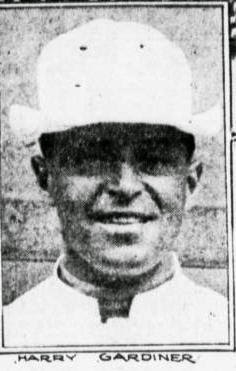
Nearly two decades later the professor’s prediction was put to the test.  On May 26, 1918, 41-year-old Harry H. Gardiner, who went by the professional name “the Human Fly,” started up the building.  A reporter from The Evening World described him as “an aviator by profession and that being a Human Fly is simply a side line.”  Gardiner’s climb was for the benefit of the American Red Cross.’

Harry Gardiner would be arrested for his skyscraper climbing today.  photo The Evening World, May 27, 1918 (copyright expired)

Fifty-thousand people crammed the streets around noon as Harry continued upward.  He became annoyed when firemen appeared and unfolded a large leather net.  "But people in the windows above began showering money down into the net—contributions for the Red Cross."

Gardiner was not content with reaching the roof.  He continued up the flagpole until he had touched the golden ball at its tip.  When he returned to street level two hours after he had begun, he told the crowd, “I have done my bit; now see to it that you do yours,” nudging the onlookers to contribute to the cause.

Suicides by jumping made the newspapers over the decades, but none would be so publicized—or questioned—as that of known anarchist Andrea Salsedo.  Accused of bomb making, Salsedo was arrested on March 7, 1920 and secretly held in the Department of Justice’s 14th floor offices.  Nearly two months later he was still confined here until his body was found smashed on the sidewalk on May 3.

Officials claimed Salsedo feared retaliation by other anarchists.  The New-York Tribune explained on May 4, “It was said that Salsedo had expressed the belief shortly after his arrest and confession in March that he would be killed by persons whose names he had mentioned in his account of the bomb plots.”

His wife was not so sure.  On January 4, 1921, Maria Salsedo filed suit to recover $100,000 in damages.  She said that during his eight weeks confinement he “was beaten, threatened and abused, and that the treatment he received broke him down mentally and physically and finally drove him to kill himself.”  There were others who felt the death was not a suicide at all, but that the anarchist had been thrown to his death.

By 1929 the Park Row Building had lost its luster.  Its title of tallest building in the world was lost in 1908 and by now other skyscrapers surrounded it.  The architectural firm of Clinton & Russell was commissioned to do a facelift of the lower floors.  The ploy succeeded for decades until at the turn of the 21st century it was once again just an outdated building that was not producing financially.

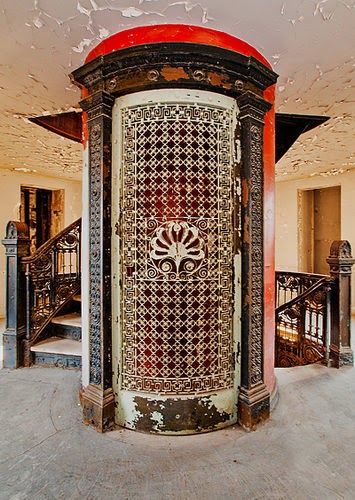
In 2000, a gut renovation was begun that converted the main building to apartments.  The commodious three-story cupolas were not included in the plan.  Until 2013.  Then they were offered as part of a single massive apartment including the 26th and 27th floors, a large private terrace and two balconies.  The price for the unfinished space, reported to be one of the largest penthouses ever offered in Manhattan, was a significant $20 million.

The three-story cupolas are part of the expansive penthouse, which includes an original elevator cage.  NYCurbed.com

The exterior of the Park Row Building is little changed since the 1929 remodeling.  Although no longer the stand-out it was in 1899, it is an important pioneer of the skyscraper age in New York City.

many thanks to reader P. Alsen for suggesting this post

Monday, December 1, 2014

The Lost Redmond Mansions -- Nos. 701-705 Park Avenue

from the collection of the New York Public Library

By the first decade of the 20th century Park Avenue above Grand Central Terminal was no longer the marginal residential thoroughfare of a generation earlier.  Mansions rivaling those on Fifth and Madison Avenue were rising at a rapid rate.

On April 20, 1912 the Real Estate Record & Builders’ Guide reported on a significant deal.  Geraldyn Redmond and his wife’s sister, Countess de Langiers Villars had bought up six Victorian houses stretching northward from the corner of Park Avenue and 69th Street.    “The buyers will erect a large dwelling on the site,” said the Guide.    It was a momentous transaction (deemed by the Guide “the largest reported on Park Avenue for private house purposes since that of the Union Theological Seminary block front directly opposite); and one that garnered much attention.

A month later the New-York Tribune, on May 15, noted “Mr. Redmond bought the plot to build a residence for himself on the corner, and another for his sister [sic], the Countess de L. Angier-Villars, on the adjoining Park avenue lot.”

Redmond’s significant fortune came from his banking firm, Redmond & Co.; and the linen business he had inherited from his father, William Redmond.   His wife, Estelle, was the daughter of Johnston Livingston and Sylvia Livingston Livingston.  She was, as repeatedly noted in newspapers “a member of one of New York’s oldest families.”  The New York Times later would report that she “was directly descended from Robert Livingston, who received a grant of land from Queen Anne in what was then the Province of New York, and which became the Manor of Livingston.  He came here in 1673, and was known as the First Lord of the Manor.”

Estelle’s sister, Carola, did what so many of New York socialites hoped their daughters would do—she married a title.  In 1893 she wed the Count Langier-Villars and, according to William H. Chambliss two years later in his somewhat catty Chambliss Diary: Or, Society as it Really Is, she “took abroad with her $500,000.”

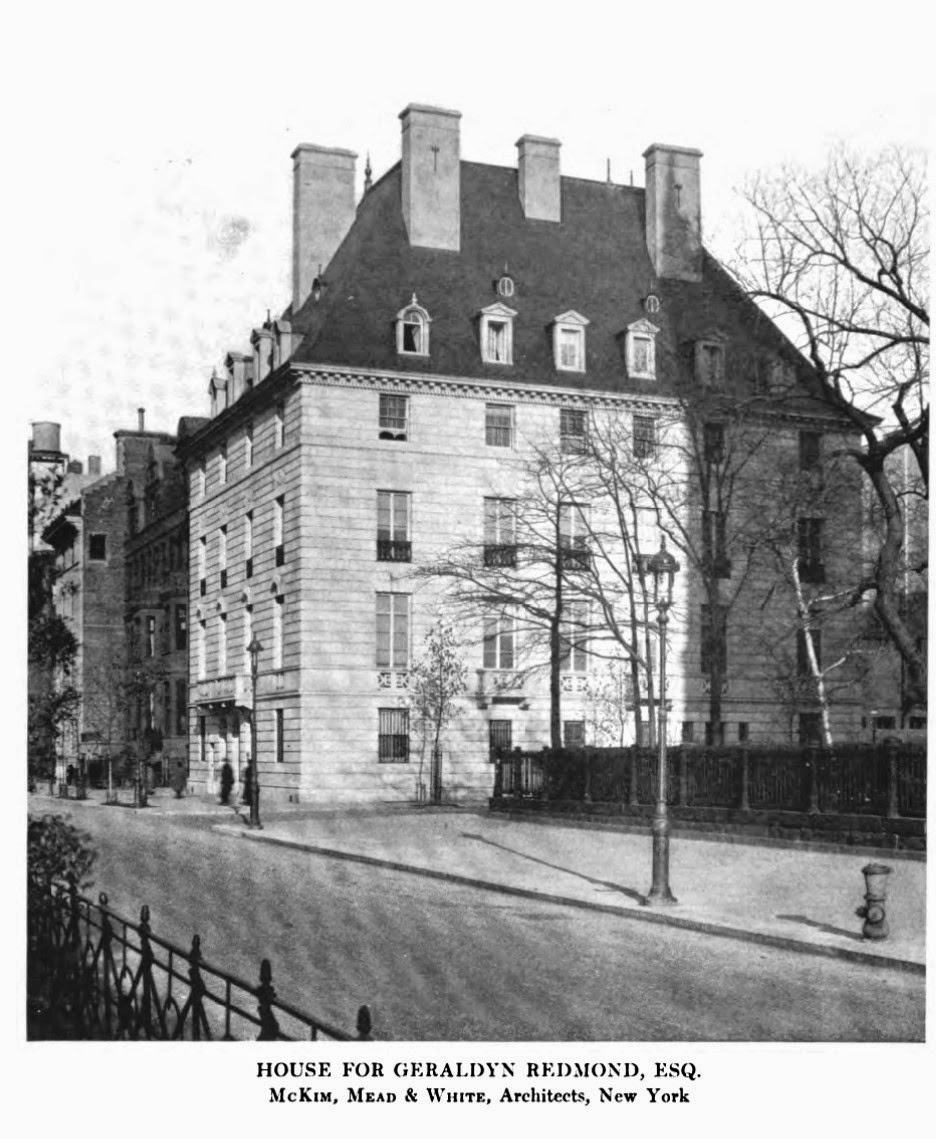
Geraldyn and Estelle sailed off to Europe for the summer; but not before putting the wheels in motion for the new paired mansions.  By the end of the year plans were nearly completed.  On December 7 The Record & Guide reported that McKim, Mead & White were the architects of the “two 5-story stone residences.”

McKim, Mead & White's original renderings were slightly different from the final design; most notably in the placement of the service entrance and the exaggerated chimneys.  from the collection of the Museum of the City of New York http://collections.mcny.org/C.aspx?VP3=SearchResult_VPage&VBID=24UAYWUEROEF&SMLS=1&RW=1280&RH=894 

Construction of the double residence would continue for several years.  In the meantime, Estelle and her sister, who no longer lived in Paris or with her titled husband, were inseparable in their social and charitable lives.  On November 23, 1913 The Sun noted “The Countess de Laugier-Villars and her sister, Mrs. Geraldyn Redmond, are interested in a sale for the benefit of St. Sylvia’s Cottage Industries, which will be held in the ballroom of the Plaza on December 1 and 2.  These industries were organized several years ago  by Mrs. Redmond for the wives and daughters of farmers in the vicinity of Tivoli, N. Y., for whom she provided instruction in lace making and fine needlework.”

Two months later, in January 1914, it was reported that the sisters “are arranging a concert for the benefit of the Little Sisters of the Assumption, to be given at Carnegie Hall on the afternoon of January 21.”  The world-famous soprano Alma Gluck was the headliner.

The close relationship between the Redmonds and the Countess extended even to travel and leisure.  On September 2, 1914 the New-York Tribune reported “Mr. and Mrs. Geraldyn Redmond and the Countess de Laugier-Villars, sister of Mrs. Redmond, who arrived from Europe on the Olympic, are at the Plaza for a few days before going to their country place at Tivioli-on-the-Hudson.”

The “country place” was Callendar House “one of the fine country seats at Tivoli,” according to The Sun.  Built in 1794 by Henry Gilbert Livingston, it had been inherited by Estelle and redesigned by McKim, Mead & White in 1910.

photo from the Yearbook of the Architectural League of New York, 1915 (copyright expired)
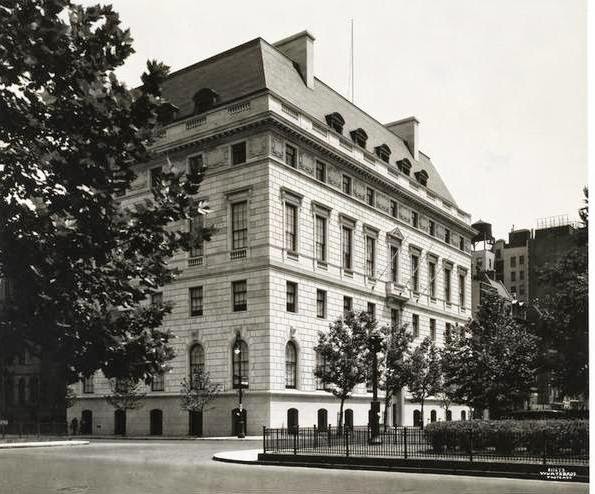
While the Redmonds and the Countess were at Tivoli that fall, the finishing touches were being put on the Park Avenue mansions.  McKim, Mead & White had produced a French country estate in an urban environment.   Stone magazine noted “This is built of French limestone…and presents a very rich and warm effect.”   The architects skillfully disguised the two homes as a single imposing residence.  The separate entrances flanked a shared service door on the Park Avenue side.  The six-story structure cost around $200,000; more in the neighborhood of $4.8 million today.

Art and architecture critic Royal Cortissoz tepidly approved of the distinctive design.  On February 14, 1915 he wrote “The urban architecture shown this year is not, in the main, imposing.  One city house makes a persuasive appeal, the French mansion erected in New York for Mr. Geraldyn Redmond by McKim, Mead & White.  Though the facades have no special distinction the high-pitched roof is a joy in itself, a rich jet of audacious design in what, when it comes to the roofs of New York dwellings, is but a sea of prose.”

The Redmonds moved into the corner house at No. 701 Park Avenue with their three sons, Johnston, Roland and Geraldyn; while the Countess took the mansion next door.    Roland Livingston Redmond would not enjoy the new mansion for long.  In May 1915 invitations were sent out for his wedding to Sara Delano.  The socially-important ceremony took place at the Delano country estate Steen Valetje.

Shockingly, it would be the last grand social event witnessed by Estelle Redmond.   The social leader died in the Park Avenue mansion on June 17, 1916, leaving a personal estate of between $3 and $4 million.

The United States entered World War I the following year and Geraldyn Jr. was made Chief Quartermaster, U. S. Navy Aviation, on August 4, 1917.   He served in that capacity until November 1918 when his 64-year old father “died suddenly of paralysis” in the mansion on November 27.

Only two weeks later, on December 18, 1918, Geraldyn Jr. was married to Katharine Register.  War had put an end to the grand European honeymoons enjoyed by wealthy newlyweds only a few years earlier.  The couple spent theirs in California, and then returned to the Park Avenue mansion.

Before long, however, the brothers leased the house.  On July 14, 1920 The Times noted that it had been taken “fully furnished” by Moses Taylor and his family.  The newspaper called it “one of the finest private residences in that locality.”   Taylor was the son of Henry A. C. Taylor, a financier and corporation director.  Moses and his wife were well known in both Manhattan and Newport society.

The year 1921 was especially busy for the Taylors.   In January a dance for daughter Marion was given in the house.  “It was preceded by a number of dinners, and the guests on their arrival at the dance were received by Mrs. Taylor and her daughter.  The dance was interrupted at midnight, when supper was served,” reported the New-York Tribune.   Only a month later it was daughter Edith’s turn to be feted.  On February 9 her mother “entertained…with a small dance at her home” for the debutante.

In 1922 the Redmond house was leased by William Rhinelander Stewart.   Like the Livingstons, Stewart’s roots included the oldest families in New York.  He was a descendant of the Lispenard family who arrived around 1693; and of Robert Stewart who settled in New York prior to the Revolutionary War.  Divorced, the 71-year old multimillionaire shared the house with his son, William Jr.  Stewart’s only daughter, Anita, had married Prince Miguel de Braganza, eldest son of the Pretender to the throne of Portugal, in 1909.  The wedding, held at Tuloch Castle in Scotland, had been deemed “a brilliant event” by The New York Times.

Like so many other royals, the Prince had a title but no money.  Two years after the marriage he became a broker’s clerk in London; then in 1921 joined the insurance firm of John C. Paige & Co.--most likely through the efforts of William Jr. who was a member of the firm.  The Times somewhat undiplomatically announced “the Prince’s status was simply that of a salesman.”

In February 1923 the Princess went to Newport “to inspect her Summer estate there,” according to a newspaper.  Prince Miguel was staying at the Park Avenue mansion with his father-in-law when, on February 20, he contracted influenza.  Overnight it developed into pneumonia and his condition was deemed critical.  The Princess was summoned home by telephone.

The Times reported on February 22 “Princess Braganza hurried back from Newport, and her brother, William Rhinelander Stewart, Jr., made a quick run up from Palm Beach.  Count Laszlo Szechenyi, Hungarian Minister to the United States, a friend of many years, came up from Washington.  They were at the bedside when the end came shortly after 2 o’clock yesterday morning.”

Funeral services were held in the Park Avenue mansion a few days later.   On April 18, 1923 the Prince’s estate was made public.  If New York, Newport and Tuxedo Park society had ever thought that the couple’s luxurious lifestyle was made possible by the Prince’s fortune, they now knew better.  The New York Times headline read “Prince Left Estate of Only $2,000.”

Princess de Braganza remained in the Park Avenue mansion with her aging father; while William Jr. moved on to No. 1088 Park Avenue. 

On June 20, 1927 rather shocking news was reported.  The exclusive Union Club had chosen to abandon its venerable clubhouse on Fifth Avenue and 51st Street and move to Park Avenue, away from the clamor of commerce.  The site it had chosen was the Redmond mansions, for which it paid $1.265 million.  “Construction will be delayed until the expiration of leases on three residences now on the property,” said The Times.

Former Senator Frelinghuysen of New Jersey was leasing the house of Countess de Langier-Villars.  The third house mentioned in the article was Johnston Redmond’s home directly to the north.

The Union Club would wait several years.  On September 4, 1929 William Rhinelander Stewart suffered a fatal heart attack in the house at the age of 78.  Within two years the leases had run their course and McKim, Mead & White’s handsome French edifice was demolished. 

The Union Club  building still stands on the side of the Redmond mansions -- photo by Wurts Bros. from the collection of the Museum of the City of New York http://collections.mcny.org/C.aspx?VP3=SearchResult_VPage&VBID=24UAYWUEROEF&SMLS=1&RW=1280&RH=894

Reportedly, Stanford White’s son, architect Lawrence Grant White, fired off a heated note to the architects of the new clubhouse, Delano & Aldrich.  In it he suggested that an inscription be carved above the Union Club’s entrance:  "Conceived by the Genius of McKim, Mead & White.  Destroyed by the Fury of Delano & Aldrich."