The Last Book

I had more books on the list, not the least of which Victor Hugo’s Les Miserables, or Virginia Woolf’s To the Lighthouse or even J.M. Coetzee’s Disgrace. Or Upton Sinclair’s The Jungle.

But things in the daily goings-on are getting mired, busy, and ugly.

What I’ve been reading a lot lately are books about the indigenous history of the United States. That list is growing.

In the middle of all of that, I listen to NPR on drives here or there, and will pick up a recent publication whose author is being interviewed on a show. Which is how I came upon …

On a sunny Sunday, I read over 120 pages in one sitting. The richest image is that of one of the three mothers, pregnant and alone at home with a whole cluster of small children, walking out into the street to meet the armed goon squad of white supremacists on their horses. It catches you in the pit of your stomach. It made me feel small, weak, and in awe of the power of that mother. That woman.

It is an image that won’t leave me soon. What does it take to make us stand tall, holding our heads high, confronting the overwhelming danger, and draw that line on the concrete, ‘This far and not an inch further. I dare you to do harm to me’?

This book has been published at the perfect time. I can’t recommend it enough. For all of us. No matter your background or ethnicity. It is about so much more than motherhood.

The Tenth

The City Beyond the River

Read it as a teenager. I read many books then but this one stayed with me. No idea how I came across it. Perhaps my literature teacher. My parents didn’t say they were even aware of it. It is a work of magical realism. 

The following was sourced online (Wikipedia in particular):

The City beyond the River (Die Stadt hinter dem Strom) is a significant German existentialist novel by Hermann Kasack, published in 1947, that explores the aftermath of World War II through a surreal, allegorical story of a city where the dead live in a purgatory-like state, dealing with themes of memory, identity, and the invisible world. It was translated into English in 1953

The protagonist is sent to a strange city on a mission to chronicle the city’s life. He encounters a world he doesn’t understand where people appear as mere shadows performing senseless, repetitive and destructive tasks. He is unable to write the chronicle but receives accolades anyway. When he returns home, he travels restlessly, lecturing on the sense of life. In the end, he travels to the city, as in the beginning.

I don’t claim it made sense to me when I was young.  Its images are unforgettable. It is dark and mysterious, and beautifully written.  I can’t speak for the translation as I read the original. I need to read it again.

The Ninth

Bought at a bookstore at the Heathrow airport terminal while waiting to board a flight to New York City. Quite possibly my first flight to the US. I didn’t have a driver’s license, carried just one small bag since I would be relying on public transportation. Given these restrictions on my travels, I would only be visiting big cities. It was all new. It was all exciting in the way things are when you’re 24. This book about the backroads to small towns no one had ever heard of sounds like the antidote to my travels but I read it like a travel companion every night on hotel beds and in various airport lounges and on flights. What stayed is the quiet pacing, the sense of wonder, and a love and appreciation of the ordinary.

There was a singularity attached to my journey and to my perception of this book during that journey. I would never travel like that again, on vouchers for domestic flights – an unending supply of tickets allowing me to hop on standby onto any flight across the lower 48 – and would never walk into the unknown with the same sense of wonder and naivete. The kind souls and sheer luck traveling beside me were extraordinary. The locker with the broken lock at Grand Central Station – the only available locker – where I stashed my bag for the day while I explored Manhattan on foot. It didn’t occur to me until I returned to Grand Central in the early evening that the bag might not be there anymore, but it was. Nothing missing. The kind physician at LAX who paid for a taxi to Santa Monica when he realized I had no clue where to go in Los Angeles and “downtown” was not an option. The sense of awe when I opened the window of the old Victorian hotel in San Francisco where I had found a cheap room. A different time.

All of it singular as I read about a world entirely alien to me – the backroads, the blue highways, the people I couldn’t fathom who lived in the wide open spaces between the big cities everyone had heard of. The kindness of strangers echoed on the pages.

Seven

Likely the best undercover journalism ever published in the United States, it chronicles the author’s detour into low-wage jobs across several states.  Ehrenreich worked as a waitress, maid, housecleaner and as a clerk at Wal-Mart, living in motels or in a trailer, in order to spell out what it’s like to be so-called “unskilled labor” in this rich country of ours.

The implicit hope is that the workers would one day rise up and rail against a system designed to keep them down, but it remains a hope for as long as the myth of ‘if only’ persists. If only you work hard enough, can work two or even three jobs, you will rise because that is the American dream, isn’t it? Likewise, as long as the myth persists that you have only yourself to blame for having to work at minimum wage, the revolt will not happen. Pride and dreams are powerful motivators. 

I read the book more than twenty years ago, at a time when I needed any kind of work to make ends meet. I worked as a day laborer doing landscaping, cleaning houses, helping people move and unpack. In the end, after countless job applications, few interviews and no hiring, I volunteered at a museum gift shop because I needed somewhere to go where people were happy to see me. I went because I hoped they would hire me. They did not.  But it helped. It made me feel better to have to leave the house a couple of times a week, get on a bus and pretend to myself I was working, contributing as a valued member of society. For nothing. Eventually, the tide turned and I was able to keep my home, car and insurance policies. I was lucky then.

The experience did not leave me.  The encounters and imagery of Ehrenreich’s book also do not leave, especially the cleaning service or the Wal-Mart workers.

When someone works for less pay than she can live on … she has made a great sacrifice for you … The “working poor” … are in fact the major philanthropists of our society. They neglect their own children so that the children of others will be cared for; they live in substandard housing so that other homes will be shiny and perfect; they endure privation so that inflation will be low and stock prices high. To be a member of the working poor is to be an anonymous donor, a nameless benefactor, to everyone.”

— Nickel and Dimed, p. 221

Found

Even though we hardly need startling reminders of the reality we’re in, it stopped me Saturday at the rural post office on the coast to find these little cards on the counter.

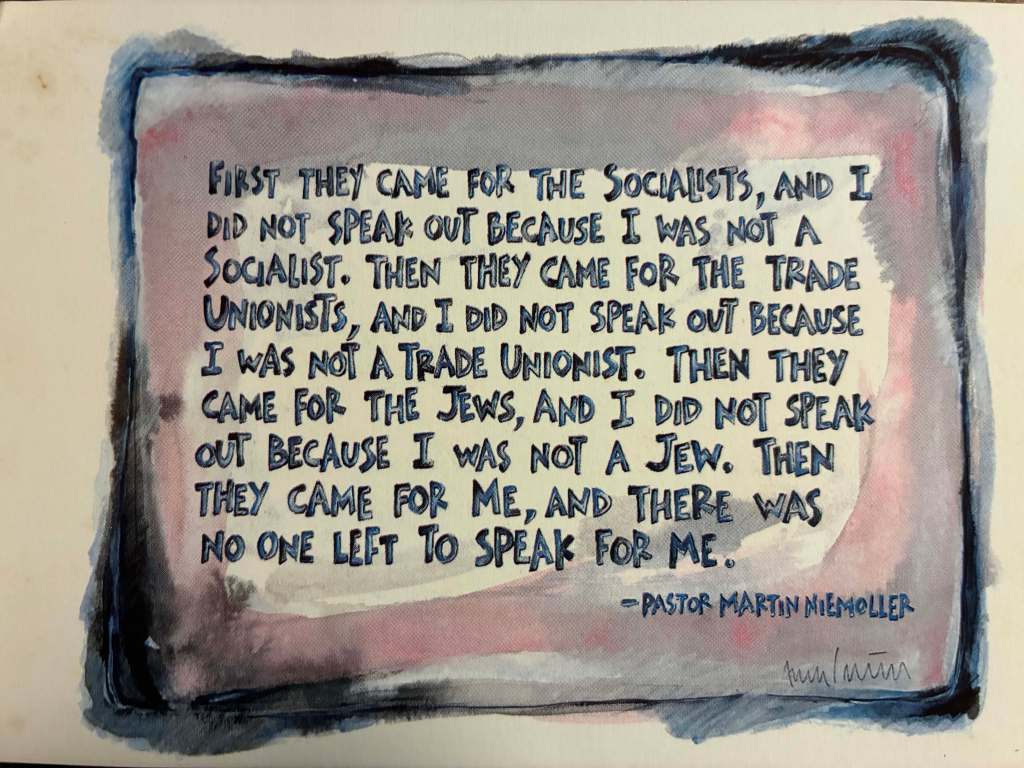
The following message has been in my possession for decades, a simple postcard I picked up and kept safe because I wanted to remember Niemoeller’s words. As if I or we might forget them. To need them now and here should stop us all.

Eight

Tackled this door stop of a book some years back despite the high drama or even the red handbag that Andrea used to swing alluding to Anna.  It felt like a book whose cliché images were too familiar before you even started the first chapter. “Happy families are all alike; every unhappy family is unhappy in its own way.” To me, Levin and Kitty were endearing. In particular, Levin’s high-minded, meandering ruminations over the abolishment of serfdom and land reform, in short, the genuinely decent and good nature of his character. Karenin is tragic as in pitiful. You might want to slap him or give him a hug or both. Anna and Vronsky are tragic as in pathetic. Read it on the wrap-around porch of my cabin and in various spots of sunlight in the early, early pre-spring in the redwoods. Tolstoy’s portrayal of human complexity and vexing stupidity is masterful and a profound expression of love. Recommend one of the newer translations of the last twenty years or so (e.g., Richard Pevear and Larissa Volokhonsky).

The sixth book

Took the book on the trip to Argentina and sat in the late bright evening hours by the open window in the Airbnb in Ushuaia. Looking out at the water toward Antarctica, reading about the personal heartbreak of a writer whose style and prose I admired, I recall touching the dust cover of the hardbound for a grounding. Astonished by the brevity of life. The shortness of it all and how radically it can end. How people used to bring food to Joan Didion in the days after her husband’s death. Asking what she needed. She needed none of that. She had been preparing dinner, each of them with their pre-dinner cocktails, when he fell. And then the other tragedy of Quintana on the horizon. So frail, and yet so strong.

I digress…

A note from the “War Dept. Army Talk 64: FASCISM!” March 24, 1945.

Bit late in the game then, boys, but hey! Thanks all the same. From the bottom of my heart. Now let’s apply this to right now in the United States.

The fifth book

I was in Frankfurt sharing a hotel room with Connie, Thomas Neurath’s sister, of Thames & Hudson. We were there for the Book Fair. Boggles the mind that the managing director’s sister, a company director in her own right, and his secretary sharing a room was considered a good way to save some money. Not that the various male editors and licensing managers shared hotel rooms.

The acquiescence of women… but back to…

The book with its gorgeous cover of a vast evening sky against a treelined ridge lay on my nightstand. At one point, Connie, a woman then in her Fifties, I’m guessing, scurried across the expanse of the room propelled by curiosity what I was reading, took one look at the cover and the title and spouted, “Goodness, Birgit, you are so morbid.”  Was that the word she used?

I was struck by her assessment of my interest in the darker side of life and, regardless if she knew the content of this novel or not, she was right because it was as much the cover as the title that had drawn me to the book in the first place. It never left me. I had no idea that I would later live in the tall dense woods, not in British Columbia, but in Northern California and write of their beauty and maybe the remoteness, of golden evening light glowing between the black feathered branches. Perhaps that remoteness, that solitude in nature, was morbid to her. Then again, given her publishing world background and the novel briefly on the bestseller list in the 1970s, she had probably read it or at least knew of it. 

Book Four

Read this book in the rattan bucket seat by the arched windows of my house off Moscow Road. It is historical fiction, the story of resistance of four sisters living in the Dominican Republic during the Trujillo dictatorship.

At the time, I found it so riveting that I took hours off my freelance work schedule to keep reading. Memorable are the description of the dictator as a goat and the astonishing bravery of these women. All of it told in a playful, irreverent way evocative of how futile the bravery may seem in light of real danger. But perhaps you reach that point when you have nothing left to lose and accept the fate of incarceration, disappearance, torture and death rather than figuring out how to accept or at least put up with the reprisals and oppression to continue living, keeping your head down. 

Design a site like this with WordPress.com
Get started