The denizens of Wayland Wood

7 04 2025

“March is the month of expectation, the things we do not know.”

Emily Dickinson


Last weekend, I went for a quick wander in Wayland Wood. This patch of ancient woodland is at its best in spring. It’s apparently the largest woodland in South Norfolk; I’m assuming that Thetford Forest doesn’t count because it’s plantation. It also has a recorded history going back to the Domesday Book in 1086. There is a bank and ditch surrounding it that is probably medieval in origin, along with a secondary bank and ditch surrounding an extension area, which is also medieval. There are also ponds and hollows in one area of the wood which are from a later date.

The wood is also Watton’s only claim to fame as it’s thought to be the origin of the Babes in the Wood story, in which two children are abandoned in a wood by their uncle. They wander until they die, at which time they are covered with leaves by robins. It’s a cheerful tale … as are so many traditional fairy tales.

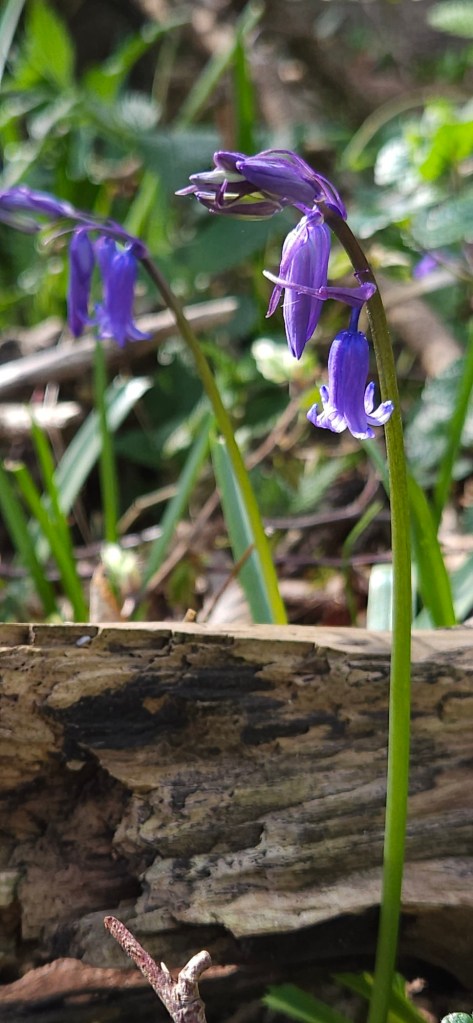
Native trees abound, such as Oak, Ash, Willow, Bird Cherry, and Hornbeam. There is also a large central area made up of coppiced Hazel. In spring, Primroses, Early Dog Violets, Wood Anemone and Celandines splash patches of colour everywhere. As the year progresses, these are replaced by Early Purple Orchids and a luxurious carpet of Bluebells. Rarities such as Yellow Star-of-Bethlehem can also be found here, although I haven’t seen it for a couple of years; probably because the area I normally look has grown quite tall and light levels are correspondingly reduced.

O, it came o’er my ear like the sweet sound, That breathes upon a bank of violets.

Duke Orsino, ‘Twelfth Night’

In early spring, Honeysuckle vines twine through the undergrowth, their leaves edged in bright sunlit green, giving the whole area a magical, fairytale feel. Pignut creates green lace overlaying the brown crunch of last year’s leaves. The purple flowers of Ground Ivy creep along fallen branches. Barren Strawberry brings little pops of white into the dim light of the paths.

So doth the woodbine the sweet honeysuckle gently entwist.

Titania, ‘A Midsummer Night’s Dream’

The Dogwood twigs are tipped with bright crimson buds, which split to release reddish green leaf buds. And everywhere, everywhere, there are the glossy, yellow sunshine flowers of Lesser Celandine, watery yellow Primroses, and the sturdy green leaves of the upcoming Bluebells.

Himself the primrose path of dalliance treads, And recks not his own rede.

Ophelia, ‘Hamlet’

I sit, perched on the trunk of a huge fallen tree, watching the Buzzards wheel overhead, listening to the chorus of Robins (perhaps they’re waiting for me to die so they can cover me with leaves … a chilling thought), trying to catch a glimpse of the Greater Spotted Woodpecker that I can hear drumming in a nearby tree and soaking in the spring. Until I soak it in a bit too much, sneeze non-stop for ten minutes and hurriedly escape to the sanctuary of my car, which is marginally less pollen saturated.




A return to hostilities

16 03 2025

“War is what happens when language fails.”

Margaret Atwood


The lines have been drawn, and the scene is set. It’s March again, and I’m conflicted. I love spring, and I look forward every year to charting the progression of the season through its pale green beauty, floral bounty, and gradually warming temperatures. But there’s a flip side to the season, a darkness that lurks in every delicate structure on a tree branch. These ones, especially.

This is an Ash tree: Fraxinus excelsior if you’re feeling scientific, evil demon tree if you’re … well … me.

I set off this morning to visit Wayland Woods, but when I got to the carpark, it was full of heavy machinery and closed. I’ll try that one again tomorrow and see if they’ve finished. So, instead, I carried on driving and went for a wander around Great Hockham Woods.

Which is why I’d currently quite like to scratch my eyes out with a rusty teaspoon.

I do fully understand the irony of someone who likes trees as much as I do having hay fever that is tree specific. It’s not the most convenient thing in the world, if I’m honest. And these are the main culprits. Ash flowers. Ugh!

These particular flowers were bursting on a tree that had fallen down, perhaps in one of the recent storms. But somehow, despite no longer being attached to the ground, despite no longer having access to water or nutrients, it had still pushed all its energy into one last effort. One last attempt to pass its genes on to the next generation. And, despite how much I personally detest these flowers (not the trees themselves, just the pollen), the next generation of Ash is desperately needed. Norfolk is one of the areas in the UK which is worst affected by ash dieback. This rampant disease is caused by a fungus Hymenoscyphus fraxineus that originated in Asia. Having evolved without the pressure of this fungus, our European Ash has little resistance. The fungus, which produces small, white fruiting bodies, grows inside the tree and blocks water transport systems. Leaves wilt and discolour, brown, diamond shaped lesions appear at the junction of branch and trunk, the inner bark turns grey, and the tree eventually succumbs and dies.

Promisingly, the John Innes Centre in Norwich has, after extensive research, found that maybe 5-10% of Ash trees have significant resistance to ash dieback. They’ve set up a nursery of strong, healthy male and female Ash trees, which will be allowed to cross and produce a new generation of more resistant trees. They are looking for reports from members of the public of these, more healthy, trees.

https://www.norfolkflora.org.uk/jic_ash

Hopefully, this will help the UK’s Ash population recover through natural selection. I may detest what the pollen does to my eyes, but I wouldn’t want to lose the trees completely.

🌳🌳🌳


A swinger of birches

1 04 2024

“I’d like to go by climbing a birch tree,
And climb black branches up a snow-white trunk
Toward heaven, till the tree could bear no more,
But dipped its top and set me down again.
That would be good both going and coming back.
One could do worse than be a swinger of birches.”

– Robert Frost, ‘Birches’


I’d currently quite like to scratch my eyeballs out with a rusty teaspoon. This may seem a little extreme, but I would hasten to point out that the itching across my whole face is extreme as well!

Trees are one of my favourite things in the world, and I love taking photos of them, sometimes up close and personal …. which is why it’s distinctly ironic (and very inconvenient) that I’m allergic to their pollen. Academically, I knew that we were getting to that point of the year, but the notification from my weather app this week abruptly brought it home to me that things were about to get itchy!

I’m consoling myself with the fact that I know this won’t last forever, that the Birch and Ash trees (the dirty, rotten scoundrels) will have finished their annual pollen offensive in a few short weeks …. I’m not sure it’s making my eyes itch any less though.


The Silver Birch (Betula pendula) is very common around here and provides me with interesting features to photograph all the way through the year (and an irritated face … yes, I’m holding a grudge!) This weekend is the first time this year I have seen Birch flowers and leaves emerging, their bright green glowing brightly in the sunshine. The leaves are neat and tidy as they unfold themselves from their buds, their perfect pleats soon flattening out into the instantly recognisable, almost triangular leaves.

The tree is monoecious, which simply means that both male and female flowers appear on the tree simultaneously. The dangling, yellow catkins are the male flowers, carelessly scattering their pollen to the spring breezes, while the smaller, more tightly packed, bright green catkin above is the female flower.


Birch twigs were traditionally used to make brooms, which are known as besoms in Scotland. Apparently, this term was historically used in England as well, but has fallen by the wayside somewhere. When my niece was much younger, my sister, who, having lived in Scotland since her teens, is now regrettably Scottish in her accent and phraseology, used to refer to her as “a wee besom”, meaning a mischievous young girl, when she was being a bit of a madam. This stereotypical association between an instrument for sweeping and women has existed since at least the 1800s when it was originally a disparaging term, meaning “a woman of loose morals.” Modern Scottish usage has made it slightly less judgemental, and yet still links it to those of female gender and not their, equally irritating, male counterparts. That said, the phrase was probably better than some of the other ways that we could have referred to my very lovely but impressively strong-willed, independent, and occasionally awkward niece!


Thanks to their ability to grow almost anywhere, Birch trees are known to pioneer species. They were among the first plants to colonise the newly exposed, rocky, scoured ground after the retreat of the glaciers at the end of the last ice age, which may go some way to explaining why they are so common in Norfolk. They are known to improve soil, bringing nutrients up from far beneath the surface of the soil and depositing them in the top layers when they drop their leaves in autumn. Because of this soil improving ability, they are the nurse trees that enable other species to move in, creating new areas of woodland over time. This also means that if you’re managing heathland and don’t want it to become forest, you spend an awful lot of time getting rid of Birch saplings.

Perhaps because of their status as a pioneer tree, the Birch is associated in Celtic mythology with new beginnings, renewal, and purification. Pleasingly (at least in my mind), this could also be linked with the use of Birch as besom-making material; the act of sweeping is, symbolically at least, getting rid of the old to make room for the new.


The adventures of an exploring ladybird

But right now, what I’d like to do is find that teaspoon and start scratching. Perhaps I should start with antihistamines and see how that goes instead.


Design a site like this with WordPress.com
Get started