


Fact or fiction: Google Ads high rollers get better results. You probably assumed that to be a fact, but honestly, the number one Google Ads myth we hear over and over is that bigger spenders get better results.
Based on what we’ve seen in our clients’ accounts (and honestly even our own campaigns), we suspected that wasn’t actually the case. In fact, there are a few myths about Google Ads we’ve seen come up repeatedly—and they often lead businesses in the wrong direction.
That’s why we set out to discover the secrets behind high-performing Google Ads accounts. We analyzed over 250,000 reports, representing more than 15,000 individual accounts, each a business or agency that made use of our free Google Ads Grader tool last year. This exclusive study brought to light which common Google Ads assumptions were fact or fiction, and you won’t believe the results.
Contents
- The truth behind the top three Google Ads myths
- Three commonalities between strong Google Ads accounts
The truth behind the top three Google Ads myths
Let’s walk through three of the most common myths about advertising on Google and what actually makes a strong Google Ads account based on our data.
🚨 Fact or fiction: Your Google Ads account needs improvement. To find out for sure, get an instant account report using our free Google Ads Grader!
Myth #1: The more you spend, the better your results
Like we said, this is probably the biggest misconception about Google Ads.
Many businesses assume that if their campaigns aren’t working, the solution is simply to increase the budget. Google Ads is pay-to-play, so wouldn’t more pay mean more play? Not necessarily…
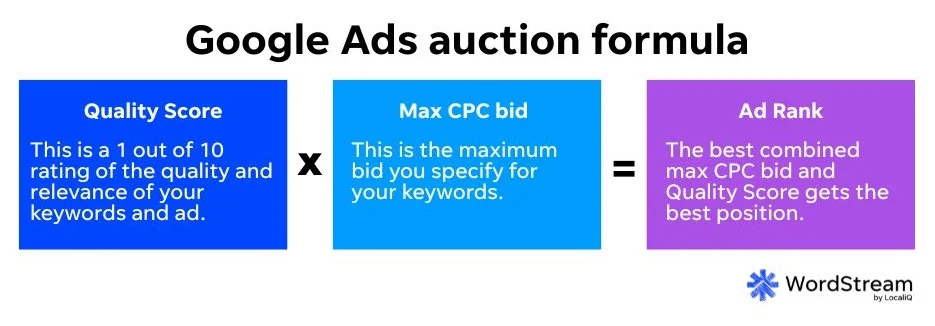
More budget can certainly help scale results. But it doesn’t fix the underlying issues that cause campaigns to struggle in the first place. Google Ads run on an auction system. The bids your budget can afford play a role, but that’s only part of the equation. Google also evaluates how relevant and useful your ads are to people searching, which is where Quality Score comes in.
Quality Score looks at three traits within your account.
- Expected click-through rate: This is based on Google’s estimation of how likely a searcher would be to click on your ad, based on factors like your historical click-through rate data.
- Ad relevance: This is a measure of how well your ad copy connects back to the search queries you show for.
- Landing page experience: Google determines how navigable, accessible, optimized, and relevant your landing page is to searchers.
In other words, Google is trying to show searchers the ads that best answer their query.
So an advertiser with a smaller budget, but highly relevant ads and landing pages, can often outperform someone spending more.
We’ve seen plenty of accounts where the problem wasn’t the budget at all. The issue was that the ads were too generic, the keywords were too broad, or the landing page didn’t match what the searcher was looking for. The strongest Google Ads accounts focus on improving the signals Google uses to evaluate quality, like
- Writing ads that closely match search intent.
- Organizing keywords into tightly themed ad groups.
- Sending traffic to landing pages that clearly answer the search.
When those pieces are aligned, something interesting happens: Performance often improves without increasing spend.
Myth #2: More impressions mean more conversions
Another assumption we see a lot is that the goal of Google Ads is simply to show up as much as possible.
More impressions should mean more clicks, and more clicks should mean more leads…right?
Not necessarily.
Our study found that some advertisers were generating a huge number of impressions but very few conversions. In fact, accounts with the lowest range of impressions (fewer than 20,000 over a 90-day period) had the highest conversion rate of the bunch at 4.1%, while accounts with the highest range of impressions (over 80,000) had the lowest average conversion rate at 2.4%.
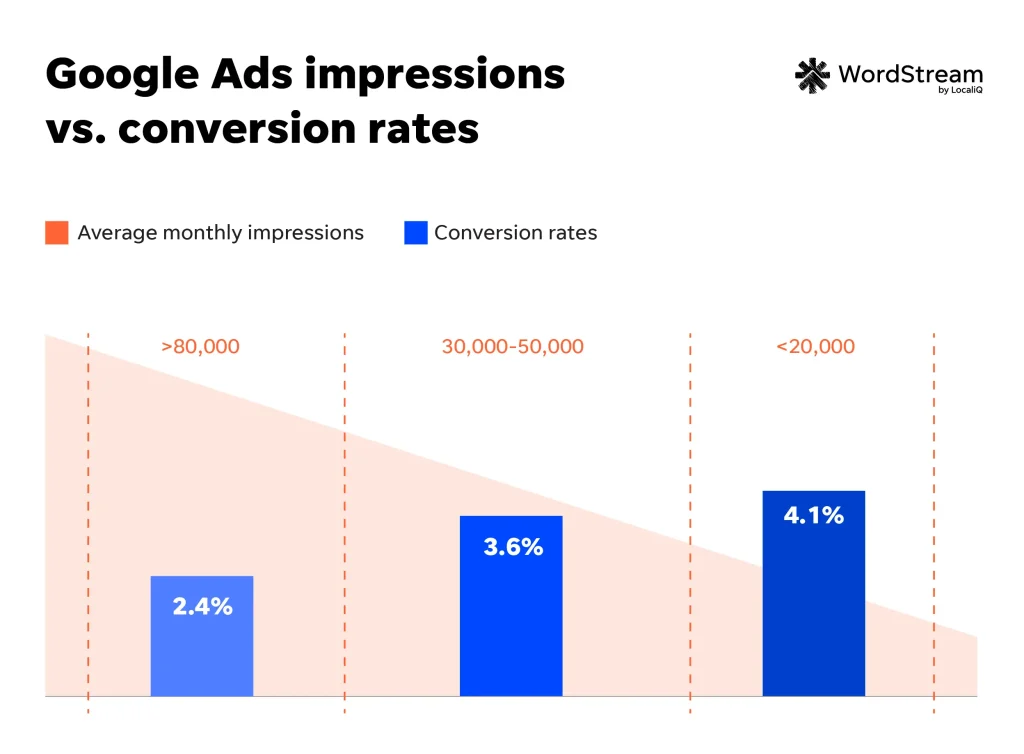
In other words, visibility alone doesn’t guarantee results. It’s easy for campaigns to rack up impressions when keywords are too broad or when ads are eligible to show for a wide range of searches. However, those impressions can come from people who aren’t actually looking for what you offer. So the campaign looks busy on the surface with lots of impressions and activity, but conversions stay low. This usually happens for a few reasons:
- Keywords are too broad and trigger ads for loosely related searches.
- Ads appear for informational searches instead of buying intent.
- Campaigns prioritize reach instead of relevance.
When that happens, impressions become more of a vanity metric than a performance metric.
In contrast, high-performing Google Ads accounts focus less on how often ads appear and more on who they appear for. Instead of chasing impressions, they prioritize showing up for searches with real intent. Now, that doesn’t mean impressions don’t matter, but it’s important to factor other metrics into your strategy, such as conversion rate, cost per lead, or return on ad spend.
Narrowing keyword targeting, adding negative keywords, and refining ad messaging so ads show up for the right searches, instead of every possible search, can be a Google Ads game-changer for many businesses. Remember, in Google Ads, the goal is to be seen by the right person at the exact moment they’re looking for what you offer.
Myth #3: Once a campaign is live, it runs itself
Another assumption we hear a lot is that Google Ads can turn into an easy “set it and forget it” channel for brands. While campaign automation has definitely improved over the years, Google Ads still works best when actively managed.
When you look at high-performing accounts, they’re rarely static. In fact, they’re refined frequently. With good reason, as the search landscape is constantly changing, from consumer behavior evolving and competition increasing to new queries emerging every day.
If a campaign chills on cruise control for too long, or worse, sits untouched for months, performance usually drifts. That’s why the best accounts treat Google Ads as an ongoing optimization process. For example, regularly adding negative keywords stops your ads from appearing for searches that aren’t relevant.
Even small, more frequent changes to ad headlines or calls to action can have a noticeable impact on click-through rate and conversions. Usually, strong advertisers are almost always running some form of ad testing.
In another example, routine keyword cleanup and optimization can make a difference in overall performance, too. Adding (and tweaking) long-tail keywords tends to bring in users who already know what they’re looking for—which, again, can lead to better conversion rates.
You’ll also want to continuously test your landing pages to ensure that they load quickly, clearly answer the search, and make it easy to convert.
The common thread here is simple: the best accounts are ones that keep evolving.
What a strong Google Ads account actually looks like
After looking at thousands of campaigns, we started to notice that the best-performing accounts tend to share a few characteristics, and they probably aren’t what you might think.
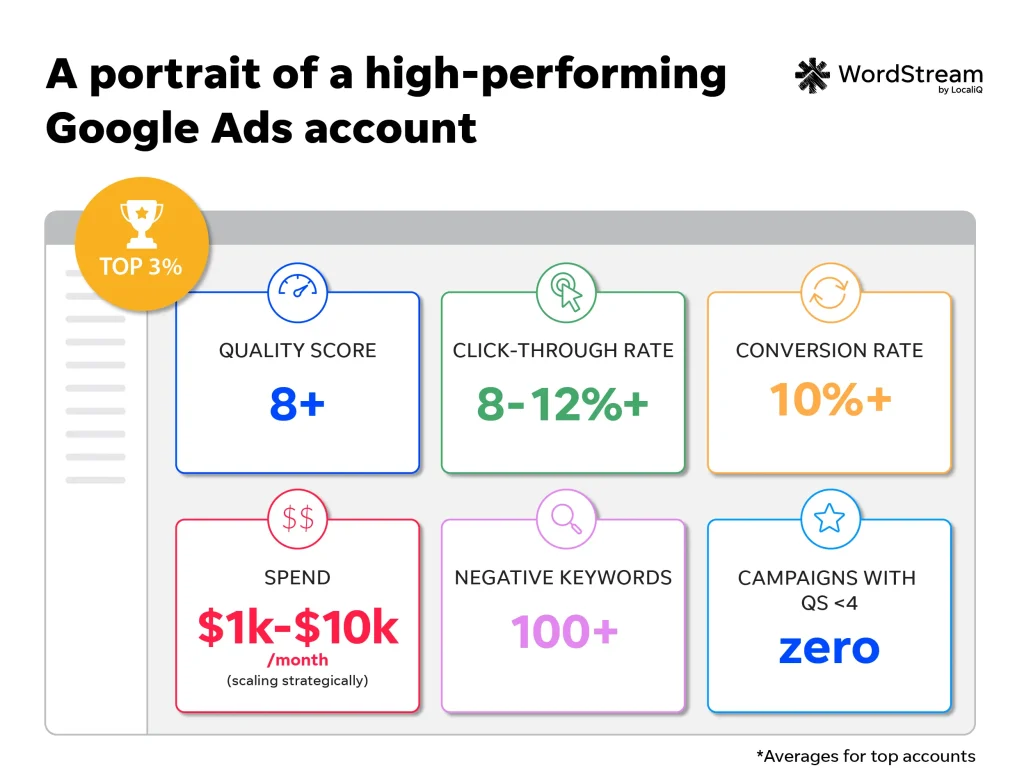
Only 3% of the accounts we analyzed fell into a “good” or “strong” account performance category. Here are some of the common factors we noticed when we took a closer look that can help you optimize your own account to be similar to the top 3%.
💡 Ready to level up your Google Ads game? Download our free PPC 101 guide that has everything you need to get started!
1. Clear relevance from search to landing page
Seasoned Google advertisers know to make it clear in their accounts that their ads match what their typical customer is searching for.
For instance, if someone searches for “emergency plumber near me,” the ad should talk about emergency plumbing, and the landing page would reinforce that message immediately. That consistency improves both user experience and conversion rates.
2. Clean, logical account structure
One of the most common problems in struggling accounts is a messy campaign structure. If you don’t have a clear account structure, you could end up lumping keywords targeting very different topics into the same ad group and find that your ads become generic because they have to cover too many scenarios.
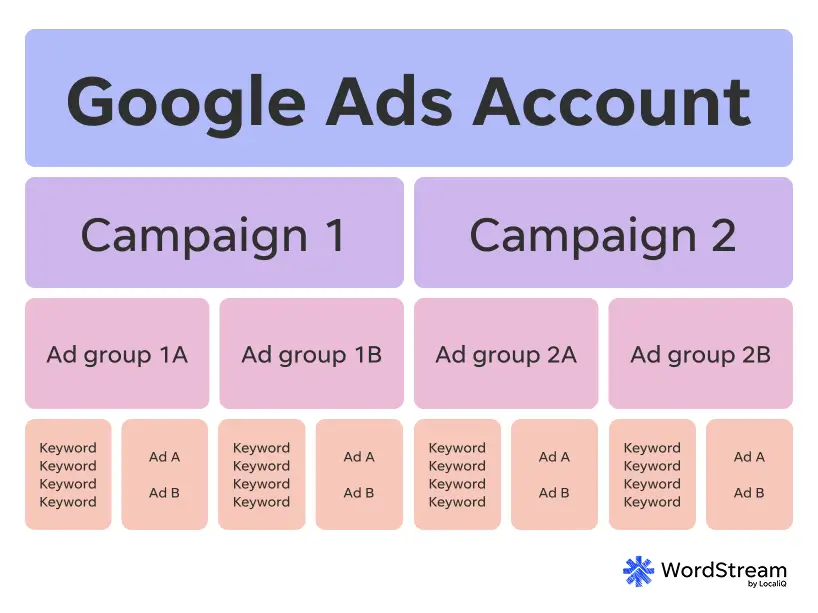
High-performing accounts average roughly two to three times more ad groups per account than low-performing accounts and run more campaigns overall, indicating more granular structure and intent segmentation. They also used more campaigns that are separated by goals, locations, or services, along with significantly more ad groups to align keywords, ads, and landing pages tightly.
For example:
- Roof repair
- Roof replacement
- Roof inspection
Each group has its own tailored ads and landing pages.
That structure makes it much easier for Google (and the searcher) to understand what the ad is about.
3. Strategic use of negative keywords
One of the clearest differences between strong and struggling accounts is the use of negative keywords.
According to our data, accounts with at least one negative keyword saw an average conversion rate of 13%, while accounts with none averaged 4.6%.
Negative keywords work because they filter out irrelevant searches. Instead of showing up for every loosely related query (and wasting impressions and clicks), your ads appear for the searches most likely to convert.
Healthy accounts treat negative keywords as an ongoing process, regularly reviewing search terms and tightening targeting over time.
Is your Google Ads account a pretty picture?
Google Ads success usually isn’t about a single trick or tactic. It’s about getting the fundamentals right. While myths of Google Ads might say otherwise, the data-backed facts prove that across thousands of accounts, the strongest campaigns focus on clear campaign structure and continuous optimization. So don’t fall victim to common Google Ads misconceptions; instead, focus on the foundations of your account and perfect the basics to find online advertising success for your business. For more ways to maximize your Google Ads campaigns, see how our solutions can help!
This is just a small peek at the data! Want to learn more? Read the full Google Ads Report over on the WordStream blog to get even more insights and data into what makes a good Google Ads account.

Recommended for you


Unlock your business potential
We offer innovative technology and unparalleled expertise to move your business forward.