

Stockholm, as many of you know, is my former hometown. Now spending the month of July here with family and friends is a real treat. The weather is fantastic and the whole city is in ‘summer mode’. Walkers, bikers, flowers and restaurants have taken over many streets in the central parts of the city, like this one where I’m staying.

 The day is 18 hours long, the sun rises before 4 a.m. and goes to sleep around 10 p.m. The picture below was taken around 10:30 p.m., just after sunset. Unfortunately this night owl is not inclined to get up early enough to offer sunrise pictures.
 There are so many places to visit, but first I wanted to go to Skansen, the world’s first and oldest open-air museum. And a place where we took numerous weekend walks when our son was small. So last Sunday my sister and I made plans to go there. I invite you to join us.
 The Swedish way of life in the past is exhibited in villages of authentic old residences, farmsteads, shops, a pottery, a bakery, a bank, a post office and a large number of specialized workshops and factories, store houses and barns. These exhibitions are manned with people sporting time-typical outfits. They can tell the stories (in many languages) about life in Sweden from late 1600s to early 1900s. Please follow us to the glassblower’s workshop, where the master is working on small animals in brilliant colors. Then we’ll stop at the general store, the bakery, and the pottery still making lergods typical in Sweden in the 1800s and early 1900s.


 Next, let’s take a peek into the life of middle class people at a house where the publisher and his wife lived in early to mid-1800s. Their parlor houses an old piano in a good working order and we can see the weekly magazine they published spread on the dining table. The intricate wall paper is not clued onto the walls, but as customary, it’s nailed on the walls so that should the family need to move, they could take it to their new house.


 The workers’ quarters are not as elaborate, many people used to live in one room in a house like this. We can also take a peek through the door into the shopkeeper’s room adjacent to the shop.


We walk the cobblestone alleys between the old houses enjoying the beauty preserved from old times.

 Next we find a bank and a government office.

 Skansen also houses authentic old farmsteads and typical farm animals, such as cows, pigs, goats and chicken. I focused my camera only on the smaller, more colorful animals.


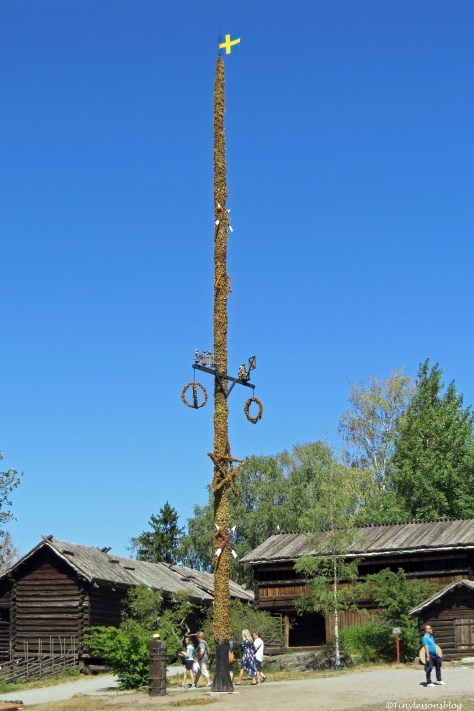
 Passing a windmill, a belfry and a traditional (now dried out) midsummer pole, we can observe a woman taking care of her cottage garden, just like women had done in the 1800s.


 From there we walk to see some Nordic wildlife. The huge brown bear is bound to leave a lasting impression.

 The lynx appears sweet like a house cat, but appearances can be deceiving…
 And at the home of the wolf, we are in for a surprise. Mama wolf has three cubs!


 We stay for a while and watch the cubs play. Luckily they have a large area to explore. Finally our feet decide it’s time for a late lunch at one of the restaurants and we round up our ‘wild tour’ by visiting the moose and the European bison.

 Of course we have to ‘shoot’ some birds on the way too. The Skåne geese have young goslings. (Aww). And finally we have to document the Swedish version of Mr. and Mrs. Mallard.


 Greetings from Skansen and thank you for visiting this unique museum with us!


 A pleasant surprise, a treat actually, came on my second day in Milan. A memorable dinner at Castello Visconteo. This castle, built in the 14th century, is just over an hour’s drive from Milan. Incredibly charming and a bit mysterious when you arrive at night.
 I couldn’t get enough of the beautiful decorations, still partly preserved on the walls and ceilings.
 And the 5-course candlelit dinner was delicious, traditional dishes from Lombardy accompanied by Tuscan wines.
 I couldn’t take too many pictures at the table, but had to sneak a shot of this perfect Italian version of Crème Brule.
 Once my work was done and I had some time to look around, I realized Milan was quite a green city. And I don’t mean the parks. I noticed that people had surrounded themselves with greenery right where they lived. Rooftop gardens, terraces and balconies with green plants were everywhere. I started snapping pictures of a them as I passed different buildings in the city center. Here’s a small sample.


 The most amazing green buildings I encountered, however, were the two towers of Bosco Verticale (Vertical Forest) opened in 2014. Together, these two residential high-rise buildings host over 100 apartments and 20,000 plants, among them about 900 trees. I could only get a picture of one of them, but you’ll get the idea.
 These trees, shrubs and other plants fight air pollution. They can transform approximately 44,000 pounds of carbon dioxide into oxygen each year. Quite amazing, isn’t it? Needless to say, I was impressed by these green marvels, designed by the Italian architect Stefano Boeri and a large team of specialists.

 From looking up, I went to looking down. The traffic scene on any street always included scooters. In fact, one could see long lines of them for rental at some street corners.
 And I noticed the many innovative parking practices. Here just one example.
 From looking down, I went to looking through…the shop windows at Galleria Vittorio Emanuele II, the worlds oldest shopping mall.
 Its construction started in 1865, but there was nothing old-fashioned about it. This mall housed shops of the famous designers of our time.
 I went window shopping and saw whimsical fashion creations…some more suitable for the cat walk than my walk-in closet. Or my wallet.
 And I saw winter gear in muted colors. More my style, with Florida length cropped pants and all, but my wallet still didn’t agree.

 Some shops offered boots too…
 …and I passed many windows exhibiting exuberant, colorful bags. The price tags were discretely tucked under the bags, and I guess for the typical customer the price didn’t really matter. I have never been a bag lady, but they were nice to look at.


 After seeing this pom-pom-fitted head-gear, I gave up. I would not leave with any of those fancy shopping bags with a world-famous designer’s name on it. So I walked out. And was faced with a wall of faces.
 A modern touch on old walls right next to Piazza del Duomo, which is the main city square in Milan. I walked closer and saw the Duomo, Milan cathedral, in all its beauty.

 Lots of people and pigeons outside, but the inside was very peaceful. I spent some time there in silent contemplation. And lit candles for each of the two men I lost recently.
 When I came out I was greeted by a street musician and the many pigeons calling this square home.
 I noticed the lion was yawning…and took it as a sign it was time to catch a bus back to my hotel.
 Thank you for joining me on this mini-tour. The always scary-looking beast, Mr. D., and I wish you all a wonderful Halloween week.

 Part of the sinking is due to natural compaction of the sediments on the 118 islands that make up the city, but a slightly larger part is due to human activity, such as conservation and renovation of the historic buildings. Some say the huge number of tourists descending on the city center on a daily basis also contributes, at least indirectly, to the sinking. And it doesn’t help that the water levels in the Adriatic Sea are rising due to global warming.
 I felt a bit guilty being one of the about 30 million tourists visiting Venice annually. Tourism has clearly made it more difficult for the locals to live, and afford to live, in the city. Many have already moved to the mainland. And tourism contributes very little towards the overwhelming challenges of conservation and protection against the rising waters faced by the residents. I am all for an entry fee for visitors and all the other limiting measures now contemplated by the Mayor and local government of Venice.
 I also believe that banning the huge cruise ships from sailing into the lagoon would be a good step in the right direction…just check the
  These thoughts in mind, but happy it was not raining, I set out to navigate my way from the (in comparison) small boat towards Piazza San Marco, or St. Mark’s Square as we call it in English.
 Once at the Piazza, I was fascinated by the gorgeous, intricate details of the Basilica San Marco. I just walked around it and zoomed in on one detail after another.


 The sights around the Piazza were just stunning. One beautiful building, statue, detail or pigeon next to another.


 I stayed there for quite a while and came across this ancient “letter box” in the wall. It was not one of the famous Boca de Leons through which citizens could anonymously send accusations to the Doge. This one had a more serious clang to it. The accusations of crime had to be signed with the name and address of the accuser. If, after a thorough investigation, the accusation was found correct and a crime had been committed, the accused would be punished. Sometimes beheaded. But should the accusation be unfounded, the accuser would be punished. Ouch. Judging from the discolorations around the letter hole, it seems this method of getting justice had been used quite frequently.
 The “weatherman”, as Venetians call the angel at the top of St. Mark’s clock tower, predicted overcast skies and some wind but no rain for the day. Encouraged by this good forecast, I decided to take a gondola ride.
 I walked to one of the “Gondola stations”. I wanted to see the ordinary houses where people lived, and some of the 430 bridges, cruising through a few of the 170 narrow canals.
 And after a short wait I was onboard. My gondolier worked hard to get us out to the Grand Canal. It should be noted that it’s not easy to become a gondolier. While the license is often transferred from father to son, the aspiring gondoliers must go to gondola school, do a formal internship of 6-12 months and pass a practical exam in front of 5 gondola judges. Among the approximately 400 licensed gondoliers today, there is only one woman.

 We passed many beautiful buildings and churches exhibiting more exquisite mosaics.
 From the Grand Canal we entered the narrow, residential canals, sometimes navigating through traffic jams of gondolas, residents’ boats and water taxis.
 Boats were “parallel parked” in the front of the homes just like we would see cars elsewhere.
 We glided under some of the beautiful large and small bridges.

 And I witnessed, with some heartache, the true romance of gondola rides…a musician and a soloist onboard entertaining a couple. But “O’ Sole Mio” didn’t help to bring out the sun.
 The gondola ride was a unique experience to say the least. After the ride, I visited a glass factory. Or rather a workshop and sales quarters of one of the producers of the famous Murano glass. They had a small workshop in the city, while their main factory was…on the island of Murano. I watched the Master create a vase, and of course ended up buying some small, but still fairly pricey gifts.
 Walking back to the boat over numerous brides, I got lost. The best way to see Venice, according to some. I noticed I was surrounded by several restaurants and realized I hadn’t eaten since my light breakfast at 5:30 a.m.
 After some pizza and a glass of red wine, I regained my bearings. …and encountered some of the mysteries of this unique city.
 From behind my Volta mask, I wish you all a beautiful Sunday and a great week ahead.

 On residential streets,
  As usual, people were gathering around the many drinking wells around the city exchanging the latest news and some, without a doubt, also engaging in rumor mongering.
 Nobody worried about the fact that the water to these fountains was flowing through lead pipes.
 The bath houses were still busy with late morning bathers, men and women enjoying separate quarters. Their clothing neatly tucked away in the “lockers” around the bath.
 Some people were lingering in the colorfully decorated common areas of the bath house.
 This Tuesday morning, life was going on its usual merry ways at the many hotels (and brothels), shops and bakeries in the city.


 The morning rehearsals at the Grand Theater had just concluded and the spectators were leaving the venue. It was a perfect morning.
 The smaller Forum was busy too. Young men were competing in athletics, their families cheering them on. Some were standing in small groups discussing politics.
 At the affluent villas of the nobel class and newly rich merchants, the morning was spent leisurely around the house.
 Guests were entertained in the larger atrium, where the rainwater had been gathered in a shallow “pool” for some cooling on this warm summer morning.

 The servants were busy dusting the frescos and cleaning the mosaic floors in and outside of the house.
 Inhabitants and guests of the most opulent villas facing the sea, could enjoy splendid views from their elaborate terraces and gardens.
 Those less fortunate could enjoy the public green spaces sprinkled around the city.
 But the busiest place this morning was the Forum. It was the economic, religious and political center of the city, where municipal buildings, courts, temples and commercial activities were located around the two-story portico.

 The northern end of the Forum was closed by the Capitolium, with Mount Vesuvius rising towards the sky right behind it.
 An ordinary late summer day. Until … around noon, a “cloud of unusual size and shape” appeared overtop Vesuvius.
 It could be seen across the city. At first, there was curiosity. But an hour later when ash started falling, people begun to panic. Many rushed towards the harbor, others started running north or south along the coast, but some 2000 people were hesitant to leave their homes. They would ride out whatever was coming and chose to take shelter in buildings and underground cellars they deemed safe. But the eruption escalated fast. Around 2 p.m. ash and white pumice was falling over the city at a rate of 10-15 cm (4-6 inches) an hour.
 By 5 p.m. the sun was completely blocked and there was no light for the people still seeking shelter or running away from the city. Ash, bits of pumice and charred rocks were falling on the city. Fires were burning everywhere. Roofs started to collapse.
 And then, in the morning of August 25, just before 7 a.m., a pyroclastic cloud of hot ash and toxic gas surged down on the city killing everyone who had remained in its vicinity. Not one was spared. Men, women, children and animals all perished.
 The eruption buried the city under 4-6 meters (13-20 feet) of volcanic ash and pumice. Life as it had been on that late summer day in 79 A.D. was frozen in time for almost 1700 years.
 Pliny the Younger, a Roman writer who managed to escape from the city in time, described the eruption in letters to his friend, which were discovered in the 16th century. The ruins of Pompeii were found only in 1748.
 About 80% of the city has now been excavated and as the work progresses, we learn more about that fateful day 1938 years ago.
 As I am starting to “unpack” my latest travels, I wish you all a wonderful week ahead.


 TINY LESSONS BLOG