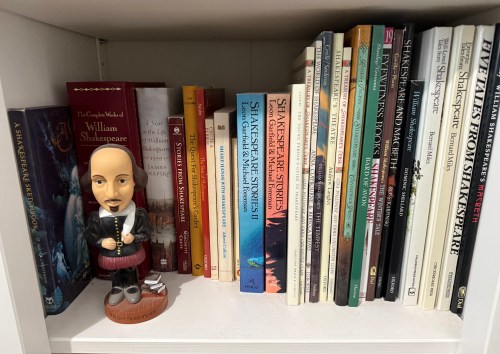
The Classics Club, Round 3


I first joined The Classics Club in March of 2017 and signed up to read 50 books in 5 years. I finished those first fifty books and it turned out to be a really enjoyable reading experience for me. I do love reading the classics, so I immediately started a second round of reading 50 books in the next 5 years! I have just finished reading those 50 books, and I’m now ready to start my third list of 50 classics!

One disclaimer… As you can see from looking at the list of my second round of classics, I did not review all that I read on the list. After my husband’s death in 2022, I found it difficult to read, my blogging became very inconsistent, and I simply couldn’t focus to write reviews of the books I was able to read. My reading focus has returned, but I can’t promise to write a review of every book I read now. Life has changed for me, so I am giving myself permission to simply continue participating in The Classics Club and reading another 50 classics in 5 years, and writing as many reviews of those books as I can.

As with my first two lists, my reading will be a mix of novels, novellas, non-fiction, short stories, and poetry — a combination of adult and children’s literature. This time I’ve decided to create a pool of classics I’m interested in reading, add to it often as I run into other books I’d like to read, and choose my 50 from that changing pool of books. I will keep a running list of the books I read along this journey, so please check back here to see my progress. My new time goal for completing this third round of reading 50 books in 5 years is March 30, 2031!  Once again, that sounds so far away, but I know that five years goes by in a flash, and what pleasurable reading years they will be!

The Classics Club List #3

GOAL DATE:  March 30, 2026 – March 30, 2031
Progress = 00/50

Red = Link to my review
Blue = Read but not reviewed yet

GOAL DATE:  March 30, 2026 – March 30, 2031

Classics Completed:

  1. .
  2. .
  3. .
  4. .


MY POOL OF CLASSICS I’M INTERESTED IN READING:

  • Agee, James:  A Death in the Family
  • Allende, Isabel:  The House of the Spirits
  • Arkell, Reginald:  Old Herbaceous
  • Austin, Mary Hunter:  The Land of Little Rain
  • Babbitt, Natalie:  The Moon Over High Street
  • Baldwin, James:  The Fire Next Time
  • Berry, Wendell:  Hannah Coulter
  • Beston, Henry:  The Northern Farm: A Glorious Year on a Small Maine Farm
  • Blythe, Ronald:  In the Artist’s Garden
  • Buck, Pearl S.:  Sons
  • Camus, Albert:  The Stranger
  • Chagall, Marc:  My Life
  • Choi, Sook Nyul:  Year of Impossible Goodbyes
  • Conrad, Joseph:  The Secret Agent
  • de Beauvoir, Simone:  Inseparable
  • Dostoyevsky, Fyodor:  The Idiot
  • Eliot, George:  Daniel Deronda
  • Emecheta, Buhi:  The Joys of Motherhood
  • Gogol, Nicolai:  Dead Souls
  • Goldman, William:  The Princess Bride
  • Gunther, John:  Death Be Not Proud
  • Hesse, Hermann:  Siddhartha
  • Hinton, S.E.:  The Outsiders
  • Irving, Washington:  Tales of the Alhambra
  • Knowles, John:  A Separate Peace
  • Kuroyanagi, Tetsuko:  Totto-Chan, The Little Girl at the Window
  • Lee, Laurie:  As I Walked Out One Morning
  • Lindbergh, Anne Morrow:  North to the Orient
  • Malraux, Andre:  Man’s Fate
  • Mansfield, Katherine:  New Zealand Stories
  • Márquez, Gabriel García:  Chronicle of a Death Foretold
  • Miller, Arthur:  Death of a Salesman
  • Momaday, N. Scott:  House Made of Dawn
  • Morrison, Toni:  Home
  • Narayan, R.K.:  Malgudi Days
  • O’Nan, Stewart:  Emily, Alone
  • Okakura, Kazuko:  The Book of Tea
  • Pilcher, Rosamunde:  A Place Like Home
  • Potter, Beatrix:  The Fairy Caravan
  • Proust, Marcel:  Days of Reading
  • Proust, Marcel:  Remembrance of Things Past
  • Miss Read:  Thrush Green
  • Rushdie, Salman:  The Enchantress of Florence
  • Shakespeare, William:  Hamlet
  • Sharma, Bulbul:  The Ramayana
  • Shute, Nevil:  On the Beach
  • Soseki, Natsume:  Botchan
  • Soseki, Natsume:  Kokoro
  • Stegner, Wallace:  Crossing to Safety
  • Steinbeck, John:  Cannery Row
  • Steinbeck, John:  East of Eden
  • Tanizaki, Jun’ichirō:  The Makioka Sisters
  • Tey, Josephine:  The Daughter of Time
  • Tokarczuk, Olga:  Flights
  • Tolstoy, Leo:  Anna Karenina
  • Tzu, Lao:  Tao Te Ching
  • von Arnim, Elizabeth:  The Caravaners
  • Wiesel, Elie:  Night
  • Woolf, Virginia:  A Room of One’s Own

Porchreader…
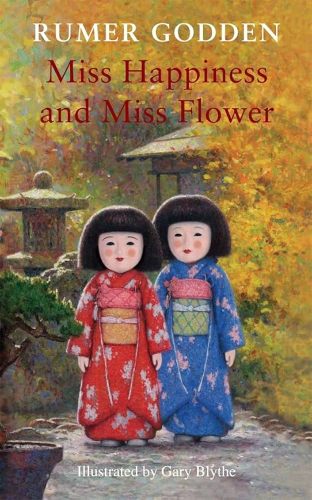
Miss Happiness and Miss Flower

Miss Happiness and Miss Flower, by Rumer Godden, was such a sweet book to complete my 50 books in 5 years challenge with The Classics Club! I am going to list Rumer Godden as one of my favorite authors now because I’ve really enjoyed each book I’ve read by her so far, both her books for children and for adults. Thank goodness there are a lot more to read!

This story warmed my heart. A young girl who has been living in India is sent to England to live with her aunt and uncle and cousins. She is very shy and very homesick, and just doesn’t fit in anywhere. But a great aunt living in the United States sends her a package with two Japanese dolls, Miss Happiness and Miss Flower. The dolls, too, are very homesick, and Nona senses this and decides to make a home for them. She first goes to the local bookshop to find out about Japanese houses. The bookstore owner is a grumpy old man who is immediately charmed by Nona’s  joy of reading and her intense desire to learn. So he provides the books she wants to read about Japanese culture. To build the dollhouse, she enlists the aid of her cousin, Tom, who loves woodworking. And as she begins to gather materials to make all the furniture and clothing, and even a garden, her enthusiasm is contagious and brings help from lots of different people. The project brings together school friends and parents and community members. The only problem is that her cousin Belinda feels left out and jealous…

I would have loved this book as a child! It is very respectful in how it presents cultural differences, and very respectful to the reader in providing a lot of extra information and explanations about Japanese culture.

Death

The Dance of Death, from the film, The Seventh Seal, by Ingmar Bergman…

Now that’s a post title that certainly grabs attention, but it’s a subject I would like to talk about and share with you. It is something I think of daily, for so many reasons: my own aging, personal losses of loved ones and friends, the state of the country and the world. But I am not a morbid person, and I find that my particular awareness of the presence of death gives me a deep and reverent appreciation for LIFE. But even though, that’s not something we talk about every day in our culture… but we do read about it often!

A quick look at my bookshelves and my reading lists reveal an inordinate number of books that have Death in the title. Death is the subject of so many of our greatest classics, because what gives us a deeper look into LIFE than ruminating about Death?

So I find myself reading more deliberately about death these days, not shying from the subject. This morning I finished reading Leo Tolstoy’s The Death of Ivan Iliych, and earlier this week I finished Willa Cather’s Death Comes for the Archbishop. Two very different stories about death written by great authors, both stories were very moving. Willa Cather’s beautifully written story about the life and death of a French Catholic priest relocated to New Mexico, was gorgeously described. Leo Tolstoy’s step by step account of the decline and death of this man was harder for me to read because I couldn’t find much to respect in the man’s life or in the way he faced death. It was so different from my own experiences with the decline and death of loved ones close to me.

When I read Simone de Beauvoir’s A Very Easy Death, (about the death of her mother) six months before my own mother died in 2018, I was deeply moved by the intimate honesty of it, and it helped me to deal with my own loss later that year.

Other titles that I find on my bookshelves are Death of a Salesman, by Arthur Miller; Death Be Not Proud, by John Gunther;  A Death in the Family, by James Agee,  Year of the Death of Ricardo Reis, by Jose Saramago; Dead Souls, by Nicolai Gogol; and Chronicle of a Death Foretold, by Gabriel García Márquez. Some of these titles have been on the shelf for a long long time. But I seem to be slowly getting to all of them!

Flurry

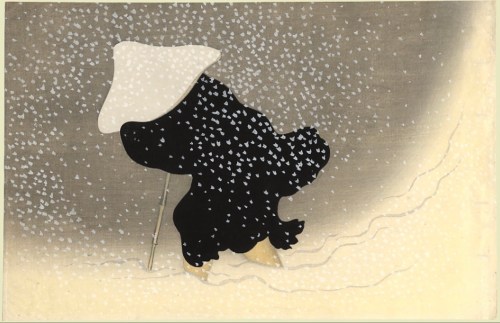
Snow Flurries, by Kamisaka Sekka

It’s January so you might think the title of this post is about snow, but it’s not. It’s a word that best describes the reading that I have been doing this month…a flurry of reading. It started with the last book I read in 2025, The Color of Air, by Gail Tsukiyama. That’s an historical fiction story of the Japanese and Korean sugar plantation workers near Hilo, Hawaii, and is set in 1935, when Mauna Loa erupted and threatened the water supply to Hilo and the surrounding area. It is quite a fascinating story, and one that has special meaning for me because my mother-in-law was 13 years old at the time and living (and working) on a sugar cane plantation south of Hilo. How I wish I could ask her about it! Click here to read a post I wrote about that part of my husband’s family history.

My parents-in-law met and fell in love in Hawaii. My father-in-law was retired from the Navy after 6 years of service and then a civilian worker at the Naval Air Station in Pearl Harbor. We were told that they watched the bombing of Pearl Harbor from the hillside that December morning. They wouldn’t ever talk about it, but among their belongings after they had both passed away, we found a framed shadow box with a twisted piece of metal in it collected quietly after the attack.

The Color of Air, and the family memories it triggered, started my flurry of reading about the Japanese American experience in Hawaii and on the west coast of the United States before, during and in the aftermath of World War II. Those are the stories that shaped my husband’s family, and our own family.

Because they lived in Hawaii during the war, my in-laws were not incarcerated in the Japanese American internment camps. But had they already moved to the mainland, to the west coast, they would have been relocated.

So my flurry of reading is a very personal search for understanding of what happened in the history of my family, and in the history of this country. This is not an easy subject to immerse oneself in, but I feel it is extremely relevant to what is happening in the US today, and should be studied and talked about more because history is repeating itself.

Some of the books on this list have been banned in the US. Some are books written for children. some are graphic novels, some are poetry. Each one is a powerful telling of that shameful part of our history. And the history of that horrific experience is brilliantly told in Rachel Maddow’s podcast, Burn Order. I highly recommend listening to that podcast.

Links to my flurry of reading and listening:

Burn Order, podcast by Rachel Maddow

Currently reading, or waiting to start:

More about the artist, Kamisaka Sekka

Looking Back at 2025

Hello, my friends.
I am checking in here after another prolonged period of blogging silence, to say hello, to talk briefly about my reading, and to share a few experiences that made 2025 a special year for me.

Blogging was put on the back burner for most of 2025. As most of you know, I lost my dear husband, Byron, three years ago to cancer. Byron was my soulmate in every way, and one of the delights over our 53 years together was sharing a love of reading. So, my silences and sporadic blog posts are definitely a part of my grieving. There are times I simply can’t read, let alone write a review of what I’ve read. But I miss my blogging friends and sharing about my reading and the changes in my life, so here I am, navigating new waters, and finally checking in with you again.

Here’s a brief look back at 2025…

Reading:

  • In 2025, I actually read 59 books!

Some Highlights of my Reading Year:

  • As part of the Chapter-a-Day challenge, I read both Roots, by Alex Haley, and Lonesome Dove, by Larry McMurtry. I really enjoyed the slow pace of reading just one chapter a day. My friend, Marlo, and I are continuing that chapter-a-day “habit” and are now reading 20000 Leagues Under the Sea, by Jules Verne.
  • I enjoyed reading Ship of Lost Souls: The Tragic Wreck of the Steamship Valencia, written by a friend, Rod Scher, and then had the pleasure of attending one of his book talks in Seaside, Oregon. I am really looking forward to reading his next book!
  • I also read a book written by a former professor of mine. Darkroom, One Life Developing: A Photographer’s Memoir, by Barbara Richards. The class I took from her was called “Ways of Seeing,” She had such an impact on my life and is the inspiration for my love of photography, so I was very happy to discover her memoir.
  • 2025 marked the 250th birthday of Jane Austen, so I reread my three favorites of her novels, and loved them all over again.

The Other Highlight of 2025:  Travel!

I also enjoyed some traveling in 2025. There were two extended stay trips to Seaside, Oregon. One Seaside week was spent with friends who came to spend time together at the beach. Weather was wonderful, but shortly after we arrived, there was a Tsunami warning, which stayed in effect for a couple of days, and unfortunately kept us from spending much time on the beach! Oh well.

In early September I visited my friends in Cedar City, Utah, to see a performance of Macbeth at the Utah Shakespeare Festival. Early followers of my blog may remember that when I was teaching 6th grade, we traditionally taught about Shakespeare at the end of the school year and our students performed a shortened, but lively, version of Macbeth. Always a highlight of the school year for me!

THE highlight of the year:

The ultimate highlight of 2025 for me, though, was a very meaningful adventure. Some time during the two years of Byron’s illness, he ordered an art print. I don’t remember him telling me anything about it (grief brain, perhaps), and I knew very little about the artist, but we both loved it after he hung it in our living room. And during his final weeks, when he could no longer go upstairs to the bedroom, his hospital bed was set up in our living room/dining room area where he was able to look directly at that painting. So, yes, it’s a very special painting for me now.

In the early fall, I discovered that that painting was on exhibit at the Art Institute of Chicago, as part of a wonderful traveling exhibition of artist Gustave Caillebotte’s work. I toyed with the idea of traveling to Chicago to see it, and asked my daughter if she would go with me. She wasn’t able to do that, so I gathered all my courage and decided I would put together a solo trip. Not my first time traveling alone, but the first time I would traveling without going to spend time with my people! I planned this trip very carefully (loved the planning part!), and every bit of it was especially meaningful. Lots of time to spend at the Art Institute, an afternoon on the Architectural River Tour to celebrate Byron’s love of architecture, and plenty of walking and exploring Chicago time. This trip was truly a celebration of Byron, and a wonderful experience for me.

 

I don’t know what 2026 will bring, but I am enjoying my reading again, and hopefully I will be able to return to my blog a little more frequently. I haven’t signed up for any reading challenges for this year, but I have a lot of books I’m looking forward to reading.

Thank you, my friends, and Happy Reading in 2026!
Love,
Robin

A Playlist

Mom’s “playlist”…

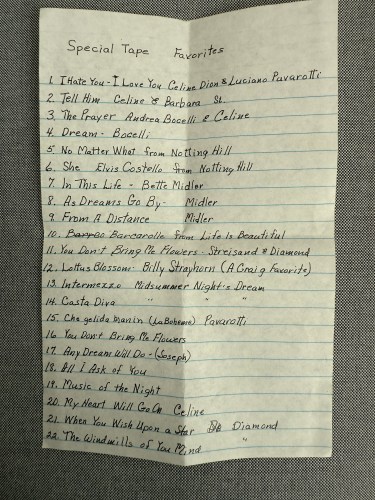
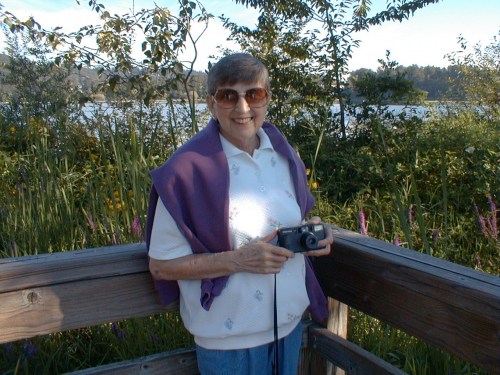
Over the years on this blog I’ve shared a lot of book stories about my mom. She was my lifelong book buddy, an avid reader, and always an inspiration to me (in so many different ways). She read a lot, but she also listened to a lot of music. I knew she loved opera, and musicals, and movie soundtracks. But I found an unexpected gift from her this week.

Earlier in the week, I pulled her old iPod out of the drawer I put it in seven years ago. It was pretty old technology back then, so I had simply set it aside, not wanting to get rid of it. But I was cleaning out drawers and found the box with her much used iPod in it, and when I opened the box, I found a handwritten list of the songs that the iPod contained. Her favorites, said the heading. So I decided to make a playlist of her music on Spotify. “Mom’s Favorites” is one hour and thirty-four minutes of pure Mom!

I was able to share the music with my brothers, and it’s fun to have playing in the background as I continue with my organizing tasks.

Love you, Mom.❤️

Mom

The Osage Orange Tree


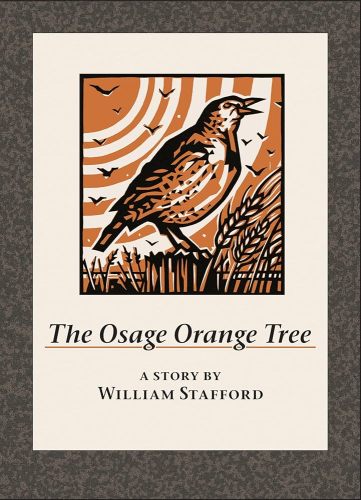
What to do when you wake up at 3:00 in the morning and can’t get back to sleep? I don’t know why I woke up so early this morning, but my mind started racing and I finally gave up and turned on my light and reached for a book. That book was The Osage Orange Tree, by the poet, William Stafford.

It’s actually a story, beautifully told in the succinct and evocative language of a master poet. It is a coming-of-age story that tells of two young high school students during the Depression, who become friends. It’s a quiet but deeply felt story, a slice of life during a difficult time, their friendship a ray of hope in a dismal world. A moment in time for the young man on the brink of manhood.

The illustrations, created by Oregon artist, Dennis Cunningham, were beautiful blockcuts that separated each “chapter” of the book and added an almost visual poetry to the story. And when you finish reading it, there is an exquisite Afterward written by another of my favorite poets, Naomi Shihab Nye.

This little book is a treasure.

Roots

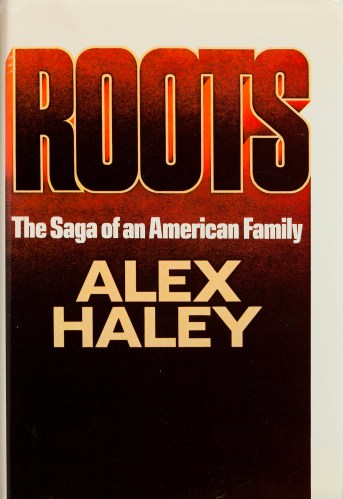
We hear a lot these days about “intergenerational trauma,” a term that describes the impact of traumatic experiences on subsequent generations in a family. I thought of this term as I finished reading Roots: The Saga of an American Family, by Alex Haley, this week. But I felt that what I would call “intergenerational resilience” is what this story is really about.

The story begins with the birth of Kunte Kinte in 1750, in the village of Juffure, in the Gambia, West Africa, who grew up with a rich inheritance of intelligence, strong spiritual beliefs, a deep understanding of the natural world, and with powerful leadership skills. His potential for excellence in his close-knit community within a deeply rich culture, was great. However, all of that was stolen from him when he was kidnapped as a teenager, and sold into slavery. He survived the horrific journey across the ocean in a slave ship, and was sold upon arrival to a slave owner who saw him simply as a good workhorse.

Kunte fought for his freedom with every fiber of his being, running away numerous times only to be caught each time. The final attempt to flee to freedom resulted in his being maimed by the slave owner, so he could never run away again. But the maiming also awakened in Kinte a new strength and will to live. He had survived the unsurvivable, and had lived. Everything he had been taught by his family, all his experiences growing up in his culture, fed that resilience, and from that came a strength that runs through his family to this day. Each subsequent generation of his family shared the stories of Kunte’s life, each generation drew strength from those stories and lived their own lives with great integrity and dignity, their true inheritance.

I started reading this book on January 1st as part of an unusual reading challenge created by Nick Senger: American Masters Chapter-a-Day Read-along. It was an incredible experience to read this book one chapter at a time. I had time to really absorb and appreciate each nuance of the story, to fully feel the impact of every carefully chosen and crafted word Mr. Haley wrote.

This has been a profound reading experience for me. After reading this story, I don’t think I can ever see the world quite the same again. It made me look again at my own family background and family struggles over time, and appreciate them with new eyes.  And reading it at this time, with all the turmoil within our country right now, added a powerful current dimension to understanding the struggles of Alex Haley’s family within our American culture. The problems at the heart of this story still exist today.

It is going to take me a long time to process this book. I know I’ll be thinking of it for a long time yet. And if asked, I’d have to say that this is one of the best books I’ve read over a lifetime of reading.

A huge Thank You to Nick Senger for creating the challenge that led to this amazing reading experience. And another Thank You to my friend, Marlo, who read it alongside me (although we live many miles away from each other). Sharing our thoughts and reactions as we read through the book really enriched my experience with it.

“Early in the spring of 1750, in the village of Juffure, four days upriver from the coast of The Gambia, West Africa, a man-child was born to Omoro and Binta Kinte.”