“What the
detective story is about,” author P. D. James says, “is not murder but the
restoration of order.” Something has gone astray in the world of the
story—perhaps horribly astray—and only when things have been put right do we have
some sense of resolution, and until that resolution we feel on edge.
We were
made to exist in an orderly universe. The opening pages of Scripture, the story
of Genesis 1, is many things, one of which is a narrative of creation, differentiation,
and providential ordering that reflects the goodness of God. Four words—“Did
God actually say…”—disrupted that gracious orderliness and disorder shattered
what had been made good. Now we yearn for order, prefer it, and instinctively
know that disorder can blossom into a chaos that can be deadly. In such a
world, when a detective solves the crime a bit of order is restored in a corner
of our badly fragmented world. Even a fictional account can refresh our hope
that against all odds order just might be able to be restored.
The best
detective stories tell the truth about existence, evil, and justice. They are
not limited to law and order, but show that mercy must also be present if the
order that is restored is to allow human flourishing. It is this full-orbed realism
that makes the 19th century story of Les Misérables contemporary, even in a pluralistic, secular society
like our own.
Foyle’s War

Starring
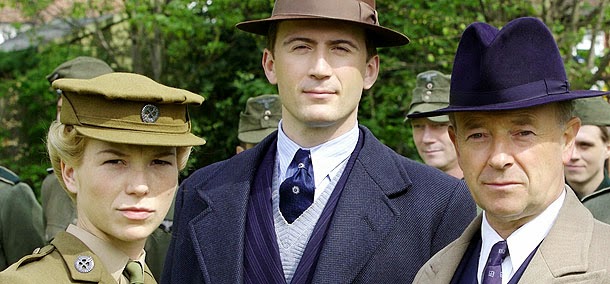
Michael Kitchen as Detective Chief Superintendent Christopher Foyle, this BBC
series is a superb production in every way. Kitchen is not well known as an
actor, but he plays Foyle with a quiet, powerful dignity that makes the viewer
care about him and about the victims of the crimes he investigates. Foyle’s War also stars Samantha “Sam”
Stewart (played by Honeysuckle Weeks) as Foyle’s driver, and Paul Milner
(Anthony Howell) as Foyle’s assistant.
World War
II has begun, and to his disappointment, the British government believes Foyle
to be of greater value working as a detective in Hastings, a small town on the
southern coast of England than serving in the war effort. Crime continues, of
course, even in wartime, and so in each episode Foyle is called upon to
investigate some foul deed.
The
historical accuracy—in dialogue, sets, events, costuming, etc.—is impeccable,
and watching Foyle’s War is a
fascinating education in what life was like in the British Isles during World
War II. The writers do not cheat, like many detective writers do, but allow us
to see all the clues as Foyle uncovers them. When he reveals the culprit at the
end we realize we knew all we needed to know to come to the correct conclusion
but unlike Foyle were not observing the details of the case with enough care.
Perhaps most admirable of all, Foyle is consistently depicted as a man of
integrity and honesty. It is difficult, in a drama, to depict good and moral
characters without having them seem bland and boring. In Foyle’s War, the crime provides the color and the detective, rather
than being made interesting by having weird quirks, inner struggles, or special
effects, is allowed to be a man of few words and deep character.
We have
watched some of the episodes multiple times, purely for the enjoyment of seeing
them. At the end we are always satisfied, not simply because a measure of order
has been restored, but because we feel edified, having watched a virtuous
character bring law, justice, and mercy into his corner of a broken world.
[Each
episode of Foyle’s War, 2002-2013, created
by Anthony Horowitz, runs 90-100 minutes and is available on Netflix and DVD.]
Kidnap and Ransom

Produced
for British TV, Kidnap and Ransom follows
the efforts of professional negotiator Dominic King (played brilliantly by Trevor
Eve) as he seeks the release of hostages held by international terrorists and
paramilitary gangs. King’s goal is not justice—to maintain his ability to
negotiate with the bad guys he permits no police involvement—but to restore the
victim to their life and family, hopefully unharmed.
The
locations are exotic, the trajectory of each story is plausible, and the fact
that the crime is ongoing as King intercedes for the kidnapped increases the
tension. King is shown to be a man of integrity and great courage, whose
commitment to his calling costs him greatly, fracturing his relationship with
his wife and daughter.
Kidnap and Ransom is not always easy to
watch. Each kidnapping, fraught with danger and shock, is filmed in enough
detail to draw us into the fright that is overwhelming for the victim. Often
the negotiations take time, sometimes lots of time, and as they drag on the
victim languishes is some vile cell. This too is depicted realistically, and
reveals the awful emotional and spiritual toll that must be involved.

International
kidnapping has become a tool of war in our world, a way to raise funds, gain
notice in the media, and impress recruits. It is a wicked practice and one that
should cause us to pray that God’s will would be done on earth even as it is in
heaven. Kidnap and Ransom has helped
me see the news behind the headlines with greater clarity and compassion.
[Each
episode of Kidnap and Ransom, 2011-2012,
runs 45 minutes. There are two series of 3 episodes each and is available on Netflix and DVD.]

In his new book Jerram Barrs has a chapter on the striking episode in Jesus’ life that is recorded in St John 7:53-8:11.
They went each to his own house, but Jesus went to the Mount of Olives. Early in the morning he came again to the temple. All the people came to him, and he sat down and taught them. The scribes and the Pharisees brought a woman who had been caught in adultery, and placing her in the midst they said to him, “Teacher, this woman has been caught in the act of adultery. Now in the Law Moses commanded us to stone such women. So what do you say?” This they said to test him, that they might have some charge to bring against him. Jesus bent down and wrote with his finger on the ground. And as they continued to ask him, he stood up and said to them, “Let him who is without sin among you be the first to throw a stone at her.” And once more he bent down and wrote on the ground. But when they heard it, they went away one by one, beginning with the older ones, and Jesus was left alone with the woman standing before him. Jesus stood up and said to her, “Woman, where are they? Has no one condemned you?” She said, “No one, Lord.” And Jesus said, “Neither do I condemn you; go, and from now on sin no more.”
Jerram’s reflections on this text are exactly what those of us who know him have come to expect from him—thoughtful, true to the text, and sensitive to real people living real lives in a broken world. What stunned me, however, and what I want to highlight here are the study questions he included for this text. Unless I am badly out of touch with the sort of discussion that usually goes on in Bible studies today, his questions are of a different sort entirely. The sort of questions we should be addressing but usually don’t. Truth be told, I don’t even think of them.
1. What in your life would you hate to have exposed for public humiliation? This is a question to answer on your own, just between you and the Lord. If you are considering these questions in a group setting, it might be valuable for everyone present to take a few minutes to reflect on this question before discussing the following ones.
2. Are there particular sins in the lives of others that you have exposed for condemnation or even for the public humiliation of the sinner?
3. Are there unbelievers, maybe in your own family or workplace, to whom you need to apologize for the way you have criticized or judged them in the past?
4. What are the sins that preachers most often tend to parade for the church’s condemnation?
5. Are there particular kinds of sinners from whom you have desired to separate yourself?
6. Why do we all find it so much easier to see the sins of others and to criticize them, rather than to see our own sins and to criticize ourselves?
7. Are there examples in your life and ministry where you have shown the kind of mercy to a sinner that Jesus shows to this woman?
Source: Learning Evangelism from Jesus by Jerram Barrs (Wheaton, IL: Crossway Books; 2009) pp. 253-254.