A site for links and information about graphic novels for anyone interested in reading them. I hope that you find my posts informative, useful, or entertaining. Thanks for stopping by!
Showing posts with label Joyce Brabner. Show all posts
Sunday, June 15, 2014
The Beats: A Graphic History
The Beats covers a lot of ground in terms of a historical movement and its constituents. The Beat Generation monicker is applied to a group of writers whose works appeared post-World War Two and were a precursor to the hippie counterculture of the 1960s. Most of this book covers a triumvirate of Beat writers, Jack Kerouac, Allen Ginsberg, and William S. Burroughs. It is unflinching in its portrayals of their drug use, sexual activities, and various other activities, though it only documents profane activities and does not depict them. It also chronicles their major works, career achievements, and the arcs of their lifetimes. It is at once highly informative
as well as entertaining enough, full of interesting tidbits and good stories.
After attending to the "big three" Beats, the rest of the book contains many shorter pieces about less well known poets and writers, like Lawrence Ferlinghetti and Kenneth Rexroth. I found these succinct pieces more desirable and informative.They certainly cast a larger view of the movement and these authors that went beyond the hard-drinking, hard-living, and largely misogynistic portraits of Kerouac, Burroughs, and, to a lesser extent, Ginsberg.
Although I am a big fan of much of Harvey Pekar's comics work, overall this set of stories is a little stiff, perhaps too journalistic, and overly celebratory for me. Additionally, I am a big fan of Ed Piskor's work, but this effort is more a story with graphics than it is a graphic narrative. I think he has grown exponentially as a comics creator, and his more recent efforts on Wizzywig and Hip Hop Family Tree are more fleshed out, vibrant, and exciting. More to my liking among the Beat poets stories were some of the shorter stories in the back of the book, especially the ones about Gary Snyder drawn by Peter Kuper and Diane di Prima illustrated by Mary Fleener. I was also enthralled by Trina Robbins and Anne Timmons' tale of painter Joy DeFeo creating The Rose, and the final piece in the book by Jeffrey Lewis on poet/anarchist/pacifist Tuli Kupferberg and his band The Fugs, which excellently portrays the transition from Beats to hippies.
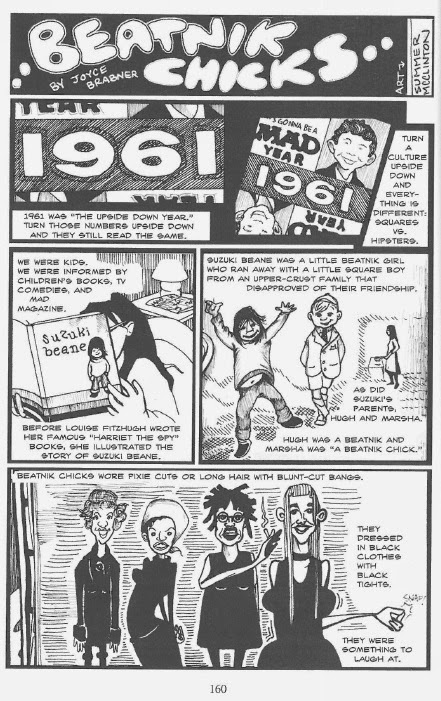
Perhaps the best part of this book was a piece written by Joyce Brabner and drawn by Summer McClinton about beatnik women. This visual essay provides a strong counterpoint to the rest of the book, acknowledging and transcending the sexism and cruder parts of the beatnik movement. It is a smartly written and well flowing look at a largely overlooked set of writers and thinkers who deserve more credit for their accomplishments.
The reviews I have read have taken this history to task for various matters. The New York Times' John Leland called the book "plainly celebratory" and added that it glosses over some history and is somewhat self-promoting. Pádraig Ó Méalóid, a fan of Pekar's earlier work, did not enjoy this book, stating "that the writing and art often seemed terribly static and undynamic." Gerald Nicosia felt that the beginning of the book was a "disaster" and fraught with errors, but that the latter parts focusing on beatnik women and more minor poets saved it. He summed up that it was "notable for the completeness of its portrait of that magical era - an achievement that, whether in comics or literary biographies, is as impressive as it is rare."
The Beats: A Graphic History was published by Hill and Wang.
Labels:
1950s,
1960s,
anthology,
biography,
drug culture,
Ed Piskor,
Harvey Pekar,
Joyce Brabner,
literature,
nonfiction,
poetry,
social studies,
The Beats,
US history
Tuesday, December 25, 2012
Our Movie Year
Harvey Pekar was well known for his autobiographical comics, particularly his decades long series American Splendor. He became a fixture on Late Night with David Letterman, and eventually his idiosyncratic voice was portrayed in the 2003 film American Splendor directed by Shari Springer Berman and Robert Pulcini and starring Paul Giamatti. This movie won the Sundance Grand Jury Prize and the FIPRESCI Prize at the Cannes Fim Festival and also brought Pekar an unprecendented level of fame and attention. This graphic novel mostly chronicles the year the movie broke.
With its pages, Harvey worries about his post-movie life, fearing all the attention will go away and he will be seen as a flash in the pan. He also details his many travels (sometimes telling the same tale more than once), brushes with famous folk, and obsesses over care for his cats, house, and bills while he is gone. Ironically, maybe the most affecting stories, about a vet visit for a cat and another about a saltwater aquarium doomed by a power outage, have nothing to do with the movie. Also, the last third of the book contains a number of various and sundry works Harvey wrote about celebrities and musicians from the past as well as his selections for the movie soundtrack, making for an interesting, if disconnected, hodge-podge.
This book was illustrated by an all-star team of Pekar's collaborators, including R. Crumb, Frank Stack, Gerry Shamray, Gary Dumm, Ed Piskor, and Dean Haspiel. Their different styles cast different tones for the stories and events, echoing the look of past American Splendor comic books and also the metanarrative of the film. Pekar, who wrote the stories in this book, died in July of 2010, and his life is properly celebrated in this obituary.
Reviews I have read of this book have been on the negative side, perhaps due to comparison with the usual high standards set by Pekar's other works. The Onion A.V. Club's Tasha Robinson wrote, "The results are scattershot and even sometimes impersonal, which is unusual for Pekar's work. It seems incongruous that his world-hopping and his celebrity encounters should so often be humdrum, while his detailed recounting of an hour spent waiting for a tow truck is so involving." The reviewer at Grovel commented on how the book is uneven but "despite its faults this is a great companion to the movie, not least of all because it goes further behind the scenes than even the movie itself did." Kevin Forest Moreau concluded that this book was a weak offering in the American Splendor corpus, "somewhat intimidating and, yes, padded."
This book was published by Ballantine Books.
Monday, January 10, 2011
Our Cancer Year
Harvey Pekar was the first substantial autobiographical comics creator. His comic book American Splendor was published for decades, and he gained fame from his appearances on Late Night with David Letterman and, eventually, the movie based on his life and comics. This particular book is an extension of his comic books, telling the story of a harrowing year. It begins with a move from a cozy apartment into a new house, and there is trepidation about the new living arrangement that rattles both Harvey and his wife, Joyce. On top of this situation, Joyce is involved with a group of young activists from the Middle East and Cambodia who are dealing with the escalating political situation that turns into Operation Desert Storm. Amidst all this turmoil and tension, Harvey is diagnosed with lymphoma.Much of the book chronicles his struggles with cancer and the treatments he received. Pekar does not sugarcoat what he went through. He vividly describes his agony, the weakness caused by the chemotherapy, and the anxiety he felt when he could not receive treatments because of his low T-cell count. What is more, he is a difficult patient to deal with, and there are many times he wishes for death. The difficult emotion situations are given excellent treatment by Frank Stack, a long-time American Splendor contributor. Stack has had an interesting and varied career, known for his underground comix as well as works in a much more academic and fine arts vein. Here, his expressionistic work and use of negative space creates a great range of tones and fluidity.
Our Cancer Year was awarded the 1995 Harvey Award for Best Graphic Novel of Original Work. Reviewer Todd VerBeek commented that he was disappointed with some aspects of the book but admitted it is full of "devastating and encouraging" moments. John Hogan wrote that like in much of his other work "Pekar is able to find the glorious in even the most mundane traits of mankind." J. Stephen Bolhafner called it "deep" and "meaningful" as a story of illness, courage, and love.
This book is published by Running Press and a short preview is available from Amazon.com. More of the book can be seen at Google Books.
Labels:
autobiography,
Frank Stack,
Harvey Pekar,
Joyce Brabner,
OGN,
Our Cancer Year
Subscribe to:
Comments (Atom)


