
Showing posts with label Swallow. Show all posts
Showing posts with label Swallow. Show all posts
Monday, 29 September 2025

Friday, 17 January 2025
April 2024

A suitably brief résumé from me for April. Mainly because it was six months ago. The best birds seen during the month have already been featured in a couple of previous blogs so you can find longer accounts and many more photos of those further back if you so wish.
Thursday, 2 May 2024

Sunday, 10 December 2023

Sunday, 16 July 2023
A Slow Start but a Lightning Finish; Sunday 11 June 2023

Our first full day in Scotland didn't start as we'd planned. In fact that's not quite true since we hadn't planned to do anything specific. The weather forecast wasn't promising with thunder and lightning likely across the Speyside region. So we took it easy, watched the mizzle through the cottage windows and considered our options. My original plan was to go to the Ythan Estuary and see the King Eider that had been present throughout the preceding fortnight until Friday, but then it had disappeared so there didn't seem much point in keeping to it. After much deliberation we eventually decided to go for the tried and trusted drive around Lochindorb where we'd be able to see birds from the car windows and avoid getting wet.
However, before we'd reached the end of the drive, Mrs Caley announced that a Red-necked Phalarope had been reported at the RSPB's Loch of Strathbeg reserve on the north-east Aberdeenshire coast so we made a quick change to the Sat Nav and headed eastwards after all. Better weather was to be expected once we'd gotten away from the mountains too so we were hopeful of a good day. Unfortunately after an early positive update on the status of the Phalarope a further report, when we were about halfway there, said that it had been flushed by a Sparrowhawk and had disappeared. We kept on course to Strathbeg anyway because sometimes birds will return once the coast is clear. The Red-necked Phalarope had other ideas though and wasn't seen again, so for the third time this year already, we missed out on seeing one by just an hour or so.
I spent a bit of time scanning the marshes at the reserve but couldn't find anything other than Lapwings and Oystercatchers. The vibrant Common Tern colony at the visitor centre had also been deserted this year. The outbreak of bird-flu definitely seems to have affected the status quo this year. In the carpark we watched some of the Tree Sparrows and got a close up view of a Swallow which was sitting out the drizzle that had followed us from Speyside.
 |
| Tree Sparrow (Passer montanus) |

 |
| Swallow (Hirundo rustica) |
We decided to cut our losses and head down the coast towards the Ythan Estuary to the difficult to find, unless you know where it is, Meikle Loch near Collieston. Over the years we've seen many good birds in the area. At the Ythan we saw our first Greater Sand Plover after driving from the Isle of Skye to twitch it before doubling back for a week in Speyside. We've seen a Roseate Tern at the Ythan mouth and of course, Elvis the King Eider on many occasions. Close to Collieston we saw a fabulous Blyth's Reed Warbler, a photograph of which gained me my one and only Photo of the Week award from BirdGuides. At Meikle Loch itself, we saw a Lesser Yellowlegs once. Just in the past week a Pectoral Sandpiper and three Temminck's Stints had graced the shallow Loch but sadly all four had decided to disappear as we were winging our way northwards on the Saturday.
The entry track to the small parking area by the loch side has become more than a little rough since I'd last driven it a few years back. The grass that grows in the middle of track was high enough to give the undercarriage of the car a good brush. I was terrified that the grass could be concealing a rock or two so I drove very gingerly indeed. Once I'd reached the parking area, I even gave the car a once over, but all seemed to be fine. The loch itself doesn't actually look attractive to wading birds, there are no muddy edges and reeds grow around most of it so the waders use a corner of the loch that has a rocky shore and some rocky groynes that fishermen have presumably laid for better access to deeper water. Even though the Pectoral Sandpiper and Temminck's Stints had moved on, I knew that there were three Little Stints still present and I found them readily enough on one of the small man-made rocky peninsulas. Conditions were still a bit grey and dreary and they were a fair distance away so you may have to squint a bit at the photo below, but all three birds are in it.
 |
| Little Stint (Calidris minuta) |
Year List addition;
245) Little Stint
Monday, 8 November 2021
OCD #3, The Young Ones, Mid-July 2021

Either side of finally life ticking the Black-browed Albatross and adding an Elegant Tern the following day (see here) some birds seen locally provided me with great entertainment.
Wednesday 14th July, Marsh Gibbon, Bucks
I'd been working on a farm near Marsh Gibbon, a village set on the northern edge of the River Ray flood plains while the farm is surrounded by arable crops and lies on the western edge of BBOWT's Upper Ray Meadows Reserve which makes up a significant part of the flood plain. Luckily the farm is around 2 metres above the river level so doesn't flood! The house that I was helping to renovate has a porch, with a vaulted roof space, to the front door and four pairs of Swallows had attached their nests to the exposed beams. Despite the comings and goings of the builders the parent Swallows appeared to be none too bothered and were actively feeding the young throughout the day. The young themselves were at varying stages of development with one particular nest getting close to overflowing with four chicks growing to fledgling size. After forgetting to take my camera many times, I finally remembered it on the day that those four chicks finally "branched out" onto one of the beams and later into the yard outside. I spent a very happy break and, a little bit prolonged lunchtime photographing the chicks.
Some photos from under the porch eaves in the morning;
 |
| adult Swallows |
 |
| young swallows |


 |
| feed time |

And some from outside in the early afternoon;


The fields surrounding the farmhouse also held other interesting birds. Partridges of both persuasions were seen most days as were the ubiquitous Red Kites. A Marsh Harrier sauntered through once and Little Owls could be heard, although I never found any of them. The best birds present were several pairs of Yellow Wagtails which clearly must have bred in the area owing to the number of juvenile birds. There were also Hares feeding on the grass lawns next to the house on most days before the work got going in earnest.
 |
| juvenile Yellow Wagtail |
 |
| adult Yellow Wagtail |
 |
| Brown Hare |
Sunday 18th July, Banbury
After our weekend away twitching the Albatross and Elegant Tern it was back to local birding for the Sunday morning. WhatsApp birding groups have been one of the great improvements in obtaining local birding news that concern species that are not national rarities and via the Banbury group I had learned of a family of Little Owls that were staying faithful to their nesting tree near the town. It was forecast to be a scorching hot day so Mrs Caley and I arrived at the tree early and spent a very relaxing couple of hours watching the adults along with their two recently fledged Owlets.
 |
| adult Little Owl |
 |
| juvenile Little Owl |
It's been a good year for Little Owls locally and we've seen several around Oxfordshire after struggling to find any last year. We've also encountered a few while on our trips out further afield. This particular family had chosen an isolated tree to nest in that sits in a hay meadow but still close enough to the farm track to allow observation.


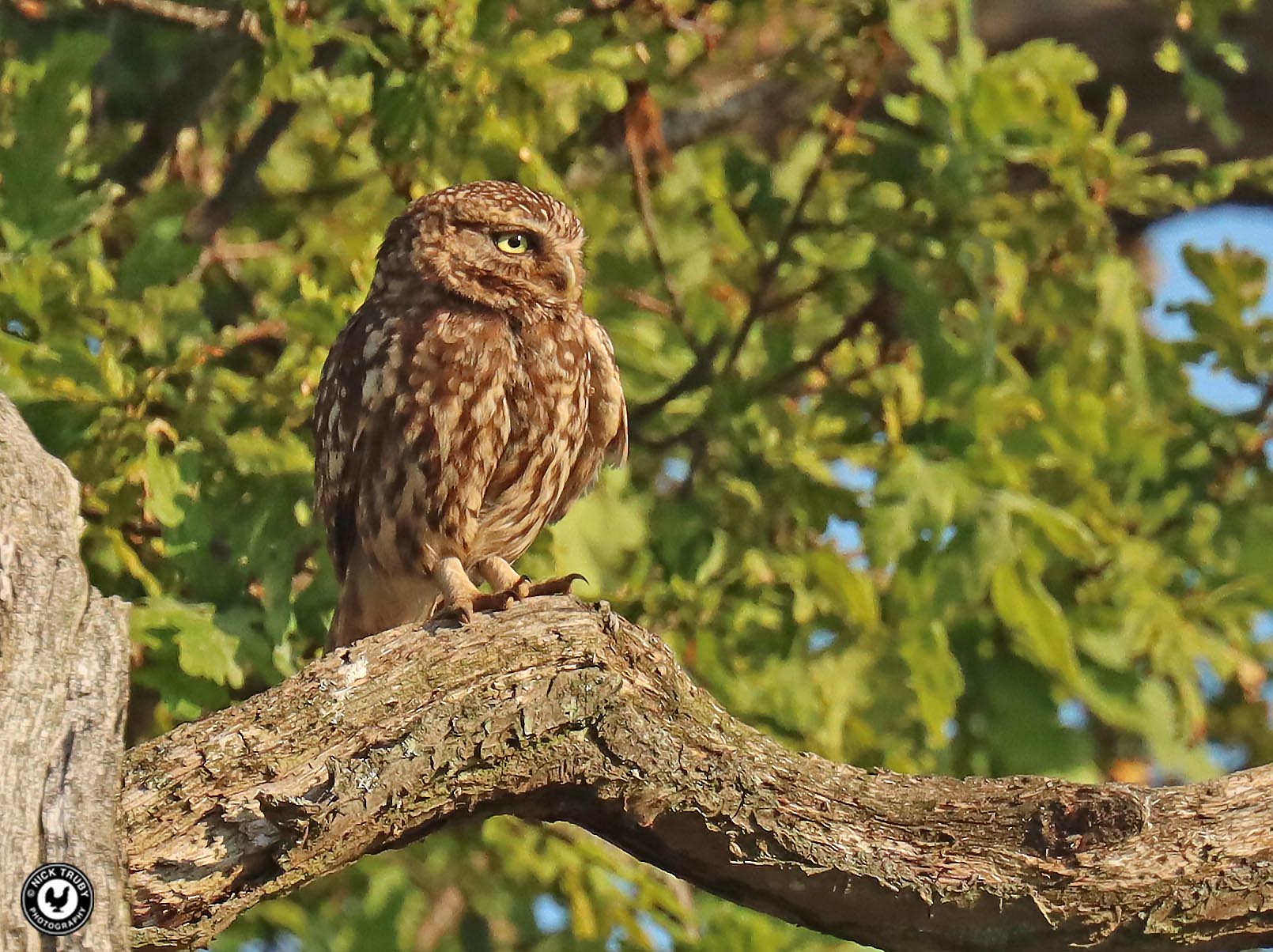
Once the morning had warmed up the Owls began to hunt for insects in the recently cut field and used the hay bales and a tractor trailer as vantage points. It all made for a very quintessential British countryside scene.


The tree itself is typical of the type that Little Owls choose, old and partially decaying which provides lots of cavities but still bearing a lot of dense foliage around the bole of the tree which provides cover when required. The dead outer branches provide lots of photogenic perches for the Owls to pose on and the youngsters in particular seemed to enjoy clambering about in the outer boughs.


After taking hundreds photos of standing Owls, staring Owls and sleepy Owls, I set myself the task of attempting to capture the Owls in flight.


There was still more time to get a few more frames of the fierce and piercing stare shots that Little Owls are renowned for! It had been a terrific morning!


Subscribe to:
Comments (Atom)