Showing posts with label promoting races. Show all posts

Wednesday, October 05, 2016

Promoting - Hours, or What It Takes

I recently answered a question about promoting, and one of the follow up questions was about the kind of hours I claimed to have put into putting on the Bethel Spring Series. I made a step-by-step list of hours, starting with the "before there's officially a race" to "now we have permission" to "just before the race" to "okay it's race time!"

I expanded on some of the thoughts and also included some pictures.

Keep in mind that other than some help setting up and breaking down, marshals, and officials, I did virtually everything myself. Not really ideal but this way I could only blame myself.

Carpe Diem Racing.
That's the name of the promoting company.
It started out as the club/team name back in 1990, with the name decided at my house between four proposed names in 1989. I suggested CDR, taking inspiration for the name from a trinket catalog which had a sweatshirt with the saying on it. It became a bit more well known when an Olympic team member was interviewed wearing a similar/same sweatshirt.

October:
10-20 hours: My time would start in October when I started to piece together changes/improvements for the races the following year. Permission from the town (possibly attend meetings, talk on phone, etc). Lining up officials (my favorite officials lived close by, they were reliable, consistent, and helped create a good race environment so I'd book their time as early as possible). I'd rough out any registration spreadsheet changes, something that's evolved over about 10-12 years. It saves a ton of time/energy on race day but I keep breaking it when I try and improve it.
Running total: 10-20 hours

December:
10-20 hours: December I was getting into the groove. Renew various legal entities (LLC, liability, workman's comp, debate doing it another year, etc). Start ordering stuff like numbers, set up infrastructure, etc.
Running total: 20-40 hours

January:
20 hours: January would be mostly virtual work. BikeReg. Permits. Lining up volunteers, employees. For legal reasons I had to have employees because I was paying them and I was telling them what to do. With an accountant wife I had to play 100% by the rules, it's like a pro cyclist being married to a WADA person, no hint of anything possible. One year I had 9 or 10 employees, toward the end more like 6. I would spend time fixing stuff I broke on the spreadsheet. I have to finalize any changes with categories/classes, etc. There was always very vocal feedback on that stuff and I tried to accommodate the racing community (because I'm one of them).
Running total: 40-60 hours

The van was parked here over the winter of 2011-2012.

February:
50? hours: February I was in full race promotion swing. I almost never trained much in February, there were some years where I'd ride 2-3 times during the whole month. I'd go to the venue at least once or twice to check on things. Sometimes I'd sweep or break up ice or what not. For a number of years I'd clear snow off areas for start/finish and portapotties; one year I dragged my quite-ill mom along so she could get out of the house. I think she sat in the car (running, with the heat on) for about 3 hours while I cleared what I could.

A February trip to get rid of snow on the inside/sprint line.
I seeded the snow/ice with lots of salt, in preparation for clearing it another day.

For Bethel, for many years, it was a 3.5-4 hour round trip just to get to the course. With the trailer it was more like 4.5-5 hours round trip. I'd go pick up trophies at some point (35-45 minutes from Bethel). Every now and then I'd train new staff, where I'd drive to their house, set up the camera and laptop, train them in the basics, go over stuff, break down, and return home. I'd check/test the equipment. Organize bib numbers. Order stuff I forgot to order or that got used up or that disappeared. Make lots of lists.

Pretty much every employer has allowed me to work on the race during the day. Even in a retail store I was probably working as much as 4-6 hours a day checking/answering emails. When I did IT I just dedicated one screen to race stuff, leaving two other screens for work. I'd crank through the race stuff, alt-tabbing between work and race as work allowed. For my running time I'm not counting that. I spent all my free time after work doing race stuff. I'd ride when I could because I had to, for my mental health.
Running total: 90-110 hours

March-April
March/April are race weeks. Killer. Thing though was that it was less trying to figure out how to do things at a theoretical level and much more "do this now". For example in January I'd be honing registration processes, trying to think through how things would work. At the first race the registration line was real and whatever I had to do I had to do. Things become very clear when it's "right now!"

My one escape was that I usually raced one race. Earlier in the life of the Series I'd do two races, because I didn't have to do results and such. Back then the officials handled all of that, and we didn't have to upload results because no one expected results to be online for a week or, before the internet wasn't just AOL, ever.
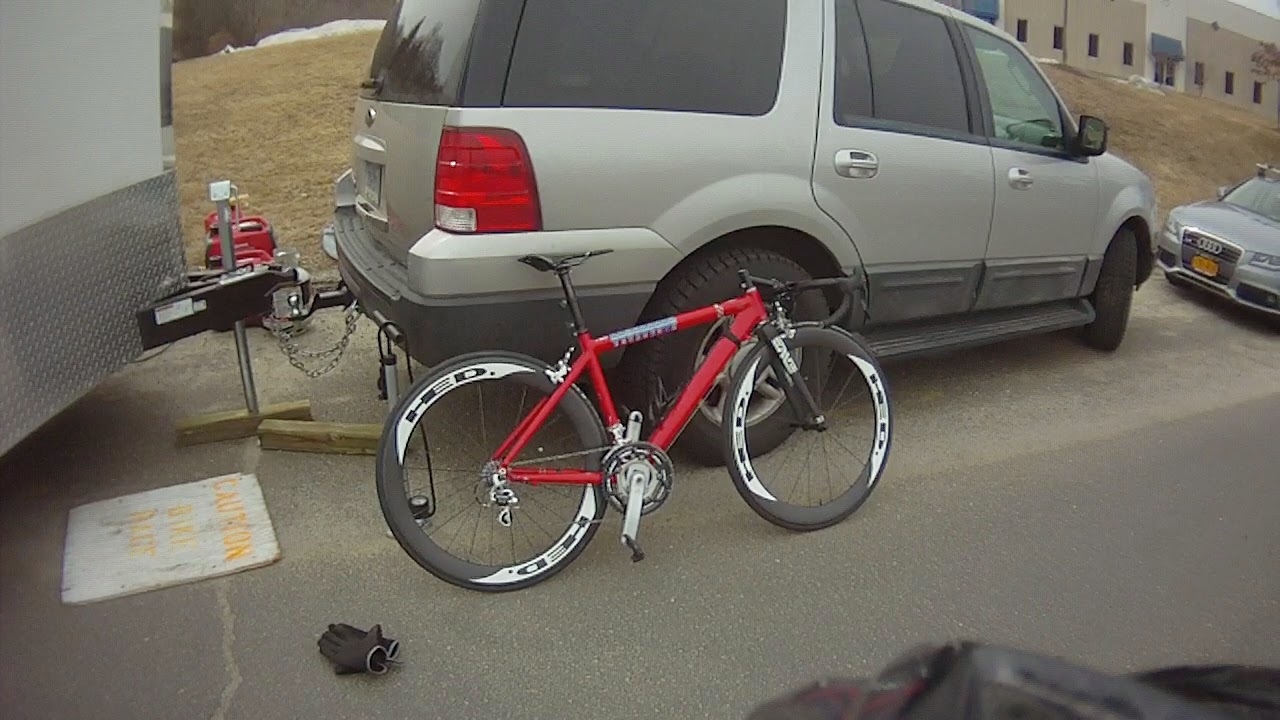
My bike at a 2014 Bethel. I'd race once that day, winning the field sprint behind a break.
The bleak weather probably meant a not-so-great day in terms of dollars/numbers.

60 hours, give or take, for the first week alone. First week is the hardest. 2-4 hours after registration closes Thursday (each week) organizing the registration spreadsheet, figuring out numbers, etc. I print releases at Staples because it's cheaper by a lot. For me I use $35 of toner plus paper if I print myself, it's about $25 if I have Staples do it. Plus they use nice paper. Drawback is that the Staples thing adds 1 hour of driving time to pick up the print job. 5-8 hours on Friday getting stuff packed/etc, 18 hours Sat 6 AM final pack and head down to the course for Sweep Day, and finish up at maybe 1 AM answering emails etc. Then 5 AM - 5 PM for the race. Another 2.5 hours to get home, unpack the most valuable stuff (laptop, etc), then upload results, make registration fixes, etc. With travel before, emails continuously, fix whatever I broke on the spreadsheet, upload results to my website, to USAC, work until maybe 11 PM (if not much later), call it 18 hours.
Running total: 150-170 hours
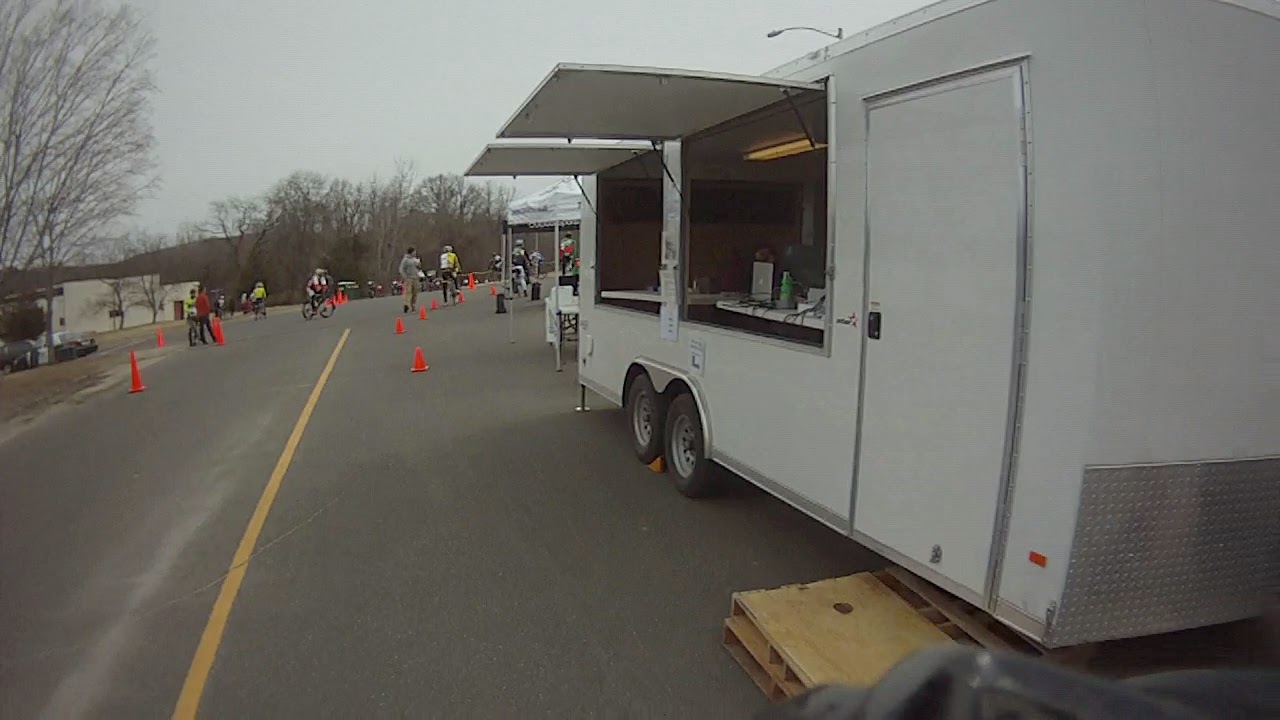
The trailer at one of the Bethels in 2014.

30-32 hours x 5-6 weeks, i.e. each week after that. 2-4 hours after registration. 2 hours emails every day (that's a very kind number), say 10 hours a week. 2 hours to break stuff down in house and pack. Race day is always about 18 hours (5 AM - 11 PM).
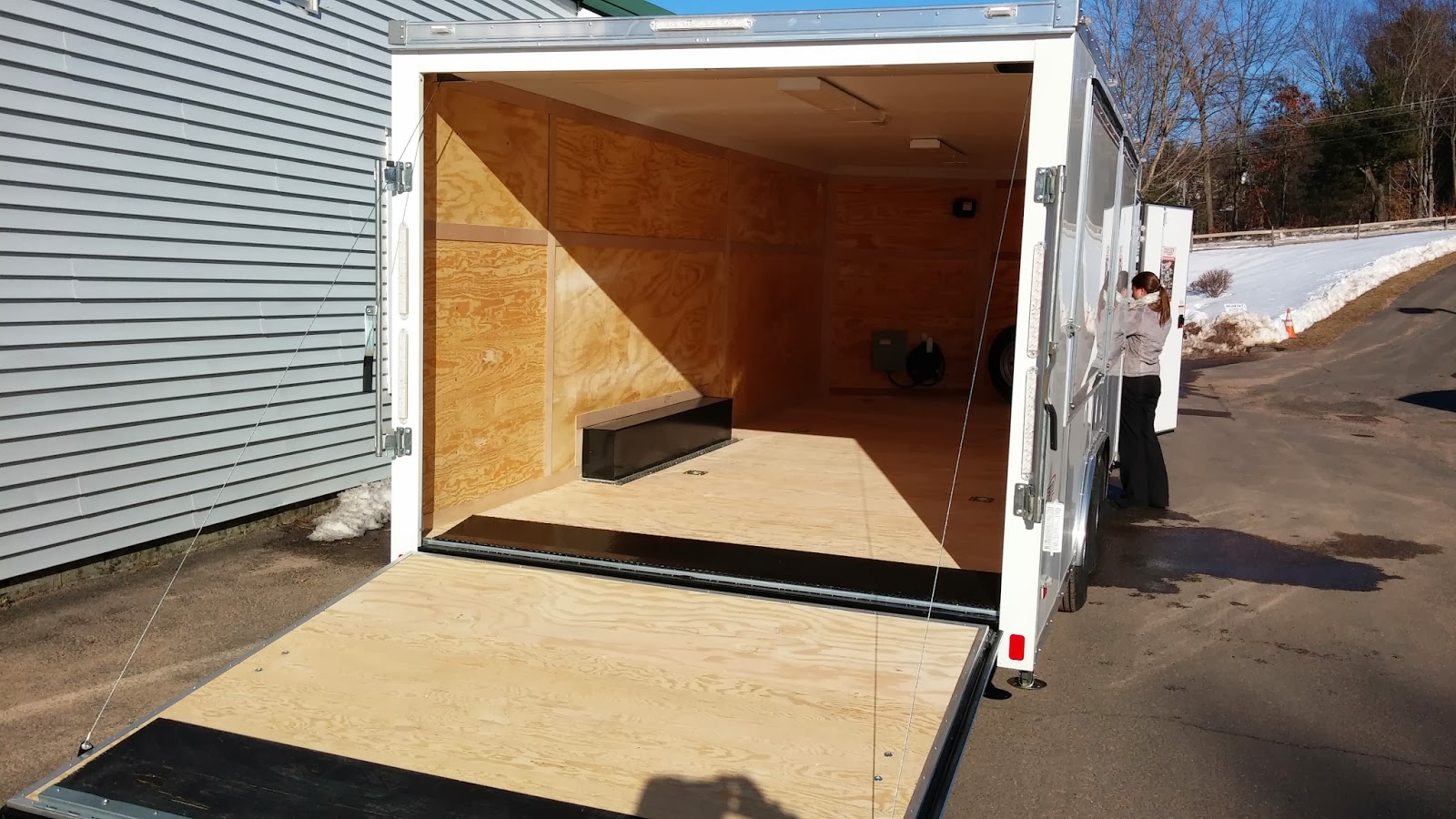
Bare trailer when I picked it up.

Trailer before I finished the inside, end of 2014 Bethel Spring Series.

After finishing the inside, before the shelf/hook/etc.
Brighter, which was my goal.

Trailer during a quiet bit of registration at the club's cross race in 2015.
There are plexiglass shields for the windows for cold/wet weather, built in tables, storage stuff on walls, shelf up front, drawers, heaters, microwave, even a fridge.

Not counting any emergency sweep days although I've spent 8-16-24 hours a week clearing courses some years (3-5 hours per trip, plus drive time, multiple trips some years). Also emergency meetings with angry tenants, meeting with town, etc. Not counting any of that.

Birthing room, 2012. Round table under window has registration laptop for Bethel stuff.
Yes I worked on registration on and off during the whole process.

When my son was born it was the 2nd week of Bethel in 2012. Went to the hospital Thursday evening. Was answering questions about registration and Cat 5 stuff on the way to the hospital. Set up laptop, wireless modem, and cranked through emails and calls while wife was induced. Nothing happened (we went through this the prior week as well, before the first week of racing). Went home Friday evening. Fri night her water broke. Went to hospital. I tried to answer some emails/questions but I was exhausted because we were up from 11 PM until my son was born at 9:33 AM. Wonder and joy and all that. Then back to the laptop. 3 PM wife kicked me out, told me I had to leave to get ready for the races because everyone was depending on me. I was really tired the next day.
Running total: 300 - 360 hours

Conservatively speaking I'll say that I put in 300-350 hours annually for the Bethel Spring Series.

Addendum time

The thing is that my number is pretty conservative. A busy year I'm guessing another 100 hours minimum, if I counted all the various stuff that I don't count because it doesn't happen every year, like making proposals and attending meetings to secure a venue. For example I secured 3 venues in 2015, used only two, made 3? 4? site visits, all for a venue we never used.

When I was searching for new venues, between 2014 and 2015, I probably spent 20-30 hours on that alone, during the summer. 4-5 hours at a time, couple times a month. Some emails, calls, stuff like that, tracking down legal land owners, then asking about holding events there.

I do payroll in there somewhere. Well technically the Missus does that, but I write the checks and pay the people that work for the race. I have to buy misc stuff, heaters for example, or get propane tanks filled for said heaters. Then replacements for heaters that broke or don't work. Adapters to use big propane tanks on little heaters. Fans. Fabricate some stuff like lap card stuff or tables or platforms. I've bought two wheeled leaf blowers. 5 or 6 generators. I've had to go get extension cords, cones of various sizes, bins, binder clips, pends, drawers, chairs, tables, tents (and fix tents), etc etc. I'm not counting the time to buy any of that stuff.

Website stuff is nutty. I did it all by hand early on, before stuff like Wordpress existed. Now I use Wordpress with the help of one of the guys that does the races. I can get lost for 4-5 hours when I start doing site stuff. Getting the sites up and running took a bit of time and effort. Not counting any of that.

The last week of the Series there are more things for me to do but generally within the same time frame. In other words I do more stuff, like doing podium pictures, but since those are between races it's just part of the day. I usually put off unpacking stuff for a month or three, usually until I have to clear out the trailer (or the van before that). Unpacking is usually quick, just a few hours once I drive everything home. I once left my van at the venue for 3 months, returning in late July to drive it home. Admittedly I made a day of it, rode 5 hours there, did the Wed night crit, then drove the van away.

Unpacking the van in September (Labor Day) one year.

I was totally burnt out on race promotion stuff by the time mid-April showed up.

Each year it seems like I spend 3-5 full days working on stuff for the trailer. I'd disappear for an entire Saturday and/or Sunday, 8-10 hours each day, to fix things up.

I also spent considerable time figuring out camera stuff. I'm on our 5th or 6th camera, each one requiring some learning, set up, testing, etc.

Still from a 1080p@30fps camera test. Car was going 35 mph.

I spend time organizing stuff in our storage bay (we rent it to store stuff for the races) or my basement (we have to keep release forms for 10 years now, plus I have all sorts of delicate/weather sensitive promoting stuff down there) or the garage (most of the gas powered stuff like leaf blowers, generators, etc). Nowadays I have to keep track of the trailer which is not parked at home and the tow vehicle which is parked in the storage bay. I pull out the tow vehicle every now because the year I didn't drive it from April until sometime deep in the winter the battery was dead and it just wasn't happy. At first we put just 1000 miles annually on the tow vehicle. The van also - one year I think I put about 450 miles on it. For the entire year! I got rid of it because it started having random problems, probably due the fact that I almost never drove it and it was never indoors (doesn't fit in a garage).

So that's it.

I tell racers to go thank the promoters whenever they race. Thank the marshals, registration people, everyone involved. I don't think I'm unique in the kind of effort I put into a race. Every promoter ends up living the race for a while, way beyond anything they expected when they first got into it. I was lucky in that I could ease my way into it. In the "old days" promoting was a bit less formal, a bit less structured. Now it's pretty tough to start up a race, and for someone actually closing blocks of roads in a city or doing a rolling closure for a road race... yeah, I can't imagine doing that.

Tuesday, August 02, 2016

Promoting - Revisiting The Trailer

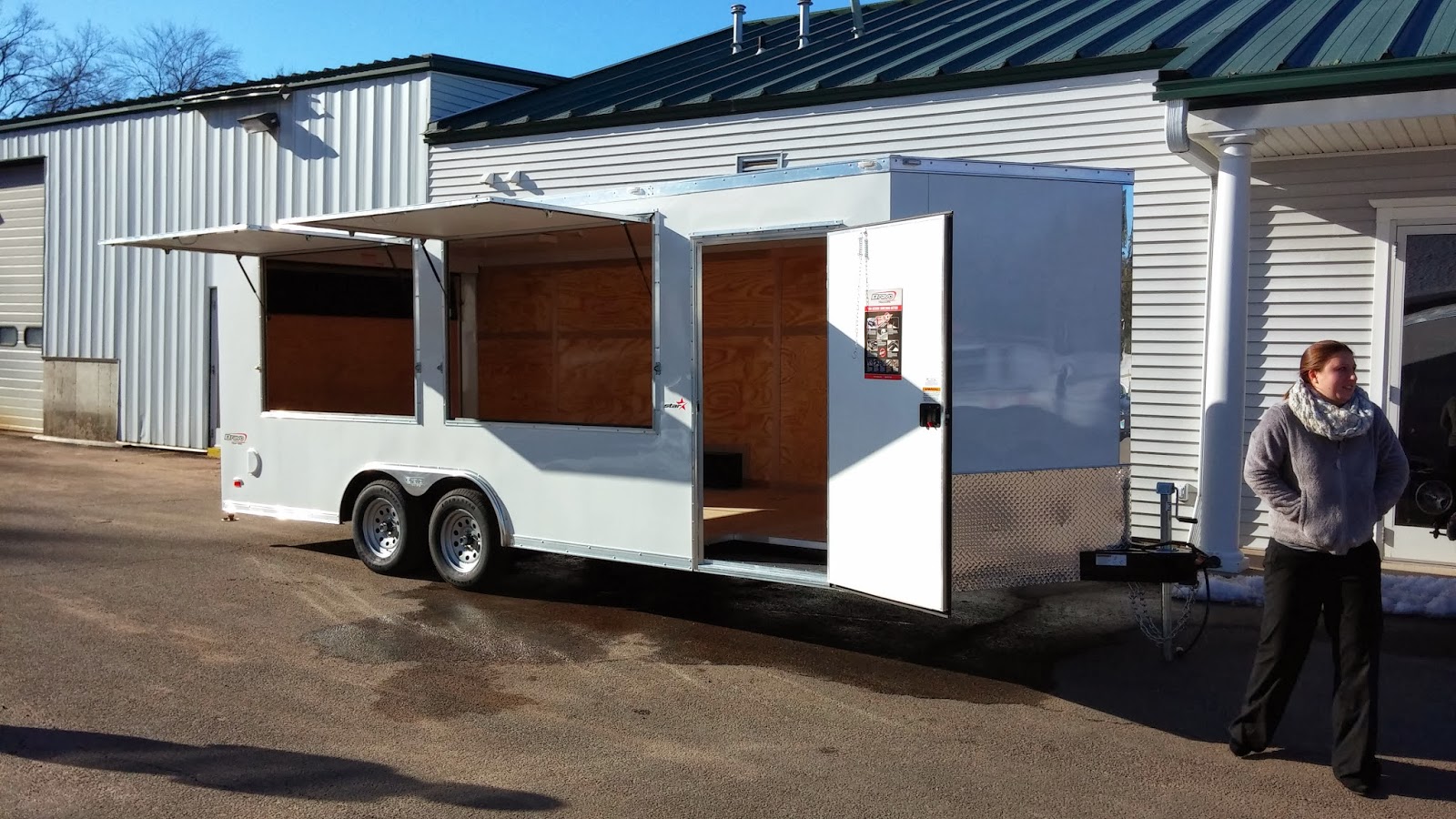
Trailer. It looks big until it's next to an 18 wheeler.
I think I could drive my whole rig onto an 18 wheeler trailer.

This isn't a revisiting like "Should I have bought the trailer?" kind of revisiting. It was actually me visiting the trailer. I don't see or step into it that often and this year I think I was there three, maybe four times. All but one time was having to deal with a tire that went flat (ends up a bad valve, but once a tire is flat it's hard to troubleshoot a tiny leak off the side of a bad valve).

The last time I went there was to pick up one of the home fans that I'd moved over to the trailer for air circulation. We actually used the fans for cold weather, if I recall correctly, because the heaters we used didn't really distribute the heat well. And of course we used them for warm weather, for a little bit of air movement in the shade and shelter of the interior of the trailer.

I don't visit the trailer much because, honestly, I've felt sort of burnt out on the promoting gig. It's at best a break even thing, usually a money loser, so it's not really satisfying in that respect. Of course on the other hand promoting races is sort of my identity in the local cycling world, and in that respect promoting has given me back a lot of intangibles.

I bought the trailer a couple years back with the idea that I'd be promoting Bethel races for forever. Of course that's the year when the trampoline place opened, literally hundreds of cars drove around the course during race day, and the venue became essentially unusable for bike races.

Then over the winter of 2015-2016 the bit with my dad came up so I couldn't commit to promoting races at all, even working them. Nowadays I have a very small window of time available if the Missus covers for me, but otherwise it's basically impossible for me to be away from the house for more than an hour or three at a time, including driving time. That makes promoting a day of racing pretty much impossible. Therefore 2016 became the first year in over 20 years that I didn't promote a race.

It meant that I no longer needed to visit the trailer, the pitiful sight of the flat tire notwithstanding. Since I park it at a local business (one added benefit: security cameras) the flat tire looked kind of bad so I felt some internal pressure to fix it.

I was there at the trailer with Junior so he was pretty excited about the visit. For him visiting the trailer is a special event. He gets to run around inside this room-on-wheels he doesn't get to explore often, he gets to jump out of the door, and there's all sorts of neat things he discovers on each visit.

For this visit it was safety pins. Picking up stray safety pins kept him plenty busy while I unstrapped the stuff inside the trailer in order to extract the fan.

The whole process of unlatching the tie down straps, of moving around the inside of the trailer, it brought me back that promoting feeling, like I was getting ready to work a race. At that point I realized something.

I missed it.

I felt like I belonged in that trailer. It's where I was meant to be, if that makes any sense.

Others have joked about the trailer.

"If you get a bathroom installed you could live there."
"You know, if something happened at home you could live in here."

Stuff like that.
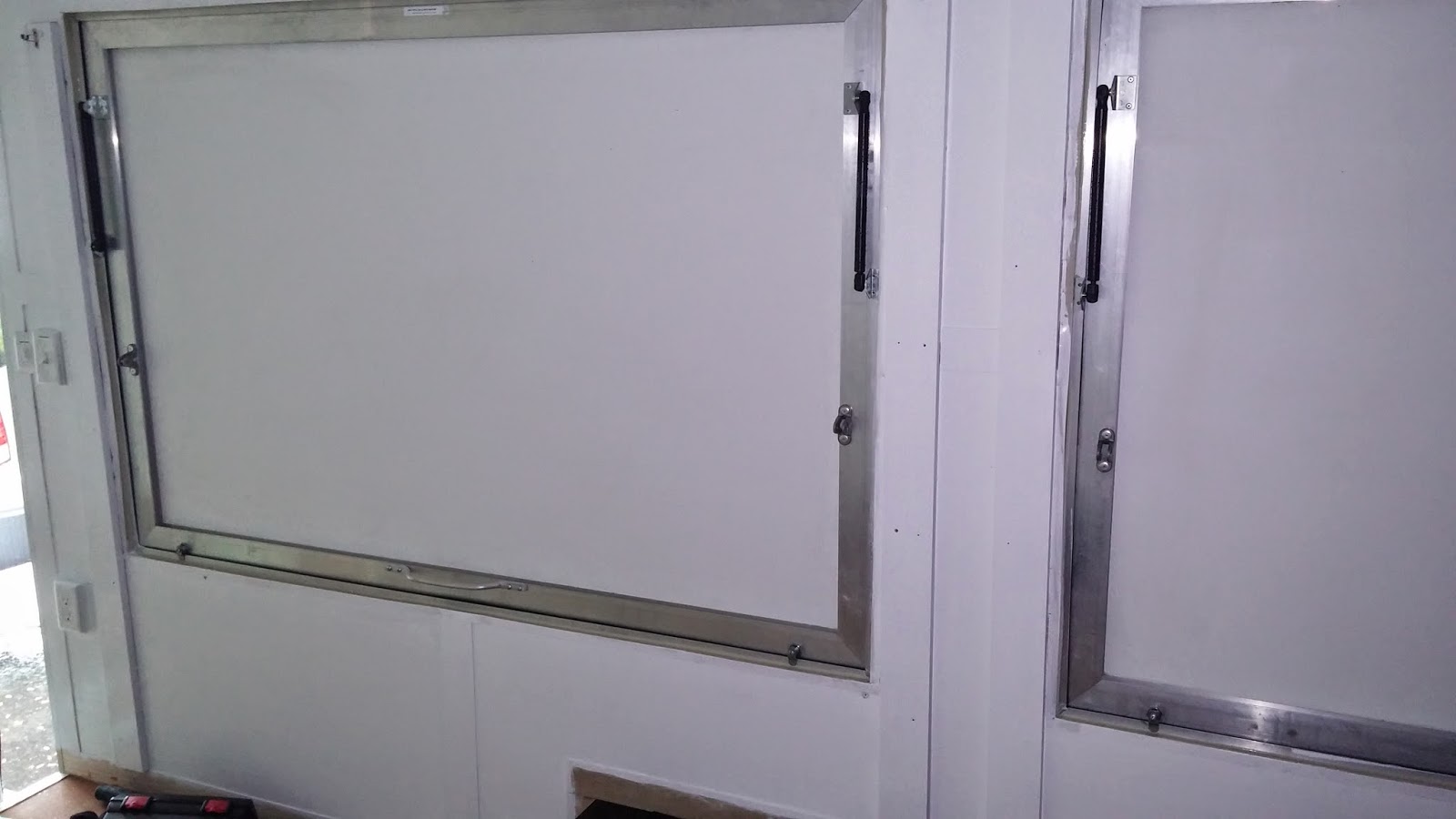
The reality is that the trailer is actually a nice spot to hang out, at least once I did some work to the inside. It's relatively warm in the winter, it's usually pretty cool in the summer, it's about as big as one of those tiny houses or maybe a small RV (it is about 20'x8' inside so about 160 SF).


Inside of the trailer when I finished the floor and walls.

It's a good set up, in terms of infrastructure for a race. It has a generator set up, regular plugs, lots of built in interior lights, the two big windows for registration (and clear windows with teller-like-openings for cold weather), a space to store stuff, tables, chairs, a spot for finish line tape, One Day and Annual Forms, two sets of drawers for numbers and such, so on and so forth.

Trailer at the 2015 Silk City Cross Race.
It's a bit messier here.

I do wish I'd had a vent installed in the roof, or even an AC unit mount, something to put a closeable hole in the roof. This would have given me an opening to either run out a video cable (vent) or do a direct mount in a turret-like structure for the finish line camera (AC mount). With a semi-permanently mounted camera I'd realistically put one of the two monitors on the wall - we could do photo finish reviews inside the trailer without any problems, even in inclement weather. At this point our finish line camera system is a camera on a tripod, which works but isn't wind proof nor water proof.

At any rate I looked around the trailer while I wrestled with the straps and such. It was cool inside, even though it was pretty hot outside. I took the opportunity to clean up a bit, to put the newly fixed tire/wheel unit onto the spare tire mount. I looked through some bins to see if there was anything I should keep at home, electronics and such. I think I grabbed one of the 2014 purple t-shirts.

(A tip: don't get more t-shirts than you think you need, and in fact divide what you think you'll need by half and get that many t-shirts max.)

The trailer reminded me it isn't all fun and games. The big metal plate that bridges the gap between the trailer floor and the ramp fell only my leg, scraping the skin off a solid part of my calf. If it was road rash I'd have needed one of those 4"x4" pieces of Tegaderm to cover it.

Metal plate - that black strip - doesn't look heavy but it really is.
About 8' wide, about 15-18" long, and definitely thick enough to support a car.

I grunted in pain and made some kind of face. Junior tuned into that and asked me if I was hurt. I told him I was okay but that I hurt myself on the "black metal piece".

I loaded the fan into the car while Junior played in the trailer, carefully staying toward the front of the trailer, away from that "black metal piece".

I walked around the trailer as I usually do when I leave it. Tires were all good, the spare looked fine. The rest of it looked okay, no wasps flying around.

Junior did a couple final flying leaps out of the trailer before I closed the door and locked up. He wanted to play in the sand in the parking lot so I watched while he moved sand from here to there and back again.

Junior playing in the parking lot.

It was getting time to go. We were about 8 or so minutes from the house but we'd burned a lot of time at the trailer. I wanted to get back to relieve the Missus of her watch-over-Pops duties.

As we pulled out of the lot Junior piped up.

"Can you play Uncle Gene's song? The one with the drums?"

I thumbed the control on the steering wheel.

I found URT's "I Erase"
"That one?"
"No, the one with the drums."

URT "Not Just One"
"This one?"
"No..."

I clicked again.

URT "Sea Monster"
"This?"
"No."

URT "Deepest Knife"
"This.."
"Yes! This is the one!"

URT "Deepest Knife"

We drove home in the warm sun. I thought about the trailer and realized there was something I had forgotten to do. I got home and pulled up an email. It was from the guys that promote the Silk City Cross race, my teammates. They'd asked me if I could help with registration this year. They knew about my situation at home, they'd been super supportive about the Spring Series (which I eventually had to cancel), but it never hurts to ask, right?

I clicked on Reply All.

I told them I'd be able to help out.


I'll be there.

Monday, March 09, 2015

How To - Be A Good Racer


Although it's been a bit nutty and I haven't really been able to post much, the reason for the frantic stuff happening before the Aetna Nutmeg Spring Series has to do securing a venue, making sure it's usable, and trying to make things happen so that we can all race. I may share some of the trials and tribulations in a later post but for now I want to focus on one thing:

How to be a good racer.

I'm not talking about FTP and wattage and intervals and tactics and drafting.

I'm talking about your behavior as a racer.

As a racer, what can you do to help the race promoter? Not marshaling and stuff, but just in being a good racer.

This is a key aspect in grassroots racing. The biggest challenge for a promoter is to secure a venue. This means getting permission to use a course (aka "permission to break traffic laws like 'not racing on public roads'") and the related costs to that permission (permits, police, department of public works stuff, etc).

After that it's pretty straightforward to hold a race, if one can say that.

There are a few reasons races die off. One is the venue gets too busy such that the it's impossible to hold a race safely. This happened to the Bethel Spring Series with one business opening up that put literally hundreds of cars driving through the venue over the course of a day.

Another is the promoter decides to pull the plug, either for money reasons (typically associated with the costs of holding a race, aka the costs related to getting permission to hold the race). I know there were a few "classic" races I used to attend where the promoter was sinking $8k a year or more (in the 1980s!). After a few ten thousand dollars of money tossed into the black hole the promoters in question gave up.

There are related things, of course. Poorly attended or poorly managed events may disappear quickly. Off-time events may not survive - crits in January in Connecticut, for example, or roller races in July.

Typically a grassroots race promoter promotes a race for reasons other than money. It's a sense of duty, a sense of "I have to do it because no one else is doing it", or something similar to that.

Therefore the worst reason to lose a race is because the racers misbehaved. To me that's just incomprehensible, for racers to behave so poorly that the event gets banned.

This has happened in the area, with a road race in Massachusetts. The race got canceled not because of venue permissions, venue traffic, costs, promoter burn out, scheduling, any of that regular "promoter headache" stuff.

The race got canceled because so many racers were peeing on people's lawns, bushes, buildings, whatever.

That's it.

None of us want a race go go away, and for one to go away because of racer behavior is just a kick in the face to the promoter and the host venue/town/area.

I'm going to make a quick list of things a racer can do to help keep a race alive, barring the other non-racer factors.

Good racers do the following things:

1. Smile and say hi to everyone, locals and racers alike. Happy racers are friendly racers are good racers are a benefit of the race.

2. DON'T pee in public. Just don't. In my races someone that pees in public forfeits their entry, prize, points, everything. Use the portapotties. Promoters pay for them, you might as well use them. If there aren't enough then mention it to the promoter. Trust me, the promoter would much rather spring for another portapottie than risk losing the race.

3. Change discretely. Imagine an (stranger) 8 year old boy or girl standing in the vicinity when
you're changing. Is what you're doing appropriate to do in front of them? If not then make it so. Cover up, close a door, whatever it takes.

4. Buy your food/fuel in town and post it on Facebook or Twitter wherever. The host town is hoping that by allowing the race to happen that they get some people to spend money in town, Facebook stuff, all that. A tired but happy racer chowing down is a great image too, for your sponsors and friends.

5. DON'T swear, at least too loudly. It's against the rules and for a reason - dropping F-bombs and such doesn't go over well with parents trying to do right by their kids.

I figure five things is a nice, sweet list. Short and simple.
If we all work together we can grow the sport. Yeah, promoters have to do whatever to hold races, and I understand that many/most of us racers have no interest in promoting a race. That's fine - it's like asking a sprinter to climb or a climber to sprint, I think promoting is something people do or don't do.

However, all of us racers enjoy racing, and we can all help whoever promoter at their race. Let races stand or fall on its merits. It's our duty as racers to honor the promoters' efforts to bring us races.


Tuesday, January 20, 2015

Promoting Races - Trailer Stuff Again

Although it's been cold and icy out we used the trailer to move some stuff into the Missus's office. I got to the office just ahead of everyone else so I had time to walk around inside the trailer and take a few pictures. I felt pretty good about all the stuff I'd done to make the trailer a better "race event" trailer.

Trailer backed up to the front doors of the office.

One big thing is that I'm much more at ease driving the trailer around. I'd like some lights down low so I can see how much clearance I have when, say, taking a slow turn with a snow bank on the inside, but otherwise I'm much more relaxed when pulling the trailer. I used to be a nervous wreck but now it's actually very soothing and comforting.

I do want to buy a stabilizer / weight distribution thing for the hitch. What it does is basically put a lever on the tow vehicle so the trailer doesn't pull down on just the ball, it pushes down on a long "bar" if you will so the tow vehicle gets loaded more equally front and rear. This would keep the rear of the tow vehicle from getting pulled down (and the front from being pulled up).

It also helps prevent the trailer from swaying in windy situations, typically when a semi passes me on the highway.

On this day, with a lot of running water freezing on the much colder ground, I also thought that getting snow tires for the trailer might be good. It'll be less prone to sliding on snow and in the summer it wouldn't make much of a difference. I run snows on the tow vehicle year round since I only put 1000-2000 miles on it a year and I wanted tires for the worst conditions, aka snow/ice.

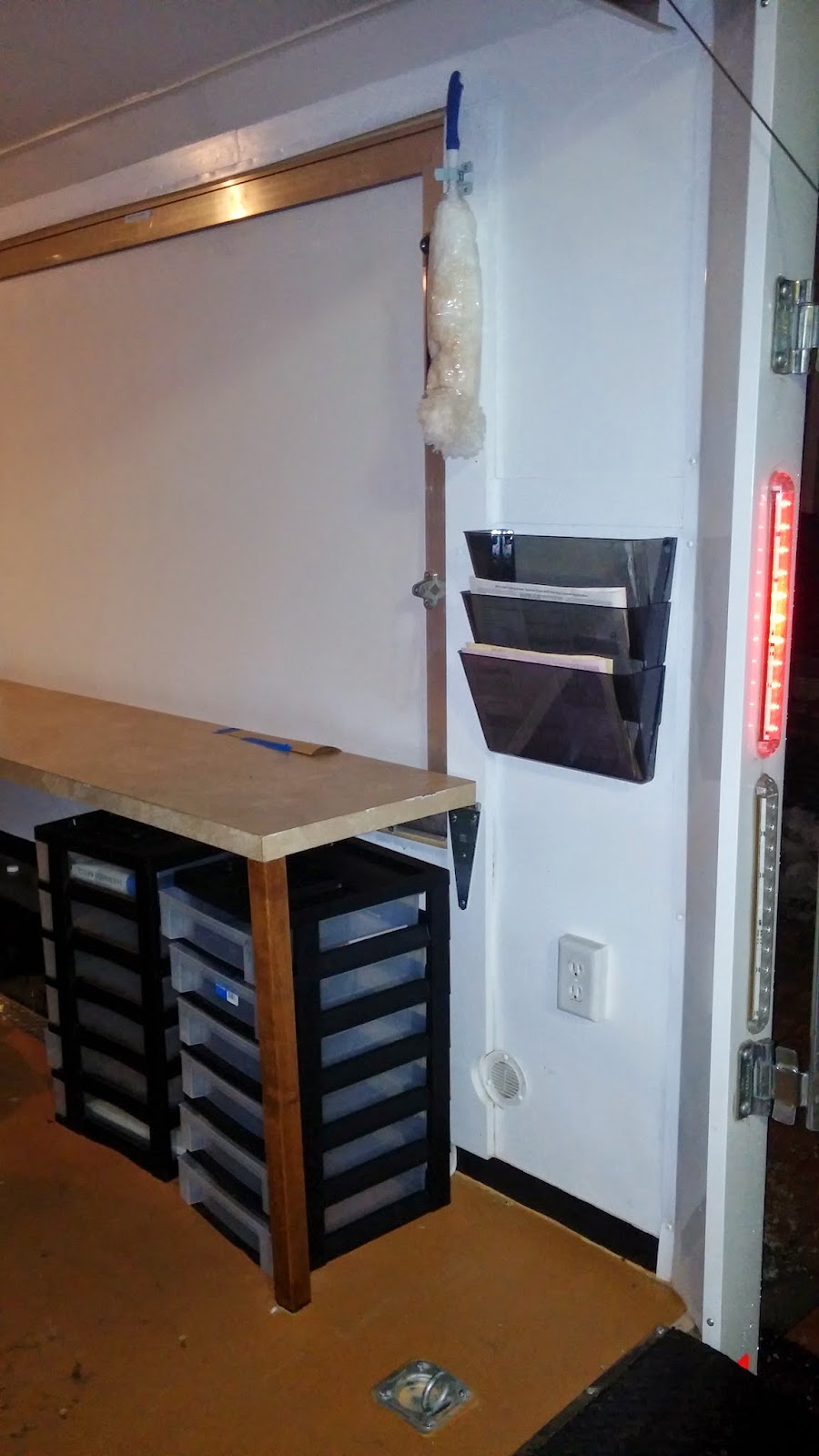
One Day Licenses and Annual Renewals go in those bins.

I always lose track of the One Day and Annuals so I got an inexpensive bin set up to hold them. I keep blank forms in two pockets and put the filled in forms in the third. Makes it super easy to keep track of them, and since they're wall mounted it's hard to drop the folder or whatever.

The drawers are for the different categories, for numbers and releases. Put in a filled in release, pull out a number. It's easier to find a release if you need to get it. It's also neater than tossing all the releases into one box or bin.

Tables fold up but I leave them down. Legs unscrew when the tables are up.

Power outlet - the trailer is wired for 110v.

The circle is a little vent. There's one down low in the back, one up high in front. It's for air circulation.

The fuzzy thing hanging is a duster.


Carpe Diem Racing has a new site, revamped if you will. This will become the new central site for the events that CDR promotes or works.

Tape.

I have white duct tape for finish lines. The black duct tape is to border the while, but often it's not necessary. It's nice for a deluxe finish line though.

The blue painter's tape is for posting results. It makes it much easier to pull down all the tape at the end of the day. We also post any notes/signs/etc using the blue tape.

Yellow caution ribbon is for marking areas off-limits and such. I have a bundle of 50 cyclocross type stakes for staking out such areas.

Notes for registration folks from the last event we did, the 2014 Silk City Cross.

People inevitably ask about start times and such. We post that stuff between the two side windows so we have a copy and we don't waste 200 pages of paper printing out flyers that get tossed after a few views.

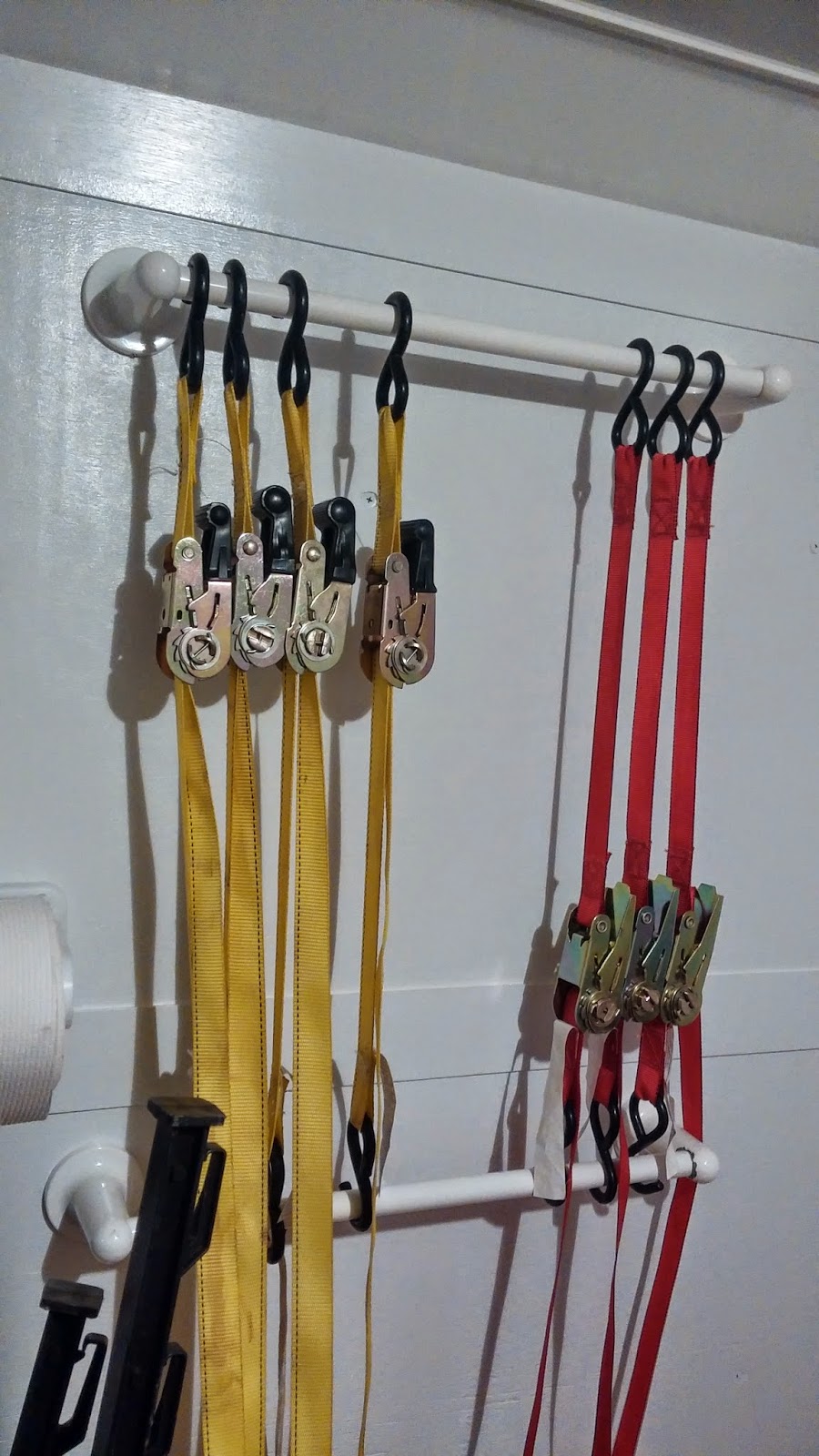
Tie down straps.

There's a bunch of stuff tied down in the trailer. I have more straps ready to go.

Note the lights? There are 12v dome lights, which I had on. There's also four 4' long 110v fluorescent lights which are not on - they're hooked to the 110v circuit.

Poster from the old days.

I wanted to put up a poster or two. This one is real, it was really signed by local star Mark McCormack and his teammate Bart Bowen. Ironically Mark's brother Frank didn't sign it but I've actually raced against him on a day I had the trailer at the race in 2014. I'll have to get him to sign the post if I can get him and the trailer in the same location.

Tables, sewer grate covers, cones, toilet paper.

Promoters can never have enough toilet paper. The day that you think you don't need more is the day that the portapotties weren't restocked and it's 77 degrees and sunny and 200 extra racers show up unexpectedly.

And there's no toilet paper.

I have 3 or 4 or 5 such packages strewn around the trailer and the tow vehicle.

You can see the top of one of the stacks of large cones. There are 10 or 12 in one stack, 13 or 15 in another.

Other things include a camera tripod, ladder, tall step stool, chairs, some other stuff.

Two tents.

Both have a couple broken pieces so I need to fix them up.

We moved a super heavy desk (visible) and two file cabinets on this trip. We stayed well below the trailer's 3500 lbs load limit, and I put the desk stuff over the rear axles. The trailer handled well.

Small cones, gas can, and a fire extinguisher.

After a minor engine fire back in the day I've been a fire extinguisher nut. The trailer has a dedicated fire extinguisher mounted to the wall. Go in the side door, look down and right, and it's there.

Small cones for minor things. I have about 6 or 8 left of the 20 or so original. I have about 6 or 8 left of the 20 or so old large cones. I have 25 new large cones.

I have to get a couple more things for the whole set up. Every year there's a refinement or two that I can do and this year is just like the others.

I'm starting to ramp up stuff for the new Aetna Nutmeg Spring Series. Stay tuned and hope to see you out there!

Thursday, June 12, 2014

Promoting - Trailer Work

Ah, the trailer.

What started out as a glimmer of an idea a year ago had turned into something much, much more.

Trailer when I picked it up.

Trailer at the dealer.
6' tall inside. Tall enough for me, not for some of the taller folks around.

Trailer at the dealer.
Note the pristine leading aluminum trim piece.

I think the first week with the trailer? It was raining.

If you look carefully you'll see the window hatch things are pointed above horizontal. They streamed water into the trailer. If we had used the window support struts they'd have been pulled down a bit and water would have flowed away from the trailer. Next time.

The last week at Bethel.
Note the not-so-pristine leading aluminum trim piece.

The trailer worked well at Bethel, based on its "unmodified" status. With full size tables inside we didn't have that much room. No organization so it took a while to pack up. No finish on any surfaces so spilling stuff caused a ruckus as we scrambled to clean things up. It certain beat a tent, though, and on the rainy day it was great.

The trailer and tow vehicle in their glory.

After the 2014 Bethel Spring Series ended I embarked on a project to fix up the trailer to make it much more efficient. I wanted to make it a bit more pleasant looking as well, more professional. Finally I hoped to make it a bit more durable, by finishing the wood, and by doing some preventative stuff to the steel frame.

I took some "before" pictures, after clearing out the trailer. I made the mistake of washing the deck and hosing it out. I think I should have sanded and then just stained. Washing it out, just before a few days of heavy rain, meant the floor absorbed a lot of water, probably warping it a bit.

However it's done so I went ahead and took pictures before staining it. I used Wolmann's deck stain, solid "Cedar". Solid means it covers the most, masking imperfections the best. Since the floor was made with low quality 3/4" plywood it was basically the worst looking wood you could get. Not a problem for a contractor or car hauling trailer but I wanted the trailer to look a bit more like an office and a bit less like, well, like a beat up contract or car hauling trailer.

Unfortunately we spilled some stuff inside the trailer so there were some stains (coffee, hot chocolate), hence my "washing" effort. Overall though that isn't a bit deal, I'm more worried about the floor rotting than anything else.

I have to seal the bottom of the floor as well, meaning from outside I have to spray up to the exposed wood underneath, so that's on the agenda somewhere. The wood is currently painted but I have no idea how durable the paint is; I want to use automotive undercoating that's flexible and chip-resistant.

View to the rear, after the Bethel Spring Series.
D-rings in the floor are rated for 5000 lbs each, apparently anchored to the 6" steel frame tubes.

The wheel wells intrude because the trailer is the legal maximum width of 8.5 feet. This means the wheels need to be recessed. On a 7 foot wide trailer the wheels sit out at 8.5 feet and the trailer's interior walls are straight. I opted for more room, especially considering that the "foot print", meaning the width at the tires, is the same. Cost increase was negligible, and towing won't be hugely affected either, with the 7' and 8.5' trailers only a couple hundred pounds different weight-wise (the 8.5' trailer is also 4' longer, accounting for most of that extra weight; both use the big 6" steel frame tubes).

View to the "back" of the trailer, the left side (for me the "front" is the side with the concession windows)
Note more D-rings. There are eight in the trailer.

I ordered four extra D-rings because I need to tie down tents and such. The best place to put all the mass is just in front of the front axle. Basically everything heavy will sit between or directly in front of the wheel wells. If I stuck with the four original D-rings I'd have anchor points at the corners. Adding four more anchor points just around where most of my gear will sit… that was a no brainer.

The nose of the trailer. I added the fire extinguisher because that's the way I roll.
Forward D-rings.

Up front I plan on loading the bins with lightweight things like numbers, release forms, radios, printer, first aid kit, small microwave, stuff like that. I have maybe 10? bins for up there. I set them up in a row between the front D-rings and pull one tie down strap over them. That's super secure and works well.

I hope at some point to have a little fridge up there. A fan will be necessary in the summer. I'd like to have real heat but I need to figure something out. The big windows on the side will negate any attempt to fully heat the trailer, but to keep it "warmer than freezing" would be a good thing.

I added the fire extinguisher just because.

Deck Stain

The first layer of deck stain.

After the first coat on the floor.

I didn't mask or anything so it's a bit rough. Also no sanding, so the floor is literally a bit rough.

Wood Verticals For Folding Table/Desks

I want to have built in tables for registration. By using narrower tables (18 inches instead of 36 inches), there will be more room in the trailer. Also we don't need tons of room on the tables - we just end up piling our own junk on the big folding tables we used earlier.

Okay, I piled up my stuff on it, not everyone else, but still, we don't need all that table top space.

I planned on wood verticals to hold hinges. The tables will normally be open but they can be folded down if I need to put something big in the trailer, like a car or something. The verticals will support the back half of the desks, I'll have legs for the front half.

Trimmed the wood to clear the baseboard, if you will, and the vent hole.

The verticals have screws running to the steel studs in the walls (the studs seem to be about 1-1.5 inches square steel tubing). Since the tables will have legs the verticals will only need to keep them from tipping over, they won't support all the weight.

Wood verticals between the windows.
The verticals are poplar, the softest of the hardwoods.

The center verticals are shorter due to the wheel well intrusion. The verticals are "screwed and glued" to the wall. The glue will help secure the verticals to the plywood walls, while the screws into the steel actually anchor them. You can see the tube of construction adhesive on the wheel well in the picture above.

Originally I was thinking of a set of shelves between the two windows, to hold the printer and such, but I realized that when it rains all that area will get wet. Therefore no shelves right now for the printer and such.

The forward part of the trailer, the forward wood vertical is leaned up against the wall.

Although I would like to have shelves up front for now I'm leaving that alone. I'm more concerned with the tables and securing some of the load against the back wall.

Primer

The next step would be the primer. I used Zinsser acrylic (water-based) primer. Zinsser because I had some and could get more. Water based because of the easier clean up.

Primer (Zinser).
Note the wood on the wall about a foot above the wheel well - this is for storing the tables and such.

I decided that I'd install lightweight D-rings on the wall. I'll place the folding tables (for release forms and such outside the trailer), the folding tables, and other lightweight stuff. I'll keep them "floor supported", meaning the objects will sit on the floor, and I'll use either bungee cords or tie down straps to hold them against the wall. This means the D-rings will only need to keep the stuff from tipping over, not actually support the weight.

The spare tire is mounted in a similar fashion. The tire sits on the floor and the bracket is there simply to keep the tire from falling over.

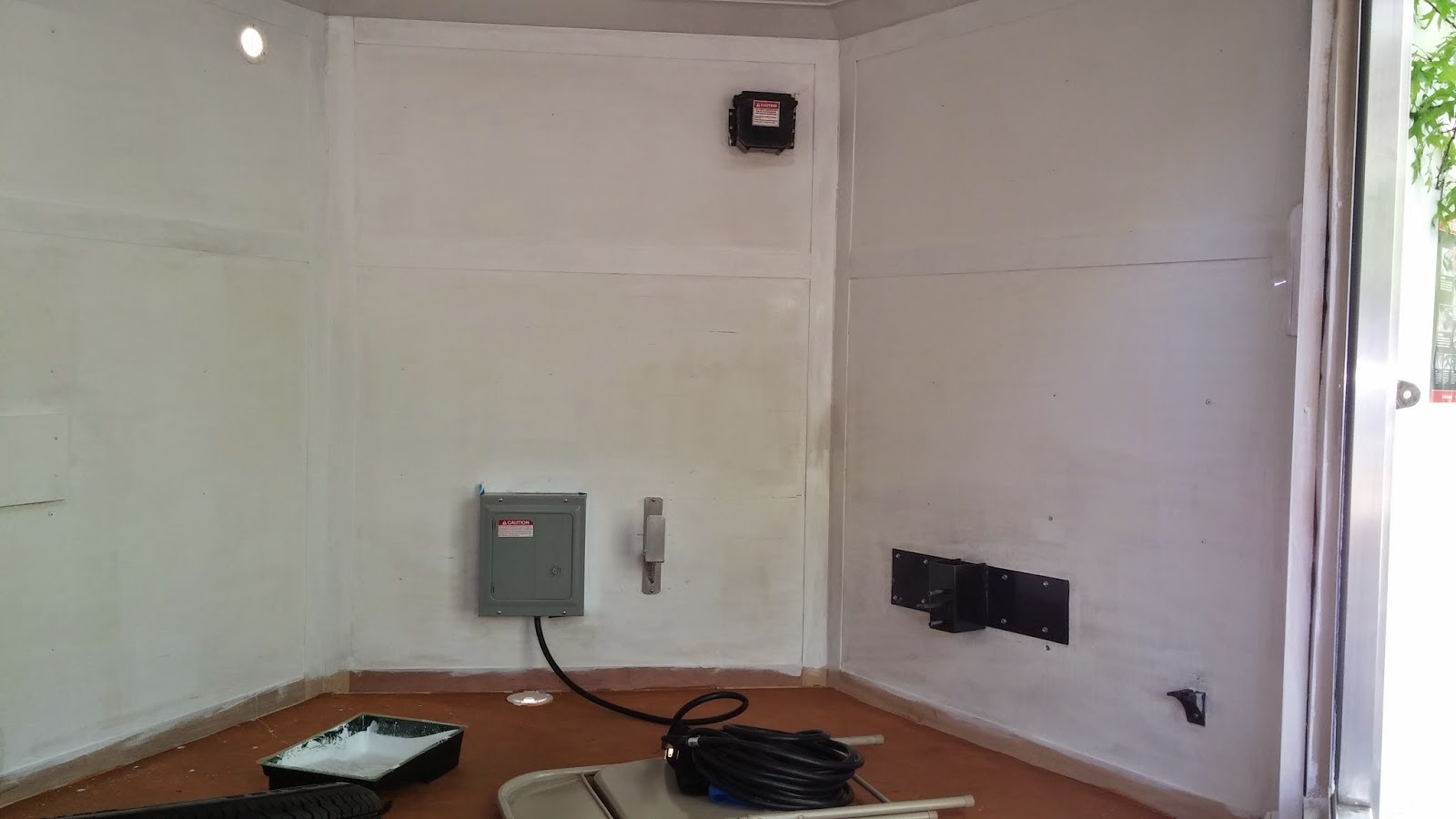
Primer layer, looking at nose and back wall.

You can see the wood planking on the wall for the lightweight D-rings.

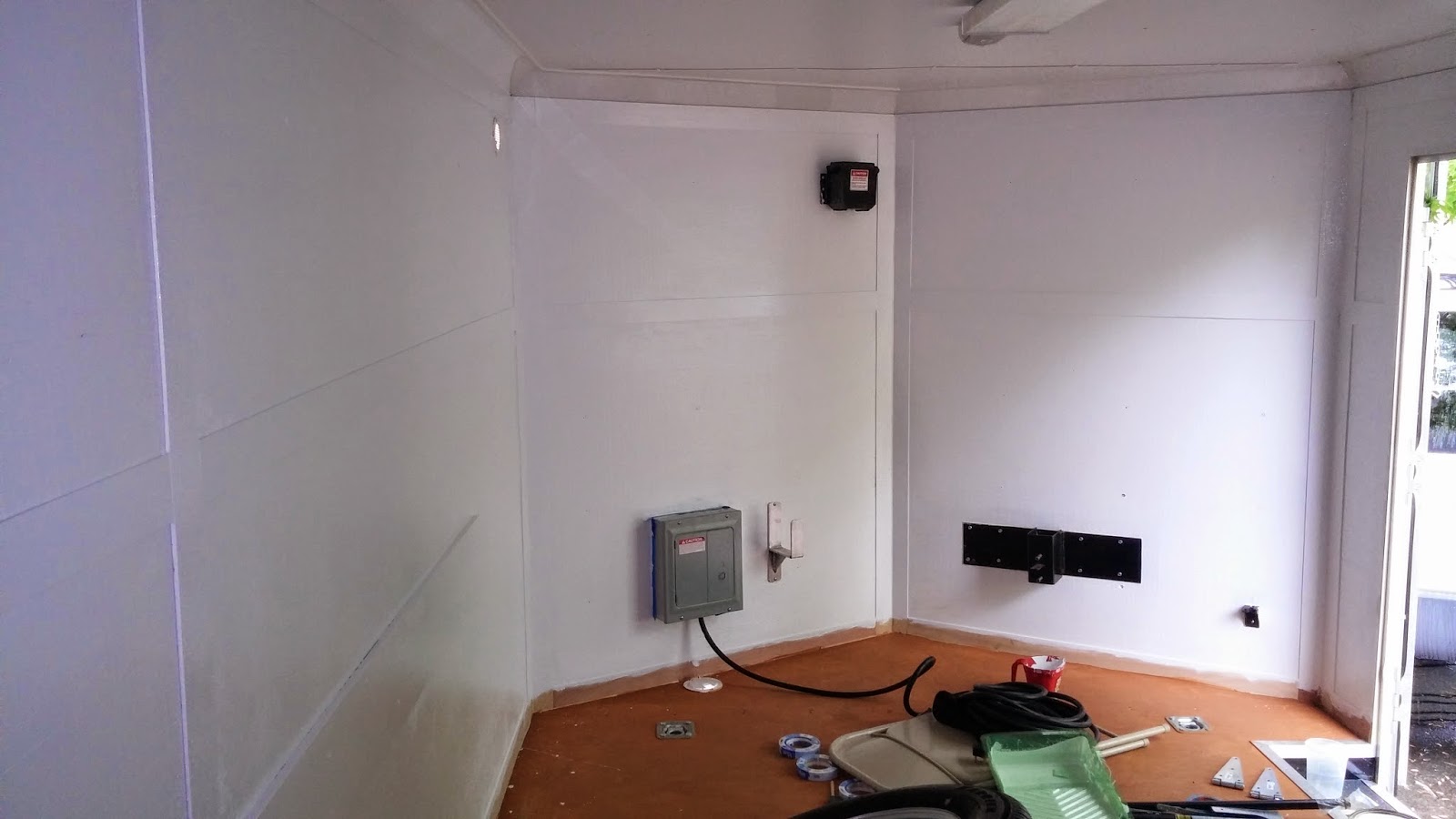
Primer layer, nose.

You can see the breaker box up front. There are three circuits, one for the overhead lights, one for the front plug, one for the rear plug. The big cable drops to the outside and plugs into an RV type plug or, with an adapter, into a generator.

The silver thing next to the breaker box holds the cable for storage.

The big rectangular bracket is for the spare tire. The little bracket is for the fire extinguisher.

The box up top is the battery for the electric brakes. If the trailer detaches from the tow vehicle a cable gets yanked and it deploys the electric brakes. Since the trailer is detached there's no power from the tow vehicle so the trailer has to have a battery.

Second Layer Primer

I decided to do a second layer of primer. I wasn't sure if the wood would bleed through the first layer.

Primer layer, tail of trailer.

Primer, more detail on the wood on back wall.

Close up of my rough primer job and the two verticals between the windows.

Note that I didn't prime the "baseboard" bit of trim. I planned on painting them black and figured black doesn't need primer. I was also contemplating buying proper baseboard vinyl type trim but that's not in the budget for now.

Semi-gloss White Paint

I used WeatherAll from True Value, their outdoor paint. Lifetime warranty or something.

Semi-gloss outdoor paint, one layer.

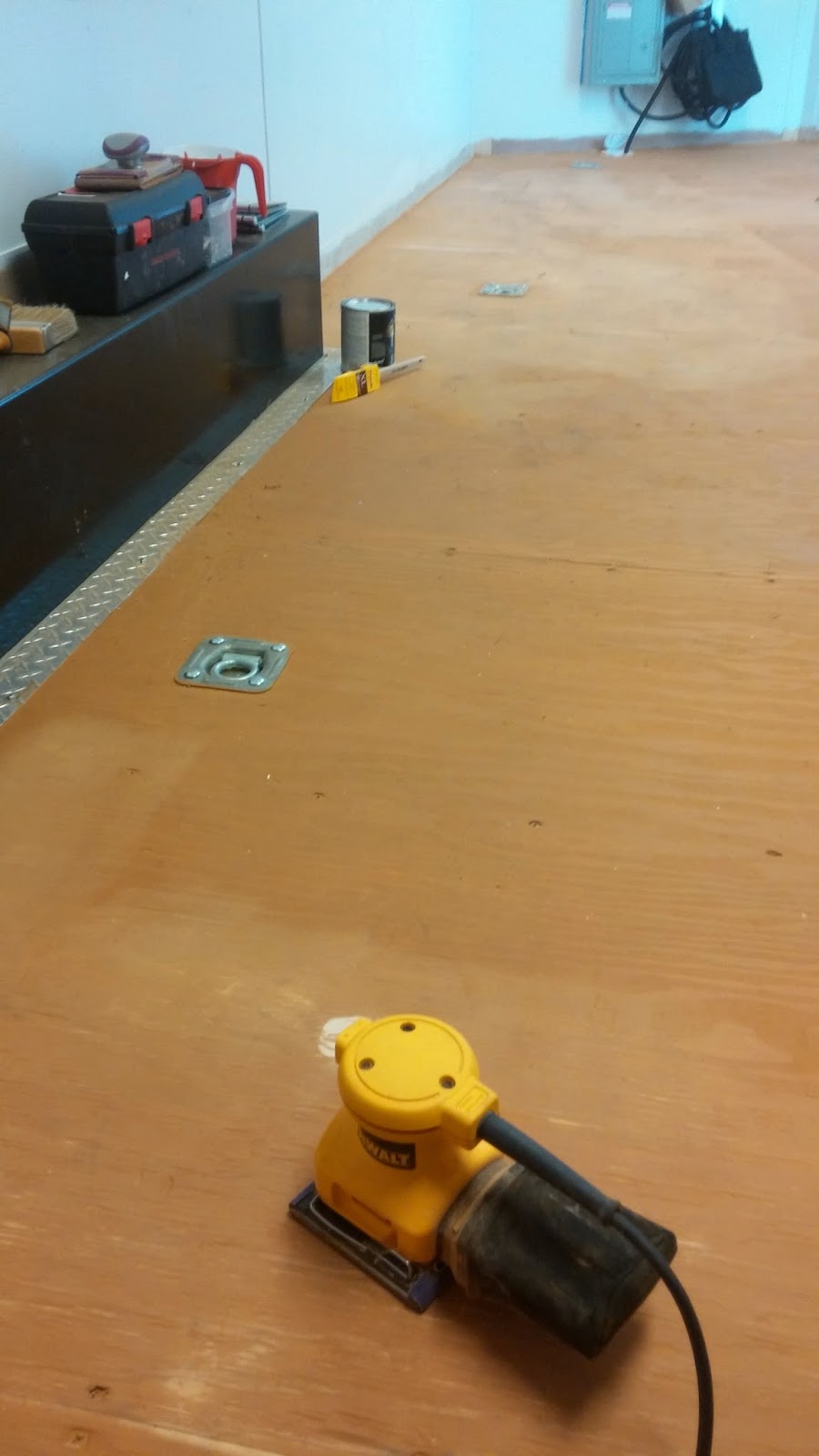
If it looks a bit tan it's because I painted it and then sanded the floor. The dust from the sanding went everywhere and the walls have a film of tan dust on them.

Semi-gloss outdoor point, one layer, windows (which are shut obviously).

Looks much better, more together.

Tail of trailer, white semi-gloss.

The back looks better also.

White semi-gloss, back wall towards the tail.

I really wanted to do the baseboard but ran out of time. I was spending 3-5 hours at a time working on the trailer, in lieu of training or yard work or whatever else I might do while Junior is in daycare. I only had two half days during the week (daycare time). For a couple weekends I spent all Saturday and Sunday working on the trailer, with the Missus kind enough to look after Junior for that time.

Back wall with semi-gloss coat.

Sanding Floor

I decided to sand the floor because it was so rough. When I hosed down the floor it really raised a lot of wood grain and I didn't want to have chunks of floor catch on stuff. I only have the little sander so that's what I used. I went through three packs of good quality sand paper. I used some cheaper stuff and that lasted literally a foot of length of the trailer and even then I was only sanding the smoother bits. The good stuff lasted maybe two to three feet of floor, and I used it on the roughest stuff.

Sanding the floor before the second layer of deck stain.

Deck Stain Plus Baseboard Paint

Once I got the floor sanded I brushed the dust off the baseboard area (it was pretty thick) and painted the baseboard. Good brushes let you paint trim accurately, and the Purdy brush we had at home was great (1.5" angled XL). The brush really helped, I could draw a nice straight edge without any taping. It was nice also because I was tired and I lay on the floor while painting the baseboard.

After the baseboard paint I did another layer of deck stain, backing out to the front door like the first time. Since I'd sanded down a lot of the stain in places the coating wasn't super even but it's what it'll be for now.

Baseboard done in black, second layer deck stain done also.
I didn't do any extra layers on the ramp, it's just one coat.

I did notice that the original layer of stain had penetrated deep into the wood. This is good because that was my intent, protect the wood. Also if I dig the edge of a leaf blower into the floor it won't be raw wood right away, it should be stained wood for a bit.

Not that I, ahem, have dug the edge of a leaf blower into the floor.

Baseboard done, second layer deck stain.

Baseboard and second layer deck stain.
Trailer is full of deck stain colored sanding dust, it needs to be wiped down.

Tables/Legs

The biggest initial project for me was making tables that worked inside the trailer. Due to the jutting wheel wells the folding tables ended up crooked inside the trailer. Also, since we didn't need all three feet of table, it took up a lot of room.

My plan was to make two 18" deep tables, about 6' wide (the width of the trailer windows). They would be mounted on piano hinges and fold down out of the way, with folding legs. As I learned more about what I needed to do, and with the realization that I needed to simplify things, I modified my plans.

Eventually I went with slightly wider tables, about 79" so that the tables extended about 3" to each side of the window. This would allow me to use big hinges on each side - the piano hinges would bind if the wood warped, and with all this stuff exposed to the elements, I figured I'd be looking at warped wood.

John S, a long time friend and supporter, made the tables for me, so my thanks to him. He also advised me on some of the logistics of securing the tables to the sides, weight bearing things, and other topics that I didn't know I needed to know.

For legs I decided to get the type that screw into the base of the table top. The folding legs would involve more hardware, more planning, and for the screw-in legs I just had to buy four legs and four plates. It took a few minutes to secure the plates, a few more to mount the tables.

As far as unfolding the table it takes about 15 seconds to install a leg, it's a one person job, and in less than a minute I can have all four tables set up. I plan on leaving the tables up since the 18" depth doesn't take up much space.

Tables, with finished legs.

For wood people the tables are made with 3/4" plywood with a veneer thing on them (I forget the name of the veneer).

I got the legs and plates at Lowes, finishing them with Minwax stain and a spray can poly.

D-rings, strap bars

I wanted an organized place to store some of the often-used lightweight stuff. This included the folding tables, folding chairs, tripod, tie down straps, broom, some other stuff.

Tie down strap rack.

I spend an inordinate amount of time untangling the straps if they're in a bin. This way they're easy to use, "pre-loaded" if you will, and easy to put away. I used two 18" towel bars, anchored in the 3/8" plywood sides. I don't put a lot of tension on the straps, and in fact many of them are loose but the hooks keeps the strap in place.

Yellow straps are heavier duty, red ones are lighter duty.

Although used for transportation (tying things down in the trailer) they also get used to tie down the tents outside. When setting up it's nice to have organized straps.

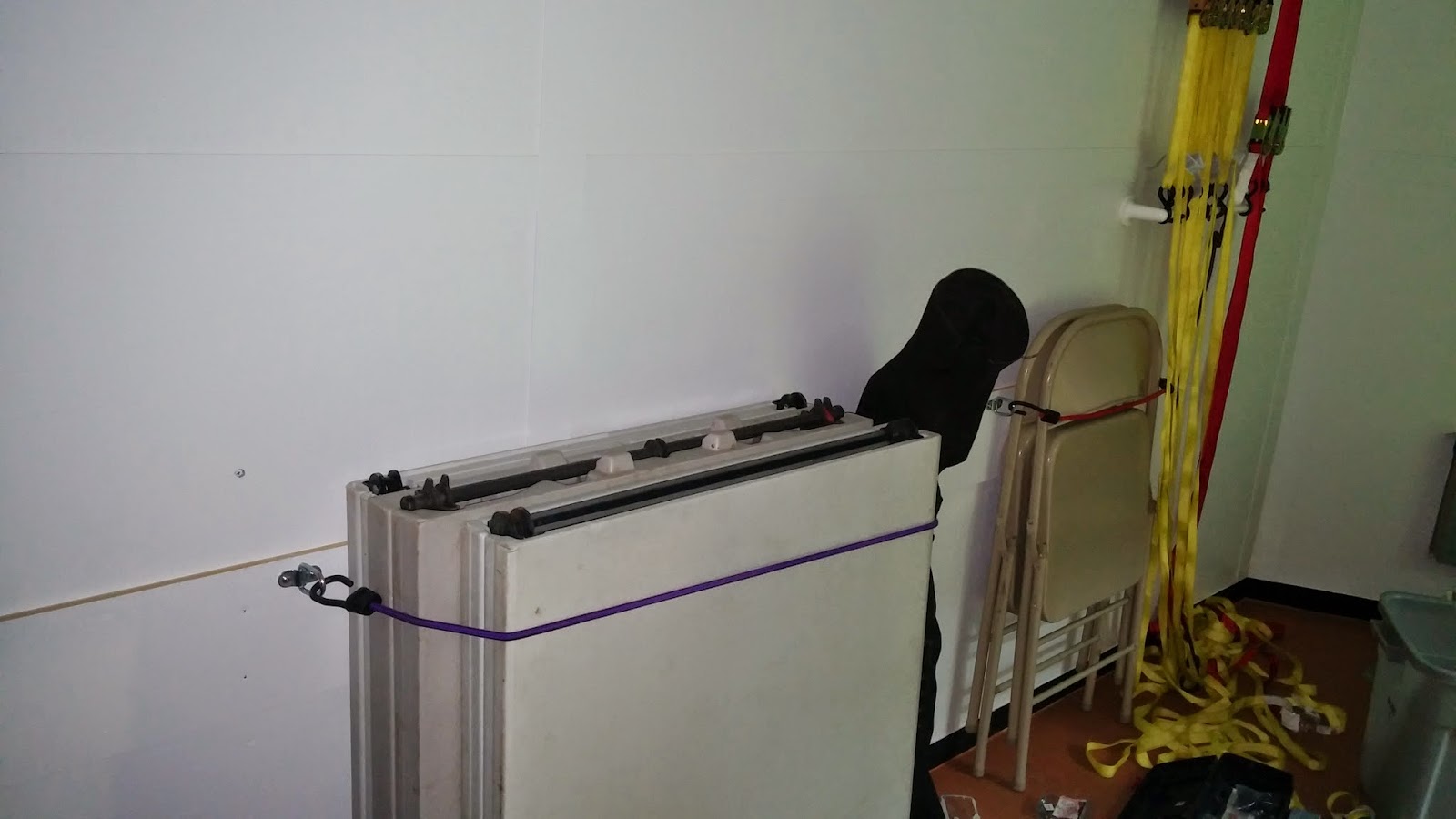
Securing lightweight items like tables, chairs, tripod, and, later, a step stool.

The floor bears the weight so the sides only have to keep them from falling over. I've secured wood on the side of the trailer using construction adhesive as well as screws anchored in the metal studs. The idea was to keep the light stuff vertical and out of the way. Based on my trip to and from White Plains, including some pretty rough pavement, everything works fine.

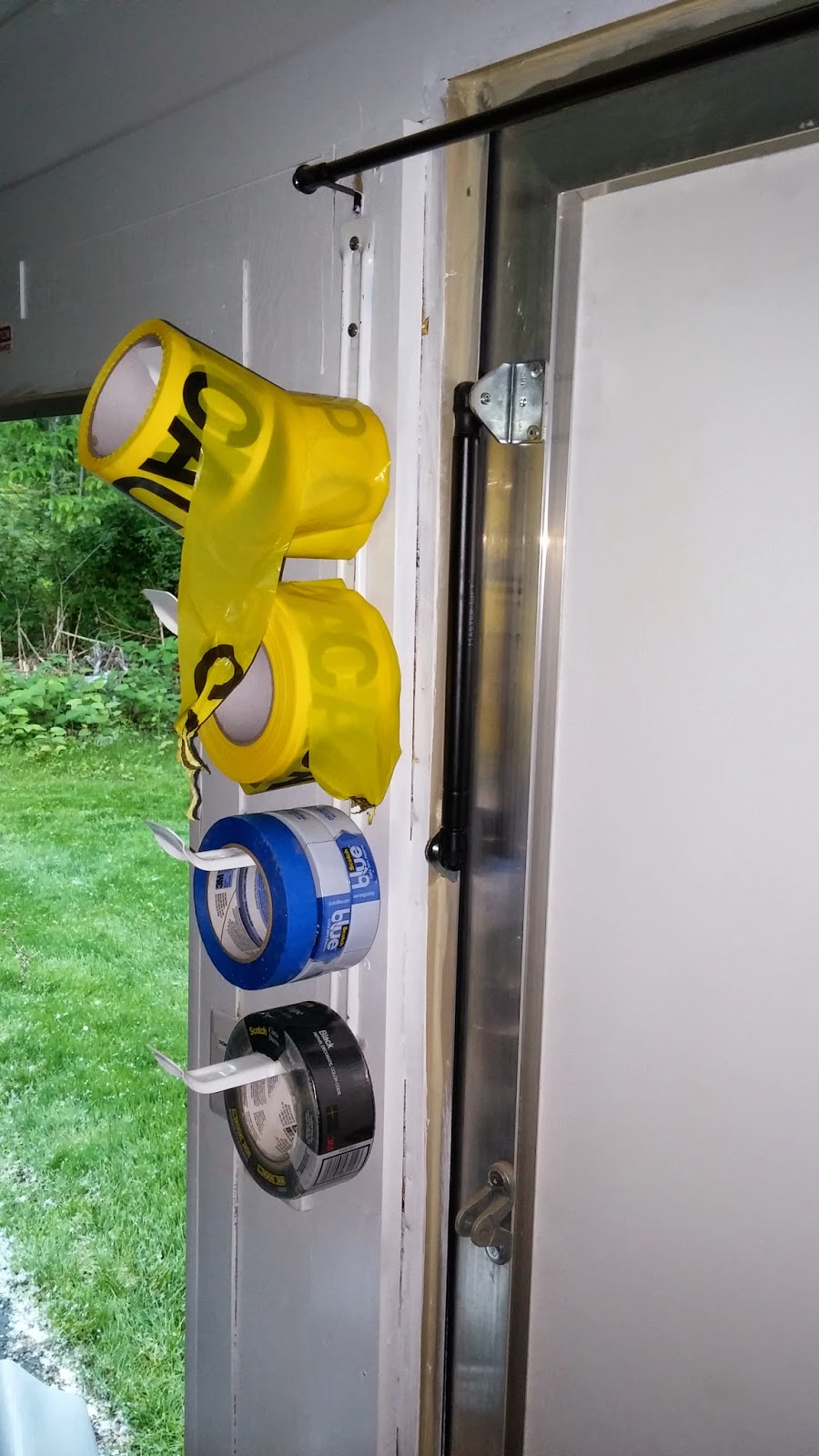
Tape hooks.
I added white duct tape (ideally a finish line is a black line in a white background).
The curtain rod is currently not used, looking for a better idea for a sun-screen type thing.

So that's the trailer, as it is now. I'll do a post on the White Plains Crit, where I used the trailer with its modifications for the first time.

Hopefully I can get some more things done to it and make it an all season trailer.

Supplies bought at:
Valley Home and Garden, Simsbury, CT ("VHG") - everything but what I got at Lowes, so paint, stain, hooks, bars, all hardware for securing things to the walls, fire extinguisher, paint brushes, all tapes (Caution, blue painters, white and black duct tape), paint supplies, drill bits, sandpaper, and who knows what else.

Lowes, Bloomfield, CT ("Lowes") - wood, table legs, table leg plates.