Showing posts with label opensource. Show all posts

Saturday, December 12, 2009

Data Walks - a #climatedata proposal

In response to the UK Met Office's recent data release and Manuel Lima's call for visualisations, there's been a flurry of #climatedata activity in the last couple of days, including some revealing visualisations. Though I'm looking forward to playing with the data myself, this isn't a post about visualisation. It's a simpler proposal for a way to make the data tangible.


Global warming is ultimately a question about change in a single measurement - temperature - over time. One way or another, it can be boiled down to a line graph. How best to make that line tangible? Visualisation is great, but how else could we feel those changes, especially over time? One way would be to walk the data. We could make a kind of giant line graph, in the form of a path or road, then walk from 1850 to 2009. According to the Met Office's graph - remixed above with a picture of my local landscape - this would be a fairly undulating journey, but the last half especially would be a distinct and noticeable climb. Building this path at a walkable scale seems like hard work though. It would be much easier to use the paths we already have. So, here's a recipe for a #climatedata walk:

  1. Make a graph. There are all kinds of options here. The Met Office graph shows global difference from a long-term (1961-1990) average. You could for example use local data only, or use raw average temperatures rather than difference from average. You would also need to select a year range from the data - want to walk the whole century or just post-WW2? All the data choices should be made clear to any walkers.
  2. Fit to landscape. This is the tricky part. The idea would be to find a walkable route with changes in elevation that fit your line graph well. Finding a perfect fit will be very difficult, but finding an OK fit should be possible. This will involve some scaling questions: how long will the walk be, and how much elevation will it cover? Accessibility, ergonomics, experience design, affect - lots of juicy design decisions here. One crude but easy fitting procedure would be to begin with a route, find its elevation profile, then scale the graph to fit the start and end points of the graph to the route start and end, then note the points where the path and the graph intersect. Maybe some GIS / maps people could help with software tools here for route finding and fitting?
  3. Tick marks. Walk the route and mark it out in order to make the whole thing legible. Mark out years or decades, as well as temperature variation (elevation). One option for paths with an imperfect fit, would be to notate the difference between the path and the graph at certain points, as well as points where the path and the graph intersect.
  4. Walk. Again you can imagine many ways to do this, ranging from big organised public walks, to smaller private ones. Of course walking often leads to talking - and in a different way to, say, looking at a graph.
I should emphasise that I haven't even tried this, yet, but I hope to - Canberrans, if you're interested in helping organise a walk here, let me know. Wherever you are, if you do try it, let me know - also feel free to adapt / refine / repurpose the procedure. Could be fun, even informative - at the very least, you'll walk up a hill.

Read More...

Saturday, December 05, 2009

Readings in Digital Design

The Master of Digital Design launched this year with an introductory unit which featured UC alumni Supermanoeuvre, and turned out some great work. Next year it ramps up, with more units and more students - very exciting. I'm currently preparing "Readings in Digital Design", a history and theory unit that presents some key concepts in this nascent, multidisciplinary field (or meta-field). While developing the unit I've also been thinking about how to make the whole course "open" in the broadest sense - accessible, transparent, connective, collaborative. There's a tangle of technical and institutional issues here which I have no single solution to, so in the meantime I'll take a "small pieces loosely joined" approach - this post is the first of those small pieces - the draft reading list at the core of the new unit.

The list attempts to sample the breadth of digital design practices and approaches - so it spans cyberculture, architecture, product design, interaction design, and media art. It also mixes historical sources, academic articles, blog posts and web video, for the same reason, to give a sense of the range of contexts and discourses at work here. With the exception of a couple of firewalled papers (thanks Wiley and ACM), all the sources are freely available online.

Feedback very welcome, as well as additions or gap-plugging - especially on open source in digital design, and tangible / physical computing. Please reuse / remix also, and let me know if you do - call it Creative Commons by-nc-sa.

Readings in Digital Design - Master of Digital Design 2010

Being Digital


Pre/Histories of Digital Design


Networks

Open Source

Designing with Data


Fab!


Ubiquitous Computing and Urban Informatics

Parametricism and its Discontents

Tangible and Physical Computing

Biomimicry, Complexity and Self-Organisation

Redesigning Design

Sustainable Digital?

Read More...

Sunday, August 23, 2009

Tiny Sketching

As a kind of test pattern to fill the current break in transmission, here are my contributions to Tiny Sketch, an OpenProcessing / Rhizome competition (open until mid September) for Processing sketches under 200 characters.

In Bit Sunset I just load the pixels[] array, pick a random block of pixels, and add a large number to their value. This process throws up some surprising results as the colour values gradually increase, then start pushing into the alpha bits of the ARGB integer; eventually, as it fills the alpha bits, it settles into a pallette of pinks and greens that are gradually smashed into pixel-dust.


Albers Clock was an attempt to slow the pace of TinySketch even further; it visualises the current time in the form of an Albers square, with three colours, one each for hour, minute and second. I also like that it creates an image that is synchronous (within timezones, at least), unlike the asynchronous, individualised runtimes of most sketches.


There are dozens of amazing sketches in this collection - it's a fascinating microcosm (in every sense) of the current Processing / generative / code art scene. Given the tight constraints it's not surprising to see some demoscene virtuousity in the code - like Martin Schneider's Sandbox, a physical simulation painting app in 200 characters. There is also some classic software art conceptualism and reflexivity - like Jerome St Clair's Joy Division cover and Kyle MacDonald's Except. Great to see projects like this - and OpenProcessing itself - reviving applet culture in an open source, web2.0-flavoured way.

Read More...

Wednesday, April 15, 2009

Master of Digital Design / Grow Your Own Logotype

Over the past year or so I've been working on a major new offering here at UC. So, I'm delighted to finally launch the new Master of Digital Design online. This course will offer something quite unique in the Australian context: a trans-disciplinary coursework Masters focused on digital practice for designers and creative practitioners of all sorts. The key practical approaches are generative techniques, data visualisation and design, and physical computing; and we'll be using these to address three core themes or questions: the urban, the public, and the sustainable.

As readers of this blog will know, these themes and approaches are right in line with my own research and creative interests; so frankly, I'm thrilled to be leading this course. Teaching with me will be a crew of talented designers, artists and researchers including Stephen Barrass, Sam Hinton and Geoff Hinchcliffe. Finally, we'll be drawing on the wisdom and experience of an international advisory panel whose work exemplifies what we mean by digital design - a practice that engages deeply, and critically, with digital processes, digital materials, and digital contexts: Karsten Schmidt, Rory Hyde, Nervous System, Anthony Burke and foAM.


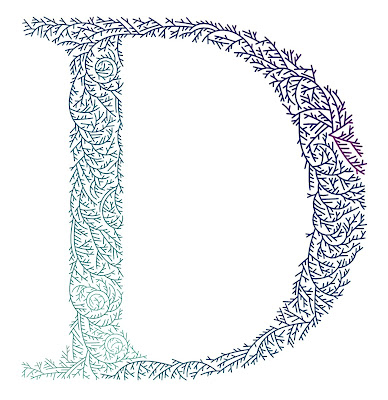
The course launch has also provided a great excuse (er, opportunity) to play with some ideas around generative branding and marketing. I've been tinkering with this logotype for ages; it uses the same basic algorithm as Limits to Growth but artificially constrains the growth to a letterform (in the guise of a hidden bitmap image). Lately I've extended the logotype into a little generative marketing gadget; a Processing applet that lets you grow endless variations, and receive the results as a PDF file, attached to an email. The aim is to provide a little taste of the power - and pleasure - of generative design.

Behind the scenes this project was yet another demonstration of the brilliance of Processing and its community. The key technical challenge was the upload-and-email functionality. Seltar's "save to web" hack provided the template; upload image data over HTTP, and have a PHP script catch and save the file. From there it was relatively straightforward to have PHP generate the email, with the help of the Pear MailMime package. The final step was uploading a PDF, rather than a bitmap. This seemed impossible, because the built-in PDF library needs to write a local file, which means the extra annoyance of a signed applet. I posted a query on the Processing forums and within 24 hours PhiLho saved me with a solution that extends the PDF class to allow access to the PDF data as a Byte array, without first saving the file. Amazing: thank you! Add the super-useful ControlP5 for the UI sliders and buttons, and the whole thing is built on, in and with free, open-source software. Again, a demonstration of why digital design is such an exciting field of practice right now.

Read More...

Wednesday, July 16, 2008

Radiohead's Data Melancholy

In case you missed it, Radiohead have gone all data-aesthetic with their latest video, House of Cards. What's more, it's fully zeitgeist-compliant, with open access and a call for re-visualisations of a quite massive dataset: hundreds of megabytes of spatial data gathered with various 3d laser-scanning rigs. If the download stats and early signs are anything to go on, we will be seeing much more of this dataset.


As well as being technically cool, the project is yet another sign of the increasing cultural prominence of data as both material and idea - in that sense, after Design and the Elastic Mind and Wired's "Petabyte Age", this is more of the same. But it's also something different, it seems to me. Like any other visualisation, House of Cards doesn't only use data, it presents a certain sense of what data is, means, and (crucially) feels like; and this is where it's different. The dominant narrative of data visualisation at the moment is informed by the networked optimism of web 2.0, where the social sphere, and increasingly the world as a whole, is unproblematically digitised; where more is more and truth, beauty, and commercial success all are immanent in the teeming datacloud.

House of Cards, by contrast, is a manifestation of data melancholy. Data here is low res, with a sketchy looseness of detail that evokes the gaps, the un-sampled points. This data is also abject or corrupt, the scanner intentionally jammed with reflective material, a bit like the metallic chaff used to confuse missile guidance systems. These glitches are familiar devices in electronic music and video, including Kid A-era Radiohead. However here the errors are very much in the data; they have migrated out of the music, which is human, organic and more or less intact here. This disjunction between failed data and the emotional, human domain is what characterises the data melancholy; it's illustrated beautifully at the end of House of Cards, with the "party scene" (one of Thom Yorke's ideas for the clip), a social scene decimated into abstract clouds of points. This theme also resonates across In Rainbows, especially in the closing track, Videotape: "this is one for the good days / and I have it all here, in red blue green." Here image data is again a sort of failed trace of an emotional reality, all that remains of "the most perfect day I've ever seen."


Yorke's other motif for House of Cards was "vaporisation," which is clear enough in the clip; I think its most effective in the final shots of the house; the earlier clips of Yorke disintegrating seem a bit langurous, with that undulating look of Perlin noise (is it, anyone?). The house shot in particular reminded me of Brandon Morse's Preparing for the Inevitable; Morse's work in general has a related feel about it, though the models seem to be synthesised rather than sampled. Again the poetics is one of cool, digital melancholy, where tragedy is stripped down to a set of vectors and forces (above: Collapse, from Flickr). Here though, rather than a failure of data (sampled representation) it's a failure of the procedural model, or perhaps failure with, or in, the model.

Read More...

Tuesday, May 20, 2008

Draw a Straight Line...

Instruction Set is an embryonic open software project with a simple process, gathering different code implementations of a given "instruction." The format reminds me of two Whitney Artport projects - CODeDOC (2002), and Casey Reas' {Software} Structures (2004). It's good to see this approach being updated and opened out for a wider community.


The initial instruction was La Monte Young's wonderful Composition 1960 #10: "Draw a straight line and follow it." Implementations range from the abstract and conceptual to the more performative, in languages from Python and Javascript to Supercollider and Processing; web2.0 nerds like me will appreciate markluffel's Twitter version. Anyhow, I've just posted a belated implementation of "Draw a straight line..." (screengrab above). Nothing amazing, more just filling in a gap and solving a pragmatic problem - how to wring some generative juice out of the instructions - by manipulating the space, rather than the line.

That follow up post on transmateriality and hardware practice is coming soon, really. Off-task productivity is an amazing thing.

Read More...

Tuesday, May 22, 2007

Fijuu, 3D Synaesthesia and the Loungeroom

Game/art notable Julian Oliver (aka delire) has been using game engines for audiovisual performance since way back. In 2001 I saw him play a Quake mod that had been rigged with audio samples and proximity triggers to create an immersive first-person performance tool; a digital hardcore jumping castle (I think the system was related to the later q3apd). In conversation at the same event, he argued for the potential of this approach. I saw the Quake mod as an ingenious sample trigger interface - a kind of 3D drum machine - but Oliver was looking ahead to realtime manipulation and deformation of geometry and sound. In retrospect he was evoking a form of synaesthetic media, where spatial and sonic attributes are fused and cross-mapped, so that the form is the sound. Gesture is significant here too - in performance practice gesture is at the interface of space, motion and sound. Oliver was imagining dynamic form as an articulation of sonic gesture, but also the prospect of folding back 3D form into sound; procedural texture-mapped geometry as a sonic provocation. What does this sound like?


This conversation came back to me vividly when I ran into fijuu2, a project by Oliver and Steven Pickles. Fijuu comes close to realising what Oliver imagined in 2001: a plastic, gestural, realtime audiovisual 3d environment. Forms twist, shatter and rotate, hovering inside cylindrical arcs of a gesture sequencer. Sound and form transform in unison, evoking a third, more abstract thing, the map or pattern that links them. Global filters influence sound and image, making another (logical) map between pixel shaders and audio effects. It's great to see lush, gaming-grade 3d graphics diverted towards a more abstract aesthetics of play.

fijuu is also interesting as a case study in art/game crossover and the free software ecology. It runs on Linx, using the Ogre graphics engine; all free and good, but installation looks fairly daunting. Apparently it will one day be available as a Linux live CD, bypassing the installation process and maybe approaching a game-console level of runnability. This is the exciting bit, for me. It would be great if artists could join the current battle for the "converged" screen (MediaCentre, PS3, FrontRow, TiVo, etc). One way would be for artists to somehow gain a toehold in mass market console gaming - but that doesn't seem likely, despite the odd promising exception. Another is for art to occupy interstitial attention, with screensavers like The Endless Forest and E-volved Cultures. Fijuu signals a third possibility, for art to temporarily occupy ubiquitous PC hardware as if it were a console. Back to the demoscene, and forward, to generative AV 3D interactive art in your loungeroom.

Read More...