Showing posts with label siberia. Show all posts

Saturday, March 19, 2016

The Siberian Unicorn Found a Refugium, Surviving until 29,000 Years ago

The beautiful title "Siberian unicorn" belongs to Elasmotherium sibiricum - an elasmotherium Siberian rhinoceros, which as previously thought became extinct 350,000 years ago. Nowadays the researchers of Tomsk State University (TSU) figured out that the "unicorn" found his last refuge "only" 29,000 years ago in Kazakhstan. The article, describing the new location of the fossil mammals in the Pavlodar Irtysh, was published in February 2016 in the American Journal of Applied Science.

"Most likely, in the south of Western Siberia it was a refúgium, where this rhino had preserved the longest in comparison with the rest of its range. There is another option that it could migrate and dwell for a while on the more southern areas," said Andrey Shpanski, a paleontologist at TSU. These conclusions were made due to research of the rhinocero's skull, found near Kozhamzhar village in Pavlodar region (Kazakhstan). The skull is well preserved: there are some cracks but no trace of pelletization, gnawing, and exfoliation. The fossils of the "unicorn" were examined by radiocarbon AMS-method analysis in the laboratory 14CHRONO Centre for Climate, the Environment, and Chronology (School of Geography, Archaeology and Palaeoecology; Queen's University Belfast; Belfast, UK). It turned out that the skull belonged to the animals that died 29,000 years ago. "Most likely, it was a very large male of very large individual age (teeth not preserved). The dimensions of this rhino today are the biggest of those described in the literature, and the proportion are typical," said the University's scientist.

Saturday, December 05, 2015

Did the Siberian Traps Begin With an Ooze or a Bang?

The onset of flood volcanism in the north-western part of the Siberian Traps: Explosive volcanism versus effusive lava flows

Authors:

Jerram et al

Abstract:

The Siberian Traps large igneous province was formed during the end-Permian, about 252 Ma ago. Basaltic melt was injected into the organic and salt rich Tunguska sedimentary basin, forming interconnected sill complexes and associated hydrothermal vent complexes. Thick deposits of basaltic tuff and tephra covered the paleosurface before the onset of flood volcanism, commonly taken as direct evidence for the explosive nature of the initial phase of volcanism. The field work in this study revealed that tuffs are virtually absent along a 150 km long transect along the Dyupkun lake and Kureika river, even though tuff is shown on available geological maps. Towards the south and west, the transition between the end-Permian sediments and the flood basalts is either characterized by thin (2–5 m) to no tephra deposits (Khantaika area), hyaloclastites and associated lake-deposited tephra (Kureika area), or massive tephra deposits from local eruptive centers (Severnaya area). The new results can be put into the context of other studies about volcanic tuff horizons in Siberia, and questions the notion of province-scale explosive volcanism in Siberia during the onset of flood volcanism. Moreover, the main thicknesses of explosive tuff deposits, up to 700 m, are located in the central and southern parts of the province where the LIP erupted through thick Cambrian salt and carbonate sequences. Since numerous phreatomagmatic pipes are present in these areas, we suggest a causal relationship between deep magma–sediment interactions, explosive eruptions and the resulting environmental stress that initiated the end-Permian mass extinction.

Monday, November 16, 2015

Denisovans Sister Group to Neandertals, More Genetically Diverse & Inhabited Siberia for Long Time

Nuclear and mitochondrial DNA sequences from two Denisovan individuals

Authors:

Sawyer et al

Abstract:

Denisovans, a sister group of Neandertals, have been described on the basis of a nuclear genome sequence from a finger phalanx (Denisova 3) found in Denisova Cave in the Altai Mountains. The only other Denisovan specimen described to date is a molar (Denisova 4) found at the same site. This tooth carries a mtDNA sequence similar to that of Denisova 3. Here we present nuclear DNA sequences from Denisova 4 and a morphological description, as well as mitochondrial and nuclear DNA sequence data, from another molar (Denisova 8) found in Denisova Cave in 2010. This new molar is similar to Denisova 4 in being very large and lacking traits typical of Neandertals and modern humans. Nuclear DNA sequences from the two molars form a clade with Denisova 3. The mtDNA of Denisova 8 is more diverged and has accumulated fewer substitutions than the mtDNAs of the other two specimens, suggesting Denisovans were present in the region over an extended period. The nuclear DNA sequence diversity among the three Denisovans is comparable to that among six Neandertals, but lower than that among present-day humans.

pop sci write up at Nat Geo.

Tuesday, March 03, 2015

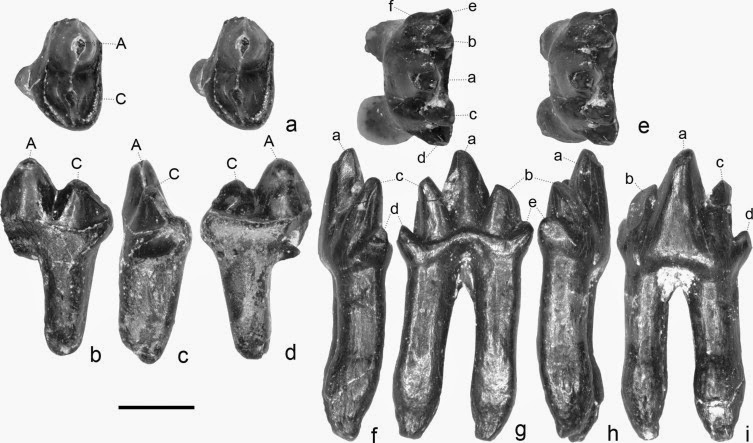
Two new Mammal Localities From Lower Cretaceous Siberia


Two new mammal localities within the Lower Cretaceous Ilek Formation of West Siberia, Russia

Authors:

Averianov et al

Abstract:

Two new mammal localities have been discovered in the Lower Cretaceous Ilek Formation of West Siberia, Russia, during a field work in 2014. The Smolenskii Yar locality in the Chebula District of Kemerovo Province produced an upper molariform tooth (M2) of a Gobiconodontidae indet. The Ust’-Kolba locality in the Tisul’ District of Kemerovo Province yielded a lower molar (m2) of the zhangheotherian Kiyatherium sp. These are the ninth and tenth Mesozoic mammal localities for Russia. The Kiyatherium-bearing vertebrate assemblage from the Shestakovo 3 and Ust’-Kolba localities is likely to be the youngest within the Ilek Formation, reflecting the time after the extinction of the Tritylodontidae.

Wednesday, January 14, 2015

An Unique Mammalian Assemblage From Early Cretaceous Siberia


Mammal remains from the Lower Cretaceous Bol'shoi Terekhtyul' locality in West Siberia, Russia

Authors:

Averianov et al

Abstract:

Four mammalian taxa have been identified based on upper molariform tooth and edentulous dentary fragments from the Bol'shoi Terekhtyul' locality of the Lower Cretaceous Ilek Formation (Krasnoyarsk Territory, Russia): Docodonta indet., Amphidontidae indet., Zhangheotheria indet. sp. A and sp. B. The docodontan from Bol'shoi Terekhtyul is smaller than Sibirotherium rossicum from the Ilek Formation at Shestakovo 1 locality (Kemerovo Province, Russia) and may belong to a distinct taxon. It is one of the younger docodontans in the fossil record. The mammal assemblage from the Bol'shoi Terekhtyul' locality is drastically different from the mammal assemblage of nearby localities of the Ilek Formation along Bol'shoi Kemchug River, which consists of Gobiconodontidae and Amphilestidae. The reason for this faunal discrepancy is unclear for the moment.

Wednesday, October 22, 2014

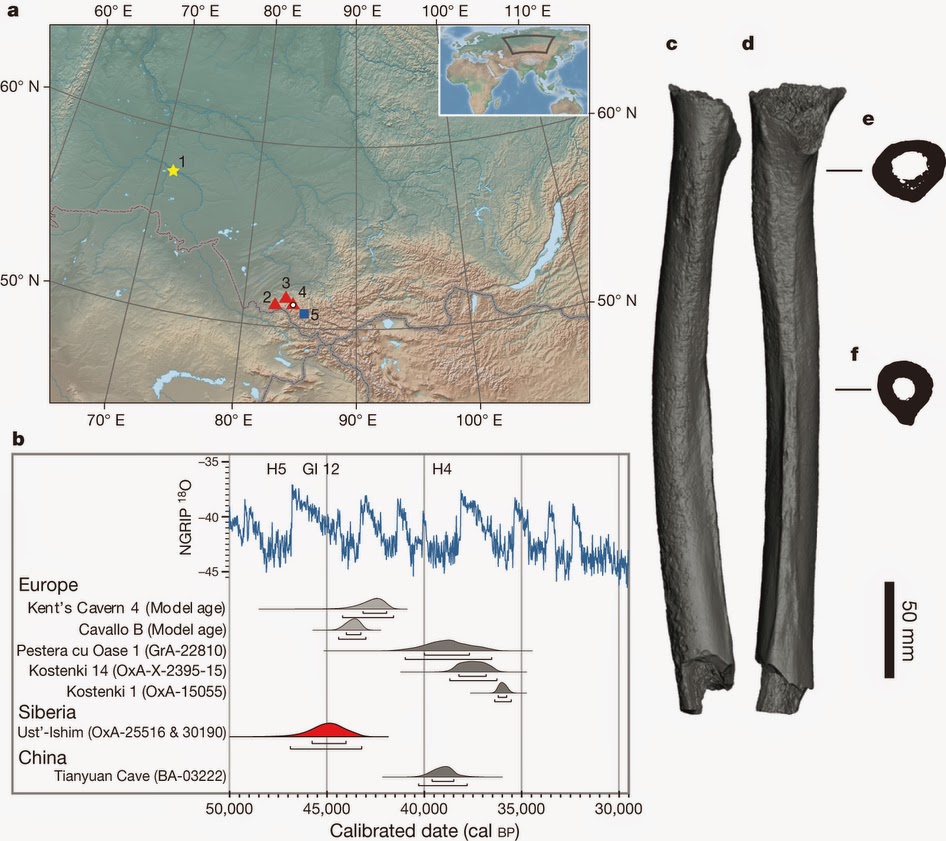
45,000 Year Old Siberian Man had Significantly More Neandertal Genes Than Modern People


Genome sequence of a 45,000-year-old modern human from western Siberia

Authors:

Fu et al

Abstract:

We present the high-quality genome sequence of a ~45,000-year-old modern human male from Siberia. This individual derives from a population that lived before—or simultaneously with—the separation of the populations in western and eastern Eurasia and carries a similar amount of Neanderthal ancestry as present-day Eurasians. However, the genomic segments of Neanderthal ancestry are substantially longer than those observed in present-day individuals, indicating that Neanderthal gene flow into the ancestors of this individual occurred 7,000–13,000 years before he lived. We estimate an autosomal mutation rate of 0.4 × 10⁻⁹ to 0.6 × 10⁻⁹ per site per year, a Y chromosomal mutation rate of 0.7 × 10⁻⁹ to 0.9 × 10⁻⁹ per site per year based on the additional substitutions that have occurred in present-day non-Africans compared to this genome, and a mitochondrial mutation rate of 1.8 × 10⁻⁸ to 3.2 × 10⁻⁸ per site per year based on the age of the bone.

Now we know when Neandertals got the Sapiens drunk enough for the first beer goggles.  

Wednesday, July 30, 2014

More Mysterious Giant Holes Have Appeared in Siberian Russia

Two more craters of unknown origin have been spotted in Russia's Siberia region, weeks after a similar-looking hole was found in the isolated northernmost area, a local paper reported.

The Siberian Times, an English-language newspaper, published pictures of two new giant holes discovered by reindeer herders, one located in the Yamal and the other in the Taymyr peninsula, both above the Arctic circle.

Friday, July 25, 2014

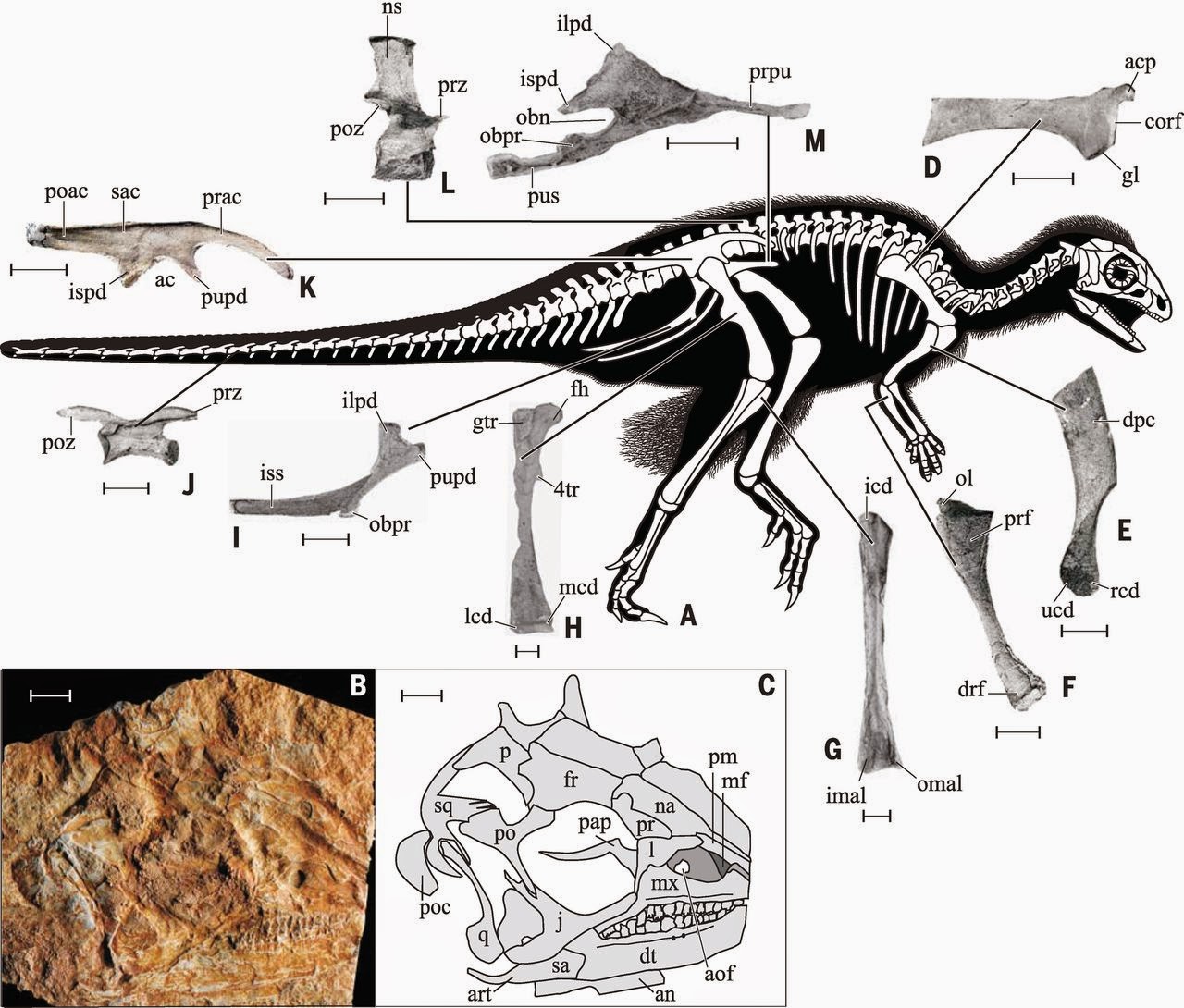
Kulindadromeus zabaikalicus: a Feathered & Scaled Ornithischian Dinosaur From Jurassic Siberia


A Jurassic ornithischian dinosaur from Siberia with both feathers and scales

Authors:

Godefriot et al

Abstract:

Middle Jurassic to Early Cretaceous deposits from northeastern China have yielded varied theropod dinosaurs bearing feathers. Filamentous integumentary structures have also been described in ornithischian dinosaurs, but whether these filaments can be regarded as part of the evolutionary lineage toward feathers remains controversial. Here we describe a new basal neornithischian dinosaur from the Jurassic of Siberia with small scales around the distal hindlimb, larger imbricated scales around the tail, monofilaments around the head and the thorax, and more complex featherlike structures around the humerus, the femur, and the tibia. The discovery of these branched integumentary structures outside theropods suggests that featherlike structures coexisted with scales and were potentially widespread among the entire dinosaur clade; feathers may thus have been present in the earliest dinosaurs.

some great pictures @ Archosaur Musings. Also at Lost Worlds.

Friday, July 18, 2014

Anthracolestes sergeii: a new Dryolestid Mammal From Bathonian Jurassic Siberia


The oldest dryolestid mammal from the Middle Jurassic of Siberia

Authors:

Arerianov et al

Abstract:

Anthracolestes sergeii, gen. et sp. nov., based on three isolated lower molars and several edentulous dentary fragments from the Middle Jurassic (Bathonian) Itat Formation at Berezovsk Quarry in Krasnoyarsk Territory, Russia, is the oldest and most basal representative of Dryolestidae. It shows four unambiguous synapomorphies of Dryolestidae: lower molars with unilaterally hypsodont crowns, unequal roots, and pronounced precingulid instead of cusp f, and dentary with unequal alveolar borders. The dental formula of the new taxon is i1–4, c (double-rooted), p1–4(?), and m1–4(?). Anthracolestes sergeii, gen. et sp. nov., is plesiomorphic relative to more derived and geologically younger dryolestids in having possibly fewer lower molars, less pronounced mesiodistal compression of lower molars, oblique protocristid, short mandibular symphysis, and shallow mandibular ramus of the dentary. Asia is most likely the place of origin for Dryolestidae, but this group is so far not known from that continent after the Middle Jurassic.

Monday, May 19, 2014

Evgenavis nobilis: A Confuciusornithiform Bird From Barremian/Aptian Cretaceous Siberia

A confuciusornithiform (Aves, Pygostylia)-like tarsometatarsus from the Early Cretaceous of Siberia and a discussion of the evolution of avian hind limb musculature

Authors:

O'Connor et al

Abstract:

We describe a new isolated tarsometatarsus from the Early Cretaceous (Barremian-Aptian) Ilek Formation Shestakovo-3 locality in western Siberia. The new specimen represents a new taxon, Evgenavis nobilis, gen. et sp. nov., significantly increasing the Mesozoic avifauna from Russia. The specimen shares morphologies with a number of basal ornithothoracine taxa, but shows most similarity to the basal pygostylian Confuciusornis sanctus, the oldest known beaked bird and most common taxon from the Yixian Formation. Evgenavis may represent the first record of Confuciusornithiformes outside of the Jehol Group and its equivalent deposits. However, this is not supported by cladistic analysis, which weakly resolves the new species and Mystiornis both within the diverse Enantiornithes, indicating that additional material is required to assess the systematic position of Evgenavis nobilis (Aves incertae sedis). The three-dimensional preservation of the specimen allows for a partial reconstruction of the pedal musculature, revealing a primitive stage in the evolution of the neornithine condition.

Monday, December 30, 2013

Stem Therian Amphibetulimus From Bathonian Jurassic Siberia

Stem therian mammal Amphibetulimus from the Middle Jurassic of Siberia

Authors:

Alexander Averianov, Thomas Martin, Alexey Lopatin and Sergei Krasnolutskii

Abstract:

Amphibetulimus krasnolutskii is known from the Middle Jurassic (Bathonian) Itat Formation of Krasnoyarsk Territory, West Siberia, Russia, by several edentulous and three dentigerous dental fragments, preserving p1, antepenultimate, and ultimate lower molars, and by an upper molar. It is unique among stem therians by widely open trigonids on the posterior lower molars, paraconids that are higher than the metaconids and have keeled mesiolingual vertical crests, pronounced unilateral hypsodonty of the lower molars and correlated unequal alveolar borders of the dentary ramus, and a linear Meckelian groove that is not connected to the mandibular foramen and extends along the pterygoid ridge. Amphibetulimus differs from more derived stem therians by a simple unicuspid talonid without an incipient talonid basin and a distinct labial cingulum on the upper molars. The lack of an ectotympanic facet and the long linear Meckelian groove extending onto the pterygoid ridge suggest that Amphibetulimus had a derived state of the transitional mammalian middle ear, where the ear ossicles were connected to the dentary not by a thick “ossified” Meckelian cartilage, but by a thin Meckelian cartilage, as in prenatal and early postnatal stages of some modern therians.

Wednesday, October 30, 2013

Warming of Permafrost on Siberian Coast is Greatly Increasing Erosion


This photo illustration shows the erosion of the east-Siberian island Muostakh. The blue line marks ist coastal line in the year 1951, the red line presents its status in the year 2012. In the upper right corner one can see an aerial picture of the island's northern tip, taken in the year 2012. At its narrowest point the island is shrinking more than four meters per year.
The high cliffs of Eastern Siberia – which mainly consist of permafrost – continue to erode at an ever quickening pace. This is the conclusion which scientists of the Alfred Wegener Institute, Helmholtz Centre for Polar and Marine Research have reached after their evaluation of data and aerial photographs of the coastal regions for the last 40 years. According to the researchers, the reasons for this increasing erosion are rising summer temperatures in the Russian permafrost regions as well the retreat of the Arctic sea ice. This coastal protection recedes more and more on an annual basis. As a result, waves undermine the shores. At the same time, the land surface begins to sink. The small island of Muostakh east of the Lena Delta is especially affected by these changes. Experts fear that it might even disappear altogether should the loss of land continue.

The interconnectedness is clear and unambiguous: The warmer the east Siberian permafrost regions become, the quicker the coast erodes. "If the average temperature rises by 1 degree Celsius in the summer, erosion accelerates by 1.2 meters annually," says AWI geographer Frank Günther, who investigates the causes of the coastal breakdown in Eastern Siberia together with German and Russian colleagues, and who has published his findings in two scientific articles.
link.

Friday, October 25, 2013

Evidence of the Onset of the Hirnatian Ordovician Glacations From Siberian Russia

Late Ordovician cooling event: Evidence from the Siberian Craton

Author:

Andrei Dronov

Abstract:

The Upper Ordovician of the Tungus Basin on the Siberian Platform is represented by cool-water carbonates. Onset of cool-water conditions starts at the Darriwilian, and it is associated with widespread phosphatization, especially in the Volginian, Kirensko-Kudrinian and Chertovskian regional stages (mid-Darriwilian–lower Sandbian). The shift from tropical-type to temperate-type carbonates was preceded by destruction of the warm-water “carbonate factory” and a large input of siliciclastic material (Baykit Sandstone) during the Vikhorevian and Mukteian regional stages (lower to mid-Darriwilian). Wide distribution of temperate-type carbonates across the Siberian Platform, located in the low latitudes in the Ordovician time, can be explained by upwelling of cold oceanic waters and their penetration into epicontinental seas. The same situation was recorded for the Upper Ordovician of the North American Platform. Newly discovered K-bentonite beds in the uppermost Sandbian–Katian of the Tungus Basin are also associated with cool-water carbonates. The K-bentonite beds point to extensive volcanism on or near the western (in present-day orientation) margin of the Siberian Craton in the Late Ordovician time. Timing of the volcanism is surprisingly close to the period of volcanic activity of the Taconic Arc near the margin of Laurentia. Both upwelling and volcanism seem to be activated by the same plate-tectonic reorganization, and both these processes seem to play an important role in a global, later Ordovician cooling terminated by the Hirnantian glaciation.

Monday, May 20, 2013

Siberia: No Sign of a Snowball Earth Here


Testing the snowball Earth hypothesis for the Ediacaran

Authors:

a. Alexei V. Ivanov (a)
b. Anatoly M. Mazukabzov (a)
c. Arkady M. Stanevich (a)
d. Stanislav V. Palesskiy (b)
e. Olga A. Kozmenko (b)

Affiliations:

a. Institute of the Earth's Crust, Siberian Branch, Russian Academy of Sciences, Lermontov Street 128, Irkutsk 664033, Russia

b. Institute of Geology and Mineralogy, Siberian Branch, Russian Academy of Sciences, Academician Koptyug Boulevard 3, Novosibirsk 630090, Russia

Abstract:

Ediacaran Siberia was at tropical paleolatitudes when the glacigenic strata of the Goloustnaya Formation (Baikal Group, Siberia) were deposited at sea level. The presence of such deposits (at tropical latitudes) is at the core of the snowball Earth hypothesis, which is generally accepted for the previous Cryogenian glaciations. To test this hypothesis for the Ediacaran Period, we determined concentrations of platinum group elements (PGE) in the transitional unit between glacigenic conglomerates and postglacial cap carbonates of the Goloustnaya Formation. We speculate that if oceans were completely covered by ice during the glaciation, the ice prevented accumulation of PGE-rich cosmic dust and micrometeorites during that period, i.e., the snowball Earth stage. Such particles would have accumulated rapidly on the ocean floor at the ice-melting event, providing a geochemical signal; however, unlike the previous Cryogenian glaciations, this signal is at a background level, and we conclude that either the Ediacaran glaciation did not reach the snowball stage, or it was of very short duration.

Thursday, August 27, 2009

Has the Dam Disaster in Siberia Affected Them Like the Ukrainians with Cherynobl?

ust as the 1986 Chernobyl nuclear accident convinced many Ukrainians that they did not want to remain part of the Soviet Union, so too, despite all the differences in the extent of the disaster, the Sayan-Shushen dam accident is leading many Siberians to conclude the same thing about remaining part of the Russian Federation.

[...]

Many in Moscow and elsewhere continue to comfort themselves with the notion that it is wrong to draw any parallels between the impact of Chernobyl on Ukrainians and the impact of Sayan-Shushen on Siberians. After all, they say, Siberia has “nowhere to go.” But that is not quite the case, Tarasov suggests.

“Under Gorbachev and Yeltsin, only a politician who did not need public support could fail to speak about the necessity of decolonizing [that region with its immense natural resources] and the establishment of a Siberian (Eastern Siberian, Central Siberian and Yenisey) Republic” as a goal of Russian policy.

Under Putin, however, no one remembered “Siberian separatism” because Moscow had “buried the theme of regional patriotism.” And efforts by the supporters of that idea seldom found much support. But if a problem is not discussed, Tarasov says, “it does not disappear. It simply goes into the underground.”

The Sayan-Shushen dam disaster and even more the way Moscow has mishandled it and the media have discussed it suggest that Siberian separatism may be about to re-emerge and challenge not only the relationship between Putin and the oligarchs but also that between “the colony” of Siberia and the imperial center.


hmmm. That might be overblown, but...

Monday, September 24, 2007

Siberia: More Good (?) Money After Bad

The Russian government plans to allocate up to 600 billion rubles ($23.6 billion) to fund development projects in Eastern Siberia and Far East by 2013, Kamil Iskhakov, presidential envoy in the Far East, told the Far Eastern International Economic Forum on September 18. Total investments in the region could reach 9 trillion rubles ($354 billion) by 2025, he told Forum participants.

However, the Forum's host, Khabarovsk regional governor Viktor Ishayev, sounded less optimistic. China, Japan, and South Korea still remain regional economic leaders, he noted, while Russia's Eastern Siberia and Far East, along with North Korea and Mongolia, are becoming increasingly marginalized.

Ishayev complained about low incomes in Eastern Siberia and the Far East, which are some 12% below Russia's average. He suggested that Moscow should allow Far Eastern regions to retain a larger share of corporate profit taxes and VAT. He also urged the government to prioritize exports of finished petrochemical products, not oil and gas, or the region risks becoming a raw-materials supplier to the region's more advanced economies (Interfax, RIA-Novosti, September 18-19).


In short, they're promising a lot more money even when they have not quite delivered on what they promised before.