Showing posts with label Myrmecophily. Show all posts

Wednesday, January 22, 2025

[Entomology • 2022] Review of the Genera Rondoniella Kaszab, 1970 and Durandius Kaszab, 1970 (Coleoptera: Tenebrionidae), with description of R. hosoishii sp. nov. from an ant nest in Cambodia


[1] Rondoniella costata Kaszab, 1970; 
[2-4] R. hosoishii Maruyama & Ando, 2022 


Abstract
The enigmatic tenebrionid genera Rondoniella Kaszab, 1970 and Durandius Kaszab, 1970 are briefly reviewed and diagnosed. Rondoniella hosoishii sp. nov. is described based on specimens collected from a nest of the arboreal ant Crematogaster sewardi in Cambodia. Because of where R. hosoishii sp. nov. was collected and its specialized morphology, the members of Rondoniella and its close relative Durandius are considered to be myrmecophilous, as was suggested in the original description. They also have reduced mouthparts, which are unknown in other tenebrionids, and they might receive food from ants by trophallaxis.

 Cnemeplatiini, Indochina, Laos, myrmecophily, Pimeliinae, taxonomy, Thailand

 1, Habitus of Rondoniella costata Kaszab, 1970; 
2, habitus of R. hosoishii Maruyama & Ando sp. nov. (holotype male); 3, ditto (paratype female); 4, head of R. hosoishii sp. nov., ventral view;
5, habitus of R. bremeri Ferrer & Moragues, 2000;
6, habitus of Durandius ardoini Kaszab, 1970; 7, ditto, head, ventral view.

Rondoniella hosoishii sp. nov. 

Etymology. The specific epithet is cordially dedicated to Dr. Shingo Hosoishi (Kyushu University), who collected the type series.

Diagnosis. Rondoniella hosoishii sp. nov. is most closely similar to R. costata Kaszab, 1970 in color and general body shape, but distinguished from it by the lateral depression of the pronotum being narrower, the punctation onthe pronotum being finer, the striae on the elytra less clear, the tibiae being broader and less punctate, the tarsi being shorter and thicker.


Munetoshi MARUYAMA and Kiyoshi ANDO. 2022. Review of the Genera Rondoniella Kaszab, 1970 and Durandius Kaszab, 1970 (Coleoptera: Tenebrionidae), with description of R. hosoishii sp. nov. from an ant nest in Cambodia. Zootaxa. 5209(2); 293-300. DOI: doi.org/10.11646/zootaxa.5209.2.9

Thursday, November 28, 2024

[Entomology • 2024] Evolution of Leafcutter Ant Myrmecophiles: Hamotus heidiae, A New symbiont of Acromyrmex Colonies with undetectable hydrocarbons (Coleoptera: Staphylinidae: Pselaphinae)


  Hamotus heidiae Parker,

in Parker, Maruyama, Okamoto, Schultz et Alvarado, 2024. 

Abstract
Colonies of Atta and Acromyrmex leafcutter ants provide niches for diverse insect species, but few such organisms have evolved obligate myrmecophilous associations inside host colonies. We report a remarkable pselaphine rove beetle myrmecophile, Hamotus heidiae sp. nov., discovered in galleries of Acromyrmex histrix Latreille in lowland tropical rainforest within Tambopata National Reserve, Peruvian Amazonia. Presence of adults and putative larvae inhabiting the central nest implies an obligate relationship, with development of the beetle likely occurring inside the colony environment. Phylogenetic analysis of four genomic loci confirms that H. heidiae is a morphologically derived member of the New World Hamotus-generic complex and is tentatively placed into Hamotus Aubé on morphological grounds. The new species is phylogenetically distant to the genus Attapsenius Bruch—previously, the only pselaphine taxon known with certainty to be an obligate myrmecophile of leafcutter ants. Both H. heidiae and Attapsenius emerge from a newly recognized “Tyrine-group” within Pselaphinae—a major radiation that includes multiple independent origins of myrmecophily and termitophily. We were unable to detect cuticular hydrocarbons (CHCs) on the body surface of H. heidiae adults. Chemical insignificance may form part of the strategy that this myrmecophile, and possibly other pselaphines, employ to infiltrate host colonies.

Keywords: Pselaphinae, Myrmecophily, Cuticular hydrocarbons, Leafcutter ants, Chemical ecology, Evolution


Hamotus heidiae Parker, new species

Etymology: The new species is named in honor of Dr Heidi Kay Parker, for her scientific intuition, expertise, and accomplishments, her passion for and deep knowledge of the biological world, and for her love, support, and encouragement of the first author’s interest in beetles.


J. Parker, M. Maruyama, T. Okamoto, T. R. Schultz and M. Alvarado. 2024. Evolution of Leafcutter Ant Myrmecophiles: Hamotus heidiae, A New symbiont of Acromyrmex Colonies with undetectable hydrocarbons (Coleoptera: Staphylinidae: Pselaphinae). Insectes Sociaux. DOI: doi.org/10.1007/s00040-024-01005-x

Monday, November 18, 2024

[Entomology • 2023] Hathoronthophagus spinosus • A New Genus and Species in the Diverse Dung Beetle Tribe Onthophagini Streubel, 1846 (Scarabaeidae: Scarabaeinae) from South Africa


Hathoronthophagus Stals, Daniel & Deschodt, 2024
Hathoronthophagus spinosus (Deschodt in Deschodt & Sole, 2023)

in Stals, Daniel et Deschodt, 2024.  

in Deschodt & Sole, 2023.  
 
Abstract
A new dung beetle genus and species is described and pictured following its recent discovery on a farm in South Africa. Hathor spinosa Deschodt, new species belongs to the subfamily Scarabaeinae, tribe Onthophagini Streubel, 1846, it shows a unique set of characters. A map is provided to show the type locality of the new genus and species that has a putative association with ants.

Coleoptera, Putative ant association, dung beetle, Afrotropical region


Christian M. Deschodt and Catherine L. Sole. 2023. A New Genus and Species in the Diverse Dung Beetle Tribe Onthophagini Streubel, 1846 (Scarabaeidae: Scarabaeinae) from South Africa.  Zootaxa. 5375(2); 279-284. DOI: doi.org/10.11646/zootaxa.5375.2.9

 
===========

In November 2023, Deschodt & Sole (2023) proposed the new genus-group name Hathor Deschodt for a peculiar, putatively ant-associated onthophagine dung beetle from Gauteng province, South Africa. The genus is as yet known only from the female holotype of the species Hathor spinosa Deschodt, 2023. It was overlooked that the new generic name is preoccupied by Hathor Kirkaldy & Edwards, 1902, as regulated by the Principle of Homonymy (Articles 52–60 of the International Code of Zoological Nomenclature [henceforth the Code, Anonymous 1999]). Hathor Kirkaldy & Edwards is a monotypic genus of red bug or cotton stainer (Hemiptera: Heteroptera: Pyrrhocoroidea: Pyrrhocoridae) from tropical Africa, itself a junior subjective synonym of Sericocoris Karsch, 1892. Sericocoris is currently a valid genus (Robertson 2004; Stehlík & Jindra 2011).

Coleoptera, Scarabaeidae, Scarabaeinae, Onthophagini


Coleoptera: Scarabaeidae: Scarabaeinae: Onthophagini
Genus Hathoronthophagus Stals, Daniel & Deschodt, replacement name

Hathoronthophagus spinosus (Deschodt in Deschodt & Sole, 2023), new combination


Riaan Stals, Gimo M. Daniel and Christian M. Deschodt. 2024. Hathoronthophagus, new replacement name for Hathor Deschodt, 2023, preoccupied genus-group name of a putatively myrmecophilic dung beetle (Scarabaeidae: Scarabaeinae: Onthophagini).  Zootaxa. 5397(3); 449-450. DOI: doi.org/10.11646/zootaxa.5397.3.10

Sunday, October 9, 2022

[PaleoEntomology • 2022] Amplectister terapoides • A Remarkable New Fossil Species of Amplectister (Coleoptera: Histeridae) with Peculiar Hindleg Modifications: Further Evidence for Myrmecophily in Cretaceous Clown Beetles


[A-B] Amplectister terapoides n. sp.
[lower]  Terapus sp. (probably undescribed) from Cerrado habitats.
Colonides beetle with Eciton burchellii army ants in Peru.

Yamamoto & Caterino, 2022
Terapus sp. with Eciton ants photo by Taku Shimada (AntRoom, Tokyo).

Abstract
Myrmecophily is a phenomenon of the symbiosis of organisms that depend on various ant (Formicidae) societies. Such interspecies associations are found in several unrelated lineages within the clown beetle family Histeridae. Recent studies have suggested that the origin of myrmecophily can be traced back to mid-Cretaceous based on a few fossil records from Kachin amber from northern Myanmar. Here, we describe a remarkable new species, Amplectister terapoides n. sp., from Kachin amber. This is the second species of the extinct genus Amplectister Caterino and Maddison, which has been found from the same amber deposit and has also been considered to be myrmecophilous. The new species here described has the most heavily modified hindlegs in any fossil histerids or even beetles discovered until now, indicating further evidence for ant colony association. Our discovery demonstrates that significant and diverse morphological adaptations to myrmecophily had already occurred during the Cretaceous.

Keywords: Histeridae, Mid-Cretaceous, Palaeodiversity, Inquiline, Kachin amber, Southeast Asia

Amplectister terapoides n. sp., holotype, SEHU-0000121201.
(A) General habitus, dorsal view. (B) General habitus, ventral view.
Scale bars = 0.5 mm.

Amplectister terapoides n. sp., holotype, SEHU-0000121201.
(A) General habitus, dorsolateral view. (B) General habitus, ventrolateral view.
Scale bars = 0.5 mm.

Systematic palaeontology
Superfamily Histeroidea Gyllenhaal, 1808
Family Histeridae Gyllenhal, 1808

Genus Amplectister Caterino and Maddison, 2018

Amplectister terapoides n. sp.
 
Stratigraphic position and age: Kachin amber, unnamed horizon, mid-Cretaceous (near Albian–Cenomanian boundary).

Type locality: The Noije Bum hill mines, Hukawng Valley, Kachin State, northern Myanmar.

Etymology: The species name refers to the marked similarity in modifications of the posterior legs to those in the haeteriine genus Terapus Marseul, 1863 (see Fig. 6A). That name, in turn, translates to ‘mutant foot’.
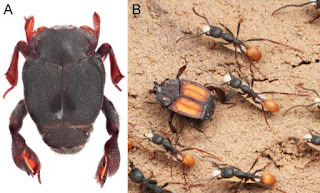
  Extant Haeteriinae associated with Neotropical army ants (Ecitonini).
(A) Terapus sp. (probably undescribed) from Cerrado habitats, with a pronotal-elytral length of 4.8 mm. (B) Colonides beetle with Eciton burchellii army ants in Peru.
Photo credit for (B): ©Taku Shimada (AntRoom, Tokyo).

Conclusions
A remarkable new fossil species of clown beetles, Amplectister terapoides n. sp., is described from mid-Cretaceous Kachin amber from northern Myanmar. Based on the well-preserved adult specimen, we could observe many morphological characters from various angles. The overall morphological characters found in the hindlegs are exceptional; they are markedly expanded and enlarged, also possessing dramatic features such as the presence of numerous peculiar, honeycomb-like large punctures on the metafemora and metatibiae, together with stiff long setae along the inner marginal surface on the metatibiae. We hypothesise that these specialised anatomical features strongly suggest the Mesozoic beetle was a true myrmecophile, a symbiont in some Cretaceous ant’s nest. Along with previous studies (Caterino and Maddison, 2018, Zhou et al., 2019), our discovery further reinforces an ancient origin of obligate behavioral symbioses between clown beetles and ants, and that these associates had diversified considerably by mid-Cretaceous.


Shûhei Yamamoto and Michael S. Caterino. 2022. A Remarkable New Fossil Species of Amplectister with Peculiar Hindleg Modifications (Coleoptera: Histeridae): Further Evidence for Myrmecophily in Cretaceous Clown Beetles. Palaeoworld. In Press. DOI: 10.1016/j.palwor.2022.09.010