Showing posts with label Phyllodactylidae. Show all posts

Monday, April 6, 2026

[Herpetology • 2025] Phyllopezus sapirangaUncovering Neotropical Rock Geckos’ Diversity: Multiple Data Sources on an Integrated Taxonomic Approach reveal A New Species of Phyllopezus Peters, 1878 (Squamata: Phyllodactylidae) from northeastern Brazilian Atlantic Forest


 Phyllopezus sapiranga
Dubeux, Vieira Dubeux, Neves, Werneck, Rodrigues, Mott & Nunes, 2025
 
 
Abstract
Using an integrated taxonomic approach based on a robust data set including external morphology, cranial anatomy, hemipenial morphology, scale microstructure, and molecular data, we describe a new species of gecko of the genus Phyllopezus from mountains in the northeastern Brazilian Atlantic Forest. The species is currently known to occur in Serra da Jiboia, municipality of Elísio Medrado, Bahia state, and Serra de Itabaiana, municipality of Areia Branca, Sergipe state. The new species is genetically related and more morphologically similar to Phyllopezus diamantino and Phyllopezus selmae, sharing all diagnostic characteristics for both these species, but distinguished from their congeners by meristic and morphometric characters. The new species is the first Phyllodactylidae to have its hemipenial morphology described and together with the cranial anatomy and the description of the microstructures of the dorsal scales provided here, it encourages the use of new approaches for the description of the cryptic species present in this species complex.
 
Keywords: Cryptic diversity, Integrative taxonomy, Morphological data, Molecular phylogeny, Hemipenial morphology, Cranial anatomy, Scale microstructure

  Coloration in life of Phyllopezus sapiranga sp. nov.
(A–E) Holotype [male, CHUFPE-R 1962],
(F) Male paratype [CHUFPE-R 1960]; (G) Juvenile paratype [CHUFPE-R 1972].

Phyllopezus sapiranga sp. nov.

Etymology. The specific epithet is a homage to Marco Antônio de Freitas (also known as Marco "Sapiranga"), a herpetologist whose tireless efforts in research, management and fiscalization of several protected areas in the state of Bahia, has helped and helps contribute to the knowledge and conservation of Brazilian herpetofauna.


Marcos J.M. Dubeux, Gisele M.N. Vieira Dubeux, Jessika M.M. Neves, Fernanda P. Werneck, Miguel T. Rodrigues, Tamí Mott and Pedro M.S. Nunes. 2025. Uncovering Neotropical Rock Geckos’ Diversity: Multiple Data Sources on an Integrated Taxonomic Approach reveal A New Species of Phyllopezus Peters, 1878 (Squamata: Phyllodactylidae) from northeastern Brazilian Atlantic Forest. Zoologischer Anzeiger. 319; 173-195. DOI: doi.org/10.1016/j.jcz.2025.09.011 [November 2025] 

Saturday, April 19, 2025

[Herpetology • 2025] Homonota chelemini • A New Gecko (Phyllodactylidae: Homonota whitii group) from the Diaguita highlands, Argentina, with an updated phylogeny for the genus


Homonota chelemini 
Morando, Sánchez, Vrdoljak, Pérez, Sites & Avila, 2025
 

Abstract
The South American Transition Zone (SATZ) connects the Neotropical and Andean regions, stretching from western Venezuela to northern Chile and central-western Argentina. In Argentina, the northwestern Altoandina Cuyana province includes arid and semi-arid ecosystems, particularly the Diaguita District, spanning Catamarca, La Rioja and northern San Juan. This mountainous region, including the Sierra de Famatina and Cordillera Frontal de los Andes, hosts species adapted to extreme conditions. Despite its biodiversity, the region's endemicity and phylogenetic uniqueness remain poorly understood, especially as these ecosystems face growing climate threats, such as heatwaves. Geckos (Order Gekkota) are one of the oldest lizard clades, with divergences over 150 million years ago. Particularly, the genus Homonota (Phyllodactylidae) is endemic to the southern cone of South America, primarily in Argentina, with species also found in Brazil, Paraguay, Bolivia and Uruguay. As part of a broader investigation on geckos of this genus and to advance their systematic study, we generated data from two mitochondrial and 12 autosomal loci across 14 species, along with a comprehensive morphological dataset of meristic measurements and scale counts. Detailed analyses were conducted within an integrative species assessment framework. Consequently, we describe a new species of Homonota from the Diaguita biogeographic district in northwestern Argentina, representing the northernmost member of the H. whitii group. The species inhabits a mountainous region known for its micro-endemism, further highlighting the area as an important biodiversity hotspot for dryland ecosystems. Additionally, we provide an updated molecular phylogenetic hypothesis for the genus, offering new insights into the evolutionary history within Homonota and the broader biodiversity of the SATZ.

Keywords: endemic, integrative taxonomy, lizard, NW Argentina,  South American Transition Zone (SATZ)


Homonota chelemini sp. n. 


Mariana Morando, Kevin I. Sánchez, Juan E. Vrdoljak, Cristian H. F. Pérez, Jack W. Sites Jr. and Luciano J. Avila. 2025. A New Gecko (Phyllodactylidae: Homonota whitii group) from the Diaguita highlands, Argentina, with an updated phylogeny for the genus. Zoologica Scripta, 00, 1–19. DOI: doi.org/10.1111/zsc.12725 [01 March 2025]

Un nuevo gecko para la fauna de lagartijas de Argentina

Friday, November 8, 2024

[Herpetology • 2024] Asaccus authenticus • Taxonomy of Iranian Asaccus (Squamata: Phyllodactylidae) with Description of A New Species from southern Iran


Asaccus authenticus
Nazarov, Nabizadeh, Rajabizadeh, Melnikov, Volkova, Poyarkov & Rastegar-Pouyani, 2024

Bandar-e Jask Leaf-toed Gecko  ||  DOI: 10.11646/zootaxa.5514.2.1 

Abstract
We provide the first diversity assessment of Iranian species of the genus Asaccus based on COI DNA-barcoding. We analyzed 53 samples of Iranian Asaccus representing nine OTU corresponding to 10 currently recognzied nominal species, and evaluated both morphological and genetic data to support the recognition of a new species from Bandar-e Jask, Hormozgan Province, southern Iran—Asaccus authenticus sp. nov. The new species is characterized by medium body size (SVL max 55.5 mm), elongated limbs, and relatively small dorsal tubercles arranged in 12–14 regular rows. Morphologically Asaccus authenticus sp. nov. resembles both Arabian and Iranian representatives of the genus; phylogenetically it forms a highly divergent lineage with sister relationships to all other Iranian congeners. We applied the geometric morphometrics method to compare the position and shape of postmental plates for almost all members of Asaccus and evaluated the importance of this character in species diagnostics in this group. We also critically evaluate the recent phylogenetic data on Asaccus and discuss the most problematic questions on taxonomy of this genus. We also revalidate Asaccus ingae (Eiselt, 1973) as a full species; overall our work raises the total number of species of the genus Asaccus to 20.

Reptilia, systematics, phylogeny, COI, mtdNa, barcoding, distribution, Zagros Mountains, Persian gulf, reptiles 


Asaccus authenticus sp. nov.

Etymology: the species name ‘authenticus’ is a latin adjective in nominative singular (masculine gender), meaning ‘genuine’ or ‘original’. the name is given in reference to the distant phylogenetic position of Asaccus authenticus sp. nov. with respect to other Iranian congeners, as revealed by the latest phylogenetic studies (Fattahiet al., 2020). We propose “Bandar-e Jask Leaf-toed Gecko” as a common name of the new species.  


 Roman A. Nazarov, Hossein Nabizadeh, Mehdi Rajabizadeh, Daniel A. Melnikov, Valentina R. Volkova, Nikolay A. Poyarkov and Eskandar Rastegar-Pouyani. 2024. Taxonomy of Iranian Asaccus (Squamata: Phyllodactylidae) with Description of A New Species from southern Iran.  Zootaxa. 5514(2); 101-128. DOI: doi.org/10.11646/zootaxa.5514.2.1

Sunday, April 10, 2022

[Herpetology • 2022] Phyllopezus diamantino & P. selmae • Two New Species of Geckos of the Genus Phyllopezus Peters, 1878 (Gekkota: Phyllodactylidae) from northeastern Brazil


(A) Phyllopezus diamantino (B) Phyllopezus selmae

Dubeux, Gonçalves, Palmeira, Nunes, Cassimiro, ... et Mott, 2022. 
 
Abstract
We describe two new species of Brazilian geckos of the genus Phyllopezus based on morphological and molecular data. The first species is currently known from a relictual Cerrado enclave—“campos rupestres”, in the mountains of the Serra do Espinhaço in the state of Bahia. The second species is known from northeastern Atlantic Forest and transitional areas with Caatinga biome in the state of Alagoas. The two new species are sister taxa and together are the sister clade to the remaining species in the Phyllopezus pollicaris species complex. These new species can be morphologically distinguished from their congeners by meristic and morphometric characters, in addition to color pattern and genetic differentiation.

Keywords: Reptilia, cryptic diversity, integrative taxonomy, lizards, morphological data, molecular phylogeny 

 Color in life of topotype (unvouchered specimen) of Phyllopezus diamantino sp. nov.

Coloration in life of Phyllopezus selmae sp. nov.
paratype [MHNUFAL 16198] 

Coloration in life of dorsal view of the body and dorsolateral view of head of
(A) Phyllopezus diamantino sp. nov. [topotype (unvouchered specimen)]
and (B) Phyllopezus selmae sp. nov. [paratype (MHNUFAL 16198)].


Marcos J. M. Dubeux, Ubiratan Gonçalves, Cristiane N. S. Palmeira, Pedro M. S. Nunes, José Cassimiro, Tony Gamble, Fernanda P. Werneck, Miguel T. Rodrigues and Tamí Mott. 2022. Two New Species of Geckos of the Genus Phyllopezus Peters, 1878 (Squamata: Gekkota: Phyllodactylidae) from northeastern Brazil. Zootaxa. 5120(3); 345-372. DOI: 10.11646/zootaxa.5120.3.3 


Tuesday, March 16, 2021

[Herpetology • 2021] Phyllodactylus cleofasensis • A New Species of Leaf-toed Gecko (Phyllodactylidae, Phyllodactylus) from María Cleofas Island, Nayarit, Mexico


Phyllodactylus cleofasensis 
 Ramírez-Reyes, Barraza-Soltero, Nolasco-Luna, Flores-Villela & Escobedo-Galván, 2021


Abstract
We describe a new species of leaf-toed gecko of the genus Phyllodactylus from María Cleofas Island, the smallest island of Tres Marías Archipelago, Nayarit, México. Genomic, phylogenomic, and morphological evidence support that the new species presents a unique combination of diagnostic characters. Morphologically, the new species has a high number of tubercles, head to tail (mean 47), longitudinal ventral scales (mean 61), and third labial–snout scales (mean 26). Gene flow tests revealed the genetic isolation of insular populations from mainland counterparts. In addition, we confirmed the non-monophyly of P. homolepidurus and P. nolascoensis, and we show that the taxon P. t. saxatilis is a complex; therefore, we propose taxonomic changes within the saxatilis clade. The discovery of this new insular endemic species highlights the urgency of continued exploration of the biological diversity of island faunas of Mexico.

Keywords: Endemic gecko, genomics, insular species, morphological traits, Tres Marías Archipelago


Figure 7. Dorsal view of Phyllodactylus cleofasensis sp. nov., in life.
(Photo by Armando H. Escobedo-Galván).

Phyllodactylus cleofasensis sp. nov.
  
Phyllodactylus tuberculosus (in part) Wiegmann 1835 (Stejneger 1899)
Phyllodactylus lanei (in part) Smith 1935 (Zweifel 1960)
P. tuberculosus saxatilis (in part) Dixon 1964 (McDiarmid et al. 1976; Casas-Andreu 1992; Woolrich-Piña et al. 2016)

Common name: María Cleofas leaf-toed Gecko, Salamanquesa de la Isla María Cleofas.

Diagnosis: Phyllodactylus cleofasensis is a species of medium to large body size. Snout-vent length of P. cleofasensis measured during fieldwork ranged from 44.8 to 77.0 mm (mean 59.5 mm). Concerning body size, P. cleofasensis differs (in mean size) from P. magnus (73.03), P. nolascoensis (56.29), P. partidus (55.12) and P. saxatilis (65.44). Phyllodactylus cleofasensis has a white venter, variable dorsal coloration, and a greater number of paravertebral dorsal tubercles (mean 47.89). Three meristic characters mainly differentiate P. cleofasensis from the rest of the species of the saxatilis clade (P. saxatilis, P. nolascoensis, P. partidus, P. homolepidurus and Phyllodactylus sp.) (Table 3): paravertebral dorsal tubercles from head to tail (mean 47.89); number of scales across the snout, starting from the 3rd labial scale (mean 26.5); and number of longitudinal ventral scales from an imaginary line of the forelimbs to the cloacal opening (mean 61). Phyllodactylus cleofasensis has the highest values of the mentioned characters, while the rest of the studied species presented lower counts compared to other Phyllodactylus species in Mexico (Tables 2 and 3). The new species has the second highest mean number of dorsal tubercles after P. delcampi (63.4). Other Phyllodactylus species have fewer mean dorsal tubercles (P. paucituberculatus, 28.7; P. duellmani, 37.1; P. bordai, 32.9; P. davisi, 41.6; P. muralis, 33.1; P. homolepidurus, 35.9; P. xanti, 37; P. lanei, 32.4; P. papenfussi, 33.2; P. isabelae, 32.3; P. lupitae, 28.8; P. rupinus, 28; P. benedettii, 28.8; and P. kropotkini, 28.4). Regarding the number of scales crossing the snout, P. cleofasensis has a very similar number of scales to P. muralis (26.1) and P. lupitae (25.5); lower counts occur in P. unctus (21.7), P. paucituberculatus (19.5), P. duellmani (19.9), P. delcampi (21), P. bordai (19.4), P. davisi (23.7), P. muralis (26.1), P. homolepidurus (22.5), P. xanti (16.5), P. lanei (21.6), P. papenfussi (17.8), P. isabelae (21.1), P. rupinus (20.6), P. benedettii (22), and P. kropotkini (20.2). Concerning ventral scales, P. cleofasensis has a mean of 61, similar to three species of the lanei clade (or clade I), namely, P. lupitae (61.5), P. rupinus (62) and P. lanei (62.86). The rest of the Phyllodactylus in Mexico have less than 61 scales: P. kropotkini (60), P. benedettii (59.71), P. xanti (58.75), P. angelensis (56.75), P. davisi (55.5), P. magnus (55.3), P. partidus (55.2), P. saxatilis (55), P. santacruzensis (54), P. muralis (53.9), P. isabelae (53.85), P. nolascoensis (52.75), P. homolepidurus (52.5), P. bordai (51.91), P. bugastrolepis (51.57), P. duellmani (48.75), P. paucituberculatus (48.66), and P. unctus (48.5).

Etymology: Specific epithet is taken from the type locality María Cleofas Island, with the Latin suffix -ensis meaning, “originating from.” Specific epithet is masculine, in agreement with the gender of Phyllodactylus.
 
Figure 2. Vegetation typed on María Cleofas Island
A scrub forest B small area of Rhizophora mangle C tropical sub-deciduous, and D deciduous forest.


 Tonatiuh Ramírez-Reyes, Ilse K. Barraza-Soltero, Jose Rafael Nolasco-Luna, Oscar Flores-Villela and Armando H. Escobedo-Galván. 2021. A New Species of Leaf-toed Gecko (Phyllodactylidae, Phyllodactylus) from María Cleofas Island, Nayarit, Mexico. ZooKeys. 1024: 117-136. DOI: 10.3897/zookeys.1024.60473

Tuesday, April 10, 2018

[Herpetology • 2018] Taxonomic Changes and Description of Two New Species for the Phyllodactylus lanei complex (Gekkota: Phyllodactylidae) in Mexico


Phyllodactylus benedettii
Ramírez-Reyes & Flores-Villela, 2018


Abstract 

An integrative taxonomy approach was implemented based on analysis of genetic, phylogenetic, morphological and ecological data to identify the cryptic diversity within the Phyllodactylus lanei complex. At least six species can be identified, of which four are currently considered subspecies: Phyllodactylus lanei, Phyllodactylus rupinus, Phyllodactylus isabelae, Phyllodactylus lupitae and two corresponding to undescribed taxa, which are identified and described in this contribution. These differ from other Mexican geckos in several characters: genetic distance (DNAmt), position in molecular phylogeny (concatened data DNAmt+DNAnu), species tree, morphological characters such as snout-vent length, longitudinal scales, tubercles from head to tail, interorbital scales, scales across venter, third labial–snout scales and rows of tubercles across dorsum; there are also differences in their bioclimatic profiles (temperature and precipitation) and geographical distribution. The most recent studies on taxonomy and evolution of Mexican geckos (Phyllodactylus) show that the diversity of this group of reptiles is currently underestimated, suggesting that more research and conservation efforts are should be addressed at these lizards.

Keywords: Reptilia, molecular phylogenetics, endemic geckos, diversity, species validation, morphology, bioclimatic profiles, integrative taxonomy, species tree


 Tonatiuh Ramírez-Reyes and Oscar Flores-Villela. 2018. Taxonomic Changes and Description of Two New Species for the Phyllodactylus lanei complex (Gekkota: Phyllodactylidae) in Mexico. Zootaxa. 4407(2); 151–190.  DOI:  10.11646/zootaxa.4407.2.1

Thursday, March 1, 2018

[Herpetology • 2018] Homonota marthae • A New Species of Homonota (Squamata, Phyllodactylidae) from the central region of northern Paraguay


Homonota marthae
Cacciali, Morando, Avila & Koehler, 2018

   DOI: 10.3897/zse.94.21754 

Abstract
Homonota is a gecko distributed in central and southern South America with 12 species allocated in three groups. In this work, we performed molecular and morphological analyses of samples of Homonota from the central region of northern Paraguay, comparing the data with those of related species of the group: H. horrida and H. septentrionalis. We found strong molecular evidence (based on 16S, Cyt-b, and PRLR gene sequences) to distinguish this lineage as a new species. Morphological statistical analysis showed that females of the three species are different in metric characters (SVL and TL as the most contributing variables), whereas males are less differentiated. No robust differences were found in meristic characters. The most remarkable trait for the diagnosis of the new species is the presence of well-developed keeled tubercles on the sides of the neck, and lack of a white band (crescent-shaped) in the occipital area, which is present in H. horrida and H. septentrionalis. Nevertheless, in our sample, we found three specimens (one juvenile and two young adults) that exhibit the white occipital band. Thus, this character seems only reliable in adults of the new species. The new species is parapatric to H. septentrionalis, both inhabiting the Dry Chaco of Paraguay.

Key Words: Dry Chaco, Gekkota, phylogeny, South America, taxonomy

Figure 4. Dorsal (A) and ventral (B) views of the holotype of Homonota marthae

Figure 6. Plate showing the difference in scalation among individuals of similar sizes and same gender, of Homonota marthae (A, C, E) and H. septentrionalis (B, D, F). Note the more developed keeled tubercles on the sides of the neck in the former species. 

Homonota marthae sp. n.

Diagnosis: A species of Homonota assigned to the horrida group given its relationship (based on molecular evidence) with H. horrida, and by the color pattern composed of a vertebral and five to seven transversal clear lines appearing as a banded Homonota smilar to H. horrida and H. septentrionalis. Homonota marthae has a robust body, and prominently keeled tubercles disposed in four to eight longitudinal rows on the dorsum.
....

Etymology: This species is named in honor of our indefatigable colleague Martha Motte, who is not only dedicated to safekeeping the herpetological collection of the “Museo Nacional de Historia Natural del Paraguay”, but also does a great job in providing selfless support to scientists that are striving to improve the knowledge of the Paraguayan herpetofauna.

Habitat and distribution: Homonota marthae is known from the central area of the Paraguayan Dry Chaco in the Department of Boquerón (Fig. 5). The environment is a xeric forest with abundance of thorny vegetation and almost absence of a herbaceous stratum. Nevertheless, a more detailed analysis of museum collections is advisable for a better knowledge of the distribution of this species.

This species is a dry forest inhabitant, but it is also frequently found in human dwellings. Talbot (1978) recorded the use of logs of Drunken tree (Chorisia speciosa: Malvaceae) as shelter by Homonota in the Dry Chaco, since the wood of this tree keeps high water levels. Additionally, Cacciali et al. (2007a) demonstrated the use of subterranean caves (usually armadillo burrows) by Homonota in several areas of the Paraguayan Chaco.


 Pier Cacciali, Mariana Morando, Luciano Javier Avila and Gunther Koehler. 2018. Description of A New Species of Homonota (Reptilia, Squamata, Phyllodactylidae) from the central region of northern Paraguay.  Zoosystematics and Evolution. 94(1): 147-161.  DOI: 10.3897/zse.94.21754

Sunday, January 7, 2018

[Herpetology • 2018] Asaccus arnoldi • Systematics, Biogeography and Evolution of Asaccus gallagheri (Squamata, Phyllodactylidae) with the Description of A New Endemic Species from Oman


Asaccus arnoldi
 Simó-Riudalbas, Tarroso, Papenfuss, Al-Sariri & Carranza, 2018


Abstract
The Hajar Mountains are the highest mountain range in eastern Arabia. Despite being classified as a mountain desert, it is considered one of the top biodiversity hotspots of Arabia. As a result of its relatively old geological origin, complex topography, environmental heterogeneity and geographic isolation from other mountain ranges, its fauna and flora have diversified significantly producing high levels of endemicity, particularly amongst reptiles. Several genetic studies indicate that this diversity may still be underestimated, especially within some groups containing morphologically similar species like the nocturnal geckos of the genus Asaccus. These have radiated extensively on both sides of the Gulf of Oman, in the Hajar Mountains and the Zagros Mountains of south-west Asia, and are a good example of the faunal affinities between these two mountain ranges. In the present work, we analyse A. gallagheri, the smallest species of the Arabian radiation, using an unprecedented sampling across its entire distribution range and an integrative approach combining morphological, macroecological and multilocus molecular data with the objective of clarifying its systematics and phylogeography. The results support the presence of two allopatric species within A. gallagheri that split approximately 6 Ma. The newly discovered species is endemic to the Eastern Hajars and is described herein mainly on the basis of its smaller size and high genetic divergence from A. gallagheri. The molecular analyses also uncovered remarkable levels of genetic diversity within both species. The present study highlights the diversity of the genus Asaccus in south-east Arabia and stresses its relevance from a conservation point of view.

Key words: Arabia, biogeography, endemicity, geckos, Hajar Mountains, hypervolumes, species delimitation, taxonomy

Fig. 3. View of the type locality and general appearance in life of Asaccus arnoldi sp. nov.
1) Holotype of A. arnoldi sp. nov. (male; voucher code BMNH.2008.961);
2) Rocky sides of Wadi Bani Khalid in 2016;
3) Female (above) and male (below) A. arnoldi sp. nov. with the characteristic dimorphic tail colouration.
All photographs taken by Salvador Carranza.

Asaccus Dixon and Anderson, 1973
Asaccus arnoldi sp. nov.


Asaccus arnoldi sp. nov.

Etymology. The species epithet arnoldi is a genitive Latin noun to honour the British herpetologist, Dr E.Nicholas Arnold, for his life-long dedication and contribution to Arabian herpetology, including the description of the little-known gecko Asaccus gallagheri 45 years ago.  


Marc Simó-Riudalbas, Pedro Tarroso, Theodore Papenfuss, Thuraya Al-Sariri and Salvador Carranza. 2018. Systematics, Biogeography and Evolution of Asaccus gallagheri (Squamata, Phyllodactylidae) with the Description of A New Endemic Species from Oman. Systematics and Biodiversity.  DOI: 10.1080/14772000.2017.1403496


Saturday, August 5, 2017

[Herpetology • 2017] Ptyodactylus ruusaljibalicus • Cryptic Diversity in Ptyodactylus (Reptilia: Gekkota) from the northern Hajar Mountains of Oman and the United Arab Emirates uncovered by An Integrative Taxonomic Approach


Ptyodactylus ruusaljibalicus 
 Simó-Riudalbas, Metallinou, de Pous, Els, Jayasinghe, Péntek-Zakar, Wilms, Al-Saadi & Carranza, 2017

 Ruus al Jibal Fan-footed Gecko,  الأقدام مروحية الجبال رؤوس وزغة  DOI: 10.1371/journal.pone.0180397 

Abstract

The Hajar Mountains of south-eastern Arabia form an isolated massif surrounded by the sea to the east and by a large desert to the west. As a result of their old geological origin, geographical isolation, complex topography and local climate, these mountains provide an important refuge for endemic and relict species of plants and animals. With 19 species restricted to the Hajar Mountains, reptiles are the vertebrate group with the highest level of endemicity, becoming an excellent model for understanding the patterns and processes that generate and shape diversity in this arid mountain range. The geckos of the Ptyodactylus hasselquistii species complex are the largest geckos in Arabia and are found widely distributed across the Arabian Mountains, constituting a very important component of the reptile mountain fauna. Preliminary analyses suggested that their diversity in the Hajar Mountains may be higher than expected and that their systematics should be revised. In order to tackle these questions, we inferred a nearly complete calibrated phylogeny of the genus Ptyodactylus to identify the origin of the Hajar Mountains lineages using information from two mitochondrial and four nuclear genes. Genetic variability within the Hajar Mountains was further investigated using 68 specimens of Ptyodactylus from 46 localities distributed across the entire mountain range and sequenced for the same genes as above. The molecular phylogenies and morphological analyses as well as niche comparisons indicate the presence of two very old sister cryptic species living in allopatry: one restricted to the extreme northern Hajar Mountains and described as a new species herein; the other distributed across the rest of the Hajar Mountains that can be confidently assigned to the species P. orlovi. Similar to recent findings in the geckos of the genus Asaccus, the results of the present study uncover more hidden diversity in the northern Hajar Mountains and stress once again the importance of this unique mountain range as a hot spot of biodiversity and a priority focal point for reptile conservation in Arabia.
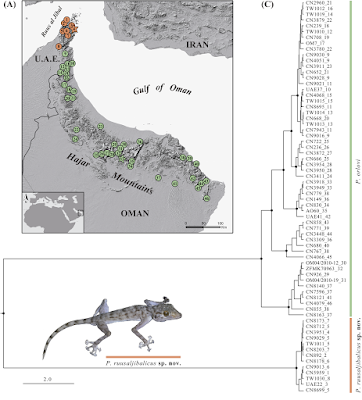
Fig 1. Geographical distribution and phylogenetic relationships of the two species from the Hajar Mountains. 


Fig 5. View of the common habitat in the mountainous Ruus al Jibal and general appearance in life of Ptyodactylus ruusaljibalicus sp. nov.
  
(A) Rocky habitat in the type locality on the 23rd of April 2013. (B) Holotype of P. ruusaljibalicus sp. nov. (voucher code NHMUK2013.347) including a detail of the cloacal tubercles at the tail base.
 All photographs taken by Salvador Carranza. 

Taxonomy

Despite the high level of crypsis between the populations from the Ruus al Jibal and P. orlovi in the characters studied here, the results of the two mitochondrial and four nuclear gene fragments analysed (Figs 1B, 1C and 2) clearly show that these two lineages have been evolving independently for a long time. As a result of that, and based also on a few morphological traits (see diagnosis below, Tables 1 and 2 and S3 Table), we describe this unnamed population from the extreme northern part of the Hajar Mountain range as a new species.

Family Phyllodactylidae

Genus Ptyodactylus Goldfuss, 1820

Ptyodactylus ruusaljibalicus sp. nov.

Etymology. The specific name “ruusaljibalicus” is an adjective that refers to Ruus al Jibal, that means “Heads of the Mountains”, where all the specimens that belong to this species have been found to date and from where the species is probably endemic.

Diagnosis. A large size species of the genus Ptyodactylus characterized by the following combination of characters: (1) large size with a maximum recorded SVL of 90.01 mm for males and 85.94 mm for females (only one female known); (2) head narrow with elongated snout; (3) 12–13 infralabials and 12–14 supralabials; (4) dorsum with 9–11 irregular longitudinal rows of round, enlarged and slightly keeled tubercles; (5) absence of enlarged tubercles on the dorsal side of the extremities; (6) four prominent cloacal tubercles at the tail base (two on each side); (7) 9–11 subdigital scales on the 4th finger and 10–11 under the 4th toe; (8) 18–22 terminal lamellae under the 4th finger and 20–22 under the 4th toe; (9) in life, uniform light grey dorsum, some specimens with dark brown transverse bands that extended onto the tail. Underside of body and tail ivory-white.

Distribution and ecology. Despite intensive sampling across the Hajar Mountain range and other areas in Arabia carried out between 2004 and 2014, Ptyodactylus ruusaljibalicus sp. nov. has only been found in the Ruus al Jibal region, from the Musandam Peninsula to the Dibba region in the UAE. It can be therefore considered endemic to this distinctive geographical area (Fig 1A). The northernmost and southernmost localities lie approximately 26 km northwest and 58 km south-west of the type locality, respectively. The minimum distance between Ptyodactylus ruusaljibalicus sp. nov. and P. orlovi is 23 km by air. Ptyodactylus ruusaljibalicus sp. nov. inhabits cliffs and cave fissures, rocks and boulders at different heights. The species is mainly nocturnal, although some specimens were out in the shade during the day.

Proposal of common names.
English: Ruus al Jibal fan-footed gecko
Arabic: الأقدام مروحية الجبال رؤوس وزغة


Marc Simó-Riudalbas, Margarita Metallinou, Philip de Pous, Johannes Els, Sithum Jayasinghe, Erika Péntek-Zakar, Thomas Wilms, Saleh Al-Saadi, Salvador Carranza. 2017. Cryptic Diversity in Ptyodactylus (Reptilia: Gekkonidae) from the northern Hajar Mountains of Oman and the United Arab Emirates uncovered by An Integrative Taxonomic Approach.
 PLoS ONE. 
12(8): e0180397. DOI: 10.1371/journal.pone.0180397


Friday, September 2, 2016

[Herpetology • 2016] Phyllodactylus pachamama Applying n-dimensional Hypervolumes for Species Delimitation: Unexpected Molecular, Morphological, and Ecological Diversity in the Leaf-Toed Gecko Phyllodactylus reissii Peters, 1862 (Squamata: Phyllodactylidae) from northern Peru


Phyllodactylus pachamama 
Koch, Flecks, Venegas, Bialke, Valverde & Rödder, 2016

DOI: 
10.11646/zootaxa.4161.1.2  

Abstract

An integrative taxonomic approach based on morphology, molecular analyses, and climatic niche modeling was used to uncover cryptic diversity in the phyllodactylid gecko species Phyllodactylus reissii. At least three distinct species could be identified among the examined specimens from southern Ecuador and northern Peru. Phyllodactylus magister, described by Noble (1924) from arid Andean valleys of the Chinchipe and Marañón rivers in the Peruvian Department of Cajamarca and synonymized with P. reissii by Dixon & Huey (1970) is elevated from synonymy and a detailed redescription is provided. A new species of the genus Phyllodactylus from the Andean dry forest of the southern Marañón valley is identified and described herein. Phyllodactylus pachamama sp. nov. is differentiated from other South American congeners on the basis of mtDNA sequence divergence, morphological characters, and differences in the realized climatic niche. At least in Peru, P. reissii seems to primarily inhabit the northern coastal region west of the Andes, while the inter-Andean area along the Río Marañón and its tributaries seems to be inhabited mostly by other species of the genus, which are endemic to this area. The Andean valleys are underestimated in terms of biodiversity and lack thorough investigation and conservation actions.

Keywords: Reptilia, new Phyllodactylus, Gekkota, Andes, Marañón valley, realized niche comparison, morphology, species delimitation, Phyllodactylus magister, phylogenetic relationships, molecular analysis, 12S rRNA, 16S rRNA


Etymology. The specific epithet pachamama is derived from the Quechuan language and can be translated as Mother Earth. It represents the name of a goddess revered by indigenous people from South America, and in particular from Andean regions. According to many believers, problems will arise when people take too much from nature, because they are stealing it from Pachamama. This name was chosen to emphasize the need for protected areas along the Marañón river and blames the numerous ongoing mining and dam construction activities for exploiting this unique habitat.


Koch, Claudia, Morris Flecks, Pablo J. Venegas, Patrick Bialke, Sebastian Valverde and Dennis Rödder. 2016. Applying n-dimensional Hypervolumes for Species Delimitation: Unexpected Molecular, Morphological, and Ecological Diversity in the Leaf-Toed Gecko Phyllodactylus reissii Peters, 1862 (Squamata: Phyllodactylidae) from northern Peru. Zootaxa. 4161(1): 41–80.  DOI: 10.11646/zootaxa.4161.1.2

Monday, August 29, 2016

[Herpetology • 2016] Microendemicity in the northern Hajar Mountains of Oman and the United Arab Emirates with the Description of Two New Species of Geckos of the Genus Asaccus (Squamata: Phyllodactylidae); Asaccus gardneri & A. margaritae


 Asaccus gardneri & A. margaritae 
 Carranza​​, Simó-Riudalbas​, Jayasinghe, Wilms & Els, 2016 

 
DOI: 10.7717/peerj.2371

Abstract  
Background
The Hajar Mountains of Oman and the United Arab Emirates (UAE) is the highest mountain range in Eastern Arabia. As a result of their old geological origin, geographical isolation, complex topography and local climate, these mountains provide an important refuge for endemic and relict species of plants and animals with strong Indo-Iranian affinities. Among vertebrates, the rock climbing nocturnal geckos of the genus Asaccus represent the genus with the highest number of endemic species in the Hajar Mountains. Recent taxonomic studies on the Zagros populations of Asaccus have shown that this genus is much richer than it was previously thought and preliminary morphological and molecular data suggest that its diversity in Arabia may also be underestimated.

Methods
A total of 83 specimens originally classified as Asaccus caudivolvulus (including specimens of the two new species described herein), six other Asaccus species from the Hajar and the Zagros Mountains and two representatives of the genus Haemodracon were sequenced for up to 2,311 base pairs including the mitochondrial 12S and cytb and the nuclear c-mos, MC1R and ACM4 genes. Phylogenetic relationships were inferred using both Bayesian and maximum-likelihood approaches and the former method was also used to calibrate the phylogenetic tree. Haplotype networks and phylogenetic trees were inferred from the phased nuclear genes only. Sixty-one alcohol-preserved adult specimens originally classified as Asaccus caudivolvulus from the northern Hajar Mountains were examined for 13 morphometric and the five meristic variables using multivariate methods and were also used to diagnose and describe the two new species.

Results
The results of the molecular and morphological analyses indicate that the species originally classified as Asaccus caudivolvulus is, in fact, an assemblage of three different species that started diversifying during the Mid-Miocene. The molecular phylogenies consistently recovered the Hajar endemic A. montanus as sister taxon to all the other Asaccus species included in the analyses, rendering the Arabian species of Asaccus polyphyletic.

Discussion
Using this integrative approach we have uncovered a very old diversification event that has resulted in a case of microendemicity, where three morphologically and ecologically similar medium-sized lizard species coexist in a very short and narrow mountain stretch. Asaccus caudivolvulus is restricted to a small coastal area of the UAE and at risk from heavy development, while the two new species described herein are widely distributed across the northern tip of the Hajar Mountains and seem to segregate in altitude when found in close proximity in the Musandam Peninsula (Oman). Similarly to other integrative analyses of Hajar reptiles, this study highlights the high level of diversity and endemicity of this arid mountain range, underscoring its status as one of the top hotspots of reptile diversity in Arabia.

Keywords: Phylogeny, Systematics, Arabia, Diversification, Reptiles, Speciation, Taxonomy, Evolution, Mountains, Biogeography


Salvador Carranza​​, Marc Simó-Riudalbas​, Sithum Jayasinghe, Thomas Wilms and Johannes Els. 2016. Microendemicity in the northern Hajar Mountains of Oman and the United Arab Emirates with the Description of Two New Species of Geckos of the Genus Asaccus (Squamata: Phyllodactylidae).  PeerJ. 4:e2371. DOI: 10.7717/peerj.2371