
a plant enters the supermarket, «3:AM Magazine», Daniel Davis Wood editor, March 16, 2026.
Category: english texts
Instructions without Manual
This talk, given at the Cambridge Creation Lab, unfolds as a sustained inquiry into numbers, signs, and memory, approaching computation, notation, and writing as generative rather than instrumental media. Moving between algebra, asemic writing, physics, and typographic practice, Federici reframes numbers as aesthetic entities, silence as a relational medium, and writing as an experimental apparatus—where data, symbols, and material traces converge into living systems of sense.
White Noise, errata | signal loss | unwritten | data, year 2, volume 2, 01/2026 | buy on amazon
Subscribe on SUBSTACK to receive free excerpts from White Noise directly in your inbox.
Authorship as Spectral Reduction

All that remains to be done is to play with the pieces. Playing with the pieces—that is postmodern. [Jean Baudrillard, Interview: Game with Vestiges, On the Beach, no. 5 (Winter 1984): 24.]
I.
Faced with generative models, the idea of a structuring self appears increasingly inadequate. Instead, a dispersive principle emerges: the self does not retain the sign or signal to process it, but decomposes its field of possibilities.
This is not a mere loss of subjectivity, but a shift in function. The decomposition of the message acquires relational value. Writing aligns with the structures of the networks it engages with, without these assuming the role of superior instances. There is no central point absorbing and reorganizing, but a network of connections in which overall order prevails over individual identities. As in a lattice, it is the relations that determine the system’s properties.
From this perspective, the proliferation of artificial entities capable of acting beyond mere imitation may reshape power dynamics, reducing the human to a minimal but functional presence. Human and machine, still perceived as opposed terms, follow convergent trajectories.
In literature, this translates into practices of textual recomposition that do not aim to restore lost authorship but operate within a condition of dispersion. Here, practices such as found poetry and sought poetry are renewed.
In found poetry, the author explored a space in search of a potential text. The gesture resembled restoration more than production: gaps could be filled or left active as structural elements. In sought poetry, the search was mediated by an algorithm, authored or adopted by the writer, used as a selection device.
In both cases, authorship shifted toward method, operating within a framework oriented toward a probable, though not fully determined, outcome.
The use of artificial networks introduces further variables, multiplying modes of encounter with the text. The apparent organicity of inference processes conceals zones of opacity and recursion, bypassable through the controlled introduction of noise in the triggering conditions. In this space, linguistic and mathematical metrics come into relation.
Whether the author acts as filter or detection point, their position has shifted: no longer external to the work, but internal to a genuinely experimental process. Investigation thus oscillates between two poles: a possible synthesis and the detection of a minimal signal.
As Baudrillard suggests, it is in these modes of play that the conditions of writing are redefined today. In dialogue with artificial intelligences—not opposed to the human, not biological—the text ceases to be the product of an individual will and manifests as an open system.
II.
Authorship no longer coincides with the production of sign or signal, but with the definition of a principle of triggering and selection. AI generates a linguistic continuum in which units of sense overlap and interfere; the author intervenes by setting operational thresholds.
Reading functions as a process of discrimination. Machine-generated material points to a plurality of interpretations, which the author filters, intensifies, or attenuates through indirect interventions that do not integrate directly into the work, but guide its emergence. Variants do not constitute narrative alternatives, but modulations.
Selective textual perception takes shape through the interplay between what can be said and what is read. AI provides a diffuse, unstable linguistic output, within which the author focuses on elements that tend to differentiate without stabilizing.
In terms of signal theory, AI can be understood as a generator of structured noise, where the noise itself conveys information. Analysing this output allows dominant components and deviations to be distinguished, establishing the contours of the work. Meaning does not precede the operation: it is its outcome.
Authorship thus defines itself as spectral reduction: a provisional arrest of dispersion that renders, for a given time, a single frequency legible among many.
The relationship between author and AI does not take the form of antagonism, but of operational interaction. AI expands the domain of the possible; the author delimits the present. The emergent work is not transmission, but a pattern of refracted-recompositions within the network.
White Noise, errata | signal loss | unwritten | data, year 2, volume 2, 01/2026 | buy on amazon
Subscribe on SUBSTACK to receive free excerpts from White Noise directly in your inbox.
White Noise n.2
not-quite-archive of errata | signal loss | unwritten | data

co/ordinates : misreading asemic writing as kitsch: scientific forms and structural depth; ten olivetti tables; first study about farfalla; first study across silence; warten auf god; rooks, knights (and other probabilities); negotiating authorship in the age of AI; [ controlled ] generative drift; two letter excerpts (and a recast); cracking the algorithm; being an event; authorship as spectral reduction; stanzas I-III; consciousness as a state of language; hypothesis on a practice of operative writing; short abstract in computational algebra; instructions without a manual; translanguaging in asemic writing: a metric space approach
buy on amazon
Subscribe on SUBSTACK to receive free excerpts from White Noise directly in your inbox.
language effects produced by the dispersion of air in Zurich HB
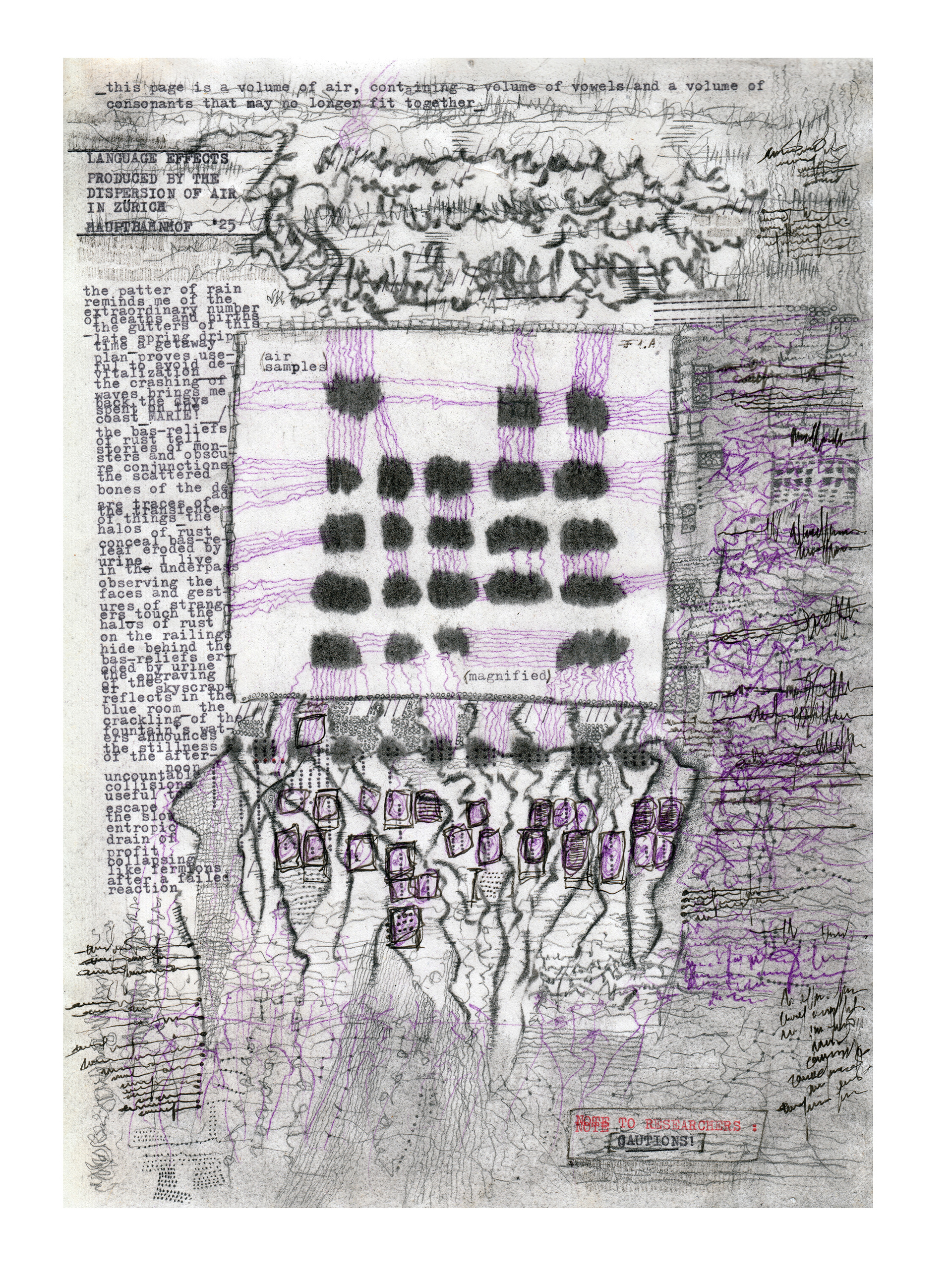
«Cognitive capitalism relies not only on the production of knowledge, but on the optimization of intelligibility. Asemic writing resists this imperative. It is illegible not because it is random, but because it refuses the contract of communicative transparency. The interpretive effort it demands is no longer one of extraction (of content), but of immersion (in form and sensation). It asks us to remain within the indeterminate, the affective, the pre-conceptual—a space outside marketable cognition.» Federico Federici, from Cognitive Labor and the Poetics of Illegibility, in progress.
WHITE NOISE – Volume 1

co/ordinates : editorial; [44.231108, 8.248847]; wind-learning machine; sonogram of bark as a function of wind time; [44.231594, 8.250014]; patterns that characterize the wind in the observed area; winter concert; in vivo z-stacking and 3D-reconstruction of textual patterns; a young reader’s guide to melting ice; the glacier; investigation of empirical tendencies; asemic writing as a field; the patient’s records; difference and repetition; unsigned notice, New York (1967); (rare) essential biogenic elements; a zero-point writing?; abstract set algebra; from world to wor[ ]d; writing in response to a request for a written text; ding an sich; polymorph studies; W.12 [ ] air (“on the loose string”, solo). //// buy on amazon
Objects – Teoksista
W O R K S [ on NOKTURNO.fi ]
Objects under investigation is a collection of separately conceived works that address the problem of textual-related medium and, in a sense, mediality in art from an experimental perspective. The word object[s] is meant as a neuter reference to both the text as a phenomenon and the text as a product in itself. It suggests the idea of something to be physically handled, while not necessarily a physical object.
As stated by Rosalind Krauss, any medium may bring about art, and the special condition conventionally addressed as post-mediality is to employ media traditionally not intended to make art. Discussing the medium when dealing with broadly intended textual objects is rather challenging. The issue cannot, in fact, be restricted to the invention of a set of unreadable signs §apparently disjointed from reality, as in the case of asemic writing, nor to the combination of such signs with alphabets or languages from the most disparate fields, as with other hybrid forms. The process of writing becomes open, yet more intrinsic, and the concept of medium gets reframed. Moreover, since writing is hardly separable from reading, a further and possibly even more complicated field of investigation comes into play: what does it mean to “read” something asemic? Does it make sense to attempt to sequence an asemic pattern? Reflecting upon this as a feasible connection to sound-poetry, a twofold proposal is presented: the first two audios feature a texture of noise and words stemming from partially asemic pieces, while the third one explores the phenomenon of a glacier melting, recorded through a set of contact microphones and later remixed, resulting in the hybrid forms of “EIS”.
From a linguistic point of view, a medium partakes as an idiom of a particular art practice. It is the trait that cannot thoroughly be translated or transferred to another practice. Its Latin etymology reads “what lies in between”. The two competing polarities of this relationship must hence be investigated. A medium sets itself as a middle term between ‘reality’ (whatever one may define by this) and ‘reification’ or, narrowing the scope, between what an art piece is aimed at (‘objectivity’) and what it ultimately consists of (‘objectification’).
It is a ‘tension’ in both that objectivity and objectification tend to overlap (while hardly or partially actually doing so) and in the sense of the tensor, which defines the metric within the space (mathematical, artistic and so forth) under investigation, i.e., the tools that set out the proper relationships between the ‘objects’ considered.
It is a method (a system of rules or procedures) to work out the cross-breeding of different practices, like the folding of surfaces in abstract geometry. This resembles the idea of curvature, which Albert Einstein identified as the inherent property of spacetime which is ‘responsible’ for gravity: “matter tells spacetime how to curve and curved spacetime tells matter how to move.” Signification no longer appears as something emanating from particular nodes (words) or well organized clusters of them (lines, sentences) and propagating through the text, but as a feature of the text[ure] itself. If a body’s weight on Earth can be ascribed to the fact that it is traveling through a warped spacetime, why not apply the same description to the feeling of detecting signification throughout an asemic field and envision it as a sort of warped textual surface, whose words are possibly elsewhere but not far enough to be neglected?
The relational structure is the true essence of the textual medium and includes the metric set by the printed, painted, typewritten, handwritten, generative and so forth signs combined with a variety of materials (papers, cardboards, plastic sheets, glues, et cetera) that potentially enrich and further complicate the linguistic stack. Both the ‘writer’ and the ‘reader’ operate at an experimental level: the writer sets up the experiment, collects some preliminary data that the reader interprets.
But the ‘writer’ is, in turn, a ‘reader,’ possibly the first, and his role is rather delicate since, in the asemic field, he must avoid disturbing the signs with too much consciousness. His consciousness is to be analytical right before and at the end of the process, not so much in the making of it sign-by-sign, not as a word-by-word writing.
Asemic works evoke interference patterns, extended fields of sense whose elements of signification are not word-situated. They are seats of signs that reinvent or conceal their meaningfulness to deliver it into new contexts.
The combination of words and asemic signs presents a further degree of complexity since the linearity, first of writing then of reading, is faced with the nonlinearity of vision. The interaction between strings of words or full sentences and asemic components doubles the experience of a metric. The residual readability of the text with its metrical content and the metric space of the visual arrangement of both words and asemic signs add up and lead to a sort of hermeneutic pressure that the act of ‘reading’ only partially releases.
Objects under investigation on kokoelma teoksia, jotka tutkivat tekstuaalisen mediumin kysymystä ja mediaalisuutta taiteessa kokeellisesta näkökulmasta. Sana objekti on neutrinen viittaus sekä tekstiin ilmiönä että tekstiin tuotteena. Se ehdottaa ajatusta jonkin fyysisestä muotoutumisesta, samalla kun kysymys ei välttämättä ole fyysisestä objektista.
Kuten Rosalind Krauss ehdottaa, mikä tahansa mediumi voi saada aikaan taidetta. Jälkimediaaliset olosuhteet viittaavat sellaisten medioiden käyttöön, joita perinteisesti ei ole suunniteltu tai tarkoitettu taiteen teon välineiksi. Mediumin käsite on monimutkainen puhuttaessa tekstuaalisista objekteista. Ilmiötä ei voi rajata semanttisesti merkityksettömien, todellisuudesta irrallaan olevien merkkijoukkojen keksimiseksi, kuten aseemisen kirjoittamisen tapauksessa, eikä liioin tällaisten merkkien yhdistämiseen täysin itselle vieraiden aakkostojen tai kielten kanssa, kuten toisissa hybridimuodoissa. Kirjoittamisen prosessi muuttuu avoimeksi, ja samalla kuitenkin implisiittiseksi, ja mediumin käsite tulee kehystetyksi. Lisäksi, koska kirjoittaminen on vain vaivoin erotettavissa lukemisesta, laajenee kysymys edelleen ja mahdollisesti vielä monimutkaisemmaksi: mitä tarkoittaa aseemisen kirjoituksen lukeminen? Onko järkeä koettaa sekvensoida aseemista kuviota? Pohdittuani aseemisuuden mahdollisia yhteyksiä äänirunouteen, esittelen kaksinkertaisen ehdotuksen: ensimmäiset kaksi ääniteostani sisältävät melun tekstuureja ja sanoja, jotka juontuvat osin aseemisista teoksista. Kolmas ääniteokseni taas tutkii jäätiköiden sulamista, joka on äänitetty kontaktimikrofonivälineistöllä ja myöhemmin uudelleenmiksattu, mikä on johtanut EIS-teoksen hybridisiin muotoihin.
Lingvistisestä näkökulmasta medium on tietyn taiteen praksiksen puhetapa, piirre, jota ei täysin pysty kääntämään tai siirtämään toiseen praksikseen. Termin medium latinankielinen etymologia viittaa välissä olevaan (eng. ’what lies in between’). On syytä tarkastella tarkemmin tämän sidoksen kahta vastakkaista napaa. Medium asettautuu keskinapaiseksi termiksi ’todellisuuden’ (eng. ’reality’, kuinka se sitten määritelläänkään) sekä ’konkretisoinnin’ (eng. ’reification’) välillä, tai vielä tarkemmin: sen välillä, mihin taideteos pyrkii (objektiivisuus, ’objectivity’) ja mistä se ehdottomasti koostuu (objektifiointi, ’objectification’).
Syntyy jännite, joka johtuu ensinnäkin siitä, että objektiivisuus ja objektivisointi pyrkivät limittymään (samalla kun tuskin tai vain osin todella limittyvät), ja toiseksi tensorista (geometrista tilaa kuvaava fysiikan käsite), joka määrittää tutkittavana olevan tilan metriikkaa (matemaattista, taiteellista, ja niin edelleen), eli välineitä, jotka määrittelevät valittujen objektien välisiä suhteita.
Erilaisten taiteen praksisten välimaastossa työskentely on metodi (sääntöjen tai proseduurien järjestelmä), kuten pintojen taittuminen abstraktissa geometriassa on. Se muistuttaa kaarevuutta, jonka Albert Einstein määritteli avaruusajan luontaiseksi ominaisuudeksi, joka vastaa painovoimasta: ”aine kertoo avaruusajalle, kuinka kaartua, ja kaartunut avaruusaika kertoo aineelle, kuinka liikkua”. Merkitys ei enää näyttäydy jonkin erityisen solmukohdan (sanat) tai niiden hyvin järjestäytyneiden ryhmien (säkeet, lauseet) virtaamisena ja tekstissä leviämisenä, vaan tekstuurin itsensä ominaisuutena. Jos ruumiin paino maapallolla voidaan yhdistää kiitämiseen vääristyneen avaruusajan läpi, voisiko samaa ilmiötä soveltaa tunteeseen merkityksellisyyden löytämisestä aseemiselta kentältä. Tällöin aseemisuuden voisi kuvitella eräänlaiseksi vääristyneeksi tekstipinnaksi, jonka sanat ovat mahdollisesti toisaalla, mutta eivät niin kaukana, että niiden olemassaolon voisi täysin kieltää.
Relationaalinen rakenne on kirjallisen mediumin olemus ja se pitää sisällään tulostetut, maalatut, konekirjoitetut, käsin kirjoitetut, generatiiviset ja muut merkit, jotka yhdistyvät erilaisiin materiaaleihin (papereihin, kartonkeihin, muovilevyihin, liimaan ja niin edelleen), mikä rikastaa ja edelleen monimutkaistaa lingvististä kekoa. Sekä ’kirjoittaja’ että ’lukija’ toimivat kokeellisella tasolla: kirjoittaja rakentaa kokeen, kerää alustavaa tietoa ja lukija tulkitsee sen.
Mutta ’kirjoittaja’ on kuitenkin myös ’lukija’, mahdollisesti ensimmäinen sellainen, ja hänen tehtävänsä on varsin hienovarainen, sillä aseemisella kentällä hänen on vältettävä merkkien rikkomista liialla tietoisuudella. Hänen tietoisuutensa on oltava analyyttista juuri ennen ja jälkeen prosessin, mutta kirjoittamisen hetkellä kysymys ei ole merkki kerrallaan etenemisestä, ei samoin kuin sanoilla kirjoittaessa.
Aseeminen teksti saa aikaan häiriömäisiä kuvioita, merkityksen laajentuneita kenttiä, joilla merkityksen elementit eivät ole sanallisia. Ne ovat merkkien sijoja, jotka keksivät uudelleen tai kätkevät merkityksellisyytensä kuljettaakseen sen uusiin konteksteihin.
Sanojen ja asemaattisten merkkien yhdistelmä luo lisää monimutkaisuutta, sillä ensin kirjoittamisen ja sitten lukemisen lineaarisuus kohtaa näkemisen epälineaarisuuden. Sanajonojen tai kokonaisten lauseiden ja aseemisten komponenttien välinen vuorovaikutus kerrostaa luetun tai koetun merkityksiä. Tekstin ja sen sisällön jäänteinen luettavuus ja sekä sanojen että aseemisten merkkien visuaalisen asettelun tila yhdistyvät ja johtavat eräänlaiseen hermeneuttiseen paineeseen, jonka ”lukemisen” teko vapauttaa vain osittain. [translated by Elina Sallinen ]
On a certain practical uncertainty – Kindle edition

buy: barnes&noble | kindle | amazon.com | .uk
Berlin n.3 – 柏林其三 (translated by Zihan Zhang)

Berlin n.3/柏林其三, «诗殿堂 / Poetry Hall», Tr. by Zihan Zhang/张紫涵译, Sylvia Cavanaugh editor, issue 10, December 31, 2020.
Further images, documents and texts here: Vertebrae: a book of abandoned buildings and bodies, LN 2019, ISBN 978-1710418811 [Eng]
buy: barnes&noble | amazon.com | .uk • read: archive
The Berlin texts – 01

Subscribe: Apple Podcasts | Google Podcasts | Android | Podcast Index | TuneIn | RSS
The waste wall, November 1961, Nassau Review Poetry Award 2019, «The Nassau Review», NCC editors, May 2019.
Further texts are available here: Vertebrae: a book of abandoned buildings and bodies, LN 2019, ISBN 978-1710418811 [Eng]
buy: barnes&noble | amazon.com | .uk • read: archive
 WEISSES WERK