
I believe this barn may have been associated with this historic farmhouse. It’s a classic hay barn with a tractor shed on one side and stock stalls on the other. The photograph dates to 2013.

I believe this barn may have been associated with this historic farmhouse. It’s a classic hay barn with a tractor shed on one side and stock stalls on the other. The photograph dates to 2013.

In architectural parlance, pen is just another word for room, and when considering the hard lives sharecroppers faced, it seems cruelly appropriate. Some call these utilitarian houses “early duplexes” and in some cases, it’s true that two families lived in them, but more often than not, the term double-pen just means two rooms.
The Georgia Historic Preservation Divisions has this to say about the double-pen cottage: “Double-pen houses consist of two rooms, typically square. As in the single-pen house, the arrangement and location of openings varies, but the most easily recognizable double-pen house has two doors in the main facade. Chimneys or flues may be located at either or both ends. Gabled roofs are the most common by far. Few double-pen houses remain in their original form in Georgia. Most of these were constructed for agricultural or industrial workers between the 1870s and 1930s…”
I believe this tenant house is the last remaining structure on this historic farm property. The Durrence family had a large tobacco operation here at one time. As to the house, it sits on modern tapered cinderblock piers so it has been re-settled, as a means of preservation. It has no impact on the importance of the structure. .

This historic home is located in the Altamaha community. According to Kent Pearson, “Laurence Pearson (1831-1911), a carpenter and joiner, did indeed build the house which was owned and occupied by four generations of the Pearson family. Laurence was the son of John Pearson (1777-1857) of Pennsylvania, who established the family in Tattnall County in the early 1800’s. John built the first sawmill in the area on Slaughter Creek when he purchased a 1000 acre parcel of virgin timber land in 1832 for the princely sum of $1,200, where the family homestead and farm were located. Laurence’s brother, John (Jr), was also a carpenter. Between them, they built a number of houses in the area. And according to John P. Rabun, Jr., John Pearson and George Merriman built a Greek Revival courthouse in Reidsville in 1857.“

The house is presently part of Red Earth Farm. Another notable Pearson House is located just down the road.

I photographed this partly deconstructed farmhouse with Mike McCall in 2010. I’m unsure as to its fate, but it was a nice example of a common type of rural housing in this area. The gable vents are of a style I call “vernacular Gothic” for lack of a better term. I guess “church window” vents would also apply. Whatever their correct terminology, they were once widespread in this part of Southeast Georgia.

The Camilla-Zack community, which was first known as Springfield, and later the Log Cabin community, for the structure documented in this post, was an historic Black community established by Zacharias (Zack) Hubert (1845-1926) in the 1870s.

Hubert was born enslaved in Warren County on the plantation of the French Huguenot immigrant family of Benjamin B. Hubert (1720-1794). Zack’s father, Paul, also born on the Hubert plantation, served as its foreman and memorized passages from Bible without knowing how to read or write. Hiram Hubert encouraged him to preach, even though Georgia law prevented it, and he was “allowed” to marry Jincy, a house slave, in 1832. To their union were born eleven children, including Zack. Zack was the constant companion of Henry Clay Hubert (1842-1930) on the plantation, and despite Georgia laws, was encouraged by his enslaver to read and write.

After the Civil War, the newly freed Hubert slaves rented land near the Hubert plantation, but upon the death of their father in 1868, sought to move away to new land. In 1869, Zach rented a 20-acre farm near Powelton, in Hancock County, and soon found a lawyer in Sparta named Henry Burt who was willing to sell land to anyone, including freedmen. The land was characterized by stumps and rock, but soon Zach, and two of his brothers, David and Floyd, made an agreement with Burt and purchased 165 acres of land at $10/acre, to be paid in 3 years. The brothers vastly improved the land and the debt was paid in full, but Burt rescinded his offer of a full title after the agreed-upon three year contract. The Huberts were undaunted.

They continued to pay rent on land they had already paid for and soon found a White lawyer, Poulton Thomas of Crawfordville, who encouraged Henry Burt to honor his agreement with the Hubert brothers. After some legal wrangling, including threats of breach of contract, Burt capitulated and in 1876 the Hubert brothers became the first African-American landowners in Hancock County, and possibly in the entire region. During this time, in 1873, Zack met and married Camilla Hillman (1858-1925). They had twelve children, two of whom became college presidents. Zack was the de facto leader of this growing community, establishing a church and school.

The Camilla-Zack Country Life Center, as it was originally known, was the focal point of the community, symbolically and literally. It was built by the Hubert sons.

Benjamin Franklin Hubert (1884-1958) established the Association for Advancement of Negro Country Life in 1929 and the Center was a culmination of his vision. He became president of the Georgia State Industrial College [now Savannah State] and served in that capacity until his retirement in 1945.

550 pine logs taken from the surrounding forest and 150 tons of local granite were used in the construction of the Center. Including the porches, the building contains over 2500 square feet of usable space.

The rooms are trimmed with pine and the ceilings feature exposed timbers. The large central community room is anchored by a large granite fireplace. There is also a library in the center, and a kitchen and dining room, as well as bedrooms and an indoor bath.

A cement swimming pool was built about 300 yards behind the Center adjacent to a clear spring. There was also a health center on the property, but it is no longer extant.

It wouldn’t be an exaggeration to call this community a sort of Black Utopia, in that it thrived with little interaction with the wider world, an island unto itself during the dark years of the Jim Crow era.

By promoting self-sufficiency and land ownership, in tandem with a strong embrace of education, the community met its goals. For several years, Black rural teachers even came for training on community involvement. And by 1940, Blacks owned 27,000 acres of land in Hancock County.

The Log Cabin community, as it came to be affectionately known, weathered the years of the Great Depression in good stead and survived into the 1950s.It was even held up by segregationist governor Herman Talmadge as an example for Southern rural blacks to emulate. By that time modern trends were taking people of all races away from the countryside with the promise of better lives in rapidly expanding urban centers.

Ben Hubert, who never married, died in 1958. The Center and surrounding property were left to his siblings, and Mabel Hubert Warner (1900-1973) purchased their shares in 1962. It is still in the family and has been recognized as a Georgia Centennial Farm.
Camilla-Zack Community Center District, National Register of Historic Places

A 1988 survey of historic resources in Jones County documented this structure as part of the Lamar Farm, which at the time included a farmhouse and three outbuildings. The survey also noted the Bateman Company had owned the property since circa 1953 and been involved in the peach business.

Though no determination was made in 1988 as to the function of this structure, its location along the rail line, the shed doors, and the loading platform suggest a freight warehouse. This may have been a modification for the Bateman peach business or may have been an original use. The lack of windows in the structure also indicates a warehouse usage.

This house was the center of a small farm that was kept up for many years, even when no one lived here. The photograph dates to 2010; the house was recently demolished. There are still barns on the property, painted bright red like the house.

This stock and hay barn stands on a property which still includes an Irwinville Farms house. These amazing utilitarian structures were built for about $200 during the Great Depression as part of an economic rescue program designed to bring farmers out of the devastating downturn which began in 1919 with the proliferation of the boll weevil and continued until the start of World War II. A few of these barns remain today, in varying states of repair, but all should be considered of historical importance.
I’ve discussed Irwinville Farms extensively in the past and will be updating some sites I’ve already visited, as well as adding other examples from my archive.
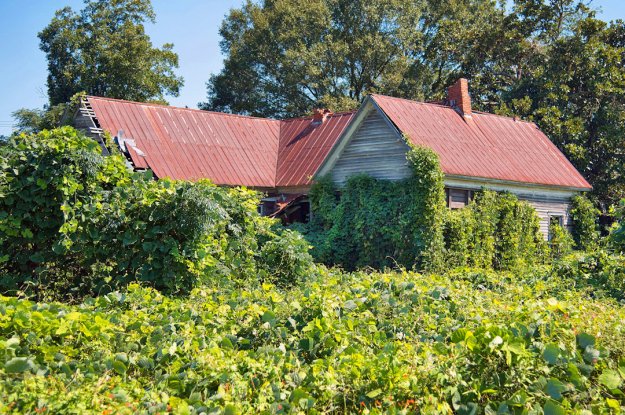
Oakville, like many places I photograph, has been forgotten by nearly everyone. It was likely named for a plantation of farm, since there was never a post office or railroad station named Oakville in Terrell or Randolph County. The only thing I could find, besides plenty of kudzu, was this abandoned farmhouse.

This exquisite Georgian Cottage, heavily influenced by the Greek Revival, is, architecturally, one of the finest houses in Lee County. According to the History of Lee County, Georgia (1983), it has traditionally been known as the Byne Plantation. It’s still at the center of a large working farm in the historic Oakland community.
Gilbert M. Byne (1825-1910) was the first member of the Byne family to live in Lee County, establishing a large plantation near this site upon his arrival. He married Georgia Virginia McKnight (1854-1924) of Coweta County in 1883 and continued to expand his land holdings throughout his life. He also served as a Lee County commissioner. Gilbert’s grandfather, the Rev. Edmund Byne (1730-1814), migrated from King and Queen County, Virginia, to Burke County, Georgia, in 1781, and founded two churches there.
I first thought the house to be of antebellum construction but after consulting the Lee County history, believe it was built in the early 1880s, soon after Gilbert was married. The history notes that he had a new road cut through the area to accommodate such a place. The Bynes’s only child to live to adulthood, Marilu Byne (1890-1979), married Alvah Wallace Barrett, Sr. (1889-1956), and they continued to maintain the plantation until the waning days of the Great Depression, when they lost the property through a mortgage to the Haley family.
The Georgian Cottage type, two bays deep divided by a central hallway and therefore symmetrical in layout, is inherently Greek Revival in spirit, and this house certainly exemplifies that. It’s a well-maintained beauty.