If you’re new to sourdough, a sourdough starter is a live fermented culture of flour and water. Once it becomes bubbly and active, a small portion is added to your sourdough bread recipe to make it rise- no commercial yeast is required.
You’ll find more detailed writing and supplemental information in my book (trust me, I could go on and on!) but for now, all you need to know is this: without a sourdough starter the whole concept of sourdough baking would not exist.
So, what type of container is best for your starter? Does it even matter?
In my experience, sourdough storage depends on the baker’s preference.
To be honest, I’ve never heard of a container that’s necessarily good or bad, but I’m sure you’ll get all kinds of opinions if you ask around! In fact, I love when people post their starters to Instagram or to their blog. It’s fun to see the variety.
Here are four simple options to get you started:
1.) Glass Jar
This is my personal favorite. Over the years I’ve moved away from plastic containers and Tupperware out of choice. I like glass. It’s easy to clean and you don’t have to worry about any weird chemicals leaching into your starter.
Also, because glass is clear you can see everything that’s going on inside (all the bubbles, foamy stuff, any liquid… ). This instant visual access is super important when getting to know your starter and what you can do to fix it, if necessary. I’ll never forget: over the summer a fleet of fruit flies decided to take up residence in my jar. Had I been using a solid container of some sort, I never would’ve seen them! Gross, I know.
There are all types of glass jars you can choose from: mason jars, jam jars, latch top jars, canning jars with those metal ring tops you can never find… it’s up to you.
Regarding jar size, it’s all relative to the amount of starter you currently have or want to maintain in the future. Your starter will grow to at least double in size, sometimes more, and you’ll need a jar to accommodate this. You can cover it loosely with a lid, plastic wrap, or even a small cloth. I go back and forth depending on my mood. Keep in mind, the jar might burst if the lid is on too tight which means you’ll run the risk of getting glass shards in the mixture. This happened to me once and I had to throw the whole thing out.
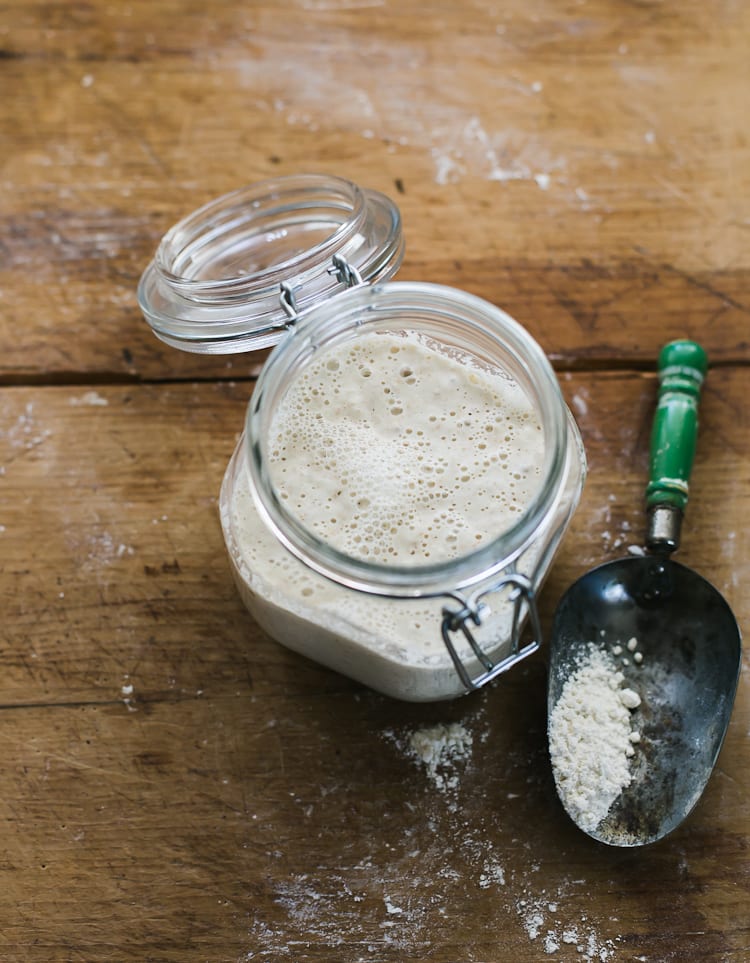
I use a 3/4 L jar for my starter, which is pictured above. You can purchase it here.
2.) Plastic Container
Although my preference is glass, I first started with a plastic container. I had no problems with it at all. From memory, I think it was a small, random BPA-free Tupperware container I unearthed from the depths of my kitchen cabinet.
As previously mentioned, I moved away from plastic. But there’s another reason why I made the switch: size.
Most plastic containers (unless you’re using a Chinese quart container for soup) are not tall. They’re wide and squat. I didn’t like this because it was hard to tell when my starter had doubled in size, which is a visual benchmark for when it’s ready to use.
In comparison to glass however, plastic doesn’t break; it only melts should you leave it on the bottom rack of your dishwasher ;)
3.) Pint Jar
When all of my glass jars are dirty or being used for something else, I use a pint glass! Yes, the kind you drink beer from at a bar. These are perfect for sourdough starters. They are nice and tall, and you can cover the top with a cloth or plastic wrap. Any type of large and tall glass will do. I have a stash in my kitchen.
4.) Stoneware Crock
Personally, I’ve never used this. King Arthur Flour offers large sourdough crocks which seem pretty popular. The selling point is that its material is non-reactive and the crock itself is easy to identify, so you won’t accidentally throw it out because it looks like pancake batter in a jar (see option #3). Unlike glass, I’m pretty sure these crocks do not burst easily either. Regardless, I still prefer clear containers so I can monitor what’s going on inside.
♦ ♦ ♦ ♦ ♦ ♦ ♦
Whatever container you choose, the trick is to play around to see what you like.
You might begin with a certain jar only to realize that it’s particularly annoying to clean, which then motivates you to switch to something else. And this is okay. Plus, overtime your starter will form crusty bits of dried flour at the top of the container and near the lid. When this happens (and it will), you’ll need to change it out anyway. So get creative and experiment with what you have!
So what about you? What type of container do you use for your sourdough starter?

Comments
Kim says
First time making croutons and love them made out of sd. I didn’t have dill but used garlic powder and fresh Asiago cheese. Came out delicious.
C. H. says
Rebecca,
One of two things could be happening. – You may have introduced some bacteria to the jar. However, I imagine it is just the dark liquid that forms on some sourdoughs when it isn’t being fed enough. Look up Hooch – see if this matches what you think is mold.
Don’t give up! It is worth the effort.
Renee says
Your raison cinnamon bread recipe was delicious. It was so tender, soft and tasty. I would give it five stars. Do u have a cinnamon pumpkin bread
Using the starter. If so; I would would have it. Thank you.
Les says
Hi Emilie, I’ve followed your brilliant instructions from scratch and now have a great starter that I’m confident to use/maintain and am at last making some really nice loaves of bread, so thank you for making this a simple and strait forward process, simply fantastic! I do have one question, if I wanted to make up another starter, can I simply spoon some of the existing one into another jar and then feed it up etc? Many thanks again, Les.
Rebecca Martin says
I get mould on the side of my jar after about the 5th day. Why would that happen?
Suzan says
Hello Clever Carrot!
I bought the Bormioli Rocco jar from the link in this article, however I wasn’t sure if it should be clamped shut while the sourdough is feeding which seems like it wouldn’t be able to breathe, or if it should just be notched over the clasp with a large gap opening. Or should the gasket be taken out and then clamped?
Thanks for being the sourdough queen!
Suzan
Luella says
I use a plastic container with a lid for a portion of discard that is always handy for “discard” recipes. That is afterall a starter in it’s own right…. I change it out every couple of months.
My true starter stays in a glass jar with a coffee filter and ring rather than the lid itself. This was very helpful to me because i am still learning. My starter, also known as “Leviathan” thanks you as well 😉;)
Shelle says
I’m thinking of using an old candle jar for my starter, I never know what to do with them, they have lids and are clear glass.
Dana Chalamet says
I wouldn’t as it’s most likely NOT food safe glass. Who knows what you’ll be leeching into your dough.
Mindi says
I bought dehydrated sour dough starter and a glass sour dough container. This is day 3 for me and I’m not sure which lid to use. It came with a solid wood lid with a plastic ring to fit tight, and a breathable fabric with elastic to hold to the jar.
I’m starting this journey completely clueless lol, so this page will probably save future me some tears!
Julie Parisi says
I have a talk ,lock n lock
sharon wilson says
I’m new at this. I purchased starter from someone and forgot to ask how much starter there was in the jar. Kinda did a take out measure. I wonder if going to work.
also wonder if I could use the discard to make another feeder jar. ??
Thank you,
Sharon Wilson
Graham Bulmer says
Does the starter glass jar need to be air tight or do you need some air exchange to take place?
Emilie Raffa says
It depends on how you feed, store and maintain your starter. I recommend having a lid on hand to keep it airtight as needed, for example, if you store your starter in the fridge. When storing it room temperature, it’s nice for some air to get in above and beyond when you feed it, so resting the lid on top is sufficient and keeps the flies out.
Linda says
I love your site very informative I am new and nervous in starting. A friend give me some hydrated starter . How doi rehydrate it .thank you so much. You are awesome
Joe says
How did the fruit flies get inside a sealed jar?
Judith Caminiti says
This was really helpful!
Thank you
Marie says
Very helpful information about the types of vessels for sourdough starter. I am just beginning my sourdough journey, but I like glass, too!
Rudy says
What’s the best lid for storing in the fridge? I currently use a Weck jar with the glass cover, rubber gasket and clips. I never thought about it bursting but it’s a very good point!
Amal says
I am starting on my sourdough journey. I would like to use the latch type jar. Should I remove the rubber seal and latch it without it so pressure doesn’t build up?
William R Smith says
I use a paper coffee filter and a rubberband.
Chris McCallum says
I’ve left it slightly ajar just resting the lid on and it seemed to work. I think cheesecloth might be ideal with an elastic. I’m not sure sure. I’ve also used a plastic wrap placed over it or even a large ziploc baggie.
Amelia Chipman says
I saw a lady that removed it so I did on the 2 I am using to grow my starter.
Izzie says
Hi! I am about to start on my sourdough starter journey (wish me luck!). I have the same type of glass jar you use in this post (with the air-tight clamp). Can I clamp it shut or is it advisable to use a plastic wrap/cloth cover instead. Thanks!
Beth says
I bought your book, but due to a shipping error, it has been delayed. I went by the recipe listed here for the starter and I don’t know what I am doing wrong. Started off great, but I’m on day 5 and have not seen it grow and deflate. I have a rubber band around the jar. I did have one day with hootch, poured it off, and fed it. Started to feed it twice a day, but nothing. I have moved it to the microwave ajar with the light on. Today I moved it to a new jar as the other was crusty.
Do I just keep feeding it twice a day until grows?
Emilie Raffa says
Hi Beth! It sounds like your starter needs more time to cultivate the yeasts- this is normal. Sometimes it can take up to 2 weeks or more to become established, especially if the weather is cold. Conversely, if the weather is warm (or it’s placed in a spot that’s too hot for too long) your starter will actually rise and fall very quickly, giving the illusion that it’s not active when in fact it is- you just missed the growth. In you case, I’m not sure if you need to feed it twice a day at this point. I would feed it 1x/ day, per the recipe instructions. Instead of the microwave tip, try a hot water bath instead to give it a boost. To do so: Fill an appropriate sized bowl with hot water (not too hot) and place your starter inside. Monitor for bubbles inside the jar. Change the water out ever so often when it eventually becomes cold. Good luck!
Susan says
I’m really excited to create a starter and bake my way through your book. I purchased the spiral bound edition and everything looks amazing. I have several of the glass jars & I intend to use one of them.
Emilie Raffa says
Fantastic! Enjoy the journey, Susan!
Cassandra says
Can I use a tall pickle Jar? I never made sourdough bread before and I just got my stater but the only container I have is this.
Please help
Thank you
Emilie Raffa says
You most certainly can! Any tall jar works. You’ll be fine with what you have. FYI: As you get to know your starter, keep an eye on it after it’s fed (when stored in glass jars). If there’s too pressure much build up, and the top is screwed on too tight, the starter might burst through the jar.
John says
Hey there, my starter is in a glass jar and I’m not sure if I should keep the lid on tight/loose or not at all. Does having the lid on deprive it of oxygen? Thanks
Susan says
Yes ,
this was very helpful information. I am hoping to make my starter soon.
Bev says
Hi Emilie, I am a new Sourdough enthusiast and am loving your book and videos!! They are so helpful for my Sourdough Adventure! Thank you so much!
Bev
Calgary Alberta
Canada
Efffie says
Yesterday I fed my starter for the second time after it was in the fridge for a few days, to leave the counter overnight. I used a bamboo cup for this (the firm type, that looks like plastic). After maybe two hours, I saw that the cup was cracked, thinking I just hadn’t noticed this, and transferred the starter to another (similar) bamboo cup and left it on the counter overnight. This morning I saw that maybe 5 centimeter from the wall of the tray was completely gone. Dissolved or something. Also the edges of the bottom were just gone! I have used these bamboo cups before but never had something like this. Any thoughts how this is possible?
Many thanks
Simonne says
Possibly you CANNOT store plant in plant.
Karen Irmscher says
I love your book, which I first checked out from the library then bought one of my own because I wanted to eat everything in it. . My next loaf will be my 7th attempt. None have turned out lofty and airy like your pictures, though some have had your lovely designs on top. I want them to be at least partly whole wheat. Using about 2/3 King Arthur bread flour.
I live in the Pacific NW where the air isn’t warm this time of the year. My house is usually about 70. Even though my starter is bubbly and refreshed, the bread comes out dense and heavy. I’ve tried turning the oven on, then off, for the bulk rise. One of the times I forgot to turn it off, so I ended up with a partially baked glob. The birds and squirrels liked it well enough. I’ve tried an ice chest with a heating pad, but maybe that was too hot. You say keep it between 70 and 80 F. I l looked online for thermometers, but most start their readings at 100.
Recommendations for the problem and/or type of thermometer to look for and source. Thanks for any help you can give.
Margie Reardon says
I’m not sure what to do with my stater that has reached the top of my jar. Can I put some in another container and will it hurt my baby if I do. I used the pasta sauce jar, very clean because we use them to put a drink in. I did 1/2 cup whole wheat flour, 1/2 all purpose flour and 1/2 cup water. So I’m lost day 2. Margie
lucy says
i had the same problem :(
Katie says
My started is on its way so I need a jar, and found this page really helpful! I was looking at a fermenting jar, which allows built up gases to escape out of the top. Is this an appropriate container? The starter supplier said I need an airtight jar but lots of people seem to put cloth over the jar so I’m a bit confused.
Thanks!
Emilie Raffa says
Hi Katie! You can go either way. Sometimes I keep my starter completely airtight if I really want to build up the air bubbles. Or, if there are fruit flies around (they love starters in the summer) the lid is necessary. Other times, for a little bit of air, I just leave the lid on top of the jar (not airtight). Works fine. Some bakers use a cloth, but I’ve found that too much air can get inside which dries out the surface of the starter.
Colleen Richardson says
Your post was very helpful. I ordered a 1/2 Ball canning jars and they won’t be here in time. My starter is on Day 5 and the canning jar it’s in will not be big enough. I have a big plastic container for making artisan bread. Can I use that or should I divide the starter into two jars and divide the feedings that way also? I hope this makes sense and thank you!
Colleen
Ann H says
First, I want to say I LOVE your book. Purchased the Kindle version when the paperback was out of stock and bought the paperback! Quick question… I’m following your baking schedule by feeding my starter on Friday morning to make my dough that evening. I have max rise in my starter late afternoon and mix dough that evening then feed starter and keep it on the counter. Next morning, if I want to bake something else… will I need to discard and feed before using starter or can I use the discard in the morning for my dough without a feed? Didn’t know if not having the starter at max volume would make a difference.
I hope this makes sense. Can’t wait to try more of your recipes… the Saturday Morning Fruit & Nut Toast is truly amazing…my family REQUIRES at least 1 loaf a week (dried tart cherries & cranberries with pecans)!
Lee Hopkins says
Hi,
Do you have to discard every time or could I just add to the current volume to increase the amount? Current starter, Alma, – 3 oz. Add 3 oz flour and 3 oz water?
Thanks,
Lee
Nick says
You can, but now you’ll have 9 oz of starter. Then, you’ll have to add 18 more ounces to that, and it’ll continue to triple in size. Discarding makes it so that you keep just as much as you need (and you don’t end up wasting more flour than necessary.) There are also lots of good simple recipes to use discarded starter for (like sourdough pancakes!)
RuthAnne Sulja says
Hello there! I just received some sour dough starter in a jar from a friend. When I got home I put it in the fridge. My question is, if I want to make something with it like waffles, do I leave it in the fridge until the day I want to make something or do I take it out of the fridge the night before?
Emilie Raffa says
I would take it out the night before. If it develops a layer of liquid on top, discard it before using.
Ashrrita says
My Starter is named Mr. Vincent Van Dough and he is 10 days old :)
I actually bought a pair of identical 1L Mason Jars and I use those to store the starter. After every feed I change the Jar and it’s been going well so far. Thank you for so much useful information on your website!
Talya says
I am happy to say that my starter is going well. Too well infact that it keeps overflowing the jar that I have. Can I just change jars by putting half the starter in a new jar and feeding it? It won’t die?
Emilie Raffa says
Absolutely! You can change jars anytime :)
Federica Vallega says
Hi everyone,
I got given a sourdough starter 5 days ago, left it in the kitchen counter and today 5 days later did what my friend told me.
Theres 200 gr inside the jar so I poured out 100 gr and fed the other 100 gr by putting 50 flour and 50 water. Left it over night and I dont think it rised or even bubbled. It is double de size but only because I added 50 and 50. Am I doing anything wrong? Did I kill it by not touching it for 5 days.
Thanks
Federica
Emilie Raffa says
Federica, sometimes starters need time and additional feedings to perk up. The rise is not always an instant process, especially if it has not been fed in a while. For best results, try feeding it following a 1:1:1 ratio by weight. For example, if you have 50g starter, feed it with 50g flour + 50g water.
Chris says
Exactly.
My starter sometimes takes 2-3 consistent feedings before it fully wakes up..
Trina C. says
Hi Emilie, I found your wonderful blog through Andrea Mowry’s blog. You keep talking about your starter doubling. How can it double if I keep removing starter every time I feed it. Also, what is your process when you measure and weigh the ingredients? I end up with a sink full of bowls just to get everything weighed for preparing the dough.
Thank you. Trina C.
Emilie Raffa says
Trina, your starter will double in volume when the yeasts begin to cultivate. When I weigh my ingredients, I use one mixing bowl for the entire process. When the bowl is kept on the scale, simply set to zero each time before adding a new ingredient. This keeps the mixing process clean and streamlined. No need for additional bowls.
John D. says
In your article, you mention “Keep in mind, the jar might burst if the lid is on too tight which means you’ll run the risk of getting glass shards in the mixture. This happened to me once and I had to throw the whole thing out.”
I have the same mason jar with clasp lid….how do I store it in the fridge without making it airtight? I just started my starter process 2 days ago so will see how it goes, but there are bubbles! I’m doing the Day 3 phase today
Emilie Raffa says
John, you can just place the lid down without clamping it shut or put a piece of plastic wrap over the top. Additionally, when you feed it 1x per week in the fridge the rise will slow down, which usually prevents too much pressure build up.
Paula says
Can I just remove the rubber ring to make it slightly less than airtight?
Emilie Raffa says
Absolutely!
Rick says
Okay, I am new to baking, I cook everything else, yet I figured, it’s time to start baking. I have a starter going in two, one quart mason jars, lids on loose. They are being feed twice a day with 2oz ap flour and warm water. Weighed on digital scale and divided equally. Due to the virus and panic buying, only flour available is, all purpose flour. Are there any reasons to use or not use it and are there any specific tricks to using it. Have a great day…
Emilie Raffa says
Rick, you can absolutely use ap flour to feed your starter(s). That’s what I use. It’s practical, inexpensive and reliable. Just make sure it’s unbleached for best results.
Lianne byrne says
Hi, how to I store my starter if am only baking bread once a week?
Emilie Raffa says
Hi there! Using any of the above containers is fine, stored in the fridge.
Pam Aguiar says
I am so confused I think I’ve done everything wrong.I was given a jar of starter they told me it had been going for 10 yrs.? She told me each day to add warm water add flour stir then add starter i assumed from the jar she gave me stir and put in fridge because I can’t find any flour in town right now. The next day I did the same thing and added starter from the jar she gave me and I have been doing that for a week keeping in fridge. She said she uses a new clean jar every day. Am I CRA CRA ? how do you Ever get extra starter? she said you could fry your extra started with some chives etc. in it should I not have been taking the starter out of the jar she gave me and adding it all to one jar? I’m sooo confused. She just had a new baby in the middle of all of this and I don’t want to bother her. HELP
Kim says
If you still have that starter going – I”m just learning how to do this, but basically when you feed it – you pour off half the starter that you have, then replace the amount you poured off with equal parts flour and water (yes, you can just eyeball it). The “extra” starter is what you poured off. – which you can use for bread, or fry up with chives, or whatever. If you leave the starter on the counter you have to do this whole process once a day; if you store it in the fridge you only have to do it once a week. For more info you can google “King Arthur sourdough starter”. Hope this helps!
Eric says
Hi there CC- this was the part I also was confused about. Here’s my sitch: I bake weekly and keep starter in fridge.
What is feed schedule, and when do i discard?
I had thought I should feed the starter the night before planning to bake, to ensure a happy bubbly starter.
Am I also Supposed to feed an additional time during the week?
And when do I discard half, etc?
Adrianne Gagnon says
My understanding is that you keep your starter in the fridge all week and take it out the day before you plan to bake. Let it come to room temp, then feed it and leave it overnight and bake your bread the next day. Use half your starter to bake your bread and put the other half back in the fridge to use next week! Make sense? I have just started this journey and yes, it can be very confusing! I like this site as well as videos by Patrick Ryan, an Irish baker.
Mildred Derry says
This is a little off topic but any suggestions appreciated. In a nutshell I find the whole process of establishing a starter exhausting. Mind you at almost 80 I find most things exhausting. But with the starter process it’s the massive mess to clean up. At the end I have a flour covered kitchen. Counter, floor, and me. Enough dirty dishes and utensils to rival a holiday aftermath. I will admit I am know in our family as a messy cook. Have accepted and lived with this label. But this process just makes me want to nap. Suggestions anyone
Emilie Raffa says
Hi Mildred! I’ve found that transferring the flour (out of the bag) into a very large, wide mouth glass mason jar keeps the flour mess at bay. Just scoop and add from there. I always mix my starter with a fork, which is cleaned with a napkin and rinsed. Hope this helps!
Sharon says
Hi Mildred, I made a big mess too with feeding my sourdough starter. Now I lay a large page of newspaper on the counter before I start, then put everything you need on top of the paper. After you feed your starter…. roll up the mess and throw it in the trash. ALSO it was suggested: Use COLD water for cleaning up the sticky dishes. I’m going to try that from now on.
Bonnie Nawrocki says
I bought your book because I baked my only beautiful loaf so far in my sourdough bread-making adventure by using the recipe from your blog. The book will be delivered tomorrow. I can’t wait to get started with more recipes!
Emilie Raffa says
Hi Bonnie! That is so very kind of you! I hope you enjoy the recipes… thanks so much for stopping by :)
Sandra says
Hopefully this is still monitored! With the jar you use, do you use the rubber seal as well? You state the kid should not be too tight…this jar (I have one) has the rubber seal that you can put on or leave off, is that how you prevent the seal from being too tight? Thanks!
Emilie Raffa says
Hi Sandra! No, I don’t use the seal. It was too much of a pain to clean ;) To prevent it from being too tight, you can either close the lid (without the latch) or, if you want more air, cover the jar with cheesecloth. Another idea is to lay a fork across the top and then close the lid. Hope this helps!
Kaitlyn says
Question: How often do you wash your jar? I established my starter in December, and I was going to dry my starter out over the holidays (when I wasn’t home, so I could use the oven), and wash my jar, but I didn’t. I still have yet to wash my jar. There are some crusty parts, though I try to scrap them out when I can. I bake about once a week, and keep my starter in the fridge.
I am using a glass jar with a plastic lid (though I cover it with plastic wrap first), that is about 1 L, but I’m not totally sure about the size. I think it could hold at least two cups, possibly even 3 or 4 cups.
Martti says
Thank you for this most interesting web page. About the size of the jar when growing a starter from the beginning, I would recommend a 2L jar, because a starter might easily double or triple in size if it happens to grow vigorously.
My late mother used to have a wooden tub (perhaps 10 liters by volume) when she baked sour rye bread. She simply left some of the dough in the tub covered by a linen cloth. That was (and is) the traditional way (at least in Finland) to preserve the starter (or “root”) “from mother to daughter”.
Laura says
Just had a question about the crusty bits that form on top? Do you mix that back in or scoop it out? Just reading up before I start this endeavor!
Chloe says
Hi there,
I have just recently started my own starter and it is almost time to store it. I am worried my jar might not be right for my starter. I purchased a clasp closing canning jar (looks like your first picture above). I noticed in your picture the jar does not have its sealing ring. Do you think my jar may be ok? I plan on storing my starter in the refrigerator if that helps.
Thank you!
Rose Mary SRudy says
Purchased your new book but would like to purchase some of your starter also. Thank you.
Emilie says
Your sourdough starter is on it’s way, Rose Mary :)
Judy’s says
Hi ..have starter ….now what do I do