Showing posts with label History. Show all posts

Sunday, August 9, 2015

The Actions of a Few


Recently, as some of you know, we experienced what I can only describe as a debacle on social media, causing me to make a decision I never thought I would make... to close down a canning group that was 27K Plus members strong. 

To close a Facebook group is no simple process... the only way is to delete all members, then delete yourself... it took about a week for me to complete this task. During the deletion process, I received comments, private messages, emails, messages on my personal Facebook page... some supportive and understanding, some rude, some telling me how I should run things, some advising me to pass the torch to someone else and simply go away myself.The common thread on many of the comments and messages criticizing my decision usually included something like "why would you close a group this large due to the actions of a few?"

The answer? My answer? I got to the point where I couldn't tell who the "bad guys" were... I got tired of being told how to run things... I got tired of the drama, the backbiting, the arguing... I got tired of the criticism, the finger pointing, the feeling of anonymity people seem to get when on the www... where they feel they can say ugly things while hiding behind the anonymity of social media that they wouldn't dare say to a person's face. And I wasn't about to give my "baby" to someone else... I started this group, I grew this group, I couldn't simply give it away... my name, my work, my reputation was tied to this group.

Anyway... the common thread, "why let the actions of a few?" got me thinking about all the times in history where things, good and bad, were affected by "the actions of a few." I'd like to list a few examples of how the "actions of a few" changed the world...


  • In 1973, Norma McCorvey, using the pseudonym Jane Roe, got abortion legalized in the United States... Roe v. Wade.
  • On December 1, 1955 in Alabama, Rosa Parks decided to defy racial segregation rules by not giving up her seat for a white passenger when asked. Her actions sparked the Montgomery Bus Boycott, designed to put enough economic pressure on the city to listen. The campaign was so successful, it led to the desegregation of buses by the US Supreme Court. Rosa’s defiance changed the course of civil rights in American history.
  • In 1963 Madalyn Murray O'Hair started a movement that eventually  led to the removal of prayer in schools in the US.
  • Emily Davison was a women’s suffrage activist. She was imprisoned nine times, and endured force-feeding while on hunger strike. In 1913, her protest at the Epsom Derby resulted in her death, as she was trampled by King George V’s horse. She died of her injuries in hospital four days later. Her intention for the protest has always remained unclear, but she is remembered as a symbol of the struggle undertaken for the right for women to vote.
  • Adolf Hitler, German dictator, and his Nazi minions during the 1930s were the reason millions of Jewish people were slaughtered during the Holocaust... All Germans were NOT Nazis and tens of thousands of Germans lost their lives as well by protesting the actions of a few.
  • Only 56 men signed the Declaration of Independence.
  • Only 3 percent of the citizens of what is now the United States of America fought in the Revolutionary War that brought independence from Great Britain.
The above are only a few examples of how "the actions of a few" made huge changes. "The actions of a few" can be a powerful thing!

I don't even BEGIN to include myself or my small actions in the grand scheme of history... but I like to think I've made a small difference. That I've given inspiration and confidence to a small group of people that helped them to become more self-sufficient, to take the power of feeding their families into their own hands, to learn a skill that will serve them well. I'd like to think I have played a small part in that.

Can on, my friends!


Thursday, April 11, 2013

Rye 'n' Injun Bread... Farmer Boy

The chapter on cutting ice from the big pond in Laura Ingalls Wilders' Farmer Boy always amazed this Southern girl... especially when I read the book the first time as a child...  How they stacked the ice in the ice house, packing in on all sides with sawdust so it would keep even through the hottest summer... and they had ice for ice cream and lemonade any time they needed it.

When Almanzo and his Father and brother Royal came home the evening after finishing up with the ice.. to have their Saturday night bath... Mother was putting Sunday dinner in the oven for the next day... She made chicken pie, baked beans, and Rye 'n' Injun Bread...

Here's the recipe for Rye 'n' Injun Bread from the Little House Cookbook... I gotta try this... SOON!!!! After my Saturday night bath! ;)


    1 1/2 c. corn meal
    1 1/2 c. rye flour
    2 tsp. baking soda
    1 stp salt
    2 eggs
    3/4 c. molasses
    1 c. buttermilk

In a large bowl, mix flours, baking soda and salt. In a seperate bowl, mix eggs, molasses and buttermilk. Pour liquid ingredients into dry ingredients and stir until well mixed. Do not beat. Grease a 9x13" pan. Put mixture in pan. Fill another 9x13" pan with water and put on bottom rack of oven. Preheat oven to 200 degrees. Bake at 200 degrees for 3-4 hours. Cut into 16 pieces. Serve hot or cold. Great with butter and/or honey. Makes 16 servings. 

Sunday, April 7, 2013

Helping Hands and Simple Fun... Another "Little House" Lesson


When I was growing up, my grandmothers, my Mama, and my aunts all gathered together to can... "many hands make light work." And it almost felt like a party, except for the hard work, but even stringing and breaking bushels of green beans or peeling peaches until the juice ran down and dripped off your elbows, became fun with all the talk and laughter around the table or sitting in the shade of my Nanny's apple tree. These times of hard work have become some of my most treasured memories.

Having family or neighbors to help with the "big work" was even more important in the "Little House" days...

From Little House in the Big Woods...


Uncle Henry came to help Pa butcher the hog. He brought Aunt Polly's sharpened knife.  They made a bonfire and heated a big kettle of  water over it.  The pig pen was nearby.  Laura plugged her ears with her fingers because she didn't want to hear the pig squeal as it was being killed. "After that, Butchering Time was great fun."
Uncle Henry and Pa were "jolly".  There was spare ribs for dinner. Pa promised the girls they could play with the bladder, which he blew up like a balloon. They played games like volley ball and kick ball with the blown-up bladder. He also gave the girls the pig's tail, which was roasted, sizzled, fried and sprinkled with salt. They ate all the meat off the bones, knowing there wouldn't be another pig's tail until next year.
The hog was scalded in hot water.  They laid it on a board.  Then it was scraped with knives until all the coarse bristles came off the skin.  Then the hog was hung in a tree.  The insides were taken out, and it was left hanging to cool.  Then it was taken down, and cut up.
From this hog came: hams, shoulders, side meat, spare-ribs, belly, heart, liver, tongue, and headcheese.  The dishpan that was full of bits and pieces would be made into sausage. The meat was laid on a board and sprinkled with salt. The hams and shoulders were pickled in brine, then smoked.
Pa said, "You can't beat hickory-cured ham."
Uncle Henry went back home after dinner.  Pa went into the Big Woods to do more work.  Laura and  Mary helped Ma with carrying wood and watching the fire. Ma put lard in big iron pots on the cookstove.  Ma skimmed out brown "cracklings"....she would use them to flavor "johnny-cake" later.
Ma made headcheese. She scraped and cleaned the head carefully.  She boiled it until all the meat  fell off the bones.  Then the meat was chopped into fine pieces and seasoned with pepper, salt and spices.  It was mixed with pot-liquor and cut into slices after it cooled.
The little pieces of lean and fat that  came off the larger pieces were made into sausage.  Sausage balls were put in a pan out in the shed to freeze.  These were good to eat all winter.
When Butchering Time was over there were:  sausages, headcheese, big jars of lard, a keg of white saltpork out in the shed, smoked ham and shoulders in the attic.

Wednesday, March 27, 2013

Getting Ready for Winter... more lessons from "Little House" books


Preparing for winter was important in the "Little House" days... with the days of big supermarkets, truck deliveries every day, and greenhouse foods, we've moved away from the necessity of "putting up" for the winter... I think it's time we got back to those days... what a peaceful, comfortable, secure feeling it gives me when I know that if a winter storm or a hurricane hits, I've got plenty for us to eat without having to brave the elements to grab that last loaf of bread or gallon of milk everyone seems to rush out to get. I like to call it "food insurance!"

Mary and Laura play with their dolls among the pumpkins and other
food stored in the attic in the "Little House in the Big Woods"
From Little House in the Big Woods
One morning Pa went away before daylight with the horses and wagon, and that night he came home with a wagonload of fish. The big wagon box was piled full, and some of the fish were as big as Laura. Pa had gone to Lake Pepin and caught them all with a net.
Ma a cut large slices of flaky white fish, without one bone, for Laura and Mary. They all feasted on the good, fresh fish. All they did not eat fresh was salted down in barrels for the winter.
Pa owned a pig. It ran wild in the Big Woods, living on acorns and nuts and roots. Now he caught it and put it in a pen made of logs, to fatten. He would butcher it as soon as the weather was cold enough to keep the pork frozen.
Laura woke up and heard the pig squealing. Pa jumped out of bed, snatched his gun from the wall, and ran outdoors. Then Laura heard the gun go off, once, twice.
When Pa came back, he told what had happened. He had seen a big black bear standing beside the pigpen. The bear was reaching into the pen to grab the pig, and the pig was running and squealing. Pa saw this in the starlight and he fired quickly. But the light was dim and in his haste he missed the bear. The bear ran away into the woods, not hurt at all.
Laura was sorry Pa did not get the bear. She liked bear meat so much. Pa was sorry, too, but he said: "Anyway, I saved the bacon.”
The garden behind the little house had been growing all summer. It was so near the house that the deer did not jump the fence and eat the vegetables in the daytime, and at night Jack kept them away. Sometimes in the morning there were little hoof-prints among the carrots and the cabbages. But Jack's tracks were there, too, and the deer had jumped right out again.
Now the potatoes and carrots, the beets and turnips and cabbages were gathered and stored in the cellar, for freezing nights had come.
Onions were made into long ropes, braided together by their tops, and then were hung in the attic beside wreaths of red peppers strung on threads. The pumpkins and the squashes were piled in orange and yellow and green heaps in the attic's corners.
The barrels of salted fish were in the pantry, and yellow cheeses were stacked on the pantry shelves...
...The attic was a lovely place to play. The large, round, colored pumpkins made beautiful chairs and tables. The red peppers and the onions dangled overhead. The hams and the venison hung in their paper wrappings, and all the bunches of dried herbs, the spicy herbs for cooking and the bitter herbs for medicine, gave the place a dusty spicy smell.
Often the wind howled outside with a cold and lonesome sound. But in the attic Laura and Mary played house with the squashes and the pumpkins, and everything was snug and cosy.

Friday, March 22, 2013

Learning from the Little House Books... Smoking Venison

I first met Laura Ingalls when I was in the third grade... I began devouring the "Little House" books one by one... I read them again when I was a bit older, then again aloud to my own children and again to my grandson.

My youngest daughter, Hannah, with memories of "Little House" still treasured in her heart, bought me a beautifully bound copy of Laura's first five novels for Christmas this year... I've begun reading them again, with new eyes... and the realization that they are so much more than a sweet children's story... or historical fiction... there is much to be learned about homemaking and food preservation and self reliance in those beloved pages...


 From chapter 1 of Little House in the Big Woods...

"The house was a comfortable house. Upstairs there was a large attic, pleasant to play in when the rain drummed on the roof. Downstairs was the small bedroom, and the big room. The bedroom had a window that closed with a wooden shutter. The big room had two windows with glass in the panes, and it had two doors, a front door and a back door.
"All around the house was a crooked rail fence, to keep the bears and the deer away.
"In the yard in front of the house were two beautiful big oak trees. Every morning as soon as she was awake Laura ran to look out of the windows, and one morning she saw in each of the big trees a dead deer hanging from a branch.
"Pa had shot the deer the day before and Laura had been asleep when he brought them home at night and hung them high in the trees so the wolves could not get the meat.
"That day Pa and Ma and Laura and Mary had fresh venison for dinner. It was so good that Laura wished they could eat it all. But most of the meat must be salted and smoked and packed away to be eaten in the winter.
"For winter was coming. The days were shorter, and frost crawled up the window panes at night. Soon the snow would come. Then the log house would be almost buried in snowdrifts, and the lake and streams would freeze. In the biter cold weather Pa could not be sure of finding any wild game to shoot for meat..."

"So as much food as possible must be stored away in the little house before winter came.
"Pa skinned the deer carefully and salted and stretched the hides, for he would make soft leather of them. Then he cut up the meat, and sprinkled salt over the pieces as he laid them on a board.
"Standing on end in the yard was a tall length cut from the trunk of a big hollow tree. Pa had driven nails inside as far as he could reach from each end. Then he stood it up, put a little roof over the top, and cut a little door on one side near the bottom. One the piece that he cut out he fastened leather hinges; then he fitted it into place, and that was the little door, with the bark still on.
"After the deer meat had been salted several days, Pa cut a hole near the end of each piece and put a string through it. Laura watched him do this, and then she watched him hang the meat on the nails in the hollow log.
"He reached up through the little door and hung meat on the nails as far up as he could reach. Then he put a ladder against the log, climbed up to the top, moved the roof to one side, and reached down inside to hand meat on those nails.
"Then Pa put the roof back again, climbed down the ladder, and said to Laura:
'Run over to the chopping block and fetch me some of those green hickory chips -- new, clean, white ones.'
"So Laura ran to the block where Pa chopped wood, and filled her apron with the fresh, sweet-smelling chips.
"Just inside the little door in the hollow log Pa built a fire of tiny bits of bark and moss, and he laid some of the chips on it very carefully.
"Instead of burning quickly, the green chips smoldered and filled the hollow log with thick, choking smoke. Pa shut the door, and a little smoke squeezed through the crack around it and a little smoke came out through the roof, but most of it was shut in with the meat.
'There's nothing better than good hickory smoke,' Pa said. 'That will make good venison that will keep anywhere, in any weather.'
"Then he took his gun, and slinging his ax on his shoulder he went away to the clearing to cut down some more trees.
"Laura and Ma watched the fire for several days. When smoke stopped coming through the cracks, Laura would bring more hickory chips and Ma would put them on the fire under the meat. All the time there was a little smell of smoke in the yard, and when the door was opened a thick, smoky, meaty smell came out.
"At last Pa said the venison had smoked long enough. Then they let the fire go our, and Pa took all the strips and pieces of meat out of the hollow tree. Ma wrapped each piece neatly in paper and hung them in the attic where they would keep safe and dry."

Saturday, May 7, 2011

Canning With Mama


Mama... a name that says so many things... Friend, Companion, Confidante, Fan, Champion, Hero, Fun, Laughter, Hugs and Kisses, Nurse, Cook, Psychologist, Repairman, Chauffeur, Maid, Alarm Clock, Fashion Consultant, Hairdresser, need I go on? Mama... covers it all!


My Mama has been gone almost three years now and this Mother's Day I miss her more than ever.


But, let's talk a little about canning...

I learned how to can from my sweet Mama, who learned from her Mama, who learned from hers... we come from a long line of homemakers, I suppose. From the time I can remember, I helped with the summer canning, whether it was stringing and breaking bushels of green beans or carrying scraps out to the slop bucket, or playing with the babies so the older women could work... 


I don't remember a time when we weren't "putting up food" in the summers... canning, freezing, stirring up goodness for the winter.


My Mama, and her sisters and sisters-in-law sort of had a contest each summer... their goal? to can at least 100 quarts of green beans! I learned early on that one bushel of green beans would make 21 quarts of canned beans... and there were 7 quarts to a canner "run." So a bushel of green beans would make 3 runs of canned beans. There were summers when we would get close... maybe 85 quarts, and Mama would be a little disappointed in herself... and then there were summers we would approach 200 quarts... now THAT was success at our house!


One memory stands out... this was after I was grown and had one little newborn baby girl, my firstborn, Jill. My sister was 12 years younger than I was, so she was at the "fetch and carry" age, making cold drinks for Mama, me, and my aunts as we worked to string, break, wash, blanch, and can the day away... my sweet baby girl napped while we worked... my sister, Beth, played with her when she was awake, changed diapers, and warmed bottles.


One time Mama sent Bethie into the kitchen to make us all a glass of tea or lemonade or something... and Beth came back into the dining room where we sat around the big dining table working... her face was a bit pale... "Mama, there's a snake in the kitchen!"


Sure enough... laying there stretched out in the middle of the kitchen floor... a LONG black snake! Now, the women of my family, while strong and hardworking ladies that they were... were deathly afraid of snakes... there were shrieks and screams and running amok! If memory serves, one of my brothers was chosen to remove the snake from the kitchen... good thing! if the ladies had their way there would have been a bullet hole in the kitchen floor and snake parts all over... or at least ax marks and a chopped up reptile! Daddy never wanted black snakes killed, they ate rats and mice and scared poisonous snakes away... he usually just took them down to the barn and let them go... but THIS snake had invaded the house! I honestly don't remember whether that snake met his death that day or if my brother took him to the barn... I do remember that peace reigned once again in the house and the green bean processing continued.


There are so many memories running through my head of canning with Mama and the aunts... there was always a lot of gossiping, talking, singing, and laughter 'til the tears flowed... it made the work go faster and almost like a game. At the end of the long, hot day... we were hot, sweaty, and exhausted, but each time we heard the PING of a successfully sealed jar, each tired face around that table brightened up, the "Ooohs" would escape each mouth, and we all swelled with pride with the satisfying feeling of a job well done.


This Mother's Day I miss my Mama more and more... if your own Mama is still with you, call her, go see her, take her some flowers, give her a hug and tell her you love her.


Happy Mother's Day! I love you Mama!


Canning Granny©2011 All Rights Reserved


Monday, April 25, 2011

Canning Brunswick Stew

We recently took a vacation trip to St. Simons Island, Georgia where we visited James Gould's (Mr. Gould "Dear" of Eugenia Price's Lighthouse trilogy fame) lighthouse and attended Christ Church where the history of the island is abundant inside the beautiful old church built by the Rev. Anson Green Phelps Dodge, and among the headstones in the cemetery underneath the beautiful live oaks draped with Spanish moss. At night we stayed just up the road and across the intracoastal waterway and Marshes of Glynn in the coastal town of Brunswick.


On our return, the Canning Granny in me was bound and determined to can up some Brunswick Stew in honor of our stay on the Golden Isles of southern Georgia.


The georgiaencyclopedia.org states that...

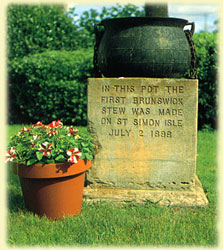
"Brunswick, Georgia, claims to be the place of origin for Brunswick stew. A twenty-five-gallon iron pot  
outside that coastal town bears a plaque declaring it to be the vessel in which this favorite southern
food was first cooked in 1898. In truth, the one-pot meal is credited to a number of places with Brunswick in
their names, but the honor (so far as the name is concerned) must go to Brunswick County,
Virginia. There, according to an entrenched local tradition supported by a 1988 Virginia General Assembly
proclamation, Jimmy Matthews, an African American hunting-camp cook, concocted a squirrel stew for his
master, Creed Haskins, in 1828, the stew being named for its home county.


As Georgia humorist Roy Blount Jr. quipped, 'Brunswick stew is what 
happens when small mammals carrying ears of corn 
fall into barbeque pits.'"


The recipe I chose to use for my stew is Spanky's Seafod Grill and Bar's 
World Famous Brunswick Stew, a recipe with several steps...
I started with the sauce
In a 2 quart sauce pan, over low heat, melt ¼ cup of butter then add:
1¾ cups Catsup
¼ cup Yellow Mustard
¼ cup white vinegar

Blend until smooth, then add:
½ tablespoon chopped garlic
1 teaspoon coarse ground black pepper
½ teaspoon crushed red pepper
½ oz. Liquid Smoke
1 oz. Worcestershire Sauce
1 oz. Crystal Hot Sauce or ½ oz. Tabasco
(I used Crystal Hot Sauce, very tasty!)
½ tablespoon fresh lemon juice

Blend until smooth, then add:
¼ cup dark brown sugar
Stir constantly, increase heat to simmer (DO NOT BOIL) for approx. 
10 minutes.
Makes approx. 3½ cups of sauce (set aside - to be added later).

DH decided the sauce would make a great BBQ sauce...
might mix some up
later and can it by itself for
basting chicken on the grill and such.
Now for the stew part of this yummy concoction...


In a 2 gallon pot, over low heat melt ¼ lb of butter then add:
3 cups small diced potatoes
1 cup small diced onion
2  14½ oz. cans of chicken broth
1 lb baked chicken (white and dark)
8-10 oz. smoked pork

Bring to a rolling boil, stirring until potatoes are near done, then add:
1 8½ oz. can early peas
2   14½ oz. cans stewed tomatoes -
(chop tomatoes, add liquid to the stew pot)

The prepared sauce
1 16 oz. can of baby lima beans
¼ cup Liquid Smoke
1  14
½ oz. can creamed corn

Slow simmer for 2 hours


Here's where I strayed from the recipe a little since I planned on canning 
this Brunswick Stew...
I added the onions, broth, chicken and smoked pork, stewed tomatoes, 

prepared sauce, liquid smoke, and creamed corn, but waited to 
add the potatoes, peas, and lima beans until just before filling my 
canning jars... didn't want my veggies to cook all to mush since 
they would be pressure canned for 90 minutes...
I added them last, just heating them through before filling my jars. 

And since the recipe I was using claimed to make one gallon of stew, 
I decided to double the recipe so I would have a full run of seven 
quart jars of stew and some left over to eat for supper.

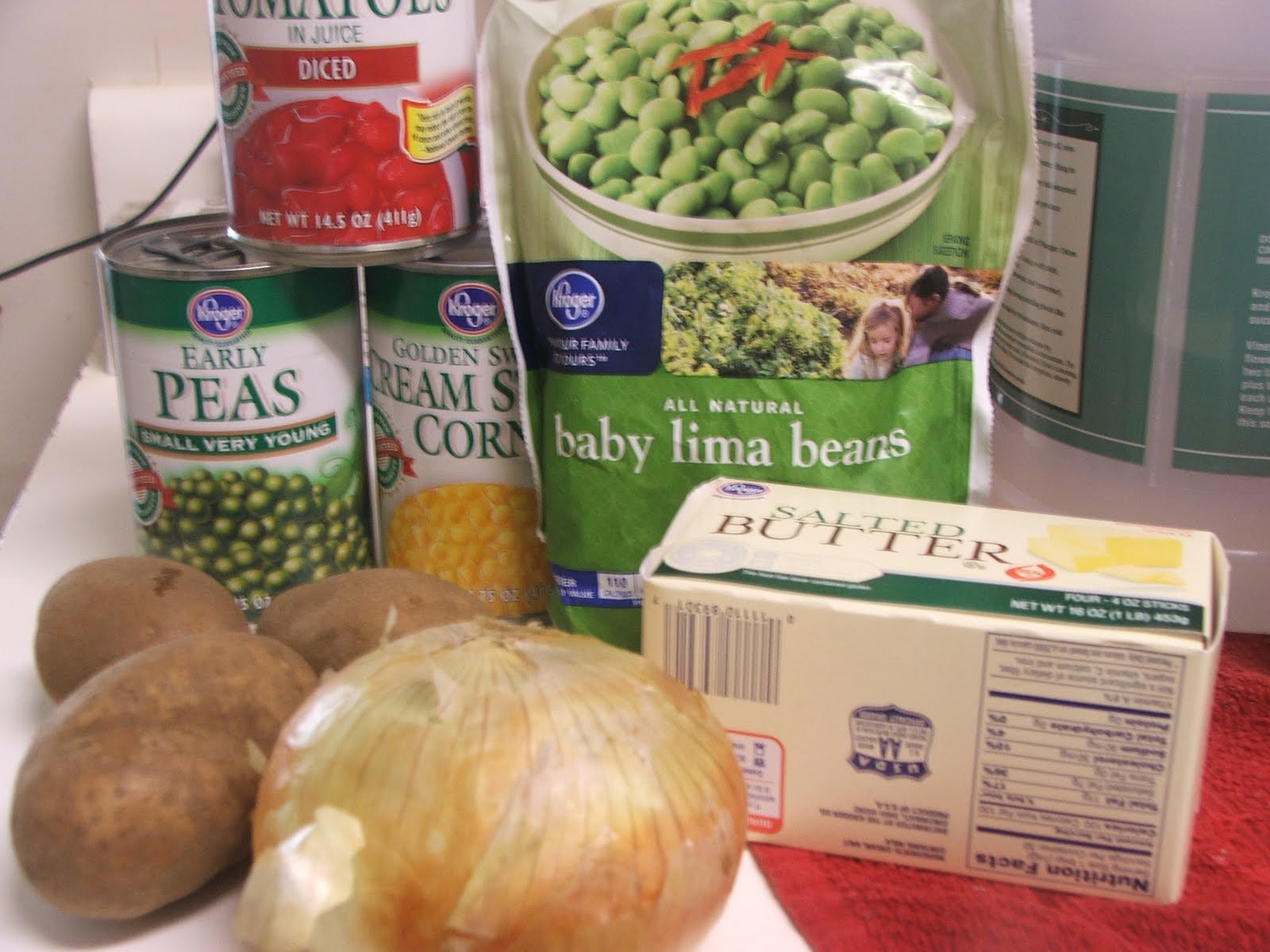
Some of the ingredients for Brunswick Stew


Roasted chicken ready for shredding and
adding to the stew pot
Adding ingredients to the stew pot
Chopping roasted chicken

Potatoes diced and ready to add to the stew pot


I added the potatoes to the stew last so they wouldn't
turn to mush during the 90 minute canning process, just
letting them heat up without cooking through.
I sterilized my quart canning jars and simmered my lids and rings for 
10-15 minutes and kept them  hot till they were ready to use.


I filled the jars leaving an inch of headspace, then wiped the jar rims with a 
damp cloth to remove any dripped juice that might keep the lids from sealing. 
I removed the lids from the simmering water with a magnetic wand
(a handy gadget to have!) and tightened them onto the jars. Using my jar lifter
(because those jars are HOT!) I loaded them into the pressure canner for 

processing.

Following my canner's instruction book for the ingredient in the stew that 

takes the most time, I pressure canned the stew at
10 pounds of pressure for 90 minutes.

After allowing the pressure in the canner to drop to ZERO, I removed 

the canner lid and, once again using my handy dandy jar lifter,
I removed the jars from the canner and placed them on a
folded dish towel on the counter to cool.

The PING! sound of a successfully sealed jar is a 

beautiful sound indeed!


Check out this YouTube video DH and I made showing some of the 
steps to canning this delicious Brunswick Stew
http://youtu.be/bXqSBROJBew


Canning Granny©2011 All Rights Reserved


Saturday, April 2, 2011

Granny Smith's Root Cellar

Papaw and Granny Smith raking hay
My Papaw and Granny Smith (my dad's parents) were the hardest working people I ever knew. They married in the 1930s, it was Papaw's second marriage and he was 24 years older than Granny. She had grown up working on her own daddy's farm and knew the value of a hard day's work. Papaw had been forced to quit school in the third grade in order to work on his family farm... amazingly to me, at the age of only nine years old, he was given the task of driving the mule and wagon to market in town each week to sell hay or corn or whatever his father's farm had produced. He went alone with a pail of cornbread, fried fatback and molasses to eat and had to stay overnight on the way there and back, camping and drinking water dipped from the creeks as he rode along.

When their children were growing up, the grew, raised, or made most of what they consumed. Granny milked the cows, everybody living in the valley around them could hear her singing old hymns as she went to milk early every morning and at sundown each evening. She pieced quilts by hand, and made everything, down to their underwear.

By the time I can remember, they had slowed down a little, but not by much... Granny had indoor plumbing and an automatic washing machine, but wouldn't wash the men's dungarees in it for fear of breaking it... as much as she did for herself and made do with so little, it always amazed me that she sent the denim work clothes out to be laundered... every week the laundry truck came by and picked up the work clothes and delivered them later on hangers, cleaned and pressed.

Until I was half grown I thought Granny Smith apples were the ones that grew in Granny's front yard. She taught us grandchildren a great game with those apples... she would sharpen a flexible stick for us to push into the apples that were laying on the ground in the yard, then like an old fashioned sling, we would sling those apples down through the pasture below. We thought it was a grand game and never realized until years later, that she was getting us to clear her yard of old apples (she wouldn't let us throw the ones still on the tree, sly woman that she was!)

Granny was as prepared for the future as anybody could be, it didn't matter when company arrived or how many dropped in for supper, there was always a jar of something to be opened, a pan of steaming fluffy biscuits quickly whipped up, some country ham or bacon fried up... we never went away hungry. I remember being sent down on many occasions to fetch something from the root cellar... this was a wondrous place for a child to explore... it was dark and cool and a welcome from the summer heat, it smelled of dampness and dirt and faintly of salt-cured ham, and I loved that place. There were wooden shelves all along the walls, lined with blue tinted mason jars filled with green beans, and corn, and pickles and tomatoes, and soup and fruit, jellies and jams, and all manner of food from the previous year's harvest. There were salted sides of pork-- bacon, ham and fatback, and rows of pottery crocks lined up on the packed dirt floor, each filled with pickled beans, pickled corn, sauerkraut, salt-pickled cucumbers, chow-chow and more.

I remember when I was 4 or 5 years old "helping" Granny make jelly from the blackberries that grew on the briar bushes along the fence behind Granny's enormous garden. There was no "Sure-Jell" in Granny's jelly. She cooked the fruit and strained it, then cooked the juice for hours and hours, steaming up her kitchen with the wonderful smell of blackberry juice. When the fruit juice had cooked down and thickened enough to suit her, she would pour the dark purple goodness into sterilized jars and top them with lids to seal up to enjoy the next winter with home churned butter on one of her delicious "cat-head" biscuits. When it got too hot in the kitchen, we were allowed to go out onto the screened back porch and get a drink of water from the bucket that had been drawn up from the well earlier that morning... we used an old tin ladle to drink from, all of us kids taking turns drinking from the same ladle... a coke couldn't have tasted any better than that cool fresh water out of a tin dipper. And later on that evening we would have a homemade blackberry cobbler made with what was left of the juicy berries we had helped Granny pick that morning.

Canning Granny©2011 All Rights Reserved

html, body, div, span, applet, object, iframe, h1, h2, h3, h4, h5, h6, p, blockquote, pre, a, abbr, acronym, address, big, cite, code, del, dfn, em, font, img, ins, kbd, q, s, samp, small, strike, strong, sub, sup, tt, var, b, u, i, center, dl, dt, dd, ol, ul, li, fieldset, form, label, legend, table, caption, tbody, tfoot, thead, tr, th, td { margin: 0; padding: 0; border: 0; outline: 0; font-size: 100%; vertical-align: baseline; background: transparent; } body { line-height: 1; } ol, ul { list-style: none; } blockquote, q { quotes: none; } /* remember to define focus styles! */ :focus { outline: 0; } /* remember to highlight inserts somehow! */ ins { text-decoration: none; } del { text-decoration: line-through; } /* tables still need 'cellspacing="0"' in the markup */ table { border-collapse: collapse; border-spacing: 0; }