Showing posts with label Stews. Show all posts
Monday, January 21, 2013
Canning Beef in Broth
I must apologize that it has been several weeks since I've written a post... between Christmas, the flu (Ugghhh!!!), and some projects around the homestead, I've been a slacker here on the blog and I beg your pardon!
I recently found boneless beef roast on sale at an excellent price, and decided I'd buy some and can it up... in chunks for stews and soups later.
First thing I did was cut it up in chunks... maybe 1 to 1-1/2 inch pieces...
I filled hot, sterilized wide mouth quart jars (and a couple of pint and a half jars) loosely with the chunks of beef (raw packed), leaving a generous one inch headspace.
Next I ladled hot beef broth in each jar (I used storebought broth this time, you could use homemade, or even bouillon and water, or just water) leaving a one inch headspace. I ran a plastic chopstick (plastic knife or a tool made especially for removing air bubbles will work as well) between the inside of the jar and the meat to get rid of any air pockets, and added more broth as necessary to adjust headspace.
I heated my lids in a pot of water, simmering for 10 minutes or so... I used a damp cloth to wipe the jar rims, then tightened the hot lids on the jars to fingertip tightness.
I processed the jars of beef in my pressure canner at 10 pounds of pressure for 90 minutes (pints would be 75 minutes). After processing, I let the pressure in my canner drop to ZERO on its own with no help, don't rush it. Then removed the jars using my jar lifter and set them on a folded dish towel on the counter to cool, and to listen for the PING of each successfully sealed jar! Love the PING!
This method can also be used for canning venison, moose, elk, antelope, etc.
One of my favorite ways to use beef in broth is to open the jar, pour it into a saucepan, thicken the broth with a little corn starch or flour to make a nice gravy, and serve over homemade egg noodles... a quick, delicious meal that makes you wanna slap yo' Granny!!!!
Monday, April 25, 2011
Canning Brunswick Stew
We recently took a vacation trip to St. Simons Island, Georgia where we visited James Gould's (Mr. Gould "Dear" of Eugenia Price's Lighthouse trilogy fame) lighthouse and attended Christ Church where the history of the island is abundant inside the beautiful old church built by the Rev. Anson Green Phelps Dodge, and among the headstones in the cemetery underneath the beautiful live oaks draped with Spanish moss. At night we stayed just up the road and across the intracoastal waterway and Marshes of Glynn in the coastal town of Brunswick.
On our return, the Canning Granny in me was bound and determined to can up some Brunswick Stew in honor of our stay on the Golden Isles of southern Georgia.
The georgiaencyclopedia.org states that...
On our return, the Canning Granny in me was bound and determined to can up some Brunswick Stew in honor of our stay on the Golden Isles of southern Georgia.
The georgiaencyclopedia.org states that...
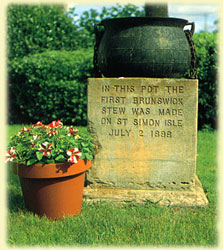
"Brunswick, Georgia, claims to be the place of origin for Brunswick stew. A twenty-five-gallon iron pot
outside that coastal town bears a plaque declaring it to be the vessel in which this favorite southern
food was first cooked in 1898. In truth, the one-pot meal is credited to a number of places with Brunswick in
their names, but the honor (so far as the name is concerned) must go to Brunswick County,
Virginia. There, according to an entrenched local tradition supported by a 1988 Virginia General Assembly
proclamation, Jimmy Matthews, an African American hunting-camp cook, concocted a squirrel stew for his
master, Creed Haskins, in 1828, the stew being named for its home county.
their names, but the honor (so far as the name is concerned) must go to Brunswick County,
Virginia. There, according to an entrenched local tradition supported by a 1988 Virginia General Assembly
proclamation, Jimmy Matthews, an African American hunting-camp cook, concocted a squirrel stew for his
master, Creed Haskins, in 1828, the stew being named for its home county.
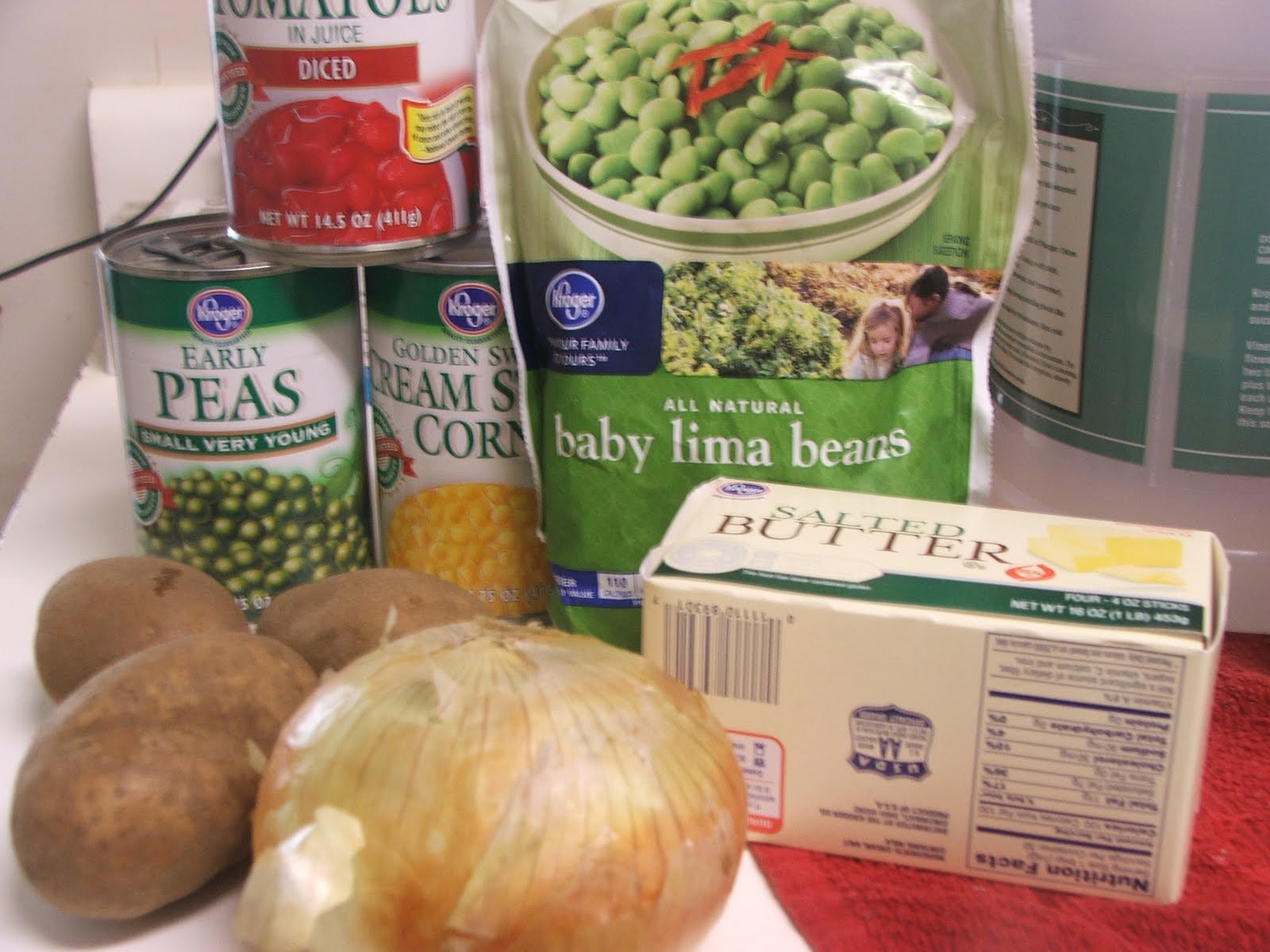
As Georgia humorist Roy Blount Jr. quipped, 'Brunswick stew is what happens when small mammals carrying ears of corn fall into barbeque pits.'" The recipe I chose to use for my stew is Spanky's Seafod Grill and Bar's World Famous Brunswick Stew, a recipe with several steps... I started with the sauce In a 2 quart sauce pan, over low heat, melt ¼ cup of butter then add: 1¾ cups Catsup ¼ cup Yellow Mustard ¼ cup white vinegar Blend until smooth, then add: ½ tablespoon chopped garlic 1 teaspoon coarse ground black pepper ½ teaspoon crushed red pepper ½ oz. Liquid Smoke 1 oz. Worcestershire Sauce 1 oz. Crystal Hot Sauce (I used Crystal Hot Sauce, very tasty!) ½ tablespoon fresh lemon juice Blend until smooth, then add: ¼ cup dark brown sugar Stir constantly, increase heat to simmer (DO NOT BOIL) for approx. 10 minutes. Makes approx. 3½ cups of sauce (set aside - to be added later).
In a 2 gallon pot, over low heat melt ¼ lb of butter then add: 3 cups small diced potatoes 1 cup small diced onion 2 14½ oz. cans of chicken broth 1 lb baked chicken (white and dark) 8-10 oz. smoked pork Bring to a rolling boil, stirring until potatoes are near done, then add: 1 8½ oz. can early peas 2 14½ oz. cans stewed tomatoes - (chop tomatoes, add liquid to the stew pot) The prepared sauce 1 16 oz. can of baby lima beans ¼ cup Liquid Smoke 1 14½ oz. can creamed corn Slow simmer for 2 hours Here's where I strayed from the recipe a little since I planned on canning this Brunswick Stew... I added the onions, broth, chicken and smoked pork, stewed tomatoes, prepared sauce, liquid smoke, and creamed corn, but waited to add the potatoes, peas, and lima beans until just before filling my canning jars they would be pressure canned for 90 minutes... I added them last, just heating them through before filling my jars. And since the recipe I was using claimed to make one gallon of stew, I decided to double the recipe so I would have a full run of seven quart jars of stew and some left over to eat for supper.
10-15 minutes and kept them hot till they were ready to use. I filled the jars leaving an inch of headspace, then wiped the jar rims with a damp cloth to remove any dripped juice that might keep the lids from sealing. I removed the lids from the simmering water with a magnetic wand (a handy gadget to have!) and tightened them onto the jars. Using my jar lifter (because those jars are HOT!) I loaded them into the pressure canner processing. Following my canner's instruction book for the ingredient in the stew that takes the most time, I pressure canned the stew at 10 pounds of pressure for 90 minutes. After allowing the pressure in the canner to drop to ZERO, I removed the canner lid and, once again using my handy dandy jar lifter I removed the jars from the canner and placed them on a folded dish towel on the counter to cool. The PING! sound of a successfully sealed jar is a beautiful sound indeed! Check out this YouTube video DH and I made showing some of the steps to canning this delicious Brunswick Stew http://youtu.be/bXqSBROJBew Canning Granny©2011 All Rights Reserved |
Subscribe to:
Comments (Atom)