Showing posts with label Women's Weekly.. Show all posts

29 June 2016

Chocolate and cherry berry Pavlova / Pavlova de chocolate, com cerejas e mirtilos.


Life can be funny sometimes.
As I was going to have lunch at a friend's house last Saturday and I was in charge of bringing dessert, I was having a wonder around my "shelf forgotten" books, in order to try to decide what to make.
I picked up this book, the Australian Women's Weekly - Indulgent Cakes and, flicking through it, I found, inside the page of this recipe, a sweet note that someone sent me, about 2 years ago, with a birthday gift (the person I'm talking about, will know what I'm talking about, if she reads this...).
I thought that this could be a good sign and if the note was marking that page, it's because, this time or another, that dessert was supposed to be tested. Therefore, I didn't look further as, the perfect pudding was decided!!
ingredients for the pavlova (serves 10):
100g dark chocolate (70% cocoa), chopped
4 egg whites
200g caster sugar
1 tbsp cornflour
1 tsp white vinegar
250g cream cheese, softened
2 tsp vanilla extract
40g icing sugar
300ml thickened cream
fresh cherries, with stem attached
method:
Preheat the oven to 120ºC. Draw a 18cm circle on a sheet of baking paper and place it, upside down, on a baking tray.
Place the chocolate in a small heatproof bowl over a small pan of simmering water (don't allow the bowl to touch the water) and stir until the chocolate is just melted. Set aside.
Place the egg whites in the bowl of an electric mixer and whisk until soft peaks form.
Add the sugar, 1 tbsp at a time, beating well between each addition and once the sugar has been all added, whisk for a further 7 minutes or until the mixture is stiff and glossy.
Add the cornflour and vinegar and whisk until well combined.
Swirl in the melted chocolate.
Place large spoonfuls of the meringue mixture into the circle, smoothing the center.
Bake the meringue for 1 and 1/4 hours, or until dry to the touch.
Turn the oven off the oven and prop the door ajar with a wooden spoon. Let the meringue cool completely inside the oven.
for the cherry and blueberry compote:
300g cherries, pitted
150g blueberries
75g caster sugar
60ml water
80g cherry jam
method:
Put the blueberries, cherries, sugar and water in a medium saucepan over medium heat.
Bring to a simmer and cook for 5 minutes or until the fruit has released juices.
Using a slotten spoon, transfer the fruit into a bowl.
Stir the jam into the juices in the pan. Bring to the boil and boil for 5 minutes or until the mixture thickens.
Pour the syrup over the cherry mixture and leave to cool completely.
to assemble:
Beat the cream cheese, vanilla and icing sugar in a small bowl until smooth.
Gradually beat in the cream, until smooth and combined.
Just before serving, spoon the cream mixture over the pavlova.
Top with the compote and decorate with fresh cherries.

__________________

Às vezes (muitas vezes), a vida é engraçada e prega-nos partidas interessantes!
No Sábado passado, tinha um almoço marcado em casa de amigos e, como já vem sendo hábito, eu estava encarregue de levar a sobremesa.
Sem ter ideia do que fazer ou levar, andava a dar uma vista de olhos por livros, supostamente, esquecidos nas minha prateleiras, quando resolvi dar uma vista de olhos neste livro.
Qual não é o meu espanto, na página desta receita, encontro um "postal" personalizado, que me foi enviado por uma certa pessoa, juntamente com um presente de aniversário super original e criativo, há 2 anos atrás.
A pessoa em referência, se ler este post, saberá a quem e ao que me refiro...

Assim sendo, nem procurei mais, pois se aquele "postal especial" estava a marcar a página da receita, estava decidida a sobremesa a fazer e, sem dúvida, foi a sobremesa perfeita.
Vamos então à receita, do livro lindo "Indulgent Cakes" das super fantásticas "Australian Women's Weekly".


ingredientes para a pavlova (para 10 pessoas):
100g chocolate preto (70% cacau), picado
4 claras de ovo
200g açúcar refinado branco
1 colher sopa de Maizena
1 colher chá de vinagre de vinho branco
250g queijo creme, tipo Philadelphia, amolecido
2 colheres chá de extracto de baunilha
40g açúcar em pó
300ml natas espessas ou para bater
cerejas frescas, com pé
preparação:
Aquecer o forno a 120ºC.
Numa folha de papel vegetal, desenhar um círculo de 18cm.
Colocar o papel vegetal, lado do desenho do círculo, virado para baixo, sobre um tabuleiro de ir ao forno.
Ferver água numa panela e baixar o lume.
Colocar o chocolate numa taça e colocar a taça (sem que esta toque na água), sobre a panela da água a ferver.
Mexer, até o chocolate estar derretido. Retirar do lume e reservar.
Colocar as claras de ovo na taça da batedeira eléctrica e bater até obter picos ligeiros.
Adicionar o açúcar, 1 colher de sopa de cada vez, batendo bem entre cada adição.
Quando tiver adicionado todo o açúcar, continuar a bater por mais 7 minutos, ou até a mistura estar macia e brilhante.
Adicionar a Maizena e o vinagre e bater até tudo estar bem incorporado.
Adicionar o chocolate derretido e envolver delicadamente, por forma a dar um efeito marmoreado à mistura.
Colocar a mistura dentro do círculo desenhado no papel vegetal, alisando o centro.
Levar ao forno por cerca de 1 hora e 1/4, ou até a mistura estar seca ao toque.
Desligar o forno, entreabrir a porta do forno (pode prender a porta com uma colher de pau) e deixar a pavlova arrefecer completamente dentro do forno.
para a compota de cerejas e mirtilos:
300g cerejas frescas, sem caroço
150g mirtilos
75g açúcar refinado branco
60ml água
80g doce de cereja (de boas qualidade)
preparação:
Num tacho sobre lume médio, colocar as cerejas, os mirtilos, o açúcar e a água.
Quando levantar fervura, cozinhar por cerca de 5 minutos, ou até a fruta começar a libertar o seu sumo.
Com a ajuda de uma escumadeira, retirar as cerejas e os mirtilos do tacho, colocá-los numa taça e reservar.
Adicionar o doce de cereja ao molho que ficou no tacho, deixar levantar fervura e cozinhar por 5 minutos, ou até a mistura estar espessa.
Deitar este xarope (sumo), sobre a fruta reservada e deixar arrefecer completamente.


para montar a pavlova:
Na taça da batedeira eléctrica, bater o queijo Philadelphia com a baunilha e o açúcar em pó.
Gradualmente, adicionar as natas e bater até a mistura estar macia e tudo estar incorporado (eu gosto de fazer este passo com a vara de arames, não vá a mistura talhar).
Antes de servir, colocar a pavlova sobre um prato de serviço.
Cobrir com a mistura de queijo e natas, decorar com a compota de cerejas e mirtilos e finalizar a decoração com as cerejas frescas com pé.

Recipe / Receita:

15 December 2014

Chocolate and cinnamon babka / Babka de chocolate e canela.


As this month is a special month because of the Christmas holidays, I'll be publishing some recipes and ideas for Christmas.
Everybody is around, in holidays, having a relaxing time and nibbling all the time, so it's good to have always something nice and homemade at hand.
This delicious babka that is utterly delicious is my first Christmas baking suggestion as it keeps very well for a few days and it's really good.
Although I made my Babka in a loaf tin Im writing down the original version.
My friend Mena published this morning this same recipe, but in a bundt cake form and you should go and have a look at it as it looks really terrific.
ingredients for the dough (serves 8):
80g sultanas
80ml coffee flavoured liqueur
180ml lukewarm milk
14g dried yeast
110g caster sugar
2 eggs, lightly beaten
1 egg yolk
450g white bread flour
3 tsp sea salt flakes
150g butter, softened and cubed
40g butter, softened and cubed
for the chocolate sauce:
200g dark chocolate, chopped
1/2 cup pouring cream
for the filling:
70g walnuts, lightly roasted and coarsely chopped (I didn't use)
75g brown sugar
2 tsp ground cinnamon
150g dark chocolate, coarsely chopped


method:
Combine the sultanas and liqueur in a bowl and set aside.
In another bowl, combine the yeast, milk and 1 tbsp of the sugar. Cover the bowl and set aside in a warm place for 10 minutes or until foamy.
Stir in the eggs and the egg yolk.
Place the flour, salt, remaining sugar and yeast mixture in the bowl of an electric mixer fitted with the dough hook attachment.
Mix on low speed until just combined and then on medium speed for 5 minutes, or until the dough is soft and elastic.
Add in the butter, a cube at a time, making sure the butter is well incorporated before adding the next cube. Mix until the dough is very smooth and elastic.
Place the dough in a large oiled bowl, cover the bowl with clingfilm and let it rest in a warm place for 1 hour or until doubled in size.
to make the filling: combine all the ingredients in a small bowl.
Preheat the oven to 200ºC and grease a 21cm cake pan with butter.
Drain the sultanas and reserve 2 tbsp of the liqueur.
Punch down the dough and knead lightly until smooth.
Roll the dough on a floured surface until you have a 30 x 45cm rectangle that is about 1cm thick.
Spread the dough with the extra 40g of butter and sprinkle evenly with the sultanas and with the filling mixture.
Starting from one long side, roll the dough firmly into a log.
Cut the log into 12 equal pieces.
Place 7 pieces, cut side out, around the outer side of the pan and place the remaining 5 pieces around the ring of the tin, overlapping slightly.
Cover with clingfilm and rest for 45 minutes or until almost doubled in size.
Bake on the lowest oven shelf for 40 minutes or until cooked through. Rest for 5 minutes before turning up side down, onto a wire rack to cool completely.
for the chocolate sauce: Place the dark chocolate, cream and reserved liqueur in a small pan over low heat and melt, stirring, until smooth. Cool for 10 minutes and serve warm drizzled over the babka slices.

Note 1: I didn't make the chocolate sauce as I think the babka is very good on its own and don't need the sauce.
Note 2: The recipe calls for the microwave to melt the ingredients for the chocolate sauce but I find it less risky to melt it in a pan, over a low heat.
__________________


Dezembro é um mês especial, pois é o mês do Natal.
As crianças e muitos adultos estão de férias, há sempre gente em casa, sejam familiares ou amigos, casa sempre cheia e com gente a entrar e a sair, ou seja, do Natal ao Ano Novo, praticamente é uma semana de ficar em casa a comer e a... comer...
Já que é um período para comer, o melhor é que sejam coisinhas boas e, de preferência, caseiras, ora assim sendo, este mês, as receitas aqui no blogue, serão já a pensar em deixar-vos sugestões para a mesa natalícia, ou simplesmente para ter à mão sempre que apetece petiscar ou tomar um chá quente com algo doce.
Esta babka é uma excelente sugestão para acompanhar uma chávena de chá quente ou café e é deliciosa e mantém-se fresca (desde que bem acondicionada), durante vários dias.
Eu fiz a minha babka numa forma de pão, mas deixo-vos a receita original, que é feita numa forma de buraco.
A Mena publicou esta manhã esta mesma receita, mas em forma de bundt cake.
Vão lá espreitar, a babka da Mena, pois tem um aspecto absolutamente divino e é caso para dizer #amenaealiasofazemcoisasboas :)))!

ingredientes para a massa (para 8 pessoas):
80g sultanas
80ml licor de café
180ml leite morno
14g fermento de padeiro seco
110g açúcar refinado branco
2 ovos, batidos ligeiramente
1 gema de ovo
450g farinha de trigo para pão
3 colheres chá de flocos ou flor de sal
150g manteiga, amolecida e cortada em cubos
40g manteiga, amolecida e cortada em cubos
para o molho de chocolate:
200g chocolate preto, picado
1/2 chávena de natas líquidas
para o recheio:
70g nozes, tostadas ligeiramente e picadas grosseiramente (eu não usei)
75g açúcar moreno
2 colheres chá de canela em pó
150g chocolate preto, picado grosseiramente
preparação:
Numa taça, misturar as sultanas com o licor e reservar.
Numa outra taça, misturar o fermento com o leite e uma colher de sopa do açúcar. Tapara com película aderente e reservar em local quente, por cerca de 10 minutos, ou até que a mistura esteja espumosa.
Adicionar os ovos e a gema de ovo à mistura do fermento e mexer.
Na taça de uma batedeira eléctrica equipada com o gancho para massas, colocar a farinha, o sal, o açúcar restante e a mistura do fermento.
Bater em velocidade mínima, só até tudo estar incorporado. De seguida, com a batedeira a velocidade média, bater por 5 minutos, ou até que a massa esteja macia e elástica.
Com a batedeira ligada, adicionar a manteiga, um cubo de cada vez, tendo o cuidado de verificar se o cubo adicionado está bem incorporado na massa, antes de adicionar o cubo seguinte. Bater até, mais uma vez, a massa estar bem macia e elástica.
Colocar a massa numa taça untada com óleo, cobrir com película aderente e deixar repousar num local quente, por cerca de 1 hora, ou até que esta tenha duplicado de tamanho.
para fazer o recheio: combinar todos os ingredientes numa taça.
Aquecer o forno a 200ºC e untar uma forma com buraco, com cerca de 21cm de diâmetro.
Coar as sultanas e reservar 2 colheres de sopa do licor utilizado.
"Espancar" a massa para lhe retirar o ar e amassá-la ligeiramente para ficar macia. Esticá-la, sobre uma superfície ligeiramente enfarinhada, até obter um rectângulo com cerca de 30 x 45cm e uma espessura de cerca de 1cm.
Espalhar os 40g de manteiga restantes sobre toda a superfície da massa e polvilhar com as sultanas e os ingredientes do recheio.
Enrolar a massa como se fosse uma torta, bem apertadinha, começando por um dos lados mais longos.
Cortar a "torta" em 12 rodelas de igual tamanho.
Colocar 7 rodelas, lado do corte virado para fora, à volta de toda a forma e colocar os restantes 5 rodelas em cima destas, mas junto ao buraco da forma. Esta parte é complicada de perceber, mas se forem a este post da Mena, verão lá uma foto que exemplifica perfeitamente o processo acima descrito.
Tapar a forma com película aderente e deixar levedar por mais 45 minutos, ou até ter quase duplicado de tamanho.
Colocar a forma na grelha mais baixa do forno e cozer por 45 minutos ou até estar completamente cozido.
Deixar repousar na forma por 5 minutos, antes de desenformar sobre uma grelha para completo arrefecimento.


para o molho de chocolate: Colocar o chocolate  as natas e o licor reservado num tachinho e aquecer em lume brando, mexendo sempre, até o chocolate estar derretido e a mistura cremosa. Deixar arrefecer por 10 minutos e servir ainda morno, em cima das fatias de babka.

Nota 1: Eu não fiz o molho de chocolate porque não achei necessário. A babka é fantástica sem o molho e assim evitam-se mais calorias :))).
Nota 2: A receita original diz para derreter os ingredientes do molho no microondas por 1 minuto em potência máxima. Eu não gosto de derreter chocolate no microondas e acho mais seguro derretê-lo em lume brando num tachinho como acima descrevi, mas quem quiser fazer o molho e utilizar o microondas, aqui fica o processo explicado.

Recipe / Receita:

10 August 2014

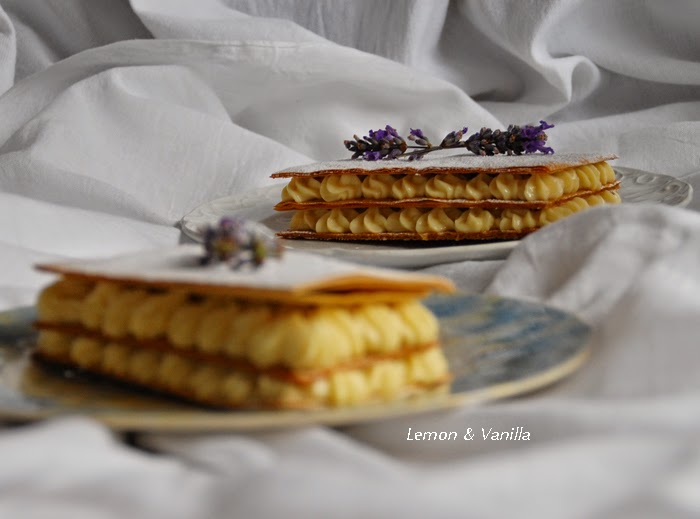
Lavender custard and fillo millefeuilles / Mil folhas de custard de alfazema e massa filo.

One of the good things about blogging is that you get to "meet" interesting people.
Of course, some stand out from the crowd for different reasons like, lifestyle, kindness or whatever. Or only because you feel you have more in common with this or that person.
All of that to say that Mena is one of those people that stands out from the crowd.
A friendship that started with the exchange of some casual e-mails, became something bigger and more intimate in terms of conversations, e-mails, daily messages and even phone calls.
Nowadays, distance is no excuse not to be connected with the people you love, as the internet makes it easy. In fact, Mena and I communicate at least once a day.
I only know Mena by photo and voice but I'm sure one day we are going to meet and I'll finally get the chance to give her a huge hug.
For now, and because today is her birthday, I just want her to know that I didn't forget about it or her.
For Mena's birthday and because she is an "indulgent flower" and my "mana Bundette", I have prepared this indulgent and scrumptious lavender mille feuilles.
Happy birthday my dear friend!!
I just made half of the recipe and the result was 2 small mille feuilles of 3 layers each but I leave you the original recipe which consists in 1 big mille feuille with 6 layers of pastry.
ingredients:
18 sheets of fillo pastry
100g unsalted butter, melted
35g caster sugar
2 tsp icing sugar
method:
Preheat the oven to 160ºC and grease and line with baking paper 3 large oven trays.
Brush one sheet of fillo pastry with some of the melted butter.
Scatter with 3/4 tsp of the caster sugar.
Repeat this process, layering five times in order to form a six layer stack.
Using a sharp knife and a ruler, cut the stack into two 12 x 28cm rectangles, discarding the trimmings.
Repeat the brushing, stacking and cutting process 2 more times and you'll end up with 6 equally sized stacks in total.
Place 2 fillo stacks, side by side, on each tray. Cover with 1 sheet of baking paper. Stack trays on top of each other and place a fourth empty tray on top of the last one.
Bake the stacked trays for 15 minutes.
Carefully remove the stacked trays from the oven and unstack them.
Return the trays to the oven and bake the stacks of fillo, uncovered, for a further 10 minutes, or until golden brown.
Cool the pastry stacks on the baking trays.
ingredients for the lavender custard:
750ml milk
8 egg yolks
220g caster sugar
75g cornflour
1 1/2 tbsp dried lavender flowers
125ml double cream
method:
Heat the milk in a saucepan until boiling point.
In a large bowl, whisk the egg yolks, sugar, cornflour and lavender flowers and gradually whisk in the hot milk.
Return the mixture to the pan. Whisk continuously for around 7 minutes over medium heat or until the mixture boils and thickens.
Remove the pan from the heat, whisk for a further minute and strain the custard into a bowl.
Cover with clingfilm and refrigerate until cool.
to assemble the mille feuille:
With an electric mixer, beat the cream in a bowl until soft peaks form. Fold the cream into the lavender custard.
Place a fillo rectangle on a serving plate.
Spread with 1/5 of the lavender custard.
Repeat the process, finishing with a fillo rectangle. Dust with icing sugar and decorate with lavender flowers.
__________________

Uma das melhores contrapartidas de ter um blogue são os conhecimentos e amizades que, numa primeira fase, virtualmente se fazem.
Não sei se é a forma como escrevem, ou algo diferente, o certo é que há pessoas por detrás dos blogues, com quem criamos empatias quase que imediatas e o que, à partida, começa por ser uma troca de e-mails de circunstância ou um tirar de dúvidas, rapidamente se transforma numa troca de e-mails diários e mais profundos.
Esta conversa toda para vos falar da Mena, sim, a nossa querida mamã da Sibéria que dispensa apresentações, a minha querida mana Bundette, com quem criei essa tal empatia acima referida e que, além dos e-mails (diários ou não), dependendo da disponibilidade de cada uma de nós, se passou também á troca de mensagens e até, esporadicamente, conversas telefónicas.
A Mena é daquelas pessoas doces e atenciosas que cativa logo de imediato e não é a distância entre Andorra e a Escócia que nos inibe de estarmos em contacto diário, pois as maravilhas da internet fazem com que não existam distâncias entre nós, a não ser as físicas.
Anseio pelo dia em que conhecerei a Mena pessoalmente e lhe poderei dar o tão prometido abraço apertado, mas até lá e porque a Mena hoje faz anos, deixo-lhe este mil folhas que preparei para ela.
Uma sobremesa indulgente e com flores - alfazema do meu jardim, que está linda e cheia de cor - para a Mena, a minha "flor indulgente do Ocidente"!!
Muitos PARABÉNS minha amiga e que tenhas um dia super feliz e mimado, ainda que os teus pintainhos não estejam aí contigo e olha...,
se choras, levas!!!
Eu só fiz metade da receita e transformei-a em 2 mil folhas pequenos, com 3 camadas de massa cada um, mas deixo-vos a receita completa, que dá para um mil folhas grande, com 6 camadas de massa filo.
ingredientes:
18 folhas de massa filo
100g manteiga sem sal, derretida
35g açúcar refinado branco
2 colheres chá de açúcar em pó
preparação:
Aquecer o forno a 160ºC e untar e forrar com papel vegetal 3 tabuleiros grandes.
Pincelar uma folha de massa filo com manteiga derretida e polvilhar com 3/4 colher de chá de açúcar refinado branco.
Repetir o processo com mais 5 folhas de massa filo, a fim de obter uma pilha de 6 folhas de massa.
Com a ajuda de uma faca afiada e uma régua, cortar a pilha das 6 folhas de massa filo em 2 rectângulos de 12 x 28cm, descartando os excessos.
Repetir o processo de pincelar, polvilhar e cortar, mais duas vezes, por forma a obter mais duas pilhas de 6 folhas de massa cada uma, o que perfará, no final, um total de 6 rectângulos de 12 x 28cm e com 6 folhas de massa filo cada um.
Colocar 2 rectângulos, lado a lado, em cada tabuleiro e cobrir com uma folha de papel vegetal.
Colocar os tabuleiros uns sobre os outros e cobrir o último tabuleiro (o que fica em cima), com um 4º tabuleiro vazio, a fim de criar peso.
Levar a pilha de tabuleiros ao forno e cozer por 15 minutos.
Findo esse tempo, retirar os tabuleiros do forno e separá-los com cuidado.
Levar os tabuleiros de novo ao forno, separados e sem papel vegetal a cobrir a massa filo, por mais 10 minutos, ou até que as pilhas de massa estejam douradinhas.
Deixar as pilhas de massa arrefecer nos próprios tabuleiros.
ingredientes para o creme de alfazema:
750ml leite
8 gemas de ovo
220g açúcar refinado branco
75g Maizena
1 1/2 colheres sopa de flores secas de alfazema biológica
125ml natas para culinária
preparação:
Aquecer o leite num tachinho, até este atingir o ponto de ebulição.
Numa taça, bater os ovos, o açúcar, a Maizena e a alfazema.
Adicionar o leite quente gradualmente, batendo sempre.
Colocar toda a mistura de volta no tacho e levar ao lume por 7 minutos, mexendo sempre, sobre lume médio, ou até a mistura começar a ferver e engrossar.
Retirar o tacho do lume e bater por mais 1 minuto.
Coar a mistura para uma taça, cobrir com película aderente e colocar no frigorífico até estar completamente fria.
para montar o mil folhas:
Com a ajuda da batedeira, bater as natas até estas formarem picos ligeiros.
Misturar as natas com o creme de alfazema, envolvendo bem.
Colocar um rectângulo de massa filo num prato de serviço e cobrir com 1/5 do creme de alfazema.
Repetir o processo, terminando com um rectângulo de massa filo.
Polvilhar com o açúcar em pó e decorar com flores de alfazema.

Recipe / Receita: