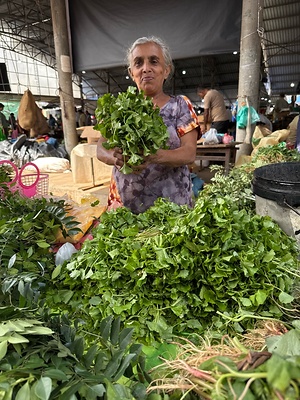
Gotu Kola Leaves
Estimated Inventory, lb : 0
Description/Taste
Gotu Kola leaves vary in size depending on maturity and growing conditions, averaging 3 to 5 centimeters in diameter. The leaves are connected to the plant by slender stems, also known as petioles, and have a signature flat, curved, kidney-shaped appearance, resembling a small lily pad with one indented side. The stems range in color from pale green to red-green and have a smooth, pliable consistency. The dark green leaves feature serrated, scalloped edges and distinct netted veins that extend from the leaf’s center. The greens are thin, slightly textured, and crisp with a succulent, subtly chewy consistency. Gotu Kola leaves are edible raw or cooked and have a fresh, earthy, and bitter taste with herbaceous undertones. Once cooked, the leaves soften and become mild and green in flavor.
Seasons/Availability
Gotu Kola leaves are available year-round.
Current Facts
Gotu Kola leaves, botanically classified as Centella asiatica, are the edible greens of an herbaceous, perennial plant belonging to the Apiaceae family. The species is revered throughout Asia as an ancient medicinal and culinary ingredient and is still used today for its nutritional properties. The name Gotu Kola is derived from Sinhalese, one of the primary languages spoken in Sri Lanka, where the species is widely used as a daily green. “Gotu” roughly translates to “cone or cup-shaped,” while “Kola” means “leaf.” This name was given to the species for its unusually shaped, rounded leaves. Gotu Kola is also known by many other regional names, especially throughout India, including but not limited to Mandukaparni, Vallarai, Bengsag, Khulakhudi, Thulkudi, Saraswati, and Karivan. Outside of India and Sri Lanka, Gotu Kola is called Luo De Da, Luei Gong Gen, and Jixuecao in China; Tsubokusa in Japan; Pegaga in Indonesia and Malaysia; and Indian Pennywort, Asiatic Pennywort, and Spadeleaf in English-speaking countries. It is important to note that Gotu Kola is sometimes called Brahmi, but this name is more commonly used for Bacopa monnieri and should not be confused. Gotu Kola appears in two main types, bush and vining habits, and these types are further categorized by their leaf size in markets. The leaves are the primary part of the plant used for medicinal and culinary preparations and are available in their growing regions, fresh or dried. Fresh Gotu Kola leaves are an everyday culinary ingredient, used in a wide array of raw or cooked dishes as a nutritionally dense green.
Nutritional Value
Gotu Kola is well-known throughout Asia as a traditional ingredient in Ayurvedic and Chinese Medicines. The species is a source of vitamins A, B, C, and D, which aid in maintaining healthy organs, support energy production, and strengthen the immune system. Gotu Kola also provides varying amounts of minerals, including iron, calcium, magnesium, potassium, phosphorus, and manganese. These minerals help the body maintain fluid balance, produce proteins for oxygen transport in the bloodstream, regulate daily nerve function, and support bone and tooth development. In natural medicines, Gotu Kola is used to improve skin health and is applied topically to cuts, burns, and other irritations to help heal and soothe. The leaves have anti-inflammatory, anti-fungal, and antibacterial properties and are believed to improve circulation. Gotu Kola is also ingested to boost digestive fire, cleanse the liver, and support metabolism. In Ayurvedic practices, Gotu Kola balances all three doshas and is nicknamed the “herb of enlightenment,” supporting cognitive function.
Applications
Gotu Kola has a green, subtly bitter, and earthy taste suited for raw and cooked preparations. The leaves are eaten raw in small quantities as a daily health booster and are also added to salads as a nutritious green. In Indonesia and Malaysia, the leaves are sometimes added to ulam, a salad comprised of fresh herbs, greens, and flowers. Gotu Kola leaves are also incorporated into chilled rolls or used as a fresh side to various main dishes. The species is extensively used in Sri Lanka, where the leaves are sold fresh, dried, and in powdered form. The leaves are mixed into salads with finely grated coconut, aromatics, spices, and lime juice, or used in malluma, a famous dish served with rice and curries. Gotu Kola is also used as a central flavoring in kola kanda, a type of congee or rice porridge made with coconut milk, leaf puree, jaggery, and vanilla extract, or it can be lightly stir-fried with coconut oil or added to dhal curry. In India, Gotu Kola leaves are cooked into chutneys, infused into ghee, or combined with spices, lentils, and onions and fried. Other regions of Asia also add the greens to soups, curries, and congee. Beyond culinary dishes, Gotu Kola is blended into smoothies, pressed into green juices, or combined with water and sugar as a light drink. The leaves are also dried and steeped into tea. Gotu Kola leaves pair well with spices like turmeric, ginger, cumin, cinnamon, and cloves, flavorings like curry leaves and lemongrass, and sweeteners like sugar, jaggery, and treacle. Freshly picked Gotu Kola leaves will keep for a few days in the fridge, but should be immediately consumed for the best quality and flavor.
Ethnic/Cultural Info
Gotu Kola leaves are a part of Asian folklore surrounding longevity and memory. In Sri Lanka, elephants have been observed consuming Gotu Kola leaves in the wild. This observation led early people groups to believe that elephants acquired their long life and good memory from their diet of the greens. Another commonly shared story notes that Bengal tigers were once seen rolling around on Gotu Kola leaves to heal wounds. This led to the species being called Tiger Grass. Both tales highlight Gotu Kola’s medicinal properties. In the modern day, a Sinhalese proverb states that “Two leaves a day keeps the old age away,” and Gotu Kola leaves are eaten daily in raw, powdered, and tea form to improve health. In addition to tigers and elephants, Gotu Kola is featured in a Laotian legend of a healer. The healer wanted to marry the chief’s daughter. As a test, the chief cut the healer's ear with his sword and stated that if the healer could fix his ear by the next day, he could marry his daughter. The healer applied a paste made from Gotu Kola leaves that night and healed his ear by the next day, allowing him to marry the chief’s daughter. News of the miraculous healing herb spread, solidifying Gotu Kola as an essential medicinal ingredient.
Geography/History
Gotu Kola leaves are native to tropical regions of Asia, South Africa, Madagascar, and parts of Australia and the Pacific Islands. The species has been growing wild since ancient times and has been naturalized as a medicinal and culinary green. Gotu Kola is harvested from wild populations and is a popular home garden plant, especially in Asia. In the wild, the plants thrive in swampy, water-filled regions such as bogs, rice fields, alongside streams, or near lagoons, up to 1,200 meters in elevation. Gotu Kola is sold fresh in its growing regions and is also commercially produced in dried and powdered form to expand availability and demand. Today, Gotu Kola leaves are often bundled or stacked in large piles by local vendors in markets and are sold for fresh purposes. The Gotu Kola leaves featured in the photograph above were sourced through a vendor at the Narahenpita Economic Center in Colombo, Sri Lanka.
Recipe Ideas
Recipes that include Gotu Kola Leaves. One
 is easiest, three is harder.
| Vidhya's Vegetarian Kitchen |
|
Vallarai Keerai Kootu Indian Pennywort Curry Recipe |
| BBC Food |
|
Gotu Kola Sambol |

Gotu Kola Leaves for sale around the world shared on the Specialty Produce App