Showing posts with label Amish. Show all posts

Wednesday, September 9, 2015

Amish Recipe Series... Sweet Peppers, Amish Style

This is the last post in our Amish Recipe Series... next series we'll do will be Soups. I've really enjoyed visiting the Amish, their culture, and their recipes. I hope you have too!


Is the Amish population growing?
Yes. The population has doubled over the past 20 years due to sizeable families (5 or more children on average) and high retention rates (on average about 85 percent of Amish youth eventually join the church).

When are Amish youth baptized?
Typically between the ages of 18 and 21. As Anabaptists, the Amish church emphasizes the importance of making a voluntary adult decision to become a Christian and join the church.

Where do Amish youth go to school?
About 90 percent attend one- or two-room private Amish schools; the others go to rural public schools. In Amish schools, an Amish teacher is typically responsible to teach all eight grades, or in the case of a two-room school, half of the grades. Amish children typically end their formal schooling at the end of eighth grade. 

Today's recipe... Remember... Disclaimer: The Amish don't always follow updated USDA canning methods, they follow methods passed down from generation to generation. Use this recipe at your own discretion, or adapt it to your own method. I am sharing these recipes EXACTLY as they were sent to me and take no responsibility for them.
Sweet Peppers, Amish Style

Peggy Stolfus

Red, yellow, and green bell peppers

To make the syrup you will need

4 cups water

1 cup vinegar

5 cups granulated sugar

Combine the above ingredients and bring them to a boil.

Next, cut the peppers into strips, all colors. Pack the peppers into jars and then pour the syrup over them. Finally, cold pack for 5 minutes

Tuesday, September 8, 2015

Amish Recipe Series... Amish Spiced Gooseberries


10 Common Amish Surnames

Certain Amish surnames occur with great frequency. Here are ten of the most common:

1. Miller-the most common of all Amish last names. Joseph Stoll writes: “The German spelling was Müller, and because there were many Millers in Europe, the name was very common, with no common ancestor for many people of this name. There were a number of Anabaptists of this name in different parts of Switzerland.” Miller is most common in the Midwest; a few Millers may be found in Lancaster County, however.

2. Stoltzfus– The most common Pennsylvania Amish surname. Nicholas Stoltzfus (1719-1774) is believed to be the common ancestor of all those with this name among Amish and Mennonites today. Also occasionally seen spelled as Stoltzfoos.

3. Yoder – A Swiss-origin name apparently derived from the name “Theodore”. Amish bearing this name spell it Yoder; GAMEO gives the following historical alternatives: Ioder, Joder, Jodter, Jotter, Yoeder, Yother, Yothers, Yotter. “Strong” Jacob Yoder (c. 1726-1790), known for great physical feats, is one of the most prominent historical carriers of this name, with many descendants among Amish today.

5. Schwartz– A Swiss Amish surname. Nearly half of the Amish in the Adams County settlement bear this name (as of 2007, 529 of 1163 Adams County Amish families were Schwartz households). Also seen in Allen County, but not common outside of Swiss communities.

4. Beiler– More commonly spelled Byler in Midwestern communities such as Holmes County, Ohio. Jacob Beiler (1698-1771), ancestor of most Amish Beilers/Bylers, arrived in America on the Charming Polly (not to be confused with the Charming Nancy) in 1737. Read Beiler’s will here.

6. Troyer- Hans Treyer or Dreier was one of the first Anabaptists executed (was drowned with two others in Bern in 1529). John Troyer of the Kokomo, Indiana community, had possibly the largest family ever among Amish, with 31 children (29 of his own by two wives, plus two step-children), though apparently not all survived to adulthood.

7. Bontrager– other forms of this last name include Bontreger, Borntrager, Borntreger. Most frequently seen in northern Indiana. A Swiss origin name.

8. King- Along with Fisher and Beiler the most common Lancaster name following Stoltzfus. A number of individuals bore the name Koenig or König in Europe. Joseph Stoll notes: “Between 1732 and 1806, 38 persons bearing the name König arrived in Philadelphia. It is not known how many of these were Amish or Mennonite.”

9. Graber- Another name common among Swiss Amish, but also seen in non-Swiss communities.

10. Fisher– most Lancaster Amish can trace their descent back to Christian Fisher who very likely arrived in 1749 aboard the Phoenix, along with numerous other Amish passengers.

Other common Amish names include Hershberger, Schlabach, Hochstetler, Zook, Mast, Lapp, Schmucker, Schrock, Gingerich, and Weaver.

Today's recipe... Remember... Disclaimer: The Amish don't always follow updated USDA canning methods, they follow methods passed down from generation to generation. Use this recipe at your own discretion, or adapt it to your own method. I am sharing these recipes EXACTLY as they were sent to me and take no responsibility for them.

Amish Spiced Gooseberries

Peggy Stolfus

5 lbs. ripe gooseberries

4 lbs. brown sugar

2 cups vinegar

2 tblsps. cloves

3 tsps. cinnamon

3 tsps. allspice

Wash and pick over the gooseberries. Combine gooseberries with spices, sugar, and vinegar, and cook slowly until the mixture becomes rather thick. Pour the spiced gooseberries into sterilized glasses and seal. This recipe will make 5 pints

Monday, September 7, 2015

Amish Recipe Series... Corn


The Amish Wedding
From amishnews.com

Most Amish weddings take place from late October through December, after the autumn harvest. Traditionally, the days for weddings are Tuesdays and Thursdays, so there is time in between to get ready for and clean up after each. Even so, it can get pretty busy during the "wedding season," with some Amish going to two or three weddings in one day!

A wedding is a particularly joyous occasion, for two baptized members of the church are joining in marriage, continuing the faith, and starting a new family together. While parents do not select who their children will marry, approval must be given, and the deacon usually acts as the go-between. At a church service after fall communion, the couples planning to marry are "published," announced in front of the congregation. But much preparation, mainly by the bride’s parents has already begun, including the planting in early summer of several hundred stalks of celery, an important part of any Lancaster Amish wedding feast.

The church service itself, held in home of the bride’s parents, is similar to the regular Sunday service. But the focus is on the serious step of marriage, for in the Amish church, there is no divorce. The sermons and Bible passages emphasize the relationship between man and wife.

When it is time for the vows, the couple comes forward. Each is asked if they will remain together until death, and if they will be loyal and care for each other during adversity, affliction, sickness, and weakness. The minister then takes the couples’ hands in his and, wishing them the blessing and mercy of God, tells them to "Go forth in the Lord’s name. You are now man and wife."

After the service, the benches used for the service are put together to form tables. During the wedding meal, the couple sits at the corner of two tables called the "eck," with their attendants on either side, and the unmarried boys sitting opposite the girls.

The meal itself is a feast indeed, including "roast," a mixture of bread filling and chicken, mashed potatoes, cole slaw, apple sauce, and creamed celery. Some leafy celery stalks are also put in jars to decorate the table. Among the desserts are pies, doughnuts, fruit, and pudding. There are usually several wedding cakes, some made by the women, but often one from a bakery as well. They are usually eaten later in the day. It will take several seatings to feed 200, 300, or more guests.

In the afternoon, the young people have a singing, and soon it is time for the evening meal, for those who have stayed through the day. For the seating of the young people, the bride makes a list of couples who are dating or interested in each other. As their names are called, they take their place at the table. On the bride’s side are the married or soon-to-be married couples, while the groom’s side has the other couples. Hymn-singing again follows the meal, with the "faster hymns" predominating this time.

After spending the night at the bride’s home, the newlyweds awake the next day to begin helping with the clean-up from the day before. The couple will spend upcoming weekends visiting relatives. Sometimes five or six houses are visited between a Friday and Sunday night. Wedding gifts are usually given to them at this time.

By the spring, the couple is usually ready to set up housekeeping in a home of their own. The groom would be growing his beard, a sign of marriage in the community. As in every culture, a wedding is a joyous celebration reflecting commitments, a new position in the community, and a new relationship as man and wife.

Today's recipe... Remember... Disclaimer: The Amish don't always follow updated USDA canning methods, they follow methods passed down from generation to generation. Use this recipe at your own discretion, or adapt it to your own method. I am sharing these recipes EXACTLY as they were sent to me and take no responsibility for them.

Recipe for Canned Corn - Amish Recipe

I've been asked to share my recipe for canned corn. I confess, I am always tweaking recipes and it's rare that I follow a recipe exactly as it is written. I can't help it--I usually think it can be improved if I added cinnamon or pepper or an extra dose of vanilla. The same goes for when I am using a recipe for canning jams. The recipe I use for canned corn comes from a recipe I modified a little bit. A dear friend of mine, who is Mennonite, gave me her family cookbook and in it are all sorts of lovely recipes; each one I've tried has been declared delicious by my family. She gave me the cookbook when I asked her about canning and said there were some recipes in there for canning. I thought it very generous to give me the cookbook when it was only our 2nd time meeting each other! Anyway, The recipe in the book is for freezing corn and is as follows:

* 4 qt raw corn, cut off cob

* 1 c sugar

* 4 tsp salt

* 1 qt water

Boil all ingredients for 15 minutes. Set pot in ice cold water. Cool completely. Ladle both corn and liquid into freezer safe containers. Freeze. 100 ears of corn equals 12 quarts.

The very first time I made this, we were eating the corn right out of the pan! Oh my! The sugar and the salt make a great salty-sweet flavor and it's Gretchen's favorite corn! She can always tell which corn I am using-- the store bought or my frozen corn. When I got the pressure canner, the instruction/recipe book included different canner recipes; the corn one is a basic one:

Boil corn on cob for 3 minutes. Remove from water and slice kernels off cob. Pack jars with corn then pour boiling water over corn, leaving 1 inch headspace. Pressure cook for 55 minutes using 10 pounds of pressure.

I modified the recipe a little bit and put a cup of sugar and 4 tsp of salt in the water to get that salty-sweet taste my family loves. I had some left over that wasn't enough to fill a jar for canning, and we tried it and it's as yummy as I hoped it would be.

 The sugar and the salt really add to the corn and make it taste great! Happy freezing or canning!

Sunday, September 6, 2015

Amish Recipe Series... Amish Plum Conserve


Amish church hymn singing

Hymns at a religious service are sung in German, with no organ or musical accompaniment, and in unison with no harmonizing. It may take as long as 15 minutes to do three stanzas, and for this reason entire hymns are not always sung. Perhaps the most amazing aspect of Amish singing is the fact that the hymnal contains no musical notation. Melodies have simply been remembered and passed down from generation to generation, most having originated in sacred or secular folk songs and Gregorian chants of the times. Because certain men in the congregation have natural musical talent, they come to learn the melodies over the years and may emerge as song leaders or "vorsingers."

Today's recipe... Remember... Disclaimer: The Amish don't always follow updated USDA canning methods, they follow methods passed down from generation to generation. Use this recipe at your own discretion, or adapt it to your own method. I am sharing these recipes EXACTLY as they were sent to me and take no responsibility for them.

Amish Plum Conserve
Peggy Stolfus

The conserve is a whole­fruit jam which can be somewhat more difficult to make.

3 pounds plums

3 pounds sugar

1 pound seedless raisins

1/2 pound chopped walnuts 2 oranges

Wash and grind the oranges. Pit the plums and cut into quarters. Combine the oranges and plums. Then add the sugar and raisins. Simmer for about 90 minutes. Add the walnuts and cook about 45 minutes longer. Pour into sterilized jars and seal.

Saturday, September 5, 2015

Amish Recipe Series... Old Fashioned Amish Apricot Jam

Photo from mennonitegirlscancook

Is it true the Amish don’t go to war?

For four and a half centuries, these people have believed that peaceable, humble Christians will go to prison rather than kill a fellow human being, regardless of nationality or ideology. Under Selective Service, they have been able to work for two years in approved alternative service projects in lieu of military service. They use the Conscientious objection.

Despite their radical stand on war, Amish have generally been regarded as good, solid citizens. They help their neighbors and support community fire and health facilities, They pay their taxes faithfully.

Today's recipe... Remember... Disclaimer: The Amish don't always follow updated USDA canning methods, they follow methods passed down from generation to generation. Use this recipe at your own discretion, or adapt it to your own method. I am sharing these recipes EXACTLY as they were sent to me and take no responsibility for them.

Old Fashioned Amish Apricot Jam

Found on mennonitegirlscancook

There is nothing like old fashioned apricot jam on a piece of toast with some cheddar cheese to top it. Everyone has their favorite way to dip into apricot jam.

This jam has no added pectin but it thickens and is still soft. I was taught by a fantastic Mennonite baker many years ago that if you wanted to bake cookies with jam inside it was best to use jam that had no pectin because it helps the jam to not absorb into the cookie which makes your cookie hollow. So if you are planning on making jam this year for Christmas you may want to put up your apricot jam now. I store my jam in the freezer where it always tastes as fresh as the day it was made. If you want to store your jam in the pantry, it is recommended that you use a hot water processing bath.

* 9 cups washed and diced apricots (about 5 pounds whole apricots)

* 6 cups white sugar

* 1/4 cup fresh lemon juice

1. You will need 10 - 1 cup / 250 ml jam jars. Wash the jars and place them in a 225 F for 10 minutes to sterilize them. Sterilize the lids in boiling water.

2. Combine all the ingredients in a heavy large pot. Stir together well and then turn the heat to medium high and stir until the sugar has dissolved and the mixture comes to a boil.

3. Continue to boil the mixture. Set the timer to 30 minutes and stir every few minutes to be sure the mixture doesn't stick to the bottom of the pot. If your pot is a good quality you should have no problem with it burning on the bottom but if you are at all unsure, it is best to stir often to ensure all your hard work is not ruined by burned jam.

4. At first the jam will foam on top but this will eventually go away and your jam will begin to thicken slightly. Put a small plate in the freezer and when the jam is near the 30 minute mark. Take the plate out after a few minutes and spoon a teaspoon of jam on the plate and allow it to cool. When the jam slowly drips down and has a thickened consistency the jam is finished. My jam usually takes about 30 - 35 minutes.

5. Ladle the jam into jars leaving 3/4 inch space. Place lids and screw tops on the jars and cool. Once cool, store the jam in a refrigerator or freeze it.

Friday, September 4, 2015

Amish Recipe Series... Amish Mustard Pickled Eggs


When did the Amish begin?
They trace their roots to the Anabaptist movement in Switzerland in 1525 at the time of the Protestant Reformation. The Anabaptists emphasized voluntary adult baptism and a church that was free from state control. Because most had been baptized as infants, they were nicknamed rebaptizers or Anabaptists. The Amish were part of this movement until 1693 when they formed their own group in Switzerland and the Alsatian region of present-day France. Their first leader was Jakob Ammann; hence, they became known as Amish.

Today's recipe... Remember... Disclaimer: The Amish don't always follow updated USDA canning methods, they follow methods passed down from generation to generation. Use this recipe at your own discretion, or adapt it to your own method. I am sharing these recipes EXACTLY as they were sent to me and take no responsibility for them.

Amish Mustard Pickled Eggs

Found on happierthanapiginmud.blogspot.com

The mustard can be tasted and there's no doubt it's a pickled egg. They would make an amazing egg salad sandwich or a colorful addition diced on top of potato salad.

2 C white vinegar

2 Tbsp. mild mustard (plain yellow prepared mustard works nicely)

1/2 C water

1 C sugar

1 Tbsp. salt

1 Tbsp. celery seed

1 Tbsp. mustard seed

6 whole cloves

1/8 tsp. turmeric, optional, added to bump up the yellow color naturally

2 onions, sliced thin

12 hard boiled eggs, peeled

1. Add everything except onions and eggs to sauce pan, bring to a boil, mix well, reduce to simmer for 10 minutes.

2. Remove from heat and cool.

3. Layer onions and eggs in jar, cover with pickle brine.

Thursday, September 3, 2015

Amish Recipe Series... Another Amish FROG Jam


Why do we see different Amish customs from community to community?

There is no central governing body for the Amish Church. Therefore, each congregation is left to answer these questions of policy on their own. Inevitably, solutions to identical issues vary from church to church.

Over a long period of time, differences in Amish customs have developed across the whole spectrum of Amish communities and individual congregations.

This explains why you see different types of dress, styles of beards, and different appearance of the horse and buggies as you travel throughout Amish country.

Although customs may differ from church to church they are still easily recognizable as “Amish customs." Traditions help the Amish preserve their identity and stay separate from the world.

Today's recipe... Remember... Disclaimer: The Amish don't always follow updated USDA canning methods, they follow methods passed down from generation to generation. Use this recipe at your own discretion, or adapt it to your own method. I am sharing these recipes EXACTLY as they were sent to me and take no responsibility for them.

FROG Jam
By Shannon Grady 

5 cups dried figs (~2 lbs), remove stems and quarter

2 cups orange juice

1 10oz bag frozen raspberries

1 Tbsp freshly grated ginger

1 cup sugar (more or less to taste)

Cooking Instructions:

1. In a large SS pot add figs and orange juice. Bring to a boil, then reduce heat to a simmer and cover.

Cook until skins are soft and the seeds have been released (~15 minutes) stir every few minutes.

2. Using a stick blender, puree the fig skins (or allow mixture to cool and then put in a blender and puree). 

3. Add raspberries and ginger. Increase heat to medium and stir frequently. Cook until the raspberries have fallen apart and are well incorporated.

4. Add sugar to taste. Since there is no pectin in this recipe the amount of sugar doesn’t matter.

5. Canning method: water bath Additional Comments: Makes 5 to 6 8oz jars

Wednesday, September 2, 2015

Amish Recipe Series... Easy Amish Refrigerator Dill Pickles

A jar of Amish Refrigerator Pickles from a
Swartzentruber Amish family in Ohio

Do Amish families play games?

Yes, Amish families do play games and read together in the evenings. Parents are involved in their children's activities. However, there are not long evenings in an Amish family. When the children get home from school, there are chores that must be done. At an early age, children have responsibilities assigned to them. After the evening meal, the school homework must be tackled, and before long it is bedtime. Amish are early risers and therefore go to bed early.

Today's recipe... Remember... Disclaimer: The Amish don't always follow updated USDA canning methods, they follow methods passed down from generation to generation. Use this recipe at your own discretion, or adapt it to your own method. I am sharing these recipes EXACTLY as they were sent to me and take no responsibility for them.
Easy Amish Refrigerator Dill Pickles

Ingredients
* 1 cup distilled white vinegar
* 1 tablespoon salt
* 2 cups white sugar
* 6 cups sliced cucumbers
* 1 cup sliced onions
* 1 cup sliced green bell peppers
Instructions
1. In a medium saucepan over medium heat, bring vinegar, salt and sugar to a boil.
2. Boil until the sugar has dissolved, about 10 minutes.
3. Place the cucumbers, onions and green bell peppers in a large bowl.
4. Pour the vinegar mixture over the vegetables.
5. Transfer to sterile containers and store in the refrigerator.

Tuesday, September 1, 2015

Amish Recipe Series... Amish Chive Vinegar


What language do the Amish speak?
In their homes and in conversations with each other, the Old Order Amish speak Pennsylvania Dutch, which is a dialect of German. We understand that it is similar to Platt that is spoken in parts of northern Germany. When children go to school they learn English. In their worship services the sermons are given in German. The German language, Deitch, is also taught in Amish schools.

Today's recipe... Remember... Disclaimer: The Amish don't always follow updated USDA canning methods, they follow methods passed down from generation to generation. Use this recipe at your own discretion, or adapt it to your own method. I am sharing these recipes EXACTLY as they were sent to me and take no responsibility for them.

Chive Vinegar

Found in mennonitegirlscancook

When chives are in bloom, make chive vinegar. In two weeks you'll have a vinegar that adds great flavour to salad dressings. I especially enjoy the addition of this vinegar in my potato salad dressing. To begin, sterilize a glass jar, then go and pick a bouquet of chives in bloom. Wash chives well and air dry. Fill jar 3/4 full with white vinegar, and add the dry chives.

Press chives into jar.

After 2 weeks the vinegar will be a nice soft pink. Using a cheesecloth strain the vinegar. Discard the chives and put the vinegar back into a clean jar. Store in a cool place. Chive vinegar has a stronger flavour so use it sparingly in place of regular vinegar in salad dressings and dip.

Monday, August 31, 2015

Amish Recipe Series... Amish Cherry Varenya


How do the Amish hold a funeral?

In Lancaster County, funeral and burial usually takes place three days after death. A funeral director from the local area assists in a minimal way, which usually includes embalming, and sometimes includes supplying the coffin and the hearse. In death, as in life the simplicity is evident. A plain wooden coffin is built. Often it is six-sided with a split lie - the upper part is hinged so it can be opened for viewing the body. It is very simple - no ornate carving or fine fabrics. Traditionally a woman will wear the white apron she wore on her wedding day. In some Amish communities both men and women wear white for burial. The tone of the two-hour Amish funeral service is hopeful, yet full of admonition for the living. There are no eulogies. Respect for the deceased is expressed, but not praise. A hymn is spoken but not sung. There are no flowers. The grave is hand dug in an Amish church district cemetery. There will be only a simple tombstone to mark the spot, much like all the other tombstones in the cemetery - in death as in life, we are all equal and do not elevate one person above another.

Today's recipe... Remember... Disclaimer: The Amish don't always follow updated USDA canning methods, they follow methods passed down from generation to generation. Use this recipe at your own discretion, or adapt it to your own method. I am sharing these recipes EXACTLY as they were sent to me and take no responsibility for them.

Amish Cherry Varenya 

From mennonitegirlscancook


A Cherry Syrup, also called Cherry Varenya is used to sweeten hot tea. They used whole pie cherries for this recipe.

1/2 Cup Water
1 Cup Sugar
1 Cup Whole Sour Cherries (Pie Cherries)
1 Tablespoon fresh lemon juice

You would increase the proportions of this recipe according to how many cherries you have on hand that you want to make into Varenya. Boil the water and sugar to make a clear simple syrup. When the liquid is clear add your cherries and let it boil for 10 to 20 minutes (depending on how hard the cherries were to begin with) At the end of the boiling add 1 Tablespoon of fresh lemon juice to help preserve the brightness of the syrup. You could increase the ingredients to have enough to can for future use. If you are familiar with canning I'm sure you can do it successfully with this syrup.

You can do this process with sliced lemons, too, to make a Lemon Varenya.

Sunday, August 30, 2015

Amish Recipe Series... Amish Poor Man's Steak


Do Amish women still use midwives for childbirth?

Some Amish women go to English doctors and have their babies in local hospitals; others go to birthing centers; and some choose to have midwives who will deliver the babies at home. It is a matter of preference.


Today's recipe... Remember... Disclaimer: The Amish don't always follow updated USDA canning methods, they follow methods passed down from generation to generation. Use this recipe at your own discretion, or adapt it to your own method. I am sharing these recipes EXACTLY as they were sent to me and take no responsibility for them.

Amish Poor Man's Steak

Found on challengedsurvival.blogspot

I knew I did not own anything large enough to mix up all the ingredients so I went down to the Dollar General and bought a 35 quart Sterlite Container. After a little soap, bleach and drying I was ready.

5 cups of celery

5 cups of onions

crushed 6 tubes of saltines which is 1 1/2 pounds

cracked open and whisked 2 dozen eggs

5 cups of milk

the recipe just reads...salt and pepper. Don't you just hate it when that happens? So I added salt and pepper. I don't exactly remember how I came up with my equation but it worked out pretty well at the time. I figured the saltine crackers are salty and the condensed mushroom soup is going to be salty so I added what I thought would be right and I will tell you how much when (if) I find the piece of paper I scribbled it on..... Just in case you want to be as adventurous as me and try this recipe.

celery, onions, saltines, eggs, milk, salt and pepper mixed together.

add the 30 pounds of ground beef

now I warn you... Run you a sink of warm/hot water near where you are working. When you start mixing and mixing and mixing all of these cold ingredients with your washed, cleaned and naked hands you are going to want to plunge them into something very warm every few minutes. My hands were burning with cold.

I used the wide mouth rim and lid again to form the patties, just like I did when I made the meatloaf last week. Using this method will ensure the patties will fit into the wide mouth canning jars.

I baked in preheated 375 degree oven for 35 minutes and alternated the pans about half way through cooking time. It took me a little over 4 hours to cook them all. I piled up 2 huge roasting pan and covered them with tinfoil and placed them in the refrigerator as they came from the oven.

I put 1/2 cup of the strained fat into a skillet and heated over medium heat until hot.

Next I added 1/2 cup of plain flour. The secret to making a good gravy base is to stir, stir, stir and don't cook it too fast. You can control this by lifting your pan on and off the eye of the stove. You want to brown the flour slowly without burning it.

I had already put 5 cans of the mushroom soup along with 5 cans of water in a pot to begin warming. I think this was almost 2 quarts. Trust me again. The recipe doesn't say how much gravy to make but you are going to need to make a lot. When I make this again I will try to get a good measurement. I had to make gravy 3 times during canning and even ended up using two more cans of soup than the recipe called for.

I added some of the mushroom soup mixture to the browned flour. Be careful...it gets angry during this procedure. Keep adding and stirring and things will calm down.

I then added my base from the skillet to the pot of mushroom soup, stirred it in well and simmered while I reheated patties in the microwave. Put a patty in the jar, cover that with the gravy mixture and then another patty and more gravy until the ingredients are one inch from the top. I got 5 patties in a jar.

I processed these for 90 minutes at 11 pounds of pressure on my dial gauge.

This recipe made 142 patties! I canned 28 quart jars

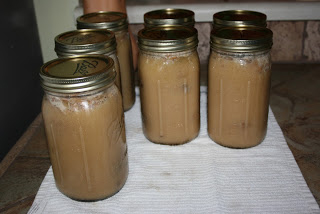
Photo of finished product as requested

Saturday, August 29, 2015

Amish Recipe Series... Amish Bread and Butter Pickles


What is the Ordnung that the Amish live by?

Donald B. Kraybill in his book, The Riddle of Amish Culture, writes: "The Amish blueprint for expected behavior, called the Ordnung, regulates private, public, and ceremonial life. Ordnung does not translate readily into English. Sometimes rendered as ordnance or discipline, the Ordnung is best thought of as an ordering of the whole way of life... a code of conduct which the church maintains by tradition rather than by systematic or explicit rules. A member noted: The order is not written down. The people just know it, that's all. Rather than a packet or rules to memorize, the Ordnung is the understood behavior by which the Amish are expected to live. In the same way that the rules of grammar are learned by children, so the Ordnung, the grammar of order, is learned by Amish youth. The Ordnung evolved gradually over the decades as the church sought to strike a delicate balance between tradition and change. Specific details of the Ordnung vary across church districts and settlements."

Today's recipe... Remember... Disclaimer: The Amish don't always follow updated USDA canning methods, they follow methods passed down from generation to generation. Use this recipe at your own discretion, or adapt it to your own method. I am sharing these recipes EXACTLY as they were sent to me and take no responsibility for them.

Amish Bread and Butter Pickles

Peggy Stolfus

1 gal. cucumbers
8 onions
2 green peppers 
2 red peppers

Slice cucumbers, peppers and onions. Pack in ice, and let it cool for 3 hours. Place a heavy weight on top the pickles (you can use a plate with a weight placed on top).

Drain well and combine with

5 cups sugar
2 tablespoons mustard seed
2 tablespoons celery seed
1½ teaspoons turmeric
½ teaspoon ground cloves
5 cups vinegar

Mix well. Pour this mixture over the pickles and then simmer for half ­an ­hour. Seal bread ­and ­butter pickles in hot jars.

Friday, August 28, 2015

Amish Recipe Series... Amish Blackberry Butter


Is it true the Amish are exempt from Medicare and Medicaid withholding? What legal basis is used for this?

Medicare and Medicaid are a part of the Social Security system. Old Order Amish believe that if the church is faithful to its calling, many government programs and commercial insurance are not needed. That conviction forced them to testify before Congress because they did not want to receive Social Security benefits. What they wanted instead was the right to look after their own elderly. They were finally given approval, if self-employed, to be exempt from paying the tax. Seldom do Old Order Amish individuals accept Social Security, Medicare, or Medicaid.


Today's recipe... Remember... Disclaimer: The Amish don't always follow updated USDA canning methods, they follow methods passed down from generation to generation. Use this recipe at your own discretion, or adapt it to your own method. I am sharing these recipes EXACTLY as they were sent to me and take no responsibility for them. Also, today's recipe is not a canning recipe.

Blackberry Butter - Amish Recipe

Found on thelazydaisykitchen.blogspot

makes one pound of butter 
Ingredients:

1 pound salted butter, softened

1/8 cup of honey

1/2 cup blackberries

Whip together butter and honey until fluffy.

Add in berries and mix in short bursts until desired look is achieved. I did not want mine to be completely emulsified, so I "broke" up the berries slightly with just a few turns of the paddle attachment.

If storing in jars, scoop into jar and wipe mouth clean. Cap and refrigerate.

If storing in logs, place a piece of plastic wrap over a piece of aluminum foil the same size. Scoop out butter along length of wrap/foil, folding wrap over butter and rolling into consistent-sized cylinder. Roll up foil around log and twist ends. Refrigerate or freeze.

Recipe from The Lazy Daisy Kitchen.

Thursday, August 27, 2015

Amish Recipe Series... Amish Beet and Apple Relish


Pennsylvania German (Deitsch, Pennsylvania Deitsch, Pennsilfaanisch Deitsch, Hinterwäldler Deutsch, usually called Pennsylvania Dutch) is a variety of West Central German spoken by the Amish and Old Order Mennonites in the United States and Canada, closely related to the Palatine dialects. There are possibly more than 300,000 native speakers in North America.

It has traditionally been the language of the Pennsylvania Dutch, descendants of late 17th- and early 18th-century immigrants to Pennsylvania, Maryland, Virginia and North Carolina from southern Germany, eastern France (Alsace and Lorraine) and Switzerland. Although for many, the term 'Pennsylvania Dutch' is often taken to refer to the Amish and related Old Order groups exclusively, the term should not imply a connection to any particular religious group.

In this context, the word "Dutch" does not refer to the Dutch people or their descendants. Instead it is probably left over from an archaic sense of the English word "Dutch"; compare German Deutsch ('German'), Dutch Duits ('German'), Diets ('Dutch'), which once referred to any people speaking a non-peripheral continental West Germanic language on the European mainland. Alternatively, some sources give the origin of "Dutch" in this case as a corruption or a "folk-rendering" of the Pennsylvania German endonym "Deitsch."

Today's recipe... Remember... Disclaimer: The Amish don't always follow updated USDA canning methods, they follow methods passed down from generation to generation. Use this recipe at your own discretion, or adapt it to your own method. I am sharing these recipes EXACTLY as they were sent to me and take no responsibility for them. Also, this is not a canning recipe, although some folks might try to adapt it to canning.


Amish Beet and Apple Relish

Found on a harmony of flavors

This relish is lovely as a relish, full side dish, alone, or as an appetizer. If you love beets as I do, this recipe is for you. Makes about 4 or 5 cups

1 pound beets 
2 Granny Smith Apples, or apple of your choice 
½ medium onion, chopped 
1 tablespoon olive oil or coconut oil 
3 tablespoons honey 
2 tablespoons cider vinegar 
½ teaspoon Kosher salt 
Freshly ground pepper, to taste 
Nutmeg - a few grinds, to taste

Heat oven to 425 degrees. Wrap beets, clean but not peeled, in foil. Place on a baking sheet and bake for 1 ¼ to 1 ½ hours, or until very tender. Remove from oven and allow to come down to just warm, still wrapped in the foil.

Combine the honey, vinegar, salt, pepper, and nutmeg and set aside.

Meanwhile, heat a skillet with the olive oil and add in the onions. Saute until soft and translucent. Peel and core the apples (may be left with skin on, if preferred) and cut them into ¼ inch cubes. Add to the softened onion in the skillet and toss until the apples are just slightly softened. Pour on the dressing to combine and remove from heat.

Slip skins off the beets and cut into ¼ inch dice and add to the rest of the mixture and allow to rest for at least 2 hours for flavors to meld.

Wednesday, August 26, 2015

Amish Recipe Series... Amish Apple Butter


Why do Amish men have beards, but not mustaches?

There are quite a few scriptures that mention beards in the Bible. An example would be Psalm 133:1,2. An Amishman does not shave his beard after he becomes married. A long beard is the mark of an adult Amishman. Mustaches, on the other hand, have a long history of being associated with the military, and therefore are forbidden among the Amish people.

Today's recipe... Remember... Disclaimer: The Amish don't always follow updated USDA canning methods, they follow methods passed down from generation to generation. Use this recipe at your own discretion, or adapt it to your own method. I am sharing these recipes EXACTLY as they were sent to me and take no responsibility for them.

Amish Apple Butter
Peggy Stolfus

4 qts. apples

2 qts. apple cider

2 cups sugar

2 cups dark corn syrup

1 tsp. cinnamon

Boil the cider until reduced to 1 quart. Pare the apples and slice into thin pieces. Put the apples into the cider. Cook very slowly, stirring frequently, until the mixture begins to thicken. Add sugar, syrup and cinnamon and continue to cook until thick enough to spread when cool. Seal in sterilized jars.

This recipe yields 5-­6 pints.

Tuesday, August 25, 2015

Amish Recipe Series... Amish Zucchini Jam


The Amish are descendants of the Anabaptist movement

Anabaptism is a Christian movement which traces its origins to the Radical Reformation. Anabaptists are Christians who believe in delaying baptism until the candidate confesses his or her faith. Although some consider this movement to be an offshoot of Protestantism, others see it as a distinct one.The Amish, Hutterites, and Mennonites are direct descendants of the movement. Schwarzenau Brethren, Bruderhof, and the Apostolic Christian Church are considered later developments among the Anabaptists.

The name Anabaptist, meaning "one who baptizes again," was given them by their persecutors in reference to the practice of re-baptizing converts who already had been baptized as infants. Anabaptists required that baptismal candidates be able to make their own confessions of faith and so rejected baptism of infants. The early members of this movement did not accept the name Anabaptist, claiming that since infant baptism was unscriptural and null and void, the baptizing of believers was not a re-baptism but in fact their first real baptism.
As a result of their views on the nature of baptism and other issues, Anabaptists were heavily persecuted during the 16th century and into the 17th by both Magisterial Protestants and Roman Catholics.

Today's recipe... Remember... Disclaimer: The Amish don't always follow updated USDA canning methods, they follow methods passed down from generation to generation. Use this recipe at your own discretion, or adapt it to your own method. I am sharing these recipes EXACTLY as they were sent to me and take no responsibility for them.


Amish Zucchini Jam

6 c grated zucchini 
2 T lemon juice 
20 oz can crushed pineapple, drained 
6 c sugar 
6 oz apricot jello 

Step I: Add 1 cup water to zucchini, bring to a boil and cook 6 minutes. 
Step II: Add sugar, lemon juice, and pineapple and cook 6 more minutes. 
Step III: Add jello and cook 6 more minutes and seal in jars. 

Monday, August 24, 2015

Amish Recipe Series... Amish Raspberry Jam


Why are Amish schools different?

School for Old Order Amish and Mennonites is only a part of the learning necessary for preparation for the adult world. Children have formal schooling in one-room schools to 8th grade and then have a structured learning program supervised by their parents. Classes in the one-room Amish schools are conducted in English, and the children learn English when they go to school. The teachers are Amish and they have no more than an eighth grade education themselves. When the landmark United States Supreme Court decision of 1972 gave exemption for Amish and related groups from state compulsory attendance laws beyond the eighth grade, Chief Justice Burger wrote: “It is neither fair nor correct to suggest that the Amish are opposed to education beyond the eighth grade level. What this record shows is that they are opposed to conventional formal education of the type provided by a certified high school because it comes at the child's crucial adolescent period of religious development.”
Mennonites, on the other hand, have dozens of parochial elementary schools, more than 20 high schools, eleven colleges, and three seminaries sponsored by Mennonite groups in North America. Mennonite families choose whether to send their children to public or church-sponsored schools. Higher education became a vocational necessity as Mennonites left the farm. Missions and service opportunities also gave rise to the need for higher education.

Today's recipe... Remember... Disclaimer: The Amish don't always follow updated USDA canning methods, they follow methods passed down from generation to generation. Use this recipe at your own discretion, or adapt it to your own method. I am sharing these recipes EXACTLY as they were sent to me and take no responsibility for them.

Amish Raspberry Jam
5 cup ground green tomatoes
4 cup sugar
6 oz raspberry jello
Place ground tomatoes and sugar in large kettle. Bring to a rolling boil and boil 10 minutes, stir constantly. Turn off heat and add jello. Stir well until dissolved and put into hot sterilized jars and seal. Cold pack 10 minutes.

Sunday, August 23, 2015

Amish Recipe Series... Amish Mincemeat

Amish-style Jelly Cupboard

Funeral Traditions Among Some Amish Communities
Traditionally, funerals in the United States are followed by a meal for family and friends to gather to celebrate the life of those who have passed on. In the Amish community, the “noon meal” is intended help members of the community breathe new life into the home of the deceased. While not a lavish feast, the meal may include mashed potatoes, gravy, cold beef, cole slaw, pepper cabbage, prunes, applesauce, cheese, bread, buns and “funeral pie,” which includes raisins. The highly conservative Nebraska Amish community still participates in a practice known as rumdraage, which involves those in mourning passing around bread and wine before the body is laid to rest in the ground.

Today's recipe... Remember... Disclaimer: The Amish don't always follow updated USDA canning methods, they follow methods passed down from generation to generation. Use this recipe at your own discretion, or adapt it to your own method. I am sharing these recipes EXACTLY as they were sent to me and take no responsibility for them.

Amish Mincemeat
2½ gallons apples, cut fine
1 gallon beef meat, ground and cooked
4 lbs. raisins
6 quarts cherries (sour)
2 quarts beef broth
2 quarts dark Karo
5 lbs. brown sugar
1 cup white sugar
2 tablespoons cloves
3 tablespoons cinnamon
3 tablespoons allspice
2 tablespoons nutmeg
2 tablespoons salt
1 quart vinegar

If you have strong vinegar just add 1 pint or to suit taste.  Mix sugar with spices and then mix all
together. Fill jars and cold pack for 30 minutes.

Saturday, August 22, 2015

Amish Recipe Series... Amish Cinnamon Apple Jelly


What is Rumspringa?

The Amish youth period Rumspringa, or “running around,” is marked by an increase in social activity

Rumspringa, or “running around”, is the term used to describe the period of adolescence Amish experience starting at around age 16. Rumspringa has been described in books and films, to varying degrees of accuracy.

There are numerous misconceptions about Rumspringa, which is a formative time for Amish youth.
Common myths about Rumspringa:
Amish youth leave home to live in the city-most Amish live at home while adolescents
Amish parents encourage their youth to “break the rules”-Amish parents, like any other, want their children to behave morally
Rumspringa is “time out” from being Amish-most Amish youth live at home and attend church during Rumspringa, and are subject to community influences, though may bend and break guidelines of the Ordnung as they are not yet church members
Rumspringa is typically a time of experimentation with sex and drugs-some portrayals of Rumspringa have depicted the time as one of wild partying, though this is the exception rather than the norm


Today's recipe... Remember... Disclaimer: The Amish don't always follow updated USDA canning methods, they follow methods passed down from generation to generation. Use this recipe at your own discretion, or adapt it to your own method. I am sharing these recipes EXACTLY as they were sent to me and take no responsibility for them.

Amish Cinnamon Apple Jelly 


1 qt apple juice

1 box Sure Jell

4 ½ c sugar

2 T red hots candy

Mix together & cook on medium boil for 3 minutes. Place in hot sterile jars & seal.

Read more: http://community.tasteofhome.com/community_forums/f/30/t/189370.aspx#ixzz3R3hBIREy

Friday, August 21, 2015

Amish Recipe Series... Amish Beet Jam


What is Amish Bed Courtship?


In the Amish districts that sanction bed courtship, the boy asks the girl if he can take her home. If she consents, they drive to her home. They immediately go upstairs and get into her bed fully clothed, where they are expected to talk all night without touching.

Bed courtship is practiced only by the ultra-conservative churches. The parents rely on the church teachings to prevent hanky-panky.

This custom is also known as bundling which the dictionary defines as sleeping in the same bed with somebody while both are fully dressed.

Bundling has biblical roots. It is not an Amish invention. The custom was practiced in Europe for centuries before immigrants introduced it to the American colonies.

In the past, the practical reason for bed courting was comfort. When homes were heated by fireplaces and had hard wooden furniture, the bed was the warmest, most comfortable place to socialize. As fireplaces and hard wooden chairs were replaced by central heating and comfortable sitting rooms, bundling faded (almost entirely) from the scene.

Note: Most of today's Amish communities do not practice bed courtship. Amish customs vary greatly from one community to another since each community has its own bishop who, with the church leaders, set the rules of their own community.


Today's recipe... Remember... Disclaimer: The Amish don't always follow updated USDA canning methods, they follow methods passed down from generation to generation. Use this recipe at your own discretion, or adapt it to your own method. I am sharing these recipes EXACTLY as they were sent to me and take no responsibility for them.

Amish Beet Jam

6 c beet juice

2 pkg Sure Jell

6 oz raspberry jello

1 ½ c lemon juice

8 c sugar

Place beet juice, Sure Jell, and lemon juice in large kettle and bring to a boil. Add sugar and jello all at one time. Boil 10 minutes and pour into hot sterilized jars and seal.

html, body, div, span, applet, object, iframe, h1, h2, h3, h4, h5, h6, p, blockquote, pre, a, abbr, acronym, address, big, cite, code, del, dfn, em, font, img, ins, kbd, q, s, samp, small, strike, strong, sub, sup, tt, var, b, u, i, center, dl, dt, dd, ol, ul, li, fieldset, form, label, legend, table, caption, tbody, tfoot, thead, tr, th, td { margin: 0; padding: 0; border: 0; outline: 0; font-size: 100%; vertical-align: baseline; background: transparent; } body { line-height: 1; } ol, ul { list-style: none; } blockquote, q { quotes: none; } /* remember to define focus styles! */ :focus { outline: 0; } /* remember to highlight inserts somehow! */ ins { text-decoration: none; } del { text-decoration: line-through; } /* tables still need 'cellspacing="0"' in the markup */ table { border-collapse: collapse; border-spacing: 0; }