Showing posts with label Homemaking. Show all posts

Thursday, April 11, 2013

Rye 'n' Injun Bread... Farmer Boy

The chapter on cutting ice from the big pond in Laura Ingalls Wilders' Farmer Boy always amazed this Southern girl... especially when I read the book the first time as a child...  How they stacked the ice in the ice house, packing in on all sides with sawdust so it would keep even through the hottest summer... and they had ice for ice cream and lemonade any time they needed it.

When Almanzo and his Father and brother Royal came home the evening after finishing up with the ice.. to have their Saturday night bath... Mother was putting Sunday dinner in the oven for the next day... She made chicken pie, baked beans, and Rye 'n' Injun Bread...

Here's the recipe for Rye 'n' Injun Bread from the Little House Cookbook... I gotta try this... SOON!!!! After my Saturday night bath! ;)


    1 1/2 c. corn meal
    1 1/2 c. rye flour
    2 tsp. baking soda
    1 stp salt
    2 eggs
    3/4 c. molasses
    1 c. buttermilk

In a large bowl, mix flours, baking soda and salt. In a seperate bowl, mix eggs, molasses and buttermilk. Pour liquid ingredients into dry ingredients and stir until well mixed. Do not beat. Grease a 9x13" pan. Put mixture in pan. Fill another 9x13" pan with water and put on bottom rack of oven. Preheat oven to 200 degrees. Bake at 200 degrees for 3-4 hours. Cut into 16 pieces. Serve hot or cold. Great with butter and/or honey. Makes 16 servings. 

Sunday, April 7, 2013

Helping Hands and Simple Fun... Another "Little House" Lesson


When I was growing up, my grandmothers, my Mama, and my aunts all gathered together to can... "many hands make light work." And it almost felt like a party, except for the hard work, but even stringing and breaking bushels of green beans or peeling peaches until the juice ran down and dripped off your elbows, became fun with all the talk and laughter around the table or sitting in the shade of my Nanny's apple tree. These times of hard work have become some of my most treasured memories.

Having family or neighbors to help with the "big work" was even more important in the "Little House" days...

From Little House in the Big Woods...


Uncle Henry came to help Pa butcher the hog. He brought Aunt Polly's sharpened knife.  They made a bonfire and heated a big kettle of  water over it.  The pig pen was nearby.  Laura plugged her ears with her fingers because she didn't want to hear the pig squeal as it was being killed. "After that, Butchering Time was great fun."
Uncle Henry and Pa were "jolly".  There was spare ribs for dinner. Pa promised the girls they could play with the bladder, which he blew up like a balloon. They played games like volley ball and kick ball with the blown-up bladder. He also gave the girls the pig's tail, which was roasted, sizzled, fried and sprinkled with salt. They ate all the meat off the bones, knowing there wouldn't be another pig's tail until next year.
The hog was scalded in hot water.  They laid it on a board.  Then it was scraped with knives until all the coarse bristles came off the skin.  Then the hog was hung in a tree.  The insides were taken out, and it was left hanging to cool.  Then it was taken down, and cut up.
From this hog came: hams, shoulders, side meat, spare-ribs, belly, heart, liver, tongue, and headcheese.  The dishpan that was full of bits and pieces would be made into sausage. The meat was laid on a board and sprinkled with salt. The hams and shoulders were pickled in brine, then smoked.
Pa said, "You can't beat hickory-cured ham."
Uncle Henry went back home after dinner.  Pa went into the Big Woods to do more work.  Laura and  Mary helped Ma with carrying wood and watching the fire. Ma put lard in big iron pots on the cookstove.  Ma skimmed out brown "cracklings"....she would use them to flavor "johnny-cake" later.
Ma made headcheese. She scraped and cleaned the head carefully.  She boiled it until all the meat  fell off the bones.  Then the meat was chopped into fine pieces and seasoned with pepper, salt and spices.  It was mixed with pot-liquor and cut into slices after it cooled.
The little pieces of lean and fat that  came off the larger pieces were made into sausage.  Sausage balls were put in a pan out in the shed to freeze.  These were good to eat all winter.
When Butchering Time was over there were:  sausages, headcheese, big jars of lard, a keg of white saltpork out in the shed, smoked ham and shoulders in the attic.

Wednesday, March 27, 2013

Getting Ready for Winter... more lessons from "Little House" books


Preparing for winter was important in the "Little House" days... with the days of big supermarkets, truck deliveries every day, and greenhouse foods, we've moved away from the necessity of "putting up" for the winter... I think it's time we got back to those days... what a peaceful, comfortable, secure feeling it gives me when I know that if a winter storm or a hurricane hits, I've got plenty for us to eat without having to brave the elements to grab that last loaf of bread or gallon of milk everyone seems to rush out to get. I like to call it "food insurance!"
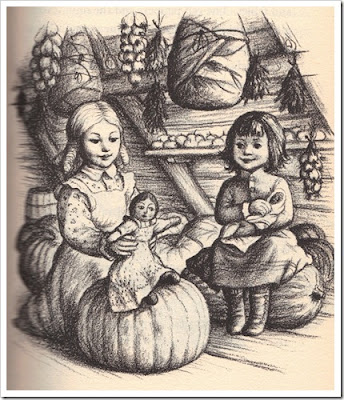
Mary and Laura play with their dolls among the pumpkins and other
food stored in the attic in the "Little House in the Big Woods"
From Little House in the Big Woods
One morning Pa went away before daylight with the horses and wagon, and that night he came home with a wagonload of fish. The big wagon box was piled full, and some of the fish were as big as Laura. Pa had gone to Lake Pepin and caught them all with a net.
Ma a cut large slices of flaky white fish, without one bone, for Laura and Mary. They all feasted on the good, fresh fish. All they did not eat fresh was salted down in barrels for the winter.
Pa owned a pig. It ran wild in the Big Woods, living on acorns and nuts and roots. Now he caught it and put it in a pen made of logs, to fatten. He would butcher it as soon as the weather was cold enough to keep the pork frozen.
Laura woke up and heard the pig squealing. Pa jumped out of bed, snatched his gun from the wall, and ran outdoors. Then Laura heard the gun go off, once, twice.
When Pa came back, he told what had happened. He had seen a big black bear standing beside the pigpen. The bear was reaching into the pen to grab the pig, and the pig was running and squealing. Pa saw this in the starlight and he fired quickly. But the light was dim and in his haste he missed the bear. The bear ran away into the woods, not hurt at all.
Laura was sorry Pa did not get the bear. She liked bear meat so much. Pa was sorry, too, but he said: "Anyway, I saved the bacon.”
The garden behind the little house had been growing all summer. It was so near the house that the deer did not jump the fence and eat the vegetables in the daytime, and at night Jack kept them away. Sometimes in the morning there were little hoof-prints among the carrots and the cabbages. But Jack's tracks were there, too, and the deer had jumped right out again.
Now the potatoes and carrots, the beets and turnips and cabbages were gathered and stored in the cellar, for freezing nights had come.
Onions were made into long ropes, braided together by their tops, and then were hung in the attic beside wreaths of red peppers strung on threads. The pumpkins and the squashes were piled in orange and yellow and green heaps in the attic's corners.
The barrels of salted fish were in the pantry, and yellow cheeses were stacked on the pantry shelves...
...The attic was a lovely place to play. The large, round, colored pumpkins made beautiful chairs and tables. The red peppers and the onions dangled overhead. The hams and the venison hung in their paper wrappings, and all the bunches of dried herbs, the spicy herbs for cooking and the bitter herbs for medicine, gave the place a dusty spicy smell.
Often the wind howled outside with a cold and lonesome sound. But in the attic Laura and Mary played house with the squashes and the pumpkins, and everything was snug and cosy.
Friday, March 22, 2013

Learning from the Little House Books... Smoking Venison

I first met Laura Ingalls when I was in the third grade... I began devouring the "Little House" books one by one... I read them again when I was a bit older, then again aloud to my own children and again to my grandson.

My youngest daughter, Hannah, with memories of "Little House" still treasured in her heart, bought me a beautifully bound copy of Laura's first five novels for Christmas this year... I've begun reading them again, with new eyes... and the realization that they are so much more than a sweet children's story... or historical fiction... there is much to be learned about homemaking and food preservation and self reliance in those beloved pages...


 From chapter 1 of Little House in the Big Woods...

"The house was a comfortable house. Upstairs there was a large attic, pleasant to play in when the rain drummed on the roof. Downstairs was the small bedroom, and the big room. The bedroom had a window that closed with a wooden shutter. The big room had two windows with glass in the panes, and it had two doors, a front door and a back door.
"All around the house was a crooked rail fence, to keep the bears and the deer away.
"In the yard in front of the house were two beautiful big oak trees. Every morning as soon as she was awake Laura ran to look out of the windows, and one morning she saw in each of the big trees a dead deer hanging from a branch.
"Pa had shot the deer the day before and Laura had been asleep when he brought them home at night and hung them high in the trees so the wolves could not get the meat.
"That day Pa and Ma and Laura and Mary had fresh venison for dinner. It was so good that Laura wished they could eat it all. But most of the meat must be salted and smoked and packed away to be eaten in the winter.
"For winter was coming. The days were shorter, and frost crawled up the window panes at night. Soon the snow would come. Then the log house would be almost buried in snowdrifts, and the lake and streams would freeze. In the biter cold weather Pa could not be sure of finding any wild game to shoot for meat..."

"So as much food as possible must be stored away in the little house before winter came.
"Pa skinned the deer carefully and salted and stretched the hides, for he would make soft leather of them. Then he cut up the meat, and sprinkled salt over the pieces as he laid them on a board.
"Standing on end in the yard was a tall length cut from the trunk of a big hollow tree. Pa had driven nails inside as far as he could reach from each end. Then he stood it up, put a little roof over the top, and cut a little door on one side near the bottom. One the piece that he cut out he fastened leather hinges; then he fitted it into place, and that was the little door, with the bark still on.
"After the deer meat had been salted several days, Pa cut a hole near the end of each piece and put a string through it. Laura watched him do this, and then she watched him hang the meat on the nails in the hollow log.
"He reached up through the little door and hung meat on the nails as far up as he could reach. Then he put a ladder against the log, climbed up to the top, moved the roof to one side, and reached down inside to hand meat on those nails.
"Then Pa put the roof back again, climbed down the ladder, and said to Laura:
'Run over to the chopping block and fetch me some of those green hickory chips -- new, clean, white ones.'
"So Laura ran to the block where Pa chopped wood, and filled her apron with the fresh, sweet-smelling chips.
"Just inside the little door in the hollow log Pa built a fire of tiny bits of bark and moss, and he laid some of the chips on it very carefully.
"Instead of burning quickly, the green chips smoldered and filled the hollow log with thick, choking smoke. Pa shut the door, and a little smoke squeezed through the crack around it and a little smoke came out through the roof, but most of it was shut in with the meat.
'There's nothing better than good hickory smoke,' Pa said. 'That will make good venison that will keep anywhere, in any weather.'
"Then he took his gun, and slinging his ax on his shoulder he went away to the clearing to cut down some more trees.
"Laura and Ma watched the fire for several days. When smoke stopped coming through the cracks, Laura would bring more hickory chips and Ma would put them on the fire under the meat. All the time there was a little smell of smoke in the yard, and when the door was opened a thick, smoky, meaty smell came out.
"At last Pa said the venison had smoked long enough. Then they let the fire go our, and Pa took all the strips and pieces of meat out of the hollow tree. Ma wrapped each piece neatly in paper and hung them in the attic where they would keep safe and dry."
html, body, div, span, applet, object, iframe, h1, h2, h3, h4, h5, h6, p, blockquote, pre, a, abbr, acronym, address, big, cite, code, del, dfn, em, font, img, ins, kbd, q, s, samp, small, strike, strong, sub, sup, tt, var, b, u, i, center, dl, dt, dd, ol, ul, li, fieldset, form, label, legend, table, caption, tbody, tfoot, thead, tr, th, td { margin: 0; padding: 0; border: 0; outline: 0; font-size: 100%; vertical-align: baseline; background: transparent; } body { line-height: 1; } ol, ul { list-style: none; } blockquote, q { quotes: none; } /* remember to define focus styles! */ :focus { outline: 0; } /* remember to highlight inserts somehow! */ ins { text-decoration: none; } del { text-decoration: line-through; } /* tables still need 'cellspacing="0"' in the markup */ table { border-collapse: collapse; border-spacing: 0; }