Showing posts with label Cabbage. Show all posts

Saturday, December 26, 2015

Soup of the Day... Weight Loss Soup

Not an exact pic... but REAL close!!!


Today's recipe... Remember... Disclaimer: Some folks don't always follow updated USDA canning methods, they may live in another country where the standards are not the same, they may use heirloom methods passed down through the generations, they may choose other canning methods not recommended. Use this recipe at your own discretion, or adapt it to your own method. I am sharing these recipes EXACTLY as they were sent to me and take NO responsibility for them.

Weigh Loss Soup
by Richard Moody 

The design of this program is to eat a healthy breakfast…. Weight loss soup for lunch and dinner. Eat healthy snacks in between to curve your hunger. 

Now to cold pack for canning… this is what I did….. Makes 7 qts… my canner full I put all of these together in pot or bowl to ladle… 

64 oz chicken broth 

6 cups of tomato juice 

2 tsp Italian seasoning 

4 cloves of minced garlic 

Dice these vegetables into separate containers… enough for ¼ cup for each quart 

Large Onion 

Zucchini squash (about 2 med to lg) 

Yellow squash (about 2 med to lg) 

I sliced and then quartered both Green beans… again enough for ¼ cup for each qt. 

Mushrooms… 1 8oz pkg was enough for ¼ cup each qt 

2 cans of red kidney beans… ¼ cup for each qt 

2 cans of Italian diced tomatoes… ¼ cup for each qt 

1 lb carrots sliced 

Shredded cabbage enough for about 1 and ½ cup for each qts 

I do sterilize the jars then let them cool down so they are not too hot to handle bare handed. I filled 7 qt jars with all these measured ingredients doing cabbage last …. Topping off each qt with packing the cabbage on the top. Then I ladled the broth mixture to 1 inch head space. I prefer to cold pack when canning… so I can control the ingredients into each jar, and I can plan a full canner. To ladle from a pot of all ingredients you may get more or less of some items into the jars. You will end up having too much ingredients… throw into a pot cook it up and you have tonight’s dinner and a full canner being processed. Put the seals and rings on the jars to finger tight and into a cold pressure canner. Bring to a steam for 10 minutes then process like you would for beans (same as meats) in your area. Again, I cold pack can to control the ingredients into each jar… and to me it’s much easier.

Tomorrow's Soup of the Day... White Bean and Spinach Soup Mix

Wednesday, December 23, 2015

Soup of the Day... UnStuffed Cabbage Roll Soup


Today's recipe... Remember... Disclaimer: Some folks don't always follow updated USDA canning methods, they may live in another country where the standards are not the same, they may use heirloom methods passed down through the generations, they may choose other canning methods not recommended. Use this recipe at your own discretion, or adapt it to your own method. I am sharing these recipes EXACTLY as they were sent to me and take NO responsibility for them.

Un­Stuffed Cabbage Roll Soup

 shared by Karen Hart

Makes 6-­ 8 quarts 

2 lbs ground Beef ( I don’t can the soup with meat in it, I cook the meat and serve with soup and rice) 

4 cans Diced Tomatoes 

2 cans Tomato sauce 

3 cup of water or chicken stock

2 onion chopped ­ medium to large 

1 large Bell Pepper Chopped 

2 tsp garlic powder 

1 large head of cabbage ­ cored and chopped 

2 tsp black pepper 

2 tsp canning salt 

2 Tbsp white vinegar 

2 tsp paprika, 

1 Tbsp Worcestershire sauce 

2 Tbsp brown sugar 

Add cooked ground meat, tomatoes, chicken stock (if using fresh tomatoes), onion, garlic, pepper, salt, vinegar, spices and sugar to a large pot and heat to simmer for about 20 min. First add chopped uncooked cabbage to quart size jars, pack it down, almost to half way. Using a slotted spoon divide hot soup mixture to each jar to 1-1/2 inch headspace. Ladle in juice from soup mixture into each jar to 1 inch headspace. If there is not enough juice ­ finish filling up jars with hot chicken broth or hot tomato juice. Wipe rims and put on lids to finger tight. Process in a pressure canner at 10 lbs of pressure for 90 mins, 75 mins for pints.

Tomorrow's Soup of the Day... Unstuffed Pepper Soup

Tuesday, December 22, 2015

Soup of the Day... Ukrainian Cabbage Soup


Today's recipe... Remember... Disclaimer: Some folks don't always follow updated USDA canning methods, they may live in another country where the standards are not the same, they may use heirloom methods passed down through the generations, they may choose other canning methods not recommended. Use this recipe at your own discretion, or adapt it to your own method. I am sharing these recipes EXACTLY as they were sent to me and take NO responsibility for them.

Ukrainian Cabbage Soup 

Found on Pinterest

NOTE: Can be canned or frozen. You can thicken the soup before freezing or after defrosting or after opening a jar to heat by making a butter-flour roux consisting of 4 tablespoons butter or margarine and 4 tablespoons all-purpose flour. 

Makes 7 - 8 quarts 

5–6 pounds pork neck bones 

2 whole bay leaves 

2 teaspoons ground black pepper 

water to cover neck bones 

1 large head cabbage, cored and shredded 

2 28-ounce cans sauerkraut 

2 large onions, finely chopped 

4 Tbsp. whole caraway seeds 

1 or 2 shredded carrots (OPTIONAL) 

Put neck bones in a large stockpot.

Add bay leaves and pepper; cover with water. Start on high heat to boil; reduce heat and cook 1 hour. Add shredded cabbage, sauerkraut (including juice), and chopped onions. Continue to cook about 45 minutes; meat will start falling off bones. Add caraway seeds. Remove and discard bay leaves. Remove bones with slotted spoon. After cooling bones, remove meat and discard bones. Add meat back to soup. 

Freeze or 

If canning, ladle soup into sterilized wide-mouth quart jars, leaving 1" headspace. Wipe rims. Cap and seal. Process in a pressure canner at 10 pounds pressure for 1 hour and 15 minutes for pints and 1 hour and 30 mins for quarts.

Tomorrow's Soup of the Day... Un­Stuffed Cabbage Roll Soup

Saturday, December 19, 2015

Soup of the Day... Turkey and Cabbage Soup


Today's recipe... Remember... Disclaimer: Some folks don't always follow updated USDA canning methods, they may live in another country where the standards are not the same, they may use heirloom methods passed down through the generations, they may choose other canning methods not recommended. Use this recipe at your own discretion, or adapt it to your own method. I am sharing these recipes EXACTLY as they were sent to me and take NO responsibility for them.

Turkey and Cabbage Soup

Found on cookingwithmaryandfriends.blogspot

1 gallon turkey stock 

3-4 cups turkey, cooked and chopped 

1 onion, chopped 

1 cup celery, chopped 

1 (14.5 ounce) can petite diced tomatoes, un-drained 

1/2 head of cabbage, chopped 

To each jar add: 

1/2 tsp. course-ground black pepper 

1/2 tsp. garlic powder 

1/2 tsp. chili powder 

1/4 tsp. cumin 

Make in quart size jars, no amt was given for how many this makes.

Layer equal amounts of onion, celery, tomatoes, cabbage and cooked turkey to each quart canning jar. Now add spices listed to each jar. Pour turkey stock over all. Run a knife around the inside of jars to remove air bubbles, and add more stock as necessary leaving a 1/2-inch head space. Cover jars with seals and rings and process in pressure canner 90 minutes at 10 lbs. pressure, would be 75 lbs for pints. Remove pressure canner from heat, allow canner to cool down completely, then remove jars and let them sit on your countertop undisturbed for 24 hours. Store in pantry. Serve over hot cooked rice with a side of corn muffins or cornbread.

Tomorrow's Soup of the Day... Turkey Corn Soup

Thursday, December 3, 2015

Soup of the Day... Russian Sweet and Sour Cabbage Soup


Today's recipe... Remember... Disclaimer: Some folks don't always follow updated USDA canning methods, they may live in another country where the standards are not the same, they may use heirloom methods passed down through the generations, they may choose other canning methods not recommended. Use this recipe at your own discretion, or adapt it to your own method. I am sharing these recipes EXACTLY as they were sent to me and take NO responsibility for them.
Russian Sweet and Sour Cabbage Soup

Adapted from recipe found on food52

Makes 3 to 4 quarts

2 pounds stew meat 

2 tablespoons vegetable oil 

1 large Bermuda onion, cut in half and sliced 

2 to 3 pounds ripe tomatoes (3 to 5 large), cored and cut into wedges (or one 28- or 35-ounce can Italian plum tomatoes) or 2 pints of home canned stewed tomatoes with juice 

2 pounds cabbage, cored and shredded (about 10 cups) 

2 quarts water 

2 teaspoons canning salt 

1/2 teaspoon black pepper 

6 tablespoons sugar 

1/4 cup lemon juice or white wine vinegar 

2-1/2 to 3 pounds potatoes (4 to 6 large), peeled and cut into 1/2 inch pieces.

Add vegetable oil to a pan and heat. Brown stew meat, remove and allow to drain well.

Add to a large pot - stew meat, onion, tomatoes, water, salt, pepper, sugar, lemon juice or vinegar, and potatoes. Bring to a boil, reduce heat and heat for 15 mins. Add cabbage and allow to cook for an addtional 5 mins (you only want the cabbage to wilt down, not cook).

Using a slotted spoon divide soup solids between 3 or 4 quart jars to a little more then 1/2 full but not more then 2/3s full. Finish filling with soup liquid to 1 inch headspace. If there is not enough liquid divide equally among the jars and finish filing with hot water to 1 inch headspace. Remove air bubbles, wipe rims, and assemble lids.

Process in a pressure canner at 10 lbs of pressure for 90 mins for quarts (75 mins for pints).

To Serve: Sprinkle some dill weed on top of soup (OPTIONAL).

Tomorrow's Soup of the Day... Russian Vegetable Soup


Tuesday, December 1, 2015

Soup of the Day... Rivers Edge Cabbage Soup


Today's recipe... Remember... Disclaimer: Some folks don't always follow updated USDA canning methods, they may live in another country where the standards are not the same, they may use heirloom methods passed down through the generations, they may choose other canning methods not recommended. Use this recipe at your own discretion, or adapt it to your own method. I am sharing these recipes EXACTLY as they were sent to me and take NO responsibility for them.

Rivers Edge Cabbage Soup

Submitted by Rebecca Hope Caldwell

1 Large can of Tomato Soup

4 cups of Water

2 stalks celery (finely chopped)

2 cloves of garlic (we used the jar of minced garlic which is 2 tsp)

1 medium onion (finely chopped)

2 bay leaves (don't chop as you will be removing them before serving)

1 14.5 oz of chicken broth

2 Tbsp of cayenne pepper

3 Tbsp of Franks Hot sauce

1 medium head of cabbage (this can depend on how much you prefer in your soup)

3 Tbsp salt

Combine all ingredients in a 5qt crockpot (or larger). Periodically you may add a little more water to make as thick or thin as your liking. Boil on medium 1-1/2 to 2 hours, until ingredients are tender. The longer you leave the soup cooking the warmer the soup will get due to the cayenne pepper.

Tomorrow's Soup of the Day... Root Vegetable Soup

Wednesday, October 28, 2015

Soup of the Day... Goulash Soup with Red Peppers and Cabbage


A spoon does not know the taste of soup, nor a learned fool the taste of wisdom. ~~Welsh expression

Today's recipe... Remember... Disclaimer: Some folks don't always follow updated USDA canning methods, they may live in another country where the standards are not the same, they may use heirloom methods passed down through the generations, they may choose other canning methods not recommended. Use this recipe at your own discretion, or adapt it to your own method. I am sharing these recipes EXACTLY as they were sent to me and take NO responsibility for them.
Goulash Soup with Red Peppers and Cabbage 
Adapted from recipe found on kalynskitchen

Makes 2 quarts 

Ingredients: 

2 onions, cut half both ways, then in thick slivers 

2 tsp. finely minced garlic 

2 T sweet Hungarian Paprika 

1 T hot Hungarian Paprika 

1/2 tsp. crushed caraway seed (optional) 

4 cups homemade beef stock (or 3 cans, 14 oz. each) 

3 cups roasted tomatoes or 2 cans(14.5 oz.) diced tomatoes 

2 cups finely diced cabbage 

1 lb. lean ground beef, browned and drained well. 

1 jar (12 oz.) roasted red peppers, diced into 1 inch pieces 

sour cream for serving 

Instructions: Add onions, garlic, paprika, caraway seed (if using), cooked ground beef, roasted tomatoes, cabbage, beef stock, roasted red peppers, and 2 cups water to soup pot and start to simmer. Simmer for 30 mins. Using slotted spoon, divide solid ingredients between the 2 quart jars. Add soup liquid to 1 inch headspace. Wipe rims, assemble lids and process in a pressure canner for 90 mins for quarts (75 mins for pints) at 10 lbs of pressure. 

Serve hot, garnished with sour cream. This freezes very well.

Tomorrow's Soup of the Day... Habitant Soup

Sunday, October 18, 2015

Soup of the Day... Corned Beef and Cabbage Soup


Today's recipe... Remember... Disclaimer: Some folks don't always follow updated USDA canning methods, they may live in another country where the standards are not the same, they may use heirloom methods passed down through the generations, they may choose other canning methods not recommended. Use this recipe at your own discretion, or adapt it to your own method. I am sharing these recipes EXACTLY as they were sent to me and take NO responsibility for them.

Corned Beef and Cabbage Soup
shared by Donna Hitchcock
Adapted from recipe found on countrycooking

Makes 7 to 8 quarts

2 large onions, chopped

3 cups of celery, chopped

3 cups of carrots, sliced 

3/4 tsp ground allspice

1 quart of home canned tomato juice or sauce, or 2 or 3 pints or 3 cans of tomato sauce 

10 cups beef broth

4 cups water

1 large head of cabbage, chopped

4 cups potatoes, cubed into 1/2 inch cubes

1 lb corned beef, cut into 1/2 cubes, trim fat

1 Tbsp of canning salt 

1 tsp of black pepper

Layer equal amounts of onion, celery, carrots, potatoes, cabbage and corned beef to each quart canning jar to about 3/4s full.

Add allspice, salt, pepper, beef broth, tomato juice or sauce, and water to a large pot. Bring to a boil. Turn off heat and ladle into jars to 1 inch headspace. Remove air bubbles and add more broth or hot water as needed to 1 inch headspace, wipe rims, and assemble lids.

Process in pressure canner 90 minutes for quarts (75 mins for pints) at 10 lbs. pressure.

Tomorrow's Soup of the Day... Cowboy Soup

Tuesday, September 29, 2015

Soup of the Day... Cabbage Soup


Health benefits of cabbage


  • Fresh, dark green-leafy cabbage is incredibly nutritious; but very low in fat and calories. 100 g of leaves provide just 25 calories.
  • The vegetable is a storehouse of phyto-chemicals like thiocyanates, indole-3-carbinol, lutein, zea-xanthin, sulforaphane, and isothiocyanates. These compounds are powerful antioxidants and known to help protect against breast, colon, and prostate cancers and help reduce LDL or "bad cholesterol" levels in the blood.
  • Fresh cabbage is an excellent source of natural antioxidant, vitamin C. Provides 36.6 mg or about 61% of RDA per 100 g. Regular consumption of foods rich in vitamin C helps the body develop resistance against infectious agents and scavenge harmful, pro-inflammatory free radicals.
  • Total antioxidant strength measured in terms of oxygen radical absorbance capacity (ORAC value) is 508 µmol TE/100 g. Red cabbages contain more antioxidant value, 2252 µmol TE/100 g.
  • It is also rich in essential vitamins such as pantothenic acid (vitamin B-5), pyridoxine (vitamin B-6) and thiamin (vitamin B-1). These vitamins are essential in the sense that our body requires them from external sources to replenish.
  • It also contains a adequate amount of minerals like potassium, manganese, iron, and magnesium. Potassium is an important component of cell and body fluids that helps controlling heart rate and blood pressure. Manganese is used by the body as a co-factor for the antioxidant enzyme, superoxide dismutase. Iron is required for the red blood cell formation.
  • Cabbage is a very good source of vitamin K, provides about 63% of RDA levels. Vitamin-K has the potential role in bone metabolism through promoting osteotrophic activity. So enough of vitamin K in the diet would gives you healthy bones. In addition, vitamin-K also has established role in the cure of Alzheimer's disease patients by limiting neuronal damage inside their brain.
Today's recipe... Remember... Disclaimer: Some folks don't always follow updated USDA canning methods, they may live in another country where the standards are not the same, they may use heirloom methods passed down through the generations, they may choose other canning methods not recommended. Use this recipe at your own discretion, or adapt it to your own method. I am sharing these recipes EXACTLY as they were sent to me and take NO responsibility for them.

Cabbage Soup 
by Vickie Wright

INGREDIENTS

½ head of cabbage, chopped

1 cup celery, diced

1 cup white or yellow onion, diced

1 cup carrots, diced

1 green bell pepper, diced

2-­3 cloves garlic, minced

4 cups chicken broth

14 oz can diced tomatoes

1 teaspoon oregano

1 teaspoon basil

½ teaspoon red pepper flakes and cayenne pepper

Salt and Pepper to taste

(I also put water, chopped potatoes and summer sausage in mine)

INSTRUCTIONS

Heat 2­-3 tablespoons of olive oil in a large pot over medium heat. Add celery, onions, bell peppers, and carrots. Saute until slightly tender. Stir in garlic. Pour in chicken broth. Stir in tomatoes and cabbage. Bring to a boil and then reduce heat. Cook until cabbage is tender. Stir in oregano, basil, red pepper flakes, black pepper and salt (if using)Taste broth and adjust seasoning if needed. Fill jars to 1 inch line and pressure can 75 minutes for pints 90 for quarts.

Tomorrow's Soup of the Day... Cajun Chicken Soup

Monday, September 28, 2015

Soup of the Day... Cabbage Soup Diet


Campbell's Soup Trivia

• In 1900 Campbell's sold about 500,000 cans of soup per year. By the early 1920s sales were about 18 million cans per week!
• Campbell Soup Company started out as a canning company in New Jersey in 1869. It was founded by an icebox maker (Abram Anderson) and a fruit merchant (Joseph Campbell). Later, Arthur Dorrance replaced Anderson, and it was a nephew of Dorrance, chemist John, who invented condensed soup in 1897. This gave the company a decided advantage over competitors because shipping costs were much reduced, which enabled it to become one of the first food companies to have national distribution. The soups won a gold medal at the Paris Exposition in 1900, and the medal has been on the label since then.
• The label on one of Campbell's original products, canned tomatoes, showed a giant tomato being hauled by two men.
• Campbell Soup Company sells more than 100 million cans of pork and beans a year.
• The colors of Campbell's Soup labels, red and white, come from the colors of the Cornell University football team.

Today's recipe... Remember... Disclaimer: Some folks don't always follow updated USDA canning methods, they may live in another country where the standards are not the same, they may use heirloom methods passed down through the generations, they may choose other canning methods not recommended. Use this recipe at your own discretion, or adapt it to your own method. I am sharing these recipes EXACTLY as they were sent to me and take NO responsibility for them.

Cabbage Soup Diet 
submitted by Wendy Parnell Creasey

Ingredients:
5 carrots, chopped 

3 onions, chopped 

2 16-oz. cans diced tomatoes with liquid 

1 large head of cabbage, chopped 

1 1-oz. envelope of onion soup mix (I used beefy onion) 

1 15-oz. can cut green beans, drained (I used home canned and liquid) 

2 quarts tomato juice 

2 green bell peppers, diced (I used different colors) 

10 ribs of celery, chopped 

1 14-oz. can beef broth 

Salt & pepper to taste 

Hot sauce to taste (optional)

Super easy directions: Prepare the above ingredients as instructed. Add everything to a large stock pot. If you need to, add water or more beef stock/tomato juice to cover the vegetables. Bring to a slow boil, then turn down to low and let simmer until the vegetables are tender.

Personally, I like big, chunky vegetables with some substance to them (NOT mushy!). If you cut the vegetables in large, hearty chunks, they will hold up very well under pressure canning (if you're the type of person to do that kind of thing *wink emoticon*).

Tomorrow's Soup of the Day... Cabbage Soup

Sunday, September 27, 2015

Soup of the Day... Cabbage Borscht


Borsch, also spelled borscht, borsht, or bortsch,
beet soup of the Slavic countries. Although borsch is important in Russian and Polish cuisines, Ukraine is frequently cited as its place of origin. Its name is thought to be derived from the Slavic word for the cow parsnip, or common hogweed (Heracleum sphondylium), or from a fermented beverage derived from that plant. The more-palatable cultivated beet eventually replaced the wild cow parsnip as the basis of the soup.

Borsches are eaten hot or cold. Some are clear and light, others thick and substantial. Many recipes counterbalance the sweetness of the beets with the addition of kvass (also spelled kvas). The term kvass may refer to a sour, slightly alcoholic beer made from bread or to a concoction of fermented beets; both are used. Vinegar, lemon juice, or citric acid can be added to achieve a similar effect.

Ukrainian borsch is a hearty soup of beef and a variety of vegetables in which root vegetables and cabbage predominate, and the soup takes its characteristic deep red colour from beets. The soup is often eaten with a sour cream garnish and with pirozhki, turnovers filled with beef and onions. A meatless beet soup is made with a stock flavoured with forest mushrooms; this Polish version is served with tiny mushroom-filled dumplings, uszka. ~britannica.com


Today's recipe... Remember... Disclaimer: Some folks don't always follow updated USDA canning methods, they may live in another country where the standards are not the same, they may use heirloom methods passed down through the generations, they may choose other canning methods not recommended. Use this recipe at your own discretion, or adapt it to your own method. I am sharing these recipes EXACTLY as they were sent to me and take NO responsibility for them.

Cabbage Borscht 
Found on Pinterest

Ingredients
5 lbs tomatoes (I used 2 quarts stewed) 

8 cups coarsely shredded cabbage (I used red) 

7 cups water 1 cup diced beets or pickled beets, drained 

2 cups chopped onions 

1 cup chopped apples 

2 Tablespoons instant beef bouillon 

2 Tablespoons sugar or brown sugar 

2 Tablespoons lemon juice 

1 teaspoon salt (optional) 

1/8 teaspoon pepper 

1 tsp. dill weed (optional) 

3 Tbsp. Tomato paste (optional) 

Directions

Wash, scald, peel, remove stem ends and cores, and quarter tomatoes. Use a small spoon to scrape out the excess seeds, if desired. In 4 to 6 quart kettle or Dutch oven combine all ingredients. Bring to a boil, boil uncovered 5 minutes. Ladle hot soup into hot jars, filling half the jar with solids and the rest with liquid. Leave 1″ head space. Adjust the lids. Process in pressure canner at 10 pounds, 60 minutes for pints or 75 minutes for quarts. Adjust for your altitude.

Tomorrow's Soup of the Day... Cabbage Soup Diet

Tuesday, September 22, 2015

Soup of the Day... Black Eyed Pea and Cabbage Soup


"Little is nobler than presiding over a kettle of homemade soup."


Today's recipe... Remember... Disclaimer: Some folks don't always follow updated USDA canning methods, they may live in another country where the standards are not the same, they may use heirloom methods passed down through the generations, they may choose other canning methods not recommended. Use this recipe at your own discretion, or adapt it to your own method. I am sharing these recipes EXACTLY as they were sent to me and take NO responsibility for them.

Black Eyed Pea and Cabbage Soup 
Found on Canning Only Recipes (Pinterest)

Makes about 3 to 4 quarts or more (depends on amount of cabbage used) 
Ingredients

1 lb pkg black-eyed peas, sorted and rinsed. (I soaked black eyed peas overnight in a bowl of water filled to about 1 inch above peas.) 

OR 

4 cups of frozen peas 

3 or 4 potatoes, cut 1/2-inch pieces 

2 medium carrots, chopped 

4 cloves garlic, finely minced or about 2 Tbsp.

2 cups water 

1 quart of beef or ham broth (homemade preferably) 

1 small cabbage or 1/2 of a large cabbage, shredded or chopped 

1 onion, cut in half and sliced thinly 

1 sweet pepper - seeds removed and chopped (optional) 

1 tsp of canning salt (optional) 

Add beef or ham broth and water to a large stock pot and heat to a boil. Add carrot, potatoes, black eyed peas, sweet pepper (if using), salt (if using), and onions. Bring to a boil and reduce heat to a simmer and cook for 30 mins. Add cabbage last 5 mins of cooking (you only want it to wilt down, not cook). Stir soup occasionally. 

Using a slotted spoon divide soup solids between 3 or 4 quart jars to about two thirds full. Finish filling with soup broth to 1 inch headspace. Wipe rims with wet paper towel, assembly lids, tighten finger tight. Process 1 hour and 15 mins for pints and 1 hour and 30 mins for quarts at 10 lbs of pressure in a pressure canner.

Tomorrow's Soup of the Day... 
Black-Eyed Pea and Sausage Soup

Wednesday, October 12, 2011

Making and Canning Sauerkraut


When I was a little girl, my Granny Smith always had a row of crocks in her cellar filled with pickles, pickled beans, pickled corn, and sauerkraut. These brine and vegetable filled vessels intrigued and fascinated me... in went a little salt, some clear, clean water, and the vegetable of choice... and out came a tasty treat! Granny always broke her corn cobs into 2-3 inch pieces for pickling... just the perfect size for tiny hands to enjoy.

Granny pickled because it was a great way preserve the crops of cabbage, corn, beans, cucumbers. Fermenting foods (that's what pickling in brine is!) was a way of life... and we've removed ourselves from it very much in this modern day of preservatives and over-processing, much to the detriment of our digestive systems... Fermented food:

1. Improves digestion... Fermenting our foods before we eat them is like partially digesting them before we consume them. According to Joanne Slavin, a professor in the Department of Food Science at the University of Minnesota, "... sometimes people who cannot tolerate milk can eat yogurt. That's because the lactose (which is usually the part people can't tolerate) in milk is broken down as the milk is fermented and turns into yogurt."
2. Restore the proper balance of bacteria in the gut... Do you suffer from lactose intolerance? Gluten intolerance? Constipation? Yeast infections? Allergies? Asthma? All these conditions have been linked to a lack of good bacteria in the gut.
3. Raw, fermented foods are rich in enzymes... According to the Food Renegade blog, "Your body needs enzymes to properly digest, absorb, and make full use of your food. As you age, your body's supply of enzymes decreases. This has caused many scientists to hypothesize that if you could guard against enzyme depletion, you could live a longer, healthier life."
4. Fermenting food actually increases the vitamin content.
5. Eating fermented food helps us to absorb the nutrients we're consuming.
6. Fermenting food helps to preserve it for longer periods of time... milk goes bad quicker than yogurt, sauerkraut, pickles and salsa will keep for months.
7. Fermenting food is inexpensive.
8. Fermenting food increases the flavor... There's a reason humans enjoy drinking wine and eating stinky cheese. There's a reason we like sauerkraut on our hot dogs and salsa on our tortilla chips. It tastes good!

OK... science lesson over...
I made sauerkraut and here's what I did...

The recipe I have called for 25 pounds of cabbage... I only had 8 pounds...


And it called for 1 cup of canning and pickling salt... I used 1/4 cup...


After peeling the outer leaves from my cabbage, removing the stem end, and weighing it, I used the slicer attachment on my KitchenAid to shred the cabbage (a food processor with slicing attachment can be used, you can use a mandoline, or you CAN use the old fashioned method of knife and cutting board, slicing thinly... you want your cabbage about 1/16 inch thick)...


Once I had chopped all my cabbage...


I put it all in a food grade plastic bucket (I used a 5 gallon bucket even though I only had about a gallon of cabbage)... a stone crock would have been nice, but I don't own one... it's on my list!


I mixed the 1/4 cup of canning and pickling salt thoroughly into the shredded cabbage. If I had followed the full 25 pounds of cabbage recipe, I would have worked in 5 pound batches at a time, layering cabbage, then salt and working it in as I went along, waiting about 15 minutes between layers.


After I had mixed the salt into the cabbage well, I let it sit for about 15 minutes and checked to make sure   there was enough juice flowing to cover the cabbage. If the water was enough to cover the cabbage I would have moved on to the next step, however, my cabbage wasn't producing enough of its own juices so I mixed up a batch of brine using 4-1/2 teaspoons of pickling salt to 4 cups of water, heating it on medium high to allow the salt to dissolve, then letting it cool to room temperature. I added the brine to the cabbage in the bucket.


The cabbage needs to remain submerged under an inch or two of water, so I placed a glass pie plate on top of the mixture and weighted it down with two quart jars filled with water.


I covered the bucket loosely with a dish towel and put the bucket lid over top, loosely. I placed the bucket of sauerkraut in a consistently cool place...
And then you wait...

... and let it ferment...

Fermentation takes place best at a cool temperature between 70 and 75 degrees F. At this temperature fermentation should take about 3 weeks. At a slightly lower temperature, between 60 and 65 degrees, fermentation may take 5 or 6 weeks to complete. If the storage is below 60 degrees fermentation may not take place. At temperatures higher than 75 degrees pickles may become soft (not sure what happens to cabbage, but didn't want to take any chances, so I kept my mixture in an area that stays between 70 and 75 degrees)

I checked the mixture every day and removed any scum that had formed. During fermentation, gas bubbles will form. When the bubbling ceases, fermentation is complete.
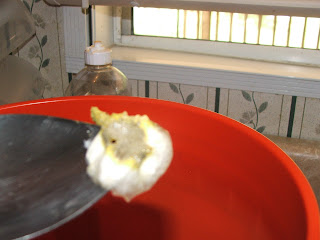
I didn't have a lot of scum to remove, thankfully,
but one time there was a big ol' glob, easily skimmed off
(I know, EWWWW, but it's a fact of life in fermenting that
we must face *grin*

Once fermentation is complete (took my sauerkraut about three weeks), and scum is removed, it's time to can it up (if you don't have a fabulous root cellar or stone crocks to store it in, that is... I must can mine!)


I decided to hot pack my sauerkraut, so I poured it from the bucket into a large stockpot to heat it up, bringing it to a simmer over medium-high heat, but not to a boil.


I prepared my pint canning jars by placing them in a flat pan of boiling water set over two stove eyes. I prepared my lids by simmering them in hot water until I was ready for them. Once my sauerkraut was heated through and my jars and lids were hot, I packed the hot sauerkraut and brine into the hot jars, leaving a half inch of headspace.


I removed any air bubbles and adjusted headspace, if necessary by adding more brine. I wiped the jar rims...


...and tightened the lids and rings on to fingertip tightness...


I placed the jars into my canner, ensuring they were completely covered with water. I brought the water to a boil and processed the pint jars in the boiling water bath for 10 minutes (quarts would be processed for 15 minutes) I removed the canner lid after processing and removed the jars using my jar lifter...


... then set my jars on a folded dish towel on the counter to cool and to listen for the PING of each successfully sealed jar.


Now for a hot dog with sauerkraut and spicy mustard!

html, body, div, span, applet, object, iframe, h1, h2, h3, h4, h5, h6, p, blockquote, pre, a, abbr, acronym, address, big, cite, code, del, dfn, em, font, img, ins, kbd, q, s, samp, small, strike, strong, sub, sup, tt, var, b, u, i, center, dl, dt, dd, ol, ul, li, fieldset, form, label, legend, table, caption, tbody, tfoot, thead, tr, th, td { margin: 0; padding: 0; border: 0; outline: 0; font-size: 100%; vertical-align: baseline; background: transparent; } body { line-height: 1; } ol, ul { list-style: none; } blockquote, q { quotes: none; } /* remember to define focus styles! */ :focus { outline: 0; } /* remember to highlight inserts somehow! */ ins { text-decoration: none; } del { text-decoration: line-through; } /* tables still need 'cellspacing="0"' in the markup */ table { border-collapse: collapse; border-spacing: 0; }