Showing posts with label Comfrey. Show all posts

Wednesday, April 11, 2012

Herbal Medicine Part 7: Udderly Healing Emergency

An herbalist friend told the following story...

John and Sue Ellen were friends of Robin's. They raised goats. John had spent years breeding goats trying to breed what he considered the perfect goat — a good mother, a good milker, gentle, healthy... Annabelle was that goat... John loved Annabelle, his perfect mixture of all things goat.

John was a quiet, gentle man... unexcitable, calm, stolid, dependable. Robin says that if John looks at a situation and quietly, almost under his breath, says, "Oh, my" then it's an emergency. John doesn't get upset easily.

Robin was visiting John and Sue Ellen one day... she and Sue Ellen were sitting in the living room drinking tea and catching up on gossip. John went outside to milk the goats. Within a few minutes, surely not long enough to get the milking done, John was back inside, standing quietly in the kitchen doorway, his face ashen... Robin and Sue Ellen imagined the worst... "What's wrong?"

"I need help." John replied.

Robin and Sue Ellen hurriedly followed John to the barn. "It's Annabelle," he said quietly, wringing his hands.

Annabelle had somehow got her udder caught on something and had torn it, badly... there was a long nasty gash down her udder and partly down one teat... so deep that there was milk and blood pouring out of the wound. John looked at Robin desperately, his eyes pleading with her to do something for his beloved Annabelle... she was the herbalist, wasn't she?

Robin rushed from the barn and began searching the ground around the house and barnyard... it was winter, not much was growing... still she searched... for something to help her dear friend's dear goat, Annabelle.

Robin found plantain growing near the barn...
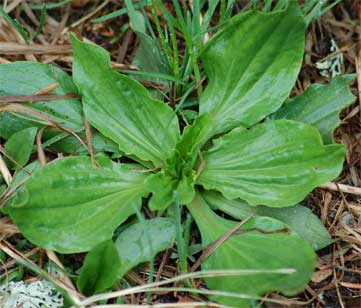
Broad-Leaf Plantain

She knew where Sue Ellen grew comfrey, but it was winter... she was on her hands and knees, quickly brushing away dead leaves and twigs until she found a few green comfrey leaves...

Comfrey plant

She crammed the leaves of both herbs into her mouth and began to chew as she ran back to the barn, and Annabelle.

Plantain is a blood purifier, it cools and soothes as it heals. Mixed with saliva and used as a poultice, it effectively aids in stopping bleeding. Comfrey heals...  and heals quickly.

John was standing in the barn with his beloved Annabelle, still looking helpless. He stepped aside as Robin rushed into the barn, removing the makeshift poultice from her mouth as she ran... She applied the herbal mixture to the wound on Annabelle's udder and held it there... John stood to the side, looking worried, and wringing his hands... Robin decided he needed something to do, so she gave him the occupation of holding the poultice on Annabelle's wound... She gave him directions to keep it on for at least a half hour...

Meanwhile she gathered more of both herbs and mixed up less hurried poultices to leave for John and Sue Ellen to apply to Annabelle a few times a day for the next several days. She gave directions for cleansing the wound and the application of the herbal poultices before leaving for home that evening.

Within three weeks, Annabelle's wound was completely healed... there is now, if you look VERY carefully, a three-inch long hairline scar where the gaping wound once was... and John still has his prized, perfect goat, Annabelle.


Saturday, March 3, 2012

Herbal Medicine Part 5: Comforting Comfrey

Comfrey in bloom

The herbalist/instructor at the herbal medicine workshop I attended told this story about one of her comfrey experiences...

Early in Robin McGee's herbalist life, her daughter injured her collar bone... off to the doctor they went, x-rays were taken, and sure enough, the collar bone was broken... after returning home, Robin decided to treat her daughter's broken bone with comfrey salve as it is said to heal broken bones... AND she wanted to prove to the doctor that it worked... so for three weeks she applied comfrey salve topically to the area 2-3 times a day. When it was time for her daughter's 3-week check of the afflicted area, back to the doctor they went, where she requested another x-ray of the area. The doctor told her there was no need for another x-ray... there wouldn't be enough healing so soon to warrant another x-ray... Robin was determined, she needed to prove to the doctor, but mostly to herself, that her methods were making a difference (remember this was early in her career as an herbalist)... She told the doctor, "Hey, dude, you're working for me... take the x-ray!" He did...

The results? The doctor, after reading the x-ray, said, "The first x-ray must have been incorrect, I see no broken bone here." Hmmm... Victory! The comfrey had worked... Robin does say that looking back, she might have used mullein along with the comfrey due to the fact that comfrey alone heals so quickly that sometimes it "over-heals" leaving calcium deposits... but she had proven to the doctor, and to herself, that she was right.


Comfrey plant
Comfrey speeds the healing of cuts, ulcerations, bruises, broken bones, pulled muscles and ligaments, and sprains.

The root and/or leaf of the the plant can be harvested any time during its growth cycle, but preferably not when in full flower... it can be used fresh or dried. After flowering, the plants are cut back, mulched with their own stems, leaves, and flowers, and allowed to grow back through the green mulch.

An infused oil may be made using dried comfrey leaves or roots to make a healing salve. Cover the dried comfrey with a good oil (I use olive), set it in a sunny window for 3-6 weeks, then strain out and use as is or add beeswax to make a salve.

The best comfrey for use in medicine is symphytum officinale... Russian comfrey (symphytum asperum) and other hybridized types are much higher in echimidine (a liver toxic PA) and should be avoided.

Contraindications: Comfrey should not be used during pregnancy or while nursing. Comfrey tincture should not be taken internally for more than 3 weeks at a time as a tonic. Comfrey should not be used externally on new puncture wounds or deep cuts, due to the likelihood that the outer skin layers will be stimulated to close up and heal prior to the draining and regeneration of deeper tissues. Instead, first use Epsom salt soaks containing calendula or chamomile tincture. Once the swelling and pain have subsided and the wound is clean and healing normally, comfrey may be safely and effectively applied to speed the process.*

*From the book Making Plant Medicine by Richo Cech
Gaia Herbs Comfrey Compound
Not long after I attended the herbal medicine workshop, I got to try out what I learned... On Mr. Granny! He was chasing an escape parakeet through the house before the dog got her, and kicked the pedestal on the dining room table... after a few French words, and getting the bird safely back in her cage, we checked out the injury... his pinky toe was black and swollen, three other toes were purple, half his foot was blue and swelling quickly... knowing that there isn't much a doctor will/can do for a broken toe, we made a trip to the local health food market in town, our wonderful little Rosewood Market, and bought a jar of Gaia Herbs Comfrey Compound (contains comfrey root, marshmallow root, mullein herb, skullcap herb, black walnut hulls, white oak bark, gravel root, lobelia, St. John's wort flower bud oil, olive oil and beeswax) and some bulk dried comfrey root and leaves (to mix up my own later)

We began treatment... by soaking in Epsom salts, followed by an application of the Comfrey Compound twice a day... the swelling was gone after two days, the bruising lessening every day until it disappeared by day 3... the pain was gone within a week. I felt victorious!!!!


html, body, div, span, applet, object, iframe, h1, h2, h3, h4, h5, h6, p, blockquote, pre, a, abbr, acronym, address, big, cite, code, del, dfn, em, font, img, ins, kbd, q, s, samp, small, strike, strong, sub, sup, tt, var, b, u, i, center, dl, dt, dd, ol, ul, li, fieldset, form, label, legend, table, caption, tbody, tfoot, thead, tr, th, td { margin: 0; padding: 0; border: 0; outline: 0; font-size: 100%; vertical-align: baseline; background: transparent; } body { line-height: 1; } ol, ul { list-style: none; } blockquote, q { quotes: none; } /* remember to define focus styles! */ :focus { outline: 0; } /* remember to highlight inserts somehow! */ ins { text-decoration: none; } del { text-decoration: line-through; } /* tables still need 'cellspacing="0"' in the markup */ table { border-collapse: collapse; border-spacing: 0; }