Showing posts with label University of Auckland. Show all posts

Saturday, March 31, 2018

Two 2018 Dante Auckland Scholarships available for Auckland University

Dante’s Scholarship 2018

For the second year, Dante Alighieri Society of Auckland is
offering tuition fees scholarships for two students to
support their study of Italian at the University of
Auckland.

The scholarships will cover tuition fees for Italian 107, to
be taken up in 2018. To be eligible, you must be a New
Zealand citizen or permanent resident, and be 25 years old
or younger.

To apply, please send an email to info@dante.org.nz
by 7 May 2018 with an up-to-date CV, a written statement
(which should include details of your proposed future
study and career, any relevant work experience, interests
and/or community involvement, your achievements, how
this scholarship would be important for you) and one
written reference.

After all applications have been assessed, suitable
candidates will be invited for an interview with Dante
Alighieri School Committee at the beginning of June.
Specific dates will be advised in due course.
The scholarships will be awarded at the beginning of July,
based on information provided in the application,
interviews and students' performances in Italian 106.
All info HERE

Sunday, October 11, 2015

Two seminars with visiting Italian professor and author Luciano Marrocu

The University of Auckland is presenting two seminars with visiting Italian professor Luciano Marrocu: Fascism on the periphery and Italian Postcolonial Literature: Ennio Flaiano’s Time to Kill. Please scroll down for more details.


School of Cultures, Languages and Linguistics
European Languages & Literatures
Research Seminar


Fascism on the periphery

Luciano Marrocu
For the Italian Fascist regime, totalitarianism was more of an aspiration than a reality, particularly because the project of nationalization had to contend with the continuing existence—and in some cases resistance—of different Italies, which jealously guarded their distinctiveness. Following the March on Rome, the regime’s project of domination had to deal with local élites, especially in the South. In only some Northern and Central areas, where the Fascist movement was strongest, could the regime count on social classes whose vision of a new Italy matched its own. Not all Italians would embrace Mussolini’s project of forging a New Italian Man.

In most of the South the regime had to deal with social classes whose histories were vastly different from those whence Fascism emerged. These Southern classes’ version of Fascism introduced attitudes, points of view, and habits that were perceived by the Centre, i.e. Rome, almost as acts of resistance to the totalitarian project.
Sardinia is a particularly useful case for examining how the Center-periphery relationship played out. As a large island located far from the Italian peninsula, Sardinia represents an extreme case, at least in the Italian context, of a remoteness that is defined not only by its geography. 


Monday 19 October 5-6.30 pm 
Arts 1 260-220


Italian Postcolonial Literature: Ennio Flaiano’s Time to Kill

Ennio Flaiano is internationally known for his collaboration with Federico Fellini, for whom he crafted the scripts of many movies during the fifties and sixties, including La Dolce Vita. More recently Flaiano has attracted the attention of post-colonial scholars for his 1947 novel Tempo di uccidere upon which Giuliano Montaldo’s 1989 film “Time to Kill,” starring Nicholas Cage and Giancarlo Giannini, is based. This novel recounts some of  Flaiano’s real-life experiences in the Italo-Ethiopian war, a conflict that resulted in Ethiopia’s subjection to Italian rule. Between November 1935 and May 1936, the 25-year-old Flaiano served as a lieutenant while taking the first steps in his literary career by keeping a sort of diary, Aethiopia. Notes for a Pop Song, which would be the basis for his 1947 novel. In the novel, he portrays an anguished Italian officer who  survives the Ethiopian war.
This lecture will follow Flaiano’s itinerary as laid out in the war diary up to the actual writing of the novel, which is recognized today as the first radical condemnation of colonialism in Italian literature.


Wednesday 21 October 4-5:30 pm 
Owen G Glen Building 260-220


Luciano Marrocu is Professor of Modern History at the University of Cagliari. His research fields include the history of the British Labour Party, the Fabian Society, and the life and writings of George Orwell. Notable publications on these topics include Il modello laburista (The Labourist Model, 1985); Il salotto della signora Webb (Mrs. Webb’s Sitting Room,1992); and Orwell: la solitudine di uno scrittore (Orwell: a Writer’s Loneliness, 2009). He has also written a seminal essay on fascism in Sardinia in the canonical History of Italy 1998.
Luciano is also a renowned fiction writer. To date he has published seven novels, most of which are set during the fascist regime. These constitute an alternative means of exploring the fascist epoch as a complement to his academic research in this field.

Saturday, February 7, 2015

Free GAPS ARTS course in Auckland to celebrate the 750th anniversary of Dante's birth

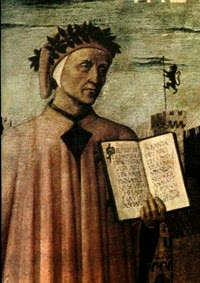
Dante. Detail from fresco by Domenico di Michelino,
Santa Maria del Fiore, Florence
This year marks the 750th anniversary of the birth of Italian poet Dante Aligheri in Florence. While the exact date of his birth is unknown, it is generally accepted to be around 1265.
To mark this occasion, Faculty of Arts alumnus Dr John Lewis will be offering a public course of reading through the Divine Comedy — widely considered the greatest literary work composed in the Italian language and a masterpiece of world literature — in its entirety.
All three books will be read over an impressive schedule of Monday evenings: Hell in the first half of 2015, Purgatory in the second half, and Paradise in the first half of 2016. Sessions will run from 7:30-9:00pm.
Previous knowledge of the poem is not necessary and notes for guidance through each session have been specially prepared. There will also be time for discussion.
In June the anniversary will be marked by two additional lectures on Dante. This course and its associated lectures will be run through the GAPS ARTS program, a tertiary level forum on European art and architecture, poetry and literature, philosophy and theology, medieval heritage, and vernacular building.
Enrolments for the course should be made by 22 February, but can be accepted at the first session on Monday 2 March. To enrol phone +64 9 828 5579 or email jahlewis@clear.net.nz.
The course is free, but donations can be made.

Find out more at GAPS ARTS.


Monday, September 15, 2014

Memories of WWII, the Resistance and the Holocaust in Italian Literature

World War II has been a crucial period for Italy’s history. In few years the country experienced the doomed alliance with Germany and the persecution of the Jews, the armistice and the Resistance, and finally the liberation. At the end of what many historians now considers as a civil war, Italy turned from dictatorship to democracy for the first time in its history. The short stories and books analysed in my course reflect upon this critical period of Italy’s history at various levels. They are: Renato Amato’s “Only a Matter of Grammar” (in The Full Circle of the Travelling Cuckoo, 1967); Beppe Fenoglio’s Una questione private (1963, translated as A Private Affair, 2007); Curzio Malaparte’s La Pelle (1947, translated as The Skin, 1988); and Primo Levi’s Se questo è un uomo (1947 and 1958, translated as If This is a Man in 1959). All these books are available in English. Therefore, this course will be appealing not only to people who know the Italian language, but also to lovers of literature and history in general. Sessions are interactive and discussion is encouraged. 
The course could consist of four two-hour lectures held on Thursday evening from 6pm to 8pm from from 18 September to 9 October.
Barbara Pezzotti teaches Italian language and culture at University of Auckland. She has published several articles and book chapters on Italian contemporary literature. She is also a former journalist for the Italian newspaper Il Sole 24 ore (the Italian equivalent of the Financial Times or Wall Street Journal).