Showing posts with label literature. Show all posts

Saturday, August 26, 2023

Colazione and RENAISSANCE WOMEN POETS


Join us for a coffee and a talk with Bruno Ferraro and Matteo Telara:


RENAISSANCE WOMEN POETS
Before Italy was united as the country we know today (1871, with Rome the capital) the cultural and artistic expressions were diverse, following the geographical configuration of the country. As two diametrically opposed representatives of what was known as a “the movement of female poets”; though all influenced by Petrarch’s poetry, both in form and themes, two writers have been selected to highlight variety of themes and conduct of life: Gaspara Stampa and Vittoria Colonna, Michelangelo’s good friend.


POETESSE DEL ‘500
L’Italia, come la conosciamo oggi, nasce solo nel 1871 con Roma la capitale; nelle varie regioni, città e province la cultura – dopo la poesia religiosa del secolo precedente di cui si ricorda Santa Caterina da Siena - conosce un nuovo gruppo di scrittrici di varie origini: cortigiane (cioè legate alle corti), donne di estrazione borghese che ha permesso loro un certo livello di istruzione, religiose. In questa presentazione, oltre ad illustrare le condizioni politico-culturali dell’epoca, si verranno a conoscere due rappresentanti di questo momento felice per la produzione letteraria delle donne; la poesia petrarchesca sottende tutta la produzione letteraria ma due rappresentanti sono diametricalmente opposte sia come formazione sia come vita: Gaspara Stampa e Vittoria Colonna, amica di Michelangelo.


Saturday 26th August 10am-12pm
Dante Rooms
Freemans Bay Community Centre
52 Hepburn St, Freemans Bay
All Welcome! Vi aspettiamo!


Saturday, February 7, 2015

Free GAPS ARTS course in Auckland to celebrate the 750th anniversary of Dante's birth

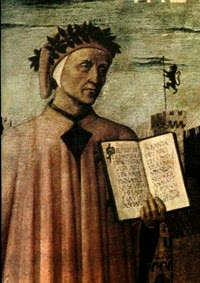
Dante. Detail from fresco by Domenico di Michelino,
Santa Maria del Fiore, Florence
This year marks the 750th anniversary of the birth of Italian poet Dante Aligheri in Florence. While the exact date of his birth is unknown, it is generally accepted to be around 1265.
To mark this occasion, Faculty of Arts alumnus Dr John Lewis will be offering a public course of reading through the Divine Comedy — widely considered the greatest literary work composed in the Italian language and a masterpiece of world literature — in its entirety.
All three books will be read over an impressive schedule of Monday evenings: Hell in the first half of 2015, Purgatory in the second half, and Paradise in the first half of 2016. Sessions will run from 7:30-9:00pm.
Previous knowledge of the poem is not necessary and notes for guidance through each session have been specially prepared. There will also be time for discussion.
In June the anniversary will be marked by two additional lectures on Dante. This course and its associated lectures will be run through the GAPS ARTS program, a tertiary level forum on European art and architecture, poetry and literature, philosophy and theology, medieval heritage, and vernacular building.
Enrolments for the course should be made by 22 February, but can be accepted at the first session on Monday 2 March. To enrol phone +64 9 828 5579 or email jahlewis@clear.net.nz.
The course is free, but donations can be made.

Find out more at GAPS ARTS.

Monday, September 15, 2014

Memories of WWII, the Resistance and the Holocaust in Italian Literature

World War II has been a crucial period for Italy’s history. In few years the country experienced the doomed alliance with Germany and the persecution of the Jews, the armistice and the Resistance, and finally the liberation. At the end of what many historians now considers as a civil war, Italy turned from dictatorship to democracy for the first time in its history. The short stories and books analysed in my course reflect upon this critical period of Italy’s history at various levels. They are: Renato Amato’s “Only a Matter of Grammar” (in The Full Circle of the Travelling Cuckoo, 1967); Beppe Fenoglio’s Una questione private (1963, translated as A Private Affair, 2007); Curzio Malaparte’s La Pelle (1947, translated as The Skin, 1988); and Primo Levi’s Se questo è un uomo (1947 and 1958, translated as If This is a Man in 1959). All these books are available in English. Therefore, this course will be appealing not only to people who know the Italian language, but also to lovers of literature and history in general. Sessions are interactive and discussion is encouraged. 
The course could consist of four two-hour lectures held on Thursday evening from 6pm to 8pm from from 18 September to 9 October.
Barbara Pezzotti teaches Italian language and culture at University of Auckland. She has published several articles and book chapters on Italian contemporary literature. She is also a former journalist for the Italian newspaper Il Sole 24 ore (the Italian equivalent of the Financial Times or Wall Street Journal).