Friday, 28 June 2019

Ham & Snap Pea Pasta Salad with Honey Mustard Dressing

I do love a good pasta salad in the summer. Anytime, really, but the next month or so is the time for snap and snow peas. Quick and simple? So much the better.

2 to 4 servings
30 minutes prep time

Ham & Snap Pea Pasta Salad with Honey Mustard Dressing

Make the Dressing:
1 tablespoon honey
2 teaspoons Dijon mustard
1/2 teaspoon sweet Hungarian paprika
salt & freshly ground black pepper to taste
1/3 cup mayonnaise (light is fine)

In a small bowl, mix the honey, mustard, paprika, salt, and pepper. Mix in the mayonnaise.

Make the Salad:
166 grams (10 ounces) stubby pasta
2 cups snap peas (or snow peas)
250 grams (1/2 pound) chopped cooked ham
1 small onion, sweet would be nice
1 stalk celery
1/4 cup chopped parsley

Put a pot of salted water on to boil, and cook the pasta according to instructions, plus one minute. Meanwhile, wash the peas and string them. Drop them into the pasta water to cook for the last 4 or 5 minutes. Drain, rinse in cold water until cool, then drain well.

Chop the ham, the onion, the celery, and the parsley. Toss them into the pasta and peas with the dressing. If you like, you can chop the onion before cooking the pasta, sprinkle it with salt, and let it drain while the pasta cooks to make the flavour milder and the onion more digestible.


Last year at this time I made Green Garlic & Pea Bruschetta with Chevre

Wednesday, 26 June 2019

Chicken & Haskap Salad

Okay, we hit a bit of turbulence there. Mom's eye troubles are not over, and we were making extra trips to Mississauga without much notice, which is nobody's idea of a good time and definitely cuts into the cooking and gardening time.

The good news is we are picking haskaps daily at the moment, along with strawberries. They are a bit late compared to last year but not quite as late as I was afraid they might be. There are lots, and this sudden turn of heat is really making them good.

I am trying to find other things to do with haskaps besides sweet things, but I had to sweeten the dressing a little - they are so very tart. I like to keep some cooked chicken around for salads in the summer. It is very quick to poach it; it can be done in 15 or 20 minutes. Lately I've also been seasoning it, wrapping it in parchment paper, and cooking it in the panini grill. That can get it cooked in as little as 5 minutes, if it's thin pieces.

2 servings
30 minutes prep time
not including cooking the chicken

Chicken & Haskap Salad

Make the Dressing:
1 tablespoon honey
2 teaspoons Dijon mustard
the juice of 1/2 lemon
1/4 cup mayonnaise (light is fine)
salt & freshly ground black pepper to taste

Stir the honey, mustard, and lemon juice together until well blended. Mix in the mayonnaise, and season with salt and pepper. Stir well again.

Make the Salad:
4 or 5 cups prepared lettuce or mixed salad greens
4 to 6 radishes
2 stalks of celery
2/3 cup fresh haskaps
150 grams skinless, boneless chicken - poached and chilled

Wash, pick over, drain, and dry the lettuce or other greens, and be sure they are torn or cut into bite-sized pieces.

Wash, trim and slice the radishes and the celery. Mix them into the lettuce or greens and put everything into a shallow salad bowl or divide between individual salad plates.

Rinse, dry, and pick over the haskaps. Scatter them over the salad. Slice the cold cooked chicken into bite sized pieces and arrange over the salad. Drizzle the salad with the dressing, and serve.


Last year at this time I made Smoked Trout & Wild Rice Salad with Peas.

Wednesday, 19 June 2019

Sour Cream Pancakes with Strawberry Maple Syrup

I made these a few times during the winter, using frozen berries for the sauce. And of course, you can replace the strawberries with other berries in season.

Perhaps it's because I rarely make pancakes these days, but I think these are awfully good pancakes - fluffy, with a bit of zing and tenderness from the sour cream. Yes, it makes them rich and special-occasion-ish, but then, pancakes are a special occasion.

2 to 4 servings - 8 to 12 pancakes
30 minutes prep time


Make the Strawberry Maple Syrup:
2 cups strawberries
1 tablespoon unsalted butter
1/3 cup dark maple syrup

Rinse, drain well, and hull the berries, cutting them up if they are large. Put them in a pot with the butter and syrup. Bring up to a boil then simmer until the strawberries are softened and starting to fall apart. Stir regularly. Remove to a jug or similar serving vessel. 

Make the Pancakes:
1 cup soft (pastry) whole wheat flour
1 teaspoon baking powder
1/4 teaspoon salt
2 large eggs
3/4 cup sour cream
mild vegetable oil to cook

Meanwhile, measure the flour and mix in the baking powder and salt.

Break the eggs into a mixing bowl and whisk until blended. Whisk in the sour cream.

Heat a large skillet over medium-high heat, and pour in enough oil to cover the bottom thoroughly.

Whisk the flour into the eggs and sour cream until smooth, but do not over-beat.

When the pan is hot, spoon in the batter to form small pancakes - a tablespoon or small serving spoon will be the right size. Do not over-crowd them. Cook on each side until set and lightly browned; they should feel firm and slightly springy to the touch when done. Serve with the strawberry maple syrup, along with butter or a dab more of sour cream.


Last year at this time I made Radishes with Lime Juice, Chile, & Mint.

Monday, 17 June 2019

Greek-Style Pork Loin Medallions

We found some pork tenderloin on sale recently, and I wanted to do something really simple with it as we are still spending so much time in the garden.

This fit the bill, and also used up several green garlic plants that had come up in undesirable places - apparently there is a reason garlic is a weed in this town - as well as the patch of oregano growing by the side of the garage. Oregano is actually very early to get started and it is best before it starts to flower so this is getting made none too early. Very tasty, we thought. 

4 servings
10 minutes prep time
4 to 8 hours to marinate
15 minutes to cook

Greek-Style Pork Loin Medallions

1/3 cup loosely packed fresh oregano leaves (10 to 12 stems)
3 or 4 cloves of garlic, OR 1/4 cup minced green garlic or garlic scapes
the finely grated zest of 1/2 lemon
the juice of 1 lemon
1/4 teaspoon salt
freshly ground black pepper to taste
1/4 teaspoon hot paprika, OPTIONAL
2 tablespoons olive oil
500 grams (1 pound plus) pork tenderloin
1 tablespoon olive oil

Strip the leaves from the stem, and mince them (leaves, not stems) and put them in dish which will  hold the pork in one or two layers, and which can be covered.

Peel and mince the garlic. If you have green garlic or garlic scapes, trim off any tough bits and mince the remainder finely. Add it to the oregano. Wash and dry the lemon, and grate in the zest. Squeeze in the juice, add the salt, pepper, and paprika, and add the 2 tablespoons olive oil.

Slice the pork tenderloin into slices about 1" thick. Put them in the marinade and turn them to coat them. Cover and marinate them in the fridge for 4 to 8 hours.

Bring the pork out of the fridge to warm up a bit about 15 minutes before cooking it. Heat the last of the oil in a large skillet over medium-high heat. Lift the pork out of the marinade and let as much liquid drain off of it as possible. Cook the medallions in the oil for 4 or 5 minutes per side, until lightly browned and cooked through. While they cooked, I lifted the oregano, garlic, etc from the marinade with a slotted spoon and added them to the pan. It's up to you if you want to be bothered.

When the pork is cooked, remove it to a serving plate and let it rest 5 minutes before serving. 


Last year at this time I made Strawberry Cucumber Salad. Wow, are things late compared to last year. There are piles of strawberries coming, but honestly, half of them are still flowers, never mind ripe. What a different year!

Wednesday, 12 June 2019

Spinach with Blue Cheese & Mushrooms

This is the last of the spinach from our garden; at least I hope there will be another wave of it later from seed planted this spring, but the overwintered spinach is now gone. We didn't have as much as usual, because the mice have discovered that life under a plastic cover in a spinach forest is a delightful way to pass the winter. Also, before the fence was put up some bloody rabbit came and nested in it too. At any rate, it was starting to bolt so I pulled it all up.

With all the cheese and cream, this is a very rich dish. Serve it with noodles or other pasta, with or without some simply cooked chicken or fish. I can also see it with baked potatoes or polenta.

You will note I do not call for any salt. Do not put salt in it. The salt in the cheese will be an elegant sufficiency and you will regret more salt. Okay? No salt. 

4 to 6 servings
40 minutes prep time

Spinach with Blue Cheese & Mushrooms

250 grams (1/2 pound) fresh spinach
125 grams (1/4) pound shiitake or button mushrooms
2 to 3 shallots
2 to 3 cloves of garlic
2 tablespoons unsalted butter
1 tablespoon flour
freshly ground pepper to taste
1 cup 5% or 10% cream
60 grams (2 ounces) crumbled blue cheese
2 tablespoons finely grated Parmesan cheese

Wash and pick over the spinach; drain well. Clean and slice the mushrooms. Peel and chop the shallots. Peel and mince the garlic.

Heat the butter in a large skillet over medium heat until melted and foaming. Add the mushrooms and shallots. Cook until softened and reduced in volume. They should not really brown, though.

Add the garlic and the flour. Season with pepper. Mix in well and cook for a minute or two, then add the cream. Stir constantly until the sauce is smooth and thickens.

Add about half the spinach, turning it over into the sauce until it is wilted. Add the two cheeses and mix in, then add the rest of the spinach. Stir gently to mix it in and wilt it, then cook the spinach until it is done to your liking. Transfer to a serving dish and serve.

Monday, 10 June 2019

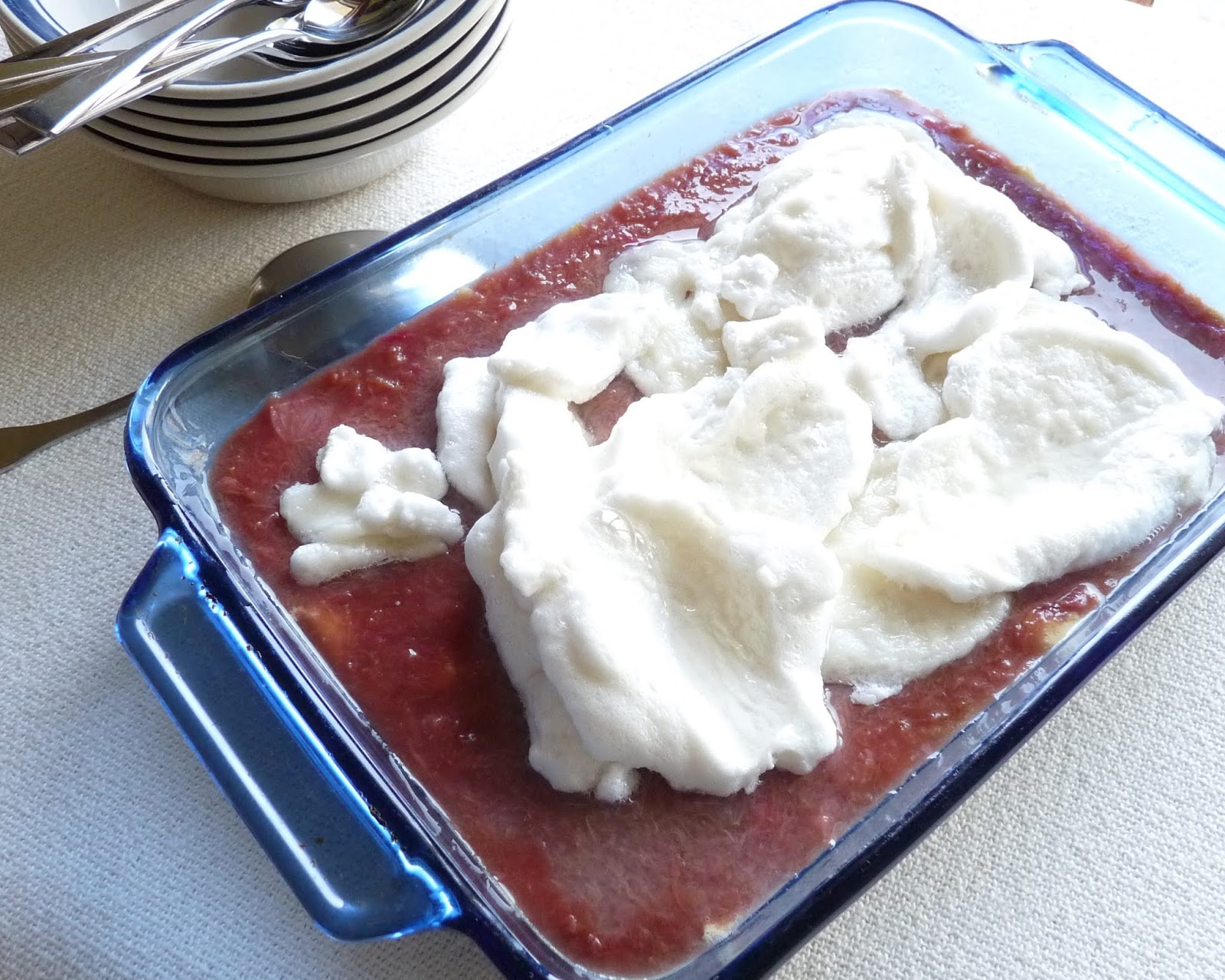
Rhubarb Ile Flottante

We had some company over for dinner recently, which meant I had an excuse to break out some dessert. And when it comes to dessert there's little I like better than fruit and custard. Right now, the "fruit" is rhubarb.

On the whole this was a successful dessert, and well-received. However, I used duck eggs to make it, and I have to say this is the third time I have tried using duck eggs to make meringue and have not been impressed with the results. They have a lower water content than chicken egg whites, apparently, and they seem to end up dense and tough no matter how well-beaten they are. Also, I cooked them a bit too long. A minute to poach the "îles" seems far too short, but so it was - my last ones were definitely better than the earlier ones.

Traditionally they are also poached in milk, but I am far too cheap to do that. I can't see that water didn't work just fine, my duck problems notwithstanding.

6 to 8 servings
1 hour prep time

Rhubarb Ile Flottante

Make the Custard:
1 cup milk
1 cup 10% cream
1/8 teaspoon salt
4 large egg yolks
1/4 cup maple syrup
1 teaspoon vanilla extract

Whisk the milk, cream, salt, and egg yolks in the top of a double boiler until smooth - set the egg whites aside in a mixing bowl; you will need them later. Whisk in the maple syrup. Heat over simmering water, whisking frequently, until the mixture begins to thicken. At that point, whisk it constantly until it thickens. This is a fairly thin custard, and once it has thickened noticeably, it will thicken no more, so be careful not to overcook it. Pour it into a shallow serving dish or divide it amongst individual serving dishes.

Stew the Rhubarb:
2 cups chopped rhubarb stems
1/3 cup maple syrup
1 tablespoon arrowroot or tapioca starch
1 tablespoon sherry

Clean and chop the rhubarb, and put it in a pot with the rest of the ingredients. Mix well to dissolve the starch before you begin to heat it. Heat it gently, stirring constantly, until it begins to simmer. Cover and simmer until the rhubarb softens and disintegrates, stirring frequently.

When it is done spoon it gently and evenly over the cooled custard.

Poach the Meringue:
4 large egg whites
1/4 cup sugar
a pinch of salt

Put a large, shallow pot of water on to boil.

Beat the egg whites until foamy, then beat in the sugar and salt. Continue beating the egg whites until they are very stiff. Drop the meringue by large spoonfuls into the boiling water. Let boil for 1 minute on each side, then remove them with a slotted skimmer, draining them well. Arrange them over the custard and rhubarb. Keep chilled until ready to serve.


Last year at this time, by complete co-incidence, I made Rhubarb Barbecue Sauce on Ribs.

Wednesday, 5 June 2019

Cool, Soggy Garden Update


This has been a long cool spring that finally seems - according to the weather forecast, at any rate - to be shifting into summer. Planting has been slow but steady, and the weeds have yet to really get going. Mr. Ferdzy has thus had a reasonable amount of time for this years' first big project: surrounding the main garden beds with chicken wire and gates in an effort to foil the rabbits. The rabbits have been terrible the last few years, and they seem to get worse every year. This year they are all over the place! Fenced just in time, I would say.


While he worked on that, I got the runners from our seedling strawberry planted out in their newly assigned bed. In spite of which, they are flowering profusely. If the weather warms up we should have a bumper crop.


Mostly, though, the garden still looks very sparse. Carrots are planted but not up. Beets and rutabaga are planted but not up. Garlic is up, and looks good, and a few leeks have sprouted where they went to seed last year. I'm leaving them in to seed again (I hope) as I lost the packet of seeds I had saved from them. I was seriously annoyed, because these are the leeks that overwintered in the garden as seeds - unusually hardy, in other words, and I particularly wanted the seeds. This way I hope to get some at least.


Tomatoes, peppers, eggplants, and about half the sweet potatoes have been planted, but it has been too cold to leave them uncovered. Those plastic sheets are starting to wear out - hastened by having deer step on them - but we are really pleased by how long they have lasted. I'd have to go back to see when we first got them, but it must be close to 8 years or even 9 years. It is 6 mil vapour barrier for construction, and we didn't really expect it to last more than 3 or 4 years.

Peas are mostly well up but nowhere close to producing, and beans have just sprouted, mostly. Some are not up yet and I am a little nervous that I will have to re-seed if some of them rot in the cold wet soil we have been having.


Our more established bed of strawberries started blooming about a week later than our seedling strawberries but it too is full of blossoms and should have an impressive crop. We have been picking asparagus for over 2 weeks and hope we have at least another week of picking to go. That's not a long season but since the bed is only 2 years old the plants are mostly not as established enough to bear more. However they are doing well and we expect the crop to improve every year.


The last thing I planted was watermelon seeds for the golden-rind project. We are only doing the one this year, as it will still produce far more watermelon than I ought to be eating. They are sharing the bed with some onions - we got carried away with several new kinds this year.


Another view of the covered beds. In the fore-ground the potatoes are just starting to sprout. That apparently empty bed next to them is actually planted with onions too, but they are still so tiny they really don't show up in the picture. I have to say, one of the reasons I'm doing a garden report today is because there is so little in the way of actual vegetables...

The weather is supposed to be shifting today into a warmer gear so hopefully things will start to change rapidly. If nothing else, I expect the next few weeks to include a lot more weeds.

Monday, 3 June 2019

Sorrel Pakoras

When I first thought of making pakoras with sorrel, I did a search to see if there was already such a thing. And while they don't seem common, there are recipes for sorrel pakoras out there. However, they struck me as a bit odd, especially when I looked at the photos, and I soon realized that they were not being made with sorrel as I know it. Eventually I figured it out - it's what gets called sorrel in the Caribbean; a kind of hibiscus.

Well, never mind. It turns out that the local (French or garden) sorrel makes perfectly cromulent pakoras. I really like the tart zing of sorrel in these little fritters, and a slightly sweet chutney would really set them off.

10 to 14 pakoras
20 minutes prep time

Sorrel Pakoras

Mix the Batter:
1/2 teaspoon cumin seeds
1 teaspoon coriander seeds
1/4 teaspoon (or to taste) ground hot red chile
1/2 teaspoon salt
1/2 cup chick pea flour
1/3 cup water, about

Grind the spices together - I find it helpful to do it with the salt. Mix them into the flour in a mixing bowl. Whisk in the water to form a smooth, soft batter.

Finish the Pakoras & Fry Them:
125 grams (1/4 pound) fresh French sorrel leaves
sufficient oil to fry

Put a kettle of water on to boil. Wash and trim the sorrel, and chop it coarsely. Put it in a strainer, and when the water boils, pour it over the sorrel to wilt it evenly.

Run the sorrel under cold water to cool it, then squeeze it until it is reasonably dry. (It will be much harder to squeeze than spinach, so just do what you can.) Mix it into the batter. You want to have a very soft but not drippy batter; add a little more chick pea flour or water if needed to achieve that.

Heat enough oil in a heavy skillet to cover the bottom of the pan very generously. Dollop out the batter in tablespoons and fry the patties over medium heat until crisp and brown on each side; about 3 minutes per side. I have an aebelskiver pan - meant for making apple pancake/doughnuts - and it made very neat little round pakoras. There is no reason they would not cook just as well in a skillet, though.

Serve them hot. I would like them with the Apple Butter Chutney I used here, but I was pressed for time and just served them with a little mayonnaise. Mayonnaise mixed with some chile-garlic sauce would have been better. Other prepared chutneys would be fine, too.


Last year at this time I made Turkey Sorrel Rolls. Yes, sorrel is definitely becoming a staple at this time of the year when there are not too many local vegetables available.