Ah, fritters. I've always loved them, and these ones have cauliflower and cheese. Can't go wrong with that!
I didn't feel like I was using a lot of materials to make this, but the final fritter count was fairly impressive - I got 21, and I think I should have made them even a bit smaller and gotten more. Next time for the 2 of us, I would make half a recipe. That's still a pretty substantial fritter feast. Given how rich they are, it's better to serve them as an appetizer to a good lot of people, I would think. Should you ever be able to assemble a good lot of people in one place again, of course, which is not looking like any time soon.
You could easily make these with leftover cooked cauliflower, or at any rate it could be cooked in advance. Once the cauliflower is ready, it takes minutes to make the batter and then you are frying. It takes attention, and there are a lot of them to do, but they cook quite quickly. I soon had a routine going.
A few years back I got a cast iron aebleskiver pan (also known as an appam pan; or close enough) and it is great for making little tidbits that seem - are, really - deep fried without using great gobs of oil. Anything frittery, or doughnut-like is terrific made in it. I keep meaning to use it more, so here's something to get me started.
4 to 12 servings (24 to 36 fritters)
20 minutes prep time to cook cauliflower
30 minutes prep time to cook fritters
3 cups finely chopped cauliflower
1/2 cup chick pea flour
2 tablespoons finely minced fresh chives.
1/4 cup grated Parmesan or similar cheese
1/4 teaspoon salt (less if cheese is salty)
freshly ground black pepper to taste
2 medium eggs
+ milk to 1/3 cup
mild vegetable oil to fry
Wash and trim the cauliflower, and cut it into small florets. Cook in boiling water until tender; about 6 minutes. Drain very well, let cool enough to handle, then chop finely.
In a mixing bowl, put the flour, minced chives, grated cheese, salt, and pepper. Break the eggs into a measuring cup and stir them with a fork. Add enough milk to make the total volume of the two things 2/3 cup - it won't be very much milk.
Mix the milk and eggs into the flour to make a smooth batter. Mix in the finely chopped cauliflower.
Heat some oil, ideally in an aebleskiver pan; a teaspoon or so into each depression. Otherwise, use a fairly deep but not too big skillet and put a generous 1/4" on the bottom. When the oil is hot, drop the batter in by fairly small spoonfuls, to form little fritters. Cook them until well browned and firm, turning them to cook on the other side when half done. The heat should be medium; you want them to cook through to the middle which means they should not brown instantly, but you do want them to get brown.
Put them onto a rack (a perforated pizza pan is good) lined with paper towel as they are done, continuing to cook the remaining batter and adding a little more oil if needed. Keep them hot in a 200°F oven, but serve them as soon as possible.
Showing posts with label Diabetic Friendly. Show all posts
Wednesday, 30 September 2020
Friday, 8 May 2020
Spinach-Spelt Spaetzle or Gnocchi
The amount of fresh spinach you need to have to end up with a fairly piddling amount of cooked spinach is amazing. I did use frozen spinach here, because there is still a fair bit in our freezer from last year, but I know very well that each packet of frozen spinach takes about 8 medium-packed cups of washed and trimmed spinach, having washed and trimmed it by the bushel. And also, while we have spinach in the garden and there are SOME leaves large enough to use, it needs to do a fair bit of growing yet. Goodness, this has been a slooooow spring and I am finding it harder to take than usual; wonder why?
I made this a couple of times to make sure I had the ideal quantity of flour; but the trouble is the exact quantity will depend on how moist your spinach is. A dough stiff enough to want to form a ball will give firmer spaetzle, but it will also be a lot harder to push through the spaetzle maker. The second time I made them I used the higher amount of flour, and could only get 2/3 of the dough through the spaetzle maker before my arm gave out. I made the rest of the dough into gnocchi after dinner and fried them up for breakfast. If you want gnocchi, that's the way to do it. For spaetzle, it's better to keep the dough softer.
With some vegetables and cheese in moderate quantities this will be a complete meal for two. If you are serving it as a more definite side dish, with a piece of fish, poultry, or other meat, it will certainly go further.
Preparing the spinach is by far the most tedious and time-consuming part of making this dish; the actual cooking takes minutes once the water comes to a boil. Do not make the batter too far in advance of the cooking time, as it will get stiff and even harder to work.
2 to 6 servings
30 minutes to prepare spinach
15 minutes to make spaetzle
170 grams (6 ounces) cooked spinach
1/3 cup water
1 large egg
1/2 teaspoon salt
freshly ground black pepper to taste
a few scrapes of nutmeg
1 1/2 to 1 3/4 cups whole spelt flour
Wash, trim and pick over, drain, and steam the spinach. You will need about 8 cups fresh to start, and you will end up, once it has been squeezed fairly dry and chopped, about 1/2 cup. You can certainly start with frozen spinach which has been thawed, or you could prepare your spinach in advance; keep it refrigerated until needed.
At any rate, once your spinach is cooked, squeeze as much liquid out of it as you can, chop, and measure it. Put it in blender (preferred) or food processor. Add the water, salt, pepper, and nutmeg, and process it until it is as smooth as you can get it. Scrape down the sides as needed. When it is a very smooth purée, scrape it into a mixing bowl.
I broke the egg into the blender, and whizzed it on low for about 30 seconds to help get all the spinach out and into the mixing bowl; it worked reasonably well in conjunction with a good silicone spatula. At any rate, mix the egg into the spinach. Then mix in the flour to make a smooth, pliable, if somewhat sticky dough. It should be on the stiff side of pliable, so add a bit more flour if necessary. Keep in mind if you are not cooking it right away, it will continue to stiffen slightly as it sits.
Bring a large pot of lightly salted water to a boil. Press the batter into the boiling water using a spaetzle maker or a strainer with moderately large holes. That silicone spatula is likely to still be very handy here. Give them a gentle stir once the batter is all in, and when the little noodles float and seem firm - a matter of only a couple minutes, unless those holes were very large - drain them well.
Toss them with butter or good oil. Serve them with cheese, or vegetables such as peas tossed in with them, or with grilled or roasted meats.
Last year at this time I made Rolled Omelette with Spring Herbs & Cheese.
I made this a couple of times to make sure I had the ideal quantity of flour; but the trouble is the exact quantity will depend on how moist your spinach is. A dough stiff enough to want to form a ball will give firmer spaetzle, but it will also be a lot harder to push through the spaetzle maker. The second time I made them I used the higher amount of flour, and could only get 2/3 of the dough through the spaetzle maker before my arm gave out. I made the rest of the dough into gnocchi after dinner and fried them up for breakfast. If you want gnocchi, that's the way to do it. For spaetzle, it's better to keep the dough softer.
With some vegetables and cheese in moderate quantities this will be a complete meal for two. If you are serving it as a more definite side dish, with a piece of fish, poultry, or other meat, it will certainly go further.
Preparing the spinach is by far the most tedious and time-consuming part of making this dish; the actual cooking takes minutes once the water comes to a boil. Do not make the batter too far in advance of the cooking time, as it will get stiff and even harder to work.
2 to 6 servings
30 minutes to prepare spinach
15 minutes to make spaetzle
170 grams (6 ounces) cooked spinach
1/3 cup water
1 large egg
1/2 teaspoon salt
freshly ground black pepper to taste
a few scrapes of nutmeg
1 1/2 to 1 3/4 cups whole spelt flour
Wash, trim and pick over, drain, and steam the spinach. You will need about 8 cups fresh to start, and you will end up, once it has been squeezed fairly dry and chopped, about 1/2 cup. You can certainly start with frozen spinach which has been thawed, or you could prepare your spinach in advance; keep it refrigerated until needed.
At any rate, once your spinach is cooked, squeeze as much liquid out of it as you can, chop, and measure it. Put it in blender (preferred) or food processor. Add the water, salt, pepper, and nutmeg, and process it until it is as smooth as you can get it. Scrape down the sides as needed. When it is a very smooth purée, scrape it into a mixing bowl.
I broke the egg into the blender, and whizzed it on low for about 30 seconds to help get all the spinach out and into the mixing bowl; it worked reasonably well in conjunction with a good silicone spatula. At any rate, mix the egg into the spinach. Then mix in the flour to make a smooth, pliable, if somewhat sticky dough. It should be on the stiff side of pliable, so add a bit more flour if necessary. Keep in mind if you are not cooking it right away, it will continue to stiffen slightly as it sits.
Bring a large pot of lightly salted water to a boil. Press the batter into the boiling water using a spaetzle maker or a strainer with moderately large holes. That silicone spatula is likely to still be very handy here. Give them a gentle stir once the batter is all in, and when the little noodles float and seem firm - a matter of only a couple minutes, unless those holes were very large - drain them well.
Toss them with butter or good oil. Serve them with cheese, or vegetables such as peas tossed in with them, or with grilled or roasted meats.
Last year at this time I made Rolled Omelette with Spring Herbs & Cheese.
Wednesday, 15 April 2020
Barley & Spelt Scones
When I went looking for barley based quick breads, I soon came across Finnish Rieska. Rieska is simply the word for bread, but it appears to mostly apply to fairly rustic flat-breads these days. There seems to be a lot of variation in the breads themselves, from simple mixtures of barley flour, water, and salt cooked somewhere between crisp and chewy, to fairly elaborate multi-grain versions with butter, eggs, and sugar, leavened with yeast or baking powder.
I have gone for a middle way with mine, and essentially used this northern Scottish barley scone recipe. It's from Orkney, which has strong Scandinavian connections so they are certainly related recipes and I am left with the impression that this could be a Finnish Rieska very easily. I've upped the salt, and the leavening, and the buttermilk; the last probably because I am using slightly different flours. I also baked mine in the oven, although there is no reason not to cook them on a griddle and I will probably try that out as the weather gets warmer and I am less enthused about putting on the oven.
Possibly I will continue to play around with other versions of barley flat-breads, or possibly I will find myself making this regularly. I was very pleased with how this turned out. I expected it to be a bit heavy, and it is; but it's light enough that I would rate it as sturdy rather than stodgy. One piece will go a long way to filling you up!
8 servings
40 minutes - 15 minutes prep time
2 cups barley flour
1 cup whole spelt flour
1/2 teaspoon salt
3 teaspoons baking powder
1 cup buttermilk plus a little
Preheat the oven to 375°F. Line a baking tray with parchment paper.
Measure the barley flour, spelt flour, salt, and baking powder into a mixing bowl and mix well.
Stir in the buttermilk. At some point you will likely need to abandon the spoon and mix it with your hand. You should get a smooth, stiff, but pliable dough. You shouldn't knead it, but it can be turned out and worked enough to get it smooth. You may need to add a tablespoon more of buttermilk to get the last bits worked in.
Once you have a smooth ball, flatten it out and put it on the prepared parchment. Keep flattening and shaping it until it is round and evenly about 3/4" thick. Score it into eighths with a pizza cutter or knife, but not all the way through. Bake for 20 to 25 minutes, until firm. Since there is no fat in it, it won't really colour up.
Let it cool to warm before cutting it into wedges and serving. Excellent with butter, cheese, jam, etc.
Last year at this time I made Cheddar Cheese Crackers.
I have gone for a middle way with mine, and essentially used this northern Scottish barley scone recipe. It's from Orkney, which has strong Scandinavian connections so they are certainly related recipes and I am left with the impression that this could be a Finnish Rieska very easily. I've upped the salt, and the leavening, and the buttermilk; the last probably because I am using slightly different flours. I also baked mine in the oven, although there is no reason not to cook them on a griddle and I will probably try that out as the weather gets warmer and I am less enthused about putting on the oven.
Possibly I will continue to play around with other versions of barley flat-breads, or possibly I will find myself making this regularly. I was very pleased with how this turned out. I expected it to be a bit heavy, and it is; but it's light enough that I would rate it as sturdy rather than stodgy. One piece will go a long way to filling you up!
8 servings
40 minutes - 15 minutes prep time
2 cups barley flour
1 cup whole spelt flour
1/2 teaspoon salt
3 teaspoons baking powder
1 cup buttermilk plus a little
Preheat the oven to 375°F. Line a baking tray with parchment paper.
Measure the barley flour, spelt flour, salt, and baking powder into a mixing bowl and mix well.
Stir in the buttermilk. At some point you will likely need to abandon the spoon and mix it with your hand. You should get a smooth, stiff, but pliable dough. You shouldn't knead it, but it can be turned out and worked enough to get it smooth. You may need to add a tablespoon more of buttermilk to get the last bits worked in.
Once you have a smooth ball, flatten it out and put it on the prepared parchment. Keep flattening and shaping it until it is round and evenly about 3/4" thick. Score it into eighths with a pizza cutter or knife, but not all the way through. Bake for 20 to 25 minutes, until firm. Since there is no fat in it, it won't really colour up.
Let it cool to warm before cutting it into wedges and serving. Excellent with butter, cheese, jam, etc.
Last year at this time I made Cheddar Cheese Crackers.
Labels:
00 All Year,
Bread,
Breakfast,
Dairy,
Diabetic Friendly,
Grains
Wednesday, 4 March 2020
Spiced Apple Baked Oatmeal Pudding
There are a lot of recipes out there for baked oatmeal, it seems, and I keep tripping over them on Pinterest. They vary widely, from the frugal and dietetic, to much richer versions I would consider too sweet even for dessert; and not just now, but back in the day when I was eating sweeter things.
Even with the fairly modest amount of sweetener I opted to put into this, I do regard it as a dessert and not as a breakfast dish, but you could. Certainly you could. You could increase the amount of sugar too, but I have to say I think anything more than twice as much as I used would be excessive.
This isn't usually described as a pudding, but I do think that's exactly what it is. It is solid and dry enough in spite of the butter and apples, that it needs some milk or cream poured over it when it is served. Custard seems a little over the top, somehow, and yet I can picture ice-cream doing very well here.
Note: Edited 04/03/2020 to fix errors in ingredient list and instructions.
6 to 8 servings
1 hour - 20 minutes prep time - and do let it cool some
Mix the Dry Ingredients:
2 cups rolled oats (large flake or quick cook)
1/4 teaspoon salt
2 teaspoons ground cinnamon
1 teaspoon ground ginger
about 1/8 teaspoon freshly ground nutmeg
Preheat the oven to 350°F.
Measure out the oats; you can leave them in the measuring cup and just pile the salt and spices on top. Set aside until needed.
Pre-Cook the Apples & Finish:
1 tablespoon unsalted butter
2 large cooking apples
2 tablespoons unsalted butter
2 tablespoons sugar
1 tablespoon molasses
1/2 to 2/3 cup milk
1 large egg
milk or cream to serve
Butter an 8" x 10" shallow baking (lasagne) pan or similar which holds 1 1/2 to 2 litres/quarts.
Wash and peel the apples. Grate them and discard the core, putting the grated apple into a reasonably large (2 l/qt) pot. Add the butter, sugar, and molasses. Bring up to a simmer, stirring frequently, until everything is well mixed, the butter melted, and the apples bubbling and exuding juice; this won't take more than 5 minutes or so.
Remove from the stove. Mix in the dry ingredients, then mix in the milk or cream. Mix in the egg. You should have a soft batter-like texture; add a splash more milk if it seems too firm. Scrape the mixture into the prepared pan and smooth it out evenly.
Bake for 35 minutes, until firm and lightly browned. Let cool to warm or room temperature, and serve with milk or cream.
Last year at this time I made Braised Steak Goulash Style.
Even with the fairly modest amount of sweetener I opted to put into this, I do regard it as a dessert and not as a breakfast dish, but you could. Certainly you could. You could increase the amount of sugar too, but I have to say I think anything more than twice as much as I used would be excessive.
This isn't usually described as a pudding, but I do think that's exactly what it is. It is solid and dry enough in spite of the butter and apples, that it needs some milk or cream poured over it when it is served. Custard seems a little over the top, somehow, and yet I can picture ice-cream doing very well here.
Note: Edited 04/03/2020 to fix errors in ingredient list and instructions.
6 to 8 servings
1 hour - 20 minutes prep time - and do let it cool some
Mix the Dry Ingredients:
2 cups rolled oats (large flake or quick cook)
1/4 teaspoon salt
2 teaspoons ground cinnamon
1 teaspoon ground ginger
about 1/8 teaspoon freshly ground nutmeg
Preheat the oven to 350°F.
Measure out the oats; you can leave them in the measuring cup and just pile the salt and spices on top. Set aside until needed.
Pre-Cook the Apples & Finish:
1 tablespoon unsalted butter
2 large cooking apples
2 tablespoons unsalted butter
2 tablespoons sugar
1 tablespoon molasses
1/2 to 2/3 cup milk
1 large egg
milk or cream to serve
Butter an 8" x 10" shallow baking (lasagne) pan or similar which holds 1 1/2 to 2 litres/quarts.
Wash and peel the apples. Grate them and discard the core, putting the grated apple into a reasonably large (2 l/qt) pot. Add the butter, sugar, and molasses. Bring up to a simmer, stirring frequently, until everything is well mixed, the butter melted, and the apples bubbling and exuding juice; this won't take more than 5 minutes or so.
Remove from the stove. Mix in the dry ingredients, then mix in the milk or cream. Mix in the egg. You should have a soft batter-like texture; add a splash more milk if it seems too firm. Scrape the mixture into the prepared pan and smooth it out evenly.
Bake for 35 minutes, until firm and lightly browned. Let cool to warm or room temperature, and serve with milk or cream.
Last year at this time I made Braised Steak Goulash Style.
Wednesday, 26 February 2020
Barley Mujadara
Mujadara is a traditional dish from the eastern coast of the Mediterranean, particularly Lebanon. Traditional, that is, when made with rice rather than barley. Amusingly, brown rice and lentils has always been one of Mr. Ferdzy's favourite dishes, although his version never had the caramelized onions. There is no question the onions take this to the next level, but there is also no question that caramelizing onions is a slow process. We haven't usually had a Turkish-style garlic yogurt with it either, but that too is an improvement, and one much easier to do. Between the onions and the yogurt and the fact that it's better for me, Mr. Ferdzy hardly missed the rice.
Me? I have to say I think it's better with barley. Less mushy, more chewy, in a very pleasant way. I think this is going to be a regular menu item in the future.
Update 28/03/2020: Subsequent attempts have shown that the barley and lentils need to be cooked with a bit more water - so adjusted.
4 to 6 servings
1 hour - always busy or attentive
Cook the Barley & Lentils:
1/2 cup pot barley
1 cup brown or green lentils
1 bay leaf
3/4 teaspoon salt
3 cups water
Put everything into a rice cooker; turn it on and cook. If it is done before the onions, unplug the cooker but leave the barley and lentils covered.
Cook the Onions:
3 large (450 grams; 1 pound) red or pink onions
1/4 cup sunflower OR olive oil
Peel the onions. Cut each one in half from top to bottom, and lay them flat on the cutting board. Cut them in half again, from top to bottom, and then in medium-thin slices.
Heat the oil in a large skillet over medium heat. Add the onions and cook for 40 to 45 minutes, stirring every few minutes, until the onions are softened, reduced and evenly quite browned. The browning process should not really start until near the end of the cooking process, so be careful not to cook them at too high a temperature.
When the onions are cooked, mix in the barley and lentils. If they have cooled noticeably, cook them in the pan long enough to heat through. Be sure the onions are well mixed into them. Transfer them to a serving dish and serve, with garlic yogurt if desired.
Garlic Yogurt:
1 cup yogurt
1/4 teaspoon salt
1 clove of garlic
Put the yogurt and salt in a small bowl.
Peel and mince the garlic, and mix it into the yogurt well with the salt.
Last year at this time I made Gingerbread Cake.
Me? I have to say I think it's better with barley. Less mushy, more chewy, in a very pleasant way. I think this is going to be a regular menu item in the future.
Update 28/03/2020: Subsequent attempts have shown that the barley and lentils need to be cooked with a bit more water - so adjusted.
4 to 6 servings
1 hour - always busy or attentive
Cook the Barley & Lentils:
1/2 cup pot barley
1 cup brown or green lentils
1 bay leaf
3/4 teaspoon salt
3 cups water
Put everything into a rice cooker; turn it on and cook. If it is done before the onions, unplug the cooker but leave the barley and lentils covered.
Cook the Onions:
3 large (450 grams; 1 pound) red or pink onions
1/4 cup sunflower OR olive oil
Peel the onions. Cut each one in half from top to bottom, and lay them flat on the cutting board. Cut them in half again, from top to bottom, and then in medium-thin slices.
Heat the oil in a large skillet over medium heat. Add the onions and cook for 40 to 45 minutes, stirring every few minutes, until the onions are softened, reduced and evenly quite browned. The browning process should not really start until near the end of the cooking process, so be careful not to cook them at too high a temperature.
When the onions are cooked, mix in the barley and lentils. If they have cooled noticeably, cook them in the pan long enough to heat through. Be sure the onions are well mixed into them. Transfer them to a serving dish and serve, with garlic yogurt if desired.
Garlic Yogurt:
1 cup yogurt
1/4 teaspoon salt
1 clove of garlic
Put the yogurt and salt in a small bowl.
Peel and mince the garlic, and mix it into the yogurt well with the salt.
Last year at this time I made Gingerbread Cake.
Monday, 17 February 2020
Banana Oat-Bran Muffins
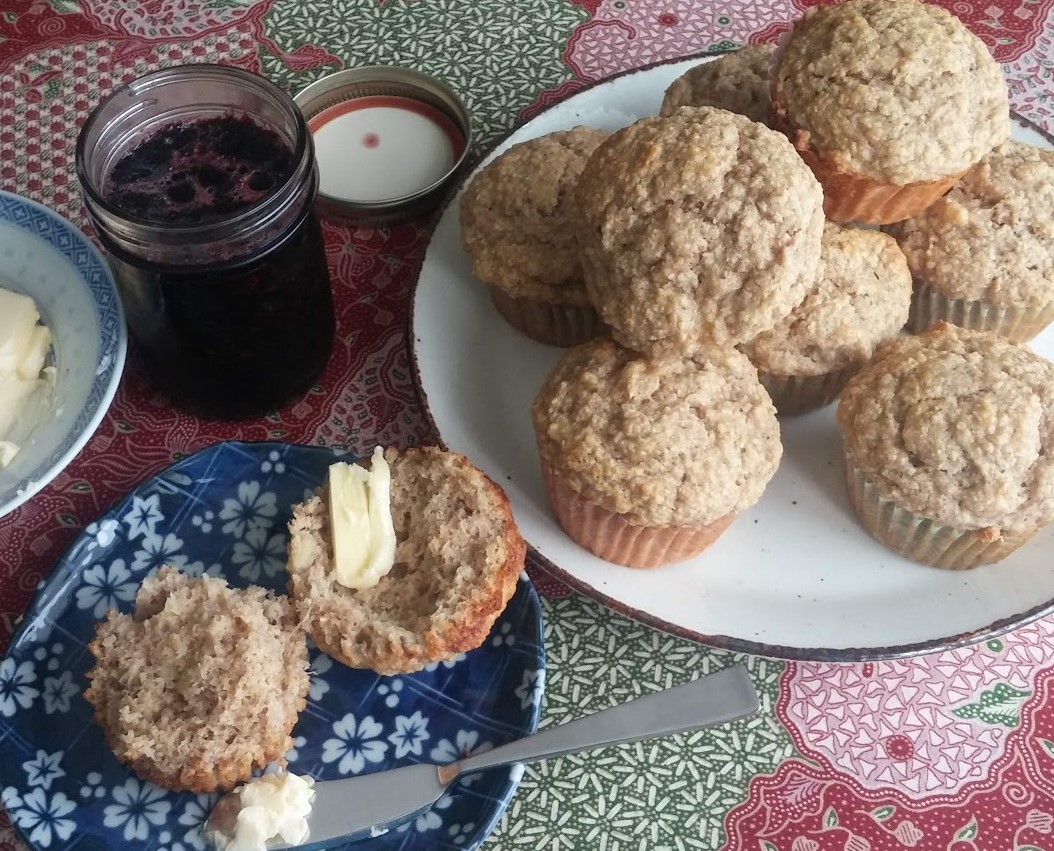
This photo was taken hastily, while I swatted Mr. Ferdzy away with one hand. He has been amazingly good at supporting me in my new diet, which let's be real, is basically his new diet too. But when there were fresh banana muffins, right out of the oven, they plainly called to him!
I'm pretty pleased with these. Banana is not the ideal fruit for pre-diabetics to eat, but it's a reasonable sometimes thing. Mix it with whole, high-fibre grains, and no further sugar (really not required) and the results are excellent. Like most muffins, they are super simple to make. You could get 12 little muffins out of this recipe, but I got 9, and I can see as few as 8 being possible. Other than the need to adjust the baking time slightly, there is no reason not to make whichever number of muffins you like.
8 to 12
40 minutes - 15 minutes prep time
Mix the Dry Ingredients:
1 cup whole spelt flour
1 cup oat bran
1/2 teaspoon salt
2 teaspoons baking powder
a little scrape of nutmeg OPTIONAL
Measure them into a mixing bowl and, er, mix.
Preheat the oven to 375°F. Put muffin liners into your muffin pan. In theory, it could be oiled and floured, but in practice, has anyone done that in decades?
Finish the Muffins:
2 cups (4 large or 5 small) mashed ripe bananas
1/3 cup mild vegetable oil
1 large egg
Peel and mash the bananas thoroughly. Mix the oil into them, then break in the egg and mix it in.
Mix the wet ingredients into the dry ingredients until combined and no dry ingredients remain, but do not over-mix. Spoon the batter out evenly between the muffin cups.
Bake at 375°F for 22 to 26 minutes, until firm and very lightly browned. They really should sit and cool for at least 15 minutes before being eaten, but good luck with that. I got 9 muffins and they took 25 minutes.
Last year at this time I made "Tandoori" Tofu.
I'm pretty pleased with these. Banana is not the ideal fruit for pre-diabetics to eat, but it's a reasonable sometimes thing. Mix it with whole, high-fibre grains, and no further sugar (really not required) and the results are excellent. Like most muffins, they are super simple to make. You could get 12 little muffins out of this recipe, but I got 9, and I can see as few as 8 being possible. Other than the need to adjust the baking time slightly, there is no reason not to make whichever number of muffins you like.
8 to 12
40 minutes - 15 minutes prep time
Mix the Dry Ingredients:
1 cup whole spelt flour
1 cup oat bran
1/2 teaspoon salt
2 teaspoons baking powder
a little scrape of nutmeg OPTIONAL
Measure them into a mixing bowl and, er, mix.
Preheat the oven to 375°F. Put muffin liners into your muffin pan. In theory, it could be oiled and floured, but in practice, has anyone done that in decades?
Finish the Muffins:
2 cups (4 large or 5 small) mashed ripe bananas
1/3 cup mild vegetable oil
1 large egg
Peel and mash the bananas thoroughly. Mix the oil into them, then break in the egg and mix it in.
Mix the wet ingredients into the dry ingredients until combined and no dry ingredients remain, but do not over-mix. Spoon the batter out evenly between the muffin cups.
Bake at 375°F for 22 to 26 minutes, until firm and very lightly browned. They really should sit and cool for at least 15 minutes before being eaten, but good luck with that. I got 9 muffins and they took 25 minutes.
Last year at this time I made "Tandoori" Tofu.
Wednesday, 22 January 2020
Russian Style Apple Batter Pudding
I don't know if they serve this sort of apple pudding in Russia, but this is basically the batter from the Russian "Lazy" Egg and Cabbage Pie I made a while back, so I would be pretty surprised if the answer was no. They certainly ought to, because it is excellent. Apple Batter Pudding is a kind of stealth official Ontario dessert; everyone goes on about butter tarts and what-not, but I bet it is much more likely that your mom made apple batter pudding.
I had already cut back the sugar when I published that recipe; this one uses about a third of that reduced amount. I now find it ample! But you could always put a little more in if you like. This version also has 2/3 the amount of flour, so even though it is a more rich and luxurious version than my original apple batter pudding, it is now a better choice for me.
More rich? Yes, look at all that sour cream. Don't forget that for best results, you should now make your own. In spite of that this is still a pretty homely dessert, good for following a light family meal, although it would certainly rise to the occasion at a more formal dinner too.
6 to 8 servings
1 hour 15 minutes - 30 minutes prep time
1 1/3 cups whole spelt flour
1/2 teaspoon salt
1 teaspoon baking powder
2 tablespoons sugar
1 cup sour cream
3 large eggs
1/4 cup mild vegetable oil
4 to 6 medium-large apples
2 teaspoons ground cinnamon
1 to 2 tablespoons sugar
Lightly oil an 8" x 10" shallow baking (lasagne) pan. Preheat the oven to 375°F.
Measure the flour and mix the salt, baking powder, and first quantity of sugar into it - right in the measuring cup; why not?
Put the sour cream into a mixing bowl and beat in the eggs, one at a time. Beat in the vegetable oil.
Peel the apples and cut them with an apple slicer; discard the cores. I then cut each slice in half again, or they are a bit thick.
Mix the dry ingredients into the sour cream, etc. It will be like a thick pancake batter. Spread about 60% of it in the bottom of the prepared pan. Spread the apple slices over the batter and sprinkle them evenly with the cinnamon and remaining sugar. Dollop the remaining batter over the top as evenly as you can - if the answer is, not very, don't worry about it - it will all straighten itself out sufficiently as it bakes.
Bake the pudding for 45 to 50 minutes until firm and set, and lightly browned. Serve warm or cool.
Last year at this time I made Strawberry-Endive Salad.
I had already cut back the sugar when I published that recipe; this one uses about a third of that reduced amount. I now find it ample! But you could always put a little more in if you like. This version also has 2/3 the amount of flour, so even though it is a more rich and luxurious version than my original apple batter pudding, it is now a better choice for me.
More rich? Yes, look at all that sour cream. Don't forget that for best results, you should now make your own. In spite of that this is still a pretty homely dessert, good for following a light family meal, although it would certainly rise to the occasion at a more formal dinner too.
6 to 8 servings
1 hour 15 minutes - 30 minutes prep time
1 1/3 cups whole spelt flour
1/2 teaspoon salt
1 teaspoon baking powder
2 tablespoons sugar
1 cup sour cream
3 large eggs
1/4 cup mild vegetable oil
4 to 6 medium-large apples
2 teaspoons ground cinnamon
1 to 2 tablespoons sugar
Lightly oil an 8" x 10" shallow baking (lasagne) pan. Preheat the oven to 375°F.
Measure the flour and mix the salt, baking powder, and first quantity of sugar into it - right in the measuring cup; why not?
Put the sour cream into a mixing bowl and beat in the eggs, one at a time. Beat in the vegetable oil.
Peel the apples and cut them with an apple slicer; discard the cores. I then cut each slice in half again, or they are a bit thick.
Mix the dry ingredients into the sour cream, etc. It will be like a thick pancake batter. Spread about 60% of it in the bottom of the prepared pan. Spread the apple slices over the batter and sprinkle them evenly with the cinnamon and remaining sugar. Dollop the remaining batter over the top as evenly as you can - if the answer is, not very, don't worry about it - it will all straighten itself out sufficiently as it bakes.
Bake the pudding for 45 to 50 minutes until firm and set, and lightly browned. Serve warm or cool.
Last year at this time I made Strawberry-Endive Salad.
Monday, 20 January 2020
Potato-Buckwheat Gnocchi
This is aaaaalmost a traditional northern Italian recipe, but I left out the white flour and used all buckwheat flour, where the traditional version uses about half and half buckwheat and white wheat flours. No doubt this is a little more rustic, but it fits my diet and is also gluten-free.
Normally one would make this right after cooking the potatoes, only letting them cool enough to handle, but since my goal is to convert the starch in the potatoes to resistant starch, I cooked them the night before, cooled them, and made the gnocchi the next day. This worked perfectly well; you can do it either way. I served mine with our homemade frozen pesto, because we have a lot of it, but I'm not sure it's the ideal treatment for these. Something similar to Pizzoccheri alla Valtellinese would probably be better, but omit the potato as it's already in the gnocchi. I think this Mushroom, Celery, & Leek Sauce would also go very well.
I served this as 4 main-course portions (froze 2 for later use) and found them a little skimpy but adequate. We do tend to have hearty appetites, so keep that in mind. Six to 8 portions would really only work as part of a multi-course meal. I have to say they did not recook well while frozen; next time I will be sure to thaw them first.
3 to 6 servings; 64 gnocchi
30 minutes to 1 hour to cook the potatoes
30 minutes to mix and form the Gnocchi
20 minutes to cook the Gnocchi
Cook the Potatoes:
500 grams (1 1/4 pounds) starchy white potatoes
You will need 4 to 6 potatoes, medium to medium large in size, but cooking them evenly will be easier if they are of similar configuration. Bring a pot of water sufficient to cover them well to a boil, and boil them for about 20 minutes, until quite tender. DO NOT peel them first, and remove them from the pot to drain, dry, and cool promptly. This will help keep the potato flesh quite dry, which is the object here.
Perhaps a better technique is to bake the potatoes at 375°F for approximately 1 hour, until tender. Remove them from the oven and let them cool.
You can proceed as soon as the potatoes are cool enough to handle, but if you wish them to do very little to raise your blood sugar, they should be cooled completely and chilled overnight first.
Make the Gnocchi:
2/3 cup dark buckwheat flour, about
1/2 teaspoon salt
1 large egg
a little potato starch OR more buckwheat flour to roll
Peel the potatoes and grate them on the finest holes of your box grater, or pass them through a ricer/food mill into a mixing bowl.
Sprinkle the flour and salt over the potatoes, and work them in, breaking up any clumps of potato until you have a fine, evenly grainy mixture.
Break in the egg, break up the yolk and mix the egg then work it into the potatoes. This is a good dough to mix with your (clean!) hands, until it reaches the texture of plasticene. You may need to adjust the amount of flour slightly. Form the dough into a ball, and let it rest for 10 to 15 minutes.
Cut the dough into quarters, and roll one quarter into a fat but straight sided tube in your hands. Roll it out with your hands on a lightly-dusted board until you have an long, even, thin roll, about 12" to 16" long. Cut it into 16 even pieces, and roll each piece with a fork until tubular and embossed with the pattern of the tines. Place them in a single layer on a large plate as you work.
Repeat with the remaining 3 quarters of the dough.
To Cook; put a large pot of boiling water on to boil. Add a little salt, but less than you would for dry pasta as the gnocchi have already been lightly salted. When the water is boiling briskly, add the gnocchi in a steady stream. Do not really stir them, but if they look like sticking to the bottom of the pot, loosen them gently. Cook them for about 4 to 5 minutes. They will float to the top in about 2 minutes, but in my experience they need just a tad longer to cook through to the middle (and next time I will make sure they are a little flatter - don't make them into perfect cylinders).
Serve them with the sauce or other treatment of your choice. Brown butter and sage is classic, as is pesto. Nothing wrong with tomato sauce, or bake them with cheese, breadcrumbs, and herbs.
Last year at this time I made Leek & Dried Tomato Salad.
Normally one would make this right after cooking the potatoes, only letting them cool enough to handle, but since my goal is to convert the starch in the potatoes to resistant starch, I cooked them the night before, cooled them, and made the gnocchi the next day. This worked perfectly well; you can do it either way. I served mine with our homemade frozen pesto, because we have a lot of it, but I'm not sure it's the ideal treatment for these. Something similar to Pizzoccheri alla Valtellinese would probably be better, but omit the potato as it's already in the gnocchi. I think this Mushroom, Celery, & Leek Sauce would also go very well.
I served this as 4 main-course portions (froze 2 for later use) and found them a little skimpy but adequate. We do tend to have hearty appetites, so keep that in mind. Six to 8 portions would really only work as part of a multi-course meal. I have to say they did not recook well while frozen; next time I will be sure to thaw them first.
3 to 6 servings; 64 gnocchi
30 minutes to 1 hour to cook the potatoes
30 minutes to mix and form the Gnocchi
20 minutes to cook the Gnocchi
Cook the Potatoes:
500 grams (1 1/4 pounds) starchy white potatoes
You will need 4 to 6 potatoes, medium to medium large in size, but cooking them evenly will be easier if they are of similar configuration. Bring a pot of water sufficient to cover them well to a boil, and boil them for about 20 minutes, until quite tender. DO NOT peel them first, and remove them from the pot to drain, dry, and cool promptly. This will help keep the potato flesh quite dry, which is the object here.
Perhaps a better technique is to bake the potatoes at 375°F for approximately 1 hour, until tender. Remove them from the oven and let them cool.
You can proceed as soon as the potatoes are cool enough to handle, but if you wish them to do very little to raise your blood sugar, they should be cooled completely and chilled overnight first.
Make the Gnocchi:
2/3 cup dark buckwheat flour, about
1/2 teaspoon salt
1 large egg
a little potato starch OR more buckwheat flour to roll
Peel the potatoes and grate them on the finest holes of your box grater, or pass them through a ricer/food mill into a mixing bowl.
Sprinkle the flour and salt over the potatoes, and work them in, breaking up any clumps of potato until you have a fine, evenly grainy mixture.
Break in the egg, break up the yolk and mix the egg then work it into the potatoes. This is a good dough to mix with your (clean!) hands, until it reaches the texture of plasticene. You may need to adjust the amount of flour slightly. Form the dough into a ball, and let it rest for 10 to 15 minutes.
Cut the dough into quarters, and roll one quarter into a fat but straight sided tube in your hands. Roll it out with your hands on a lightly-dusted board until you have an long, even, thin roll, about 12" to 16" long. Cut it into 16 even pieces, and roll each piece with a fork until tubular and embossed with the pattern of the tines. Place them in a single layer on a large plate as you work.
Repeat with the remaining 3 quarters of the dough.
To Cook; put a large pot of boiling water on to boil. Add a little salt, but less than you would for dry pasta as the gnocchi have already been lightly salted. When the water is boiling briskly, add the gnocchi in a steady stream. Do not really stir them, but if they look like sticking to the bottom of the pot, loosen them gently. Cook them for about 4 to 5 minutes. They will float to the top in about 2 minutes, but in my experience they need just a tad longer to cook through to the middle (and next time I will make sure they are a little flatter - don't make them into perfect cylinders).
Serve them with the sauce or other treatment of your choice. Brown butter and sage is classic, as is pesto. Nothing wrong with tomato sauce, or bake them with cheese, breadcrumbs, and herbs.
Last year at this time I made Leek & Dried Tomato Salad.
Labels:
01 January,
02 February,
03 March,
04 April,
05 May,
10 October,
11 November,
12 December,
Diabetic Friendly,
Eggs,
Grains,
Main Dish,
Pasta,
Potatoes
Friday, 20 December 2019
Rye Spaetzle with Caraway
This was the final dish of a menu consisting of Broiled Muscovy Duck Breast, Braised Belgian Endive, and the spaetzle. It looks a little plain - it's noodles, basically - but I have to say this is the dish that is going to stick in my memory, and which I intend to make again regularly. I am late to discovering how fast and easily spaetzle can be made, and I regret it. All those wasted years! But now I know. It helped, I think, to have a colander with fairly large holes that work well for forming the little dumplings, but I have to admit I have purchased a spaetzle maker for the next batch. This is an unusual one, which doubles as a perforated pot lid.
The rye flour worked perfectly. The caraway seeds, in my opinion were what really made these special, and the tang of the buttermilk added to the joy.
Mr. Ferdzy must have really liked them too. I was planning various things to do with the leftovers - sautéed with vegetables and sprinkled with cheese; fried with bacon, put in vegetable soup as noodles - but the quantity of leftovers is just pitiful. I guess I could throw them in some soup but it hardly seems worth the effort. They may disappear as someone's midnight snack anyway.
And as is traditional around now, it's time to step away from the computer and go spend time with the family. I hope all my readers have happy holidays, and may we all have an excellent New Year.
4 to 6 servings
15 minutes prep time plus some wait time
2 cups whole rye flour
1 teaspoon caraway seeds, OPTIONAL
1/4 teaspoon salt
3 large chicken eggs OR 2 large duck eggs
about 1 1/4 cup buttermilk
Mix the flour, caraway seeds, and salt in a mixing bowl. Break in the eggs, and whisk about 1 cup of the buttermilk in with them, then stir it all together to form a smooth batter. Let it rest for 30 minutes to an hour if you can, before you cook the spaetzle, although it is not absolutely required.
Put a large pot of salted water on to boil. Check the consistency of the batter - it should be like a thick pancake batter. I needed to add another 1/4 cup of buttermilk, but be prepared for it to vary slightly. When the water boils - which should be about 5 minutes before you are ready to serve dinner, because these little jobbies cook amazingly fast - transfer the batter to a colander (or spaetzle maker, if you have one) and press the batter through the colander using a spatula. Obviously, you want to hold the colander over the boiling water while the batter goes into it. Your third arm will come in extremely handy here - in this case attached to Mr. Ferdzy. Seriously, I am at a bit of a loss to see how this can be done by one person alone. I mean it could be, if you didn't mind a quarter of the batter all over the place, but I do.
Anyway, once all the batter is in, in little squiggles, or at least as much of it as you are going to get in, let it cook in the rapidly boiling water until they all float. This will be just about enough time to quickly wash the colander so you can use it to drain them - 3 or 4 minutes is all they will take. Serve 'em hot, with a pat of butter if nothing else, but creamy cheeses, gravy drenched meats, or saucy vegetables will all be appropriate ladled over them.
Last year at this time I made Curried Parsnips Roasted with Apples & Shallots and also Oslo Kringle.
The rye flour worked perfectly. The caraway seeds, in my opinion were what really made these special, and the tang of the buttermilk added to the joy.
Mr. Ferdzy must have really liked them too. I was planning various things to do with the leftovers - sautéed with vegetables and sprinkled with cheese; fried with bacon, put in vegetable soup as noodles - but the quantity of leftovers is just pitiful. I guess I could throw them in some soup but it hardly seems worth the effort. They may disappear as someone's midnight snack anyway.
And as is traditional around now, it's time to step away from the computer and go spend time with the family. I hope all my readers have happy holidays, and may we all have an excellent New Year.
4 to 6 servings
15 minutes prep time plus some wait time
2 cups whole rye flour
1 teaspoon caraway seeds, OPTIONAL
1/4 teaspoon salt
3 large chicken eggs OR 2 large duck eggs
about 1 1/4 cup buttermilk
Mix the flour, caraway seeds, and salt in a mixing bowl. Break in the eggs, and whisk about 1 cup of the buttermilk in with them, then stir it all together to form a smooth batter. Let it rest for 30 minutes to an hour if you can, before you cook the spaetzle, although it is not absolutely required.
Put a large pot of salted water on to boil. Check the consistency of the batter - it should be like a thick pancake batter. I needed to add another 1/4 cup of buttermilk, but be prepared for it to vary slightly. When the water boils - which should be about 5 minutes before you are ready to serve dinner, because these little jobbies cook amazingly fast - transfer the batter to a colander (or spaetzle maker, if you have one) and press the batter through the colander using a spatula. Obviously, you want to hold the colander over the boiling water while the batter goes into it. Your third arm will come in extremely handy here - in this case attached to Mr. Ferdzy. Seriously, I am at a bit of a loss to see how this can be done by one person alone. I mean it could be, if you didn't mind a quarter of the batter all over the place, but I do.
Anyway, once all the batter is in, in little squiggles, or at least as much of it as you are going to get in, let it cook in the rapidly boiling water until they all float. This will be just about enough time to quickly wash the colander so you can use it to drain them - 3 or 4 minutes is all they will take. Serve 'em hot, with a pat of butter if nothing else, but creamy cheeses, gravy drenched meats, or saucy vegetables will all be appropriate ladled over them.
Last year at this time I made Curried Parsnips Roasted with Apples & Shallots and also Oslo Kringle.
Labels:
00 All Year,
Dairy,
Diabetic Friendly,
Eggs,
Grains,
Pasta,
Side Dish
Friday, 6 December 2019
Flourless Sweet Potato & Chocolate Cake
This isn't exactly a cake. It's a bit too solid and pudding-y, but it's round and it cuts and it's full of chocolate. It's a bit like sweet potato pone meets that famous flourless chocolate cake from the '80s. Definitely delicious, and I'll take it.
As is now usual, I've kept the sugar down as much as I think reasonably possible. You could add more, I'm sure, although it seemed sweet enough for me, what with the sweet potatoes as well as the sugar. Mind you, I have definitely adjusted to having things much less sweet than I used to.
I used half sugar and half erythritol-monkfruit blend for the sugar. I've been experimenting a bit with similar artificial sweeteners, but when they run out I think I will just go back to using sugar. From my reading, it seems that although they have no calories, they still affect your blood sugar as if you had eaten sugar, and that's what leads to weight gain and diabetes, more than the actual calories. This would certainly explain why the widespread availability of artificial sweeteners has done nothing to prevent these things.
But enough about that! Have some marvelous, delicious, healthy cake!
12 servings
1 hour to 1 1/2 hours to roast the potatoes
1 hour 20 minutes - 20 minutes prep time to make the cake
Roast & Mash the Sweet Potatoes:
1 kilogram (2 1/4 pounds; 3 or 4 large) sweet potatoes
Preheat the oven to 375°F. Wash the sweet potatoes and poke them in several places with a fork. Bake for 1 hour to 1 hour and 30 minutes, until soft. Let cool.
Peel and mash the sweet potatoes very thoroughly, discarding the skins. For best results press them through a coarse sieve, potato ricer, or food mill.
This can be done up to a day in advance, and the sweet potato purée covered and kept refrigerated until needed.
Make the Cake:
1/2 cup unsalted butter
125 grams (1/4 pound) unsweetened chocolate
1/4 cup sugar
1/4 teaspoon salt
1 teaspoon vanilla extract
3 tablespoons rum OR orange juice
a little finely grated orange zest, OPTIONAL
4 large eggs
Put the butter in a heavy-bottomed, largish pot - a soup pot is excellent. The batter will be mixed right in the pot. Add the remaining ingredients, except for the sweet potatoes and the eggs. Heat gently until the butter and chocolate are melted. Stir occasionally.
Meanwhile, preheat the oven to 350°F. Line the bottom of an 9" spring-form pan with parchment paper, and butter the sides.
When everything is melted and smoothly amalgamated, remove the pot from the heat. Stir in the sweet potato purée until well blended. Break in the eggs, one at a time, and beat them in well.
Scrape the batter into the prepared pan and smooth it out evenly. Bake for 1 hour at 350°F. Let cool and set completely before serving, preferably overnight.
Last year at this time I made Winter Hodge-Podge.
As is now usual, I've kept the sugar down as much as I think reasonably possible. You could add more, I'm sure, although it seemed sweet enough for me, what with the sweet potatoes as well as the sugar. Mind you, I have definitely adjusted to having things much less sweet than I used to.
I used half sugar and half erythritol-monkfruit blend for the sugar. I've been experimenting a bit with similar artificial sweeteners, but when they run out I think I will just go back to using sugar. From my reading, it seems that although they have no calories, they still affect your blood sugar as if you had eaten sugar, and that's what leads to weight gain and diabetes, more than the actual calories. This would certainly explain why the widespread availability of artificial sweeteners has done nothing to prevent these things.
But enough about that! Have some marvelous, delicious, healthy cake!
12 servings
1 hour to 1 1/2 hours to roast the potatoes
1 hour 20 minutes - 20 minutes prep time to make the cake
Roast & Mash the Sweet Potatoes:
1 kilogram (2 1/4 pounds; 3 or 4 large) sweet potatoes
Preheat the oven to 375°F. Wash the sweet potatoes and poke them in several places with a fork. Bake for 1 hour to 1 hour and 30 minutes, until soft. Let cool.
Peel and mash the sweet potatoes very thoroughly, discarding the skins. For best results press them through a coarse sieve, potato ricer, or food mill.
This can be done up to a day in advance, and the sweet potato purée covered and kept refrigerated until needed.
Make the Cake:
1/2 cup unsalted butter
125 grams (1/4 pound) unsweetened chocolate
1/4 cup sugar
1/4 teaspoon salt
1 teaspoon vanilla extract
3 tablespoons rum OR orange juice
a little finely grated orange zest, OPTIONAL
4 large eggs
Put the butter in a heavy-bottomed, largish pot - a soup pot is excellent. The batter will be mixed right in the pot. Add the remaining ingredients, except for the sweet potatoes and the eggs. Heat gently until the butter and chocolate are melted. Stir occasionally.
Meanwhile, preheat the oven to 350°F. Line the bottom of an 9" spring-form pan with parchment paper, and butter the sides.
When everything is melted and smoothly amalgamated, remove the pot from the heat. Stir in the sweet potato purée until well blended. Break in the eggs, one at a time, and beat them in well.
Scrape the batter into the prepared pan and smooth it out evenly. Bake for 1 hour at 350°F. Let cool and set completely before serving, preferably overnight.
Last year at this time I made Winter Hodge-Podge.
Labels:
01 January,
02 February,
03 March,
04 April,
05 May,
10 October,
11 November,
12 December,
Dairy,
Dessert,
Diabetic Friendly,
Eggs,
Sweet Potatoes
Friday, 29 November 2019
Poppy Seed-Bran Soda Bread
Rudolph's make a poppy seed and bran bread that I like very much, but it doesn't make the cut for my new diet. It's quite different from this one (lots of white flour and much less bran and poppy seeds; also a standard industrial yeast-raised bread) but this has plenty of appeal too. I put in the higher quantity of poppy seeds and liked it, but I am prepared to admit that that's a lot of poppy seeds. You could certainly supply them with more discretion.
This is an excellent bread to have with a bowl of hearty vegetable soup, or I suppose you could eat it with butter and jam, although I think it is better with cheese.
12 slices
1 hour - 5 minutes prep time - allow time to cool
2 cups whole spelt flour
1 1/2 cups wheat bran
1/4 to 1/2 cup poppy seeds
1 teaspoon baking soda
1/2 teaspoon salt
2 cups buttermilk
Mix the dry ingredients together in a mixing bowl. Stir in the buttermilk until just blended. Let the batter rest for 10 minutes.
Meanwhile, grease and flour a large loaf pan and preheat the oven to 350°F. When the batter has rested (and thickened slightly) scrape it into the prepared pan and smooth it out. Bake for 45 to 50 minutes until done - test with a toothpick if you are not sure.
Let the loaf cool for 10 minutes before removing it from the pan. Let cool to just barely warm to completely before slicing and serving.
Last year at this time I made Poutine with Homemade Gravy.
This is an excellent bread to have with a bowl of hearty vegetable soup, or I suppose you could eat it with butter and jam, although I think it is better with cheese.
12 slices
1 hour - 5 minutes prep time - allow time to cool
2 cups whole spelt flour
1 1/2 cups wheat bran
1/4 to 1/2 cup poppy seeds
1 teaspoon baking soda
1/2 teaspoon salt
2 cups buttermilk
Mix the dry ingredients together in a mixing bowl. Stir in the buttermilk until just blended. Let the batter rest for 10 minutes.
Meanwhile, grease and flour a large loaf pan and preheat the oven to 350°F. When the batter has rested (and thickened slightly) scrape it into the prepared pan and smooth it out. Bake for 45 to 50 minutes until done - test with a toothpick if you are not sure.
Let the loaf cool for 10 minutes before removing it from the pan. Let cool to just barely warm to completely before slicing and serving.
Last year at this time I made Poutine with Homemade Gravy.
Labels:
00 All Year,
Bread,
Breakfast,
Dairy,
Diabetic Friendly,
Grains,
Nuts and Seeds
Friday, 25 October 2019
Roasted Chile-Garlic Broccoli & Tofu
Roasting green vegetables has been very popular for the last few years. It is not my favourite way of preparing them, but once in a while I will give it a go. It does have the advantage that most of the prep work is in advance, and very little attention is required while cooking.
It's also been a while since we have had any tofu. Since baked tofu has a chewy-crispy texture that I really like, this seemed like a good plan. This is two-thirds of that old hippie triumvirate; brown rice being the only missing element and it needn't be missing at all if that's what you make to go with this. We had quinoa and it went along very well.
This is not in any way a difficult thing to make but you must allow enough time to drain then marinate the tofu, also the baking takes some time.
2 to 3 servings
1 hour 45 minutes - 30 minutes prep time
Press & Marinate the Tofu:
350 grams (12 ounces) extra-firm tofu
2 tablespoons tamari OR soy sauce
2 tablespoons apple cider vinegar
2 tablespoons mild vegetable oil
2 tablespoons toasted sesame oil
Slice the tofu about 1 cm thick, then into bite-sized pieces. Arrange it in a shallow sieve, and put a weight on it. Press it for about 30 minutes (over a bowl to catch the liquid).
Meanwhile, mix the remaining ingredients. Put the drained tofu into a container and pour the marinade over it. Stir gently, then marinate for about 30 minutes.
Prepare the Broccoli, Etc:
1 head (1/2 bunch) broccoli
4 to 6 shallots
1 tablespoon mild vegetable oil
While the tofu marinates, wash and trim the broccoli. Cut and break it into small florets and other bite-sized pieces. Peel the shallots and cut them in quarters. Toss them both with the oil and arrange them on one side of a large baking (cookie) tray, lined with parchment paper if you like.
Preheat the oven to 400°F.
Roast the Broccoli & Tofu:
3 to 4 tablespoons potato starch
1 or 2 cloves of garlic
1 tablespoon (to taste) chile-garlic sauce
1 tablespoon soy sauce
Drain the tofu - drizzle any unabsorbed marinade over the broccoli. Pat the tofu dry with a paper towel and put it in a sieve. Sprinkle the potato starch, a tablespoon at a time, over the tofu pieces. Shake and turn them after each spoonful to get them as evenly coated as possible. Once they all have a thin coating of starch, put them on the other half of the baking tray, spread out in a single layer.
Bake the broccoli and tofu at 400°F for 20 minutes. While they bake, peel and mince the garlic. Mix it with the chile-garlic sauce and the soy sauce.
Turn the tofu over and drizzle the prepared sauce over the broccoli. Stir and turn the broccoli gently. Return the tray to the oven and bake for a further 20 minutes.
Mix the tofu into the broccoli and serve at once, with rice or noodles (or quinoa pilaf, as I did).
Last year at this time I made Beans & Sausage with Peppers & Onions.
It's also been a while since we have had any tofu. Since baked tofu has a chewy-crispy texture that I really like, this seemed like a good plan. This is two-thirds of that old hippie triumvirate; brown rice being the only missing element and it needn't be missing at all if that's what you make to go with this. We had quinoa and it went along very well.
This is not in any way a difficult thing to make but you must allow enough time to drain then marinate the tofu, also the baking takes some time.
2 to 3 servings
1 hour 45 minutes - 30 minutes prep time
Press & Marinate the Tofu:
350 grams (12 ounces) extra-firm tofu
2 tablespoons tamari OR soy sauce
2 tablespoons apple cider vinegar
2 tablespoons mild vegetable oil
2 tablespoons toasted sesame oil
Slice the tofu about 1 cm thick, then into bite-sized pieces. Arrange it in a shallow sieve, and put a weight on it. Press it for about 30 minutes (over a bowl to catch the liquid).
Meanwhile, mix the remaining ingredients. Put the drained tofu into a container and pour the marinade over it. Stir gently, then marinate for about 30 minutes.
Prepare the Broccoli, Etc:
1 head (1/2 bunch) broccoli
4 to 6 shallots
1 tablespoon mild vegetable oil
While the tofu marinates, wash and trim the broccoli. Cut and break it into small florets and other bite-sized pieces. Peel the shallots and cut them in quarters. Toss them both with the oil and arrange them on one side of a large baking (cookie) tray, lined with parchment paper if you like.
Preheat the oven to 400°F.
Roast the Broccoli & Tofu:
3 to 4 tablespoons potato starch
1 or 2 cloves of garlic
1 tablespoon (to taste) chile-garlic sauce
1 tablespoon soy sauce
Drain the tofu - drizzle any unabsorbed marinade over the broccoli. Pat the tofu dry with a paper towel and put it in a sieve. Sprinkle the potato starch, a tablespoon at a time, over the tofu pieces. Shake and turn them after each spoonful to get them as evenly coated as possible. Once they all have a thin coating of starch, put them on the other half of the baking tray, spread out in a single layer.
Bake the broccoli and tofu at 400°F for 20 minutes. While they bake, peel and mince the garlic. Mix it with the chile-garlic sauce and the soy sauce.
Turn the tofu over and drizzle the prepared sauce over the broccoli. Stir and turn the broccoli gently. Return the tray to the oven and bake for a further 20 minutes.
Mix the tofu into the broccoli and serve at once, with rice or noodles (or quinoa pilaf, as I did).
Last year at this time I made Beans & Sausage with Peppers & Onions.
Friday, 18 October 2019
Rye Apple Brown Betty
Oo, dessert! I am still finding a way to have a few. This one worked very well, although I think next time I will crumble the breadcrumbs more finely. That will be a very minor tweak, though.
Apple Betty is a very old fashioned dessert; you hardly ever see it any more. It's another excellent thing to do with old bread, though, and now that I am willing to use a bit more butter than I used to be (as it turns out butter isn't the problem; it's the carbs) it's turning out better for me. Don't be afraid to use enough to get those breadcrumbs crisp and buttery.
Otherwise this was a little zingy, a little sweet, and altogether tasty as a follow-up to a salad based meal. I used Empire apples which worked nicely and they are widely available. I like that they have quite a bit of tartness, and soften up without losing their shape.
You could use other bread than rye and have a more generous hand with the sugar, but I have to say that rye bread works really well with apples, and I thought this was quite sweet enough. The rye bread was a dark but light textured (Viking dark rye, to be precise).
4 to 6 servings
1 hour - 40 minutes prep time
allow a little time to cool to warm
6 medium-large cooking apples
4 to 6 green cardamom pods
1/2 teaspoon cinnamon
4 tablespoons Sucanat (dark brown sugar) or coconut sugar
150 grams (6 small slices) stale rye bread
4 tablespoons butter
Peel the apples, core, and slice them. Cook them in a saucepan over medium heat with a tablespoon or so of water until soft. Stir gently occasionally.
Meanwhile, crush the cardamom pods and discard the green papery hulls. Grind the seeds well and mix them with the cinnamon and the Sucanat. Cut the bread into small cubes then gently rub them to reduce them to coarse crumbs. Preheat the oven to 350°F.
Melt the butter in a shallow casserole that can go into the oven (and which will hold all the ingredients). Add the breadcrumbs and toss them in the butter, then cook them over medium heat for about 10 minutes, until lightly toasted and saturated with the butter. Sprinkle the sugar and spices over them, and mix in. Cook a minute or so longer then tip them out into a mixing bowl and replace them in the casserole with the apples.
Spread the apples to cover the bottom of the casserole evenly. Spread the sweetened, toasted breadcrumbs over the apples. Bake at 350°F for 20 minutes, until the breadcrumbs are crisp. Serve warm.
Last year at this time I made Pasta with Spinach, Roasted Squash, Shallots & Ricotta.
Apple Betty is a very old fashioned dessert; you hardly ever see it any more. It's another excellent thing to do with old bread, though, and now that I am willing to use a bit more butter than I used to be (as it turns out butter isn't the problem; it's the carbs) it's turning out better for me. Don't be afraid to use enough to get those breadcrumbs crisp and buttery.
Otherwise this was a little zingy, a little sweet, and altogether tasty as a follow-up to a salad based meal. I used Empire apples which worked nicely and they are widely available. I like that they have quite a bit of tartness, and soften up without losing their shape.
You could use other bread than rye and have a more generous hand with the sugar, but I have to say that rye bread works really well with apples, and I thought this was quite sweet enough. The rye bread was a dark but light textured (Viking dark rye, to be precise).
4 to 6 servings
1 hour - 40 minutes prep time
allow a little time to cool to warm
6 medium-large cooking apples
4 to 6 green cardamom pods
1/2 teaspoon cinnamon
4 tablespoons Sucanat (dark brown sugar) or coconut sugar
150 grams (6 small slices) stale rye bread
4 tablespoons butter
Peel the apples, core, and slice them. Cook them in a saucepan over medium heat with a tablespoon or so of water until soft. Stir gently occasionally.
Meanwhile, crush the cardamom pods and discard the green papery hulls. Grind the seeds well and mix them with the cinnamon and the Sucanat. Cut the bread into small cubes then gently rub them to reduce them to coarse crumbs. Preheat the oven to 350°F.
Melt the butter in a shallow casserole that can go into the oven (and which will hold all the ingredients). Add the breadcrumbs and toss them in the butter, then cook them over medium heat for about 10 minutes, until lightly toasted and saturated with the butter. Sprinkle the sugar and spices over them, and mix in. Cook a minute or so longer then tip them out into a mixing bowl and replace them in the casserole with the apples.
Spread the apples to cover the bottom of the casserole evenly. Spread the sweetened, toasted breadcrumbs over the apples. Bake at 350°F for 20 minutes, until the breadcrumbs are crisp. Serve warm.
Last year at this time I made Pasta with Spinach, Roasted Squash, Shallots & Ricotta.
Wednesday, 16 October 2019
Personal Update on Pre-Diabetes
(Photo is of Sunflower Vegetable Paté, which I made for Thanksgiving with minor adjustments to use as a dressing/stuffing substitute.)
Last week I had my blood sugar measured again (A1C, I believe it is called). It came in at 5.8 compared to the last time 6 months ago, when it was 6.2.
What does that mean? It means I've done well! I gather that ideally it should probably come in between 5.0 and 5.5, but this is a considerable improvement and I am no longer quite on the edge of the precipice. I've also lost about 9 to 10 kg (20 to 22 pounds) in the last year. Obviously, I am not going to celebrate by going out and eating* all those things that I gave up to achieve this. It's a long term project. However, it's nice to see that the changes I've made are on the right track and that I am, for the most part, finding them reasonably do-able.
There is still some fine tuning to be done, and I expect to find things a bit easier once the gardening season is over and I'm spending more time inside. It turned out summer was a bit difficult of a time to start a new diet plan - there isn't a lot of time or energy to cook, and I don't necessarily want much hot food anyway. Unfortunately, that traditionally has meant that we eat a lot of sandwiches and pasta in the summer (well, year round really, but summer is particularly bad). I'm still working on finding things to replace them with that don't require a lot of advance preparation and cooking.
I'm trying to come up with a plan that takes a number of factors into consideration. I don't tend to worry about calories too much. My feeling, though, is that I am eating more (calories, not volume) than I was and yet losing weight, albeit fairly slowly and still with the assistance of the 5-2 diet. Sugars, carbs, and fibre levels of ingredients are the main things that I am now checking, but they don't tell the whole story. Really low-carb days make me feel frantically horrible, so I'm aiming for "right carb" days. I try to check on glycemic index and glycemic load information, when I can find it. My nutritional counsellor through the local hospital gave me a blood glucose meter, and the proof of the blood sugar pudding can now be measured.
Here are some of the things I've been doing:
1.) Pasta: it's now whole wheat nearly always, and once a week only.
2.) Rice: it's now brown basmati or brown converted (which is a bit odd, but better than the white converted. More about converted rice lower down.) In theory it's on the menu once a week as well, but in practice we seem to having it about half that often.
3.) Quinoa: I have been making Quinoa Pilaf (without the rutabaga in it) quite often. One half gets eaten hot at dinner then in the next day or two the other half gets made into a salad. I do this about every second week, so on average, again, about once a week. It's a bit carb-y but better than rice or pasta.
4.) Sweet potatoes and squash: get served often as the "carb" portion of a meal. In the winter rutabaga will show up here too. Unfortunately, corn, beets and parsnips are going to be very occasional treats. I'm eating a certain amount of carrots, peas, and onions, about the same as I ever was.
5.) Dried beans, lentils, peas, etc are going to be eaten a lot. Two meals based on them per week is the rock bottom minimum, and I'm aiming for at least four. I have not eaten a lot of barley over the summer, but as we head into the fall I'd like it to appear on the menu once or twice a week. I'm also aiming to eat more wild rice and buckwheat.
6.) Bread: I was very frustrated by the selection of bread in local grocery stores, and by local I mean from Owen Sound to Thornbury. Owen Sound and Thornbury have, in theory, a much better selection than the local store, but in practice it was annoyingly common to drive 15 minutes or half an hour and discover they were sold out of what I wanted. Thanks to the arcane and frankly extortionate system of getting products onto the shelves of grocery stores, I was not able to place a standing order for bread either. However, I'm happy to report the problem has been solved: you can order directly from Dimplfmeier's on line and they mail it to you! It means we will be stuffing our freezer full of bread every 2 or 3 months, but it will be the bread I actually want. I'm selecting bread with fewer than 20 net carbs per slice, mostly rye flour, and no calcium propionate or other propionates. Dimpflmeier's is about the only widely available bread line that has some types to fit this profile.
7.) Natural sugars and artificial sweeteners: I've always avoided artificial sweeteners just because they all seemed to have a nasty, tinny aftertaste that spoiled whatever they were in. The good news is that there are now some that are not too bad. The even better news is that these are some of the ones with what appears to be the best health profiles. In particular, I find myself using stevia with erythritol or stevia with monkfruit. These are not the most artificial of artificial sweeteners - erythritol is a sugar alcohol and stevia and monkfruit are both sourced from plants - but they are highly processed and I am still treating them with a lot of caution. If calorie-free sweeteners prevented diabetes and weight gain, they've been around long enough and widely available enough that we ought to be seeing them making a difference. Instead, levels of weight gain and diabetes are higher than ever. They all contain carbohydrates even if they register as non caloric, and if I use them I am careful to treat the carbohydrates they contain as part of my daily allotment. That makes them only somewhat better than sugar, honey, maple syrup, etc. I find myself using natural sweeteners in combination with an artificial one, and neither in large quantities nor often.
8.) Potatoes and resistant starches: Well, here is an interesting thing. Potatoes are terrible for blood sugar! Except, if you cook them in advance, cool and chill them, then reheat them, they're not! Same with pasta, and I guess, a number of other starchy foods. We did an experiment where I ate freshly cooked potatoes, chicken and vegetables at a meal, and then ate the same thing except with reheated (pan fried) potatoes the next day. I measured my blood sugar both times and there really was a significant difference (lower) after the reheated potatoes. We did the same with a pasta meal. The difference wasn't quite as pronounced, and re-heated pasta isn't as pleasant as fried potatoes. Still, it means things like fried potatoes, pasta salad, and fried rice are going to have a place in the diet. Also doing a little cooking with potato starch is more reasonable than it might look at first glance. (Those Cocoa Crepes, for instance!) This creation of resistant starches by heating and cooling starchy foods explains why converted rice has a much better glycemic index than untreated rice. It's a bit annoying, because like re-heated pasta, converted rice isn't all that great. Still, it's better than no rice, I guess.
So now what? I'll continue to fine-tune the diet over the winter. I need to get more exercise - that's a big factor in avoiding diabetes and I haven't managed to maintain a good level of it yet. But the diet seems to be mostly under control so it's time to turn some attention there. I have a few recipes that I am still refining but which are turning into regular diet items and will probably get posted over the winter. I have added a "Diabetic Friendly" tag to the list on the side, and over the winter I will go through my recipes and add the ones I think are good for that. And so, onward and bon appétit to us all.
* I reserve the right to make a big chocolate cake and eat it too, if and when Donald Trump is evicted from power.
Last week I had my blood sugar measured again (A1C, I believe it is called). It came in at 5.8 compared to the last time 6 months ago, when it was 6.2.
What does that mean? It means I've done well! I gather that ideally it should probably come in between 5.0 and 5.5, but this is a considerable improvement and I am no longer quite on the edge of the precipice. I've also lost about 9 to 10 kg (20 to 22 pounds) in the last year. Obviously, I am not going to celebrate by going out and eating* all those things that I gave up to achieve this. It's a long term project. However, it's nice to see that the changes I've made are on the right track and that I am, for the most part, finding them reasonably do-able.
There is still some fine tuning to be done, and I expect to find things a bit easier once the gardening season is over and I'm spending more time inside. It turned out summer was a bit difficult of a time to start a new diet plan - there isn't a lot of time or energy to cook, and I don't necessarily want much hot food anyway. Unfortunately, that traditionally has meant that we eat a lot of sandwiches and pasta in the summer (well, year round really, but summer is particularly bad). I'm still working on finding things to replace them with that don't require a lot of advance preparation and cooking.
I'm trying to come up with a plan that takes a number of factors into consideration. I don't tend to worry about calories too much. My feeling, though, is that I am eating more (calories, not volume) than I was and yet losing weight, albeit fairly slowly and still with the assistance of the 5-2 diet. Sugars, carbs, and fibre levels of ingredients are the main things that I am now checking, but they don't tell the whole story. Really low-carb days make me feel frantically horrible, so I'm aiming for "right carb" days. I try to check on glycemic index and glycemic load information, when I can find it. My nutritional counsellor through the local hospital gave me a blood glucose meter, and the proof of the blood sugar pudding can now be measured.
Here are some of the things I've been doing:
1.) Pasta: it's now whole wheat nearly always, and once a week only.
2.) Rice: it's now brown basmati or brown converted (which is a bit odd, but better than the white converted. More about converted rice lower down.) In theory it's on the menu once a week as well, but in practice we seem to having it about half that often.
3.) Quinoa: I have been making Quinoa Pilaf (without the rutabaga in it) quite often. One half gets eaten hot at dinner then in the next day or two the other half gets made into a salad. I do this about every second week, so on average, again, about once a week. It's a bit carb-y but better than rice or pasta.
4.) Sweet potatoes and squash: get served often as the "carb" portion of a meal. In the winter rutabaga will show up here too. Unfortunately, corn, beets and parsnips are going to be very occasional treats. I'm eating a certain amount of carrots, peas, and onions, about the same as I ever was.
5.) Dried beans, lentils, peas, etc are going to be eaten a lot. Two meals based on them per week is the rock bottom minimum, and I'm aiming for at least four. I have not eaten a lot of barley over the summer, but as we head into the fall I'd like it to appear on the menu once or twice a week. I'm also aiming to eat more wild rice and buckwheat.
6.) Bread: I was very frustrated by the selection of bread in local grocery stores, and by local I mean from Owen Sound to Thornbury. Owen Sound and Thornbury have, in theory, a much better selection than the local store, but in practice it was annoyingly common to drive 15 minutes or half an hour and discover they were sold out of what I wanted. Thanks to the arcane and frankly extortionate system of getting products onto the shelves of grocery stores, I was not able to place a standing order for bread either. However, I'm happy to report the problem has been solved: you can order directly from Dimplfmeier's on line and they mail it to you! It means we will be stuffing our freezer full of bread every 2 or 3 months, but it will be the bread I actually want. I'm selecting bread with fewer than 20 net carbs per slice, mostly rye flour, and no calcium propionate or other propionates. Dimpflmeier's is about the only widely available bread line that has some types to fit this profile.
7.) Natural sugars and artificial sweeteners: I've always avoided artificial sweeteners just because they all seemed to have a nasty, tinny aftertaste that spoiled whatever they were in. The good news is that there are now some that are not too bad. The even better news is that these are some of the ones with what appears to be the best health profiles. In particular, I find myself using stevia with erythritol or stevia with monkfruit. These are not the most artificial of artificial sweeteners - erythritol is a sugar alcohol and stevia and monkfruit are both sourced from plants - but they are highly processed and I am still treating them with a lot of caution. If calorie-free sweeteners prevented diabetes and weight gain, they've been around long enough and widely available enough that we ought to be seeing them making a difference. Instead, levels of weight gain and diabetes are higher than ever. They all contain carbohydrates even if they register as non caloric, and if I use them I am careful to treat the carbohydrates they contain as part of my daily allotment. That makes them only somewhat better than sugar, honey, maple syrup, etc. I find myself using natural sweeteners in combination with an artificial one, and neither in large quantities nor often.
8.) Potatoes and resistant starches: Well, here is an interesting thing. Potatoes are terrible for blood sugar! Except, if you cook them in advance, cool and chill them, then reheat them, they're not! Same with pasta, and I guess, a number of other starchy foods. We did an experiment where I ate freshly cooked potatoes, chicken and vegetables at a meal, and then ate the same thing except with reheated (pan fried) potatoes the next day. I measured my blood sugar both times and there really was a significant difference (lower) after the reheated potatoes. We did the same with a pasta meal. The difference wasn't quite as pronounced, and re-heated pasta isn't as pleasant as fried potatoes. Still, it means things like fried potatoes, pasta salad, and fried rice are going to have a place in the diet. Also doing a little cooking with potato starch is more reasonable than it might look at first glance. (Those Cocoa Crepes, for instance!) This creation of resistant starches by heating and cooling starchy foods explains why converted rice has a much better glycemic index than untreated rice. It's a bit annoying, because like re-heated pasta, converted rice isn't all that great. Still, it's better than no rice, I guess.
So now what? I'll continue to fine-tune the diet over the winter. I need to get more exercise - that's a big factor in avoiding diabetes and I haven't managed to maintain a good level of it yet. But the diet seems to be mostly under control so it's time to turn some attention there. I have a few recipes that I am still refining but which are turning into regular diet items and will probably get posted over the winter. I have added a "Diabetic Friendly" tag to the list on the side, and over the winter I will go through my recipes and add the ones I think are good for that. And so, onward and bon appétit to us all.
* I reserve the right to make a big chocolate cake and eat it too, if and when Donald Trump is evicted from power.
Monday, 3 June 2019
Sorrel Pakoras
When I first thought of making pakoras with sorrel, I did a search to see if there was already such a thing. And while they don't seem common, there are recipes for sorrel pakoras out there. However, they struck me as a bit odd, especially when I looked at the photos, and I soon realized that they were not being made with sorrel as I know it. Eventually I figured it out - it's what gets called sorrel in the Caribbean; a kind of hibiscus.
Well, never mind. It turns out that the local (French or garden) sorrel makes perfectly cromulent pakoras. I really like the tart zing of sorrel in these little fritters, and a slightly sweet chutney would really set them off.
10 to 14 pakoras
20 minutes prep time
Mix the Batter:
1/2 teaspoon cumin seeds
1 teaspoon coriander seeds
1/4 teaspoon (or to taste) ground hot red chile
1/2 teaspoon salt
1/2 cup chick pea flour
1/3 cup water, about
Grind the spices together - I find it helpful to do it with the salt. Mix them into the flour in a mixing bowl. Whisk in the water to form a smooth, soft batter.
Finish the Pakoras & Fry Them:
125 grams (1/4 pound) fresh French sorrel leaves
sufficient oil to fry
Put a kettle of water on to boil. Wash and trim the sorrel, and chop it coarsely. Put it in a strainer, and when the water boils, pour it over the sorrel to wilt it evenly.
Run the sorrel under cold water to cool it, then squeeze it until it is reasonably dry. (It will be much harder to squeeze than spinach, so just do what you can.) Mix it into the batter. You want to have a very soft but not drippy batter; add a little more chick pea flour or water if needed to achieve that.
Heat enough oil in a heavy skillet to cover the bottom of the pan very generously. Dollop out the batter in tablespoons and fry the patties over medium heat until crisp and brown on each side; about 3 minutes per side. I have an aebelskiver pan - meant for making apple pancake/doughnuts - and it made very neat little round pakoras. There is no reason they would not cook just as well in a skillet, though.
Serve them hot. I would like them with the Apple Butter Chutney I used here, but I was pressed for time and just served them with a little mayonnaise. Mayonnaise mixed with some chile-garlic sauce would have been better. Other prepared chutneys would be fine, too.
Last year at this time I made Turkey Sorrel Rolls. Yes, sorrel is definitely becoming a staple at this time of the year when there are not too many local vegetables available.
Well, never mind. It turns out that the local (French or garden) sorrel makes perfectly cromulent pakoras. I really like the tart zing of sorrel in these little fritters, and a slightly sweet chutney would really set them off.
10 to 14 pakoras
20 minutes prep time
Mix the Batter:
1/2 teaspoon cumin seeds
1 teaspoon coriander seeds
1/4 teaspoon (or to taste) ground hot red chile
1/2 teaspoon salt
1/2 cup chick pea flour
1/3 cup water, about
Grind the spices together - I find it helpful to do it with the salt. Mix them into the flour in a mixing bowl. Whisk in the water to form a smooth, soft batter.
Finish the Pakoras & Fry Them:
125 grams (1/4 pound) fresh French sorrel leaves
sufficient oil to fry
Put a kettle of water on to boil. Wash and trim the sorrel, and chop it coarsely. Put it in a strainer, and when the water boils, pour it over the sorrel to wilt it evenly.
Run the sorrel under cold water to cool it, then squeeze it until it is reasonably dry. (It will be much harder to squeeze than spinach, so just do what you can.) Mix it into the batter. You want to have a very soft but not drippy batter; add a little more chick pea flour or water if needed to achieve that.
Heat enough oil in a heavy skillet to cover the bottom of the pan very generously. Dollop out the batter in tablespoons and fry the patties over medium heat until crisp and brown on each side; about 3 minutes per side. I have an aebelskiver pan - meant for making apple pancake/doughnuts - and it made very neat little round pakoras. There is no reason they would not cook just as well in a skillet, though.
Serve them hot. I would like them with the Apple Butter Chutney I used here, but I was pressed for time and just served them with a little mayonnaise. Mayonnaise mixed with some chile-garlic sauce would have been better. Other prepared chutneys would be fine, too.
Last year at this time I made Turkey Sorrel Rolls. Yes, sorrel is definitely becoming a staple at this time of the year when there are not too many local vegetables available.
Monday, 15 April 2019
Cheddar Cheese Crackers
Here is one of the first things that I have come up with on the new diet. Most bread, pasta, rice, potatoes - all out. I need something to fill the gap and home-made crackers look very promising.
I found some red lentil flour at Bulk Barn and thought it looked interesting. It helps give these crackers that unearthly orange glow, along with the paprika.
The cheese and lentil flour may make these lower in terms of glycemic load, but they make them high in calories too. They are also a lot more filling than regular crackers and I am having to train myself not to eat too many at once, because they are deceiving and I will regret it when they hit bottom in 20 minutes or so. It's hard, because the flavour is so good! Mr. Ferdzy loves them too.
36 crackers
45 minutes - 15 minutes prep time
I found some red lentil flour at Bulk Barn and thought it looked interesting. It helps give these crackers that unearthly orange glow, along with the paprika.
The cheese and lentil flour may make these lower in terms of glycemic load, but they make them high in calories too. They are also a lot more filling than regular crackers and I am having to train myself not to eat too many at once, because they are deceiving and I will regret it when they hit bottom in 20 minutes or so. It's hard, because the flavour is so good! Mr. Ferdzy loves them too.
36 crackers
45 minutes - 15 minutes prep time
1 cup red lentil flour
1/4 teaspoon salt
1 teaspoon sweet Hungarian paprika
1/4 teaspoon hot red chile flakes (to taste)
150 grams strong hard Cheddar
1/4 cup cold unsalted butter
2 to 3 tablespoons cream
Preheat oven to 350°F. Mix dry
ingredients and finely grate in the cheese. Grate in the butter; it should be kept in the fridge until the last minute. Mix by hand. Add a
little dribble of cream to help them come together.
Roll out the dough as thin
as possible, into as neat a rectangle as possible, on a sheet of parchment paper. I trim the edges and patch them to keep the sides straight. Use a pizza cutter to cut the dough into 36 rectangular crackers (6 slices per side). You could sprinkle a little salt over the tops if you liked, but with the cheese they are already fairly salty.
Place the sheet of parchment paper with the crackers onto a baking sheet. Bake for about 25
minutes, until the crackers are firm and beginning to brown just very lightly. They will continue to crisp up as they cool. You can keep them covered in an airtight container for at least a week. I assume. Mine have yet to last that long.
Last year at this time I made Madras Curry Powder.
Wednesday, 10 April 2019
Chick Pea Choux Pastry
I made a half a recipe of this as a trial run, and when it was successful made a full recipe. I did learn a few things in making these twice. The first time I was worried there was not enough flour to make the batter the right consistency, and added a little more. The result was sturdy puffs that rose, but not a lot, and tasted very robust, almost cheesy. They were quite good and I was encouraged to try again.
The second time I relaxed and trusted the original formula (this is a bog-standard choux recipe, just using chick pea flour instead of wheat flour) and also beat them for a bit longer. (You will need an electric mixer to make these, hand beating will not be sufficient.) The results were much lighter and puffier, and not quite so intense, although they are still sturdier and richer flavoured than wheat-based puffs. We thought they were really delicious.
My original impression was that these would be best in savoury applications. I filled these ones with goat cheese thinned with a little cream, and Turkish Walnut & Red Pepper Paté, thinned with enough of the soaking water to make it fairly soft. The paté in particular was amazing with these puffs. Because these are so rich I would tend to stick to vegetarian fillings, although I would avoid things made with beans. Hummus would be right out - what a lot of chick peas. Guacamole would be good, or this Herbed Cream Cheese Dip. And I'm re-thinking my original idea that they should be savoury only. They'd need a sweet filling with some robustness that wouldn't fight with the chick peas, but some things might work well. A pumpkin or maple cream might be good, or maybe the type of cheese filling that gets put in cannoli.
I used a 2 ounce (I think) disher to scoop them out, and got 22 of them. I don't think you would want them a lot smaller, or they would be hard to work with, although I'm sure you could eke out a few more than I got. You could make them larger, too - my original experiment would have made 8. At that size they should be formed like eclairs, long and thin. One of those with a good filling and salad would be pretty close to a meal, I would think.
8 to 24 puffs
45 minutes - 15 minutes prep time
1 cup filtered water
1/2 cup unsalted butter
1/2 teaspoon salt
1 cup chick pea flour
4 large eggs
The second time I relaxed and trusted the original formula (this is a bog-standard choux recipe, just using chick pea flour instead of wheat flour) and also beat them for a bit longer. (You will need an electric mixer to make these, hand beating will not be sufficient.) The results were much lighter and puffier, and not quite so intense, although they are still sturdier and richer flavoured than wheat-based puffs. We thought they were really delicious.
My original impression was that these would be best in savoury applications. I filled these ones with goat cheese thinned with a little cream, and Turkish Walnut & Red Pepper Paté, thinned with enough of the soaking water to make it fairly soft. The paté in particular was amazing with these puffs. Because these are so rich I would tend to stick to vegetarian fillings, although I would avoid things made with beans. Hummus would be right out - what a lot of chick peas. Guacamole would be good, or this Herbed Cream Cheese Dip. And I'm re-thinking my original idea that they should be savoury only. They'd need a sweet filling with some robustness that wouldn't fight with the chick peas, but some things might work well. A pumpkin or maple cream might be good, or maybe the type of cheese filling that gets put in cannoli.
I used a 2 ounce (I think) disher to scoop them out, and got 22 of them. I don't think you would want them a lot smaller, or they would be hard to work with, although I'm sure you could eke out a few more than I got. You could make them larger, too - my original experiment would have made 8. At that size they should be formed like eclairs, long and thin. One of those with a good filling and salad would be pretty close to a meal, I would think.
8 to 24 puffs
45 minutes - 15 minutes prep time
1 cup filtered water
1/2 cup unsalted butter
1/2 teaspoon salt
1 cup chick pea flour
4 large eggs
Put the water, butter, and salt into a 2 quart pot with good high sides, and bring to a boil.
Dump in the flour, and immediately start beating it in with an electric mixer until thick,
about 2 minutes. It is apt to form lumps, so the sooner you get beating it the better, and a spoon or whisk will not do. Remove the pot from the heat and continue to beat the mixture until cooled to warm.
Preheat the oven to 400°F and line one or two baking sheets with parchment paper.
Beat the eggs into the batter, one at a time, until
thick and glossy – beat for 3 or 4 minutes. Dish out the batter onto parchment, leaving 2 or 3 inches clear between each puff. Bake them at
400°F for 15 minutes. Reduce the heat to 325°F and bake them for a further 15 minutes.
Remove them from the oven and let them cool on the pans, but on a rack. Slice off the top third and add whatever filling you like, then replace the top. Serve shortly - depending on the filling, it may make them soggy if they sit too long.
Last year at this time I made Lorenzo's Pastel de Pescado.
Subscribe to:
Comments (Atom)