Showing posts with label 07 July. Show all posts

Wednesday, 8 June 2022

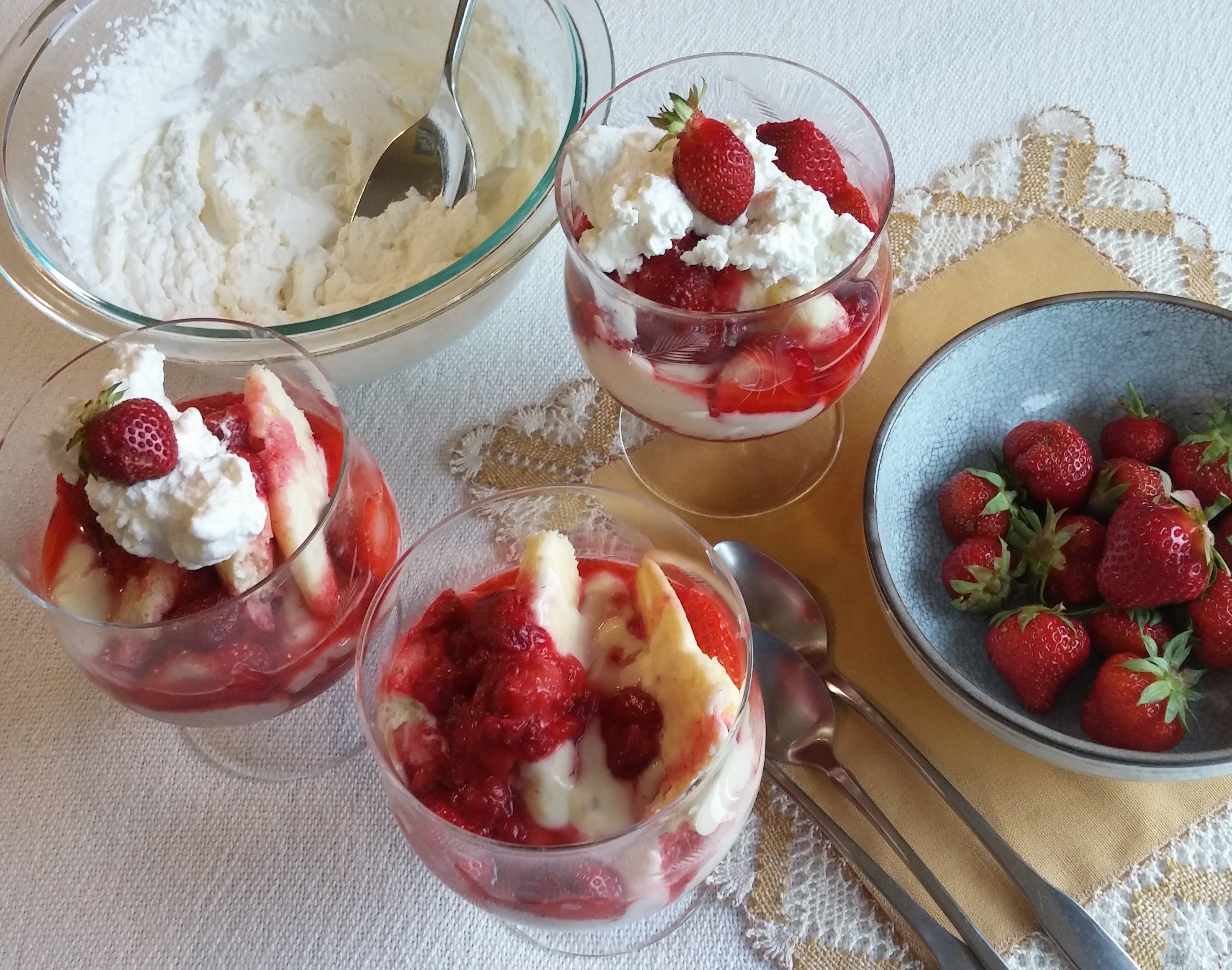
Strawberry Trifle with Sponge Cake Fingers

The first of the strawberries have been picked! They seem a little early to me, but in spite of some persistent cool weather there have also been some hot days where things have leapt forwards. It's exciting to see them but a little daunting to think about all the picking in my future, when the weeding is so far behind. 

Really, though, this recipe is about the sponge cake fingers, aka lady's fingers. They are designed to be okay on my "better carb" diet, and incidentally they can be gluten free as well. I may fiddle with the recipe in the future; they were not more exciting than lady's fingers usually are which is to say a bit dry and bland. Mostly useful for soaking in sherry and syrup and covering with custard, fruit and whipped cream. Actually, they would also be nice dunked in tea or sherry to moisten them. 

They also came out flatter than ideal, but they plainly need no more in the way of starch, and the texture was still light and fluffy enough. I may try baking them as a thin cake then cutting them afterwards. I took the leftovers and re-baked them in the oven at 200°F for 40ish minutes, and that made them quite dry and crisp. I suspect just baked as directed they have a shelf-life of a few days but re-baked crisp that they would keep for some time. 

While I would describe the sponge cake fingers as surprisingly quick and easy to make, this whole thing is really best suited to a special occasion - Canada Day coming up in the near future, although strawberry season is a special occasion in itself as far as I'm concerned.
 
6 servings
45 minutes - 30 minutes prep time to make the sponge fingers
15 minutes prep time to make the custard 
15 minutes prep time to assemble the trifle
 
 
Strawberry Trifle with Sponge Cake Fingers
 
Make the Sponge Cake Fingers:
 
In Bowl #1:
1/4 cup arrowroot starch
1/4 cup potato starch
2 tablespoons coconut flour

Sift these together into a small bowl.  

Line a large baking tray with parchment and preheat the oven to 350°F.
 
In Bowl #2:
3 large egg whites
1/4 teaspoon cream of tartar
2 tablespoons sugar OR sweetener OR combo 

Beat with an electric mixer until the egg whites will form stiff peaks.
 
In Bowl #3:
3 large egg yolks
the finely grated zest of 1/2 small lemon
1 tablespoon lemon juice
1 teaspoon vanilla extract
2 tablespoons sugar OR sweetener OR combo 

Measure all the ingredients into a mixing bowl. Beat with the electric mixer for 5 minutes until the mixture has thickened and become a much lighter yellow in colour. It is not necessary to wash the beaters after beating the egg whites.

Fold half the dry ingredients gently into the egg yolk mixture, then fold in half the beaten egg whites. Repeat with the remaining dry ingredients and egg whites. Gently spoon the mixture out onto the parchment, in fingers with a bit of room to spread. You should get 12 of them at about 1/4 cup batter per finger.

Bake them at 350°F for 10 minutes, then rotate the pans and bake for a further 10 minutes. Let them cool for 10 minutes in the pan before removing them to a rack to finish cooling. These can and should be made a day or 2 in advance.
 
Make the Custard:
2 tablespoons arrowroot starch
4 tablespoons sugar OR sweetener OR combo
a pinch of salt
2 large eggs
1 1/2 cups whole milk OR light cream
1 tablespoon unsalted butter
1 teaspoon vanilla extract 

Mix the arrowroot, sugar/sweetener, and salt in the top of a double boiler. Whisk in the eggs one at a time. 

Turn the heat on under the double boiler and bring it slowly up to a simmer. As it heats, whisk in the milk or cream a little at a time until it is all in. Continue whisking the mixture regularly as it heats, then more frequently as it begins to thicken. Towards the end you must whisk it constantly until it thickens. Remove it from the double boiler at once, then whisk in the butter and vanilla. Let it cool, whisking occasionally to prevent it from forming a skin on top. 

This should be done enough in advance to be cool, and can be done up to a day ahead and kept refrigerated if you wish. 
 
Finish the Trifle:
3 cups fresh ripe strawberries
1 tablespoon sugar OR sweetener OR combo
1 cup organic whipping cream
1 tablespoon sugar OR sweetener OR combo
a little sherry OR rum, optional

Set aside a nice selection of the best-looking berries for garnishes; about 1/2 cup of them. Wash and trim the remainder, and mash them with a tablespoon of sugar or sweetener.

Beat the whipping cream with an electric mixer with the remaining tablespoon of sugar or sweetener, until stiff. 
 
Put a puddle of the mashed strawberries in the bottom of each individual serving dish. Break a sponge finger into 2 or 3 pieces and set them in it, on their sides. Spoon a little custard around them on every side then spoon more mashed strawberries over them. A little sherry or rum can be drizzled in at some point during the assembly. Or, this could of course be done in one large serving dish. Something in clear glass so you can see the layers is traditional.

Finish each trifle with a dollop of the whipped cream and a few washed, stemmed strawberries for garnish.


Last year around now I was making Chinese Cucumber & Radish Salad, and Creamed Spinach Filled Buns.

Monday, 6 June 2022

Turkish Stewed Peas

Well, I'm going to confess; I made this in the winter with frozen peas and saved it for now. In a funny sort of way there are lots of things that can be made in the winter but late spring and early summer are difficult. I'm also a little ahead of things here; the peas are starting to form but are not yet ready to pick. Soon, though! And I think things are a tad later than usual this year. 
 
Snow peas will be ready before shell peas, and they would work well in this recipe. I do see snow peas used in Turkish cooking regularly, so there's that. It's hard to come up with recipes for snow peas that are better than steaming them and serving with a dab of butter, but this is lovely and would make a nice change.
 
Serve this with rice or pita; it will also go well with any kind of simply grilled fish, chicken or meat. It would also be delicious with poached eggs. 
 
2 to 4 servings
30 minutes prep time 
NOT including shelling the peas
 
Turkish Stewed Peas
 
1 medium onion
1/4 to 1/3 orange or yellow bell pepper
1 clove of garlic 
2 tablespoons olive oil
1 bay leaf
salt & freshly ground black pepper to taste
1/2 teaspoon rubbed mint
1 teaspoon sweet paprika
1/4 teaspoon Aleppo pepper (or to taste)
1 1/2 cups crushed tomatoes
2 cups shelled peas

Peel and finely dice the onion. Wash, trim, and dice the pepper into pieces just a little larger than the peas. Peel and mince the garlic. 

Heat the oil in a large skillet over medium heat, and add the onion, pepper, and bay leaf. Cook gently for about 5 minutes until softened and reduced in volume. 

Add the minced garlic and remaining seasonings and mix in well. Let it cook for a minute, then mix in the crushed tomatoes. Simmer for a further 5 to 10 minutes until thickened.

Add the peas and be sure they are all down in the liquid. Simmer for 6 to 8 minutes, until the peas are tender. (If using frozen peas, note that 4 minutes will likely be enough, and the same goes for snow peas.) 

Serve at once. 


Last year at this time I made Circassian Chicken.

Wednesday, 1 June 2022

Hariyali Chicken Kebabs

These were so yummy! We had no trouble (do we ever?) eating them all ourselves, with rice and peas on the side. If you were serving other Indian dishes with them, though, they would go further. Also they would go further if you are not the complete piggies that we are. You could cut the recipe in half but I suspect you could easily keep half in the fridge for cooking the next day. 

I liked the touch of red pepper, but it's not particularly traditional. Next time I might broil the peppers a bit before threading them on the skewers; they stayed pretty crisp even when the chicken was cooked.
 
2 to 4 servings
20 minutes to prepare chicken and marinade
2 to 24 hours to marinate
15 minutes to cook
 
Hariyali Chicken Kebab
 
4 to 6 cloves (1 head) garlic
2" piece of ginger
1/2 teaspoon cumin seed
1/2 teaspoon turmeric
1/2 teaspoon cinnamon
1/8 teaspoon ground cloves
1 teaspoon sweet paprika
1/4 to 1 teaspoon hot red chile powder
1/2 teaspoon salt
3/4 cup coarsely chopped cilantro
1/4 cup coarsely chopped mint leaves
2 tablespoons very thick yogurt
the juice of 1/2 large lemon
   OR 1 large lime
1 tablespoon mild vegetable oil
2 or 3 (600 grams; 1.5 pounds) skinless, boneless chicken breasts 
1/2 large red or orange bell pepper OPTIONAL

Peel and slice the garlic, and put it in the bowl of blender with the ginger, also peeled and sliced. Add the spices and salt. 

Wash and dry the cilantro and mint. Trim the stems off the cilantro, chop it coarsely, and add it. The mint leaves should be picked off the stems and the stems discarded, except for the tender tips. Add the yogurt and purée the mixture, stopping to scrape down the sides as needed. Scrape as much of it out as you can into the container in which you are going to marinate the chicken. 

Add the lemon juice to the blender and process to wash down the sides. Pour it into the rest of the marinade and add the oil. Mix well. 

Cut the chicken into bite sized pieces. Add them to the marinade and turn them to coat them in it. Cover and refrigerate for 2 hours to overnight. 

If using bamboo skewers, soak them for at least 30 minutes first; several hours is better so I try to remember to start soaking them as the chicken begins to marinate. Thread the chicken on the skewers, keeping as much marinade on them as possible. If you like, put bite-sized pieces of red or orange bell pepper in between each piece of chicken. Lay them on a broiler pan and spoon half the remaining marinade evenly over them.
 
Broil for 5 to 6 minutes per side (2 sides) until cooked through. When you turn them over, spoon the remaining marinade over them before broiling again. Serve at once with rice or naan, and the vegetable dishes of your choice. 


Last year at this time I made Pizza Crackers

Monday, 30 May 2022

Cucumber, Feta & Herb Salad

It's still greenhouse cukes, of course. We're only just planting ours today. Mint, parsley and cilantro are all up and useable by now, however. I didn't use any cilantro here, but you could. Other optional additions: a few chives and/or radishes now, melon or watermelon later in the season.
 
4 servings
20 minutes prep time
 
Cucumber, Feta & Herb Salad
 
Make the Dressing:
the juice of 1/2 lemon
3 tablespoons olive oil
a pinch of salt
freshly ground black pepper to taste
1/4 to 1/2 teaspoon Aleppo pepper
 
Mix all the ingredients in a small bowl or jam jar. 

Make the Salad:
2 or 3 small greenhouse cucumbers
100 grams (4 ounces) feta cheese
1/4 cup chopped fresh mint
1/4 cup chopped fresh parsley
2 or 3 tablespoons toasted pumpkin seeds (optional)
 
Wash, trim, and chop the cucumbers. Crumble the feta and mix it into them. Wash, dry, and chop the mint and parsley.  

Toss the salad with the dressing. This can be done up to an hour ahead to allow the flavours to blend, then sprinkle the salad with pumpkin seeds just before serving it. 


Last year at this time I made Potage Argenteil - Asparagus Soup.

Monday, 16 May 2022

German Cheese & Radish Salad

There are a lot of versions of this simple but substantial German salad; here's mine. You can eat it as-is, but I think it is most often eaten piled on a good sturdy slice of rye bread as it's almost as close to being a sandwich filling as it is to being a salad. I'd be happy to put it in a wrap with a leaf or 2 of lettuce and call it lunch, certainly. But one of my favourite things in the summer if I can round up a few eaters, is to have a salad buffet with a variety of salads, and this would make an excellent candidate for that. Also nice with a bowl of soup on the side.
 
4 servings
15 minutes prep time
 
German Cheese & Radish Salad
 
Make the Dressing:
1/2 teaspoon honey 
1 teaspoon Dijon mustard
1 tablespoon mayonnaise
2 teaspoons dill pickle brine OR apple cider vinegar
salt & freshly ground black pepper to taste

Mix the honey and mustard in a small jam jar or bowl. Mix in the mayonnaise, then the brine or vinegar. Season with salt and pepper, keeping in mind that other ingredients in this salad are salted - it's better to under-salt, and have to pass salt at the table than to overdo it here.
 
Make the Salad:
1 1/3 cups slivered radishes
2/3 cups slivered Gruyere, Emmentaler, Gouda or similar cheese
1 slice dill pickle
2 tablespoons minced chives OR green onion
3 tablespoons minced parsley
 
Wash, trim, and sliver the radishes. Cut the cheese into similar sized and shaped pieces. Dice the dill pickle fairly finely, and wash, dry, and mince the herbs. 
 
Mix everything together and toss with the dressing. Serve with buttered rye bread.


Last year at this time I made Baked Trout with Creamy Leek & Dill Sauce.

Wednesday, 20 October 2021

Golden Cauliflower

I love cauliflower, but it can be awfully pale and flabby looking. Just a little spice makes it look so much more appetizing and adds a lovely flavour.  (And nothing calls out for a little parsley over the top like cauliflower.) 

Four cups is an awful lot of cauliflower to have "left over", but it could absolutely be cooked in advance by a day or so, and re-cooked in the spices for about 5 minutes longer than called for in the recipe. In either case, it won't do the cauliflower any harm to get a bit browned in spots, in fact it's an improvement.
 
4 servings
20 minutes prep time

Cauliflower with Saffron

4 cups (1/2 a large) cauliflower florets
2 tablespoons sunflower OR olive oil
1/4 cup chicken OR vegetable broth
1/8 teaspoon salt
freshly ground black pepper to taste
1/8 teaspoon saffron threads
1/16 teaspoon sweet Hungarian paprika
1/16 teaspoon ground turmeric
2 tablespoons chopped parsley
 
Wash, trim, and cut the cauliflower into bite-sized florets. Put a pot of water on to boil for them, and boil them for 5 minutes then drain well. 
 
Meanwhile, mix all the remaining ingredients except the parsley in a small bowl, rubbing the saffron between your fingers as you put it in. Give it a stir until well combined. 
 
When the cauliflower is draining, heat the mixture in a skillet over medium-high heat. Add the drained cauliflower and cook for another 5 minutes or a bit longer, until the liquid is absorbed or evaporated and the cauliflower begins to brown slightly. Sprinkle it with the chopped parsley and serve at once.  


Friday, 15 October 2021

Macaroni & Blue Cheese

I went and bought some blue cheese on a whim (by which I mean it was on sale) and then I needed something to do with it. A look around the cupboards rounded up the usual suspects and a seasonal cauliflower, so macaroni and cheese it was. It's fairly different from the usual macaroni and cheese, but if you like blue cheese it's very good stuff. I'd have thrown some sautéed mushrooms in if I had had any mushrooms, but I didn't. You could. 

Also, I dare not refer to this as mac and cheese, as my mother screams with horror at the degeneracy of modern manners and morals every time she sees macaroni and cheese disrespected that way. It isn't even macaroni and cheese, really; I used rotini as it seems so hard to find good old elbow macaroni these days. Any small, stubby pasta will work just fine.
 
3 to 6 servings
1 hour 20 minutes - 30 minutes prep time
 

Cook the Macaroni & Cauliflower:
4 cups small cauliflower florets
225 grams to 250 grams (1/2 pound) macaroni or similar pasta
 
Wash, trim, and prepare the cauliflower. Put a large pot of salted water on to boil. Cook the pasta with the cauliflower for half the recommended time for the pasta; usually 5 or 6 minutes. (If for some reason the pasta cooking time is not 5 or 6 minutes, that's still how long to cook the cauliflower.) Drain well.

Make the Sauce:
200 grams (1/2 pound) cream cheese
3/4 cup milk
2 teaspoons barley or other flour
125 grams (1/4 pound) blue cheese
2 cloves of garlic
NO to 1/8 teaspoon salt
freshly ground black pepper to taste
1/4 to 1/2 teaspoon Aleppo pepper
 
Mix the milk slowly into the cream cheese to make a smooth sauce. Mix in the flour, then crumble the blue cheese and mix it in. Peel and mince the garlic and mix it into the sauce with the remaining seasonings. Salt will depend on how salty your particular blue cheese is.

Make the Topping & Finish:
1/3 cup finely grated Parmesan cheese
1/3 cup fine bread crumbs
2 tablespoons unsalted butter

Preheat the oven to 375°F. Lightly oil a shallow 2 quart baking dish (8" x 10" lasagne pan). 

Mix the Parmesan and the bread crumbs, and rub in the butter until they are evenly moistened. 

Mix the drained pasta and cauliflower into the sauce. Spread it all evenly into the prepared pan. Sprinkle the top evenly with the Parmesan bread crumbs. Bake for 40 to 45 minutes, until golden brown and bubbly at the edges. Let rest 5 minutes before serving. 


Last year at this time I made Koresh Karafs - Persian Celery Stew.

Wednesday, 29 September 2021

Hawawshi - Stuffed Pitas

Apparently this dish, which is sort of the Egyptian version of fast food hamburgers, was invented in the 1970s by a butcher named Hawawshi, who sold them in Cairo from a cart. 
 
It's a simple mixture of spiced meat with some vegetables, stuffed into pita bread halves (in Egypt they use a slightly thicker but similar bread called baladi; if you can get it you should use that) and baked or grilled until the meat is cooked. 
 
Many recipes call for wrapping the mixture in a homemade bread dough, but it's at least as common just to use pre-made bread. I was perfectly happy with whole wheat pitas. I've made these a couple of times, once right on the parchment and once on a rack to keep them out of the oil that exudes as they bake. It helped, but didn't make as much difference as I expected, so if you don't have one, don't worry. Some people call for cooking these in a panini grill. I haven't tried that, but I plan to. Also, you can fill these and freeze them for later. Thaw in the fridge before cooking. 
 
Keep the vegetables as dry and well-drained as you can to keep the hawawshis from getting soggy. Be sure when you are filling them to get the meat spread right to the edges, and in a thin, even layer. For this reason, cut and open all the pitas before you start filling - it will be hard to get them open properly otherwise.   
 
4 servings
50 minutes - 20 minutes prep time 

Hawawshi - Egyptian Meat-filled Pitas
 
1 small onion
1/4 large red or orange pepper
1 medium plum (paste) tomato
1 or 2 cloves of garlic
1/4 cup chopped parsley 
1/4 cup chopped cilantro
2 tablespoons fresh chopped mint OR 1 teaspoon rubbed dry mint
3/4 teaspoon salt
freshly ground black pepper to taste
1/4 teaspoon cumin seed
1/2 teaspoon coriander seed
1/8 teaspoon ground cinnamon
1/8 to 1/2 teaspoon Aleppo pepper (to taste)
400 grams (14 ounces) ground beef OR lamb OR blend
2 large OR 3 medium pita breads
a little olive oil 

Preheat the oven to 400°F. Line a baking tray with parchment paper. If you have a rack you can put over it, it's a good idea to keep the hawawshi off the paper.
 
Peel and chop the onion finely, and put it in a mixing bowl (along with everything else, up to the pita bread). Wash, trim, and chop the pepper finely. Chop the tomato finely, and salt it - set it aside to drain. It should be quite dry when added to the bowl. Wash and dry the herbs, and chop them finely. Grind the cumin and coriander seeds and add them with all the other herbs.

Add the beef or beef and lamb mixture, and mix well by hand.

Cut the pita in half and gently be sure they are completely open. Fill each half with a proportionate quantity of the filling, pressing it right up to the edges in a thin, even layer. Brush each filled half pita lightly with olive oil and lay it gently on the rack (or parchment paper, if you haven't got one). 

Once they are all filled and on the tray in a single layer, bake them for 15 minutes at 400°F. Turn them over and bake for a further 10 to 15 minutes, until crisp and browned. Let rest for 5 minutes before serving. 


Last year at this time I made Cauliflower Fritters.

Wednesday, 22 September 2021

Stewed Fish with Zucchini

I've made this three times in the last couple of weeks. The first time I had no intention of posting it - it was so plain and basic. But I enjoyed it a lot, and wanted to make it again, so I decided to make it and post it. Unfortunately, that effort turned out to be on one of the days we had a tornado warning, and while we did not have a tornado, it was so dark that I could not get a good picture. 

So here it is, the lucky third time. It's getting late enough that the zucchini are coming to an end, but hopefully there are still a few around. You can use whatever kind of white fish you like, really. I've been serving it over some drained whole grain ramen noodles and really enjoying the combination, but rice or quinoa would also be an excellent choice. I have been seasoning it very lightly - all the veggies are fresh from the garden and so good just as they are, and I don't want to overwhelm the fish. You could certainly season it up a bit, though, if you like. Italian seasonings? Curry powder? Something else?
 
2 servings
30 minutes - 20 minutes prep time
 
Stewed Fish with Zucchini
 
2 medium (225 grams; 1/2 pound) tomatoes 
2 medium (400 grams; scant pound) zucchini
1 small onion
1/2 red or orange pepper
2 cloves of garlic
2 tablespoons mild vegetable oil
1 bay leaf
salt & freshly ground black pepper to taste
2 fillets of whitefish OR 4 perch fillets (about 450 grams; 1 pound)
 
Put a small pot of water on to boil which will just cover the tomatoes. When it boils, add them and blanch for 1 minute. Transfer them to the sink and run cold water on them until cool. Peel them, chop them, and set them aside. 
 
Meanwhile, wash, trim, and dice the zucchini fairly finely. Peel and chop the onion. Wash, trim, and chop the pepper. Peel and mince the garlic. 
 
Heat the oil in a large skillet over medium-high heat. Add the zucchini, onion, and pepper, with the bay leaf, and cook until softened, reduced in volume, and lightly browned; between 5 and 10 minutes. Stir regularly. Season with salt and pepper.
 
Add the garlic and cook it in for a minute or two, then add the tomatoes. Mix in well. If the mixture seems too dry, add a few spoonfuls of water or tomato juice. 
 
Lay the fish fillets over the top of the vegetables and cover the pan with a tight-fitting lid. Reduce the heat if it seems to be bubbling a bit too madly. Cook for 7 to 9 minutes, until the fish is done. Serve with rice, noodles, or quinoa. 


Last year at this time I made Cream of Cauliflower Soup.

Monday, 20 September 2021

Mock Falafels - with Quinoa

Real falafels are not terribly difficult to make, but they do require the chick peas to be soaked in advance, and then they must be mixed in a food processor. All of which is very do-able! But sometimes you want something just a little simpler. Or maybe you are just out of chick peas, but have some quinoa, in which case you could make these instead. I don't think they are quite as good as the real thing, but somehow just cooking the quinoa in advance then mixing by hand makes them feel easier. They are still pretty darn good! Moreover, this is an excellent way to use up leftover cooked quinoa.

I do assume you have chick pea flour on hand; I use it for just about every kind of fritter and lots of other things too and could not get along without it. 

Unless and until you wrap these up in pita bread, they are gluten free. I haven't made these into a patty and eaten them in a bun yet, but I am very likely to. In that case I expect to get 6 patties.
 
The quinoa has some of the sandy texture of the soaked chick peas in the original falafel recipe but they are a little softer in texture. The flavour is really pretty close. 
 
I made these twice before posting; the first time they fell apart in the pan as I had not added enough chick pea flour. On my second go 'round, they were fine, but I found that, unlike the first time, I had to add a little water. This had less to do with the amount of chick pea flour, and more to do with differing moisture levels in the cooked quinoa. The second batch of quinoa sat a little longer, I think. In any case, you may or may not need to add some water at the end of mixing - it must be moist enough to form a ball when squeezed, but really no moister.
 
4 to 6 servings
45 minutes prep time - NOT including cooking the quinoa
 
Mock Falafels - with Quinoa

2 cups cooked quinoa
1/4 cup finely diced white OR green onion
1/4 cup finely chopped cilantro
1/4 cup finely chopped parsley
3/4 teaspoon salt
1 teaspoon cumin seed
1/4 to 1 teaspoon Aleppo pepper (to taste)
1 cup chick pea flour
none to 2 tablespoons water
oil to fry
 
To cook the quinoa: it is easiest to use leftover cooked quinoa, but to produce 2 cups cooked you will need approximately 3/4 cup of raw quinoa. To cook 3/4 cup quinoa, add 1/4 teaspoon salt and 1 1/4 cups water. Cook it in the rice cooker, or in a small pot on the stove over low heat (once boiling); it will take approximately 20 minutes and should be cooled to room temperature before you start the falafels. 

Peel or trim the onion and chop it finely. Wash and dry the cilantro and parsley and chop them finely. Put them in a mixing bowl with the prepared quinoa. Be sure the quinoa is broken down so each of the grains is separate, not stuck into large clumps. 

Grind the salt and cumin seed, and add them to the bowl with the Aleppo pepper and chick pea flour. Mix well. 

If the cooked quinoa is moist enough that the mixture can be squeezed together to form a ball, do not add any water, but mix by hand until you have stiff, not very crumbly dough. If it is too dry for this, add a little water, a spoonful at a time, until you are able to get it to hold together, but do not add enough to make it moist and soft - it should be quite stiff. 

Divide the dough into 16 equal portions and roll each portion into a ball. 

Heat the oil in a heavy skillet or aebleskiver (or appam) pan over medium heat. If you are using the latter, a teaspoon or so in each compartment will be sufficient; otherwise add enough to shallow-fry the falafels. Cook over medium heat until browned and crisp, turning to cook evenly all over. They will need 2 or 3 minutes per side; if they are browning too fast reduce the heat. Set them on paper towel as they are cooked. 

Serve warm or at room temperature, with salad or wrapped in pita (with some salad). If you like, serve with one or both of the following sauces. 

Tahini Sauce:
1/4 cup tahini
the juice of 1 small lemon
a little water

Mix the tahini with a little of the lemon juice until smooth; continue adding and mixing until all the juice is in. Slowly add a little water and continue mixing until the sauce is the texture of mayonnaise. 

Chile-Garlic Mayonnaise:
chile-garlic sauce
mayonnaise

Put as much chile-garlic sauce as you think is likely to be eaten in a small bowl. Add about an equal amount of mayonnaise or a bit less, and mix. If you think it needs more mayonnaise add more to achieve the balance you like. 


Last year at this time I made Beet Salad with Red Onions & Parsley.

Monday, 13 September 2021

Beet & Feta Empanadas

You must cook the beets for this in advance; I think it's easiest to do it a day ahead. Then you can make the filling right away, or the next day when ready to proceed - whichever is most convenient. As usual with this sort of advance cooking, they could be left over from another meal. If you no longer have the beet greens, of if they weren't that great to start with, they can be replaced with Swiss chard, which is, after all, only another kind of beet green.
 
The resulting empanadas are light but substantial enough to carry the meal. We ate them with some vegetables sticks and dip, and there were enough for two lunches. I made 6 empanadas but next time would probably make 8 - we found that 1 was not quite enough, but 2 would have been too many, so split 1 at each meal. 

And delightful as these were, I must spare a moment to rave about last years dish - Coconut Macaroon Peach Crisp! I should make it again while I can still find peaches, because it was quite amazing.
 
6 to 8 empanadas - 4 servings
20 minutes to make the filling, NOT including cooking the beets
1 hour 30 minutes - 40 minutes prep time to form & bake the empanadas
 
Beet & Feta Empanadas
 
Make the Filling:
1 cup (2 medium) finely diced cooked beets
1 small onion
2 or 3 cloves of garlic
2 cups finely chopped beet greens OR Swiss chard
1 tablespoon mild vegetable oil
1/8 teaspoon salt
1/2 teaspoon cumin seed
1 teaspoon rubbed oregano
freshly ground black pepper to taste
150 grams (5 ounces) feta cheese
 
Roast (wrapped in foil) or boil the beets until tender; about 45 minutes to an hour. Allow to cool at least enough to handle, but this can be done up to a day ahead. 
 
Peel and chop the onion fairly finely. Peel and mince the garlic. Wash, trim, and chop the beet greens. 
 
Heat the oil in a medium skillet over medium heat. Cook the onions until softened and slightly browned; about 10 minutes. Stir regularly. Add the garlic and seasonings and cook for another minute or so, then add the beet greens and cook them just until wilted down. Transfer to a mixing bowl or coverable dish and allow to cool at least enough to handle, but again, this can be done up to a day ahead.
 
Make the Pastry:
2 1/3 cups whole spelt flour 
1/2 teaspoon salt
1/4 cup cold unsalted butter
1/4 cup buttermilk
1/4 cup mild vegetable oil
1 medium egg
extra flour to roll out
1 medium egg
2 tablespoons cream
 
Put the flour and salt into a mixing bowl and blend. Grate in the butter. Measure the buttermilk and oil, and whisk one of the eggs into them. Mix into the flour to form a dough, but do not overmix. Cover it and let it rest for 15 or 20 minutes. 

Divide the dough into 6 or 8 equal pieces. Dust each one with flour and roll them out on a pastry board or piece of parchment paper to form a thin circle 7"-8" in diameter. 

Preheat the oven to 400°F. Line a large baking pan with parchment paper. 

As the circles of dough are rolled out, place 1/6 or 1/8 of the filling on one half of it, leaving space clear around the edge to fold and seal the empanada. Spread it out to reasonably flat and evenly distributed. Fold over the clear half of the dough, and press sealed around the edges. Fold the edges in, pinching them closed. Transfer the finished empanada to the prepared pan. Continue with the remaining ingredients. Poke all the empanadas with a fork to allow the steam to escape.

Mix the cream into the remaining egg. Brush the empanadas with this mixture. Bake for 25 to 30 minutes until golden brown. Allow the empanadas to cool to room temperature before serving.


Last year at this time I made Coconut Macaroon Peach Crisp

Monday, 6 September 2021

Zucchini Stuffed with Ratatouille & Feta

It's not zucchini season without some stuffed zucchini! It's not zucchini season without some ratatouille... so this, I suppose, was deliciously inevitable. 

This is a little more fiddly than just making ratatouille, but not by too much. Mostly it's blanching the zucchini. I've taken to doing this whenever I stuff zucchini, because it makes them cook so much better. They are easier to carve out, too.
 
You could use leftover ratatouille for this, making it a little different from the first time around, and a more elegant presentation than leftovers usually get.

If I had been on the ball (I was not on the ball; what else is new?) I would have put some parboiled potatoes coated in oil in the empty spaces in my pan and roasted them with the zucchini. Next time! We had these with steamed brown rice and hot tomato sauce poured over them. 

I'm assuming people will eat both halves of a zucchini, but this would also make an attractive appetizer course in a multi-course meal in which case one half per person would be plenty.
 
3 to 4 servings
2 hours - 1 hour 15 minutes prep time
 
Zucchini Stuffed with Ratatouille & Feta
 
Blanch the Vegetables:
3 large (500 grams; 1 pound EACH) zucchini
OR 4 medium (300 grams; 10 ounces EACH ) zucchini
2 or 3 medium tomatoes 

Put a large pot of water on to boil. Wash the zucchini and cut them in half from stem end to blossom end. Cut around each half zucchini about 1/2" from the side, at an angle, to allow the flesh to be loosened and scraped out leaving a 1/2" shell. At this point, it's to allow the water to penetrate and cook them evenly. 
 
When the water boils, add the prepared zucchini halves to it and boil them for 6 minutes. Lift them out and immediately drain them well and rinse them in cold water to stop them from cooking any further. 
 
Blanch the tomatoes in the boiling water for 1 to 2 minutes, until the skins crack. Rinse them in cold water until they can be handled, then peel them and discard the skins. 

Make the Ratatouille:
1 medium onion
1 small yellow or red pepper
1 medium (300 grams; 10 ounce) eggplant
2 or 3 cloves of garlic
2 tablespoons olive oil
1/4 teaspoon salt
freshly ground black pepper to taste
1 teaspoon rubbed basil OR 1 tablespoon finely minced fresh basil
1 teaspoon rubbed oregano
225 grams (1/2 pound) feta cheese
1/3 cup fine bread crumbs
1/3 cup grated Parmesan 
2 cups hot tomato sauce (optional)

Peel and chop the onion. Wash, de-seed, and chop the pepper. Wash and trim the eggplant, and cut it into bite-sized chunks. Peel and mince the garlic. 

Heat one tablespoon of the oil in a large skillet over medium-high heat. Cook the onion and pepper until softened, stirring regularly, then add the eggplant. Drizzle over the remaining oil, mix well, and cook for about 10 or 15 minutes until the eggplant is quite soft and slightly browned in spots. Mix in the garlic and cook for a minute more.

Meanwhile, scrape out the centres from the zucchini, leaving the 1/2" shell. Chop the scraped out flesh. Chop the peeled tomatoes. Add them both to the eggplant, etc, and mix in well. Cook for a further 20 minutes to half an hour, until the mixture is moist but not watery. Stir regularly to prevent sticking. 

When the ratatouille is close to ready, preheat the oven to 375°F. Lightly oil a shallow baking pan that will hold the prepared zucchini shells snugly in a single layer. 

Crumble the feta cheese and mix it into the ratatouille. Divide it equally amongst the prepared zucchini halves. Bake for 30 minutes at 375°F
 
Increase the heat to 400°F.  Mix the bread crumbs with the Parmesan and sprinkle it evenly over the top of the stuffed zucchini. Return them to the oven and bake for a further 10 to 15 minutes, until well browned. Serve with hot tomato sauce, if liked.


Last year at this time I made Acelgas Guisadas - Spanish Stewed Swiss Chard.

Wednesday, 1 September 2021

Cauliflower & Bacon Salad

Found this one in an old cook book. As usual, I forgot to note which one, but it dated to 1916. I added some parsley because it needed something more. It's still a very simple salad and much depends on the quality of the ingredients, especially the bacon - be sure to get a good one. It does not need to be too lean because the fat will form part of the dressing, but it shouldn't be too fatty either. 
 
I've written this up on the assumption that you would make it from scratch, but in fact this is probably best as a use for leftover cooked cauliflower. Scale the other ingredients to match the quantity you have; but I suspect that if you are not terribly precise it doesn't matter much. 
 
4 to 6 servings
20 minutes prep time
 
Cauliflower & Bacon Salad

4 cups cauliflower florets
1/3 cup finely minced chives
1/3 cup finely minced parsley
225 grams (1/2 pound) bacon
1 teaspoon Dijon mustard
salt & freshly ground black pepper to taste
3 tablespoons apple cider vinegar
 
Wash and trim the cauliflower, and break it into smallish bite-sized florets. Wash and dry the chives and parsley, and mince them finely. Chop the bacon.
 
Boil or steam the cauliflower until just tender; about 6 minutes. Drain well. 
 
Just before the water for the cauliflower comes to the boil, put the bacon in skillet sufficiently large for it, and cook it over medium heat until crisp. If there is too much fat - you want about 3 tablespoons worth - drain some off. Have the mustard, salt and pepper, and vinegar whisked together in a small bowl, and add them to the bacon as soon as you turn the heat off. Mix well, but be careful - it will spit and sputter quite a lot.

Pour this dressing over the very well drained cauliflower and mix well. Mix in the chives and parsley, and allow it all to cool to room temperature. Serve at room temperature.

Monday, 30 August 2021

Confetti Potato Salad

Here's a nice straightforward potato salad, but the addition of lots of other vegetables makes it prettier and more interesting than most. And dilutes those potatoes; not the best thing for me to eat.
 
I made this for a picnic, and it was lovely to dish it out of a cooler in the trunk of the car, and then sit and admire a lovely lake view while we ate. 

6 to 8 servings 
45 minutes prep time

Confetti Potato Salad

Make the Dressing:
1/2 cup mayonnaise (light is fine)
2 tablespoons Dijon mustard
1/4 teaspoon salt
freshly ground black pepper to taste
the juice of 1 large lemon

Put the mayonnaise in a small mixing bowl or jam jar. Mix in the mustard, salt, and pepper. Slowly mix in the lemon juice, keeping the texture of the dressing smooth and free of lumps. 

Make the Salad:
900 grams (2 pounds) potatoes
3 cups diced green beans
1 cup (2 medium stalks) celery
1 cup (1 medium) diced or grated carrot
1/2 cup diced red, orange, or yellow pepper
1/2 cup diced onion
1/4 cup minced parsley

Put the potatoes in a pot with water to cover them well, and boil for 20 minutes, or until just tender when pierced with a fork. Drain and cool completely. Peel them, cut them into dice, and put them in a mixing bowl. 

While the potatoes cook, wash, trim, and cut the beans into dice. Add them to the potatoes when they have about 6 minutes to cook; they should be drained, rinsed, and added to the mixing bowl with the potatoes. 

Wash, trim, and dice the celery. Peel and dice or grate the carrot. Trim, de-seed, and dice the pepper. Peel and dice the onion. Wash, dry, and mince the parsley. Add these all to the salad. Toss with the dressing and keep chilled until serving time. 


Last year at this time I made Batter Pizza with Squash Blossoms.

Friday, 20 August 2021

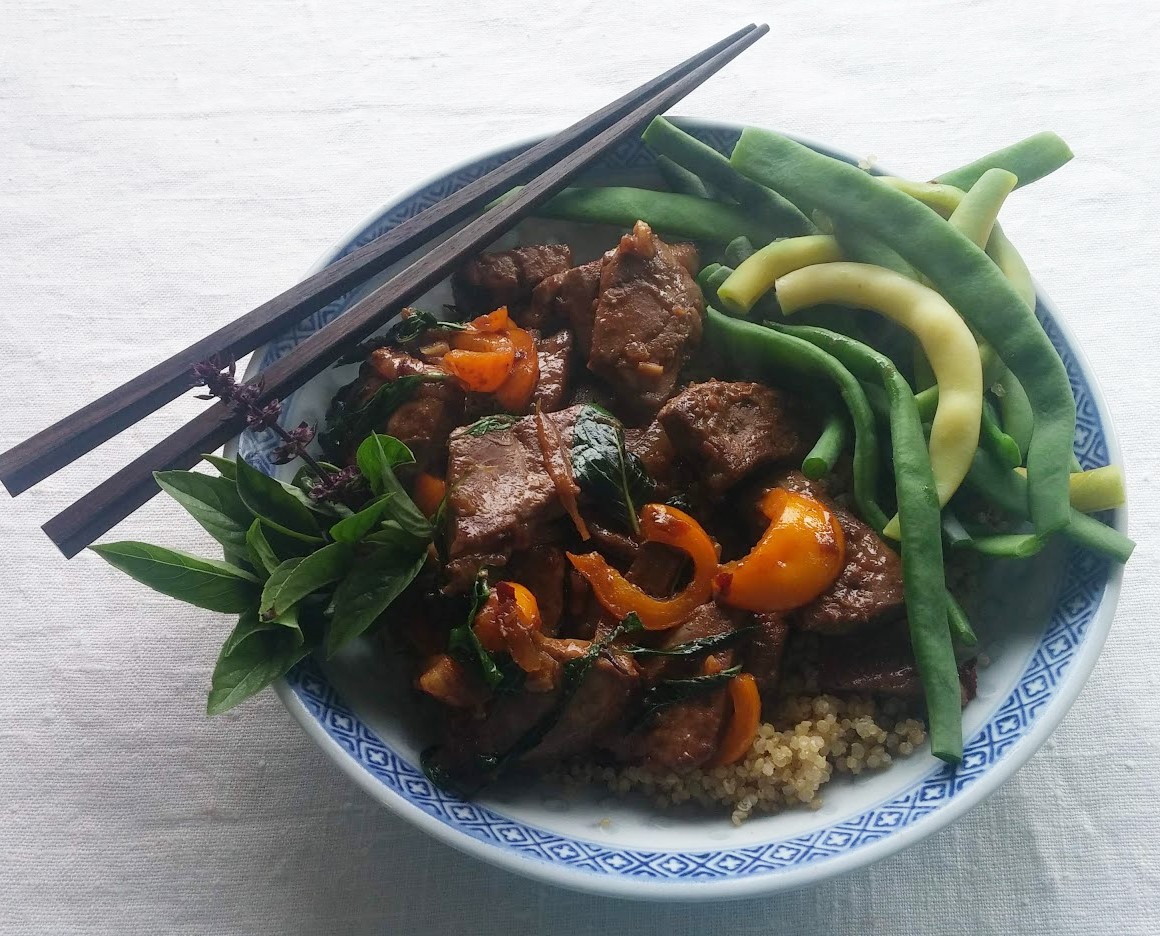
Thai Basil Stir-Fried Liver

Yes, I made Mr Ferdzy a chop. 
 
I used beef liver for this, but I tend to think lamb liver is the best liver, and I see no reason why chicken livers would not work well. I tend to avoid pork liver; it is just too intense. But if you like it, you could use it. 
 
Liver is, of course, used regularly in Thai cooking; it's just fairly unlikely to show up in North American restaurants given the lack of popularity of liver in these parts. I think the strong fragrant flavour of Thai basil goes with it extremely well. Liver in general stands up well to the kind of strong flavours in this dish, being a strong flavour itself.  

This is a pretty simple and straightforward stir-fry; as usual with stir-fries, make sure all your ingredients are prepared and ready to go before you start cooking
 
2 servings
40 minutes prep time

Prepare the Sauce:
1 tablespoon fish sauce
1 tablespoon soy sauce
1 tablespoon oyster sauce
the juice of 1/2 lime
a pinch of sugar (optional)

Mix these in a small bowl and set them aside.

Finish the Dish:

300 grams (10 ounces) beef or lamb liver
4 shallots
1 small sweet orange or red pepper 
1 cup loosely packed Thai basil leaves
3 cloves of garlic
1 or 2 small hot chiles OR dried red chile flakes to taste
2 tablespoons mild vegetable oil

Cut the liver into bite-sized pieces, discarding any tough or stringy bits. Put it in a small bowl and set it aside.

Peel and sliver the shallots. Core, de-seed, and sliver the sweet pepper. Strip the basil leaves from the stems, discarding the stems. Peel and mince the garlic, with the hot chile if you are using a fresh one.

Heat the oil in a large skillet over medium-high heat. Add the garlic and chile (or chile flakes), and let sizzle for a minute or two until the garlic just darkens a little. Add the liver, shallots, and pepper at once. Cook, stirring regularly, until the liver and vegetables are cooked - not more than 3 or 4 minutes. Add the sauce a minute or two into the cooking process; it will be absorbed and disappear about the time the meat is done.

Stir the basil leaves into the pan and turn off the heat. Keep stirring just until they are well wilted and distributed throughout, then serve at once.


Last year at this time I made Yogurt Baked Bulgur & Vegetables

Wednesday, 18 August 2021

Vegetable Whole Spelt Soda Bread

It's taken me 3 years to post this; I kept thinking I was close, but for there being too many too wet vegetables in it. Finally I have cut them down to the exact number to have a loaf bursting with them but not soggy in the middle. I still say drain that zucchini as well as you can. If you can't squeeze it well enough in your hands, press it in the strainer until it's quite dry. 

This loaf is delightful with butter and cheese; ham or chicken would be good. Maybe tomatoes and mayonnaise. Or just plain, as far as that goes. 

It won't keep very well, and although I rarely put bread in the refrigerator, this one went in. It did last for 3 days, and the vegetables kept it fresher tasting than most soda breads after that amount of time.
 
8 to 12 servings
1 hour 30 minutes - 30 minutes prep time

Vegetable Whole Spelt Soda Bread
 
1 1/2 cups drained grated zucchini - see instructions
1 1/2 cups grated carrot
1/4 cup finely minced chives or green onions
2 tablespoons finely minced parsley3 1/4 cups whole spelt flour
3 teaspoons baking powder
1 teaspoon salt
freshly ground black pepper to taste (lots!)
2 large eggs
1 cup buttermilk
 
Wash, trim, and grate the zucchini - you should start with about 2 cups of it. Put it in a strainer in layers sprinkled generously with salt, and allow it to drain for 15 minutes. Rinse thoroughly, squeeze it dry in handfuls, loosen, and re-measure. It's okay to be a little short; better than to be over.

Meanwhile, peel and grate the carrots. Wash, dry, trim, and chop the chives and parsley. Put all the prepared vegetables into a mixing bowl. 

Preheat the oven to 350°F. Line a 9" x 5" loaf pan with parchment paper, or butter and flour it. 

Measure the flour and mix in the baking powder, salt, and pepper (and some other dried herbs if you like). Mix well, then mix into the vegetables until they are evenly coated. Break up any lumps of the zucchini, in particular. 

Break in the eggs, add the buttermilk, and mix briefly but well. Scrape the dough into the prepared pan and smooth it out evenly. Bake for 1 hour to 1 hour and 10 minutes, until it tests done with a toothpick. Let cool for at least 15 or 20 minutes before cutting; to room temperature is better. 


Last year at this time I made Yogurt Baked Bulgur & Vegetables

Wednesday, 11 August 2021

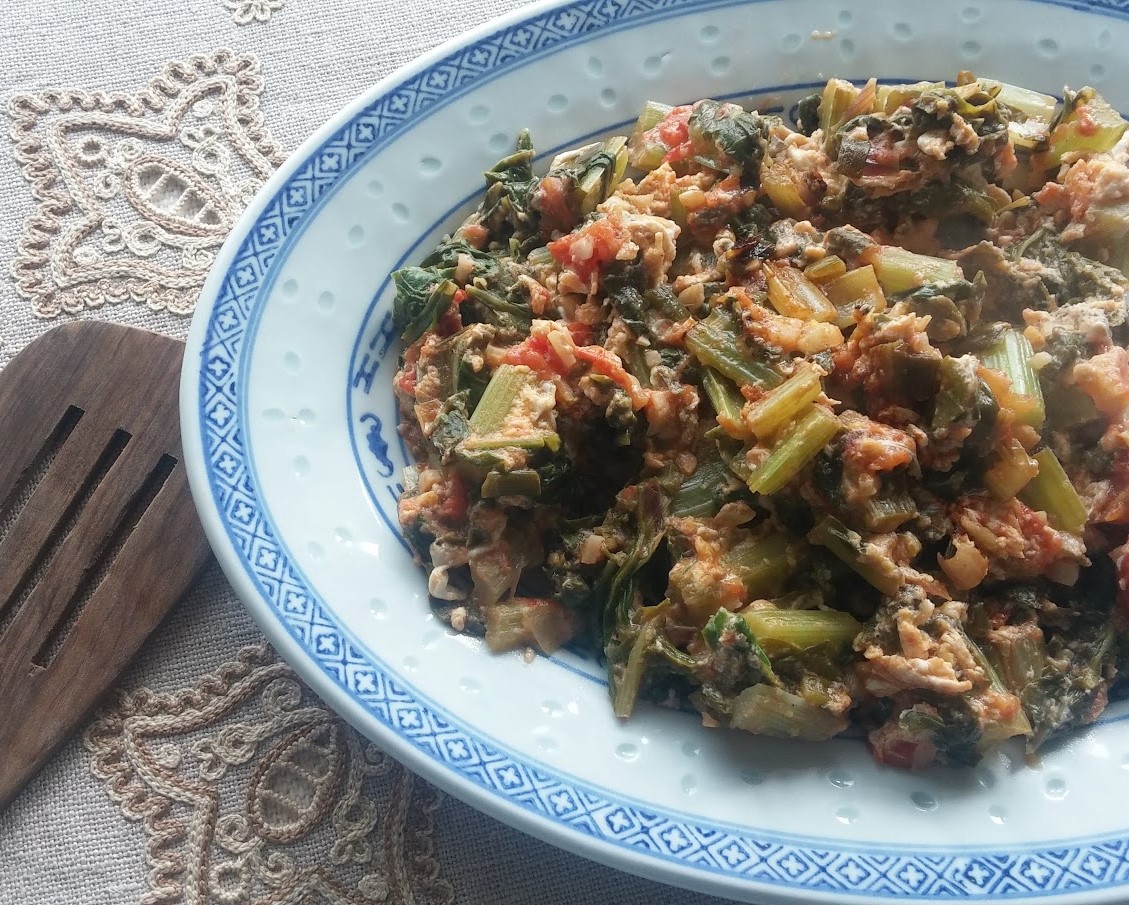
Acelgas con Huevo - Swiss Chard Spanish Style

I tend to think of dishes with eggs in them as main dishes, but this is more of a side dish. There are a number of Mediterranean vegetable dishes that include egg, but are not intended as the centrepiece of the meal. It really isn't any stranger than having a side dish with cheese or bacon in it, so I need to get over it. 
 
That said, I do not see why you could not throw in a couple of extra eggs, serve this with good crusty bread, and call it dinner.  Or as it is, pile the leftovers (should you be so fortunate as to have any) on said bread, serve it in small portions, and call it tapas.
 
True Spanish style calls for more oil than I actually used; and do use the higher quantity if you are adding more eggs. You could speed this up - not that it isn't already quite speedy for an apparently fairly elaborate dish - by cooking the Swiss chard in advance. (You know; leftovers. Or at least planovers.)
 
2 to 6 servings 
20 minutes prep time
 
Acelgas con Huevo - Swiss Chard Spanish Style
 
500 grams (1 pound) Swiss chard
1 large tomato
1 small fresh onion with greens, 
 OR 2 green onions
2 cloves of garlic
1 to 2 tablespoons olive oil
2 tablespoons red wine vinegar
1 large egg
 
Put a pot of water on to cook the Swiss chard. Wash and trim it. Chop the stems into bite-sized pieces, and the leaves a little more coarsely. 

Blanche the tomato in the boiling water for 1 minute, then cook the chard in it, stems and leaves, for 2 to 3 minutes. Rinse both in cold water. Peel and chop the tomato, and set it aside. Drain the chard well. 

Wash, trim, and chop the onions. Peel and mince the garlic. 

Heat the oil in a medium-large skillet over medium-high heat. Cook the onion for a minute or two, until well wilted. Add the garlic and cook for just another minute. Stir throughout. 

Add the tomato and mix it in well, then reduce the heat. Let the mixture simmer for 5 or 6 minutes, stirring occasionally, until the tomato has released all its liquid and cooked back down to just moist. Add the vinegar and mix it in well, and cook for a minute or 2 more, until the raw vinegar odour has dissipated. Add the Swiss chard, mix it in well, and cook, stirring occasionally, until it is done to your liking. 

Meanwhile, break and whisk the egg. Add it to the pan, and mix it in so it scrambles in small pieces. As soon as it is just set, remove the Swiss chard, etc, to a serving dish. 

Serve at once; or this is also very good at room temperature.


Last year at this time I made Fish & Summer Vegetable Chowder. 

Monday, 9 August 2021

Ham & Cheese Stuffed Zucchini

I love stuffed vegetables in general, but there is something particularly appealing about stuffed zucchini. It's not just that they taste good, it's that they are absolutely the perfect shape and size (usually) for stuffing. Ham and cheese is so classic, and they work so well here with tender, mild zucchini. 

Tatume are the squash I mostly use to stuff these days, but any kind will do. As for the breadcrumbs, use whatever (slightly stale) bread you like. I tend to use a heavy German rye bread and be a bit skimpier with it than I'm calling for, but I presume most people will use something a bit lighter and fluffier.
 
4 to 8 servings

1 hour 10 minutes - 30 minutes prep time

Ham & Cheese Stuffed Zucchini


4 short, fat zucchini of 200 grams (1/2 pound) each
1/2 cup finely diced red, orange, or yellow pepper
2 to 3 shallots
1 tablespoon mild vegetable oil
1 teaspoon rubbed savory
salt & freshly ground black pepper to taste
150 grams (5 ounces) grated Cheddar or Parmesan mix
2 cups finely diced stale bread cubes, crusts trimmed
150 grams (5 ounces) cooked ham, finely diced
2 tablespoons mayonnaise
2 teaspoons Dijon mustard
2 large eggs

Put a large steamer on to boil. Wash the zucchini, and slice off the blossom scar. Cut them in halves lengthwise, and when the water boils, put them into it, cut sides up, and steam them for 10 minutes. Use tongs to transfer them to an oiled shallow baking dish that will hold them snugly in a single layer.

Preheat the oven to 375°F. 

Meanwhile, wash, trim, and finely dice the pepper. Peel and finely chop the shallots. Cook them in a small skillet over medium-high heat until softened and reduced; season them with the savory, salt, and pepper. Keep in mind how salty the cheese and ham will be and don't use too much salt; the pepper can be applied more heavily. When done, remove these to a mixing bowl to cool.

Grate the cheese. Add about half of it to the mixing bowl, along with the bread, trimmed of any particularly hard or brown crusts and diced. Trim any fat or gristle from the ham, dice it finely, and add to the bowl. Mix well.

When the zucchini are steamed and removed to the baking pan, take a sharpish spoon and scoop out the centres to within half an inch of the shells. Let them cool enough to handle, then chop the centres finely, removing and discarding any seeds which have started to form. Squeeze out any excess liquid from them, and add them to the bowl. Add the mayonnaise and mustard, then break in the eggs. Mix well, and let the mixture sit for 5 minutes before using to stuff the zucchini shells.

Bake the stuffed zucchini for 20 minutes. Sprinkle the remaining cheese over them, then return to the oven and bake for a further 20 minutes. Let them rest for 5 minutes before serving them. 


Last year at this time I made Feta & Goat Cheese Dip.

Monday, 2 August 2021

Unsweetened Cucumber Relish

Since this is a canned for storage recipe, it won't surprise you to hear that I made it last summer, and have been eating it through the winter and up to now. I'm very pleased with how this has come out! 

Sweet relishes are no longer a good idea for me, so I came up with one that has some good, zingy flavours but no sugar. For my first bite, I have to admit I was disappointed. It looked like a classic sweet relish, after all. But pretty quickly I was judging it on its own merits, and once I adjusted, I thought it was really delicious. I put it in my tuna salad (see below!) but it is also excellent on hot dogs or other sausages, or hamburgers, or wherever you think some relish ought to go. 

The cucumbers don't need peeling as long as they are young and reasonably tender, and if they were not I would not go to all this work. I modeled this somewhat on my Bread & Butter Pickle recipe, and I suspect you could slice the cucumbers for pickles instead of relish if you preferred. I would also try it with zucchini (which have worked successfully for the Bread & Butter Pickles) but you should do a couple cups extra as they shrink down more when drained.
 
7 x 500 ml
1 hour to prepare plus 3 hours to drain 
about 1 hour to can


Unsweetened Cucumber Relish

Start the Relish:
16 cups finely diced pickling cucumbers
3 cups peeled and finely diced onions
1 cup finely diced red OR orange pepper
1/3 cup pickling salt

Wash, trim, and chop the cucumbers. Peel and dice the onions. Wash, cored and de-seed the peppers, and dice them. Layer them in a large strainer with the salt, and place in a cool spot to drain for 3 hours.

Finish the Relish:

1/4 cup peeled and minced fresh ginger
2 large heads of garlic
2 tablespoons mustard seed
1 tablespoon coriander seed
2 teaspoons ground turmeric
1 teaspoon red chile flakes
2 1/2 cups white vinegar
1 1/4 cup water

Put the jars on to boil, in a canner with water to cover them by at least an inch.
 
Peel and mince the ginger. Peel and mince the garlic. Mix them with the remaining ingredients in a canning kettle. 
 
When the water in the canner (with the jars) begins to steam, bring the spices to a boil. Boil for 2 minutes, then add all the vegetables. Bring them up to a boil, stirring regularly. 
 
Drain the jars, half into the canner and half into the sink. Place them on a heat-proof board and ladle the relish into them. Wipe the rims of the jars with a bit of paper towel dipped in the boiling water, and seal them with lids and rings which have been boiled for 1 minute (according to manufacturers instructions). 

Return the sealed jars to the canner. Boil them for 10 minutes. Allow them to cool, then test the seals and label them. Keep in a cool, dark spot for up to a year; refrigerate once open. 


Last year at this time I made Zucchini Tuna Melts.

Wednesday, 28 July 2021

Roasted Beet & Halloumi Salad

First beets out of the garden! So sweet and tasty and tender when roasted. They shrunk a bit more than I expected but perhaps they are higher in their moisture content now than they would be later in the season.

As so often is the case we ate it all as our meal, but as a side salad it would go further, and unlike a lot of salads with cheese I think it would do well in that role. Note that the only added salt is a pinch in the dressing, because the salad will be plenty salty from the halloumi. I dithered a bit about putting the honey in the dressing, but I have to say it was well worth the sugar. Truly delicious.
 
2 to 6 servings
1 hour 15 minutes - 30 minutes prep time 

Roasted Beet & Halloumi Salad

Roast the Beets & Halloumi:
600 grams (1 1/2 pounds; 6 medium) beets
3 tablespoons olive oil
250 grams (1/2 pound) halloumi cheese
 
Preheat the oven to 400°F. Peel the beets and cut them in bite-sized wedges or thick slices. Put them in a shallow roasting pan that will hold them snugly in a single layer, and toss them with the oil. Roast for 40 minutes. 

Cut the halloumi into bite-sized thick slices. When the beets have roasted for 40 minutes, give them a stir and scatter the halloumi over them. Roast for a further 15 to 20 minutes, until the cheese is soft and browned.

Make the Dressing:
3 or 4 cloves of garlic
1/8 teaspoon salt
1/2 teaspoon rubbed oregano
freshly ground black pepper to taste
3 tablespoon olive oil
3 tablespoons lemon juice
1 teaspoon honey
1/4 cup finely chopped parsley
1 more tablespoon lemon juice
 
Put the garlic, salt, oregano, and pepper into a small food processor bowl and process until finely chopped. Add the oil, a little at a time, processing well between each addition. Add the lemon juice slowly the same way, then add the honey. 
 
Have the parsley washed and finely chopped, then add it to the dressing and process again, until finely minced.
 
When the beets and halloumi come out of the oven, pour this dressing over them. Scrape it out well, use the last tablespoon of lemon juice to swish out the bowl of the food processor, then pour it over the beets and cheese as well. 
 
Mix the dressing gently into the beets and cheese, and let them cool for about 10 minutes.  
 
Finish the Salad:
4 to 6 cups chopped lettuce
   OR mixed salad greens 

Wash and dry the lettuce or greens, and arrange them in a serving salad bowl or individual salad bowls. Arrange the roasted beets and halloumi over them, drizzling with all the dressing and accumulated pan juices. Serve at once. 


Last year at this time I made Raspberry Vinegar Chicken