Showing posts with label Advance prep. Show all posts

Friday, 27 December 2019

Pumpkin Seed & Bean Purée with Roasted Lamb Chops & Oil-Poached Garlic

I've always been a bit dismayed by recipes that combined 2 types of protein; beans and meat. I was raised in the era of nutritionists assuring everyone that while we need protein, too much is not good. Furthermore, I spent my early adulthood seriously lacking in money. Serving multiple types of protein at once not only seemed a bit profligate, but was generally beyond my means.

Now that I'm trying to eat more protein and fewer carbs I have to re-think this whole attitude. I'm trying to keep my meat consumption at about what it was before, since when it comes to meat, the too much is not good idea still holds a fair bit of water. Essentially that means upping my bean consumption.

Long story short, here's some lamb chops on a bean purée. Very good too, if a bit fancy for everyday. However, as usual, nothing difficult and lots that can be done in advance. The bean purée is essentially a hummus, and if you don't serve it all, the leftovers can be treated as such, and served with chips or crudités. I'm likely to make it again for just that purpose. The garlic and garlic oil too, will have other uses, which is good, since you will only use about 1/4 of them in this recipe. The oil, if put in a very clean jar should last well, but I would try to use the garlic up within a week or so. Keep refrigerated.

4 servings
to make Oil-Poached Garlic - 1 hour - 20 minutes prep time
to make Pumpkin Seed & Bean Purée - 15 minutes prep time,
    not including cooking beans or toasting pumpkin seeds
to roast the lamb chops - 25 minutes - 5 minutes prep time


Make the Oil Poached Garlic: 
3 to 4 heads of garlic
1 cup mild vegetable oil

Peel the garlic and trim the root ends off. Put them in the top of double boiler with the oil. Bring the double boiler up to a boil, then reduce the heat slightly so that it is boiling at a slow but steady clip. Cook the garlic for 45to 50 minutes, until soft but not mushy. The oil can show small streams of bubbles, but should not be hotter than that. Check that the water level does not drop too low.

Strain the garlic from the oil, and put each in suitable separate storage containers, as you will have a fair bit of each left over. 

Make the Pumpkin Seed & Bean Purée:
1 1/2 cups pumpkin seeds, toasted
4 to 6 oil-poached cloves of garlic
2 to 3 cloves raw garlic
1 teaspoon sweet Hungarian paprika
freshly ground black pepper to taste
3 tablespoons garlic-flavoured oil (from poaching)
the juice of 1 large lemon
2 cups cooked white beans (1 cup raw)
salt if required

Toast the pumpkin seeds in a dry skillet until lightly browned if they are not already roasted and salted, and let them cool on a plate.

Put the pumpkin seeds, cooked and raw garlic, paprika, pepper, and oil into a food processor and process until very finely chopped; puréed is what you are aiming for but I don't think you are going to achieve it quite yet. Stop and scrape the sides down several times. When the mixture is very fine, add the lemon juice and process some more.

When the lemon juice is in well and you cannot see any flecks of pumpkin seed, begin adding the white beans and blend thoroughly. Taste and adjust the seasonings.

I used this right away and it was good, but we both agreed that the leftovers were better, so if you can make this from several hours to the day before, that will be good.

Roast the Lamb Chops:
8 (900 grams; 2 pounds) lamb chops
salt & freshly ground black pepper to taste

Preheat the oven to 400°F. Have your skillet or grill in the oven to pre-heat too. If using a roasting pan, put a little water in the bottom of it to prevent the drippings from smoking.

The lamb chops should be removed from the fridge to come to room temperature before cooking them.Season the chops on both sides with the salt and pepper. Place the chops in the pre-heated cast iron skillet or roasting pan, on their edges with the fatty sides down. Cover loosely with foil. Roast for 12 to 15 minutes. Remove the foil from the chops and continue roasting for another 5 to 7 minutes. Let sit in the pan for another 5 or 6 minutes to rest.

The beans should be heated while the lamb is in the oven; grease a shallow pan into which they will fit, and put it in the oven while the lamb cooks. The exact time will vary according to the depth of the pan and the temperature of the beans to start with. My beans were just warm and spread fairly shallow, and were hot within 10 minutes. Otherwise, they may take longer. It wouldn't hurt to cover them with foil too, and they will need a good stir once they come out as they will crust over a little.

Serve Up:
Put a good dollop (1/4) of the warm bean purée on each plate. Top with 2 of the cooked lamb chops. Slice or mince a clove of the poached garlic over each plate to garnish. Serve at once.  

Wednesday, 25 July 2018

Zucchini Soup to follow Turkish Stuffed Zucchini

When I made Turkish Style Stuffed Zucchini (and tomatoes), the recipe made no use of the centres taken out of the zucchini and tomatoes. So rather than waste them, I saved them and made this soup. You could also make it with new, unused zucchini and tomatoes if you didn't want to make the stuffed vegetables. If you had a bit of rice left over from eating the stuffed vegetables, you could add it and make this a more substantial soup. As it is, this would serve four as a starter, or two with just a roll or small sandwich to make a meal.

With the zucchini and tomatoes already chopped and ready to go, this went together very quickly. It was quite delicious, and I suspect I will indeed make it again without making the stuffed vegetables first.

2 to 4 servings
30 to 40 minutes prep time

Zucchini Soup with Turkish Flavours

3 cups finely diced or grated zucchini (1 medium)
1 small onion
1 medium carrot
2 cloves of garlic
2 tablespoons finely minced basil
1 tablespoon finely minced mint
2 tablespoons olive oil
1 tablespoon flour
salt & freshly ground black pepper to taste
1/4 teaspoon, or to taste, Aleppo pepper
1 cup diced raw tomato (1 large)
2 cups broth (saved from cooking stuffed veg)
1 tablespoon wine vinegar
a bit of yogurt or sour cream if desired

Chop the zucchini up a bit more if it needs it (or dice or grate it if you are starting with a whole one). Peel and chop the onion. Peel and grate the carrot. Peel and mince the garlic. Wash and finely mince the basil and mint. (If you are starting with a whole tomato, you should dice it now too.)

Heat the oil in a heavy-bottomed soup pot. Add the carrots, onions, and zucchini, and cook, stirring regularly, for about 5 to 10 minutes, until the vegetables are softened and reduced in volume, and the zucchini is looking a little browned in spots. Add the garlic, basil, and mint, and mix in well. Sprinkle the flour over the vegetables and add the seasonings. Mix in well and let cook for another minute or two, stirring frequently.

Make sure your tomato is chopped up fairly finely, then add it to the vegetables. Cook for another 5 minutes or so, again stirring frequently. Add the broth and wine vinegar, and continue to cook for another 5 to 10 minutes, stirring frequently.

Serve with a dollop of yogurt or sour cream, if you like.


Last year at this time I made Corn, Zucchini, & Barley Salad with Feta & Herbs.

Friday, 22 June 2018

Haskap Barbecue Sauce on Chicken

Yeah, I know I just did a fruity barbecue sauce. So now I have done another one. And yes, there are definite points of resemblance. Still, there are a fair few points of difference as well, and put on chicken thighs this was a quite different dish.

I will probably try this with some other berries. Blueberries or raspberries strike me as a good idea, although I might use a heavy hand with raspberries and then strain the sauce to get the seeds out. I made this with fresh haskaps but I can see no reason not to make it with frozen ones, which means you could make it all year, providing you freeze your haskaps now.

3 or 4 servings
20 minutes to make sauce
45 minutes to an hour to cook chicken

Haskap Barbecue Sauce on Chicken

Make the Sauce:
1 medium onion OR 4 large shallots
1 tablespoon mild vegetable oil
1 cup fresh or frozen haskaps
1/4 cup maple syrup
1/4 cup apple cider vinegar
2 tablespoons ketchup
1 1/2 teaspoons ground ginger
1/8 teaspoon ground cloves
1/2 teaspoon salt
freshly ground black pepper to taste

Peel the onion or shallots and chop it finely. Heat the oil in a heavy-bottomed saucepan, and cook the onions gently for about 5 minutes, stirring regularly, until very lightly browned.

Meanwhile, wash and pick over the haskaps. Add them to the onions with the maple syrup, vinegar, ketchup, and spices. Simmer for a further 10 minutes until the haskaps have completely broken down and the sauce has thickened. Stir frequently.

Use at once or transfer to a storage container, cool, cover, and keep refrigerated until needed,

Bake the Chicken:
4 to 8 chicken thighs

Preheat the oven to 375°F. Arrange the chicken thighs in a reasonably snug fitting baking dish. Brush them generously with the sauce. You can also put some under the skin if you like. Bake for 45 minutes to 1 hour, until the chicken is done.

Friday, 29 July 2016

Cold Zucchini Stuffed with Cheese and Seeds

There are lots and lots of versions of hot stuffed zucchini, but sometimes you want a cold, salad-y stuffed zucchini. Like these ones!  I was very pleased with how these turned out, and they disappeared quickly.

Serve them as an appetizer, or as part of a collection of salads for a main course.

The cottage cheese, by the way, was the ordinary soupy kind, not the kind that comes in a pressed block. Try to get a brand that is not too soupy. Also you can use pumpkin and sunflower seeds that are roasted and salted, or not. If they are salted though, be cautious about adding more.

8 to 12 servings
20 minutes to cook the zucchini 
20 minutes prep time, not including cooking the zucchini

Cold Stuffed Zucchini

Cook the Zucchini & Soak the Tomatoes:
4 to 6 medium-small zucchini
1 teaspoon salt
1/3 cup dried tomatoes

Fill a large pot with water. Make sure you can fit the zucchini in with room for them to move. You may need to do them in 2 batches.

Bring the water to a boil, add the salt, and slip in the zucchini. Boil them for 10 minutes then lift them out and rinse them in cold water until they are cool. Drain well.

While they cook, ladle out a little of the boiling water and use it to soak the dried tomatoes until they are softened. Drain them well too.

Make the Stuffing & Fill the Zucchini:
1 cup cottage cheese
1/2 cup sunflower seeds
1/2 cup pumpkin seeds
6 to 12 large basil leaves
3 or 4 sprigs of dill leaves
3 or 4 sprigs of parsley
1 green onion, cleaned, trimmed and roughly chopped
1 or 2 cloves of garlic, peeled and trimmed
1/2 teaspoon salt
freshly ground black pepper to taste

Put all the stuffing ingredients including the drained soaked dried tomatoes into the bowl of the food processor. (Wash and dry the herbs first, clean and trim and cut  up the onion, and peel the garlic.) Process until well blended but still with a fair bit of texture.

Cut each zucchini carefully in half lengthwise. Use a grapefruit spoon or other rather sharp edged spoon to scoop out the insides to within about 1/4" of the edges. Save the interior flesh for some other use. Fill the zucchini with the stuffing and set them on their serving platter.


Last year at this time I made Salmon or Salmon Trout with Raspberry Sauce

Monday, 22 February 2016

Cream of Tomato Soup

If you made Canned Tomato Sauce last summer, you already have the soup base you need to make cream of tomato soup in about 10 minutes. I guess that's twice as long as it takes to open and heat a can, but I am full of ambition. (*snork, snork*) 

Only I bet you didn't make canned tomato sauce last summer, in which case you will need to make it now. I left out the vinegar/sugar, since it's not being canned, and added a little celery and bay leaf. Pretty close, though. And yeah, we ate it with grilled cheese. Why not?

By crushed tomatoes I mean tomatoes, canned. They should be fairly liquid, if you are buying them. (I've seen cans of crushed tomatoes that are more like sauce. Canned whole or chopped tomatoes would work fine too; just chop them up a bit before you start simmering if you are using whole ones.)

4 to 6 servings
1 hour to make the base - 15 minutes prep time
15 minutes prep time to make the soup


Make the Base:
1 medium onion
3 or 4 cloves of garlic
1 medium sweet red pepper
1 medium carrot
a stalk of celery
OR a slice of peeled celeriac, chopped
1 tablespoon mild vegetable oil
4 cups crushed tomatoes
1 bay leaf (optional)

Peel and chop the onion coarsely. Peel and slice the garlic cloves in half. Core and chop the pepper coarsely. Peel and slice the carrot. Peel and chop the celeriac slice, if using, or wash, trim, and chop the celery.

Heat the oil in a large skillet over medium-high heat, and cook the vegetables in it for several minutes, until softened and slightly browned in spots. Add the tomatoes and bay leaf, stir well, and simmer for 30 to 40 minutes until the carrot slices are tender. Add a little water if it seems like too much liquid is evaporating.

Let the soup base cool a little, remove the bay leaf, then purée it thoroughly in a food processor or blender. Keep in the fridge until ready to make soup; the base should keep for at least a week if kept in a clean, well-sealed container.You should get about 4 cups of base.

Make the Soup:
1 tablespoon unsalted butter
4 teaspoons (1 1/3 tablespoons) flour
1/2 teaspoon salt
1 cup milk or light cream
2 cups prepared soup base
freshly ground black pepper to taste

Cook the butter, flour, and salt together over medium heat in a large, heavy-bottomed pot. Slowly stir in the milk or cream a little at a time, mixing really well to keep a smooth, lump-free paste. Once all the milk is in, let the cream sauce (that's what this is) thicken for a minute or two; stir regularly. Then add the soup base, season with pepper, and stir to blend it thoroughly. Let the soup heat though, stirring regularly, but don't let it simmer.


Last year at this time I made Eggs in Purgatory.

Monday, 1 February 2016

Beer-Can Roast Duck

It's duck week here at Seasonal Ontario Foods!

Just before the holidays I was able to purchase a mix of poultry from nearby Cirrus Hill Farm. I got a duck, 2 roasting chickens, 2 Guinea fowl, and a turkey. The turkey is gone, eaten at Christmas, but the rest should make an appearance as the winter progresses. Here's the duck. Not sure what kind exactly, but unless you have a muscovy duck, they should all cook similarly.

This one was fairly small, at about 3 1/2 pounds, but I expect to get three meals and an appetizer out of it for the two of us. Admittedly, one of those meals will be soup, but there will also be a generous amount of duck fat, very suitable for delectable frying; of potatoes in particular.  


The first meal is plain roasted duck; the breasts then carved off and served, and the rest set aside for later in the week. Since the skin is such an important component of a duck, I roasted on an upright roasting frame. The customary frame to use is, of course, an actual beer can, but I am dubious about the safety of the plastic films and dyes used in the labels. You can buy a roasting frame quite reasonably, and it will be well worth the money if you roast any amount or kind of fowl regularly. 

Here the bird has been dried, rubbed with salt, mounted on the frame, wing tips clipped off, and the wings tied to the bird with a bit of kitchen twine. The broth and reserved juices from the duck are about to be poured  into the pan, then it will be covered loosely in foil and into the oven it will go.


2 servings of roast breast meat
PLUS materials for other dishes
2 1/2 hours prep and cook time, plus overnight to dry off

a 1.5 to 2 kilo (3 1/2 to 4 1/2 pound) duck,
   including neck and giblets
1 cup unsalted chicken stock or water
2 tablespoons apple cider vinegar
1 teaspoon salt

If your duck is frozen, then it will need to go into the fridge, set on something to catch any leaks, and thaw slowly for 2 days.

The night before you wish to cook your duck, remove it from its packaging, draining it well as you lift it out. Carefully reserve any juices that were with it, though; mixing them with the chicken stock or water and the vinegar. Keep that covered in the fridge. Keep the neck and giblets wrapped and cold as well. Pat the duck dry with a paper towel, then leave it to air-dry on a plate overnight in the fridge.

Check that your duck and its pan will fit into the oven. You will likely need to remove at least one rack, and keep the remainder very low in the oven.

Preheat the oven to 350°F. Rub the duck with the salt, then sit it on the roasting frame, making sure it is stable and will not tip. Clip off the tips of the wings at the first joint. Reserve them with the neck piece. Tie the wings to the duck with a piece of kitchen twine. Place the frame with the duck into a deep little roasting pan; it should hold at least a quart to a quart and a half (or litres, ditto); pour the broth and duck juices half into the dish of the roasting frame and half into the larger casserole.

Cover the duck loosely with aluminum foil. You will need to seam together 2 pieces in order to get it to cover the whole bird. This is not for the benefit of the bird, but to keep your oven from being covered with a fine mist of baked-on duck fat once this is all over. If the foil is loose the duck will crisp up nicely, so do be sure to keep it loose. A little hole in the top to vent steam is a good idea.

Roast the duck for 1 hour to 1 hour and 15 minutes, according to the size of the duck. Remove the foil (but keep it), and increase the heat to 425°F. (If you wish to make and serve the Chopped Duck Liver before this meal, start it now.) Leave the duck to roast for 20 to 30 minutes more, until browned nicely to your liking.

Remove the duck from the oven, and cover it loosely with the foil again. Let it rest for 10 to 15 minutes before you carve it. I found the easiest way was to tip the contents of the dish of the roasting frame into the larger roasting pan while holding it with good sharp forks at stem and stern, then transporting it thus sideways to a carving plate. Be prepared that you will need to pull out the roasting rack by hand, padded with a clean (soon to be not-clean) rag. Carve off the breasts and serve them with whatever else you have planned; after dinner will be soon enough to start the prep for the next set of dishes.

Friday, 27 November 2015

"Sauer" Curtido

I did say I was going to try this. Attempt now underway!

I don't know why last time I made Sauerkraut I got 12 cups of vegetables into a litre jar, and this time I only got 8 to 9 cups. And yes, a litre jar is approximately 4 cups, so that is still some serious packing.) I made Sauerkraut in red and green as well as the curtido, and it was all pretty consistant.

You'll note that unlike when I made traditional short-fermentation Curtido, I did not add any fresh hot peppers. Firstly, they are no longer in season, and secondly, they got hot enough after a week in the fresh Curtido that I was a bit nervous about what would happen after 6 weeks. I'll add an update to this post once I know how this turned out...

1 packed litre - 16 servings?
1 hour prep time - plus 6 weeks fermenting time

Fermented Curtido with Sauerkraut in the background

Make the Curtido:
6 cups finely shredded white (green) cabbage
2 cups carrot, peeled and grated
1 cup sliced onion
1 teaspoon pickling salt
1 tablespoon rubbed oregano
1/2 to 1 teaspoon hot paprika or cayenne flakes

Put the number of litre canning jars you intend to fill into a canner and cover them with an inch of water. Bring them to a boil and boil for 10 minutes. 

Meanwhile, wash and trim the cabbage, and finely shred it. Measure it and put it in a large mixing bowl. Peel, grate, measure, and add the carrot. Peel the onion, and slice it in half from pole to pole. Cut each half 2 or 3 times again from top to bottom, as each half lies flat side down on the cutting board. Then, cut into thin slices the other way. Add these onion shreds to the bowl of veggies.

Add the salt, oregano, and paprika or cayenne to the vegetables. Using your very clean hands, massage the vegetables together until the seasonings are very evenly distributed throughout, and the vegetables feel limp and are giving up a little juice. When the jar is sterilized, drain it well and pack the vegetables into it, using a wooden or stone tamper to pack it all in. A funnel (dropped into the boiling water for a few minutes before use) may be useful. There should be about an inch and a half headroom at the top of the jar once it is all in.

Add the Brine & Seal:
1 cup filtered water
1 teaspoon salt

Put a lid and rim on to boil. They can be used, if they are in good condition.

Put the water and salt into a pot and heat until the salt dissolves. The water can be warm, but should not be very hot. Ladle this brine over the vegetables now packed in the jar. Once it is all in wipe the rim carefully and put the lid on, making good contact with the jar but not tightening it too much. Put it in a cool spot on a pile of newspaper to ferment for up to 6 weeks.

Check every few days. If the jars overflow and the vegetables become exposed to the air, top up with a little more brine made as above. Change the newspaper as well!

Once the curtido is fermented, keep it in a cool spot, and once you open a jar keep it in the fridge.


Last year at this time I made Sautéed Brussels Sprouts with Mashed Parsnips.

Monday, 12 October 2015

Cooked Oatmeal Waffles

I suppose this is something of a series at this point; things to do with leftover oatmeal. Muffins, cake and scones were my previous efforts; now that I have a good working waffle iron I guess these waffles were bound to be next. 

These were very fine, with a nice smooth soft texture and well-rounded flavour. We froze the leftovers, and they toasted beautifully.

12 waffles
1 hour prep time, not including cooking the oatmeal


2 cups cooked oatmeal
1/4 cup mild vegetable oil OR melted butter
2 large eggs
1 1/2 cups soft unbleached or whole wheat flour
2 teaspoons baking powder
1/2 teaspoon salt
1 cup buttermilk, thinned yogurt, or milk
mild vegetable oil to grease waffle iron

Put your waffle iron on to heat. Put the cold cooked oatmeal into a medium mixing bowl, and mash it thoroughly with your mixing spoon. When it is pretty much lump-free, mix in the oil or butter, and the eggs, one at a time.

Measure out the flour and mix the baking powder and salt into it.  Measure the buttermilk as well, and mix the flour and buttermilk alternately into the oatmeal mixture until everything is blended; do not overmix. The mixture should be a thick but flowing batter; depending on how thick your oatmeal was, you may need to adjust the flour or buttermilk quantities slightly.

Brush the hot waffle iron with oil, and spoon in enough batter to fill it, spreading it evenly to all corners. Close the iron and cook for 7 to 8 minutes, or until the waffle is golden brown and easily removed from the waffle iron. They can be kept hot in the oven until the are all done; or let them cool, freeze them, and reheat them in a toaster.


Last year at this time I made Chai-Spiced Roast Squash.

Friday, 19 December 2014

Making Buckwheat Noodles

Or, as they are often known, soba noodles, since they are pretty much a Japanese delicacy. Or are they? I discovered an Italian dish made with buckwheat noodles a little while ago; who knew? Well, besides the Italians, of course. Since I had bought a bag of buckwheat flour on a whim a little while ago, it seemed noodles were in my future.

Most recipes, European or Asian, call for a ratio of 4 parts buckwheat flour to 1 part wheat flour. I tried making a gluten-free version, and it worked well enough but it was definitely harder to work with than the version with wheat. Still, it was fine; just don't expect to cut it into long thin strands, but something shorter and more rustic. The wheat version was much easier to roll out, and I liked the finished product better too, but then I can eat wheat without trouble if I am careful.

I am calling for specific amounts of water, but they are starting amounts. One thing that was clear when I was researching recipes is that the amount of water required will vary, perhaps quite a bit, depending on what flour you have. Seasonal fluctuations in rain affect the absorbtive qualities of flour, as does the milling, and how much hull is left in the flour. The important thing is to add water until you have a smooth, easily pliable but not sticky dough. Also, I suspect a finely milled flour will yield better results than a coarsely ground flour.


4 servings per recipe
Allow at the very least an hour; it's the kind of job you pick away at
Also, best made in advance


Gluten Free Noodles:
2 cups buckwheat flour, plus a little more
2 tablespoons tapioca starch
1 cup boiling water, perhaps a little more

Regular Buckwheat Noodles:
1 2/3 cups buckwheat flour, plus a little more
1/3 cup soft unbleached OR all-purpose wheat flour
3/4 cup water

In either case, put the flours into a small mixing bowl, and stir in the water. Once it is mostly mixed with the spoon, I found it easiest to turn it out onto a clean counter or board, and knead it a bit. You will most likely need to add a bit more water, spoonful by spoonful, to achieve the right texture. If you overdo it, or if your dough is sticky from the start, add flour in the same way. The resulting dough, as noted, should be smooth and easily pliable, but not sticky.

Be careful if you are making the gluten-free noodles; the boiling water will cool off rapidly once it is in the flour, but not so rapidly that you could not burn yourself by starting to knead it too soon.

Once the dough has been mixed and kneaded, leave it for 20 minutes to an hour before rolling it out. Keep it covered with a damp cloth, or wrapped in parchment paper or plastic.

I find it easiest to roll out on a sheet of parchment paper; a well floured board would do. Roll it quite thin. I then trimmed off the rough edges to make neat rectangles, and cut the edges into short rustic noodles. Cut the dough into noodles of the size and shape you like; in either case shorter noodles (up to 6" long) will be easiest to deal with. Lightly flour the sheets of dough before stacking them to cut noodles, so they don't stick to each other. Letting the rolled out dough sit for a little while before cutting will also help.  Once cut, the noodles should be left to dry out a little more.


Once made, the noodles should be cooked in plenty of boiling water. Whether you add salt or not is up to you. The Japanese traditionally don't add salt, but they also usually would be serving them with soy sauce or other very salty soy products, I would think.

The cooking time will depend on how thinly the noodles are rolled; mine took 6 to 7 minutes, but I would start testing them as soon as 4 minutes if you have manage to get them very thin, or expect to leave them as long as 10 to 12 minutes if they are very thick. 

I served my first batch with my favourite Ginger-Peanut Sauce. That was actually half a batch of noodles, to a full batch of peanut sauce, and that was a bit too much sauce. One batch of sauce should do one batch of noodles. These were the gluten free noodles, and I cooked them with some cabbage, carrots and leeks, drained them, then returned them to the pot with the sauce until it was well mixed in.

I use that sauce mostly on vegetables, and I found that on noodles I wanted to add a bit more soy sauce to sharpen it up. I also left out the allspice and green peppercorns, and added a couple of cloves of minced garlic and some toasted sesame oil instead.


Last year at this time I made Caramel Popcorn.

Wednesday, 4 June 2014

Asparagus, Bacon, & Avocado Pasta Salad with Tangy Avocado Dressing

We do love a good meal-in-a-salad, and this was a great one. Our garden is still churning out frightening amounts of lettuce, and the asparagus is still going strong. Avocados, I admit, are not local, but they go so very well with the other ingredients. On that note, I also have to say that I think lemon juice would have been better than the apple cider vinegar, but the vinegar was what we had. It was certainly just fine!

It's a good idea to cut both avocados at once, and choose the softer one for the salad dressing.

This is a much more vegetably salad than most pasta salads, although not quite so much as the photo makes it appear - I sprinkled the asparagus over the top before I tossed it into the salad, but for some reason all the lettuce seemed to end up on top too. It does tend to float, I guess, so dig deep into the bowl when you are serving it up.

4 to 6 servings
45 minutes prep time - 30 minutes of which may be done in advance


Advance Preparation:
250 grams (1/2 pound) stubby pasta
250 grams (1/2 pound) fresh asparagus
250 grams (1/2 pound) lean bacon


Bring a large pot of salted water to a boil and boil the pasta until tender. Meanwhile, wash, trim, and chop the asparagus into bite-sized pieces. Add them to the pasta when it has about 5 minutes more to cook. Drain them both and rinse them in cold water to cool. Drain well.

Cut the bacon into bite-sized pieces, and cook them until crisp in a skillet over medium heat. Drain well.

The pasta, asparagus and bacon can be cooked up to a day ahead, and kept, covered, in the refrigerator until  you are ready to proceed.  

Make the Salad:
1 small head butterhead (aka Boston or Bibb) lettuce
1 large tomato
1 large ripe avocado

Wash the lettuce well, and chop it fairly finely. Wash the tomato and chop it finely. Cut the avocado in  half, and discard the pit. Cut each half through the flesh to the skin, with horizontal and vertical cuts, then use a large, fairly sharp-edged spoon to remove the resulting bite-sized pieces from the skin. Add the avocado pieces to the lettuce and tomato in a large salad bowl.

Mix in the prepared pasta, asparagus, and bacon. 

Make the Dressing:
1 large ripe avocado
1/2 cup buttermilk
1/4 cup apple cider vinegar OR the juice of 1/2 lemon
1/4 teaspoon salt
freshly ground black pepper to taste

Cut the avocado in half, discarding the pit. Scoop out the flesh and and mash it thoroughly. Mix it in a small bowl with the buttermilk, apple cider or lemon juice, the salt, and the pepper.

Toss the salad with the salad dressing just before serving.


Last year at this time I made Asparagus Pesto and Rhubarb Meringue Trifle

Friday, 21 March 2014

Mock "Chicken" Stock - Vegetarian, Vegan Broth

Many years ago, when soup stocks didn't come in cartons, and vegetarian soup stocks didn't come at all, I needed to create a broth to use for soups for my vegetarian friends. Cookbooks at the time advised saving all your vegetable peelings, and cooking them in water for hours, just like soup bones.

It took me several attempts to figure out why these always tasted of nothing but overcooked vegetables.

Uh.

Yeah, I know. But they said you could, in actual printed cookbooks!

Anyway, I still needed a vegetarian soup stock, so I put on my thinking cap, and over the years this is where I have arrived, so far as mock chicken stock anyway. You know how I'm always going on about saving your shiitake mushroom stems? Yep, this is where they go.

I hope it's clear from my ingredient list that you need one celery type thing, one carrot type thing, and one parsnip or parsley type thing; it's just that the exact form can depend on the season and what you have on hand. Peelings and trimmings are thriftier, but sometimes you just need to make soup so whole veggies it has to be.

Even if you are not a vegetarian, this is a handy broth to be able to make because it is so much quicker than real chicken broth. Note that it should NOT be simmered for hours - 30 minute is about the maximum, and 20 minutes may be better depending on how hard it is simmering. But you don't want to take it into that overcooked vegetable territory, so taste it occasionally after the 15 minute mark.

I have not tried it but I don't see why this wouldn't freeze well.

The only drawback it has is that it does tend to separate, so you may wish to thicken it with a little starch, which should slow down the precipitation process. I tend to use it in recipes rather than straight up, which makes that less of a problem. I would have said this is not quite as good as real chicken stock, and if we are talking chicken stock you make yourself I'd still say that's the case. However, I would not hesitate to back it against some of the so-called chicken stocks that come out of cartons.

Make about 4 cups (1 quart; 1 litre)
30 to 40 minutes prep time

the ingredients in the pot

The ingredients in the pot, ready to start cooking, above; and the finished stock, below, ready to be used to make soup or whereever chicken stock is called for.

the finished broth

1 cup diced celeriac
OR 1 large stalk of celery, OR equivalent trimmings;
1 medium carrot OR the peelings from 3 carrots;
1 small parsnip OR parsley root, OR the peelings from 2 parsnips
OR a small handful of fresh parsley
2 bay leaves
1/4 teaspoon celery seed
1 teaspoon dried chives (optional)
2 tablespoons good tasting yeast
1/2 cup dried shiitake mushroom stems
4 cups of water
1/2 to 1 teaspoon salt

If using entire pieces of vegetable, wash them very well, trim them as needed, and cut them into large bite-sized chunks.

Put all the ingredients in a large pot, and  bring them to a boil. Immediately reduce the heat to a simmer and simmer, covered, for 20 to 30 minutes - no longer. Strain well and add the salt while it is still warm. Start with 1/2 teaspoon and taste it. Add more if needed, but consider what else you are adding to the soup. Also, you can top it up with water to make 4 cups if some has boiled off, but it cooks quickly and covered so it shouldn't lose too much.

Monday, 10 June 2013

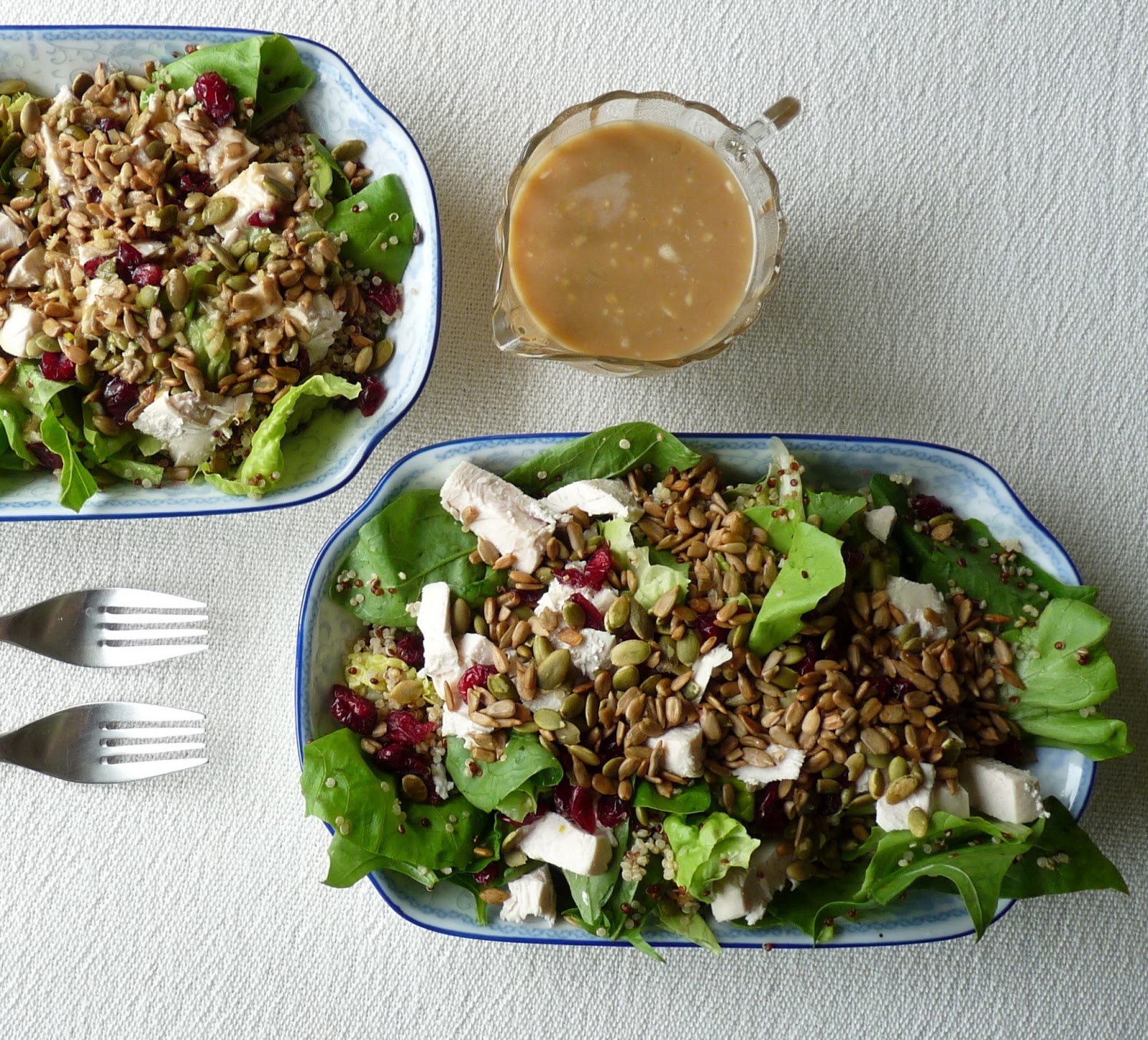
Seedy Chicken Salad with Sweet Sesame Dressing

Between the fairly cool and moist spring we  have been having so far, and the fact that we treated our lettuce bed with lime before planting, we are actually getting decent lettuce in large quantities this year. I think we are also starting to learn which varieties do well in our sandy, acidic soil.  The spinach, as usual, is bolting, but there is enough to still throw some into salads.

Since we are still doing lots of heavy digging in the garden we want our lunch time salad to have a lot of food value to it, hence the use of chicken, quinoa AND pumpkin and sunflower seeds. This is definitely a main course salad; nothing else need be served unless you want a dinner roll or something like that. If you wanted to tone it down and incorporate it into a meal with other dishes, there is no reason not to omit the chicken and do so.

4 servings
30 minutes advance prep
PLUS 15 minutes assembly time


Advance Cooking:
1 cup quinoa
1 2/3 cups water
1/2 teaspoon salt
450 grams skinless boneless chicken breast (OPTIONAL)

Put the quinoa, water and salt in the rice cooker and turn it on. Cook and let cool. Alternately, put it in a covered pot, bring it to a boil, then reduce the heat to low and simmer until tender, about 15 to 20 minutes. Let cool.

Put the chicken, if  using, into a pot with about 1 cup of water, bring to a boil, then reduce the heat and simmer, covered, for 10 to 15 minutes  until cooked. Let cool.

It's a good idea to make the dressing in advance while these two items cook, but it could be done just before you assemble the salad. Allow another 15 minutes if you do it then.

Make the Dressing:
3 tablespoons mild vegetable oil
1 teaspoon toasted sesame oil
2 tablespoons tahini
2 tablespoons honey
1/2 to 1 teaspoon very finely minced fresh ginger
1 clove of garlic, peeled and very finely minced
1/2 teaspoon Dijon mustard
the juice of 1 lime
2 tablespoons apple cider vinegar
2 tablespoons water

Put the oil, sesame oil, tahini and honey in a jar or small bowl, and mix well until the tahini and honey in particular are well-dissolved. Then add in the remaining ingredients and mix well.

The ginger and garlic should be in approximately equal quantities. Use the higher quantities if the dressing is to be used at once, the lower quantities if you are making it in advance as they will get stronger as the dressing sits.

Finish the Salad:
8 cups mixed salad greens; lettuce, spinach, arugula, etc.
1/4 cup dried cranberries
1/2 cup pumpkin seeds
1/2 cup sunflower seeds

I used a mixture of several different kinds of lettuce, with about 1/3 of greens being spinach, and thought it was a good combination, but use whatever greens you like and have. It is a good idea to toast the pumpkin and sunflower seeds until slightly browned in a dry skillet before adding them to the salad. Turn them out onto a plate to be spread out and cool once done.

Wash and drain the greens well, and tear or chop them a little on the small side. Toss them with the cold quinoa, the dried cranberries and the seeds.  Dice the cold chicken breasts and divide the pieces of chicken over the salad, either in a large flat serving dish or individual plates with the salad divided amongst them. Drizzle with the salad dressing.


Last year at this time I made Asparagus Ham & Cheese "Danish".

Friday, 4 January 2013

Carrot Dip or Spread

This is a very simple dip to put together, and since it calls for pantry staples it could be made at the last moment if necessary, although I think it's better to make it the day before it is wanted to allow the flavours to mellow. I should also mention that I have found it seems saltier with sitting for a while, so the miso should be added with some discretion. All the better if you can find a lower-salt miso to start with. 

3 to 4 cups
30 minutes prep time

Carrot Dip or Spread

450 grams (1 pound) carrots
3 to 4 cloves of garlic, peeled and trimmed
2 tablespoons tahini
2 to 3 tablespoons light miso
1 teaspoon honey
the juice of 1 small lemon
1 teaspoon chile-garlic sauce or hot sauce

Wash, peel and slice the carrots, and put them in a pot with water to cover. Boil them until quite tender; they should be easily pierced with a fork. Lift them out of the cooking water and put them in a food processor with the remaining ingredients.Start with 2 tablespoons of miso, and taste once everything is blended before adding more if it is required.

Purée everything until the texture is very smooth. You will need to scrape down the sides of the food processor several times, no doubt. If you want a dip, you should add a few tablespoons of the carrot cooking water until the exact consistency that you would like is achieved.

Transfer the dip or spread to a serving dish. Cover and let rest for an hour or so to allow the flavours to blend. Serve with crackers, bread, celery sticks, etc.


Last year at this time I made White Bean & Dried Tomato Dip. I'm so predictable...

Thursday, 23 August 2012

Making Meringues

Meringues are extremely simple to make, but they require both a sense of leisure and a dry day, or at least good central air conditioning in order for best results to be achieved. The requirements for good results are strict, but easily achieved: room temperature egg whites, squeaky clean oil free implements, well dissolved sugar and that dry day. These are not a good rainy day project, I'm afraid. The good news is they keep very well and can be made in advance.

I only made 6 meringue nests with the recipe below, and I have to say they really were too big. Not that we didn't all of us eat every bite of them, but still; too big. Next time I will make them smaller. These are more of a versatile componant of other desserts than a thing to eat by themselves, in my opinion, but there's no reason why you can't.

8 to 12 meringue nests
OR 36 cookies
OR 2 cake bases
2 hours - 30 minutes prep time PLUS time to cool completely


3 extra-large egg whites
1 teaspoon vanilla extract
1/4 teaspoon cream of tartar
3/4 cup sugar

You need to have your egg whites at room temperature. I always forget to take them out early enough, so set the eggs in a bowl of warm - not hot - tap water for about 5 minutes. Then, preheat the oven to 200°F.

Separate the eggs and put the whites in a clean dry mixing bowl, ceramic, glass or metal but not plastic. It is important that the egg whites be completely free of any oils, and plastic tends to be oily. Also be very careful when separating the eggs to not permit any egg yolk to contaminate the whites.

Add the vanilla and cream of tartar, and beat the egg whites with an electric mixer, on low to medium speed, until just past frothy and starting to gain some structure. Begin adding the sugar, a bit at a time, beating for a few seconds between each addition. Once it is all in, continue beating until the sugar is completely dissolved and the egg whites are very stiff.

Cover a baking tray with a sheet of parchment paper, and spoon the meringue mixture out into little mounds for cookies, or larger flattish discs for nests - use your spoon to build up the sides a bit if you want them to be more nest-like.

Bake them for 1 hour and 30 minutes, then turn off the oven and let them cool completely in the oven.


What you do now is up to you. I piled mine with whipped cream and fruit, but you could eat them with custard, or just plain, or if you are treating them like cake, layer them with mousse and frost them. They will store for a week or so carefully and loosely wrapped in a plastic bag, so can easily be made in advance.


Last year at this time I made Strawberry-Banana Sorbet. Another thing that could be put in a meringue nest!

Monday, 20 August 2012

Basil-Garlic Mayonnaise

I'm surprised to say I actually liked this, and thought it was delicious on those little tomato kebabs you see in the picture, and also on the boiled potatoes and green beans that followed them. I'm surprised, because I've always kind of hated mayonnaise, not just the prepared stuff you buy in plastic jars but even home-made mayonnaise. Especially home-made mayonnaise, in fact. I guess my tastes have changed.

 And of course, I'm a sucker for basil and garlic. There is no reason why you have to use the basil and garlic; you can leave it out and make plain mayonnaise. But I have to say that at this time of year, they really make that mayonnaise sing.

1 generous cup
20 minutes prep time, plus 1 hour to marinate

Basil-Garlic Mayonnaise

Prepare the Oil:
3 cloves of garlic
4 or 5 sprigs (3 or 4 leaves each) of basil
1 cup extra-virgin sunflower or olive oil

Peel the garlic, and rinse the sprigs of basil and drain them well. Slice and bruise the garlic, and shred the basil finely. Mix them with the oil, and let rest for about 1 hour. Strain well, pressing the solids to extract all the oil. Discard the solids (the basil and garlic).

Make the Mayonnaise:
2 large egg yolks
1 tablespoon lemon juice
1/2 teaspoon salt
1/2 teaspoon ground mustard powder

Put the egg yolks, lemon juice and salt in a very clean, dry glass, ceramic or metal mixing bowl. Beat them together with an electric mixer, also taking care that the beaters are clean and dry. Let the mixture rest for 4 or 5 minutes.

Then, begin beating in the oil, a few drops at a time. The mixer should be on a fairly low to medium setting; do not beat it too quickly. The mixture should thicken slightly as you work, and by the time about half the oil is in, it should be looking distinctly like mayonnaise. At that point, you can add the oil in larger and larger amounts, until it is all in and the mayonnaise is thick and creamy. Beat in the mustard powder.

Tuesday, 26 June 2012

Jamaican Curry Powder

Okay, you know what it means when I post a spice blend recipe: I'm about to use it to make something more- in this case, Jamaican Patties, both with meat and with greens.

Interestingly, formulae for Jamaican curry don't generally contain a hot element. That usually gets added to the dish in the form of hot (Scotch bonnet) chiles or hot sauce. The allspice also gives it a nice mellow quality, so you can make your final dish as mild or spicy as you like. 

about 1/4 cup curry powder
15 minutes prep time


1/2 teaspoon green cardamom (8 pods)
5 teaspoons coriander seed
3 teaspoons cumin seed
2 teaspoons anise seed
1 1/2 teaspoons fenugreek seed
1 1/2 teaspoons allspice berries
1 piece star anise

1 1/2 teaspoons ground ginger
1/4 teaspoon ground cinnamon
5 teaspoons ground turmeric

Measure out the first 7 ingredients, and toast them in a heavy skillet until fragrant and showing some signs of slight browning. This will take only a minute or two once the pan is hot. Turn them out at once onto a plate to cool.

Once cool, grind the whole spices very thoroughly. Mix the ground spices with the last three remaining spices. Keep stored in a cool, dark spot in a well-sealed jar until needed.

Monday, 31 October 2011

Ajvar

I had never made ajvar before, and I was pleased to realize it's really very easy. A little tedious to peel all the peppers, but no biggie. And since we decided to haul in all our peppers and eggplants last week, I needed something to do with some of them. I realize this is rather late in the season for making this, but bookmark it for next year. Now to figure out what to do with the other 7/8ths of a bushel of peppers sitting on my kitchen table. Not to mention probably a peck of eggplants.

Ajvar, in case you wanted to know, is simply a paste of roasted red peppers and eggplant, seasoned with lemon juice, salt and pepper, and usually smoothed with a little oil. The word is related, through the Turkish, to caviar. It hails from the Balkans, where they all fight about who invented it and how it should be made exactly. (You wondered what all that bickering was about over there. Now you know.) The Serbians seem to be carrying the day, but the Macedonians are neither down nor out. Recipes vary from all-eggplant to all-pepper, smooth or chunky, hot or mild, so take my version with a grain of salt. Also with some good sliced bread and a sprinkle of parsley, although I intend to use it on pizza, spread it on baked chicken, dip chips in it, and maybe toss it with some pasta or rice.

4 to 5 cups
2 hours or more- 1 hour prep time

Ajvar
Roast the Vegetables:
4 small eggplants (or 2 large ones; probably about 1 1/2 kilos or 3 pounds)
2 heads garlic, cleaned but unpeeled
6 to 12 thick-walled mild to slightly hot peppers, again about 1 1/2 kilos or 3 pounds

Preheat the oven to 475°F. Wash the veggies and cut off any bad spots. Arrange them in a single layer on trays, and bake them for about 30 minutes, until soft and blackened in spots. You may wish to turn a few of them half way through if they look like getting too black.

When they are done, set the garlic aside, and put the peppers and eggplant into a sealed container to steam as they cool. Let them cool for at least half an hour to several hours.

Finish the Ajvar:
3 or 4 cloves garlic
2 teaspoons pickling salt
1/2 teaspoon ground black peppercorns
the juice of 1 or 2 lemons
1/4 to 1/2 cup sunflower seed oil

Peel the cooled eggplant and peppers, discarding the skins, stems and seeds. Put them in a food processor with the peeled roasted garlic cloves and the peeled raw garlic, salt and pepper. Chop until it has reached a texture you like. Remove it to a bowl and mix in the lemon juice and the oil.

I packed mine in sterilized jars, because I hope to keep it in the fridge for a few weeks, but if you wish to can it for longer storage it must be pressure-canned. I would be more inclined to freeze it, myself.


Last year at this time I made Stir-Fried Broccoli with Red Peppers and Onions, and Smoked Fish Pie. Okay, I lied. My mom made the fish pie.

Saturday, 27 November 2010

Christmas Plum Pudding

I'm late! I really should have made these a month ago. I kept eating my figs though, before I could round up all the other ingredients. Also I can't say I am really looking forward to Christmas. What I would like to do for Christmas is to go sit on a tropical beach somewhere for a week. Or Spain. Spain would be nice. What I am actually doing, though, is having a 2 day house-party for 10 people. It seemed like a good idea in July. However, I have finally conceded that ignoring it won't make it go away and started making some plans.

I didn't really use the exact proportions of fruit listed below. What I ended up doing was going through the cupboards and using up any old fruit I could find. I did keep the orange peel and ginger about right though. Some of it was rather old and tough so I soaked it in some old sherry that also wanted using up. I can actually see some space in the pantry now! If your fruit is really fresh and moist you could skip soaking it.

Below you can see the pot I used to steam the puddings. I believe this is sold as a set to make pasta but I have only resorted to using it for pasta when my regular pasta pot is otherwise occupied. Mostly I use it for steaming things, which it does very well.

I also experimented with putting my puddings into wide-mouthed glass jars, from which they slide quite nicely, since they taper straight down. Don't regard this as long term canning, say all the experts, but I don't see why they wouldn't keep as long if not longer than puddings taken out of the mold and wrapped up in foil - at least 3 months. Plenty of booze of course is a major contributing factor in this keeping ability.


Christmas Puddings in the Steamer
Makes 4 puddings of 4 servings each
about 45 minutes prep time - 1 1/2 hours cook time
Should be made 1 to 2 months in advance


Christmas Puddings Waiting for Christmas
Mix the Fruit:
100 grams (1/4 pound) black mission figs
100 grams (1/4 pound) light raisins
100 grams (1/4 pound) dark raisins
100 grams (1/4 pound) dried cherries
100 grams (1/4 pound) chopped nuts
100 grams (1/4 pound) candied peel
50 grams (2 ounces) preserved ginger
1/4 cup rum or other booze of choice
1/2 cup soft unbleached flour

Trim the stems from the figs, and chop them to be of a size with the other fruits. Mix all the fruits (and nuts) in a container that can be sealed, with the rum, and let them soak overnight. When you are ready to make the puddings, toss them with the flour.

Mix the Dry Ingredients:
1 cup fine whole wheat bread crumbs
1 cup soft unbleached flour
1/2 teaspoon baking soda
1/2 teaspoon salt
1/2 teaspoon freshly ground nutmeg
1/2 teaspoon ground ginger
1/2 teaspoon ground cinnamon
1/4 teaspoon ground cloves

Mix these together and set them aside.

Finish the Puddings:
3 extra-large eggs
3/4 cup brown rice syrup
1/4 cup molasses
1/4 cup mild vegetable oil
1 cup buttermilk
and finally, more rum or other booze ad lib

Beat the eggs lightly with a spoon. Heat the brown rice syrup and molasses gently until they are quite fluid, but not really hot. Beat them into the eggs, then beat in the oil and buttermilk.

Butter 4 500-ml molds thoroughly.

Mix the dry ingredients into the fruits, then mix in the wet ingredients until well blended. Ladle the batter evenly amongst the molds. It will be quite runny, as you will gather. Cover the molds with buttered aluminum foil, and tie it in place with kitchen twine (or use rubber bands, if you have any of the right size).

Put the puddings into a steamer with water to the bottom of the jars. Steam for 1 1/2 hours, checking the water level regularly and topping it up with boiling water if necessary, and it will be necessary at least once I am sure.

Remove puddings from the steamer once done. You can test them with a toothpick, which should come out clean and dry. At this point I poured as much more rum over them as I could get them to absorb (several tablespoons each), put a lid and ring on them, and popped them back in the steamer for 10 minutes. They should now keep for about 3 months, I would think, in a cool dark place.

You could also make these in 2 1-litre molds, but in that case they should be steamed for at least 2 hours. These would have to be removed from the mold and well wrapped in foil once sprinkled with more rum. Again, keep in a cool dark place for up to 3 months.


To Reheat and Serve:
To reheat and serve the pudding(s), they should be steamed again for an hour. Or, what I actually do, which is to sprinkle them with a little liquid (more booze!) and microwave them until hot. The time will depend on your microwave, but almost certainly under 10 minutes to get one hot through. Much, much faster and doesn't tie up the stove when you are almost certainly wanting to use it for other things.

Serve them with Hard Sauce, which is basically boozy butter frosting.

Monday, 2 March 2009

Poultry Seasoning

In my recipes I often call for spices, ground. This is what I use. It's a granite mortar and pestle from Korea. I used to have an electric coffee grinder to do this, but it was a nuisance to clean and just didn't seem worth the effort for a teaspoon of this and a teaspoon of that. For a while, I had them both, but I got used to grinding bigger and bigger batches of spices in the mortar. Eventually I gave the coffee grinder away.

In general, it makes a huge difference in the quality of your spices to buy them whole in small quantities, to grind them only as needed, and to keep them stored in a dark cool place. Pepper, once ground, goes rancid very quickly but can be stored in the cupboard as long as it is unground. Celery seed goes rancid easily even before it is ground, and might be best kept well wrapped in the freezer.

This poultry seasoning is reminiscent of an old favourite - Bell's seasoning. Whenever we went to the U.S to visit relatives when I was a kid, we would stock up on Bell's. It wasn't available here. I don't know if it's still around or not. I'm pretty happy with this, although I miss the lovely old-fashioned box that it came in.

Enough for one chicken
5 minutes

Grinding Spices
1/4 teaspoon black peppercorns
1/4 teaspoon celery seed
1/2 teaspoon dried rosemary leaves
1/2 teaspoon sea salt
1/2 teaspoon oregano
1/2 teaspoon savory
1/2 teaspoon thyme
1/2 teaspoon sage
1/2 teaspoon ground dried ginger

Put the first four ingredients in your mortar or grinder and grind finely. Add the remaining ingredients and grind again.

Use the poultry seasoning to season stuffing for chicken, or sprinkle on the skin of a whole chicken or chicken pieces to be roasted. In that case, I like to add a bit of paprika and a bit more salt as well.

Monday, 17 November 2008

Freezing Pumpkin

We made it home for one day this week; hopefully we will get back for one more. However, we are still back in Cambridge cleaning and painting for the most part, and when we are here, we still have a pile of work to do which precluded my doing any cooking to speak of, never mind writing about it.


However, I bought one little pie pumpkin right after halloween, and was given three others, so I spent this evening pureeing them to be frozen. First I cut a lid in each one, and removed all the seeds and loose stringy bits. The stringy bits were discarded; the seeds were washed and tossed in salt and spices then roasted at 350°F until lightly browned and crunchy. I also roasted the pumpkins at 350°F, until the largest were soft through.


Once they were cooled, they were peeled and puréed.


Then I packed them into tubs to be frozen.

If I had had time, I would have preferred to cook the pumpkin in batches in a large cast-iron skillet, stirring frequently, until thick and very slightly caramelized. This would have reduced my total quantity of pumpkin, but it would have been better quality. Howver, if I have time, I can still do it on the other end.

And that's probably it for this week... now it's back to the salt mines.