Showing posts with label Maple and Honey. Show all posts

Wednesday, 27 April 2022

Maple-Tahini Haystacks

I was surprised to do the math on these and see that they are really not too bad for carbs. They were hauntingly delicious, and honestly? At half a cup of maple syrup I thought they were a touch too sweet. I might try them again with 1/3 of a cup of maple syrup. Of course, I have gotten used to barely-sweet treats. The other thing I would change next time is the size of oat flake I use. This time I used large flake oats, and found them a little too prominent. I think quick-cook oats would be better. But large flakes did not keep them from being scarfed down with enthusiasm. Hauntingly delicious, did I say? 

Like other dropped unbaked (stove-top) cookies these are stupidly fast and easy to make. I found they stayed a little sticky (another reason to reduce the maple syrup slightly?) so they were best kept in the fridge, with plenty of parchment paper to keep them separate, but they were eaten quickly enough it wasn't a big deal. 

I am trying not to make sweets too often, so it may take me a while, but if I change the amount of maple syrup I will update this recipe.
 
Makes 24
20 minutes prep time

Maple-Tahini Drop Cookies

1 1/4 cups rolled oats
1/4 cup oat bran
1/3 cup unsalted butter
1/2 cup maple syrup
1/4 teaspoon salt
3 tablespoons tahini
 
Measure out the oats and oat bran and set them aside mixed together. Set out a sheet of parchment.
 
Put the butter, maple syrup, and salt into a heavy-bottomed 1 litre/quart pot and bring to a boil. Boil gently but steadily for 5 minutes. Stir in the tahini and remove the pan from the heat. Stir in the oatmeal and bran. Cover and let rest for 5 minutes.

Scoop the mixture out onto the sheet of parchment with a small disher or tablespoon. Leave them until cool and set. Keep covered in a cool, dry spot.


Last year at this time I made Nem Nuong - Vietnamese Pork Loaf.

Monday, 11 April 2022

Tortilla de Pan

Essentially, this is a fancier French toast - Spanish toast, if you like - or a kind of pancake, more than an omelette, which is what Spanish tortillas usually are. Just to get distracted for a moment, I've come to realize by going through old cook books that what we now call French toast used to be referred to as German toast at least as often, but two world wars brought that to a definite end. Really, the first one was enough to do it. 
 
This will taste mostly quite familiar, although the touch of lemon zest along with the cinnamon is distinctive. I think it is best with fruit preserves, but have it with whatever you would normally serve with French toast or pancakes. Maybe some cream cheese and a drizzle of honey. Like the traditional Spanish tortilla of eggs and potatoes, it is customarily served at room temperature, which would make it a good choice for a breakfast or brunch buffet. If you prefer it warm, though, it will certainly be just fine that way.
 
6 servings
40 minutes - 20 minutes prep time
 
Tortilla de Pan - Spanish Bread Pancake

150 grams (5 ounces) stale bread
6 tablespoons milk or light cream
1 to 3 tablespoons sugar
the zest of 1/2 lemon
1/4 teaspoon ground cinnamon
1/8 teaspoon salt
4 large eggs
1 tablespoon mild vegetable oil to cook
 
Grate or crumble the bread very finely into a mixing bowl. Drizzle the milk over the bread, and mix it in well. Let it sit for a few minutes to soak thoroughly. The bread should be moist, but not soggy - no puddles. 

In another bowl. mix the sugar, lemon zest, cinnamon, and salt. Break in one egg and whisk it in thoroughly. Whisk in the remaining eggs. 

Fold the egg mixture into the soaked bread. Let it sit again, for a few minutes. Whisk it if the bread does not seem well broken up. 

Heat the oil in a medium skillet over medium heat. Scrape in the mixture and spread it out evenly. Cook it slowly until set and slightly browned on the bottom. Slide the tortilla out onto a plate, flip the pan over it, the flip it back to right side up with the tortilla in it. Cook the second side until set and slightly browned. All of this will require a fairly low temperature; adjust it early in the process if the tortilla seems to be browning faster than it is setting. 

Serve warm, or allow the tortilla to cool to room temperature before serving. 


Last year at this time I made Barley with Vegetables.

Monday, 21 February 2022

Beef Adobo

I think this is particularly good with bone-in beef, but it is not required.  

It's funny how one's taste evolves over the years; I think I'm getting to the point where if I am served a meat dish with no vinegar in it I feel like something vital is missing. Well, it's not missing here. It's also interesting to me to compare this dish, the result of Asian colonization by people from the Iberian peninsula, with the other such dish I made a little while ago. It's a Spanish-Filipino fusion, rather than a Portuguese-Indian one, and while there are points of similarity it's also pretty different. I don't think I could tell you which one I like better; they're different moods but I don't think I'd ever be sorry to see one of them on the table.
 
4 servings
2 hours to overnight marinade time
20 minutes prep time
2 hours cook time
 
Beef Adobo
 
2 tablespoons finely grated fresh ginger
3 or 4 cloves of garlic
2 bay leaves
1/3 cup apple cider vinegar
2 to 3 tablespoons maple syrup
2 tablespoons soy sauce
1 tablespoon fish sauce
freshly ground black pepper to taste
500 grams (1 pound) stewing beef
OR 900 grams (2 pounds) stewing beef with bones
2 or 3 medium onions
2 tablespoons mild vegetable oil

Peel and grate the ginger; peel and grate the garlic. Put them in a container which can be covered and which will hold the beef. Mix with the remaining marinade ingredients. Marinate the beef for 2 hours to overnight in the fridge. 

Peel, trim, and cut the onions in quarters, then in slices (quarter rings).
 
Heat the oil in a large heavy-bottomed soup pot over medium heat. Cook the onions in it until soft, stirring regularly. Add the beef, with the marinade. Cook gently for 1 1/2 to 2 hours until the marinade slowly evaporates and the beef fries and browns slightly in the residual oil. It's best to get it started with a lid on it, then let the liquid reduce faster towards the end of the cooking time. Let the adobo rest 5 minutes before serving. 


Friday, 4 February 2022

Panini Press Grilled Tofu

This is a pretty standard, even stripped-down, tofu marinade. I've decided I don't like to add herbs, or spices, or in particular garlic, because mostly they are inclined to scorch, however cooked. More flavour comes in with a sauce that gets served over the tofu. In this case I used Ginger-Peanut Sauce, but there are quite a number that will be suitable. I've been making the Ginger-Peanut Sauce with less water and adding a bit of chile-garlic sauce to it.

I've tried baking marinated tofu, and I've tried pan-frying marinated tofu, and those both work perfectly well. It turns out, though, that this is the easiest to do and to clean up. It will take longer than you think, particularly if you want some nice dark grill marks on your tofu - I certainly do - and it will remove quite a bit of moisture from the tofu making it particularly dense and chewy, which I also really like. On the other hand, 20 minutes isn't long and you will need that time in most cases to assemble whatever you are going to serve with it, if not longer.

A waffle iron would achieve the same results as the panini press, only with cross-hatches. Eight slices cut in the same orientation as a loaf of bread is what fits into my fairly small one, but next time I think I would cut each slice into 2 to 4 pieces as well. It depends how you want to serve it. If I had put it into sandwiches for instance, the larger slices would have been ideal.
 
2 to 3 servings
1 hour plus to marinate
about 20 minutes to grill
 
Panini Press Grilled Tofu

400 grams (14 ounces) extra-firm tofu
3 tablespoons strong soy sauce (tamari)
3 tablespoons apple cider OR rice vinegar
1 tablespoon honey, maple syrup, OR very dark brown sugar, OPTIONAL
1 to 2 tablespoons mild vegetable oil
 
Drain and blot the tofu quite dry. Cut it into 8 to 12 slices (keeping in mind how they will fit in your panini press). Put them in a zip-lock bag, or snug, flat bottomed bowl, and add the soy sauce and vinegar, and the sweetener if you are so inclined. Marinate for at least one hour, up to overnight. 

Brush the panini grill with oil, and pre-heat it. Drain and gently blot the tofu slices, and arrange them in the press in a single layer. Cook for about 20 minutes. Serve with rice or noodles, vegetables, and a sauce of your choice. 


Lasts year at this time I made Peanut Butter & Jam Crisp.

Friday, 7 January 2022

Labneh Cheesecake

"I hope you won't take this the wrong way," said Mom as she ate her piece of birthday cheesecake, "but this reminds me of Sara Lee." 
 
I didn't take it the wrong way; I had been thinking that myself. I used to love a Sara Lee cheesecake as a kid, when it was a rare treat. Mine is better of course; a little less sweet and gummy and we could ladle on the strawberry sauce ad lib.
 
I used my own homemade graham crackers for the crumbs to keep them lower carb (I'm now only using 2 tablespoons each of the Sucanat and honey; it's fine) but you will need to make them a day ahead in that case. I was also feeling reckless and decided not to pre-bake the crust. Other than a couple of pieces I should have ground finer floating up, it worked just fine - the crust was a bit softer than it would have been otherwise, but I quite liked that. It added to the Sara Lee effect.

If you can't get labneh, it's cheese, but cheese that is yogurt strained until it is too thick to stir easily. Be sure to use a good quality yogurt with no gelatine, gums, powdered milk, or other muckings about in it. One with a bit of fat to it will be a good choice. Still, for cheesecake, this hits a magic spot between relative restraint and rich creamy goodness. You will need about twice as much yogurt to make the cheese, i.e. for 450 grams labneh you will need 900 grams yogurt.
 
I forgot to grease the sides of the tin and probably baked the cake about 5 minutes too long, hence the cracking. Next time I might pour some water into the lower baking pan too. But with the sauce covering it up, nobody really noticed the cracks.
 
8 to 12 servings
1 hour 15 minutes - 30 minutes prep time 
NOT including making the graham crackers OR labneh
 
 Labneh Cheesecake with Strawberry Sauce
 
Make the Crust:
2 cups graham cracker crumbs
1/4 cup melted butter 
 
Crush the crackers to smooth crumbs, then mix in the melted butter. Line a 9" spring-form pan with parchment paper, and butter the sides. Press the graham crumbs firmly and evenly into the pan. 

Preheat the oven to 350°F.

Make the Filling & Bake:
450 grams labneh (yogurt cheese)
the finely grated zest of 1/2 large lemon
the juice of 1/2 large lemon
1 teaspoon vanilla extract
1/8 teaspoon salt
1/3 cup honey
4 large eggs
1/4 cup potato starch
 
Put the labneh in a mixing bowl, and add the lemon zest, lemon juice, vanilla extract, and salt. Mix well. Whisk in the honey, then the eggs, one at a time. Whisk in the potato starch. Scrape the mixture into the prepared pan. 

Place the pan on a baking tray (springform pans have been known to leak) and bake for 40 to 45 minutes, until just set. Let cool completely before serving.

Make the Sauce:
3 cups (frozen) strawberries OR blueberries
1 tablespoon arrowroot OR cornstarch
3 tablespoons sugar (or to taste)
 
Put the thawed or at least semi-thawed berries in a pot and mix in the starch and sugar well before turning on the heat. Heat over medium heat, stirring frequently, until thickened. Let cool before serving with the cheesecake. 


Wednesday, 22 December 2021

Honey - Almond Flour Helva

I've gotten quite obsessed with a kind of Turkish helva (aka halvah), known as "flour helva". It exists at some sort of culinary intersection between fudge and bechamel sauce, and is a popular home-made sweet in Turkey. If you are interested in the real thing, there are a lot of recipes including You-Tube videos out there. However, I thought it had real possibilities for being adapted to be much lower in sugar and carbohydrates. My version, therefore, is not going to be much like it should be, but it is something I can eat (in moderation) and I have been enjoying it very much as a Christmas treat. 

It seemed quite complicated as I read the reference recipes; it didn't help that they were all read through the prism of Google translate. However, in the end, it turned out to be really very simple once I understood the procedures. I was a bit nervous that the sugar solution ought to be boiled to a syrup, but in recipe after recipe it was not, which I believe is the reason that it could be adapted to being much lower in sugar. 
 
After I made the version below I tried it again with maple syrup; in that case measure 1/3 cup of dark maple syrup into a half-cup measure and fill up the rest with the water or other liquid as described. (I used plain water but I can see it being really good with coffee.) Also delicious.

The end result is probably a bit more cookie-like in texture than the original fudge-like version as a consequence of the greatly reduced sugar, but I find it very tasty and really, quite a big thrill! Back to the straight and narrow after the holidays. On which note, it's time to take a break. Happy Holidays to everyone! And happy (post) Solstice - the days are getting longer!
 
12 to 24 pieces
20 minutes prep time 
 

In Pot #1:
1/4 cup cinnamon tea OR water, juice, etc.
1/4 cup honey
2 tablespoons sugar OR monkfruit-erythritol sweetener
a pinch of salt
1/4 teaspoon almond extract

Brew a sweet herbal tea (I used Celestial Seasonings Apple-Cinnamon) or use plain water. I would also be inclined to experiment with pure fruit juices and perhaps coffee. To use maple syrup as the sweetener, use 1/3 cup of it and enough other liquid to bring the total to 1/2 cup as it's less concentrated than honey.

Put 1/4 cup of the tea or water in a smallish pot with the honey, salt, and sweetener. Heat over low heat until melted. Let cool for a few minutes then stir in the almond extract.

In Pot #2:
1 cup barley flour
1 cup almond flour
1/2 cup unsalted butter

Meanwhile, put the barley flour in a heavy-bottomed 2-quart (litre) pot. Heat it over medium heat, stirring frequently to constantly, until the barley flour toasts to a very light brown. Add the almond flour and continue stirring and toasting until the mixture is a fairly medium brown - about as brown as a pale brown paper bag. Add the butter, and mix it in as it melts. Continue cooking and stirring until the mixture is evenly crumbly, and a good medium paper bag brown. 

Add the contents of Pan #1 to Pan #2, being very careful - it will boil up and want to spatter. Mix well as soon as it is all in, until it forms a doughy ball. Turn it out onto a plate and let it cool for 10 minutes. Press it into an oiled 9" x 9" pan, or into candy molds, etc. I used my Madeleine pans, and got 12 pieces. Let set for at least 1 hour before turning out, and cutting it into pieces if it's a single slab. 

They last well for up to 2 weeks in a well-sealed tin kept in a cool spot. 


Last year at this time I made Braised Oxtails with Apples & Sweet Potatoes.

Monday, 15 November 2021

Honey Baked Pears

Scale this recipe up to however many pears you wish to bake. They will keep in the fridge for several days so you might as well do a good few. They are perfect for dessert, and also for breakfast - maybe with cottage cheese, although I had mine with yogurt and thought that was a great combination. 
 
I do think they are best slightly warm or at room temperature. It's easy to take the chill off leftovers with a few seconds in the microwave - just enough to soften the butter, right on up to quite warm, if that's your preference.
 
I used cranberry juice, but any pure fruit juice will likely be fine. I can also see using rum or sherry instead, if you are feeling fancy. If you use Bartlett or Anjou pears I suspect they will bake more quickly - check them at 15 minutes and half an hour. 
 
per serving
1 hour - 15 minutes prep time
 
Honey Baked Pears

1 pod green cardamom
a little freshly grated nutmeg
even less ground cloves
1 large ripe Bosc pear
1 teaspoon honey
1 teaspoon butter
1 tablespoon fruit juice

Crush the pod of cardamom and discard the green papery husk. Grind the remaining seed and mix it in a small bowl with the nutmeg and cloves - remember, this is per pear
 
Preheat the oven to 350°F. Peel the pear(s) and cut them in half. Carefully slice out the stem and core from each half. Put them in a shallow baking pan which will hold then snugly in a single layer. Dot them with the honey, butter, and fruit juice.
 
Bake them at 350°F for about 20 minutes, then baste them with the juices accumulated in the pan. Bake for a further 20 to 25 minutes, until tender. Serve warm or at room temperature, perhaps with yogurt, ice cream, or custard. 


Last year at this time I made Polish Seasoning Blend. And - yes, really - Gingerbread Poached Pears.

Friday, 24 September 2021

Frangipane Pear Tart

I am a late-comer to discovering the joys of frangipane, which is a traditional European tart filling that falls somewhere between marzipan and custard. That it is thickened and set with ground nuts rather than flour makes it ideal for people avoiding refined carbohydrates; it only needs to have the sweetener reduced and partially or totally changed to an artificial one. (I did live it up and use maple syrup; but it could be replaced with erythritol-monkfruit.) I've further reduced the chance of carbs by eliminating the crust, making this fall somewhere between a pudding and a soft cake. 

Almonds are the most traditional nut to use, but you could use all kinds of nuts to similar effect. I do think almonds are the best choice for matching with pears. I'm going to be looking for other fruit and nut pairings to be made the same way in the future; I am particularly looking forward to trying a pistachio-cherry combinations.
 
8 servings
1 hour - 20 minutes prep time
allow time to cool
 
Frangipane Pear Tart
 
1 1/2 cups ground almonds (almond flour)
2 tablespoons whole spelt flour
1/2 teaspoon almond extract
1 teaspoon vanilla extract
1/8 teaspoon salt
a good grate of nutmeg
a few good grinds of black pepper 
1/3 cup softened unsalted butter 
2 tablespoons to 1/4 cup maple syrup
3 large eggs
450 grams (3 large) Bartlett pears

Mix the almonds in a mixing bowl with the extracts and seasonings. Add the butter, and beat it in with an electric mixer. Add the maple syrup and beat it in as well. Add the eggs, one at a time, beating well after each addition. 

Preheat the oven to 350°F. Butter a 10" pie plate and dust it with a tablespoon of ground almonds. Scrape the batter into it, and spread it out evenly. 
 
Peel and quarter the pears. Cut out the cores and cut each quarter into 3 slices lengthwise. Arrange them over the batter in an attractive pattern and press them gently into it so that the batter and pears are level with each other. 

Bake for 40 minutes, until set and very lightly browned. Let cool completely before serving. 


Last year at this time I made Acelgas con Patatas - Swiss Chard with Potatoes.

Friday, 3 September 2021

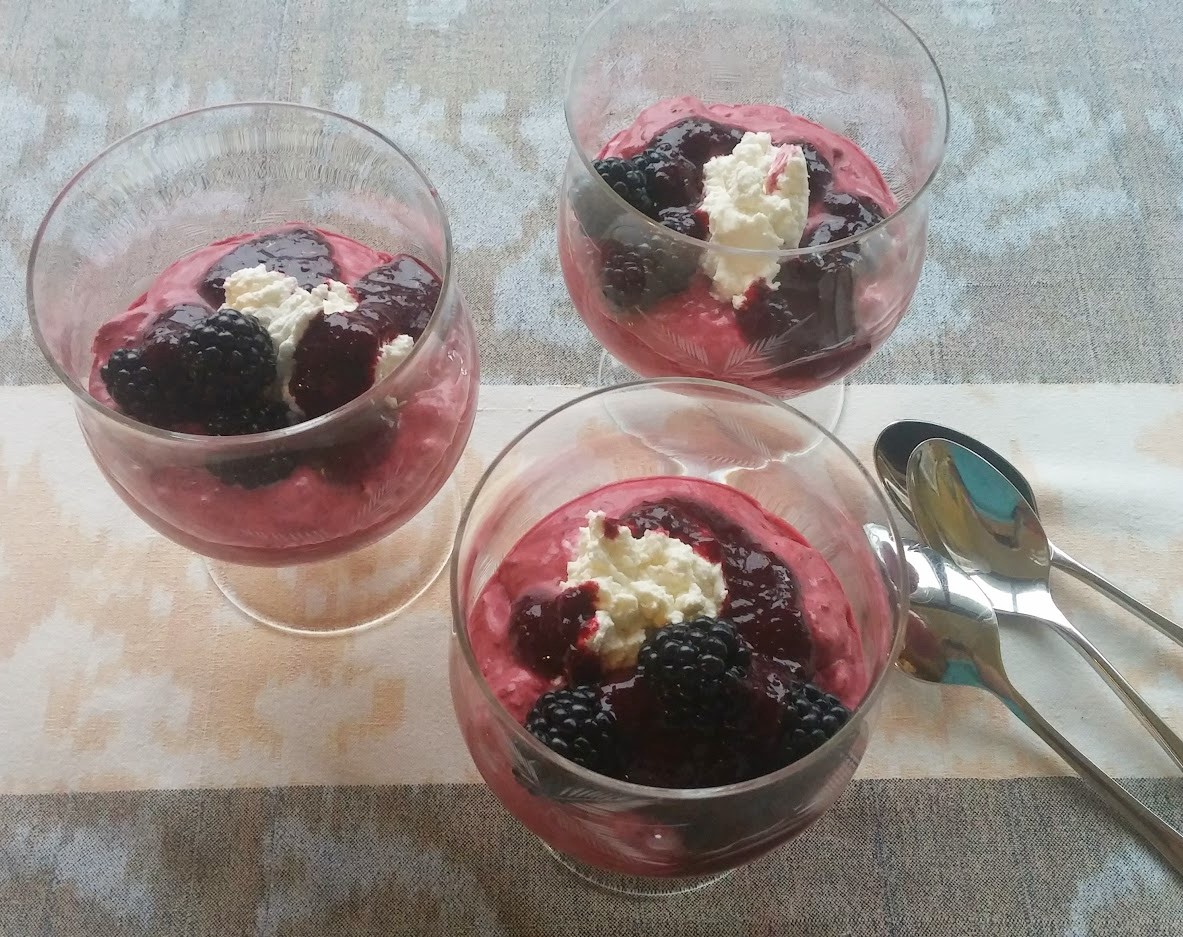
Blackberry Fool

If you have to buy blackberries, they're expensive, but if you grow them yourself you will soon have more than you know what to do with. An old fashioned fool will use quite a few, and you can keep the sweetener down to a dull roar - or not - as you like. If you want it sweeter, I would increase the sugar rather than the honey; but honestly, this was delicious as it was. 

Keeping a bit of the berry purée and the whipping cream separate is simple enough, and makes for a nice interplay of textures and intensity of flavour.
 
4 servings
30 minutes prep time
 
 
4 cups blackberries
2 tablespoons honey
2 teaspoons arrowroot
1 1/3 cup whipping cream
2 tablespoons sugar (optional)
 
Rinse and drain the blackberries well. Pick out 12 to 16 of the best, and set them aside for a garnish. Put the rest into a pot and bring to a boil. Simmer until they are falling apart. Meanwhile, mix the arrowroot into the honey. When the blackberries are done, stir the mixture into them. As soon as it thickens (practically immediately) remove it from the heat.
 
Let the berries cool for a few minutes, then run them through a food mill or press the mixture through a sieve. Let it cool completely, and keep chilled until you are ready to proceed. 
 
Beat the whipping cream, with the sugar if you like. Set aside about 1/2 cup of the whipped cream, then fold about 80% of the blackberry purée into the larger body of whipped cream. Spoon the fool into individual serving dishes. Top each with a bit of the reserved whipped cream, a few whole blackberries, and a spoonful of the blackberry purée drizzled over. Keep chilled until it is time to serve them.  


Last year at this time I made Broccoli Italian Style.

Monday, 28 June 2021

Strawberry Mousse

Strawberries are whizzing by; the June ones are pretty much over (along with June, after all). Fortunately day-neutral varieties will continue to be available, albeit in smaller quantities, through the summer. It also works perfectly well with frozen berries, so you can make it all year 'round, especially if you can get some greenhouse ones to garnish it.
 
This is a pretty simple and straightforward take on strawberry mousse, and none the worse for that - a little lime for fragrance and a touch of honey for sweetness, and then nothing to distract from the deliciousness of strawberries and cream.
 
4 to 6 servings
45 minutes -  30 minutes prep time
PLUS 3 hours to set
 
Strawberry Mousse

the finely grated zest of 1/2 a lime
the juice of 1 large lime
1 tablespoon powdered gelatine
2 cups fresh or thawed from frozen strawberries
1/4 cup honey
1/4 cup water OR apple juice or cider
1 cup whipping cream
more fresh berries for garnishing
 
Wash and dry the lime, and grate the zest into a small bowl. Squeeze the juice and add it. Sprinkle the gelatine over it and set aside. 
 
Wash and hull the strawberries, if you are using fresh ones. 

Put the honey and water into a pot and bring to a simmer. Add the berries and simmer for about 10 minutes, until they are soft. Stir regularly. 
 
Remove the berries from the heat and add the gelatine and lime juice to the pan. Stir until the gelatine is completely dissolved. Allow the mixture to cool for about 15 minutes. Mash the berries with a potato masher.
 
Put the whipping cream into a mixing bowl and beat with an electric mixer until it forms stiff peaks. Fold the berries and cream together (in either the pot or the bowl; whichever seems more amenable to containing them both). Transfer to a single or individual serving dishes, and chill until set; at least 3 hours. Serve garnished with whole or sliced fresh berries.

Wednesday, 27 January 2021

Honey Braised Turnips

We had a very small crop of late-planted turnips this fall. We planted quite a lot of seed at the beginning of August, and it all came up very nicely, and I was excited. After about a week or so, though, I noticed the greenery was not advancing, but retreating. It soon became clear that they were being eaten by bugs faster than they could grow. Only a handful survived and thrived enough to produce a usable root. We are going to have to find some way to deal with this next year; it seems the longer we garden the worse the bug situation gets. 
 
I was also surprised to see that about half of the survivors, or even a bit more, were white turnips even though we had saved seeds from Goldana. Recessive genes? Cross contamination in the previous generation? No idea. 
 
I saw the trick for cutting the turnips on Pinterest somewhere, but I can I find it now? I cannot. But cutting your turnips while they are held in the cup of a wooden spoons keeps them in a nice shape as they cook. I'll be doing it again. 
 
4 servings
1 hour 10 minutes - 10 minutes prep time
 
Honey Braised Turnips

6 to 8 medium-small (450 grams; 1 pound) turnips
2 tablespoons unsalted butter
salt & freshly ground black pepper to taste
1 teaspoon rubbed thyme
1 tablespoon honey
1 teaspoon Dijon mustard
1/2 cup chicken OR vegetable broth
 
Preheat the oven to 350°F. 

Peel and trim the turnips. Cut them into wedges, leaving them attached at the bottom. (A wooden spoon to hold them will make this easy.) Slice the butter into bits and strew it around a baking dish that will hold the turnips fairly snugly. Put them in, cut sides up. 

Measure the salt, pepper, thyme, honey, and mustard into a small bowl, and mix well. Slowly mix in the broth until everything is dissolved. Pour this evenly over the turnips. 

Bake the turnips at 350°F for 20 minutes. Turn the turnips over carefully (cut sides now down) and bake for a further 20 minutes. Turn the turnips back to cut sides up again, and bake for a final 20 minutes. Serve at once. 


Last year at this time I made Perfect Fluffy Scrambled Eggs.

Friday, 13 November 2020

"Gingerbread" Poached Pears

Fruit cooked with just a little sweetener makes an excellent dessert, and we really enjoyed these. Having said that, they would be even better with custard, whipped cream, pudding, or ice cream. 
 
There isn't as much sugar in the poaching liquid as is usual in recipes for poached fruit, so although I boiled it down to thicken it a bit, it did not get particularly syrupy. I can see these sliced over sponge cake to sop up the juices, and topped with cream and custard as a kind of trifle. We just slurped them up though, and were perfectly happy.
 
4 servings
40 minutes - 20 minutes prep time
 
 
Gingerbread Poached Pears
 
3 tablespoons honey
1 tablespoon molasses
2" stick of cinnamon OR 1/2 teaspoon ground cinnamon
1/2 teaspoon ground ginger
1/4 teaspoon grated nutmeg
4 whole cloves OR 1/8 teaspoon ground cloves  
a pinch of salt
4 quarter-sized slices of fresh ginger
1 1/3 cups water OR apple cider or juice
4 large ripe but firm Bosc or Bartlett pears
2 tablespoons rum OR sherry, OPTIONAL

Measure the honey and molasses into a pot which will hold the pears snugly, but which can be covered firmly as they cook. Mix in the spices and salt. Wash and slice the ginger, and add it, and slowly stir in the water or juice until the honey and molasses are mostly dissolved. Put a rack or something to keep the pears off the bottom of the pan into it; I used a trio of canning jar rims which worked fine. 
 
Peel the pears, and core them as much as possible from the bottom, leaving them whole. 

Bring the poaching liquid to a boil. Arrange the prepared pears onto the rack, which is there to keep them from sticking to the bottom and scorching. Cover the pot and cook the pears - they will not be covered by the liquid and will mostly steam - for 12 to 20 minutes, until just tender. Exact time will depend on the size and the ripeness of the pears. 

When the pears are done, remove them to a serving dish or storage container. Strain the cooking liquid, pressing to extract all the liquid, and discard the solids, including the rack (into the sink for washing, presumably). Return the liquid to the pot and boil it until reduced by one-third. Pour it over the pears and chill them until serving time. 


Last year at this time I made Brussels Sprouts Hash.

Friday, 16 October 2020

Graham Muffins

I was trying for the flavour of graham crackers in a muffin, and I feel like I have succeeded, but I have to admit that without the texture of a graham cracker it reads pretty much as a bran muffin. With which there is nothing wrong! This is a very nice bran muffin, with a real fibre kick to it. It may seem like it calls for a lot of cinnamon but I find using ground flax really muffles the flavour of other things; I may try putting in even more next time. 

12 muffins
30 minutes - 10 minutes prep time

Graham Muffins

Mix the Dry Ingredients:
1 1/4 cups whole spelt flour
1 1/4 cups wheat bran
1/2 cup ground flax seed
2 teaspoons baking powder
1/2 teaspoon salt
1 1/2 teaspoons ground cinnamon

Measure the dry ingredients and mix them in a mixing bowl. Preheat the oven to 350°F, and put 9 muffin pan liners in a muffin pan. 

Mix the Wet Ingredients & Finish:
1/3 cup mild vegetable oil
3 tablespoons honey
3 tablespoons molasses
1 1/4 cups buttermilk
1 large egg

Measure the oil, and mix in the honey and molasses. It may help to heat it very slightly in the microwave to allow the sweeteners to dissolve, but don't overdo it.

Measure the buttermilk in a 2 cup measuring cup. Break in the egg, and stir it in.

Mix the wet ingredients into the dry ingredients until completely blended, but do not over-mix. Divide the batter evenly between the prepared muffin cups, and bake for 20 minutes until set and firm. Let cool to at least warm before serving.

Friday, 17 July 2020

Blueberry Pie with Coconut Topping

This pie was very well received - well, pie! - including by my mother, who really does not like coconut all that much. However, even she had to concede it added just the right level of crunch and contrast to the fruity filling. Citrus juices go extremely well with blueberries, and I particularly like lime, but nothing wrong with lemon or orange either. In fact what I had was some unsweetened cherry juice. You may wish to adjust the sweetener slightly, depending on which juice you use. (Adjust up, do I even need to say? You may wish to do that anyway. As usual, we found this sweet enough but have adjusted to fairly minimal sweetness in our desserts.)

I used frozen blueberries as ours are just starting to ripen. Mr. Ferdzy has been busy covering them with netting, as this is looks like it is going to be our first substantial harvest - providing the birds don't get them.

6 to 8 servings
1 hour - 15 minutes prep time
not including time to make crust OR cool

Blueberry Pie with Coconut Topping

Make the Pie:
1 Quinoa-Potato Starch Pie Crust (or other single pie crust)
1/4 cup tapioca starch
1/4 cup honey
1/4 cup unsweetened fruit juice - orange, lemon, lime, cranberry, cherry, etc
a little grated zest if using citrus juice
1 large egg yolk
4 cups blueberries, washed and picked over

Pre-bake the pie crust as directed in the recipe, for 10 minutes. Keep the oven at 375°F when it comes out.

Meanwhile, mix the tapioca starch, honey, fruit juice and zest, if using. If your honey is very thick, you may want to warm it very briefly in the microwave or over a pan of simmering water until it is just runny. Whisk in the egg yolk.

Be sure the blueberries are well drained, then spread them in the pie crust. Pour the liquid mixture evenly over them. Bake the pie for 20 minutes.

Make the Coconut Topping:
1 cup unsweetened dessicated coconut
2 tablespoons coconut sugar
2 tablespoons unsalted butter
1 large egg white

Mix the coconut and coconut sugar, and rub the butter into them. Mix in the egg white.

When the pie has baked for 20 minutes and is beginning to look a bit set, sprinkle the topping evenly over it. Return it to the oven for another 25 minutes, until completely set and golden-brown. Let cool before serving.


Last year at this time I made Eggs with Purslane & Garlic Scapes

Wednesday, 24 June 2020

Basic Very Low Sugar Ice Cream

I started fooling around with this recipe last summer, after reading this recipe at The Guardian. As it stood, it was of no use to me as it called for condensed milk, which is sweetened (very sweetened). I decided, though, to see what I could do with evaporated milk, which isn't. The trouble with evaporated milk is that it is much thinner, and freezes differently. How would it work if made into a custard with an egg, I wondered?

The answer is, fairly well. The chocolate version of this is really quite excellent. So far, the berry version is not quite so good, being prone to large ice crystals forming in it. It also freezes much harder than commercial ice cream and must be tempered. However, it is ice cream, and ice cream that doesn't have large amounts of sugar in it, meaning that I can eat it.

I will, no doubt, continue to play around with this - especially if the weather continues at some of the temperatures we've been seeing so far - and I will probably post specific flavours separately.

I started off using an erythritol-monkfruit artificial sweetener (available at Bulk Barn). It's supposedly an all-natural artificial sweetener, and it is not supposed to raise your insulin levels, unlike other artificial sweeteners. It gets recommended a lot because of that, but I am a little dubious about it, and it still has a slightly odd aftertaste. I also found the sweetening effect to be a bit unpredictable when used alone so I tend to either just use real sugar or other regular sweeteners, or use half sugar and half of the erythritol-monkfruit blend.

Note that The Guardian's recipe calls for adding a little alcohol to keep it soft. You can do that if you like, but be aware that alcohol is basically sugar.

8 to 12 servings
about 25 minutes total prep time
allow at least 3 hours for cooling and freezing

Low Carb Chocolate and Strawberry Ice Creams

Make the Base:
1 354 ml tin evaporated milk
1 large egg
1/8 teaspoon salt
2 to 3 tablespoons sweetener of choice
1 1/3 cup whipping cream

Open (puncture in two spots) the tin of evaporated milk and pour it all into the top of a double boiler. Whisk in the egg and salt, and sweetener of your choice, the amount and type being up to you and depending on other flavourings and ingredients to be added. Also depending on the flavour of ice cream desired, other ingredients may be added now; for instance if making chocolate ice cream the cocoa powder and chocolate should go in with the sweetener.

Heat the mixture over simmering water, whisking regularly at the beginning, moving into whisking constantly as the mixture begins to thicken. Once it has thickened - and it's a thin custard, so the effect will be fairly subtle - remove it from the heat at once and let cool to room temperature before proceeding. There are some flavourings (for example the mashed berries) which may need to be added once the base is cool.

Beat the whipping cream until very stiff, and fold it into the cooled ice cream base. Transfer the mixture to a freezable container with a lid, and freeze  until solid.

It will likely need to be tempered before it is served - leave it on the counter for 30 minutes or in the fridge for about an hour before serving. These times may vary slightly depending on other ingredients added and how cold your freezer and fridge are, so check on it regularly until you have an idea of how long it will generally take.

For Chocolate Ice Cream:
2 tablespoons cocoa powder
60 grams (2 ounces) unsweetened or very bittersweet chocolate
use sugar OR erythritol-monkfruit sweetener

While the ingredients in the double boiler are still cold, mix in the cocoa powder and chocolate, broken into small pieces. Use sugar as your sweetener, to taste, or erythrito-monkfruit sweetener, or a mixture of the two. Otherwise proceed as directed above.

For Fruit (Berry) Ice Cream:
3 cups prepared frozen fruit
1 to 2 teaspoons appropriate flavouring extract, eg. vanilla, almond, lemon, etc
use honey, sugar, OR erythritol-monkfruit sweetener

Before you begin, remove the fruit from the freezer and spread it out on a plate in a single layer to partially thaw. 

Proceed as above to make the base, using honey, sugar, or erythritol-monkfruit sweetener, or a combination. Add a teaspoon of compatible flavouring extract to the custard just as it thickens, if you like. Let it cool, as above.

When the fruit is thawed ONLY JUST enough to be mashed with a fork, do so, and fold it into the custard. Then fold in the whipped cream, and freeze immediately.

For Rum & Raisin Ice Cream:
1/4 cup raisins
1/4 cup rum
1 or 2 tablespoons honey

Before you make the ice cream, soak the raisins in the rum and honey for at least an hour. Make the custard without other sweetener added, then fold in the raisins with the soaking liquid when the custard is cool, and proceed as usual.


Last year at this time I made Sour Cream Pancakes with Strawberry Maple Syrup.
Wednesday, 17 June 2020

Haskap-Hazelnut Crunch

More hazelnuts... they're neither local (alas; they used to be, before diseases destroyed them in the 1970s) nor in season, but I do have a fairly large bag of them in the freezer, and since shopping has been a challenge, shall we say, I have been digging into the freezer lately.

Haskaps (aka honeyberries) on the other hand are very much in season. We started picking them a couple of days ago, and must now pick them every day until they are over, which will not be in much more than a week or so. Short but, uh, no. Not sweet. That makes them a challenge for someone who wants to add as little sugar as possible. They are very much on a par with that other "fruit" of early summer: rhubarb. As I so often do these days, I decided the optimum way to use them would be in a crisp. With the amount of nuts I put in I decided it would be better called a "crunch".

Haskaps are a lot of work to pick and then to clean, and nuts are expensive, so this is a bit of a luxurious treat. Go ahead and serve it with cream or ice cream, and serve small portions because it's also very rich.

I put in the lower quantity of sugar in the topping, and only the honey in the fruit filling. The general consensus was that this was delicious, but would really have benefited from more sugar. So unless you are really avoiding the sugar like I am, I suggest you put it in. 

Makes 6 to 8 servings
1 hour - 30 minutes prep time

Haskap-Hazelnut Crunch

Make the Topping:
2/3 cup chopped toasted hazelnuts
2/3 cup large flake rolled oats
2/3 cup ground almonds
2 to 3 tablespoons Sucanat, coconut sugar, or dark brown sugar
1/4 teaspoon salt
1/4 cup cold unsalted butter
1/2 teaspoon almond OR vanilla extract

Toast the hazelnuts in a heavy skillet over medium heat. Transfer them to a plate to cool, then rub off the skins and crush or chop them coarsely. Put them in a mixing bowl with the rolled oats and ground almonds. Add the sweetener and salt, and mix.

Grate in the butter, stopping to turn it into the nuts, etc, every so often. When it is all in, mix the topping by hand until the butter is well distributed throughout - there should be no dry bits left - and forming small clumps. Sprinkle the flavouring extract over and mix it in.

Make the Filling & Finish:
4 cups haskap berries
1 tablespoon unsalted butter
1/4 cup honey
1/4 cup sugar
1/4 cup water
2 tablespoons minute tapioca

Wash the haskaps and pick them over, discarding any bad berries, leaves, or prominent stems. Butter the baking dish (9" x 9" or 8" x 10" or other 1 1/2 litre shallow baking pan), leaving any excess butter in the bottom. Preheat the oven to 350°F.

Measure the honey and water and heat together (the microwave, for about 20 seconds works well) until warm and liquid and easily blended. Mix in the tapioca and sugar, and toss the berries with the this mixture. Spread it all out evenly in the prepared pan.

Spread the topping evenly over the berries and bake for 30 to 40 minutes at 350°, until lightly browned and bubbling. Let cool to just warm or room temperature before serving. 

Wednesday, 18 December 2019

Braised Belgian Endive in a Ginger Clementine Sauce

Clementines are not local, but they are certainly a familiar fruit of the season. They make a great sweet and tangy sauce for slightly bitter Belgian endives. Later in the winter you could use other oranges to supply the juice - most of those will be big enough that one will do.

This is a very quick and easy recipe, but it does require several minutes of very concentrated attention right at the end, as you cook the sauce down.

4 servings
30 minutes - 10 minutes prep time


4 medium-large Belgian endives
2 tablespoons unsalted butter
2 clementines
1 teaspoon finely grated ginger
1 teaspoon honey
1 tablespoon soy sauce

Wash and trim the endives, and cut them in half. Heat the butter in a medium skillet over medium heat. When it begins to sizzle, add the endive halves, round side down. Add a tablespoon of water to the pan to help cook them. Cook for 5 or 6 minutes then turn them over.

Meanwhile, juice the clementines. Leave the juice in the lemon juicer, but remove any seeds. Peel and grate the ginger and add it to the juice. Add the honey and soy sauce to the juice.

When the endives are turned over, pour in the clementine juice, etc. Continue to cook the endives over medium heat until quite tender, about 10 minutes more. Transfer them to a serving dish using a slotted spoon, then turn up the heat and cook the remaining sauce in the pan for a few minutes until thickened. Watch it carefully; it can turn just a shade brown but that is the signal to remove it from the stove and pour it over the endives at once. Serve as soon as the sauce is put on.


Ha, ha! Oh look - last year at this time I made Endive, Walnut, Cranberry & Blue Cheese Salad.

Monday, 25 November 2019

Butternut Squash Roasted with Shallots & Cranberries

Nothing fussy about this; it's about as quick and easy as roasting squash ever gets. I'd say this is an ideal dish to serve with any poultry or pork; less ideal with beef or lamb but still good. A simple green vegetable will finish the menu.

 I am still trying to figure out how squash fit into a lower blood sugar diet. They are quite high in carbohydrates for a vegetable, and in fact contain sugars. On the other hand they rate quite low on the glycemic index and load, and some sources indicate they have blood-sugar lowering properties. On the other hand I can find references to people eating squash and having their blood sugar go up... it's a puzzle. Right now I am eating them because we have a laundry room shelf full of squash, but I will need to check my blood sugar levels over the winter as I eat them, and think about whether and how many we should plant next year. And I put honey in them too, because cranberries. However, in spite of all the potential pitfalls this is a dish for special fall and early winter occasions, and will not get eaten often.

If I wanted to make this more of a main dish, I would sprinkle some cubes of feta cheese over it for the last 10 or 15 minutes of baking.

4 servings
1 hour 30 minutes - 15 minutes prep time

Butternut Squash Roasted with Shallots & Cranberries

1.4 kilogram (3 pounds) butternut squash
6 to 8 shallots
1 cup fresh cranberries
1 tablespoon honey
2 tablespoons mild vegetable oil
salt & freshly ground black pepper to taste

Preheat the oven to 375°F. 

Peel the squash, and remove the seeds and any stringy bits from the seed cavity. Cut it into 1 centimetre slices, and then into bite-sized pieces. Peel and quarter the shallots.

Put the squash and shallots into a shallow 9" x 13" baking (lasagne) pan. Add the cranberries, washed and picked over. Drizzle the honey and vegetable oil over the squash, etc, and mix gently. Season with salt and pepper.

Bake for 1 hour and 15 minutes until the squash is tender. Stir gently halfway through the baking time. Serve at once.


Last year at this time I made Squash Poached in Maple Syrup.

Monday, 5 August 2019

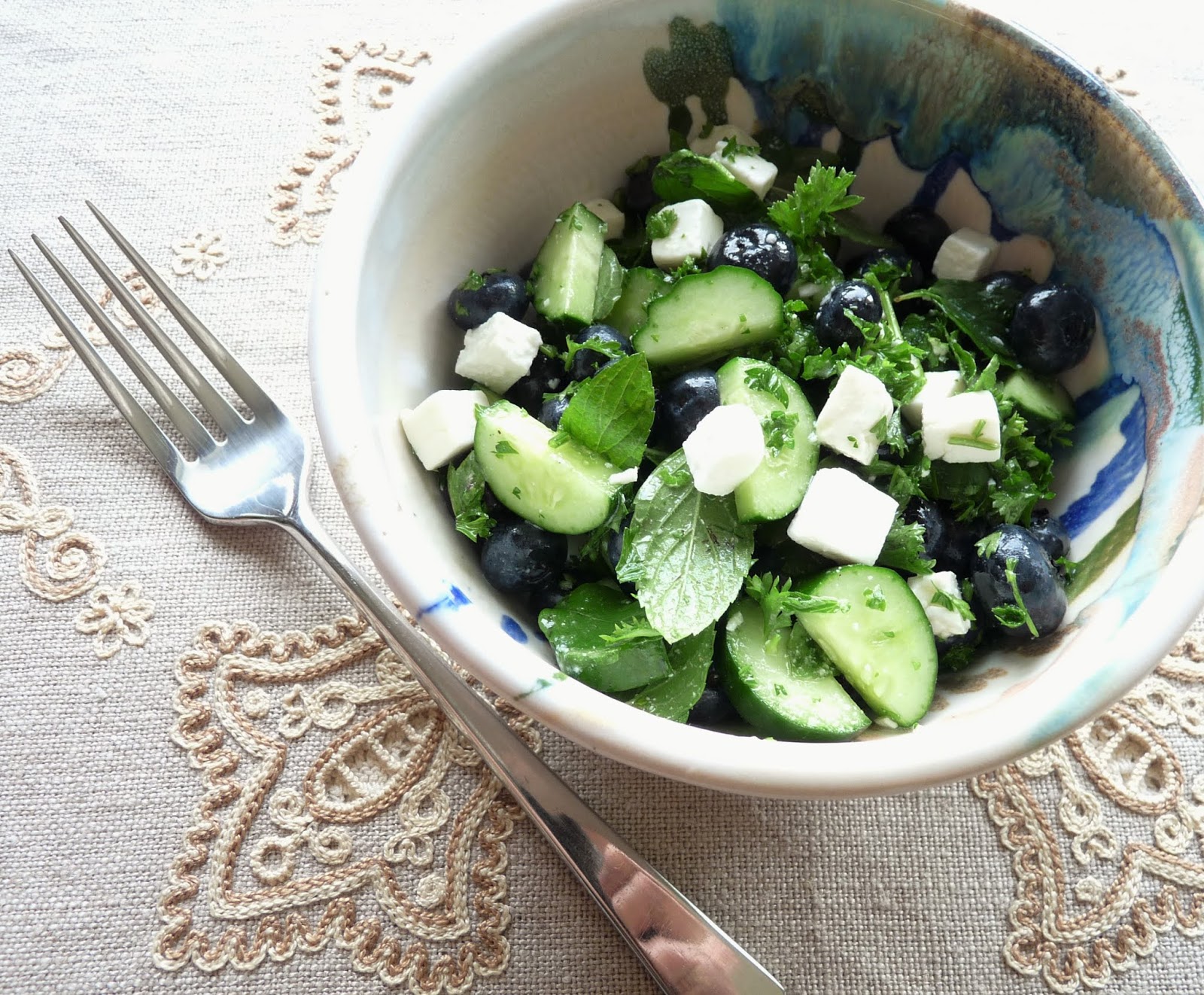
Blueberry Cucumber Salad with Feta

Well, it's a salad. Made with stuff that was around. Because, you know, it's in season. I can't say I have very much to say about it, beyond the usual cries of "Tasty!" I like cheese and fruit in salads; it is known. 

4 servings
20 minutes prep time

Blueberry Cucumber Salad with Feta

Make the Dressing:
2 teaspoons honey
the juice of 1/2 medium lime
1 tablespoon sunflower or nut oil
salt & freshly ground black pepper to taste

Mix the honey and lime juice in a small serving bowl. It may be helpful to warm the honey first; the microwave is the easiest way, for just a few seconds until liquid. Mix in the oil, and salt and pepper to taste. 

Make the Salad:
1 medium cucumber
1 cup blueberries
2 tablespoons small mint leaves
1/4 cup finely chopped parsley
90 to 125 grams ( 3 to 4 ounces) feta cheese

Wash, trim, and peel - if you like - the cucumber, and cut it into bite-sized chunks.  Add it to the bowl with the blueberries, washed and drained well. Wash, dry and finely mince the herbs, and add them. Cube or crumble the feta cheese and add, then toss the salad and serve.


Last year at this time I made Zucchini, Beans & Onion Japanese Style.

Monday, 29 July 2019

Raspberry-Mint-Tea Slushie

Hot and muggy, isn't it!? Slushies to the rescue. I put in the lower quantity of honey, and the result was tart, astringent, and very refreshing. I wouldn't have complained about a bit more sweetness, though, and you should sweeten it to your taste.

You will need a good sturdy blender to crush the ice. Don't over-load the poor beast, and if you must, transfer the ground ice to a bowl and keep it in the freezer as you crush more, then add it back in once the extract goes in.

4 to 6 servings
15 minutes to make extract
10 minutes to make slushies

Raspberry-Mint-Tea Slushie

2 cups water
1 to 3 tablespoons honey, to taste
2 cups raspberries
1 orange pekoe tea-bag
1/3 cup washed mint leaves, stripped from the stems
OR 1 teaspoon orange pekoe tea, in a tea-ball
about 3 trays of ice cubes
mint sprigs to garnish

Put the water, honey, and raspberries in a pot and bring to a simmer. Simmer until all the raspberries have broken down, about 5 minutes. Turn off the heat and add the tea-bag and the mint leaves. Cover and let steep for 4 minutes, then strain through a sieve, pressing to extract all the liquid and discarding the solids. You can keep this extract in the fridge until ready to proceed. Don't forget to check that your ice-cube trays are full!

To make the slushies, put 1/3 to 1/2 of an ice-cube tray worth of ice-cubes into a sturdy blender and run until it is fairly fine crushed ice. Add 1/2 the extract and blend again. Shake or stir the extract before adding it. Once smooth, add more ice cubes and process until you have the texture and strength that you would like. I found 1 1/2 smallish ice-cube trays worth of ice made 2 reasonably large slushies.

Garnish the slushies with a sprig of mint and serve with a straw.


Last year at this time I made Summer Fish Cakes.