Showing posts with label 11 November. Show all posts

Monday, 6 June 2022

Turkish Stewed Peas

Well, I'm going to confess; I made this in the winter with frozen peas and saved it for now. In a funny sort of way there are lots of things that can be made in the winter but late spring and early summer are difficult. I'm also a little ahead of things here; the peas are starting to form but are not yet ready to pick. Soon, though! And I think things are a tad later than usual this year. 
 
Snow peas will be ready before shell peas, and they would work well in this recipe. I do see snow peas used in Turkish cooking regularly, so there's that. It's hard to come up with recipes for snow peas that are better than steaming them and serving with a dab of butter, but this is lovely and would make a nice change.
 
Serve this with rice or pita; it will also go well with any kind of simply grilled fish, chicken or meat. It would also be delicious with poached eggs. 
 
2 to 4 servings
30 minutes prep time 
NOT including shelling the peas
 
Turkish Stewed Peas
 
1 medium onion
1/4 to 1/3 orange or yellow bell pepper
1 clove of garlic 
2 tablespoons olive oil
1 bay leaf
salt & freshly ground black pepper to taste
1/2 teaspoon rubbed mint
1 teaspoon sweet paprika
1/4 teaspoon Aleppo pepper (or to taste)
1 1/2 cups crushed tomatoes
2 cups shelled peas

Peel and finely dice the onion. Wash, trim, and dice the pepper into pieces just a little larger than the peas. Peel and mince the garlic. 

Heat the oil in a large skillet over medium heat, and add the onion, pepper, and bay leaf. Cook gently for about 5 minutes until softened and reduced in volume. 

Add the minced garlic and remaining seasonings and mix in well. Let it cook for a minute, then mix in the crushed tomatoes. Simmer for a further 5 to 10 minutes until thickened.

Add the peas and be sure they are all down in the liquid. Simmer for 6 to 8 minutes, until the peas are tender. (If using frozen peas, note that 4 minutes will likely be enough, and the same goes for snow peas.) 

Serve at once. 


Last year at this time I made Circassian Chicken.

Friday, 13 May 2022

Stuffed Tau Pok

Last time I was in a civilized place - and apparently my definition of "civilized place" is "has a Chinese/Asian grocery store" - I stocked up on tau pok. It freezes extremely well, and I freely admit it is my favourite form of tofu. In spite of consisting of deep fried chunks, it is really not greasy and the resulting chewy/airy texture is terrific. If you think you don't much like tofu and it is the texture that puts you off, this is a good way to try it again and see.

There are a number of traditional recipes for stuffing and steaming tau pok. My take on it combines things from 2 popular versions, mostly as a matter of expedience; other than the tau pok itself these are all ingredients I can get around here. 

I found the oyster sauce added a necessary punch of saltiness to these - in spite of the fish sauce, they were not really salty in themselves. If you don't have any oyster sauce, add a bit more fish sauce or double the salt in the filling.
 
16 to 20 pieces
1 hour - 20 minutes prep time
assumes puffs are steamed in 2 batches


Fried Tofu Puffs Stuffed with Meat and Green Onions

250 grams (1/2 pound) ground pork OR chicken
2 tablespoons fish sauce
1/4 teaspoon salt
freshly ground black pepper
1 tablespoon arrowroot OR corn starch
1 tablespoon finely grated fresh ginger
2/3 to 1 cup finely chopped green onion OR chives
2 teaspoons mild vegetable oil to oil dish
1 package (185 grams; 6.5 ounces) fried tofu puffs (tau pok)
about 1/2 cup chicken stock
oyster sauce
cilantro 

Put the ground meat in a bowl with the fish sauce, salt, pepper, and arrowroot. Peel and grate the ginger, and add it. Wash, dry, trim, and chop the green onions or chives very finely and add them. Mix everything very well. 

Set up your steamer; it should hold the stuffed tofu in a dish. Mine would only hold half at a time so I set up 2 dishes to go into it. Lightly oil the dish or dishes, and turn the heat on under the steamer. If you are doing it in two rounds, be sure there is plenty of water in it, or that you can add boiling water to top it up if needed. 

Meanwhile, stuff some tofu. Cut a slit in one side (top) of each puff and put in a bit of the filling You can stuff in more than you might think and I found it useful to score off the bowl of filling to make sure it was being more-or-less evenly divided. There were 18 puffs in my package, but they are plainly hand-cut and varied a bit in size so quantity may not be exact either. Arrange them in the oiled dish(es) in a single layer, stuffing up. Place them in the steamer and pour a little chicken stock on them; just enough for them to be sitting in about 1/4" of it. Steam for 20 minutes. If you have a rack or similar thing that can go under the plate to be steamed, and which has handles to allow it to lift the plate out, that is very helpful.

If you have a second dish, check the water level, and steam it for 20 minutes with a little chicken stock in the same way. 

These will be very hot when they come out, and the spongy tofu holds some of the broth to burst out and burn you when bitten, so let them sit for a full 10 minutes before serving. Garnish them with a drizzle of oyster sauce and a sprinkle of chopped cilantro, if you like. 


Last year at this time I made Sorrel Soup.

Friday, 6 May 2022

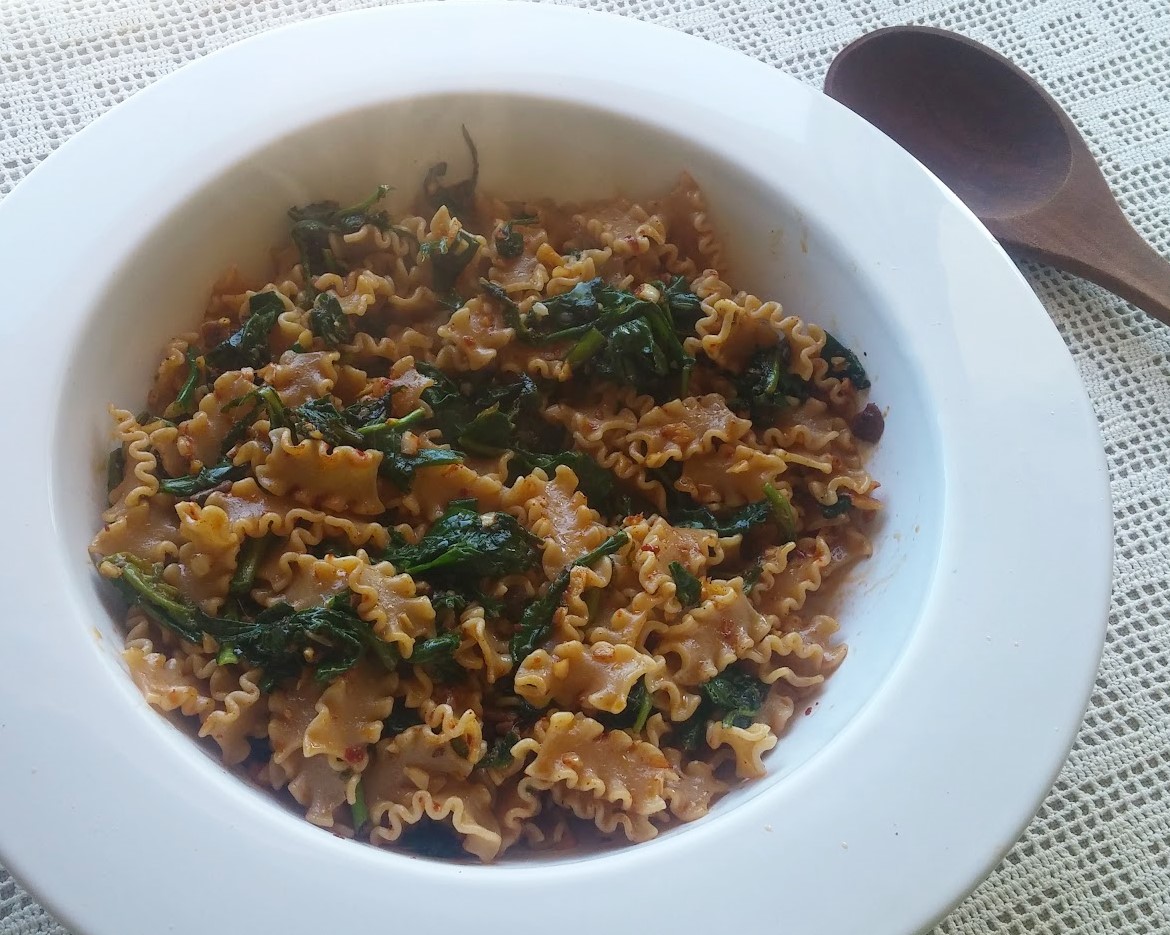
Pasta with Rutabaga Greens, Anchovies, Garlic & Chile

Here is a lively take on one of my favourite ways to prepare pasta: the pasta and some vegetable are cooked together then dressed with something richer and perhaps fried. In this case not fried, so much as infused into a generous but not too greasy amount of olive oil. (If your anchovies come with a certain amount of oil, by all means start with that when you measure the oil.) All the flavours are very strong, but in spite of that they get along with each other excellently. I used whole wheat pasta - I mostly do these day, on the rarish occasion I eat pasta at all - which can be a bit robust for more delicate sauces but which mingles well with all these equally robust ingredients. Use whatever pasta you like, though. 
 
Rutabaga greens are, as I've said before, the best (non)turnip greens, but turnip greens could be used, or Swiss chard, kale, or collards in their season. Rapini or broccoletto too, would be good, meaning this is a dish that can be made any time there are good, astringent greens around. Spinach? I think it's a little too refined to be ideal for this hearty dish, but it would work well enough if that's what you can get. Apply it with a little heavier hand, maybe. 

I'm saying 20 minutes, which is about the time for the water to come to a boil and then cook the pasta and greens, but if your greens are at all obstreperous about needing picking over, allow a little longer.
 
2 to 4 servings
20 minutes prep time

Pasta with Rutabaga Greens, Anchovies, Garlic & Chile

300 grams (10 ounces) rutabaga greens
6 to 10 cloves of garlic
1/4 to 1/2 teaspoon chile flakes
freshly ground black pepper to taste
25 grams (1 ounce; 1/2 small tin) anchovies
225 grams (1/2 pound) pasta
1/4 cup olive oil
 
Put a large pot of salted water on to boil for the pasta.

Wash and trim the greens, and chop them. Peel and mince the garlic, and put them in a small bowl with the chile flakes and pepper. Drain and mince the anchovies. 

When the water boils, add the pasta and set the timer for 1 minute longer than the recommended cooking time. When the pasta has 6 minutes left to cook, add the green, mixing them in well. 

Meanwhile, heat the olive oil over medium-low heat in a smallish skillet. When it is hot, mix in the garlic with the spices, and the anchovies. Allow them to sizzle gently in the oil until very fragrant, then remove from the heat and set aside. 

When the pasta and greens are cooked, drain them well and return them to the pot. Toss them with the hot seasoned oil and toss well to combine. Serve at once.


Last year at this time I made Cipollata.

Monday, 2 May 2022

Turkish Shepherd's Pie Kebab

Classic meat and potatoes, the Turkish way! I see a lot of versions of this on Pinterest, with the meat portion and potato portion shaped in different ways, but the dish overall consisting of all the same parts. The dishes get different names, but really, it's these components in some configuration. 

The easiest way, and the most like a classic shepherd's pie, would be to press the meatloaf mixture into a shallow baking pan, and then when the time comes, pour on the sauce then spread the potatoes evenly over the top. I've seen that done. But this shaping the meat into individual cups to hold the potato topping is even more common, although the exact shape varies quite a bit. For some reason Turkish dishes often are made into a group of clearly delineated portions like this. Perhaps it's so that if you have a large family, you know the dish will make it all they way around the table without running out because the first people to be served take too much? Or maybe I'm over-thinking it. 

At any rate, these were cute, not hard to make, and a very satisfying take on the theme of meat and potatoes. I used lamb, which is always the proper meat to use in a shepherd's pie; otherwise it's technically a cottage pie although few people seem to stick to that convention these days.
 
4 to 8 servings
2 hours. This is going to take 2 hours, with 1 1/2 hours being prep time.
 
 
Mix the Spices:
1/2 teaspoon salt
1/2 teaspoon allspice berries
freshly ground black pepper to taste 
1 teaspoon sweet or smoked paprika
2 teaspoons rubbed dry mint

Grind the salt and allspice berries, then mix all the remaining spices with them in a small bowl.

Make the Meat Patties:
1 medium onion
1 small carrot
1 cup shredded cabbage
1/4 medium red pepper
2 cloves of garlic
1 tablespoon mild vegetable oil
500 grams (1 pound) ground beef OR lamb
1 large egg
 
Preheat the oven to 375°F. Lightly oil a baking pan. 
 
Peel and finely dice the onion. Peel and grate the carrot. Wash, trim, and shred the cabbage. Deseed the pepper and dice it finely. Peel and mince the garlic.

Heat the oil in a small skillet and cook the onion and carrot until softened. Mix in the little bowl of spices. Add the garlic then the cabbage, and cook, stirring until just wilted down. Transfer it all to a mixing bowl and let it cool. 

Mix in the ground meat and the egg by hand, until you have a smooth evenly blended mixture. 

Divide the mixture into 8 equal portions, and form each one into a ball. Then press in the middle and shape each ball into a shallow bowl. Place them in an oiled baking pan, that fits them snugly but in a single layer. Bake for 20 to 30 minutes (the time necessary to cook the potatoes).

Make the Potato Topping:
700 grams (1 1/2 pounds) potatoes
3 tablespoons unsalted butter
1/3 cup yogurt
1/2 teaspoon salt
freshly ground black pepper to taste

Wash, trim, and peel (if you like) the potatoes. Cut them into even chunks. Put them in a pot with water to cover them well, and bring to boil. Boil steadily until fork tender; 10 to 15 minutes. Drain them well and mash them with the butter, yogurt, salt, and pepper. 

Finish the Dish:
1/4 cup tomato sauce
1/4 cup water
125 grams (1/4 pound) Cheddar cheese 

When the potatoes are cooked and mashed, and cool enough to handle (but still fairly hot) divide them into 8 equal portions. Shape each portion into a ball, flatten slightly, and place one on each hot, partially-cooked piece of meat. 
 
Mix the tomato sauce and water, and pour it around the meat patties.

Grate the cheese and sprinkle it over the dish. Bake at 375°F for another 20 to 30 minutes, until the cheese is browned and bubbling. Let rest 10 minutes before serving.


Last year at this time I made Vietnamese Style Noodle Salad.

Monday, 18 April 2022

Danish Meatballs in Curry Sauce

Everybody knows Swedish Meatballs! And they're delicious, no question. But rich, very rich. You would expect the Danes - who make some wildly rich dishes themselves - to try to out-do them, but in fact this popular Danish meatball dish is fairly restrained, especially if you use ground chicken. Or turkey. I didn't list it but more because I was running out of room than because I don't think you could use it. So this is really more suitable for cooking on a regular basis, and it's also quicker and easier to make.

Just like any Canadian "curry" from the past, it calls for an apple to add a little sweetness. A touch of lemon then sharpens it up. It's usually served with rice, but potatoes or noodles would be good too. Just add a green salad or vegetable to finish your meal.
 
4 servings
45 minutes prep time
 
Danish Meatballs in Curry Sauce
 
Make the Meatballs:
500 grams (1 pound) ground veal, chicken, OR pork
1 small onion 
1 large egg
3 tablespoons wheat flour OR toasted barley flour
1 teaspoon salt
freshly ground black pepper to taste
the finely grated zest of 1/2 lemon, optional
a little milk if needed
2 or 3 tablespoons minced parsley, if possible
3 cups chicken or vegetable broth

Put the meat into a mixing bowl. Peel and mince the onion, and add it, along with the egg and all the seasonings. Mix well and form into 20 or 24 equal balls. 

Bring the broth to a boil in a heavy-bottomed soup pot. Gently add the meatballs and simmer for about 20 minutes. 

Make the Sauce:
1 small onion
3 tablespoons unsalted butter
1 large apple
3 tablespoons wheat flour OR toasted barley flour
2 tablespoons Madras curry powder
salt & freshly ground black pepper to taste
the juice of 1/2 lemon OR 2 tablespoons apple cider vinegar

Meanwhile, peel and mince the onion. Heat the butter in a medium skillet over medium heat. Add the onion and cook gently. While it cooks, wash and core the apple, and cut it into dice. Add it to the onion to sauté. Stir regularly. 

When the onion and apple are softened, sprinkle the curry powder and flour over them. Mix in well and let cook for another minutes until no dry powder is visible. Season with the salt and pepper. 

Scrape them into the pot of meatballs, and mix in gently but well. Add the lemon juice. Simmer for another 5 to 10 minutes, until thickened.

Serve at once over steamed rice.


Last year at this time I made Spinach Tortilla Wraps

Friday, 15 April 2022

Iraqi Lamb & Cabbage Stew

Like most stews, there's nothing complicated about this; it just needs a little advance planning. Get the split peas and lamb cooked the day before; put everything together and simmer the next day for perfect winter comfort food. Getting towards the end of the season for that, I hope, though. It looks like after a slow start spring is finally gathering some steam. 

The recipes I looked at used lamb shank and coarsely chopped cabbage so I followed suit. However, I think that this would be just as good and certainly less expensive to make with lamb stewing meat, with or without bones although bones are better if you can find it. If you are buying your lamb from a butcher you maybe able to score some soup bones. Even a little beef bone would be better than none. In fact, if lamb is not an option I would make this with beef and still expect it to be really very good.
 
My lamb shanks were the biggest I've ever seen, so I used two for the three of us, cutting off the meat and removing the bone before serving. There was enough left over for Mr. Ferdzy and I to have it for lunch the next day. So smaller pieces of lamb are better, in my opinion, and also I would chop the cabbage more finely. With those minor changes, this is one of the best stews I've had in quite a long time. 
 
This is traditionally made with dried limes, but good luck with that. I just put in a little squeeze of fresh lime juice at the end. 

You can serve it with rice, or bread on the side. It's definitely soupy/stewy, so in any case be sure to supply spoons.
 
4 to 6 servings
2 hours 45 minutes - 45 minutes prep time

Iraqi Lamb & Cabbage Stew

Advance Cooking:
1/2 cup split yellow peas
2 cups water
1/4 teaspoon salt 
1 tablespoon olive OR mild vegetable oil
2 kilograms (4 to 6; 2 pounds) small lamb shanks
OR 1 kilo bone-in stewing lamb
water
1 teaspoon salt
 
Put the split peas, water and 1/4 teaspoon salt into a rice cooker and let them cook. Alternatively, put them in a pot and simmer gently until the peas are softened. Stir regularly. 
 
Meanwhile, heat the oil in a large skillet and brown the lamb evenly. Put it into a heavy-bottomed stew-pot with 2 cups water and 1 teaspoon salt. Cover, and simmer gently for about 1 hour, until cooked through. 

OR put it in an Instant Pot with 1 cup water and 1 teaspoon salt. Cook for 30 minutes then allow it to release naturally.
 
Both of these can be done up to a day ahead. 

Mix the Spices:
1 tablespoon coriander seed 
3/4 teaspoon black peppercorns
2 teaspoons cumin seed
1 teaspoon salt
1 tablespoon Madras curry powder
2 teaspoons sweet paprika
2 or 3 bay leaves 

Grind the coriander, peppercorns, and cumin with the salt. Mix them in a small bowl with the remaining spices and set aside until needed.
 
Make the Stew:
2 medium-large onions
6 cups chopped cabbage
2 cups crushed tomatoes
the juice of 1 medium lime
chopped cilantro of parsley to garnish, if possible

Peel the onions and chop them fairly coarsely. Wash, trim, and chop the cabbage. 
 
Add the spices and cooked peas to the meat, in a large heavy-bottomed pot. Add the tomatoes. Bring to a simmer and simmer gently for half an hour, stirring regularly. Add the onion and simmer for 15 minutes, then add the cabbage and lime juice and simmer for 10 to 15 minutes, stirring regularly, until the cabbage is done. 

If you can serve it garnished with a little chopped cilantro, so much the better. 


Last year at this time I made Onion, Mustard, & Red Pepper Bulgur.

Wednesday, 13 April 2022

Roasted Parsnip Chips

As an obsessive lover of potato chips, and as a lover of parsnips, you can bet I thought these were fabulous. You need to be picky about slicing them - getting them sliced evenly but thinly is the key to having this work.
 
I did 3 very large parsnips, and that's all of them on the plate. They really shrink down a lot in cooking so that's something to keep in mind. Next time I might decide it is worth breaking out the mandolin to slice them, and do twice as many. At least.

The line between "perfectly golden-brown and crisp" and "burnt and nasty" is probably about 15 seconds, so you must also really hover at the oven door for the last 5 minutes or so of cooking.
 
per serving
40 minutes - 15 minutes prep time
 
Roasted Parsnip Chips

1 large parsnip
1 to 2 teaspoons mild vegetable oil
salt & freshly ground pepper OR other seasonings to taste

Preheat the oven to 375°F. Line a baking tray with parchment paper. 

Peel the parsnips and discard the skins. Using the peeler, cut the parsnips into thin but even shreds. It helps to have a good sharp vegetable peeler here. You will probably get down to a point where what is left is very hard to peel into strips; give up and keep these pieces for another dish. Alternatively, and probably better; cut the parsnips into thin but even pieces using a mandolin. I wasn't going to break out the mandolin for 3 parsnips, though. 
 
Toss the parsnip slices with just enough oil to coat them evenly, then season them to your taste and toss them again. Spread them out as evenly as possible, ideally in a single layer.
 
Roast the parsnips for 20 to 25 minutes, checking them and turning them every 5 minutes. Make sure they are spread out evenly each time. Towards the end, most likely some will be done before others; pick them out and put them on their serving plate then return the rest for more roasting. Keep a really sharp eye on them for the last few minutes of cooking - they will burn very quickly once they are done.

They will cool off fast, which is fine - these are kind of like roasted potato chips, only parsnips. However, they won't keep crisp well and should be eaten promptly. 


Last year at this time I made Pulled Pork Caribbean Style.

Friday, 8 April 2022

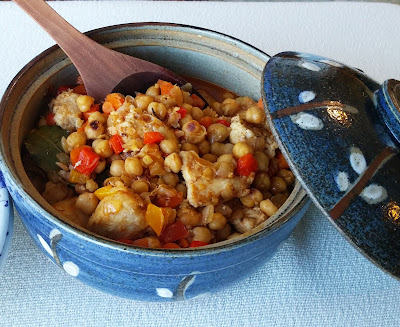
Garbanzos with Chicken & Peppers

Greenhouse peppers at this time of year; but keep this dish in mind for late summer and early fall as well. Really, this is something I would happily eat all year long, as long as I could get the peppers.
 
I know I usually refer to them as chick peas, but this dish is so distinctly Spanish, it's going to have to be garbanzos. I also have to say that if you have an Instant Pot, there is no reason not to be cooking beans from dried. If you really have to use canned beans, though, you will need 2 cans.  

There was none around at the moment, but a little parsley on top would have been ideal.
 
4 servings
1 hour 15 minutes - 40 minutes prep time 
NOT including cooking the chick peas
 
Garbanzos with Chicken and Peppers

1 1/3 cups raw chick peas
  OR 3 1/2 cups cooked chick peas
1 medium onion
1 to 3 cloves of garlic
1/2 large red bell pepper
1/2 large orange bell pepper
1/2 large yellow bell pepper
2 tablespoons olive oil
2 or 3 bay leaves
1/2 teaspoon salt
1 teaspoon cumin seed
2 teaspoons sweet OR smoked Spanish paprika
freshly ground black pepper to taste
2 cups chicken stock
1/4 cup white wine vinegar
600 grams (1.5 pounds) chicken pieces
1/4 cup barley OR wheat flour
salt & pepper to taste
2 tablespoons olive oil  

Cook the chick peas by putting them into a pot and covering them generously with water; bring to a boil, then turn it off and cover them. Let them soak for one to several hours. 

Drain the chick peas and either return them to the pot and re-cover with plenty of water and a teaspoon of salt then boil them gently until tender, or cook them in the Instant Pot - I give them 8 to 10 minutes with natural release. If cooked on the stove top, they will need 1 to 2 hours.

When you are ready to start the stew, peel and chop the onion. Peel and mince the garlic. Wash, core, and chop the peppers into dice a little larger than a cooked chick pea. 

Heat the oil in a heavy-bottomed soup pot over medium heat. Add the onion and peppers and cook for about 10 minutes, stirring regularly, until softened and reduced. Add the seasonings and mix in well, then the chicken stock and vinegar. Let this mixture simmer while you prepare the chicken to be added. 

Coat the chicken in the flour, into which the salt and pepper have been mixed. Heat the oil in a large skillet over medium-high heat, and fry the chicken on all sides until nicely browned. Add the pieces to the pot of chick peas. Use a little of the cooking broth to de-glaze the skillet, and add it back into the stew. 

Simmer for 15 to 30 minutes, until the chicken is well done and everything is thick and stewish. Rest for 5 minutes, then serve. 


Last year at this time I made Strawberry Sponge Pudding.

Monday, 4 April 2022

Belgian Endive & Cheese Tart with Walnuts

Frozen puff pastry (not to mention all the other ingredients) makes this dish rich and elegant, but it's very simple to make. A crisp green salad is all it needs to be a complete meal, and balances out the richness very well. It does well made ahead, so it would be good for entertaining, but it can't be made too far ahead, or the pastry will go soggy. It's not this recipe - that's a hazard of puff pastry generally. A couple of hours is good though.

You could also make small versions of this; it would make an excellent appetizer or hors d'oeuvre. In that case, though, I'd expect to use twice as much puff pastry as the total area covered with the filling would diminish every time you make the tarts smaller. Expect 18 (3 x 3 squares) or 32 (4 x 4 squares) little tarts. Baking time would be a few minutes less as well, so start checking them sooner. 

I dithered a bit about making this with blue cheese; if anyone ever tries that I'd love to know about it.
 
6 servings
1 hour 15 minutes - 45 minutes prep time 
plus allow some time to cool
 
Belgian Endive & Cheese Tart with Walnuts
 
Prepare the Belgian Endives:
4 medium (450 grams; 1 pound) Belgian endive
2 tablespoons unsalted butter
1 teaspoon sugar
salt & freshly ground black pepper to taste
 
Wash and trim the endives, and cut them in half lengthwise. 
 
Heat the butter in a skillet large enough to hold them in a single layer, and cook them over medium-high heat for 10 to 15 minutes, turning them over halfway through. Keep a lid on the skillet while they cook. As soon as they are turned over, sprinkle them with the sugar and season with salt and pepper.  

Once they are done, remove them from the heat and let them cool, at least enough to handle.
 
Make the Sauce:
1 tablespoon unsalted butter
1 tablespoon wheat flour
1 teaspoon Dijon mustard
3/4 cup whole milk or light cream
125 grams (4 ounces) cheese such as
   Gruyere, Gouda, Friulano - something tangy but melty
salt & freshly ground black pepper to taste
a few good grates of nutmeg
1 large egg 

Heat the butter, flour, and mustard in a saucepan and mix until they form a smooth paste; let it cook for a minute or two then mix in the milk or cream, a little at a time, to form a smooth sauce. Add the cheese, grated or cut in dice. Stir to melt it, and add the salt, pepper, and nutmeg. The amount of salt to add is going to depend very much on how salty the cheese is, but in general this dish calls for shakes of the salt shaker and not any kind of spoonfuls. 

When the cheese is melted, remove the pan from the heat. Allow it to cool enough that you can beat in the egg without the egg being in danger of cooking.
 
Assemble & Bake the Tart:
225 grams (8 ounces) frozen puff pastry, thawed 
a handful of walnuts
1/3 cup grated Parmesan cheese
 
Preheat the oven to 375°F. Roll out the pastry on a baking tray lined with parchment. Spread half of the cheese sauce over it, leaving an inch and a half to 2 inches all around. 
 
Slice the cooked pieces of endive, discarding the solid centres, and arrange them over the cheese sauce and pastry. Dot the remaining cheese sauce over them, and spread it out evenly.  Sprinkle with walnuts, and with the Parmesan cheese. Fold up the edges of the pastry to form low sides.

Bake for about 30 minutes, until set and nicely browned. Let cool to at least just warm, or to room temperature, before serving. 


Wednesday, 23 March 2022

Russian Meat Pie

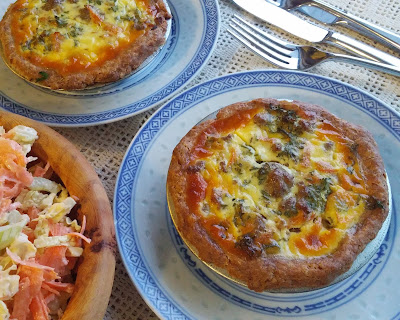
I'm giving instructions for making this as 1 large pie, but I actually made one medium pie (for my mother and I) and a couple of individual pies (for Mr. Ferdzy). This will all make sense when I also tell you that the medium pie was made with chopped lamb liver (could have use beef, or chicken for that matter) and the smaller ones had regular ground beef in them. The kind of meat you use in these is really very flexible; it just has to be chopped up fairly finely. 

This is another relative of the Russian pies made with some combination of yogurt/sour cream/mayonnaise, and no complaints here. It was lovely. 

As with the meat, the herbs can be changed around. If there's anything that's immutable, I'd say that lots of onions are required. 

It feels strange publishing a Russian recipe at the moment, but let's try to remember that people are not their nation's politics. I'd like to share a story I heard of a woman in our town, a friend of my mother-in-law's. She used to go around and share her history with high-school students. She came from Poland (I think), and was a teenager during WWII. When the Russians came in from the east, she was on the road as a refugee. She was seized by a band of Russian soldiers, raped, and left to die in a snow-bank. A little while later another band of Russian soldiers came along, who pulled her out and gave her medical treatment and took care of her until she could get to a better situation. 

Let's remember that every society has its smashers and its menders. Let us be on the side of the menders and support them wherever we can find them.
 
8 servings
1 hour 30 minutes - 45 minutes prep time
 
Russian Meat Pie
 
Make the Pastry:
1 1/2 cups whole spelt flour
3/4 teaspoon salt
3/4 teaspoon baking powder
1/3 cup cold unsalted butter
1/2 cup thick yogurt
 
Mix the spelt flour with the salt and baking powder in a mixing bowl. Grate in the butter, pausing to dust the flour over it every so often. Rub the butter into the flour until evenly distributed but still in little lumps. Mix in the yogurt to form a ball of stiff dough. Cover and set it aside.
 
Make the Filling:
3 medium onions
3 cloves of garlic
1 medium carrot 
1 tablespoon bacon fat or mild vegetable oi
1/4 teaspoon salt
freshly ground black pepper to taste
400 grams (scant pound) ground beef or other meat
1/3 cup chopped fresh parsley and/or dill
 
Peel and chop the onions. Peel and mince the garlic. Peel and grate the carrot. 
 
Heat the fat or oil in a large skillet and cook the onions and carrot gently over medium heat, stirring regularly, until softened and reduced. Add the garlic and seasonings. Add the ground or finely chopped meat, and cook until browned but still with a fair bit of pink showing. Remove the pan from the heat. 

Wash, dry, and chop the herbs. 

Roll out the pastry to fit your pie plate(s). Spread the filling out in it evenly, and sprinkle with the chopped fresh herbs. Preheat the oven to 350°F. 

Make the Topping:
1 cup thick yogurt
1/4 cup mayonnaise
3 large eggs
1/4 teaspoon salt
freshly ground black pepper to taste

Whisk the mayonnaise into the yogurt, then beat in the eggs one at a time. Season with the salt and pepper, and whisk again. Pour this evenly over the prepared pie(s). Shake them gently to settle the topping into the meat. 

Bake at 375°F for 45 to 50 minutes for a single pie, or for 30 to 35 minutes if you have made 6 single pies. In any case the filling should be just set in the middle, and show some brown spots. 

Let rest for 10 to 15 minutes before serving; also fine at room temperature.

Monday, 21 March 2022

Bulgarian Lentil Soup

This is as simple a little lentil soup as one could make; but very tasty nonetheless. Summer savory and paprika are typical seasonings in Bulgarian cuisine. When I first discovered this, I exclaimed "I'm a Bulgarian cook and didn't even know it!" 
 
Well, not quite. But I have gotten more interested in Bulgarian cuisine this winter, as you may have noticed. This is not quite the original Bulgarian soup as I found it, but close enough. The original did not have the vinegar added as it cooked, but vinegar was mixed with garlic and salt and swirled though the finished soup. I prefer to add it to the soup in good time to allow it to mingle and mellow, and to use a more Turkish finish of garlic yogurt. Since the Bulgarians also use garlic and yogurt in quantity, I'm sure I am not the first to do so. If you don't want it you don't have to; but we thought it a very good addition.   

I'm saying 15 minutes prep time, but you can't wander away for the hour of cooking - it does want stirring every so often.
 
2 to 4 servings
1 hour 15 minutes - 15 minutes prep time
 
 Bulgarian Lentil Soup
 
Mix the Seasonings:
2 teaspoons summer savory
2 teaspoons sweet paprika
1 teaspoon salt
freshly ground black pepper
 
In a small bowl; set them aside.
 
Make the Soup:
1 large onion
2 or 3 cloves of garlic
1 medium carrot
2 tablespoons sunflower OR olive oil
1 cup green or brown lentils
6 to 7 cups of water
3 to 4 tablespoons apple cider vinegar OR white wine vinegar 
 
Peel and chop the onion. Peel and mince the garlic. Peel and dice the carrot finely. 

Heat the oil in a heavy-bottomed soup pot. Cook the onion and carrot gently over medium heat, for 5 to 10 minutes,  until softened and very lightly browned. Mix in the garlic, give it another minute, then add the lentils and 4 cups water. 

Simmer gently for about 45 minutes, stirring regularly, until the lentils are tender. Add more water as it cooks down to keep a thick but soupy consistency. When the lentils seem to be done, add the seasonings and the vinegar. Simmer for a further 15 minutes or so, again stirring regularly and maintaining the consistency. 

Serve plain, or with a dollop of Garlic-Yogurt. 

Garlic Yogurt:
3/4 cup yogurt
1 clove of garlic
a pinch of salt 

When you mix the seasonings, line a strainer with a coffee filter and put in the yogurt. Strain while the soup cooks, then mix with the garlic, peeled and mashed with the salt.


Lasts year at this time I made Buckwheat & Flax Meal Tortilla Wraps.

Monday, 7 March 2022

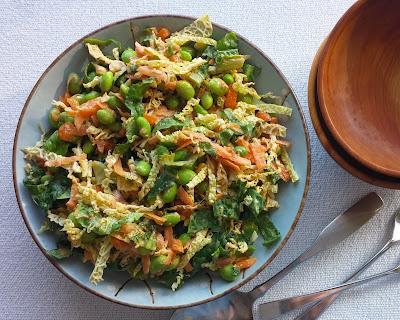
Edamame Salad

Even though we eat a fair bit of frozen vegetables around here in the winter, I tend to give them short shrift on the blog. So this week I am going to put the spot-light on them for a bit of a change. 
 
Ontario frozen edamame can be hard to find, but check your local health food store - they may have them. Mixed with cabbage and greenhouse peppers and lettuce (you could throw in a cucumber too if you like) they make a great substantial salad. 
 
I've always tried not to put sugar in vegetable and salad recipes, but maybe my tahini was unusually strong/bitter; I really felt it needed a little smoothing out. It's up to you - maybe taste the dressing before you add it.  

I assume this is the main body of the meal; it would go further as a side salad but it seems like a main dish to me with all those edamame in it. Maybe add the entire lettuce if using it as a side salad.
 
2 to 4 servings
30 minutes prep time
 
Edamame Salad
 
Make the Dressing:
1" piece ginger root 
1 tablespoon tahini
2 tablespoons soy sauce
3 tablespoons apple cider OR rice vinegar
1 tablespoon mild vegetable oil
1 teaspoon toasted sesame oil
1 teaspoon sugar
black or chile pepper to taste
 
Peel and grate the ginger finely into a small mixing bowl or jam jar. Mix in the tahini and soy sauce, then mix in the remaining ingredients, stirring well after each addition. 

Make the Salad:
2 cups frozen edamame, thawed
1/3 red, yellow, or orange greenhouse bell pepper
1 or 2 green onions
1 medium carrot
1 cup finely shredded Savoy cabbage
1/2 to 1 head greenhouse lettuce
 
Cook the edamame in boiling water for 3 minutes then drain them very well. 
 
Meanwhile, dice the pepper. Wash, trim, and finely chop the onions. Peel and grate the carrot. Wash, drain, and shred the cabbage. Wash, dry, and chop the lettuce fairly finely. Mix all these in a salad bowl. 
 
When the edamame are done, drain them and rinse them in cold water until cool. Drain well. 
 
Toss the edamame into the salad with the dressing and serve.


Last year at this time I made Braised Tau Pok & Cabbage.

Friday, 4 March 2022

Date & Apple Cake

I like to kid myself that things made with dates are "low sugar" but I'm afraid they are mostly just delicious. Still, this has a lot less sugar than most cakes.  

Like quite a few cakes with a lot of fruit in them, this can be a bit awkward to mix at the end, because the fruit seems so excessive to the quantity of batter, hence the slightly odd instructions for a combination of layering and mixing. It all works out fine in the end though, and this makes a tasty end to a meal, a good snack, or even a breakfast treat. 

Because of the amount of apple chunks in this it will not store outstandingly well. As usual, I can't say I find that a problem... it just has to be eaten. Too bad; so sad.
 
12 to 16 servings
1 hour - 15 minutes prep time
 
Date & Apple Cake

1 1/2 cups whole spelt flour
1 1/2 teaspoons baking powder
1/2 teaspoon salt 
1/3 cup unsalted butter
2 tablespoons honey
2 large eggs
1/2 to 1 cup diced dates
4 medium apples
1/2 cup milk or light cream

Measure the spelt flour and mix in the baking powder and salt. Line an 8" x 8" pan with parchment paper. Preheat the oven to 375°F.

In a mixing bowl, cream the butter and beat in the honey. Beat in the eggs, one at a time.

Chop the dates, discarding the pits, if any. Peel, core, and dice the apples fairly finely. 

Mix about half the flour into the creamed butter etc. Mix in the milk or cream, then the remainder of the flour. Mix in the dates. Because of the very large quantity of apples going into this, I found it easiest to spread about 1/3 of the batter over the bottom of the prepared pan. Sprinkle 1/3 of the apples over this, and press them gently in. Mix the remainder of the apples into the batter and scrape it all into the pan. Spread it out evenly, pressing down slightly to remove any air gaps. 

Bake at 375°F for about 45 minutes, until lightly browned and firm to the touch (done). Let cool 5 minutes then remove from the pan to a rack to finish cooling. 

Keeps for several days well-wrapped and refrigerated.


Last year at this time I made Roasted Onions with Sherry & Vinegar

Friday, 18 February 2022

Patatas al Ajillo

There are a lot of Spanish potato dishes made with this technique but somewhat varying seasonings, with a wide variety of names, often reflecting the locale where the variant is typical. The technique in question is to fry the potatoes first, then stew them in a sauce. The sauce will almost always contain paprika, and I have yet to see a version without garlic, so I am calling this Potatoes in Garlic Sauce. 
 
I put some chorizo in this, because the first version I saw had it, and I got a little fixated on it. Many recipes don't call for it, and I don't think it is at all required, especially since good chorizo can be hard to find. (I got President's Choice, because it was all I could get, but I'm here to tell you that it is best described as bad chorizo.) 
 
Tasty food is described in Spanish as "rico", that is to say; rich. High calorie foods, preferably in the form of meat, have traditionally been regarded as what food should be; perhaps not surprising in an impoverished place with more grazing than arable land, and a lot of labour to be done. In reality though, a dish like this would have been vegetarian much more often than not. The oil and potatoes still keep it plenty "rico". 

I've seen this technique in Hungarian dishes as well; if you want to go in that direction, omit the saffron, go a little lighter on the garlic, and use Hungarian paprika. If you want to put in sausage, use a dry smoked Hungarian sausage instead of the chorizo, and there you are. 

To my amusement, this reminds me of a favourite dish from my high school days, when I would order French fries with gravy from the school cafeteria, then douse them generously with vinegar and ketchup. I haven't seen leftover French fries in, uh, two years at least, but should such a thing ever reappear, I think toasting them up in a skillet and finishing them in a sauce like this would be a very reasonable way to have them.
 
I forgot to toast my flour; it should be done before you get started. I don't think it was a dire omission. 
 
2 to 4 servings
1 hour - all working time
 
Spanish Potatoes Cooked in Garlic Sauce

Prepare & Fry the Potatoes:
600 grams (3 or 4 large) potatoes
2 to 6 cloves of garlic 
1 medium onion
125 grams (1/4 pound) good dry chorizo
1/4 to 1/3 cup mild vegetable OR olive oil 

Wash and trim the potatoes; peel them if you like. Cut them into thick (1/4"/1/2 cm) slices, placing them in a large bowl of cold water as you work. Let them stay there until you are ready to start cooking. 

Peel and trim the garlic, and cut each clove into 3 slices. Peel and chop the onion - set it aside. If using chorizo, chop it into medium dice. 

Heat the oil - enough to cover the bottom of the pan by the thickness of the potatoes - in a large skillet over medium-high heat. Add the garlic cloves and let them fry until a pale straw gold, stirring to keep them cooking evenly. This won't take more than a minute or two. Remove them with a slotted spoon to a food processor or (more traditionally) a mortar. 

Lift the amount of potatoes you can fry at once from the water, and pat them dry. Fry them in the oil until a good golden brown on both sides; turn them as needed. Transfer them with the spoon to a plate as they cook, adding more dried potato slices to take their place, until they are all done. This is a slow process; allow 30 to 40 minutes depending on the size of your skillet and how brown you want them. Even if you like them fairly pale, they do need to come out of this process about half cooked so don't rush them - turn down the heat instead.
 
Make the Sauce & Finish:
3 tablespoons chopped parsley
1/4 to 3/4 teaspoon salt
1 teaspoon Spanish paprika (de la Vera)
1/4 teaspoon saffron threads
1 teaspoon toasted barley OR wheat flour
3 tablespoons apple cider vinegar OR white wine vinegar
1/2 cup water OR broth
1 tablespoon chopped parsley, again
 
While the potatoes fry, chip away at making the sauce. To the garlic add the washed, dried, and roughly chopped parsley, the salt, paprika, and saffron. Grind to a relatively smooth paste. Then add the flour, mix, and stir in the vinegar. 
 
Once all the potatoes are cooked and removed to a plate, drain the oil out of the pan. Don't wash it; in fact leave just enough oil to now put in the onion and cook it until softened and lightly browned. Add the seasoning purée to the pan. Use the water to swish out whatever utensil you made the paste in, and add that to the pan as well. Gently return the potatoes to the pan. Simmer for a further 15 or 20 minutes until the sauce has thickened to coat the potatoes. Serve at once, with the remaining chopped parsley sprinkled over the top. 


Last year at this time I made Balsamic Carrots.

Wednesday, 16 February 2022

Curried Rutabaga Soup

Here's a quick and simple soup to make, and it can be eaten at once or it will keep well for a couple of days in the fridge - in that case you might not want to add the cream until you are re-heating it. I'm calling fairly softly for both the curry powder and chile-garlic sauce; taste it and add more if you like, but I'm mindful that it's far easier to add more than to fix it once you've added too much, and both of those are subject to a high degree of personal taste modifications.

I didn't put any in, but it occurs to me that a tablespoon or 2 of maple syrup would be very good in this.
 
4 servings
1 hour - 20 minutes prep time
 
Curried Rutabaga Soup

450 grams (1 pound) rutabaga
2 bay leaves 
3 cups unsalted chicken or vegetable stock
2 tablespoons butter
1 teaspoon chile-garlic sauce 
1/2 teaspoon salt
1/2 cup 10% cream

Peel the rutabaga and cut it into dice. Put it into a heavy-bottomed 2 litre (quart) pot with water to cover it by an inch. Add the bay leaves. Bring to a boil, and boil steadily for 40 to 45 minutes until tender. There should be about a cup of cooking water left once they are done, but check the pot several times during the cooking period to ensure it does not run dry - add a little more water if necessary. 

Remove and discard the bay leaves. Purée the rutabaga with the cooking water, then leave it in the blender while you melt the butter in the cooking pot. Add the curry powder and let it sizzle in it for a minute or so. Add the puréed rutabaga. Swish out the blender with some of the stock, then add it to the pot as well. Taste, and season with chile-garlic sauce and salt to taste; adjust the amount of curry powder now too if you think it needs a little more. 
 
Bring the soup up to a simmer, then add the cream. Continue heating the soup until it is on the edge of simmering again, then serve at once. As always with cream soups, don't let it boil again for fear of curdling.


Friday, 11 February 2022

French Onion Strata

I'm calling this a strata, but it's basically French onion soup that has solidified into an equally delicious main dish. Serve it with a salad, and that's a meal. 
 
It's a little amazing to me how long long it takes onions to cook down, and also how many of them you will need. You can't wander off and leave them, either. It does make this feel a little luxurious. However, once it's in the oven all the work is done, so this is a good dish for casual entertaining, or just for days when you are pottering around the kitchen anyway.
 
4 to 6 servings
2 hours - 1 hour prep time

French Onion Casserole

6 medium-large (8 cups sliced) pink or yellow onions
2 tablespoons chicken or bacon fat, or mild vegetable oil
3 or 4 cloves of garlic
1 teaspoon rubbed savory
1 teaspoon rubbed thyme
1/4 teaspoon rubbed rosemary
salt & freshly ground black pepper to taste
300 grams (10 ounces) stale but good quality bread
2 tablespoons chicken or bacon fat, or mild vegetable oil
2 large eggs
1 1/2 to 2 cups chicken, beef, or vegetable stock
250 grams (1/2 pound) Gruyere, Gouda, Comte, or Havarti cheese 

Peel the onions, and cut them in half from pole to pole. Slice them into thin half-moons. Heat the fat or oil in a large skillet over medium heat, and cook the onions for 40 to 45 minutes, until golden brown. Stir regularly; towards the end you will need to stir them frequently. They should be a fairly even golden brown. 

Meanwhile, peel and mince the garlic, and when the onions are about done, mix the garlic into them with the seasonings, and let it cook for another minute or two. Transfer the onions to a plate and set aside. 

Also meanwhile, preheat the oven to 400°F. Slice the bread into moderately thin slices, and drizzle them with the remaining fat (melted) or oil, in a shallow 8" x 10" baking (lasagne) pan. Toss them to distribute the fat and to allow them to stand as separately as possible. Bake them for 15 minutes until crisp and lightly browned. Reduce the oven to 375°F.
 
Whisk the eggs, then whisk in 1 cup of the stock. Dice one half of the cheese and slice the other half thinly.
 
Toss the caramelized onions into the toasted bread. Mix in the diced cheese. Drizzle the eggs and stock evenly over the bread and mix again. Let rest for 5 minutes, then drizzle with more stock if necessary. The mixture should be moist, but all the broth should be absorbed and the bread should not be soggy. Spread it all out with the additions evenly distributed, and top with the remaining sliced cheese. Bake for 30 to 35 minutes until lightly browned and bubbling. Let rest for 10 minutes before serving. 


Last year at this time I made Chocolate-Sweet Potato Mousse or Frosting.

Monday, 7 February 2022

Potage Albert

I found this simple little soup in an old Canadian cook book. Most of them contain recipes which now fall somewhere between thoroughly obsolete and utterly boring, so it's always a bit of an exciting moment when I find something that looks serviceable. However, a little while later I found the same recipe in a just slightly older cook book called French Household Cooking, put out by Country Life in 1908. Tsk, tsk.
 
The first recipe was much simplified in transition, and it changed again in my hands. I thought it needed some goosing up in the way of seasonings and some acid to sharpen it. The original made use of late summer produce, and I'm sure it's delicious fresh from the garden, but it makes a quick, easy and tasty winter soup with frozen beans and canned tomatoes.
 
4 to 8 servings
30 minutes prep time NOT including cooking the beans
 
Potage Albert with white beans, green beans, potatoes and tomatoes

3/4 cup of white beans, cooked
     (about 2 cups cooked white beans)
2 cups bean cooking water OR chicken stock
2 cups diced potatoes
2 cups diced canned tomatoes
2 cups diced frozen green beans
1 medium onion
3 or 4 cloves of garlic
2 tablespoons bacon fat OR butter
salt & freshly ground black pepper to taste
1 1/2 teaspoons rubbed basil
2 tablespoons vinegar OR lemon juice 

The beans need to be cooked in advance; or you can use a tin. Save the bean cooking water for the soup, unless you are using chicken stock. 

Scrub and trim  the potatoes, and peel them if necessary. Cut them into large dice and put them in a heavy-bottomed soup pot with 2 cups bean cooking water or chicken stock. Bring to a boil and simmer for about 10 minutes, until tender. Mash coarsely right in the broth. 

Add the white beans, the tomatoes, and the green beans chopped into short lengths. Set the soup to simmer. Meanwhile, peel and chop the onion finely. Peel and mince the garlic. 

Heat the fat or butter in a skillet and cook the onion over medium heat for 5 to 7 minutes until softened and reduced in volume. Add the garlic and basil, and cook for another minute or so. Add these to the soup, and deglaze the pan with a little of the broth, adding it back in when you are done.

Season the soup with salt and pepper as needed, and add the vinegar or lemon juice. Let it simmer for a few minutes until the raw scent of the vinegar (if that's what you used) is gone. Serve hot.


Last year at this time I made Lentil, Buckwheat & Walnut Loaf

Wednesday, 2 February 2022

Patatnik - A Cheesy Potato Cake

Potato pancakes are popular all through Eastern Europe. This version is from Bulgaria, and it's pretty similar to most, although the addition of cheese is a little different. Normally, it would be sirene cheese but good luck finding that around here - feta is pretty close. The result is quite substantial, and we made it our lunch with a salad on the side. If you want to serve it with more dishes, you might want to cut back on the feta.

Feta is quite salty so be careful with adding more salt. It will need a little, but only a little. If you decide to omit the cheese you should add about 3/4 of a teaspoon of salt. You could replace the mint with basil in a pinch, but dried mint is actually an underused herb, in my opinion. It's worth getting it and seeing what you think of it. It's good with cheese dishes generally.

As with any dish made with grated raw potatoes, the difference between complete success and a soggy yet crumbly mess is *squeezing* those potatoes to remove as much liquid as possible. It makes all the difference. 

I actually broiled my Patatnik for 6 minutes at the end, and it looked like it. As a lover of dark crunchy potatoes I regret nothing; but I am recommending a somewhat shorter time.
 
4 servings
1 hour 20 minutes - 20 minutes prep time

Patatnik - A Cheesy Potato Cake

1 tablespoon unsalted butter
600 grams (1 1/4 pounds) baking potatoes
2 tablespoons potato starch
1/4 to 1/2 teaspoon salt (consult the feta)
freshly ground black pepper
1 teaspoon rubbed savory
1 to 2 teaspoons rubbed dried mint
1/2 to 1 teaspoon Aleppo pepper
1/2 cup feta or sirene cheese, crumbled
1 large OR 2 small eggs
1 tablespoon unsalted butter, again

Generously butter a 9" pie plate or similar shallow baking pan. Preheat the oven to 400°F. 

Wash, trim, and grate the potatoes coarsely. Squeeze them hard over the sink by handfuls, to remove as much water from them as you possibly can. Put the handfuls of dried potato shreds into a mixing bowl. When the potatoes are all squeezed, add the potato starch and seasonings. Toss well to combine. 

Crumble in the feta cheese and mix. Break in the egg(s) and mix thoroughly. The potatoes should be coated enough to stick together, but not noticeably eggy. Scrape them into the prepared pan, and press them gently but evenly into a layer. Dot with the remaining butter. 

Bake the Patatnik for 45 to 50 minutes, until golden brown. If you feel it is done, but not quite as brown as you would like, put it under the broiler for 3 or 4 minutes. Let it rest for 10 minutes before serving. 

This can be cooked on a griddle as pancakes as well; oil it well then ladle in thin pancakes. Cook until well-browned on both sides, adding more oil as needed. Expect to get 6 to 8 fair sized pancakes. I have not tried this as I tend to think that the oven is both easier and not much slower given that you are unlikely to be able to cook all your pancakes at once, but I'm putting it out there.


Last year at this time I made Almost Whole Stuffed Cabbage

Monday, 24 January 2022

Patta Gobhi (Aloo)

Stewed cabbage; with potatoes if you like. I made Sweet Potato Roti and another dish with turnips, so I left them out. This is a simple but lively Indian-style dish, which I made as part of a meal that I will be posting about all week. It goes together very quickly, once the measuring and chopping have been done. It's amazing too, what a little spicing will do to give a new look to good old winter stand-bys.
 
4 servings
45 minutes prep time
 
Patta Gobhi (Aloo)- Stewed Cabbage, Possibly with Potatoes
 
Prepare the Vegetables:
4 cups chopped cabbage 
1 medium onion
1/4 teaspoon salt 
2 medium potatoes, optional

Chop cabbage and onion, mix by hand with salt and drain for 15 minutes. Rinse and drain them very well. Dice the potatoes into 1" chunks.
 
Prepare the Spices:
1" piece of ginger
2 cloves of garlic
1/2 teaspoon ground turmeric
1/8 to 1/2 teaspoon red chile flakes (to taste)
1/4 teaspoon ground fenugreek seeds
1/8 teaspoon ground cloves 
1/4 teaspoon salt

Peel and mince ginger and garlic. Mix everything in a small bowl. 
 
Finish the Dish:
1 tablespoon mild vegetable oil
1 teaspoon cumin seeds
1 teaspoon mustard seeds
1 teaspoon fennel seeds
2 cups chopped or crushed tomatoes
 
Heat the oil in a large skillet over medium heat. Add the cumin, mustard, and fennel, and cook until they sizzle and pop. Be careful with this; the spices can scorch very easily. Add the bowl of spices, and cook for another minute, stirring, then add the cabbage and onions. Cook for about 10 minutes, stirring regularly, until lightly browned. Mix in the potatoes, if using, and the tomatoes. Add a little water if necessary to get the potatoes cooked, then allow the liquid to evaporate to a clinging sauce.


Last year at this time I made Yiahni Potatoes.