Showing posts with label A Field Report. Show all posts

Monday, 7 October 2019

A Visit to Cedar Down Farm


Another farm tour day with EFAO! This one was Innovation on a Vegetable Farm, the vegetable farm in question being Cedar Down Farm, near Neustadt. This seemed a little similar to the event we attended at Persephone Market Garden, but since it was nearby we decided to go. Nearby is relative; it was still an hour drive away. Southern Ontario is big! Like Persephone, Cedar Down supplies vegetables through a CSA plan, as well as to a few restaurants.

We gathered in front of the barn where vegetables are cleaned and stored. Note the equipment lined up against the wall of the barn. Cedar Down is a larger operation than Persephone, with 4 workers, aiming to become 4 1/2, versus 1 1/2. One of the big differences the degree to which Cedar Down uses mechanization.


We started with a tour of the garden, in particular the four big greenhouses, 2 of which are moveable. This one contains tomato plants. Leslie Moskovits, one of the farmers, was very excited about a system from Qlipr, a Dutch company, that supports the tomatoes and is very easy to install and move - it's a bit like suspending tomatoes from coat-hangers, which slide around and can be lifted off the support string for access to the top of the plant, no ladders required. .

Leslie and Jeff Boesch, her partner, have been experimenting with grafting tomatoes for increased production and longevity of the plants. There is a fairly steep learning curve involved - or at least it's a rather chancy operation - but grafted tomatoes do deliver, and they will continue to work with them. The root stock supplies the plant with disease resistance, but the tomatoes are still exactly the type which gets grafted onto it.  


This greenhouse contains pepper plants, and a third contains cucumbers. The greenhouses are used for early spring greens, then changed to other plants as the regular garden season commences. Unusually, Cedar Down has three CSA seasons: spring, summer, and winter meaning that customers can choose what time of the year they want to receive vegetables from the farm, up to all of it.


Leslie talks about the ins and outs of the greenhouses. Mostly they are fairly simple, but there are complications. Two of them move on ski-like bases, and the cucumbers require a system of fans to prevent them from succumbing to mildew.

Moving a greenhouse requires that the ends be removed, and the greenhouse braced to prevent it from flattening out as it is moved. It is locked in place with metal posts which are detached for moving. Then it is pulled to the new position, where another set of metal posts await it. Those are locked in place, and the ends replaced. 


Here, squash cure in one of the smaller greenhouses, which also has greens started for late autumn into winter crops.


There are about 6 acres of vegetables in the fields each year, with about the same planted in a cover crop. Unusually, the fallow fields are kept in cover crops for 2 years. Jeff and Leslie use a no-till system as much as possible, but they do till around the edges of the fallow fields, lest they shrink - quite considerably - due to the incursion of weeds.


I mentioned that this is a more mechanized farm than most small market gardens. Here is a piece of equipment which allows three people to be planting rows at once. The tanks put water onto the seedlings so they go into the ground well watered.


I was amused by the vegetable washing station, which consisted of two re-used bathtubs and some plastic laundry baskets. Looks like it works very well, though, for the investment.


Leslie talks to the group about the running of the farm. They raise no animals on the farm, other than a few family chickens, but they fertilize extensively with Biofert, as well as feather meal, fish based fertilizers, and gypsum.


Vegetables at a cleaning station in the barn await storage in one of several cold rooms. Later they will go into winter CSA boxes - a bit of a rarity in the Ontario market gardening world.

Friday, 13 September 2019

A Visit to St. Mary's Farmers Market


Mr Ferdzy and I drive down to Windsor almost every month to visit his mother, who is now residing there. This time, we stopped in St Mary's and spent 2 nights there as a mini-vacation. Our final night was Friday, so we stopped by the farmers market very briefly on Saturday morning.

It's been a while since I've done a market visit! Partly because once you are growing most of your own vegetables, the appeal does wane and partly because we have been so busy these last few years. I do miss them though.

St Mary's farmers market is fairly small, but seems like a particularly nice market nevertheless. It starts at 8:00 am Saturday mornings between Victoria Day weekend and Halloween (aka the end of October). Most markets seem to stop after Thanksgiving so that's a nice little bonus 2 weeks.


This fun little sign advertising all things chicken (plus dog treats and garlic) caught my eye.


The last (getting there, anyway) of the peaches next to the first of the apples, plus pears, plums, and other fruits at this stand. Even without the neon labels they'd be very colourful.


These vegetables are almost as colourful. Perky greens, purple kohlrabi, a rainbow of peppers, beans, beets, garlic, shallots, summer squash, and there was even some of the elusive fennel bulbs.


Immigrants have done wonderful things for Canadian food in my lifetime and it seems at the moment that many farmers markets have a Syrian family selling their home-made dishes. That's what I call a win-win situation.


Corn! Haven't seen very much of it this year - mind you I haven't been looking since I shouldn't eat it - and potatoes. Hm, shouldn't eat them either. That leaves carrots, tomatoes, and what looks like homemade jams. Which I shouldn't be eating... oh well, more for the rest of you.


Big bunches of flowers give the fruits and vegetables a run for the title of "most colourful". Okay, I think they win!


Even the picnic tables got little arrangements.


Gladiolas - the quintessential end-of-summer flower. Wow!


Some really magnificent melons next to sign for a whole array of intriguing fruits and vegetables, behind them all kinds of pasture-raised pork products.


Okay, some canning I could eat! I think this company is based in London.


And finally, the one thing we actually bought - some 100% rye bread from Breadtopia. We've been eating it all week and it is amazing! The rest of the baking looked really lovely but less like things I could eat.

It hardly seems fair - not only is St. Mary's a beautiful little town in a very attractive setting with lots of walking and hiking in the area, they have an impressively good farmers market for their size. Now we wish we lived much closer. If you are nearby, it's definitely a market that should be checked out.


Friday, 26 July 2019

An EFAO Workshop on No-Till Growing at Persephone Market Garden


Wednesday afternoon saw us out, standing in a field, as we were given a tour of Persephone Market Garden by farmer Kristine, for members of the EFAO. This was a workshop on how they are transitioning to no-till market gardening. Our garden isn't a market garden, but it's big and unwieldy, and no-till definitely interests us.

What you see in the photo above is literally the foundation of this technique - a big pile of composted sheep manure. Kristine and Thorsten keep a small herd of sheep mostly for this manure, although they also provide some meat and wool.


Once we were past the manure we walked up a slight slope to the upper garden. There are at present four quadrants of about 1/4 acre each to the garden, with the potential of up to six sections. Tomatoes are a major crop for Persephone, and Kristin plants a 100' row of tomatoes, then a row of something else, then another row of tomatoes in this section. Here you see watermelons (Crimson Sweet) in between the tomatoes. Other rows were of onions, carrots, salad green, etc. They are all heavily mulched in chopped straw.

Kristine plants varieties in multiple locations throughout the garden, so that localized problems don't necessarily mean the loss of the entire crop. 


One of Kristine's garden helpers checks for ripeness. This section is mostly peppers, with hoops in place to cover them when the weather requires it in the fall. Persephone Market Garden is in between Owen Sound and Sauble Beach, on the Bruce Peninsula, and frost comes in September.

You can see that the rows between the vegetables are covered in landscape fabric, weighted with old tires. The first step towards no-till is to remove as much of the existing weeds as possible, usually by smothering/heating them under a barrier cloth or plastic. You can see an open field beyond the planted section, where Kristine is, in fact, still tilling the ground to eliminate as many weeds as possible, especially persistent running grasses. Once a no-till situation has been established, maintaining it is quite do-able; the hard part is getting there. I know from our own garden that twitch grass just regards a plastic ground cover as a kind of blanket, and gets cosy.


There was a very good turn-out for this workshop. People came from as far away as (nearly) North Bay, from as far south as near Lake Erie. Most of them are also market gardeners. 


No-till gardening requires the tolerance of a certain level of weeds. The idea is to keep the ground covered, with mulch or landscape cloth if necessary, but preferably with plants. Once the ground is clear enough, a layer of compost (that sheep manure, augmented with horse manure from another local farm) is placed, and seedlings transplanted into it. Mulch is added, and as plants are harvested the process is repeated.

Kristine has adopted the no-till system used by Singing Frogs Farm, in California, who were pioneers in the technique. The goal is improved soil health, including a complex of beneficial microrrhizal interactions, and the retention of organic matter and, crucially, water. I noted that in spite of a very hot, dry summer (at least this latter half of it) plants looked green and healthy.

Actually, the farm struggles with some water issues generally. They are located on the lower slope of a drumlin, and water from the near-by road which is not plowed in winter settles  onto the upper part of the garden where it is held in place by the clay sub-soil. To alleviate this situation, drainage ditches have been dug between the lower edge of the field and the driveway. Future plans involve installing a water-collection pond near where the compost pile in the first photo sits, which would direct water from the upper fields, keep it for irrigation and possibly even moderate early frost effects on the garden.


The plants that end up in the fields start here, for the most part. Only a couple of crops, such as carrots, are direct seeded. This is a new greenhouse installed in the last year, dug into the ground for temperature moderation in both hot and cold seasons, and with large water tanks under shelves of plants also for temperature moderation.


In the summer, the greenhouse is covered with shade cloth to keep it from getting too hot. Beyond it you can see a field of asparagus. I was surprised and intrigued to see that the flock of sheep was in that field - I presume they eat everything but the asparagus. How convenient!


Here is a better view of the greenhouse layout. We hear that in the spring it has the bonus of being canoe-able...


The building to which the greenhouse is attached is where vegetables are sorted and packed. There is an out-door wash area, roofed but otherwise open, with steel sinks, spray faucets, and a mesh table for drying off the washed veggies. Then they come in to this roller-topped table set up where orders are packed in tubs.


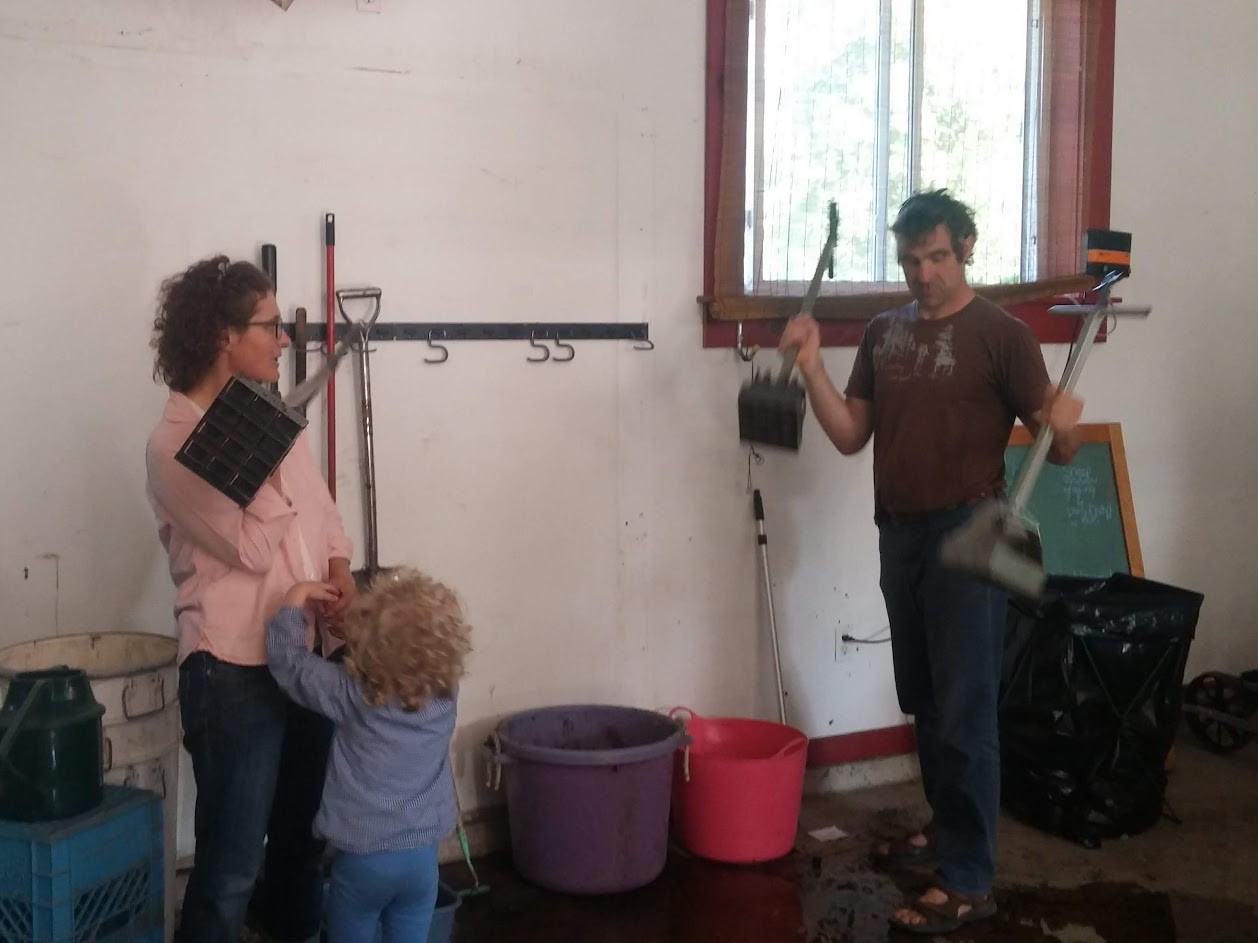
Finally - well, not actually finally, but finally for the tour - we had a look at the tools used to form the soil blocks in which vegetables are started, in a mixture of seed-starting mix and compost. After that, the real final part of the tour was a lovely pot-luck dinner, of which I took no photos because I was too busy eating and chatting. A good time and good food was had by all, until dusk, mosquitos and long drives home required us to leave. Many thanks to Kristine and Thorsten for this tour. I hope Mr. Ferdzy and I will be able to incorporate some of the ideas into our garden. 


Addendum: Thorsten sent a photo of the attendees gathered for the pot-luck!

Monday, 8 April 2019

A Lamb Banquet with Ontario Sheep Farmers


It's been a while since we've been on an outing around here! So when I saw a poster advertising the 17th Annual Lamb Banquet, put on by District 2 of the Ontario Sheep Farmers, I told Mr. Ferdzy he was taking me out for dinner. It was a bit of a drive to the Egremont Optimist Club in Holstein (Holstein! There's that place again!) but the room was full. Lots of people are prepared to do some driving for a lamb banquet, I'd say.


In addition to the meal there was a silent auction with items running from the charming and whimsical...


... to the more practical.


Another view of a few of the silent auction offerings and the attending crowd.


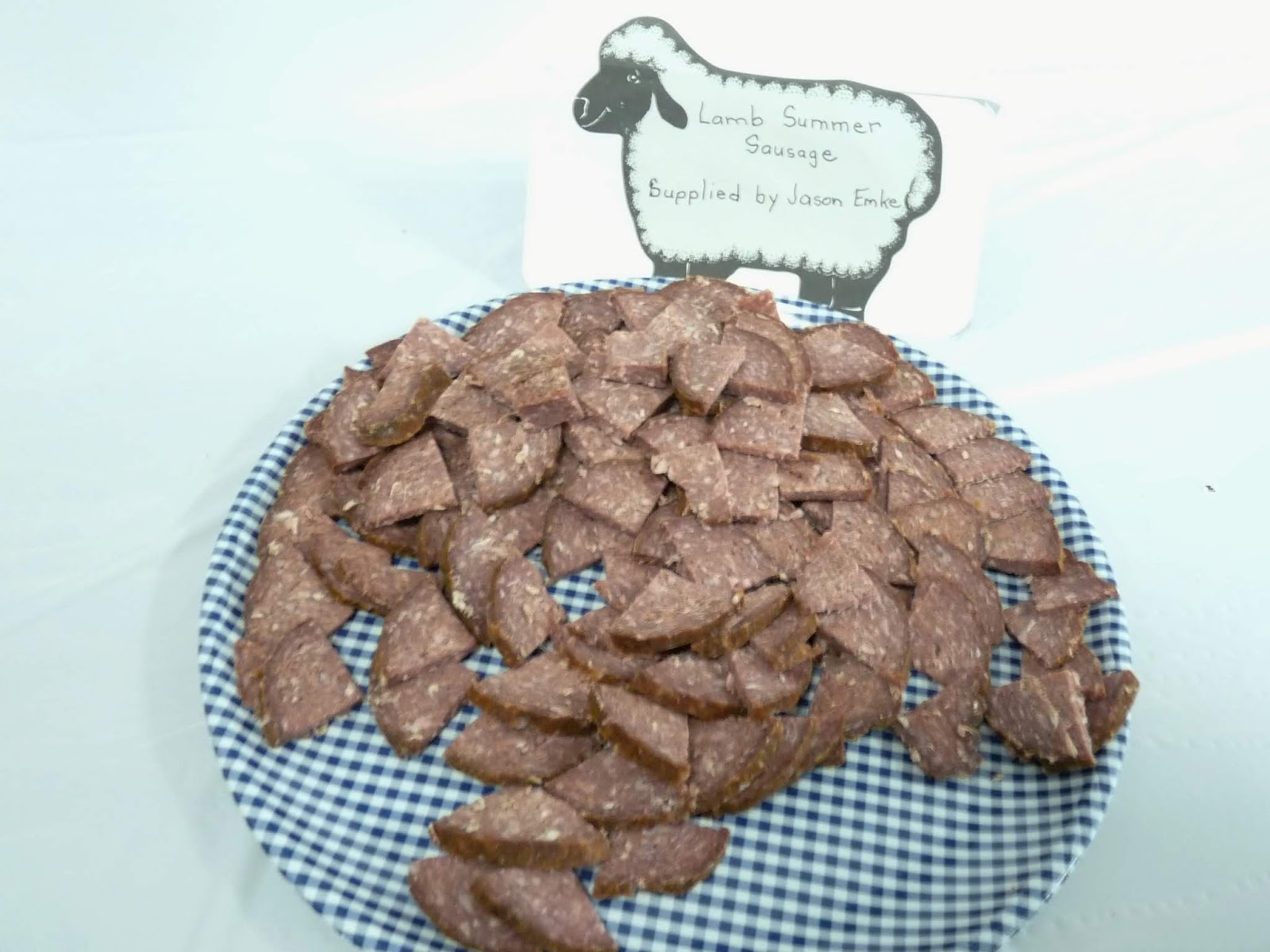
As people found their seats and introduced themselves to each other, they were able to snack on lamb summer sausage (supplied by Jason Emke) and little lamb shishkebabs, which appeared in waves as they came off the grill, and so are not shown as they disappeared almost as quickly.


I stuck my head inside the kitchen, where the volunteers seemed to have everything under control just a few minutes before dinner was announced.


A lot of planning goes into this kind of event, with contributions of various kinds from a lot of different places and people, not to mention the planners and volunteers.


After a few very short introductory speeches, we were called up by table to help ourselves from the buffet. Of course we were on the side of the room that got called up last! We have a talent for getting the slowest line in the grocery store, too. We didn't mind the wait though, because shortly after we first sat down, a couple came and asked if the seats opposite us were taken. We said they weren't, and then they sat down and we all looked at each other, and said, "My! You look familiar!"

It was Bill Stonehouse and his wife, from whom we bought our last couple of lambs, some of which is still in our freezer. It was nice to have someone we knew to chat with, and we hardly noticed the wait (which wasn't all that long, after all).


And here's what I ate, minus the summer sausage and shishkebabs, although you can see the discarded skewers. I was a bit amused by the fact that every vegetable seemed to have been chosen as something pre-diabetics should not eat, except for a couple of salads which I'm sure had sugar in the dressing. I skipped the desserts (sob!) and the roll, and just had a small spoonful of each of the veg, including some lovely real mashed potatoes. Oh well, more room for lots of lovely LAMB!

And now I must confess that I am a bad reporter. I'm sure the post dinner time included speeches, and there was something about $5 lamb and mysterious buckets, there was the silent auction to conclude, and, well, I don't know exactly what, because mindful of the fact that our next day was pretty much scheduled and that we had an hour drive to get home, we snuck out before that part started.


Last year at this time I made Garlicky Dill Vegetable Salad.

Monday, 27 August 2018

A Fundraising Dinner for EFAO and a Visit to The New Farm


Last Thursday a couple of events coincided. The Ecological Farmers of Ontario (EFAO) held their first-ever fund-raising dinner at the The New Farm, which is just 45 minutes away from us. It was also my birthday, so I strong-armed Mr. Ferdzy into going as a birthday treat. Since we were in a wild and reckless mood, we took my Mom too. At $150 each, that was a bit wild and reckless. Still, I think this is about the second time in 30 years together that I have made Mr. Ferdzy take me out for my birthday so on a pro-rated basis he has not done badly.

We arrived in the late afternoon and enjoyed some drinks and nibbles before dinner, which was to be served in the barn - you can see one of the tables at the far right of the photo. We didn't know too many people so we milled around for a while. People seemed to be pretty friendly, and being the world's dorkiest conversationalist, I tried to break the ice by asking, "So, are you a farmer?" There were some, but mostly people weren't, is my impression. 


Guillermo, one of the chefs from Richmond Station restaurant, passes out appetizers and chats with some of the guests. Guillermo - gosh I hope I have that name right, somebody please correct me if I don't - actually works at the farm, growing vegetables in the large (laaarge) kitchen garden, which then go to the restaurant in Toronto. Except for the ones that are eaten on the spot, of course. The New Farm has a very efficient and attractive cooking and dining set-up and meals and events happen there regularly.


I can tell you who two of these people are; Mr Ferdzy and the famous Mom, both on the right. The man in the violet shirt is Thorsten Arnold, who told me that "his wife is the farmer, he just helps some" and not that he is the Strategic Initiatives and Fundraising Coordinator for EFAO. But I guess it serves me right; I asked him if he was a farmer.


 A couple of the chefs haul vegetable scraps out to the poultry pen. The chickens are plainly prepared for this routine, and mobbed the scraps as soon as they were dumped.


Gillian Flies (left) and Brent Preston (centre) are the farmers behind The New Farm. They introduced themselves and the event, and then we heard a few words from Ali English (right) who is the executive director of EFAO.


Next Gillian and Brent gave a tour of the farm. They talked about their conversion to a no-till system, newly implemented, and the changes they are already seeing. Behind them is one of their fields, recently mown, in which a "cocktail" cover crop had been grown. Sunflowers, radishes, and an assortment of other plants were grown to pull up nutrients from the depths of the soil and provide organic matter. They will compost over the winter then provide improved soil for spring planting.


The New Farm started as a mixed vegetable farm, but has evolved to supply mostly salad greens to mostly restaurants (about 70 of them, between Toronto and Collingwood) and a few markets; about 20 of those. That white streak in the background is another field of greens, being kept under row covers to keep the pests out.


 One of the new features of the no-till system is the use of tarps to prepare planting areas, by killing the weeds, and possibly warming the soil. Although as Brent said, that has not exactly been an issue this year. The photo above makes it clear that there are surprising differences between the covered spots and the uncovered spots. Ignore the lettuce on the right and focus on the spinach seedlings in the centre. The ones on the right were planted in the area that had been covered by a tarp. The ones on the left were planted in the area which was not covered. There was a very distinct line between the two!

The tarps they are using are made of a plastic film, actually for use with silage on dairy farms, as it is readily available and affordable. 

 Next we all trooped over to the "kitchen garden" The woman in the front there is Fran McQuail, one of the founders of the EFAO, of Meeting Place Organic Farm. She is looking at the beds of carrots, which are being grown as part of a trial of carrot seeds. EFAO does a lot of farmer-led research, which it turns out is a lot more complex, expensive and generally not done, than you would have thought. Because ecological farmers don't tend to be big consumers of industrial farm products, they don't tend to have much research done on their behalf. This is one of the real benefits of belonging to EFAO.


 Guillermo and Katrina McQuail in the garden.


And then, it was time for dinner. I took a picture of this first plate that was brought out, a delicious sign of things to come, with hummus, quinoa tabbouleh, roasted tomatoes, arugula and amazing little homemade pita breads  - the extra touch that let us know that dinner, by chef Carl Heinrich of Richmond Station, was going to something out of the ordinary.

After that the dishes came fast and furious, and I was too busy eating and talking to our neighbours to take any pictures. There were some really delicious beets with yogurt and mint (yes, there was a definite middle-eastern vibe going on); there was charred eggplant with yogurt and corn; stuffed pattypan squash; and a fairly simply cooked pastured chicken with grilled scallions. It was all so good!


At the very end I remembered to take one more picture of the very impressive peach shortcake which finished the meal, as we listened to a short speech from Tony McQuail. It wasn't quite as dark as the photo makes it out to be; but I did need to use the flash. After that we headed out, as we still had a bit of a drive to get home. It was a very enjoyable evening and I was sorry to see it end.