Wednesday, 29 September 2021

Hawawshi - Stuffed Pitas

Apparently this dish, which is sort of the Egyptian version of fast food hamburgers, was invented in the 1970s by a butcher named Hawawshi, who sold them in Cairo from a cart. 
 
It's a simple mixture of spiced meat with some vegetables, stuffed into pita bread halves (in Egypt they use a slightly thicker but similar bread called baladi; if you can get it you should use that) and baked or grilled until the meat is cooked. 
 
Many recipes call for wrapping the mixture in a homemade bread dough, but it's at least as common just to use pre-made bread. I was perfectly happy with whole wheat pitas. I've made these a couple of times, once right on the parchment and once on a rack to keep them out of the oil that exudes as they bake. It helped, but didn't make as much difference as I expected, so if you don't have one, don't worry. Some people call for cooking these in a panini grill. I haven't tried that, but I plan to. Also, you can fill these and freeze them for later. Thaw in the fridge before cooking. 
 
Keep the vegetables as dry and well-drained as you can to keep the hawawshis from getting soggy. Be sure when you are filling them to get the meat spread right to the edges, and in a thin, even layer. For this reason, cut and open all the pitas before you start filling - it will be hard to get them open properly otherwise.   
 
4 servings
50 minutes - 20 minutes prep time 

Hawawshi - Egyptian Meat-filled Pitas
 
1 small onion
1/4 large red or orange pepper
1 medium plum (paste) tomato
1 or 2 cloves of garlic
1/4 cup chopped parsley 
1/4 cup chopped cilantro
2 tablespoons fresh chopped mint OR 1 teaspoon rubbed dry mint
3/4 teaspoon salt
freshly ground black pepper to taste
1/4 teaspoon cumin seed
1/2 teaspoon coriander seed
1/8 teaspoon ground cinnamon
1/8 to 1/2 teaspoon Aleppo pepper (to taste)
400 grams (14 ounces) ground beef OR lamb OR blend
2 large OR 3 medium pita breads
a little olive oil 

Preheat the oven to 400°F. Line a baking tray with parchment paper. If you have a rack you can put over it, it's a good idea to keep the hawawshi off the paper.
 
Peel and chop the onion finely, and put it in a mixing bowl (along with everything else, up to the pita bread). Wash, trim, and chop the pepper finely. Chop the tomato finely, and salt it - set it aside to drain. It should be quite dry when added to the bowl. Wash and dry the herbs, and chop them finely. Grind the cumin and coriander seeds and add them with all the other herbs.

Add the beef or beef and lamb mixture, and mix well by hand.

Cut the pita in half and gently be sure they are completely open. Fill each half with a proportionate quantity of the filling, pressing it right up to the edges in a thin, even layer. Brush each filled half pita lightly with olive oil and lay it gently on the rack (or parchment paper, if you haven't got one). 

Once they are all filled and on the tray in a single layer, bake them for 15 minutes at 400°F. Turn them over and bake for a further 10 to 15 minutes, until crisp and browned. Let rest for 5 minutes before serving. 


Last year at this time I made Cauliflower Fritters.

Monday, 27 September 2021

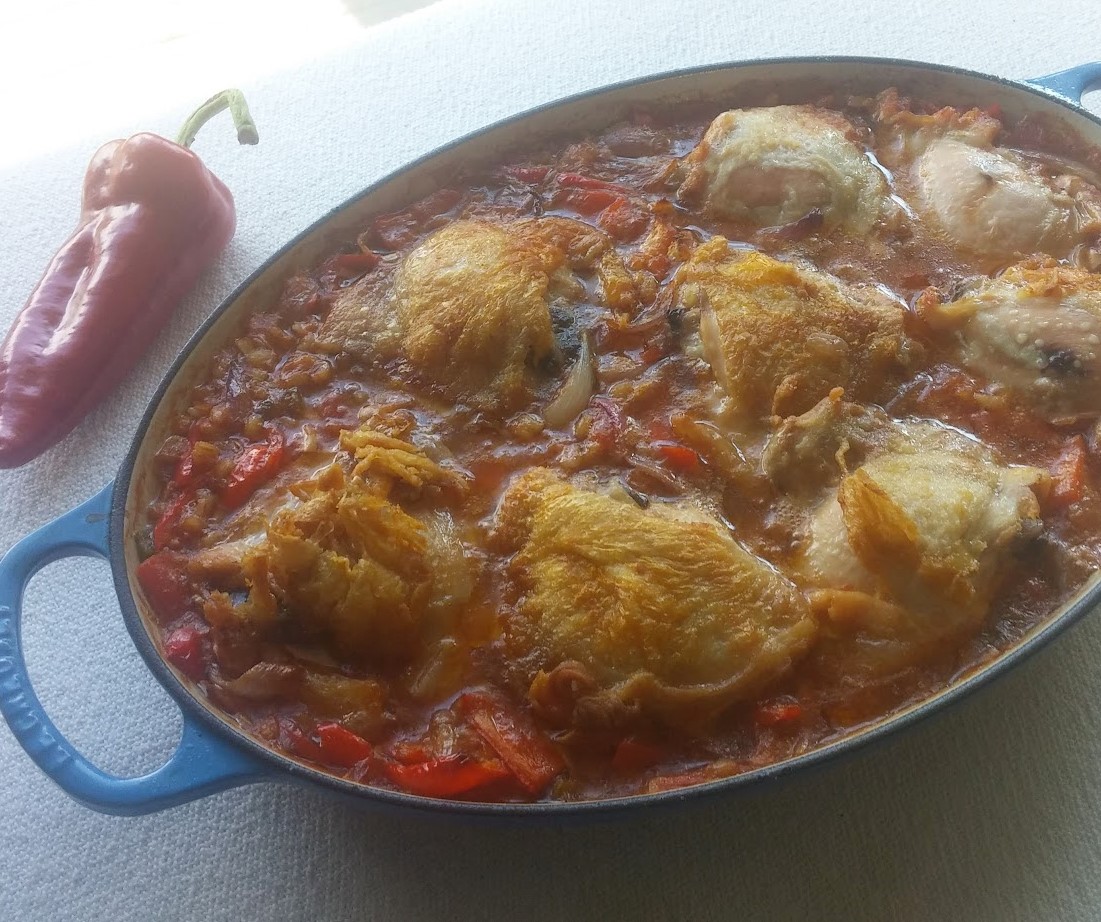
Cebada con Pollo

Everybody knows Arroz con Pollo, but as I point out to the edge (?) of tedium, I need to avoid too much arroz. Barley is a much healthier choice, and fortunately it goes with chicken just as well as rice. It does make it slower to cook, but not really any harder. 
 
This was one of the dishes my parents learned to make when we lived in Mexico when I was very young, and it has remained a favourite with everyone ever since, and has also become much more widely known. 

You can make this all winter - it's a great winter dish - with greenhouse peppers, pickled Jalapeños, and canned tomatoes but there is no doubt it is particularly nice at this time of year when all those things can be had fresh from the garden.
 
Mexican Style Chicken with Barley

Cook the Barley:
1 cup barley
1/2 teaspoon salt
3 cups water
 
Put these into the rice cooker and cook. This can be done up to a day in advance. 
 
Finish the Dish:
450 grams (1 pound) red peppers
3 small red onions
1 to 3 Jalapeño peppers
3 or 4 cloves of garlic
1 kg (2 pounds) chicken pieces
1 tablespoon mild vegetable oil
2 cups crushed or chopped tomatoes (fresh or canned)
1 cup water OR chicken stock
 
 Wash, core, and dice the peppers. Peel and chop or sliver the onions. Wearing gloves, wash, core, and dice the Jalapeños. Peel and mince the garlic. Blot the chicken dry with a bit of paper towel. 
 
Preheat the oven to 375°F. 

Heat the oil in a large oven-proof skillet or stove-top safe casserole. Brown the chicken pieces well, then transfer them to a plate. If there is excess fat left in the pan, drain if off until there is just enough to sauté the vegetables. 

Sauté the peppers and onions until softened and partially cooked. Add the Jalapeños and garlic and cook for another minute or two. Then, add the tomatoes and water or stock. Mix well. Add the barley and mix it in well, then nestle the chicken pieces into it, so they are mostly submerged but the top layer of skin stays out to get crispy. 

Transfer the pan to the oven and cook for 50 minutes to an hour, until the chicken is done. Let rest for 5 or 10 minutes, then serve. 


Last year at this time I made Chicken 65.

Friday, 24 September 2021

Frangipane Pear Tart

I am a late-comer to discovering the joys of frangipane, which is a traditional European tart filling that falls somewhere between marzipan and custard. That it is thickened and set with ground nuts rather than flour makes it ideal for people avoiding refined carbohydrates; it only needs to have the sweetener reduced and partially or totally changed to an artificial one. (I did live it up and use maple syrup; but it could be replaced with erythritol-monkfruit.) I've further reduced the chance of carbs by eliminating the crust, making this fall somewhere between a pudding and a soft cake. 

Almonds are the most traditional nut to use, but you could use all kinds of nuts to similar effect. I do think almonds are the best choice for matching with pears. I'm going to be looking for other fruit and nut pairings to be made the same way in the future; I am particularly looking forward to trying a pistachio-cherry combinations.
 
8 servings
1 hour - 20 minutes prep time
allow time to cool
 
Frangipane Pear Tart
 
1 1/2 cups ground almonds (almond flour)
2 tablespoons whole spelt flour
1/2 teaspoon almond extract
1 teaspoon vanilla extract
1/8 teaspoon salt
a good grate of nutmeg
a few good grinds of black pepper 
1/3 cup softened unsalted butter 
2 tablespoons to 1/4 cup maple syrup
3 large eggs
450 grams (3 large) Bartlett pears

Mix the almonds in a mixing bowl with the extracts and seasonings. Add the butter, and beat it in with an electric mixer. Add the maple syrup and beat it in as well. Add the eggs, one at a time, beating well after each addition. 

Preheat the oven to 350°F. Butter a 10" pie plate and dust it with a tablespoon of ground almonds. Scrape the batter into it, and spread it out evenly. 
 
Peel and quarter the pears. Cut out the cores and cut each quarter into 3 slices lengthwise. Arrange them over the batter in an attractive pattern and press them gently into it so that the batter and pears are level with each other. 

Bake for 40 minutes, until set and very lightly browned. Let cool completely before serving. 


Last year at this time I made Acelgas con Patatas - Swiss Chard with Potatoes.

Wednesday, 22 September 2021

Stewed Fish with Zucchini

I've made this three times in the last couple of weeks. The first time I had no intention of posting it - it was so plain and basic. But I enjoyed it a lot, and wanted to make it again, so I decided to make it and post it. Unfortunately, that effort turned out to be on one of the days we had a tornado warning, and while we did not have a tornado, it was so dark that I could not get a good picture. 

So here it is, the lucky third time. It's getting late enough that the zucchini are coming to an end, but hopefully there are still a few around. You can use whatever kind of white fish you like, really. I've been serving it over some drained whole grain ramen noodles and really enjoying the combination, but rice or quinoa would also be an excellent choice. I have been seasoning it very lightly - all the veggies are fresh from the garden and so good just as they are, and I don't want to overwhelm the fish. You could certainly season it up a bit, though, if you like. Italian seasonings? Curry powder? Something else?
 
2 servings
30 minutes - 20 minutes prep time
 
Stewed Fish with Zucchini
 
2 medium (225 grams; 1/2 pound) tomatoes 
2 medium (400 grams; scant pound) zucchini
1 small onion
1/2 red or orange pepper
2 cloves of garlic
2 tablespoons mild vegetable oil
1 bay leaf
salt & freshly ground black pepper to taste
2 fillets of whitefish OR 4 perch fillets (about 450 grams; 1 pound)
 
Put a small pot of water on to boil which will just cover the tomatoes. When it boils, add them and blanch for 1 minute. Transfer them to the sink and run cold water on them until cool. Peel them, chop them, and set them aside. 
 
Meanwhile, wash, trim, and dice the zucchini fairly finely. Peel and chop the onion. Wash, trim, and chop the pepper. Peel and mince the garlic. 
 
Heat the oil in a large skillet over medium-high heat. Add the zucchini, onion, and pepper, with the bay leaf, and cook until softened, reduced in volume, and lightly browned; between 5 and 10 minutes. Stir regularly. Season with salt and pepper.
 
Add the garlic and cook it in for a minute or two, then add the tomatoes. Mix in well. If the mixture seems too dry, add a few spoonfuls of water or tomato juice. 
 
Lay the fish fillets over the top of the vegetables and cover the pan with a tight-fitting lid. Reduce the heat if it seems to be bubbling a bit too madly. Cook for 7 to 9 minutes, until the fish is done. Serve with rice, noodles, or quinoa. 


Last year at this time I made Cream of Cauliflower Soup.

Monday, 20 September 2021

Mock Falafels - with Quinoa

Real falafels are not terribly difficult to make, but they do require the chick peas to be soaked in advance, and then they must be mixed in a food processor. All of which is very do-able! But sometimes you want something just a little simpler. Or maybe you are just out of chick peas, but have some quinoa, in which case you could make these instead. I don't think they are quite as good as the real thing, but somehow just cooking the quinoa in advance then mixing by hand makes them feel easier. They are still pretty darn good! Moreover, this is an excellent way to use up leftover cooked quinoa.

I do assume you have chick pea flour on hand; I use it for just about every kind of fritter and lots of other things too and could not get along without it. 

Unless and until you wrap these up in pita bread, they are gluten free. I haven't made these into a patty and eaten them in a bun yet, but I am very likely to. In that case I expect to get 6 patties.
 
The quinoa has some of the sandy texture of the soaked chick peas in the original falafel recipe but they are a little softer in texture. The flavour is really pretty close. 
 
I made these twice before posting; the first time they fell apart in the pan as I had not added enough chick pea flour. On my second go 'round, they were fine, but I found that, unlike the first time, I had to add a little water. This had less to do with the amount of chick pea flour, and more to do with differing moisture levels in the cooked quinoa. The second batch of quinoa sat a little longer, I think. In any case, you may or may not need to add some water at the end of mixing - it must be moist enough to form a ball when squeezed, but really no moister.
 
4 to 6 servings
45 minutes prep time - NOT including cooking the quinoa
 
Mock Falafels - with Quinoa

2 cups cooked quinoa
1/4 cup finely diced white OR green onion
1/4 cup finely chopped cilantro
1/4 cup finely chopped parsley
3/4 teaspoon salt
1 teaspoon cumin seed
1/4 to 1 teaspoon Aleppo pepper (to taste)
1 cup chick pea flour
none to 2 tablespoons water
oil to fry
 
To cook the quinoa: it is easiest to use leftover cooked quinoa, but to produce 2 cups cooked you will need approximately 3/4 cup of raw quinoa. To cook 3/4 cup quinoa, add 1/4 teaspoon salt and 1 1/4 cups water. Cook it in the rice cooker, or in a small pot on the stove over low heat (once boiling); it will take approximately 20 minutes and should be cooled to room temperature before you start the falafels. 

Peel or trim the onion and chop it finely. Wash and dry the cilantro and parsley and chop them finely. Put them in a mixing bowl with the prepared quinoa. Be sure the quinoa is broken down so each of the grains is separate, not stuck into large clumps. 

Grind the salt and cumin seed, and add them to the bowl with the Aleppo pepper and chick pea flour. Mix well. 

If the cooked quinoa is moist enough that the mixture can be squeezed together to form a ball, do not add any water, but mix by hand until you have stiff, not very crumbly dough. If it is too dry for this, add a little water, a spoonful at a time, until you are able to get it to hold together, but do not add enough to make it moist and soft - it should be quite stiff. 

Divide the dough into 16 equal portions and roll each portion into a ball. 

Heat the oil in a heavy skillet or aebleskiver (or appam) pan over medium heat. If you are using the latter, a teaspoon or so in each compartment will be sufficient; otherwise add enough to shallow-fry the falafels. Cook over medium heat until browned and crisp, turning to cook evenly all over. They will need 2 or 3 minutes per side; if they are browning too fast reduce the heat. Set them on paper towel as they are cooked. 

Serve warm or at room temperature, with salad or wrapped in pita (with some salad). If you like, serve with one or both of the following sauces. 

Tahini Sauce:
1/4 cup tahini
the juice of 1 small lemon
a little water

Mix the tahini with a little of the lemon juice until smooth; continue adding and mixing until all the juice is in. Slowly add a little water and continue mixing until the sauce is the texture of mayonnaise. 

Chile-Garlic Mayonnaise:
chile-garlic sauce
mayonnaise

Put as much chile-garlic sauce as you think is likely to be eaten in a small bowl. Add about an equal amount of mayonnaise or a bit less, and mix. If you think it needs more mayonnaise add more to achieve the balance you like. 


Last year at this time I made Beet Salad with Red Onions & Parsley.

Friday, 17 September 2021

Cheesy Poblano Soup

This is a very traditional soup, in poblano growing areas. Ontario is not a traditional poblano growing area, but things change. They certainly can be grown here, and every so often you luck out and find some at the grocery. Or else you grow them yourself, which is what we did. They are a really delicious chile, with a distinctive flavour and ideally just a flicker of heat to make them even more interesting. 
 
I have to say we have run into some difficulties growing them. The first attempt involved seeds purchased from OSC, and the strain they sold had plainly been selected for blandness. We were very disappointed in them. This years variety, for which we sourced seeds in the USA, went to the other extreme - the peppers are surprisingly hot. I didn't mind and enjoyed the soup a lot anyway, but Mr. Ferdzy and my mother would have liked them to be a little more as they should have been. 
 
You should probably taste your chiles once they have been roasted. If you think they are not hot enough, add a little pickled Jalapeño brine to the soup. If they seem too hot, I suspect the best plan is to replace some of them with some other, milder, green pepper - maybe some Cubanelles.
 
4 servings
30 minutes to prep the chiles
45 minutes to make the soup
 
Cheesy Poblano Soup

500 grams (1 pound) fresh poblano chiles
1 medium onion
1 stalk of celery
3 to 4 cloves of garlic
1/2 teaspoon salt
1 teaspoon cumin seed
1 teaspoon rubbed oregano
2 tablespoons barley or other flour
OR 1/4 cup cooked rice 
2 tablespoons mild vegetable oil
3 cups unsalted chicken OR vegetable stock
the juice of 1 small lime
2 to 3 tablespoons chopped cilantro
1/2 cup diced or grated Monterey Jack or similar cheese
 
Turn the broiler on to preheat for a few minutes while you wash the peppers. Broil them until the skin blisters and darkens, then turn them until they are evenly broiled all over. Allow them to cool enough to handle, then peel off the skins and discard them. Remove and discard the stems and seeds as well. Chop the peppers roughly. 
 
This can be done up to a day ahead, in which case keep them in the fridge in a covered container. 
 
Peel and dice the onion. Wash, trim, and chop the celery. Peel and mince the garlic. 
 
Grind the cumin seed with the salt and mix with the minced garlic, oregano and flour or rice; set aside.
 
Heat the oil in a heavy-bottomed soup pot or deep skillet over medium-high heat. Add the onion and celery, and cook for about 10 minutes,  until softened and reduced, and lightly browned in spots. A couple minutes before they are done, add the garlic and seasonings and mix in well. 

Mix in the prepared chiles, and cook for another few minutes. Add the chicken stock and simmer for about 10 to 15 minutes, stirring regularly. 

Transfer the soup to a blender or food processor. Add the lime juice and cilantro, and blend until smooth. 

Return the soup to the pot and add most of the grated cheese. Gently heat the soup until the cheese is melted and the soup is steaming hot, but do not let it boil. Serve at once, garnished with the last of the cheese and a little more chopped cilantro if you like. 


Last year at this time I made Chick Peas with Ham & Spinach.

Wednesday, 15 September 2021

Fennel & Green Beans

The first time I made this, we weren't too impressed with it, so there leftovers. The leftovers, on the other hand, were amazing! So thus I figured that this was better as a room temperature salad type dish (that Turkish zeytinyagli influence again) than as a hot vegetable. Also that it needed to be cooked longer than I usually cook vegetables. And I can attest that it will certainly do it no harm to wait (well covered) in the fridge overnight. 

I was much happier with this second attempt, which I made a couple of hours ahead. It might  be even better for a longer rest. I was expecting leftovers again, but Mr. Ferdzy pretty much inhaled it, so that hypothesis is untested. 

Go lightly with the nutmeg; just a whisper. I used water, but I believe I used stock the first time I made it. It adds to it, I'd say, but water is certainly good enough.
 
4 to 6 servings
40 minutes prep time - hours to rest
 
Fennel & Green Beans

2 cups chopped green beans
2 cups sliced fennel bulb
2 shallots
2 cloves of garlic
1 tablespoon olive oil
salt, pepper & freshly ground nutmeg to taste
1/2 cup water, chicken stock, or vegetable stock 
the juice of 1/2 medium lemon

Wash, trim, and slice the green beans into bite-sized pieces. Trim the fennel bulb, discarding tough stems, any core, and the root plate. Slice into pieces similar to or a little larger than the green bean pieces. Peel and sliver the shallots. Peel and mince the garlic. 

Heat the oil in a large skillet over medium heat. Cook the fennel for 10 to 15 minutes, stirring occasionally until quite soft but not browned. Mix in the shallots, then the beans. Add a couple tablespoons at a time of the water or stock to help cook the beans down, and cook them, stirring regularly, until tender; another 10 or 15 minutes, adding the water or broth as needed. 

While they cook, season the vegetables with salt and pepper to taste, and a little grate of nutmeg. 

When the vegetables look about done to your liking, add the garlic and mix it in well; let it cook for a minute or so. Then stir in the lemon juice. 
 
Let the dish rest for several hours to overnight (in that case refrigerate), and serve at room temperature. 


Monday, 13 September 2021

Beet & Feta Empanadas

You must cook the beets for this in advance; I think it's easiest to do it a day ahead. Then you can make the filling right away, or the next day when ready to proceed - whichever is most convenient. As usual with this sort of advance cooking, they could be left over from another meal. If you no longer have the beet greens, of if they weren't that great to start with, they can be replaced with Swiss chard, which is, after all, only another kind of beet green.
 
The resulting empanadas are light but substantial enough to carry the meal. We ate them with some vegetables sticks and dip, and there were enough for two lunches. I made 6 empanadas but next time would probably make 8 - we found that 1 was not quite enough, but 2 would have been too many, so split 1 at each meal. 

And delightful as these were, I must spare a moment to rave about last years dish - Coconut Macaroon Peach Crisp! I should make it again while I can still find peaches, because it was quite amazing.
 
6 to 8 empanadas - 4 servings
20 minutes to make the filling, NOT including cooking the beets
1 hour 30 minutes - 40 minutes prep time to form & bake the empanadas
 
Beet & Feta Empanadas
 
Make the Filling:
1 cup (2 medium) finely diced cooked beets
1 small onion
2 or 3 cloves of garlic
2 cups finely chopped beet greens OR Swiss chard
1 tablespoon mild vegetable oil
1/8 teaspoon salt
1/2 teaspoon cumin seed
1 teaspoon rubbed oregano
freshly ground black pepper to taste
150 grams (5 ounces) feta cheese
 
Roast (wrapped in foil) or boil the beets until tender; about 45 minutes to an hour. Allow to cool at least enough to handle, but this can be done up to a day ahead. 
 
Peel and chop the onion fairly finely. Peel and mince the garlic. Wash, trim, and chop the beet greens. 
 
Heat the oil in a medium skillet over medium heat. Cook the onions until softened and slightly browned; about 10 minutes. Stir regularly. Add the garlic and seasonings and cook for another minute or so, then add the beet greens and cook them just until wilted down. Transfer to a mixing bowl or coverable dish and allow to cool at least enough to handle, but again, this can be done up to a day ahead.
 
Make the Pastry:
2 1/3 cups whole spelt flour 
1/2 teaspoon salt
1/4 cup cold unsalted butter
1/4 cup buttermilk
1/4 cup mild vegetable oil
1 medium egg
extra flour to roll out
1 medium egg
2 tablespoons cream
 
Put the flour and salt into a mixing bowl and blend. Grate in the butter. Measure the buttermilk and oil, and whisk one of the eggs into them. Mix into the flour to form a dough, but do not overmix. Cover it and let it rest for 15 or 20 minutes. 

Divide the dough into 6 or 8 equal pieces. Dust each one with flour and roll them out on a pastry board or piece of parchment paper to form a thin circle 7"-8" in diameter. 

Preheat the oven to 400°F. Line a large baking pan with parchment paper. 

As the circles of dough are rolled out, place 1/6 or 1/8 of the filling on one half of it, leaving space clear around the edge to fold and seal the empanada. Spread it out to reasonably flat and evenly distributed. Fold over the clear half of the dough, and press sealed around the edges. Fold the edges in, pinching them closed. Transfer the finished empanada to the prepared pan. Continue with the remaining ingredients. Poke all the empanadas with a fork to allow the steam to escape.

Mix the cream into the remaining egg. Brush the empanadas with this mixture. Bake for 25 to 30 minutes until golden brown. Allow the empanadas to cool to room temperature before serving.


Last year at this time I made Coconut Macaroon Peach Crisp

Friday, 10 September 2021

Indian Railway Omelettes

Somebody described this in a Guardian food column, and it sounded so good. When I searched for it, up came a number of versions. This one has it elaborately folded into 4 slices of light toast, like a cross between a club sandwich, a toasted Western, and origami. A toasted Eastern, maybe, and all the better for the extra flavours. People generally do seem to eat them in a sandwich, perhaps with sliced tomato or cheese, perhaps with Green Chutney, although honestly, ketchup gets mentioned much more often.
 
I did my usual (now) thing and put in a little potato starch for better holding and folding, but you don't have to. Most versions seem pretty unspiced for an Indian dish, just calling for salt and pepper, but a little cumin and turmeric will liven it up if you feel deprived. Some versions just put the raw vegetables straight into the eggs, but a few minutes spent softening them up beforehand will definitely improve it. Really, it's a pretty straightforward omelette but the combination of onions, chiles, and cilantro is delightful. I wouldn't pass up on the tomato either, but make sure it's a fairly dry one (or use the juice in place of the water) AND chop it very finely, or it won't set properly.
 
2 omelettes
30 minutes prep time
 
Indian Railway Omelettes

Prepare the Vegetables:
1 small onion OR 2 shallots
1 small hot green chile
1/4 yellow or red sweet pepper
1 small tomato (optional)
1 clove of garlic
1/4 cup chopped cilantro
2 teaspoons mild vegetable oil
 
Peel and chop the onion or shallots. Wash, trim, de-seed, and mince the chile and sweet pepper. Core and chop the tomato, and drain it well if watery. Peel and mince the garlic. Wash, dry, trim, and chop the cilantro. 
 
Heat the oil in a flat griddle or skillet over medium heat. Add the onion (shallots) and peppers. Cook until softened and slightly browned; several minutes. Add the garlic and mix it in, then add the tomato. Cook until the tomato is just softened, then stir in the cilantro. Transfer the vegetables into the bowl of whisked eggs, and mix them in. Wipe the skillet with a piece of paper towel to clean off any remaining bits. 

Make the Omelettes:
3 tablespoons water
1 teaspoon potato starch (optional)
4 large eggs
salt & freshly ground black pepper to taste
1/4 teaspoon cumin seeds, ground (optional)
1/4 teaspoon ground turmeric (optional)
1 tablespoon mild vegetable oil

While the vegetables are cooking, whisk the water and potato starch in a small mixing bowl. Break in the eggs, whisking after each one goes in. Season with salt, pepper, cumin, and turmeric. 

Heat half the oil in the cleaned skillet, and pour in half the egg mixture with the vegetables mixed in. Cook until mostly set, then fold it in half. Press gently to work any uncooked egg to the edge of it to finish cooking. Transfer it to a plate. Wipe the skillet again, add the remaining oil, and repeat with the remaining egg and vegetable mixture. Serve at once. 


Last year at this time I made Peperoni con la Mollica.

Wednesday, 8 September 2021

Parchment Cooked (Mostly) Duck, Chicken, or Fish

You must have a panini (sandwich) press for this, or similar electric griddle which heats from both top and bottom. Possibly even a waffle maker will work, but I have not tried it. You must also have parchment paper. 

I should probably have posted about this earlier this summer, since one of the best things about this technique is that it keeps the heat down in the kitchen. The other best thing about it, though, is that it cooks duck, chicken, or fish pieces in 2/3 the time of pan or broiler cooking, with very little mess, and so I do cook this way all year. The result produced is somewhere between poaching and broiling; once you have the times down you can have perfectly cooked, tender and juicy poultry or fish. I haven't tried pork chops, because things really don't brown, although I guess like the duck they could be browned in a pan afterwards. But once you are using another pan, you lose a lot of the point of this technique.

If you are cooking duck breast it must still be finished in a pan in order to get that crispy skin which is what makes duck breast so special. Duck is the only poultry that has skin that will crisp even after it is otherwise cooked, so don't expect to be able to do that with chicken. Chicken cooked by this technique should be skinless. Fish could have skin, but it won't be nice - peel it off and discard it once cooked, or better, use skinless fish fillets to start with as well. 
 
It's duck in the photo; cooked the way we like it which is less rare than usually recommended. The panini press cooks at a reliable and relatively low temperature, but both sides at once, which is why it cooks things quickly (though not in half the time) yet keeps them tender and moist. 

It will depend on the size of your appliance, but for mine and for most of them, 2 servings will be the most you can cook at once. The times listed below assume 2 pieces; you may wish to check earlier for doneness if you are only cooking one piece.
 
per portion
5 to 10 minutes prep time
8 to 16 minutes cook time
5 minutes rest time
 
Duck Breasts Cooked in a Panini Press
 
1 or 2 boneless portions of duck breast, chicken, or fish fillets
seasonings to taste
parchment paper
 
Lay out a piece of parchment paper of sufficient size to wrap around your portions of duck, chicken, or fish on the counter. Sprinkle the seasonings you wish to use lightly over it. Lay the portions on the seasoned paper so that they will fit properly in the appliance as they cook, but with a small amount of space between them if more than one piece. You can usually do 2 chicken or duck breasts, 4 chicken thighs, or up to a pound of fish pieces. Season the tops as well.  
 
Plug in the panini press or other griddle to preheat for a minute or so. 

Fold the top and bottom of the parchment paper up to meet each other, and fold them to interlock and lie flat over the pieces of meat. Neatly fold up the edges to make a flat, fairly rectangular package. Place it in the centre of the press, and close it firmly. 

Cook for:

 - 4 to 6 minutes for fish, depending on type and thickness
 - 6 minutes for chicken
 - 6 to 8 minutes for duck breast, depending on thickness and desired level of doneness

THEN rotate the package (not turning it over), press back down firmly, and cook for a further:
 
 - 4 to 6 minutes for fish
 - 5 to 6 minutes for chicken
 - 6 to 8 minutes for duck breast
 
Remove the package at once to a plate and let rest for 5 minutes before serving, for fish or chicken. 
 
For duck breast, it should be unwrapped and placed in a hot, lightly oiled pan skin-side down until the skin is crispy, about 5 minutes. Transfer, skin side up, to a serving plate, cover loosely, and now let it rest 5 minutes before serving. Tongs are the best tool for all of this. 
 
If the cooked meat is to be used cold in salads, transfer it to the fridge as soon as it is cool, well wrapped or in a container.


Last year at this time I made Cauliflower Finnish Style

Monday, 6 September 2021

Zucchini Stuffed with Ratatouille & Feta

It's not zucchini season without some stuffed zucchini! It's not zucchini season without some ratatouille... so this, I suppose, was deliciously inevitable. 

This is a little more fiddly than just making ratatouille, but not by too much. Mostly it's blanching the zucchini. I've taken to doing this whenever I stuff zucchini, because it makes them cook so much better. They are easier to carve out, too.
 
You could use leftover ratatouille for this, making it a little different from the first time around, and a more elegant presentation than leftovers usually get.

If I had been on the ball (I was not on the ball; what else is new?) I would have put some parboiled potatoes coated in oil in the empty spaces in my pan and roasted them with the zucchini. Next time! We had these with steamed brown rice and hot tomato sauce poured over them. 

I'm assuming people will eat both halves of a zucchini, but this would also make an attractive appetizer course in a multi-course meal in which case one half per person would be plenty.
 
3 to 4 servings
2 hours - 1 hour 15 minutes prep time
 
Zucchini Stuffed with Ratatouille & Feta
 
Blanch the Vegetables:
3 large (500 grams; 1 pound EACH) zucchini
OR 4 medium (300 grams; 10 ounces EACH ) zucchini
2 or 3 medium tomatoes 

Put a large pot of water on to boil. Wash the zucchini and cut them in half from stem end to blossom end. Cut around each half zucchini about 1/2" from the side, at an angle, to allow the flesh to be loosened and scraped out leaving a 1/2" shell. At this point, it's to allow the water to penetrate and cook them evenly. 
 
When the water boils, add the prepared zucchini halves to it and boil them for 6 minutes. Lift them out and immediately drain them well and rinse them in cold water to stop them from cooking any further. 
 
Blanch the tomatoes in the boiling water for 1 to 2 minutes, until the skins crack. Rinse them in cold water until they can be handled, then peel them and discard the skins. 

Make the Ratatouille:
1 medium onion
1 small yellow or red pepper
1 medium (300 grams; 10 ounce) eggplant
2 or 3 cloves of garlic
2 tablespoons olive oil
1/4 teaspoon salt
freshly ground black pepper to taste
1 teaspoon rubbed basil OR 1 tablespoon finely minced fresh basil
1 teaspoon rubbed oregano
225 grams (1/2 pound) feta cheese
1/3 cup fine bread crumbs
1/3 cup grated Parmesan 
2 cups hot tomato sauce (optional)

Peel and chop the onion. Wash, de-seed, and chop the pepper. Wash and trim the eggplant, and cut it into bite-sized chunks. Peel and mince the garlic. 

Heat one tablespoon of the oil in a large skillet over medium-high heat. Cook the onion and pepper until softened, stirring regularly, then add the eggplant. Drizzle over the remaining oil, mix well, and cook for about 10 or 15 minutes until the eggplant is quite soft and slightly browned in spots. Mix in the garlic and cook for a minute more.

Meanwhile, scrape out the centres from the zucchini, leaving the 1/2" shell. Chop the scraped out flesh. Chop the peeled tomatoes. Add them both to the eggplant, etc, and mix in well. Cook for a further 20 minutes to half an hour, until the mixture is moist but not watery. Stir regularly to prevent sticking. 

When the ratatouille is close to ready, preheat the oven to 375°F. Lightly oil a shallow baking pan that will hold the prepared zucchini shells snugly in a single layer. 

Crumble the feta cheese and mix it into the ratatouille. Divide it equally amongst the prepared zucchini halves. Bake for 30 minutes at 375°F
 
Increase the heat to 400°F.  Mix the bread crumbs with the Parmesan and sprinkle it evenly over the top of the stuffed zucchini. Return them to the oven and bake for a further 10 to 15 minutes, until well browned. Serve with hot tomato sauce, if liked.


Last year at this time I made Acelgas Guisadas - Spanish Stewed Swiss Chard.

Friday, 3 September 2021

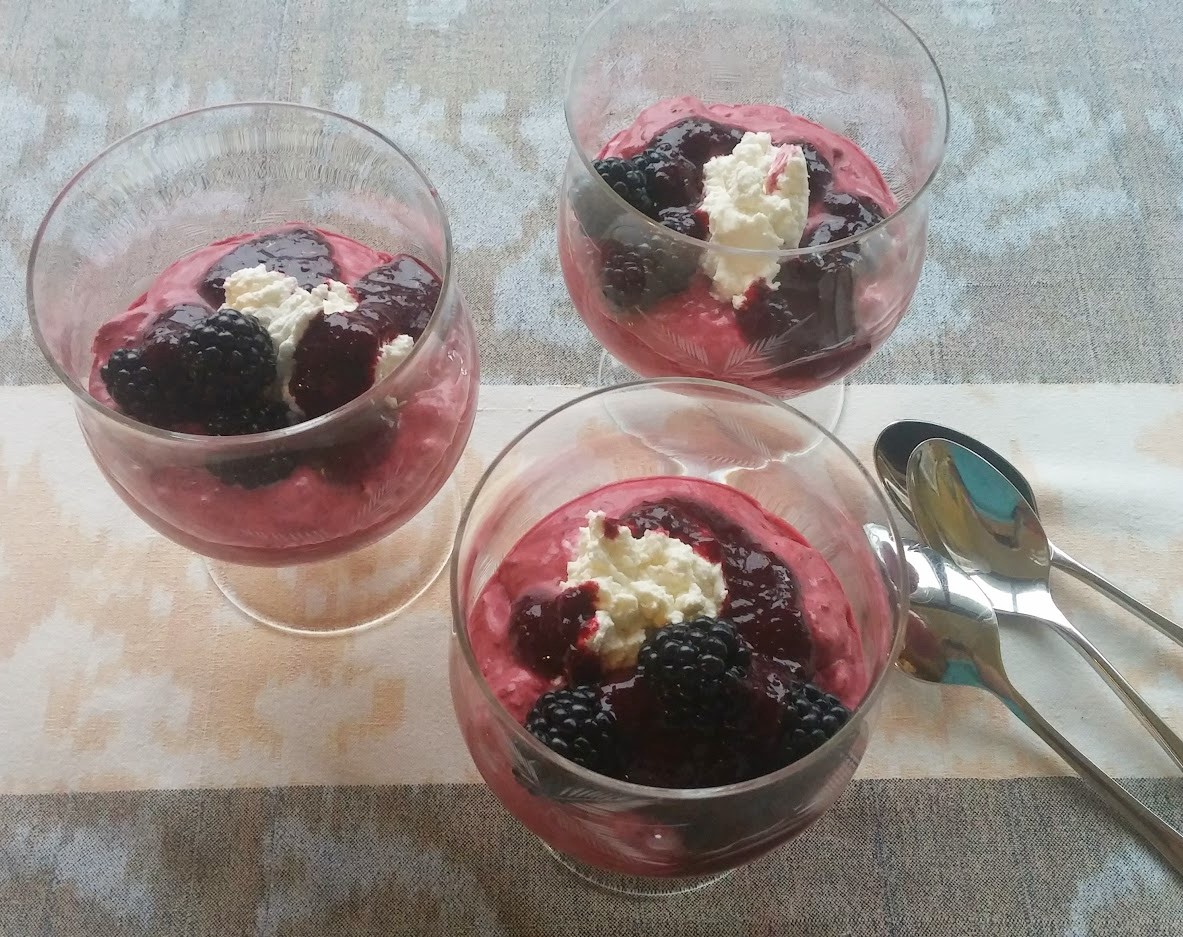
Blackberry Fool

If you have to buy blackberries, they're expensive, but if you grow them yourself you will soon have more than you know what to do with. An old fashioned fool will use quite a few, and you can keep the sweetener down to a dull roar - or not - as you like. If you want it sweeter, I would increase the sugar rather than the honey; but honestly, this was delicious as it was. 

Keeping a bit of the berry purée and the whipping cream separate is simple enough, and makes for a nice interplay of textures and intensity of flavour.
 
4 servings
30 minutes prep time
 
 
4 cups blackberries
2 tablespoons honey
2 teaspoons arrowroot
1 1/3 cup whipping cream
2 tablespoons sugar (optional)
 
Rinse and drain the blackberries well. Pick out 12 to 16 of the best, and set them aside for a garnish. Put the rest into a pot and bring to a boil. Simmer until they are falling apart. Meanwhile, mix the arrowroot into the honey. When the blackberries are done, stir the mixture into them. As soon as it thickens (practically immediately) remove it from the heat.
 
Let the berries cool for a few minutes, then run them through a food mill or press the mixture through a sieve. Let it cool completely, and keep chilled until you are ready to proceed. 
 
Beat the whipping cream, with the sugar if you like. Set aside about 1/2 cup of the whipped cream, then fold about 80% of the blackberry purée into the larger body of whipped cream. Spoon the fool into individual serving dishes. Top each with a bit of the reserved whipped cream, a few whole blackberries, and a spoonful of the blackberry purée drizzled over. Keep chilled until it is time to serve them.  


Last year at this time I made Broccoli Italian Style.

Wednesday, 1 September 2021

Cauliflower & Bacon Salad

Found this one in an old cook book. As usual, I forgot to note which one, but it dated to 1916. I added some parsley because it needed something more. It's still a very simple salad and much depends on the quality of the ingredients, especially the bacon - be sure to get a good one. It does not need to be too lean because the fat will form part of the dressing, but it shouldn't be too fatty either. 
 
I've written this up on the assumption that you would make it from scratch, but in fact this is probably best as a use for leftover cooked cauliflower. Scale the other ingredients to match the quantity you have; but I suspect that if you are not terribly precise it doesn't matter much. 
 
4 to 6 servings
20 minutes prep time
 
Cauliflower & Bacon Salad

4 cups cauliflower florets
1/3 cup finely minced chives
1/3 cup finely minced parsley
225 grams (1/2 pound) bacon
1 teaspoon Dijon mustard
salt & freshly ground black pepper to taste
3 tablespoons apple cider vinegar
 
Wash and trim the cauliflower, and break it into smallish bite-sized florets. Wash and dry the chives and parsley, and mince them finely. Chop the bacon.
 
Boil or steam the cauliflower until just tender; about 6 minutes. Drain well. 
 
Just before the water for the cauliflower comes to the boil, put the bacon in skillet sufficiently large for it, and cook it over medium heat until crisp. If there is too much fat - you want about 3 tablespoons worth - drain some off. Have the mustard, salt and pepper, and vinegar whisked together in a small bowl, and add them to the bacon as soon as you turn the heat off. Mix well, but be careful - it will spit and sputter quite a lot.

Pour this dressing over the very well drained cauliflower and mix well. Mix in the chives and parsley, and allow it all to cool to room temperature. Serve at room temperature.