Wash, trim, and peel (if you like) the potatoes. Cut them into even chunks. Put them in a pot with water to cover them well, and bring to boil. Boil steadily until fork tender; 10 to 15 minutes. Drain them well and mash them with the butter, yogurt, salt, and pepper.
Showing posts with label Potatoes. Show all posts
Monday, 2 May 2022
Turkish Shepherd's Pie Kebab
Classic meat and potatoes, the Turkish way! I see a lot of versions of this on Pinterest, with the meat portion and potato portion shaped in different ways, but the dish overall consisting of all the same parts. The dishes get different names, but really, it's these components in some configuration.
The easiest way, and the most like a classic shepherd's pie, would be to press the meatloaf mixture into a shallow baking pan, and then when the time comes, pour on the sauce then spread the potatoes evenly over the top. I've seen that done. But this shaping the meat into individual cups to hold the potato topping is even more common, although the exact shape varies quite a bit. For some reason Turkish dishes often are made into a group of clearly delineated portions like this. Perhaps it's so that if you have a large family, you know the dish will make it all they way around the table without running out because the first people to be served take too much? Or maybe I'm over-thinking it.
At any rate, these were cute, not hard to make, and a very satisfying take on the theme of meat and potatoes. I used lamb, which is always the proper meat to use in a shepherd's pie; otherwise it's technically a cottage pie although few people seem to stick to that convention these days.
4 to 8 servings
2 hours. This is going to take 2 hours, with 1 1/2 hours being prep time.
1 teaspoon sweet or smoked paprika
2 teaspoons rubbed dry mint
Grind the salt and allspice berries, then mix all the remaining spices with them in a small bowl.
Make the Meat Patties:
1 medium onion
1 small carrot
1 cup shredded cabbage
1/4 medium red pepper
2 cloves of garlic
1 tablespoon mild vegetable oil
500 grams (1 pound) ground beef OR lamb
1 large egg
Preheat the oven to 375°F. Lightly oil a baking pan.
Peel and finely dice the onion. Peel and grate the carrot. Wash, trim, and shred the cabbage. Deseed the pepper and dice it finely. Peel and mince the garlic.
Heat the oil in a small skillet and cook the onion and carrot until softened. Mix in the little bowl of spices. Add the garlic then the cabbage, and cook, stirring until just wilted down. Transfer it all to a mixing bowl and let it cool.
Mix in the ground meat and the egg by hand, until you have a smooth evenly blended mixture.
Divide the mixture into 8 equal portions, and form each one into a ball. Then press in the middle and shape each ball into a shallow bowl. Place them in an oiled baking pan, that fits them snugly but in a single layer. Bake for 20 to 30 minutes (the time necessary to cook the potatoes).
Make the Potato Topping:
700 grams (1 1/2 pounds) potatoes
3 tablespoons unsalted butter
1/3 cup yogurt
1/2 teaspoon salt
freshly ground black pepper to taste
Finish the Dish:
1/4 cup tomato sauce
1/4 cup water
125 grams (1/4 pound) Cheddar cheese
When
the potatoes are cooked and mashed, and cool enough to handle (but still
fairly hot) divide them into 8 equal portions. Shape each portion into a
ball, flatten slightly, and place one on each hot, partially-cooked piece of meat.
Mix
the tomato sauce and water, and pour it around the meat patties.
Grate the cheese and sprinkle it over the dish. Bake at 375°F for another 20 to 30 minutes, until the cheese is browned and bubbling. Let rest 10 minutes before serving.
Last year at this time I made Vietnamese Style Noodle Salad.
Labels:
01 January,
02 February,
03 March,
04 April,
05 May,
09 September,
10 October,
11 November,
12 December,
Beef,
Cabbage,
Carrots,
Dairy,
Lamb,
Main Dish,
Onions Leeks and Other Alliums,
Peppers,
Potatoes
Monday, 25 April 2022
Potato Chips Spanish Tortilla
I've seen this recipe around for years; it was definitely a little fad for a while. Finally, I got around to trying it myself. The theory is that is in a real Spanish tortilla, potatoes are slowly fried to beautiful golden-brown before having the egg mixture poured onto them and being cooked into a tortilla. It's a long, slow process! Here, potato chips are "reconstituted" in the egg mixture, and then become golden-brown, soft potatoes that are then cooked into a tortilla.
My verdict - it's not bad, it's an okay tortilla, but not worth the buzz. It's something I'd do on a camping trip maybe, because it would save on the hauling around of actual potatoes and it's something you could do over a campfire, providing you had hauled in a good heavy skillet. Huh. This is already looking kind of problematic as an idea, actually.
Needless to say, if you decide to try it, you should use the best quality potato chips you can find. They should be unsalted or only very lightly salted, and adjust any salt you add to the eggs accordingly.
If the Spanish have a second civil war, it will be over whether one puts onion into a tortilla, or not. I am a firm concebollista, yesterday, today, and forever! But if you don't want it, it is conceivably possible to leave it out. Or use onion-flavoured chips, maybe.
2 to 4 servings
30 minutes - 20 minutes prep time
1 shallot OR small onion
6 large eggs
170 grams (6 ounces) thick potato chips
a pinch of salt (maybe)
freshly ground black pepper, other herbs to taste
2 tablespoons olive oil
Peel and mince the shallot or onion.
Break the eggs into a mixing bowl, whisking between each one. Add about 3/4 of the potato chips, pressing them gently into the eggs, and let them soak for about 15 minutes. Turn and baste them with the egg occasionally, and also season them with the salt and pepper, and any other seasonings you may wish to add.
Heat 1 tablespoon of the oil in an 8" skillet and cook the onion gently over medium heat, stirring as needed, until softened and reduced in volume. Let it cool a minute then add it to the egg mixture.
Wipe out the pan with a bit of paper towel, leaving as much of the oil as possible but getting up any little bits of onion which may scorch or cause the tortilla to stick. Add a bit more oil as needed to cook the tortilla. Heat the pan over medium heat - a little cooler than for most omelettes.
Pour in the eggs and potato chips, spreading them out as evenly as possible and pressing the chips - by now they should be quite soft - down into the eggs. Cook gently over medium heat, shaking the pan occasionally to prevent sticking, until the bottom half is well set.
Flip the tortilla onto a plate - be careful and do it over the counter because the top will still be somewhat liquid - then slide it back into the pan. Lift one corner to pour in any liquid egg etc that didn't make it back into the pan. Continue to cook and shake, until the bottom of the tortilla is set. Slide it out onto a plate - a clean one, whether you have washed and dried the first one or are using another - and let it cool to just warm or room temperature before serving. Serve it garnished with the remaining potato chips.
Last year at this time I made Creamed Carrots & Belgian Endive.
Labels:
00 All Year,
Appetizers and Hors d'oeuvres,
Eggs,
Main Dish,
Potatoes
Wednesday, 9 March 2022
Greek Stewed Green Beans & Potatoes
Does this look like a make-do dish of forlorn frozen veg? No, no it doesn't. I've made essentially this before, when all the vegetables were in season, and it is extra-delightful then; no question. But frozen beans and canned tomatoes are perfectly fine, teamed with winter potatoes and alliums and gently stewed. This version was seasoned with more of a Greek twist (cinnamon) versus my original more Italian take, to which you should revert if you prefer it.
I've been cooking more with whole cinnamon lately. It's definitely a little more luxurious, but it does provide different results from using the powdered. Don't forget to pick it, and the bay leaves, out before serving. Unless, as in this household, they are redeemable for prizes (generally a kiss from the cook).
2 to 4 servings
3 medium (450 grams; 1 pound) potatoes
1 large onion
2 or 3 cloves of garlic
3 tablespoons olive oil
1" piece of cinnamon
1 or 2 bay leaves
1/2 teaspoon salt
freshly ground black pepper to taste
2 cups crushed tomatoes
1/2 cup water
2 to 3 cups frozen green beans, thawed
the juice of 1/4 lemon, optional
Wash and trim the potatoes, and cut them into chunks. Cover them with water and boil for 10 minutes.
Meanwhile, peel and dice the onion a little coarsely. Peel and mince the garlic.
Heat the oil in a heavy-bottomed soup pot, over medium-high heat, and cook the onion until softened and reduced. Add the cinnamon - split in half if you can -, bay leaves, salt and pepper, and garlic. Mix in and cook for another minute or so.
When the potatoes are done, drain off all but about 1/2 cup of the cooking water, then add them with it. Add the tomatoes and simmer the stew gently until the potatoes are nearly done. Add the chopped, thawed beans and simmer until they are done to your liking (for me, that's about 5 minutes). Add the lemon juice in the last few minutes of cooking.
Last year at this time I made Red River Rye Bread.
Friday, 18 February 2022
Patatas al Ajillo
There are a lot of Spanish potato dishes made with this technique but somewhat varying seasonings, with a wide variety of names, often reflecting the locale where the variant is typical. The technique in question is to fry the potatoes first, then stew them in a sauce. The sauce will almost always contain paprika, and I have yet to see a version without garlic, so I am calling this Potatoes in Garlic Sauce.
I put some chorizo in this, because the first version I saw had it, and I got a little fixated on it. Many recipes don't call for it, and I don't think it is at all required, especially since good chorizo can be hard to find. (I got President's Choice, because it was all I could get, but I'm here to tell you that it is best described as bad chorizo.)
Tasty food is described in Spanish as "rico", that is to say; rich. High calorie foods, preferably in the form of meat, have traditionally been regarded as what food should be; perhaps not surprising in an impoverished place with more grazing than arable land, and a lot of labour to be done. In reality though, a dish like this would have been vegetarian much more often than not. The oil and potatoes still keep it plenty "rico".
I've seen this technique in Hungarian dishes as well; if you want to go in that direction, omit the saffron, go a little lighter on the garlic, and use Hungarian paprika. If you want to put in sausage, use a dry smoked Hungarian sausage instead of the chorizo, and there you are.
To my amusement, this reminds me of a favourite dish from my high school days, when I would order French fries with gravy from the school cafeteria, then douse them generously with vinegar and ketchup. I haven't seen leftover French fries in, uh, two years at least, but should such a thing ever reappear, I think toasting them up in a skillet and finishing them in a sauce like this would be a very reasonable way to have them.
I forgot to toast my flour; it should be done before you get started. I don't think it was a dire omission.
2 to 4 servings
1 hour - all working time
Prepare & Fry the Potatoes:
600 grams (3 or 4 large) potatoes
2 to 6 cloves of garlic
1 medium onion
125 grams (1/4 pound) good dry chorizo
1/4 to 1/3 cup mild vegetable OR olive oil
Wash and trim the potatoes; peel them if you like. Cut them into thick (1/4"/1/2 cm) slices, placing them in a large bowl of cold water as you work. Let them stay there until you are ready to start cooking.
Peel and trim the garlic, and cut each clove into 3 slices. Peel and chop the onion - set it aside. If using chorizo, chop it into medium dice.
Heat the oil - enough to cover the bottom of the pan by the thickness of the potatoes - in a large skillet over medium-high heat. Add the garlic cloves and let them fry until a pale straw gold, stirring to keep them cooking evenly. This won't take more than a minute or two. Remove them with a slotted spoon to a food processor or (more traditionally) a mortar.
Lift the amount of potatoes you can fry at once from the water, and pat them dry. Fry them in the oil until a good golden brown on both sides; turn them as needed. Transfer them with the spoon to a plate as they cook, adding more dried potato slices to take their place, until they are all done. This is a slow process; allow 30 to 40 minutes depending on the size of your skillet and how brown you want them. Even if you like them fairly pale, they do need to come out of this process about half cooked so don't rush them - turn down the heat instead.
Make the Sauce & Finish:
3 tablespoons chopped parsley
1/4 to 3/4 teaspoon salt
1 teaspoon Spanish paprika (de la Vera)
1/4 teaspoon saffron threads
1 teaspoon toasted barley OR wheat flour
3 tablespoons apple cider vinegar OR white wine vinegar
1/2 cup water OR broth
1 tablespoon chopped parsley, again
While the potatoes fry, chip away at making the sauce. To the garlic add the washed, dried, and roughly chopped parsley, the salt, paprika, and saffron. Grind to a relatively smooth paste. Then add the flour, mix, and stir in the vinegar.
Once all the potatoes are cooked and removed to a plate, drain the oil out of the pan. Don't wash it; in fact leave just enough oil to now put in the onion and cook it until softened and lightly browned. Add the seasoning purée to the pan. Use the water to swish out whatever utensil you made the paste in, and add that to the pan as well. Gently return the potatoes to the pan. Simmer for a further 15 or 20 minutes until the sauce has thickened to coat the potatoes. Serve at once, with the remaining chopped parsley sprinkled over the top.
Last year at this time I made Balsamic Carrots.
Monday, 7 February 2022
Potage Albert
I found this simple little soup in an old Canadian cook book. Most of them contain recipes which now fall somewhere between thoroughly obsolete and utterly boring, so it's always a bit of an exciting moment when I find something that looks serviceable. However, a little while later I found the same recipe in a just slightly older cook book called French Household Cooking, put out by Country Life in 1908. Tsk, tsk.
The first recipe was much simplified in transition, and it changed again in my hands. I thought it needed some goosing up in the way of seasonings and some acid to sharpen it. The original made use of late summer produce, and I'm sure it's delicious fresh from the garden, but it makes a quick, easy and tasty winter soup with frozen beans and canned tomatoes.
4 to 8 servings
30 minutes prep time NOT including cooking the beans
3/4 cup of white beans, cooked
(about 2 cups cooked white beans)
2 cups bean cooking water OR chicken stock
2 cups diced potatoes
2 cups diced canned tomatoes
2 cups diced frozen green beans
1 medium onion
3 or 4 cloves of garlic
2 tablespoons bacon fat OR butter
salt & freshly ground black pepper to taste
1 1/2 teaspoons rubbed basil
2 tablespoons vinegar OR lemon juice
The beans need to be cooked in advance; or you can use a tin. Save the bean cooking water for the soup, unless you are using chicken stock.
Scrub and trim the potatoes, and peel them if necessary. Cut them into large dice and put them in a heavy-bottomed soup pot with 2 cups bean cooking water or chicken stock. Bring to a boil and simmer for about 10 minutes, until tender. Mash coarsely right in the broth.
Add the white beans, the tomatoes, and the green beans chopped into short lengths. Set the soup to simmer. Meanwhile, peel and chop the onion finely. Peel and mince the garlic.
Heat the fat or butter in a skillet and cook the onion over medium heat for 5 to 7 minutes until softened and reduced in volume. Add the garlic and basil, and cook for another minute or so. Add these to the soup, and deglaze the pan with a little of the broth, adding it back in when you are done.
Season the soup with salt and pepper as needed, and add the vinegar or lemon juice. Let it simmer for a few minutes until the raw scent of the vinegar (if that's what you used) is gone. Serve hot.
Last year at this time I made Lentil, Buckwheat & Walnut Loaf.
Wednesday, 2 February 2022
Patatnik - A Cheesy Potato Cake
Potato pancakes are popular all through Eastern Europe. This version is from Bulgaria, and it's pretty similar to most, although the addition of cheese is a little different. Normally, it would be sirene cheese but good luck finding that around here - feta is pretty close. The result is quite substantial, and we made it our lunch with a salad on the side. If you want to serve it with more dishes, you might want to cut back on the feta.
Feta is quite salty so be careful with adding more salt. It will need a little, but only a little. If you decide to omit the cheese you should add about 3/4 of a teaspoon of salt. You could replace the mint with basil in a pinch, but dried mint is actually an underused herb, in my opinion. It's worth getting it and seeing what you think of it. It's good with cheese dishes generally.
As with any dish made with grated raw potatoes, the difference between complete success and a soggy yet crumbly mess is *squeezing* those potatoes to remove as much liquid as possible. It makes all the difference.
I actually broiled my Patatnik for 6 minutes at the end, and it looked like it. As a lover of dark crunchy potatoes I regret nothing; but I am recommending a somewhat shorter time.
4 servings
1 hour 20 minutes - 20 minutes prep time
1 tablespoon unsalted butter
600 grams (1 1/4 pounds) baking potatoes
2 tablespoons potato starch
1/4 to 1/2 teaspoon salt (consult the feta)
freshly ground black pepper
1 teaspoon rubbed savory
1 to 2 teaspoons rubbed dried mint
1/2 to 1 teaspoon Aleppo pepper
1/2 cup feta or sirene cheese, crumbled
1 large OR 2 small eggs
1 tablespoon unsalted butter, again
Generously butter a 9" pie plate or similar shallow baking pan. Preheat the oven to 400°F.
Wash, trim, and grate the potatoes coarsely. Squeeze them hard over the sink by handfuls, to remove as much water from them as you possibly can. Put the handfuls of dried potato shreds into a mixing bowl. When the potatoes are all squeezed, add the potato starch and seasonings. Toss well to combine.
Crumble in the feta cheese and mix. Break in the egg(s) and mix thoroughly. The potatoes should be coated enough to stick together, but not noticeably eggy. Scrape them into the prepared pan, and press them gently but evenly into a layer. Dot with the remaining butter.
Bake the Patatnik for 45 to 50 minutes, until golden brown. If you feel it is done, but not quite as brown as you would like, put it under the broiler for 3 or 4 minutes. Let it rest for 10 minutes before serving.
This can be cooked on a griddle as pancakes as well; oil it well then ladle in thin pancakes. Cook until well-browned on both sides, adding more oil as needed. Expect to get 6 to 8 fair sized pancakes. I have not tried this as I tend to think that the oven is both easier and not much slower given that you are unlikely to be able to cook all your pancakes at once, but I'm putting it out there.
Last year at this time I made Almost Whole Stuffed Cabbage.
Labels:
01 January,
02 February,
03 March,
04 April,
10 October,
11 November,
12 December,
Dairy,
Eggs,
Main Dish,
Potatoes,
Side Dish
Monday, 24 January 2022
Patta Gobhi (Aloo)
Stewed cabbage; with potatoes if you like. I made Sweet Potato Roti and another dish with turnips, so I left them out. This is a simple but lively Indian-style dish, which I made as part of a meal that I will be posting about all week. It goes together very quickly, once the measuring and chopping have been done. It's amazing too, what a little spicing will do to give a new look to good old winter stand-bys.
4 servings
45 minutes prep time
Prepare the Vegetables:
4 cups chopped cabbage
1 medium onion
1/4 teaspoon salt
2 medium potatoes, optional
Chop cabbage and onion, mix by hand with salt and drain for 15 minutes. Rinse and drain them very well. Dice the potatoes into 1" chunks.
Prepare the Spices:
1" piece of ginger
2 cloves of garlic
1/2 teaspoon ground turmeric
1/8 to 1/2 teaspoon red chile flakes (to taste)
1/4 teaspoon ground fenugreek seeds
1/8 teaspoon ground cloves
1/4 teaspoon salt
Peel and mince ginger and garlic. Mix everything in a small bowl.
Finish the Dish:
1 tablespoon mild vegetable oil
1 teaspoon cumin seeds
1 teaspoon mustard seeds
1 teaspoon fennel seeds
2 cups chopped or crushed tomatoes
Heat the oil in a large skillet over medium heat. Add the cumin, mustard, and fennel, and cook until they sizzle and pop. Be careful with this; the spices can scorch very easily. Add the bowl of spices, and cook for another minute, stirring, then add the cabbage and onions. Cook for about 10 minutes, stirring regularly, until lightly browned. Mix in the potatoes, if using, and the tomatoes. Add a little water if necessary to get the potatoes cooked, then allow the liquid to evaporate to a clinging sauce.
Last year at this time I made Yiahni Potatoes.
Friday, 14 January 2022
Fish Fillets in Potato Crust
When I made Gomel-Style Cutlets a while back I threatened to coat other foods to be pan-fried in grated potato, and now I've finally done it. This is a bit like fish and chips, chips included with the fish. A little cole slaw or other salad should finish the meal nicely.
This is a very simple way to cook fish, but I'd say there are two points to watch carefully for success. The first is to be sure your fish fillets are as dry as you can reasonably get them, or the potato crust won't stick well. The second is that while they are being cooked, do not press them down into the oil. I did that, and it packed the potato together too firmly - I believe it would have been a little more crispy if I had managed to refrain. Still, we all enjoyed these and I will try to improve my technique by making it again.
2 servings
30 to 40 minutes prep time
675 grams (1.5 pounds) white fish fillets
1/3 cup barley or wheat flour
freshly ground black pepper OR other seasonings to taste
2 large eggs
450 grams (1 pound; 3 medium-large) white potatoes
1/4 teaspoon salt
mild vegetable oil to fry
If you start with frozen fish, it must be thawed. In any case, unwrap the fish fillets and lay them on a good pad of paper or kitchen towels; if kitchen towels preferably clean, but not your good ones. Let them blot and dry thoroughly while you prepare the other ingredients.
Put the flour on a plate and mix in any seasonings you wish to use. I kept it simple with just some pepper, but a little paprika and thyme would be a good choice. Whisk the eggs on another plate. Wash, peel, and grate the potatoes. Mix them with the salt and let them sit for a few minutes, then squeeze them well to remove and discard as much liquid from them as possible. Put them on another plate.
Heat a large skillet or griddle over medium-high heat. Pour in about 1/4" of oil. While it heats, coat each fish fillet in flour on both sides, then in egg on both sides, and then in the potatoes, ensuring an even coating of potato all over. Lay them in the hot oil and cook for about 5 minutes per side, until golden-brown. If they do not all fit in the pan (unlikely unless you are using a fairly large griddle) put them on a platter in the oven, kept warm at 200°F until they are all done. Add a little more oil to the pan as required in cooking them. Serve as quickly as possible.
Last year at this time I made Apple-Peanut Cole-Slaw with Coconut-Curry Dressing.
Labels:
01 January,
02 February,
03 March,
04 April,
08 August,
09 September,
10 October,
11 November,
12 December,
Eggs,
Fish,
Grains,
Potatoes
Friday, 31 December 2021
Jota - Slovakian Bean & Sauerkraut Stew
It's the end of the year, so it's the end of the year lucky bean dish. This traditional Slovakian dish usually has a variety of smoked pork products added to it, but I didn't happen to have any and wanted to keep it a little lighter. It's still a pretty substantial meal. I did use some bacon fat, but some kind of vegetable oil is all it needs to be vegetarian. If you want to use some meat, cut it in chunks (unless it's on the bone) and cook it with the beans once the water has been changed.
I have to say though, my end of the year lucky bean dishes are not doing the trick. I would be happier to see the end of 2021 if I thought 2022 would be any better; I think it's going to take more than beans though. Here's to good luck to us all...
4 servings
1 hour - 30 minutes prep time
NOT including cooking the beans
1 cup dried borlotti or pinto beans
1 teaspoon salt
2 medium onions
1 medium carrot
2 or 3 medium potatoes
2 or 3 cloves of garlic
1 tablespoons bacon fat OR mild vegetable oil
2 bay leaves
1 tablespoon sweet smoked paprika
1/4 to 1 teaspoon hot smoked paprika
1/3 cup tomato sauce
2 cups sauerkraut
1 tablespoon vinegar (optional)
Cover the dry beans generously with water, then bring them to a boil and boil one minute. Remove them from the heat, cover them, and let them soak for 2 hours to overnight. Drain them and add enough water to them to cover by about an inch. Add the salt. Simmer until tender, stirring regulary; about an hour. Or, cook them in an Instant Pot for 6 to 8 minutes. Allow to release naturally. This can be done up to a day ahead.
Peel and dice the onions. Peel and grate or dice the carrot. Wash, trim, peel if you like, and cut the potatoes into chunks. Peel and mince the garlic.
Heat the fat or oil in a large heavy-bottomed soup pot over medium-high heat. Cook the onions and carrots, stirring regularly, until softened and slightly reduced. Add the garlic, bay leaves, paprika, and Aleppo pepper and mix in well. Add the cooked beans with their cooking liquid, and the tomato sauce, and mix well. Mix in 1/2 of the sauerkraut. Add the potatoes when they are ready. Simmer the beans for 30 to 45 minutes, stirring regularly, until the mixture is thick and well-amalgamated. Keeping in mind that there is a little more sauerkraut to be added, taste and decide if you want it a little more sour, in which case add a spoonful of vinegar.
Once the beans have been added, put the potatoes in a separate pot and cover them with water. Bring them to a boil and boil for 12 to 15 minutes, until tender. Drain them and add them to the stew.
Add the final cup of sauerkraut just before you are ready to serve, and allow it to just heat through.
This keeps and re-heats well, as with most bean dishes.
Last year at this time I made Lentils with Smoked Sausage.
Monday, 20 December 2021
Cream Puff Potatoes
I served these as a side dish with steak, but they would make an interesting starter course. Mine were also filled with creamed spinach, but they are quite fine on their own. They might make a good way to serve potatoes if you are serving from a buffet. You could make them small enough to be manageable as finger food, although in that case I suspect you should bake them for a slightly shorter time.
It has to be admitted this is a bit of a gimmick, but it's one that is both do-able and eat-able (with pleasure), which is more than can be said of a lot of foody gimmicks.
4 to 6 servings
8 to 16 cream puffs
40 minutes - 10 minutes prep time
NOT including baking the potatoes
1 cup very smooth mashed potato (2 medium)
1/4 cup unsalted butter
1/4 teaspoon salt
1/2 cup potato starch
other seasonings to taste, such as pepper, nutmeg, or chives
2 large eggs
Bake the potatoes until tender then cool them, and run them through food mill. This can be done up to 24 hours in advance.
Preheat the oven to 400°F. Line a baking sheet with parchment paper.
Melt the butter in large heavy bottomed pot with the salt; mix in the finely mashed potato. Mix in the potato starch and seasonings - you want at least a little pepper, but season them to taste - until it comes together to form a ball. Remove the pot from the heat.
In a few minutes when the mixture is sufficiently cool not to set them, beat in the eggs one at a time with an electric mixer. Beat for 2 minutes. Form the mixture into little buns spread out on the parchment paper, and bake them for 15 minutes. Reset the heat to 325°F and bake for 15 minutes more. Serve at once.
Last year at this time I made Beet Mousse. Yeah, yeah: mid December is when I tend to have fits of playing with my food.
Monday, 18 October 2021
Fennel, Leek, & Potato Soup
This was a simple and tasty soup. I will note that I put the fronds on as a garnish, but I think they actually added a lot to the flavour - so don't do as I did and leave them in big chunks, but chop them finely and sprinkle them over the soup generously.
4 servings
45 minutes to 1 hour - 30 minutes prep time
2 cups diced (1 medium) fennel bulb
2 cups diced (2 medium) leeks
2 tablespoons butter OR chicken fat
3 cups diced (4 medium) potatoes
1 teaspoon salt
freshly ground black pepper to taste
1/4 to 1/2 teaspoon red chile flakes
1 teaspoon fennel seed
2 tablespoons barley or wheat flour
4 cups chicken OR vegetable stock
1/4 cup chopped fresh green fennel fronds
Wash, trim, and dice the fennel, discarding the tough stalks and root plate. Save a frond or two to garnish. Wash, trim, and dice the leeks.
Heat the butter or chicken fat in a large heavy, bottomed soup pot over medium heat. Add the fennel and leeks and cook gently stirring regularly, for 10 to 15 minutes until softened and reduced but not browned. Meanwhile, dice the potatoes. Add them when there is about 5 minutes more for the vegetables to cook. Add the seasonings and flour, and mix in until no dry flour can be seen.
Add the chicken stock and simmer for 20 to 30 minutes until the potatoes are tender. You may wish to mash them a bit before serving, or not. Serve each bowl garnished with a tablespoon of the finely chopped fennel fronds.
Last year at this time I made Graham Muffins.
Monday, 30 August 2021
Confetti Potato Salad
Here's a nice straightforward potato salad, but the addition of lots of other vegetables makes it prettier and more interesting than most. And dilutes those potatoes; not the best thing for me to eat.
I made this for a picnic, and it was lovely to dish it out of a cooler in the trunk of the car, and then sit and admire a lovely lake view while we ate.
6 to 8 servings
45 minutes prep time
Make the Dressing:
1/2 cup mayonnaise (light is fine)
2 tablespoons Dijon mustard
1/4 teaspoon salt
freshly ground black pepper to taste
the juice of 1 large lemon
Put the mayonnaise in a small mixing bowl or jam jar. Mix in the mustard, salt, and pepper. Slowly mix in the lemon juice, keeping the texture of the dressing smooth and free of lumps.
Make the Salad:
900 grams (2 pounds) potatoes
3 cups diced green beans
1 cup (2 medium stalks) celery
1 cup (1 medium) diced or grated carrot
1/2 cup diced red, orange, or yellow
pepper
1/2 cup diced onion
1/4 cup minced parsley
Put the potatoes in a pot with water to cover them well, and boil for 20 minutes, or until just tender when pierced with a fork. Drain and cool completely. Peel them, cut them into dice, and put them in a mixing bowl.
While the potatoes cook, wash, trim, and cut the beans into dice. Add them to the potatoes when they have about 6 minutes to cook; they should be drained, rinsed, and added to the mixing bowl with the potatoes.
Wash, trim, and dice the celery. Peel and dice or grate the carrot. Trim, de-seed, and dice the pepper. Peel and dice the onion. Wash, dry, and mince the parsley. Add these all to the salad. Toss with the dressing and keep chilled until serving time.
Last year at this time I made Batter Pizza with Squash Blossoms.
Monday, 5 July 2021
Turkish Egg Salad
Just like North American egg salads, this has only a few simple ingredients and goes together very quickly. It's quite different though. No goopy mayonnaise, but a zingy lemon vinaigrette. Lots of fresh and sprightly herbs instead of, uh, nothing really. Instead of a smooth finely chopped texture, lots of big tasty chunks.
Most of the recipes I looked at didn't call for either potatoes or peas, although a number included some other vegetable. Like most really simple recipes, you do it your way, with your way having a lot to do with what's around at the time. I used potatoes this time, but I plan to use peas soon, because this is something that's likely to become a regular menu feature.
4 servings
15 to 30 minutes advance prep
15 minutes to finish
Advance Preparation:
225 grams (1/2 pound) new potatoes
OR 2 cups shelled peas, snap, or snow peas, blanched
5 large eggs
If using potatoes, choose ones of equal size. Put them in a pot with water to cover, and boil them until tender; 15 to 20 minutes. Rinse them in cold water and let them cool.
If using peas, shell or trim them and blanch them in boiling water until tender. Rinse in cold water and drain very well.
Put the eggs in a pot of water to cover them, and bring them to a boil. Boil them for 1 minute, then remove them from the heat. Leave them in the water, covered, for 10 minutes then transfer them to cold water and allow to cool completely.
Make the Dressing:
the juice of 1/2 large lemon
3 tablespoons olive oil
1/4 teaspoon salt
freshly ground black pepper to taste
1/4 teaspoon ground sumac
1/4 teaspoon rubbed basil
1/4 teaspoon rubbed dried mint
Aleppo pepper to taste
Mix all the ingredients in a small bowl or jam jar and set aside until needed.
Finish the Salad:
2 or 3 green onions
1 or 2 tablespoons finely minced fresh dill
1 cup finely chopped parsley
Wash, trim, and finely chop the onions, dill and parsley. Put them in a salad bowl.
Peel the potatoes, if using, and cut in bite-sized chunks. Add them to the herbs, or the peas if they if they are being used instead. Peel the eggs and cut them in bite-sized chunks and add them to the salad. Mix gently and drizzle with the dressing.
Last year at this time I made Green Garlic & Sesame Fried Chicken.
Friday, 25 June 2021
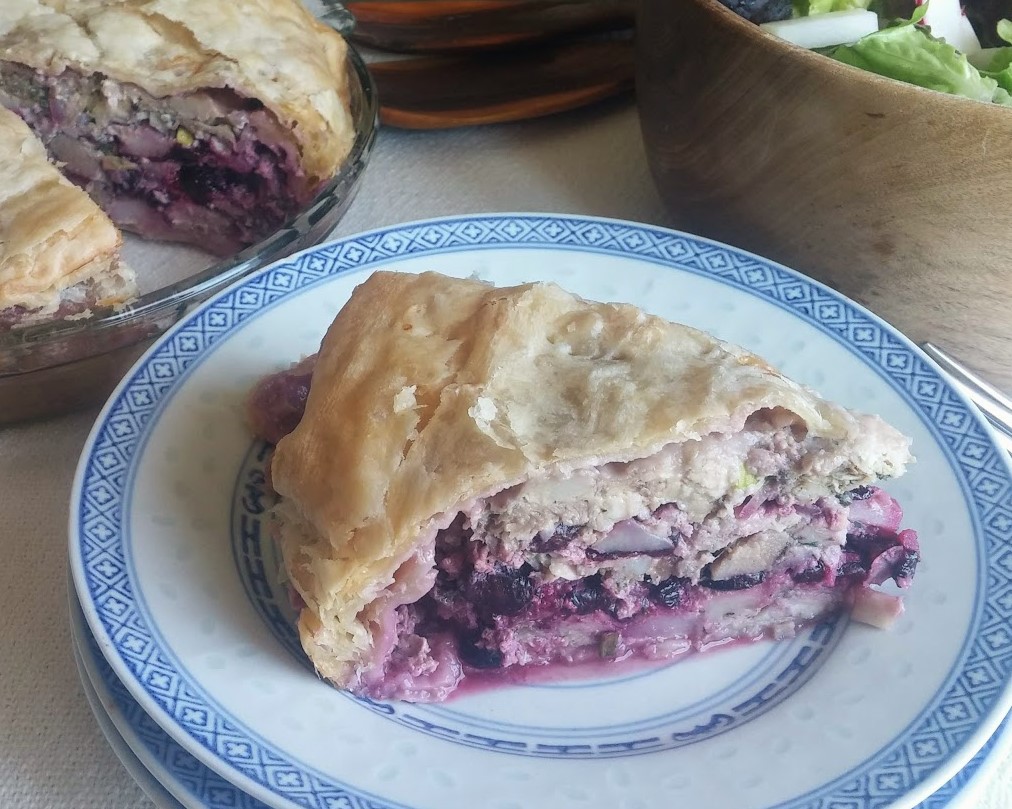
Haskap Chicken Tourtière
This is trailing a bit... due to very early heat and drought haskaps are mostly over already. But maybe you were able to freeze some. In spite of everything we got a pretty good crop; what we could snatch from the birds, who have definitely found them.
There's already a lot going on here, so I resorted to frozen puff pastry for the crust, although what this mostly requires is some patience. Time to cook the potatoes; time to bake the pie; and time for it to cool.
Now that haskaps are fading from the scene, you could use currants instead. Red or black ones for best effect, although they will be a bit seedier than the haskaps.
Given the size and richness of the ingredients this is a bit of a party piece; and who knows? Someday soon we'll be able to gather more than two or three together again. As of yesterday, Mr. Ferdzy and I - my mother was done with it a few weeks back - are fully vaccinated. Hurray!
8 servings
2 hours - 40 minutes prep time
NOT including cooking the potatoes
NOT including cooling time
Pre-Cook the Potatoes & Mix the Seasonings:
300 grams (10 ounces; 4 medium) potatoes
1 1/2 teaspoons salt
1/2 teaspoon black peppercorns
1/2 teaspoon celery seed
1/4 teaspoon allspice berries
1 1/2 teaspoons rubbed savory
1/2 teaspoon rubbed sage
1/2 teaspoon ground ginger
1/4 teaspoon ground cloves
Put a pot of water on to boil and boil the potatoes for 10 minutes. Drain and allow to cool. You could also use leftover baked or boiled potatoes - you want approximately 2 cups once peeled and diced, which is what you should do once your potatoes are cool.
Grind the salt, peppercorns, celery seed, and allspice together. Put them in a small bowl with the rest of the seasonings.
Prepare the Filling:
1 cup finely chopped green onions
500 grams (1 pound) ground chicken
2 large eggs
500 grams (1 pound) skinless, boneless chicken pieces
Wash, trim, and chop the green onions. Put them in a mixing bowl with the ground chicken, the cooled, diced potatoes, the spices, and the eggs.
Preheat the oven to 350°F.
Chop the remaining chicken into bite-sized pieces and add to the mixing bowl. Mix everything well together.
Finish & Bake the Pie:
450 grams (1 pound; 2 rolls) thawed from frozen puff pastry
2 cups haskap berries
Take one sheet of the thawed puff pastry and roll it out slightly. Line a large (10") pie plate with it, letting the corners drape over the edges. Spread 1/3 of the chicken filling evenly in it.
The berries must be washed and picked over, and drained well. Spread half of them evenly over the chicken filling in the pie-crust. Top with another 1/3 of the chicken filling, evenly spread out, then add the final layer of berries and chicken filling in the same way.
Fold the edges of the puff pastry up over the filling. Roll the remaining piece slightly and lay it on top so that the triangular edges are sticking out over the straight sides of the bottom piece. In between each of the folded up sections, pull the pastry slightly away from the pie plate and tuck the triangular overhanging pies in along the inside of the pie plate. Once they are all in, pinch around the edges to seal, and shape the top of the pie nicely. Poke it all over with a fork to allow the steam to escape. Put the pie plate on a baking tray - I think you can rely on this one to be a leaker - and bake for 1 hour and 15 to 20 minutes, until golden brown.
Let the pie cool to just warm or room temperature before serving. It will definitely cut better once cool, and can be made in advance and refrigerated; bring it out 15 minutes or so before serving to bring it back to room temperature.
Last year at this time I made Basic Very Low Sugar Ice Cream.
Friday, 12 March 2021
Two Potato & Celeriac Salads
These are both salads I found in old cook books. The first one was from an Edwardian era Jewish cook book; this is the one that calls for the pickled red cabbage posted earlier this week.
The second was from the same era but French. It was called Salade Malgache, meaning Madagascar Salad. There is nothing about it that has to do with Madagascar other than that the French would have recently invaded and colonized it. Presumably the author of this cook book aimed at middle-class households approved. I have corrected the title to reflect those things. It is a nice little salad of northern European winter vegetables, and deserved better.
In spite of how pretty these two salads look together, I would in future not be inclined to serve them at the same time, given the overlap of the two main ingredients - they are a little too similar.
4 servings each
45 minutes to boil the vegetables
30 minutes to assemble the salads
Country Salad:
1 cup peeled and diced boiled potatoes
1 cup peeled and diced boiled celeriac
2 tablespoons olive oil
1 to 2 tablespoons red cabbage brine, lemon juice, OR apple cider vinegar
a few hydroponic lettuce leaves
Boil the potatoes until tender, with the skins on. Cool them in cold water, then drain them well and dice, peeling them if you are so inclined.
Peel the celeriac and cut it in slabs 1/2" to 3/4" thick before boiling them until tender. Cool and dice like the potatoes.
Toss the potatoes, celeriac, pickled red cabbage, oil, and brine, lemon juice, or vinegar together and arrange the salad over a few clean lettuce leaves.
Salade Bourgeoise Impérialiste:
1 cup peeled and diced boiled potatoes
1 cup peeled and diced boiled celeriac
1 cup peeled and diced boiled red beets
3 tablespoons mayonnaise
1/2 teaspoon Dijon mustard
salt & freshly ground black pepper to taste
2 or 3 tablespoons lemon juice
1/2 cup chopped walnuts
a few hydroponic lettuce leaves
Boil the potatoes until tender, with the skins on. Cool them in cold water, then drain them well and dice.
Peel the celeriac and cut it in slabs 1/2" to 3/4" thick before boiling them until tender. Cool and dice like the potatoes.
Boil the beets until tender, about 45 minutes. Cool them in cold water, peel, and dice.
Whisk the mayonnaise, mustard, salt, pepper, and lemon juice together. Mix the vegetables and toss them with the dressing and half of the walnuts. Arrange them over the lettuce and sprinkle the remaining walnuts over the top. (I left the beets out, and sprinkled them over the top too, to keep more contrast in the presentation; but it's up to you.)
Last year at this time I made Baked Kibbeh.
Labels:
01 January,
02 February,
03 March,
04 April,
10 October,
11 November,
12 December,
Beets,
Cabbage,
Celery and Celeriac,
Lettuce,
Nuts and Seeds,
Potatoes,
Salad
Wednesday, 24 February 2021
Bachelor's Baked Hash
This recipe turned up in a Nova Scotia cook book from 1939. Mom came over to help us eat it, and she liked it a lot - I think it reminded her of food from her childhood. We liked it, too; it's just some good, tasty comfort food. And presumably easy enough for even a bachelor to make; huh. Although the original had the ingredients put through a meat grinder, which thing most people no longer have, and I would think that cleaning it afterwards would eliminate any advantage that it would have had over just chopping and grating stuff.
Anyway, parsley and celery aren't in season at the moment, but if you have them, put them in; they do improve it. Otherwise feel free to season it up to your taste - I put in savory and paprika, but my favourite Polish seasoning would have been good too. If you are using a regular fat ground beef put in the low amount of stock; if your meat is lean or cooked you should add more. It will be a bit of a judgement call, but the end goal is to have a hash neither soupy nor too dry.
4 servings
1 hour 20 minutes - 20 minutes prep time
3 medium carrots
1 large onion
1 stalk of celery (optional)
1/3 cup finely chopped fresh parsley (optional)
1 teaspoon salt
freshly ground black pepper to taste
1 teaspoon rubbed savory OR thyme
1 teaspoon sweet Hungarian paprika
OR other seasonings to taste
500 grams (1 pound) ground beef OR chopped cooked beef
1/3 to 1 cup beef OR chicken stock
3 medium (500 grams; 1 pound) potatoes
2 cups fresh breadcrumbs
3 tablespoons butter
Wash, peel, and grate the carrots; put them in a mixing bowl. Peel and chop the onion. Wash, trim, and chop the the celery and parsley, if using. Add to the bowl, along with the seasonings. Crumble in the beef and mix by hand, until everything is evenly distributed and the mixture has a loose, crumbly texture.
Lightly oil a 9" x 13" or similar shallow 3 litre (quart) baking (lasagne) pan. Preheat the oven to 350°F.
Wash, trim, and dice the potatoes. Put about 60% of them over the bottom of the prepared pan. Mix the remainder into the hash, and spread it out over the potatoes evenly. Pour over the stock.
Butter slices of stale bread well and cut it into fine crumbs, then rub the butter through them until it is evenly distributed and they are all moistened with the butter. Sprinkle the buttered crumbs evenly over the pan of hash.
Bake at 350°F for about 1 hour, until the top is crispy and the broth is absorbed or evaporated. Let the hash rest for 5 minutes before serving.
Last year at this time I made Red Cabbage, Apple, Celeriac, & Belgian Endive Slaw.
Friday, 22 January 2021
Yiahni Potatoes
Saucy and delicious! The three of us didn't quite manage to polish them off but pretty close. Do watch them especially at the end of the cooking, as the sauce goes from quite thin and watery to thick in the space of about 5 minutes.
These are probably at least as popular in Greece, if not rather more so, than the usual Greek Lemon Roasted Potatoes found in Canadian Greek restaurants. For the home cook, they are a lot faster and don't require the oven to be on either. I did not peel mine, but I did scrub them extremely thoroughly and they lost a certain amount of skin that way.
4 to 6 servings
45 minutes - 20 minutes prep time
Set Aside:
2 bay leaves
1/4 teaspoon rosemary leaves
1 teaspoon rubbed thyme OR savory
6 allspice berries
12 black peppercorns
1/2 teaspoon salt? 2 or 3 cloves of garlic
Measure these out into a small bowl. Peel and mince the garlic, and add it. Set aside until needed.
Cook the Potatoes:
1/4 cup olive oil
1 cup vegetable stock
1 cup crushed tomatoes
1 tablespoon tomato paste
OR 1/4 cup tomato sauce
900 grams (2 pounds) potatoes
Be sure your potatoes are well scrubbed before you start; if you are inclined to peel them, I would do that too.
Heat the oil in a heavy-bottomed soup pot over medium heat. When it is hot, add the bowl of seasoning and mix in well. When the garlic is sizzling, add the stock, crushed tomatoes, and tomato paste or sauce. Mix well. Cover and bring it up to a boil while you trim and quarter the potatoes.
Add the prepared potatoes to the boiling broth and cover. Keep them at a slow boil or hard simmer for 20 to 30 minutes, until they are tender. Remove the cover and let them rest about 10 minutes, until warm rather than hot. Serve warm.
Last year at this time I made Russian Style Apple Batter Pudding.
Labels:
01 January,
02 February,
03 March,
04 April,
10 October,
11 November,
12 December,
Potatoes,
Side Dish,
Tomatoes
Friday, 27 November 2020
Baked Sweet Potato Samosas
Traditional samosas are not the worst thing I could eat, since the potatoes get cooked twice, but they aren't the best thing either. They probably still are not; oh well. I love them too much to give them up entirely. They do work deliciously well with sweet potatoes instead of regular potatoes. Although, if you prefer the classic ones it's easy enough to revert to using regular potatoes. In any case, before you get started you need your potatoes of either type cooked, and the peas to have been thawed, since I assume at this time of year they will be from frozen.
Serve them with the Apple Butter Chutney I made to go with Samosa Pie. You could replace the lime juice in the chutney with apple cider vinegar if you like; I did, since I didn't have a lime. It worked just fine.
Note that the pastry will feel a bit too wet once the water goes in, and that's okay - it will firm up as it sits.
8 to 12 samosas
1 hour 20 minutes - 40 minutes prep time
NOT including time to cook potatoes OR thaw peas
Make the Pastry:
2 cups whole spelt flour
1/4 teaspoon baking soda
1 teaspoon salt
6 tablespoons mild vegetable oil
1/2 to 2/3 cup water
1 tablespoon lemon juice
Mix the flour with the baking soda and salt in a mixing bowl. Mix in the oil, until the mixture is crumbly and there is no dry flour remaining. Mix the lemon juice into a 1/2 cup of water, then stir them in to form a slightly soft dough - if it does not form a soft dough, add a tablespoon or 2 more of water until it does. Turn it out onto a clean surface and knead for a few strokes until it is quite smooth, but don't over-work it - it is pastry, after all. It should not be sticky. Return it to the bowl, cover, and let rest for 20 to 30 minutes. It will firm up a bit as it sits.
Mix the Spices:
1 teaspoon cumin seed
1 teaspoon coriander seed
1 teaspoon mustard seeds
1/4 teaspoon black peppercorns
1/4 teaspoon fenugreek seeds
1/2 teaspoon salt
1 teaspoon amchur powder
1/2 teaspoon ground turmeric
1/2 teaspoon ground ginger
1/8 to 1/4 teaspoon red chile flakes
Grind the cumin, coriander, mustard seed, peppercorns, fenugreek, and salt until fine. Mix in the amchur powder, turmeric, ginger, and red chile flakes to taste.
Make the Filling:
1 1/2 cups (1 large) diced cooked sweet potato
1 cup thawed frozen peas
1 medium onion
1 tablespoon mild vegetable oil
Peel and dice the baked sweet potato, and mix with the thawed frozen peas.
Peel and chop the onion. Heat the oil in a small skillet over medium-high heat, and cook the onion until softened and translucent, but not much browned. Add the spice mixture and mix in well for another minute or so, then add it all to the vegetables and mix well.
Preheat the oven to 375°F. Line a large baking tray with parchment paper.
Divide the dough into 4 or 6 even pieces. Roll each one into a ball, then roll a ball into a circle, about 1/8" thick. Dust with a little flour as you roll if necessary to keep it from sticking. Cut the circle in half.
Brush the straight, cut side with a little water, then overlap one half with the other half of the wet edges, and pinch them together to form a little cup. Fill this with 1/8th or 1/12th of the prepared filling. Wet the open edges of the dough, then pinch them together to seal. Put the finished samosa onto the prepared tray. Repeat with the other half of the circle, and then with the remaining pieces of dough until all the samosas are formed.
Bake them at 375°F for 10 minutes, then turn them over. Bake for a further 10 minutes. Let cool; serve them warm or at room temperature.
Last year at this time I made Braised Muscovy Duck.
Friday, 6 November 2020
Duck Pasties
If you thought cabbage rolls stretched a little bit of duck pretty far, how about these pasties? Again, if you are shy on the amount of duck meat needed, you can fry up a few slices of bacon with the onion. However, you should also be sure not to make too much filling - don't go over the quantities listed - as this amount will make 6 very stuffed pasties. Each one is a meal with just a bit of salad to keep it company. We ate some of the leftovers cold and re-heated some in a hot oven; they were delicious both ways. Just don't microwave them, as the pastry will go soggy, as it always does.
This is a real left-over busting meal. Or to put it another way, you need to cook your potatoes and rutabaga in advance. It's all in the perspective, I suppose. If you have a little good thick gravy left over a spoonful will help keep them moist, but it's not traditional to add it, as far as I know, and if you have any holes in the finished pasties, it will leak out.
I actually used the buttermilk instead of cream to thin my egg yolk, since it was already out. It seemed to work just fine. We thought these were delightful, and I will likely make them again with leftover turkey, because I can see that working really well too. Or the traditional roast or braised beef, for that matter.
In the end, that one 6 pound duck fed the 3 of us as a roast dinner, followed by 2 meals of cabbage rolls for 2 of us, the 3 of for lunch, and it looks like Mr. Ferdzy and I will have one more round of pasties. I did throw in about a quarter pound of bacon to make it stretch, but still, FIVE* meals (12 servings), plus there is still a fair bit of duck stock in the fridge. I'd say we squeezed our money's worth out of that bird.
6 pasties
1 hour 15 minutes - 40 minutes prep time
NOT including time to cool
Make the Pastry:
2 1/4 cups whole spelt flour
1/2 teaspoon salt
1/4 cup cold unsalted butter
1/4 cup mild vegetable oil
1/4 cup buttermilk
the white of 1 large egg
Measure the flour and salt into a mixing bowl and mix. Grate in the butter, turning it to coat it in the flour. Add the oil, buttermilk, and egg white, and mix everything well, cutting it together with a pastry cutter or the side of a spoon. Once it is well blended but still with lumps of butter, pull it together to form a ball (by hand). Let rest for 20 minutes while you make the filling.
Make the Filling & Finish:
1 small onion
1 teaspoon duck fat or other oil
1 1/2 cups diced cooked duck meat
3/4 cup diced cooked potato
3/4 cup diced cooked rutabaga
salt & freshly ground black pepper to taste
extra whole spelt flour for rolling
up to 6 tablespoons leftover duck gravy OPTIONAL
1 large egg yolk
2 tablespoons light cream
Peel and dice the onion, and cook it in the fat or oil over medium heat until softened and translucent. Put it into a mixing bowl with the diced cooked duck, potato, and rutabaga. Season carefully with salt and generously with pepper.
Preheat the oven to 400°F.
Divide the dough evenly into 6 pieces. Dust a sheet of parchment paper with a little flour, and roll the first piece of dough out into a circle. Be sure that it is large enough to hold the filling. Put 1/6th of the filling on it, along with up to a tablespoon of leftover gravy, if you have it, and fold it over to close. Press sealed along the edges, then roll the edge up and press again to be sure to have a good seal. Lift the pasty onto a baking tray lined with another piece of parchment paper, leaving space for the rest.
Repeat with the remaining pieces of dough and filling.
Bake the pasties for 15 minutes. Whisk the egg yolk and cream together. Brush the pasties with this mixture, then return them to the oven for a further 15 minutes of baking. Serve warm or at room temperature. If kept in the refrigerator, bring them out 20 minutes before serving to take the chill off them. They will also reheat well in the oven.
*The mathematically astute will conclude, correctly, that Mr. Ferdzy and I were piggies with the pasties.
Last year at this time I made the tasty but perplexing Turkish Lentil & Potato Salad.
Subscribe to:
Comments (Atom)