Wednesday, 30 June 2021

Mid Summer Garden Update


Here we are at the end of another month, and what a strange one it has been. No sooner had I hit "post" on last month's update, than we had a hard frost. May 28th! I have never seen a frost that late in all my years of gardening. Some things were hit very hard, and recovery has been slow or else I had to do replanting.
 
Right after the frost it went back to being hot and dry. There has been next to no rain until this last week when we had a torrential downpour, but fortunately no actual tornadoes, unlike some nearby places. We were very glad to have it, and bartender! I'd like another, please. It looks like going back to being pretty dry though, so I expect to still have to spend a lot of time watering. 


Haskaps are done, strawberries are done, blueberries are gearing up. This section will, we hope, have netting draped over it before the blueberries ripen so that, unlike the strawberries, we get most of them. The local crows have developed a keen interest in the garden, and I identified some strawberry filled scat that appeared as having most likely been dropped by a fox, which fills me with dismay. Apparently they climb about as well as squirrels, which is to say very well indeed. 
 
The poppies are gearing up to bloom, so that's exciting! 


The mid-season and on peas have tripled in size since last month's photo, and are flowering and producing peas at a good clip. The rain came just in time to do them a lot of good.


On the other hand, I kind of regret having left the rutabaga to go to seed in the beans. I'll be glad to have the seed, but it is definitely inhibiting the beans, which were also one of the things hardest hit by the frost. I'd say 80% took severe damage, and about 20% were outright killed and had to be replanted.
 
The early peas (far left bed) are essentially over; my plan for the next few days is to rip them out and replant short season dry bush beans in their place. 

Sweet potatoes are in; I feel like they are behind, but fortunately they were not planted when the frost hit so no damage was done to them - they would likely have been wiped out as probably the most cold sensitive vegetable in the garden. Behind them, the onions are doing well in spite of the fact that some critter keeps biting them off at random. And behind them, the garlic is noodling along right on schedule - the frost did not faze it at all. 


The rutabagas have required two seedings to get going, and the carrots - what carrots, you ask? Indeed; what carrots? There are none, in spite of us having bought a great many types of new carrot seed, and planting probably literally thousands of seeds. No sooner does it germinate than something - no idea what - comes along and eats it. This is a bit of a blow, and we are not sure what to do. I guess I will try one more reseed - although most of the seed we bought is gone - and see if any survives.

The potatoes, behind them, are doing okay; definitely better for that hit of rain. They seem small and behind mostly from lack of water, although their early foliage did get a bit nipped by the frost.

In the leaf section, Brussels sprouts and cauliflowers are looking surprisingly good. We put just about everything into cut up pop bottle "greenhouses" as early plantings here also suggested that they were going to be eaten if not protected. Amazingly, it seems to work! 

We are optimistically trying for some corn, in hopes that the new fence will protect it. Behind it there is some sorghum, which looks exactly like the corn, but smaller.

I had to reseed a few squash, but most of them survived the big chill, and at this point I have no idea which ones were reseeds and which ones were survivors. These are mixed maximas, and I can see they intend to live up to their name.

The leeks and onions are about to flower, and so are the celeriacs. The tomatoes are odd - I had to replace a few, but mostly they lost their central growing tips to the frost, and have ended up being very short and very bushy. We'll see how they do when the septoria leaf spot really gets going. Most of them are just starting to flower now - late, I think - but a few have good sized tomatoes already, having shrugged off the frost and kept going. I will be sure to save some seeds from them.

The barley is looking battered, as the crows at the least have been at it; I suspect others critters too have found it. I think we are going to give up on barley even though we had much better germination this year and it looks so much better and more productive. It's just such a draw to pests. As for the herb bed, most of the herbs have not come up. I planted it late, it's terrible soil now because Mr. Ferdzy dumped a bunch of soil onto that he dug up while building the fence, in an effort to raise it (which needed to happen, but I am a bit glum that he couldn't have made an effort for slightly better stuff). HOWEVER, we will fertilize it and grow stuff in and in a couple of years it will be okay. Herbs don't need the greatest soil anyway. 

Aaaand, that's pretty much it. I am feeling battered and a bit stunned. I hope to have a better report next  month. Mr. Ferdzy is SO CLOSE to finishing the fence, and the irrigation lines are all in. Once he covers the berries, he will be able to help with the actual gardening, and I should be a bit less overwhelmed by it all. The one good thing about how dry it was, was that the even the weeds weren't growing all that much. Now that we've had some rain, they are back to growing, yes, just like weeds, and the fact that I haven't been able to get to them is becoming really apparent. With all the replanting and weird weather, though, I went straight from planting to harvesting. Normally we have a couple of weeks to work on getting the weeds down to a dull roar in between. Not this year. 
 
We'll see what next month brings. Beans, I expect - they are in flower right now. Zucchini hopefully won't be far behind. And we expect to start being able to visit some relatives now that we are all vaccinated. We will head down to Windsor for a weekend in July, people are planning to visit us in August, and in October we'll head to Quebec for a few days of visiting. I am so ready for things to be more normal, in the garden and everywhere.

Monday, 28 June 2021

Strawberry Mousse

Strawberries are whizzing by; the June ones are pretty much over (along with June, after all). Fortunately day-neutral varieties will continue to be available, albeit in smaller quantities, through the summer. It also works perfectly well with frozen berries, so you can make it all year 'round, especially if you can get some greenhouse ones to garnish it.
 
This is a pretty simple and straightforward take on strawberry mousse, and none the worse for that - a little lime for fragrance and a touch of honey for sweetness, and then nothing to distract from the deliciousness of strawberries and cream.
 
4 to 6 servings
45 minutes -  30 minutes prep time
PLUS 3 hours to set
 
Strawberry Mousse

the finely grated zest of 1/2 a lime
the juice of 1 large lime
1 tablespoon powdered gelatine
2 cups fresh or thawed from frozen strawberries
1/4 cup honey
1/4 cup water OR apple juice or cider
1 cup whipping cream
more fresh berries for garnishing
 
Wash and dry the lime, and grate the zest into a small bowl. Squeeze the juice and add it. Sprinkle the gelatine over it and set aside. 
 
Wash and hull the strawberries, if you are using fresh ones. 

Put the honey and water into a pot and bring to a simmer. Add the berries and simmer for about 10 minutes, until they are soft. Stir regularly. 
 
Remove the berries from the heat and add the gelatine and lime juice to the pan. Stir until the gelatine is completely dissolved. Allow the mixture to cool for about 15 minutes. Mash the berries with a potato masher.
 
Put the whipping cream into a mixing bowl and beat with an electric mixer until it forms stiff peaks. Fold the berries and cream together (in either the pot or the bowl; whichever seems more amenable to containing them both). Transfer to a single or individual serving dishes, and chill until set; at least 3 hours. Serve garnished with whole or sliced fresh berries.

Friday, 25 June 2021

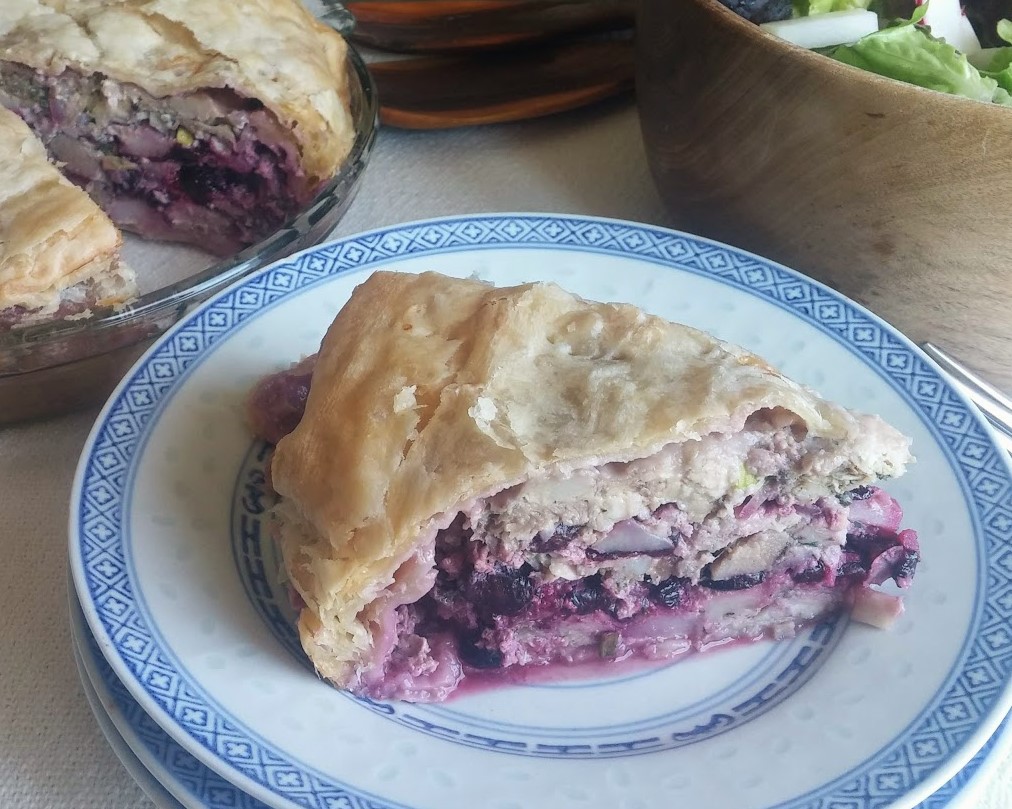
Haskap Chicken Tourtière

This is trailing a bit... due to very early heat and drought haskaps are mostly over already. But maybe you were able to freeze some. In spite of everything we got a pretty good crop; what we could snatch from the birds, who have definitely found them. 
 
There's already a lot going on here, so I resorted to frozen puff pastry for the crust, although what this mostly requires is some patience. Time to cook the potatoes; time to bake the pie; and time for it to cool. 

Now that haskaps are fading from the scene, you could use currants instead. Red or black ones for best effect, although they will be a bit seedier than the haskaps. 

Given the size and richness of the ingredients this is a bit of a party piece; and who knows? Someday soon we'll be able to gather more than two or three together again. As of yesterday, Mr. Ferdzy and I - my mother was done with it a few weeks back - are fully vaccinated. Hurray!
 
8 servings
2 hours - 40 minutes prep time
NOT including cooking the potatoes
NOT including cooling time

Haskap Chicken Tourtière

Pre-Cook the Potatoes & Mix the Seasonings:
300 grams (10 ounces; 4 medium) potatoes
1 1/2 teaspoons salt
1/2 teaspoon black peppercorns
1/2 teaspoon celery seed
1/4 teaspoon allspice berries
1 1/2 teaspoons rubbed savory
1/2 teaspoon rubbed sage
1/2 teaspoon ground ginger
1/4 teaspoon ground cloves
 
Put a pot of water on to boil and boil the potatoes for 10 minutes. Drain and allow to cool. You could also use leftover baked or boiled potatoes - you want approximately 2 cups once peeled and diced, which is what you should do once your potatoes are cool. 
 
Grind the salt, peppercorns, celery seed, and allspice together. Put them in a small bowl with the rest of the seasonings. 
 
Prepare the Filling:
1 cup finely chopped green onions
500 grams (1 pound) ground chicken
2 large eggs
500 grams (1 pound) skinless, boneless chicken pieces

Wash, trim, and chop the green onions. Put them in a mixing bowl with the ground chicken, the cooled, diced potatoes, the spices, and the eggs.  

Preheat the oven to 350°F. 

Chop the remaining chicken into bite-sized pieces and add to the mixing bowl. Mix everything well together.
 
Finish & Bake the Pie:
450 grams (1 pound; 2 rolls) thawed from frozen puff pastry 
2 cups haskap berries
 
Take one sheet of the thawed puff pastry and roll it out slightly. Line a large (10") pie plate with it, letting the corners drape over the edges. Spread 1/3 of the chicken filling evenly in it. 

The berries must be washed and picked over, and drained well. Spread half of them evenly over the chicken filling in the pie-crust. Top with another 1/3 of the chicken filling, evenly spread out, then add the final layer of berries and chicken filling in the same way. 

Fold the edges of the puff pastry up over the filling. Roll the remaining piece slightly and lay it on top so that the triangular edges are sticking out over the straight sides of the bottom piece. In between each of the folded up sections, pull the pastry slightly away from the pie plate and tuck the triangular overhanging pies in along the inside of the pie plate. Once they are all in, pinch around the edges to seal, and shape the top of the pie nicely. Poke it all over with a fork to allow the steam to escape. Put the pie plate on a baking tray - I think you can rely on this one to be a leaker - and bake for 1 hour and 15 to 20 minutes, until golden brown. 

Let the pie cool to just warm or room temperature before serving. It will definitely cut better once cool, and can be made in advance and refrigerated; bring it out 15 minutes or so before serving to bring it back to room temperature. 


Last year at this time I made Basic Very Low Sugar Ice Cream

Wednesday, 23 June 2021

Moo Goo Gai Pan

This classic Chinese-Canadian dish can be found on the menu of every Chinese take-out on the continent, probably. The name translates to fried chicken and mushrooms, although a generous quantity of other vegetables is usually included. You can make it at any time of year with whatever vegetables are in season, but I particularly like it now with snow or snap peas. Later on, broccoli is an excellent choice too; but asparagus, green beans, zucchini, cauliflower, Brussels sprouts or even cabbage or kohlrabi would all work. I tend to think something green but not too thin and leafy works best. I list carrot and red pepper as optional, but if you can get at least one of them they will add a very desirable pop of colour.
 
Garlic is the usual choice, but when the peas are in, so are garlic scapes, and they work very well, although like last year, I'm finding them rather tough and stringy this year from lack of water. 

As for the mushrooms, you can keep it inexpensive and easy with basic button mushrooms, or branch out with shiitake or oyster mushrooms. If using shiitake, you can reduce the amount by weight by about 1/3; you will still have about the same volume as you would with other, moister mushrooms. 

Mr. Ferdzy and my mother were quite impressed at how much this tastes like take-out Moo Goo Gai Pan... and it really does! Serve with steamed rice or fried noodles for the complete experience.
 
2 to 4 servings
45 minutes prep time, PLUS time to marinate the chicken

Stir Fried Chicken with Mushrooms - Moo Goo Gai Pan

Marinate the Chicken:
450 grams (1 pound) skinless, boneless chicken pieces
1 tablespoon mild vegetable oil
1/2 teaspoon salt
1 tablespoon soy sauce
2 tablespoons arrowroot or corn starch
 
Cut the chicken into bite-sized pieces. Toss it with the remaining ingredients in a coverable container,. Cover and refrigerate for 30 minutes to several hours. 

Make the Sauce:
1/3 cup chicken stock
1 tablespoon arrowroot or corn starch
1 tablespoon soy sauce
1 tablespoon oyster sauce
1 tablespoon sherry OR Chinese cooking wine
2 teaspoons toasted sesame oil
 
Dissolve the arrowroot in the chicken stock, then add the remaining ingredients. Cover and set aside until needed (in the fridge if done much in advance.) 
 
Prepare the Vegetables & Finish the Dish:
1 carrot (optional)
1/4 of a red pepper (optional)
225 grams (1/2 pound) mixed fresh mushrooms
2 cups snow peas
2 or 3 cloves of garlic OR garlic scapes
1 fresh onion with the greens OR 3 or 4 green onions
4 tablespoons mild vegetable oil

Peel and slice the carrot thinly, or the pepper into slivers. Clean and quarter or otherwise cut the mushrooms into bite-sized pieces. Top and tail the snow peas. Peel and mince the garlic, or trim the garlic scapes and chop them into inch-long pieces. Peel and chop the onion and the greens, keeping them separate, or trim and chop the green onions. 
 
Heat half the oil in a large skillet over high heat. Add the chicken, with the marinade, and cook until the chicken is cooked through, stirring regularly. Transfer it to another dish once it is done, leaving behind as much oil as possible. However, you will likely need to add a little more to cook the vegetables. 
 
Add the carrots or pepper to the pan and cook for just a minute or so, stirring frequently. Add the mushrooms and white parts of the onions, and continue to cook and stir. When they look partially cooked add the snow peas, garlic, and onion greens. Cook for another 2 minutes or so, until the vegetables all appear to be done but still quite crisp. Add the sauce and mix it in well. Cook for about 1 minute more, until the sauce is thickened. Serve at once with rice or noodles.


Last year at this time I made Peas in Butter Sauce

Monday, 21 June 2021

Steak & Blue Cheese Salad with Horseradish Dressing

Salads with meat have become a mainstay here, as a brief look at the posts from the last month or so will show. I've even done a steak salad with lots of radishes already, although this one is a bit different; richer from the blue cheese and creamy dressing, and with a more traditional Canadian flavour profile (by which I think I mean the richness, and the horseradish). 

I'm calling for the steak to be cooked and served warm, but it would be perfectly good with cold steak, leftover from a previous meal. At this time of year if you do outdoor grilling, cooking a little extra for cold salads later is a great idea. 

And now it's the solstice. Hard to believe that from here on in (for the next 6 months, anyway) the days are getting shorter. But given the weather it seems like we've had a long summer already.
 
4 servings
45 minutes prep time 

Steak & Blue Cheese Salad with Horseradish Dressing
 
Make the Dressing:
1/4 cup mayonnaise
3 tablespoons thick yogurt or sour cream
1 tablespoon olive oil
1 tablespoon apple cider vinegar OR lemon juice
2 tablespoons prepared horseradish
salt & freshly ground black pepper to taste
 
Mix all of the above in a small bowl or jam jar. 
 
Make the Salad:
1 small red onion
8 cups mixed salad greens
1 medium carrot
8 to 16 red radishes
600 grams (1.25 pounds) sirloin OR striploin steak
1 tablespoon mild vegetable oil
125 grams (1/4 pound) blue cheese
 
Peel and sliver the onion. Put it in a colander and sprinkle it with salt. Set it aside to drain. 
 
Wash, pick over, and chop the salad greens. Rinse well again and dry them thoroughly. Divide them over 4 dinner plates. Peel and grate the carrot, and wash, trim, and chop the radishes, and distribute them over the salads. 
 
Season the steak with salt and pepper. Heat the oil in a large skillet over medium-high heat. Cook the steak for 3 to 5 minutes per side, until done to your liking. Let it rest for 5 minutes before slicing it into bite-sized pieces and distributing it over the salads. Crumble the blue cheese over the salads. Drizzle the dressing over the salads, and serve at once.  


Last year at this time I made Herby Peas & Bulgur Salad

Friday, 18 June 2021

Pea & Bulgur Pilaf

We are currently up to our eyebrows in peas; apart from trying to keep things watered (egad) most of my time is being spent picking, shelling, and freezing peas; a state of affairs likely to last for at least another week. We did pause to eat a few though. 
 
This is a very simple side dish, and provides the carbs and vegetable all in one, so all you need to complete the meal is some type of protein - an excellent dish for very busy gardening days, although it does need a little time for the bulgur to soak. That'll give you time to shell the peas.
 
3 to 4 servings
1 hour - 20 minutes prep time

Pea & Bulgur Pilaf
 
1 cup bulgur
1/4 teaspoon salt
2 cups boiling water
1 fresh onion, with green top OR 3 or 4 green onions
1/4 cup finely minced fresh parsley
2 to 3 tablespoons finely minced fresh mint
2 cups shelled green peas
2 tablespoons mild vegetable oil
freshly ground black pepper to taste

Put the bulgur and salt into a bowl which will hold the heat (ceramic is best) and pour over the boiling water. Cover and let sit for 20 minutes to half an hour. 

Meanwhile, wash, trim, and chop the onion, parsley, and mint. Keep the white parts of the onion separate from the green parts. Shell the peas. 

Heat the oil in a skillet over medium-high heat. Add the white parts of the onion and cook for a minute or two, until softened. Add the bulgur, along with any remaining water in the bowl that is not yet absorbed. Simmer until the liquid is mostly absorbed, stirring occasionally. Add the peas and continue cooking and stirring until they are done (2 or 3 minutes) and the mixture looks moderately dry. Add the green onion tops and the herbs, and mix in until well wilted. Season with pepper to taste. 

Remove the skillet from the heat and cover it. Let the pilaf rest for 5 minutes before serving it. 


Last year at this time I made Haskap-Hazelnut Crunch.

Wednesday, 16 June 2021

Salmon, Snow Pea & Lentil Salad

Some advance cooking required here - although either the lentils or salmon could easily be leftovers - but this is otherwise a very simple salad. It's quite substantial for its volume - I was afraid it wouldn't be quite enough for the 3 of us, but in fact there was a little leftover, even with Mr. Ferdzy still eating like a fence-building bear. 

I've taken to cooking fish or boneless chicken for salads (or sometimes just to eat at once) in my panini press. It's quick - about 2/3 the time of broiling it - it's clean - the parchment paper is just discarded, and sometimes the panini press doesn't even need to be wiped - and it produces good quality results somewhere between poaching and grilling. The parchment paper keeps all the juices in and you get very moist results. (If you use this technique and plan to eat the fish or chicken hot, leave it wrapped and resting for 5 minutes before you open and serve it.)

I went with a Mediterranean flavour profile here, but I think it would be just as good to replace the seasonings I used with some Furikake. I'd omit the dill, in that case.
 
3 to 4 servings
1 hour to cook lentils
15 minutes to cook salmon 
20 minutes to finish the salad
 
Salmon, Snow Pea & Lentil Salad

Do the Advance Cooking:
1 cup brown or green lentils
2 1/4 cups water
1/4 teaspoon salt
400 grams skinned and boned salmon pieces
salt & freshly ground black pepper to taste
 
Rinse and pick over the lentils, and put them in a rice cooker with the water and salt. Turn on and let cook. Once they are done, remove the insert from the cooker and let the lentils cool completely. Cover. This can be done up to a day ahead, and the cooled lentils kept in the fridge. 
 
Season the salmon pieces with salt and pepper, and wrap them in parchment paper, so that there is a good sealed seam on top and then fold up the edges so the salmon won't leak as it cooks. Cook it in an electric grill (panini press) for 3 minutes, then rotate the package of salmon and cook for a further 3 to 4 minutes. Lift it out to a plate to cool, leaving it wrapped. Again, this can be done up to 24 hours ahead and kept in the fridge until needed.  You could also start with leftover cooked salmon; about 2 cups when chopped.

Make the Dressing:
1/4 teaspoon salt
1/4 to 1/2 teaspoon Aleppo pepper
1/2 teaspoon rubbed savory
the zest of 1/2 large lemon
3 tablespoons olive oil
the juice of 1 large lemon
 
Put the salt, Aleppo pepper, savory, and lemon zest into a small bowl or jam jar. Add the olive oil and stir until the salt is dissolved. Whisk or stir in the lemon juice. 
 
Make the Salad:
2 cups snow peas
2 to 3 tablespoons finely minced fresh chives
2 to 3 tablespoons finely minced fresh parsley
2 to 3 tablespoons finely minced fresh cilantro
2 to 3 tablespoons finely minced fresh dill
1 small head Bibb (Boston) lettuce
 
Wash the snow peas, and top and tail them. Put a pot of water on to boil, and boil them for 2 minutes. Rinse immediately in cold water until they cooled, then drain very well. 
 
Wash, trim, dry, and mince all the herbs. Put them in a mixing bowl with the snow peas. Add the lentils and the salmon, broken into large flakes or chunks. Toss with the salad dressing. 

Serve the salad over the washed and dried lettuce leaves, or if you prefer chop them and toss them with the salad. 


Monday, 14 June 2021

Haskap-Mango Jam

It seems like the haskaps and strawberries are very early this year, and we are picking tons of them already. They are really producing in the heat, although there is some trouble with quality - well, the haskaps seem fine but the strawberries have a slight tendency to turn to mush - I think they are actually, literally, cooking right on the plant, it has been so hot. 
 
But there are no strawberries here. I've made them into jam with mangoes before, and very good it is too. This is basically the same, but with haskaps. Haskaps definitely make a jam that sets better than strawberries do. And of course, if you want to keep the fruit completely local, there's always strawberry-haskap jam. As with the other haskap based jams, the haskap flavour tends to predominate, but the mango comes through in the finish. And given what tedious little buggers the haskaps are to pick, it's nice to get some volume somewhere else.
 
5 x 250 ml jars
1 hour work time
 
Haskap-Mango Jam

4 cups haskap berries
2 cups sugar
900 grams (2 pounds; 3 medium-large) mangoes
 
Put the jars (I always add 1 half-size jar, just in case) into a canner or other large kettle with water to cover them by at least an inch. Turn the heat to high to bring them up to a boil, and boil them for 10 minutes. Add a ladle and funnel to the top of the jars to sterilize as well. 

As soon as the heat goes on for the jars, wash and pick over the haskaps, removing and discarding any stems, debris, and bad berries. Put them in a heavy-bottomed soup pot or jam kettle. Add the sugar, and stir well. Turn on the heat to bring them slowly up to a boil. 

Meanwhile, peel and chop the mangoes, discarding the peels and pits. Add the chopped mangoes to the haskaps. Boil steadily for approximately 20 minutes, until the jam is cooked and runs from the spoon in a single wide stream. It can wait a little for the jars to be done (just turn off the pot) but they should be ready at about the same time.

When the jars begin to boil, put the lids into a smaller pot with water to cover them, and bring them to a boil. Boil for 1 minute, or according to the manufacturer's instructions. 

Drain the boiled jars half back into the pot, and half down the sink. Set them on a clean board, and use the funnel and ladle to fill them. Wipe the rims of the jars with a piece of paper towel dipped into the pot of boiling water, then seal them with the boiled lids and rims. Return them to the pot of boiling water for 10 minutes. Remove them carefully (without tilting them) to the board and allow to cool completely. Check that they have sealed, label, and store in a cool, dark spot for up to a year - refrigerate once open. 


Last year at this time I made Vaguely Thai Chicken Salad Cups.

Friday, 11 June 2021

Salpicon de Res

It's another very simple salad, with radishes, and yet fairly different from other radishy salads I've made this spring/early summer. This one is popular from southern Mexico through much of Central America.
 
You will need to have some leftover cooked beef, or else to make a trip to your local deli counter. The chewier it is, the finer you should chop it, and in general this salad is best with everything chopped fairly finely. Tomatoes will be from the greenhouse at this time of year, but they are an important part of the salad. 

Are we eating a lot of fast and easy salads at the moment? Yes, whenever possible. I am not at all impressed at how hot and dry it is already, apart from that vicious round of frost about 2 weeks ago. Salads definitely hit the spot. Also, got to eat that lettuce (and those radishes) fast - I don't think they will last well this year.
 
2 to 4 servings
30 minutes prep time
NOT including cooking or cooling the beef
 
Salpicon de Res - Central American Beef & Radish Salad

Make the Dressing:
1/2 teaspoon salt
1/2 teaspoon rubbed oregano
freshly ground black pepper to taste
1 tablespoon chopped pickled Jalapeño pepper
the juice of 2 limes OR 1 lemon
3 tablespoons olive oil
 
Mix everything in a small bowl or jam jar, and set aside until needed. 

Make the Salad:
2 cups diced cooked (roast or steak) beef
2 cups diced red radishes
1/4 cup finely chopped parsley
1/4 cup finely chopped chives OR green onion
2 tablespoons to 1/4 cup finely chopped cilantro 
2 tablespoons to 1/4 cup finely chopped fresh mint
1 or 2 large red tomatoes
1 small head lettuce 

Trim and dice the meat. Wash, trim and dice the radishes. Wash, dry, and mince all the herbs. Wash, trim, and dice the tomatoes. Mix all these in a bowl, and toss with the dressing.

Wash and separate the lettuce leaves, and dry them well. You can chop them and add them to the salad, or serve the salad over them; whichever you like. 


Last year at this time I made Balkan Yogurt Soda Flatbreads.

Wednesday, 9 June 2021

Creamed Spinach Filled Buns

I bought some good quality hamburger buns on impulse (and on sale), and since they are now actually a rare treat, I had to think of something rather special to do with them. Here it is! 

You are basically turning them into baked French toast, stuffed with creamed spinach. Spinach is mighty tedious to pick over and process, which is why I have listed such a long prep time. You could cut off at least 20 minutes by using frozen, and to be fair I am probably allowing too long because most purchased spinach will arrive in the kitchen in much better condition than mine does. Mine is generally bolting, and covered in dirt; 3 separate soaks are not too many. Still, give them plenty of time - if they sit a few minutes before serving, no harm done as they are probably better warm than piping hot. These would be terrific to take on a really fancy picnic - eat them cold, or wrap them in foil and reheat them on a grill.

Once you are past messing about with the spinach, these are very easy, and my guest (yes, all right, it was Mom, as usual) was very impressed by these. Me too, really. Definitely a worthy end for all those carbs.
 
4 servings
1 hour 30 minutes - 1 hour prep time
 
Creamed Spinach Filled Buns
  
Make the Filling:
200 grams (scant 1/2 pound) cooked spinach
3 or 4 green onions 
2 tablespoons unsalted butter
1 tablespoon barley or other flour
salt  & freshly ground black pepper & nutmeg to taste
1/2 cup 10% cream
60 grams (2 ounces) old Cheddar cheese

Wash and pick over the spinach; steam it until just wilted and plunge it in cold water to stop it cooking any further. Squeeze it quite dry and chop it very finely. Wash, trim, and finely chop the green onions. 

Heat the butter in a medium sized skillet over medium heat and add the green onions. Cook for a couple of minutes, stirring regularly, until well wilted down. Add the flour and seasonings and cook to a paste. Slowly mix in the cream to make a smooth sauce. Add the spinach and cheese and remove from the heat. Stir until the cheese is melted.
 
Fill & Bake the Buns: 
4 good large buns, but could be a bit stale
1 tablespoon unsalted butter
3 large eggs
salt & freshly ground black pepper to taste
3/4 cup milk
2 to 3 tablespoons grated Parmesan cheese 

Preheat the oven to 350°F. Line a baking pan which will hold the buns snugly with parchment paper, and butter it and the sides generously.
 
Use a steak knife, or other small serrated knife, to cut an inverted cone from each bun. Remove the inner crumbs from the cone, leaving a half-inch thick lid. Use a grapefruit spoon to scoop the crumb from inside the buns leaving a half-inch wall all around. The crumbs are discarded - by which I mean you toast them until dry then crush them and put them in your crumb jar; you do have one, don't you? - and the lids are put back on the now hollow buns. Set them aside for the moment.

Whisk the eggs, salt and pepper, and milk in a bowl which will allow the buns to be easily dipped into them. Dip each bun into the egg mixture, turning them and spooning egg mixture into them until the are well soaked. Put them into the prepared pan. There should be just enough of the egg mixture left for soaking the lids. 

Divide the creamed spinach amongst the soaked buns. Sprinkle a tablespoon or so of Parmesan over the spinach. Soak the lids in the remaining egg and milk, and put them in place over the spinach filling. Sprinkle a little more Parmesan over the buns.
 
Bake the buns at 350°F for 30 minutes. Serve warm or at room temperature. Keep well-wrapped in the fridge once cooled if you are not serving them shortly. 


Last year at this time I made Rhubarb Soup.

Monday, 7 June 2021

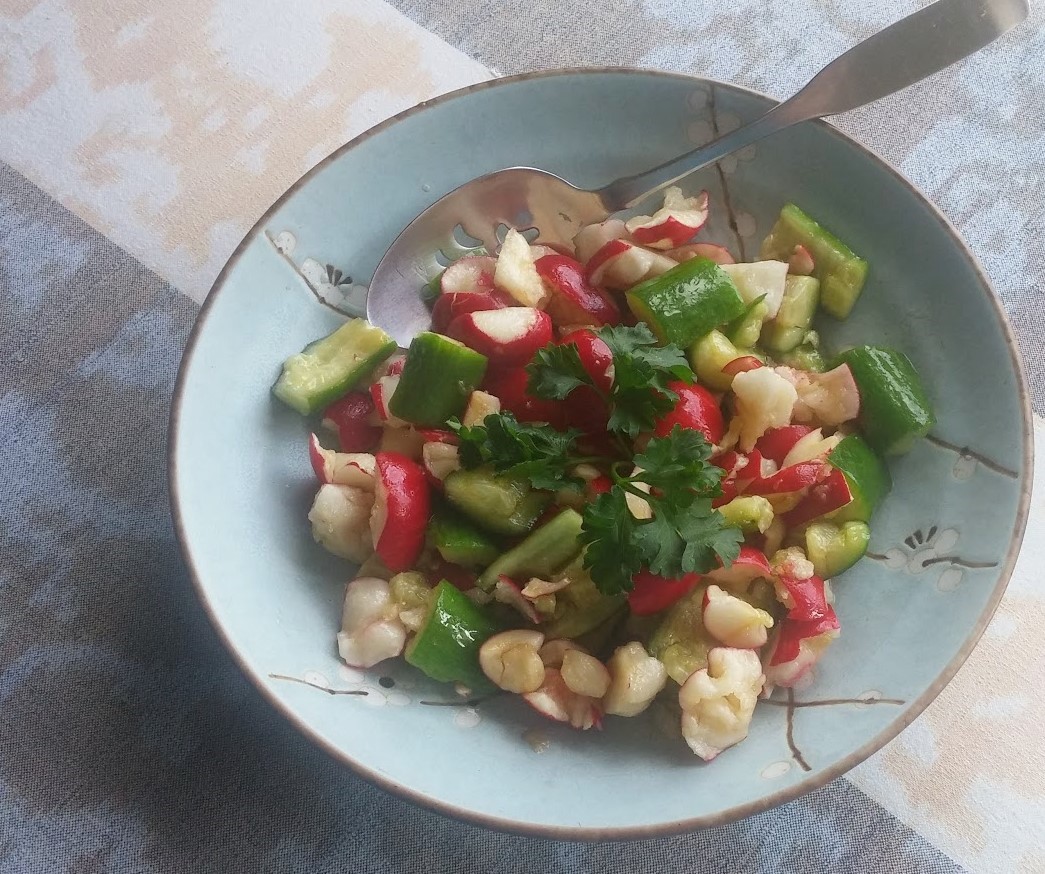
Chinese Cucumber & Radish Salad

There isn't too much to say about this; it's a quick and easy fairly traditional Chinese salad... perfect in both the making and the eating for long hot days in the garden, which is definitely what's on the agenda at the moment. Radishes should be out and about; cucumbers will still be greenhouse ones but nothing wrong with that. Cilantro coming up like the weed that it is.
 
4 servings
40 minutes - 10 minutes prep time
 
Chinese Cucumber & Radish Salad

10 to 15 radishes (1 bunch)
2 or 3 small greenhouse cucumbers
1 teaspoon sugar
2 teaspoons soy sauce
2 teaspoons toasted sesame oil
2 tablespoons rice vinegar
a little chile-garlic sauce, to taste, optional 
a few sprigs of cilantro to garnish

Wash and trim the radishes and cucumbers, and slice them (or break them into chunks, by smashing them lightly with the bottom of a glass). Put them in a serving bowl. 

Mix the sugar, soy sauce, sesame oil, and vinegar (and chile-garlic sauce, if using) in a small bowl until the sugar is dissolved, then pour it over the salad. Let sit for 30 minutes before serving. Sprinkle with a little chopped cilantro if you like it. 


Last year at this time I made Tofu & Mushroom Patties.
 

Friday, 4 June 2021

Circassian Chicken (Çerkez Tavuğu)

I served this with bread and salad, which I think is fairly traditional, but less than ideal for me. Next time I will keep it simpler and healthier, and skip the bread - there's plenty right in the chicken - and eat it wrapped in whole lettuce leaves. We all really liked this, and it's simple and delicious enough that I intend to make it quite often this summer. You could make this at any time of the year, but as a cold salad I think it is perfect summer food.
 
It's Turkish, of course, although we did not happen to encounter it while we were there. The use of breadcrumbs as a "sauce" is quite unusual, but it's a great way to use up stale bread. I've seen a few recipes with yogurt instead of the breadcrumbs, but I think that changes it to something more pedestrian. However, if it comes out a bit thick I would not hesitate to loosen it with a spoonful of yogurt if I was short on the chicken stock. 

You can add some vegetables to it if you like, but any recipe I saw with other vegetables in it was not written in Turkish by Turkish cooks; take that for what it is worth. The number of portions assumes bread and salad at the lower end, and that it is part of a mezze spread with multiple dishes available, at the upper end.
 
4 to 12 servings
45 minutes prep time 
BUT it should be made somewhat in advance to cool and rest
 
Circassian Chicken (Çerkez Tavuğu)
  
Cook the Chicken:
450 grams (1 pound) skinless, boneless chicken pieces
1/4 teaspoon salt
1 bay leaf
1 small carrot (optional)
1 small onion (optional)
1 small stalk celery (optional)
2 cups water
 
Put the chicken pieces into a pot with the salt and a bay leaf, and whichever of the seasoning vegetables you can round up. Cover with about 2 cups water and bring up to a simmer; simmer gently until cooked, about 20 to 30 minutes. Let cool. 
 
Strain the stock, discarding the solids - other than the chicken - and keep it and the chicken cool in the fridge until ready to proceed. 

Make the Dish:
2 or 3 cloves of garlic 
1/2 teaspoon cumin seed, ground
1/2 teaspoon coriander seed, ground
1/4 to 1/2 teaspoon Aleppo pepper
salt & freshly ground black pepper to taste
1 cup chicken broth, PLUS some more
1 cup fine dry bread crumbs
1 cup crushed walnuts
walnut pieces
parsley
 
Peel and grate the garlic; keep it in 2 piles, one a little larger than the other. 
 
Grind the cumin and coriander seeds, and put them in a little bowl with the remaining spices. 
 
Be sure the bread crumbs and walnuts are prepared before you start assembly; the bread should be in bits the size of a pea or smaller (you can grind them in a food processor if you like). The walnuts can likewise be almost milled fine, or left in little chunks depending on the texture you prefer. 

Shred the chicken into fine pieces.
 
Heat 1 cup of the chicken stock with about 2/3 of the garlic. When it comes to a boil, add the bread crumbs and the bowl of spices and mix well. When it is a solid mass, remove it from the heat. Stir in the crushed walnuts, and the remaining (raw) garlic. You should have a smooth, soft, and pliable but not liquid paste. If it is too thick, thin it with a little more chicken stock (or yogurt). It will thicken a bit with sitting so that's something to keep in mind. Mix in the shredded chicken.

Spread or mound the chicken in a serving dish, and garnish it with larger walnut pieces and chopped parsley to taste. Drizzle it with the Chile Oil. Serve at room temperature, but keep it refrigerated if you are not serving it right away - just take it out about 10 or 15 minutes before serving to take the chill off. Don't put on the Chile Oil until you are about to serve it.

Make the Chile Oil:
3 tablespoons olive oil
1/2 teaspoon Aleppo pepper
1 teaspoon paprika
a pinch of salt

Put the oil into a very small pan and heat it until it shimmers and smells of olives, and generally is quite hot but not boiling. Turn off the heat and add the spices. Mix them in well - they will probably sizzle a bit - and let the oil sit for about 10 minutes before drizzling it over the chicken.


Last year at this time I made Smoked Trout, Asparagus & Chick Pea Salad.

Wednesday, 2 June 2021

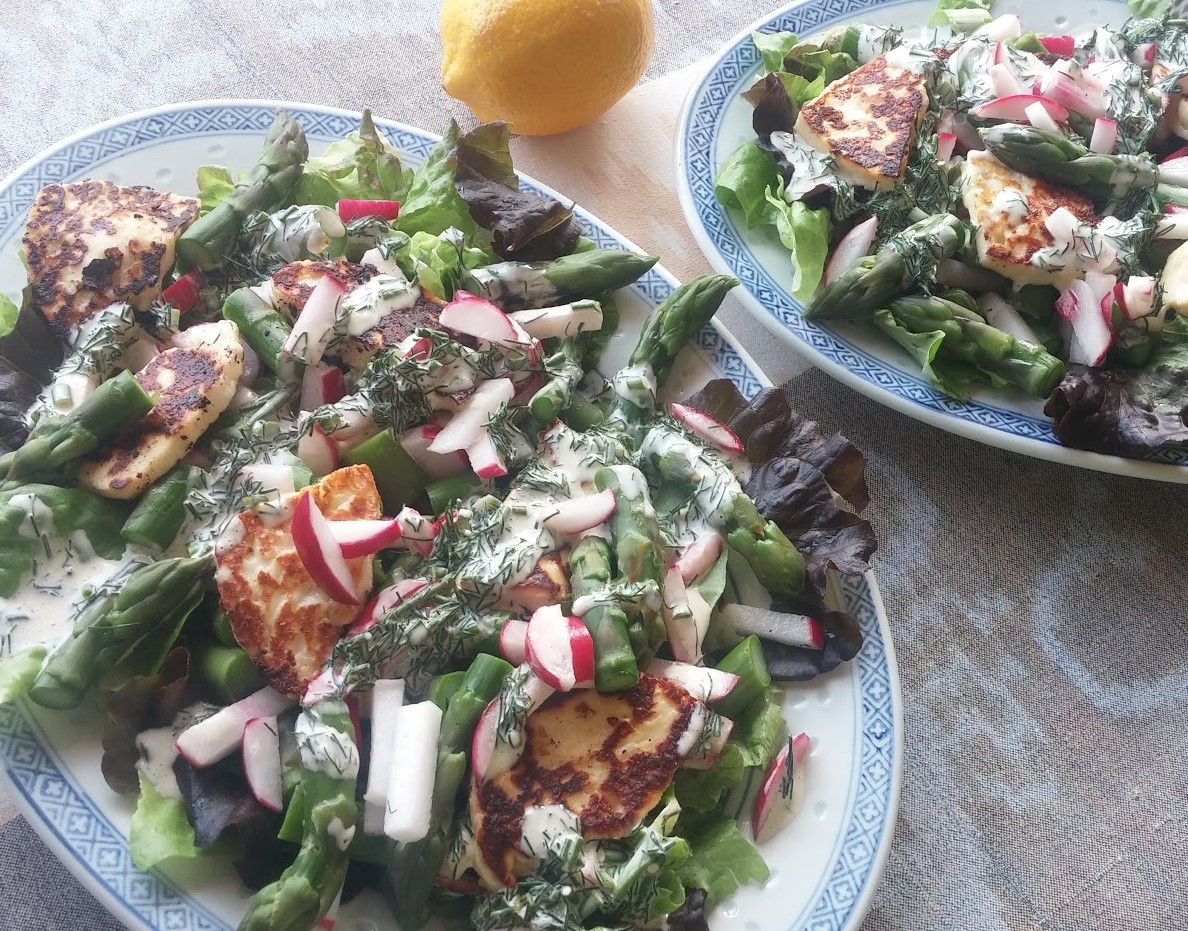
Asparagus, Radish, & Halloumi Salad with Dill Dressing

This was a very simple salad with not really a lot of things in it, but they were all such good things and they all went along with each other so agreeably that I have to say this is a landmark salad. There is still time, I hope, to make it a couple of times before asparagus season is over. Although it's definitely running on the early side, what with that burst of very hot weather in the middle of May. 

Naturally we ate it all, but as a starter salad to a multi-course meal it would serve up to 6 people. Really, though; it's so delightful and satisfying that I think you should just eat this salad. Maybe follow it up with some Strawberry Crisp.
 
2 to 6 servings
30 minutes prep time
 
Asparagus, Radish, & Halloumi Salad with Dill Dressing

Make the Dressing:
2 tablespoons minced fresh chives
1/4 cup minced fresh dill
freshly ground black pepper to taste
1/3 cup mayonnaise (light is fine)
2 teaspoons Dijon mustard
the juice of 1 large lemon
 
Wash, dry, and mince the chives and dill, then mix them with the remaining ingredients in a small bowl or jam jar. Add the lemon juice slowly at the end to ensure the dressing is free of lumps. 
 
Make the Salad:
500 grams (1 pound) fresh asparagus 
1 head Boston or Bibb lettuce
6 to 10 radishes
150 to 250 grams (5 to 8 ounces) halloumi cheese
a little oil to fry

Wash and trim the asparagus, and cut it up. Keep the tips separate. Cook the asparagus without the tips in boiling water for 4 minutes, adding the tips after 1 minute. Rinse in cold water to stop them cooking further and drain well. 

Wash and chop the lettuce, and wash, trim, and slice or chop the radishes. Mix the lettuce, asparagus, and radishes in a salad bowl or arrange them on individual plates. 

Heat the oil in skillet over medium heat, using just enough oil to keep the cheese from sticking. Slice the cheese and fry it on both sides until nicely browned, just a few minutes per side. Turn it out and cut it up into bite-sized pieces, and sprinkle them over the salad(s). Drizzle with as much of the dressing as you like (there will likely be extra) and serve at once. 


Last year at this time I made Strawberry Crisp. So good!