Monday, 29 November 2021
Squash with Za'atar & Tahini Sauce
Monday, 22 November 2021
Cheesy Spaghetti Squash
Wednesday, 2 December 2020
Pumpkin or Sweet Potato Baked Oatmeal
Wednesday, 25 November 2020
Squash & Brussels Sprouts Parmigiano
900 grams (2 pounds) butternut squash
450 grams (1 pound) Brussels sprouts
300 grams (10 ounces) unripened firm (not hard) cheese such as
mozzarella, friulano, scamorza, fontina, or even cheese curds
100 grams (3 to 4 ounces) grated Parmesan cheese
3 tablespoons mild vegetable oil
3 tablespoons barley flour
1 teaspoon rubbed sage OR rosemary
a little grated nutmeg (optional)
salt & freshly ground black pepper to taste
1/2 cup 10% cream
Cut the squash, de-seed it and peel it, and slice it thin, in bite-sized pieces. Trim and slice the Brussels sprouts thinly as well and place them in a colander.
Put a kettle of water on to boil and use it to blanch the Brussels sprouts. Once the boiling water has been evenly poured all over them, let them drain well.
Slice or dice the chosen cheese, and grate the Parmesan.
Preheat the oven to 350°F. Lightly oil a shallow 2 quart baking dish (9" x 13" lasagne pan).
Put the squash in the pan and drizzle the oil over it; toss gently to distribute. Sprinkle over the flour and the seasonings; toss gently to distribute them. Add the drained Brussels sprouts and the main cheese and mix gently. Spread everything out evenly, and pour the cream over it.
Bake the Parmigiano for 20 minutes at 350°F. Sprinkle the Parmesan cheese evenly over the top and return to the oven for a further 40 minutes. Let the Parmigiano rest for 5 to 10 minutes before serving.
Last year at this time I made Butternut Squash Roasted with Shallots & Cranberries.
Wednesday, 18 November 2020
Squash Kibbeh
Monday, 9 November 2020
Acorn Squash Soup
Wednesday, 21 October 2020
Table Queen (& Gill's Golden Pippin) Acorn Squashes
In the photo above, there are 2 Table Queen and 2 Gill's Golden Pippin acorn squashes, the Table Queen being dark green and the Golden Pippin being, uh, golden. Acorn squash are distinctive, generally vaguely acorn shaped (if you use your imagination) but with distinctive fluting. They are fairly small, running from just one or two servings each, up to about 4 servings per squash. In general, the Table Queen run larger than the Gill's Golden Pippin; the one at the top is an unusually big example. I've written about Golden Pippin before.
Acorn squash are members of the cucurbita pepo group, meaning that they are related to most of the zucchini and summer squashes, and will cross with them. In my experience the resulting crosses are rarely good; they get tough and seedy too fast as summer squash, and lack good flavour and keeping qualities as winter squash. Acorn squash are about the only form of cucurbita pepo that are eaten as storage squash, and they are not particularly long lasting. They will be good from now through the end of the year, but by January they really should be gone or rapidly disappearing, as they are noticeably not as good as they were.
Table Queen was apparently introduced to widespread commerce in 1913 by the Iowa Seed Company (according to Baker Creek) and became immensely popular. All through my youth and really, up to today, this was the basis for commercially produced acorn squash, if not in fact the exact variety. I confess that when I started gardening I regarded Table Queen with some disdain as a common and not very interesting acorn squash, but it really isn't true, and a good home-grown one is delicious.
There is a Table King, in both bush and vine varieties, which I presume are the result of breeding and selection for more productivity, disease resistance and compactness, but my impression is that they are not hugely different. A Golden Table Queen won the All American Selection in 1939, but it seems to have disappeared. There is also a bush version of Table Queen, but mine was the classic vining version. Vines can get to 20 feet long under ideal conditions, and they are pretty amenable to being piled up on themselves, but trellising is really a good idea. Squash that have been kept off the ground develop better shapes and are less likely to develop mould problems ore be attacked by insects or other pests. I am finding that this year the Table Queen have a very tough skin, and are harder to cut than the Golden Pippin.
The Arikara first nation of North Dakota were skilled and productive gardeners, trading their excess produce over a wide area, and their vegetables have been a prolific source of genetic material for North American vegetables to this day, particularly for corn, squash, and beans. Table Queen was likely developed from one of their squash, and may not even be all that much changed from what they grew. It is certainly a very well adapted squash all over North America, from Texas to eastern Canada, from Florida to British Columbia. It has good resistance to vine-borers, squash bugs and cucumber beetles, the three plagues of squash. It ripens in 80 to 85 days from germination, which will give plenty of time from a late May to June 1st planting date. Under ideal conditions and with good soil (so not me) you can apparently get up to 8 squash per vine.
To some degree Table Queen has been replaced by similar but hybridized versions, but the original is still an excellent plant with great productivity and resiliency, and is fairly widely available.
Monday, 10 February 2020
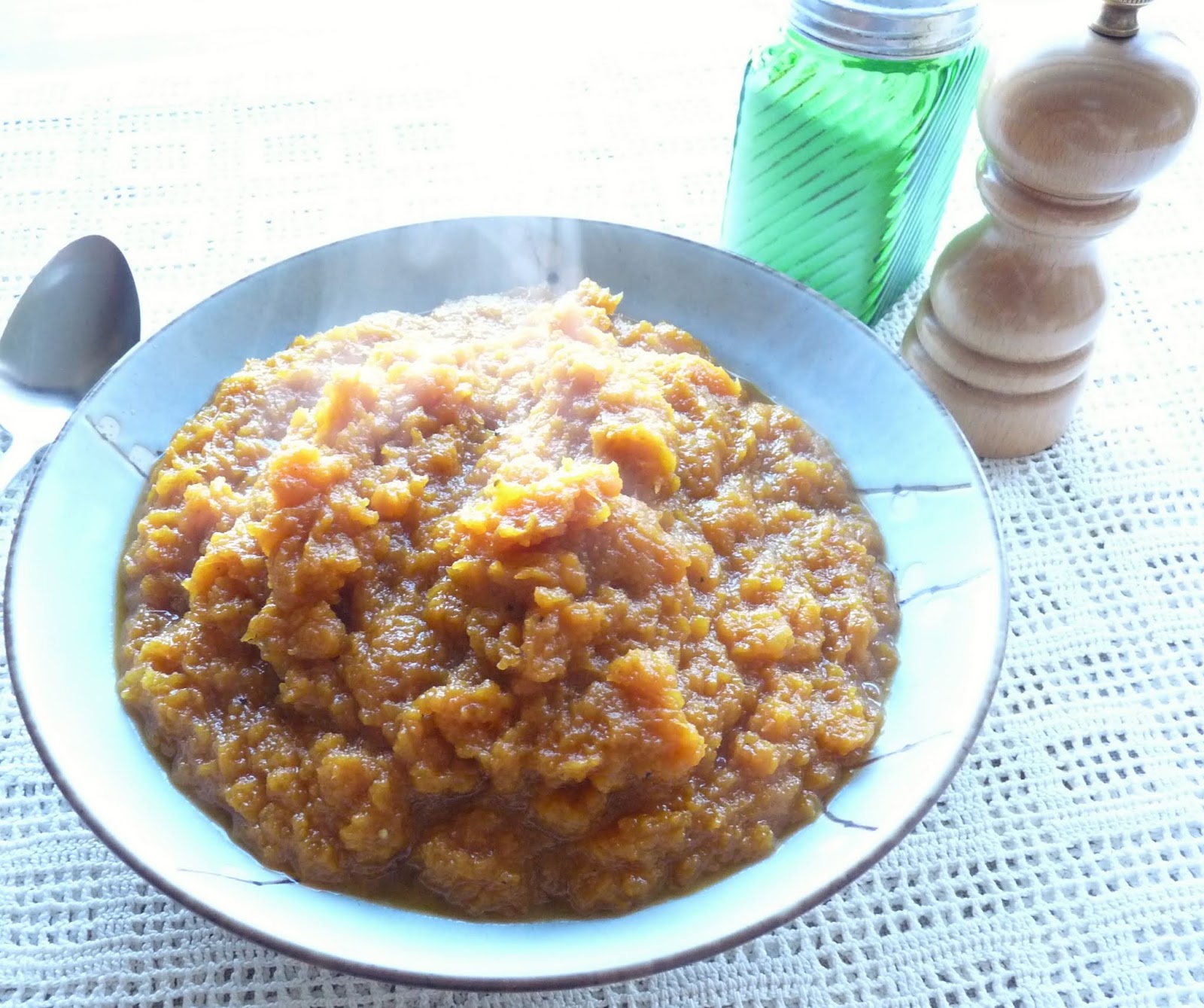
Apple Butter Mashed Squash
I hope you can find squash at this time of year. I can still get lots just by walking into the laundry room, but you may have to go to a farmers market if you don't grow your own. By now they are a little starchier and less sweet than they would have been in the fall, so a touch of apple butter helps bring that back. You may wish to apply it with a slightly heavier hand than I did. At any rate, you scale the ingredients to the amount of cooked squash you have. Baked, boiled, or steamed; just make sure it is well mashed.
1 to 2 servings per cup
15 minutes prep time not including first cooking the squash
1 cup cooked mashed squash
1 tbsp butter
1 tbsp apple butter
1/4 tsp salt
freshly ground black pepper
a few gratings of nutmeg OR 1/8 teaspoon gr cinnamon
Put the squash in a saucepan with the remaining ingredients and heat until steaming hot. Stir, from frequently to just about constantly, to prevent it from catching.
Aaaaand serve it.
Wait; that's it?
Yes. Yes, it is.
Ha ha! Last year it was Butternut Squash Stuffed with Wild Rice & Mushrooms and I said the exact same things about finding squash at this time of year.
Monday, 25 November 2019
Butternut Squash Roasted with Shallots & Cranberries
I am still trying to figure out how squash fit into a lower blood sugar diet. They are quite high in carbohydrates for a vegetable, and in fact contain sugars. On the other hand they rate quite low on the glycemic index and load, and some sources indicate they have blood-sugar lowering properties. On the other hand I can find references to people eating squash and having their blood sugar go up... it's a puzzle. Right now I am eating them because we have a laundry room shelf full of squash, but I will need to check my blood sugar levels over the winter as I eat them, and think about whether and how many we should plant next year. And I put honey in them too, because cranberries. However, in spite of all the potential pitfalls this is a dish for special fall and early winter occasions, and will not get eaten often.
If I wanted to make this more of a main dish, I would sprinkle some cubes of feta cheese over it for the last 10 or 15 minutes of baking.
4 servings
1 hour 30 minutes - 15 minutes prep time
1.4 kilogram (3 pounds) butternut squash
6 to 8 shallots
1 cup fresh cranberries
1 tablespoon honey
2 tablespoons mild vegetable oil
salt & freshly ground black pepper to taste
Preheat the oven to 375°F.
Peel the squash, and remove the seeds and any stringy bits from the seed cavity. Cut it into 1 centimetre slices, and then into bite-sized pieces. Peel and quarter the shallots.
Put the squash and shallots into a shallow 9" x 13" baking (lasagne) pan. Add the cranberries, washed and picked over. Drizzle the honey and vegetable oil over the squash, etc, and mix gently. Season with salt and pepper.
Bake for 1 hour and 15 minutes until the squash is tender. Stir gently halfway through the baking time. Serve at once.
Last year at this time I made Squash Poached in Maple Syrup.
Monday, 11 November 2019
Spiced Roasted Apple & Acorn Squash Soup
4 servings
1 hour 30 minutes - 30 minutes prep time
Mix the Spices:
1 teaspoon fennel seeds
1 teaspoon anise seeds
1/2 teaspoon allspice berries
1/2 teaspoon black peppercorns
1 teaspoon salt
Grind everything together and set aside.
Roast the Squash, Etc & Finish the Soup:
1 large (1kg; 2 1/4 pounds) acorn squash
4 medium apples
4 shallots
2 tablespoons mild vegetable oil
3 cups unsalted chicken OR vegetable stock
2 tablespoons apple cider vinegar
Preheat the oven to 400°F.
Cut the squash into quarters and scoop out the seeds and stringy bits from the centre. Rub the cut edges with a little oil, and roast the squash until tender, about an hour and a quarter.
Meanwhile, peel the apples, core them, and slice them into wedges - I used an apple cutter. Peel and cut the shallots into quarters. Toss both with a little oil and the spice blend, and spread them on a baking tray. Bake for about 45 minutes, until softened and slightly browned. Start checking them at the 30 minute mark though; apples vary a lot in the length of cooking time required, and much depends on how thickly you have sliced them.
The apples can cool while the squash finishes. Once the squash is roasted and cool enough to handle, peel off and discard the skins. Run the flesh through a food processor until smooth. You can add any quantity of the apples and shallots that you like, up to all of them, or you can keep some out, and mash them, and add them later to provide some chunky texture to the soup. Use some of the stock to thin the squash if it is too thick for the food processor.
Put the puréed squash, etc into a soup pot with the remaining apples and shallots (lightly mashed), the remaining stock, and the vinegar. Heat to a good simmer and serve.
Friday, 8 November 2019
Braised Pork Ribs & Squash
The black bean sauce I had was also fairly spicy, which was a thing I liked in the finished dish, but use whatever black bean sauce you like/have/can get. I also saw a few versions of this recipe which called for oyster sauce instead. I don't think it would have the same depth of flavour but it would do in a pinch.
I thought of making this in the Instant-Pot, but it cooked quickly enough that it would actually have been slower, what with the ramping up and the cooling down. Which is a bit amazing since they have the look and taste of something that spent the entire day simmering. This is supposed to be made with small cut spare ribs, but regular pork back-ribs are what I can easily get. They were a bit too large to be ideal, but they worked and we ate them and they were delicious, so no harm, no foul.
Serve with rice and a simply cooked green vegetable.
4 servings
1 hour 30 minutes - 30 minutes to marinate - 20 minutes prep time
Marinate the Pork Ribs:
2 tablespoons vinegar
2 tablespoons soy sauce
1 tablespoon toasted sesame oil
2 tablespoons black bean and garlic sauce
OR 2 tablespoons oyster sauce
1 teaspoon arrowroot
600 grams (1 1/2 pounds) pork ribs
Mix the vinegar, soy sauce, sesame oil, and black bean sauce, and arrowroot in a shallow flat-bottomed pan (I used my smaller lasagne pan). Cut the ribs into individual pieces and toss them in the marinade, then lay them out in it in a single layer. Let marinate for 30 minutes (or up to 3 hours in the fridge).
Cook the Ribs & Squash:
600 grams (1 1/2 pounds) butternut or kabocha squash
1 large leek
2 cloves of garlic
1 tablespoon grated or finely minced fresh ginger
2 tablespoons mild vegetable oil
2 cups water
Cut the squash and remove the seeds and stringy bits. Peel it and cut it into large bite-sized chunks. Wash, trim, and chop the leek into smaller pieces. Peel and mince the garlic. Peel and mince (grate) the ginger.
Heat the oil in a heavy-bottomed soup pot or Dutch oven (bastible) over medium-high heat. Lift the ribs out of the marinade - scrape it back into the marinating dish - and put them in the oil. Brown the ribs on both sides. Throw in the ginger and garlic for the last minute of cooking.
Add the water to the marinade and swish it out into the pot of ribs once they are all browned. Add the squash and leek. Mix everything gently, then allow the the water to come up to a boil. Reduce the heat to a simmer, and simmer the ribs, etc, for about 30 minutes, until the squash is tender and the meat is starting to come off the bones. Give it another gentle stir once or twice during the cooking period. The water should cook down to a thick sauce, but make sure it does not boil dry - add more water if that seems like a possibility. Let rest for 5 minutes then serve.
Last year at this time I made Pasta with Bacon, Broccoli, Leeks & Cream.
Friday, 11 October 2019
Acorn Squash with Wild Rice & Mushroom Stuffing
The stuffing is a little salty on its own; you should be careful to mash it into the squash as you eat it to get just the right balance.
4 to 8 servings
1 hour 45 minutes - 45 minutes prep time
Pre-Cook the Wild Rice & Squash:
1/2 cup raw wild rice
1/4 teaspoon salt
2 cups water
2 large acorn squash
2 tablespoons mild vegetable oil
Put the wild rice into a rice-cooker with the salt and water. Turn on and cook until done.
Preheat the oven to 400°F. Cut the squash in half and remove the seeds and loose strings. Rub them with the oil, and place them face up in a baking tray. Bake until there is only slight resistance when pierced with a fork; should be about 40 minutes to an hour.
Make the Seasoning Mix:
2 tablespoons chick pea flour
2 tablespoons nutritional yeast
2 tablespoons soy sauce
2 teaspoons Dijon mustard
freshly ground black pepper to taste
1 teaspoon rubbed thyme OR savory
1/4 cup water
Measure everything but the water into a small bowl and mix until well blended. Add the water, a little at a time, and stir it in until you have a smooth sauce.
Make the Filling & Stuff the Squash:
4 large shallots
1 large stalk of celery
6 to 8 large button mushrooms
2 tablespoons mild vegetable oil
Peel and chop the shallots. Wash, trim, and chop the celery. Clean, trim, and chop the mushrooms. Heat the oil in a large skillet over medium-high heat and cook the vegetables until softened and slightly browned, stirring frequently. Mix in the cooked wild rice for the last few minutes of cooking.
When the squash is about 80% cooked (as described above) divide the filling between the four half squash pieces. Divide the seasoning mix evenly between the squash, drizzling over the filling.Add enough water to the pan the squash are in to cover the bottom of it by about 1/4".
Return the squash pieces to the oven and bake for a further 30 minutes or so, until the filling is lightly browned and the squash is completely tender. Cover with a tea-towel and let rest for 10 minutes before serving.
If you decide you have put the filling in too early, and the squash needs more time to bake, you may wish to add a bit more water to the pan, and cover the squash with foil to keep the filling from drying out.
Last year at this time I made Lo-Bak Pancakes.
Friday, 8 February 2019
Butternut Squash Stuffed with Wild Rice & Mushrooms
This requires a little advance planning, but it's an excellent - festive, even - vegetarian main dish needing only a salad or green vegetable to make it a complete meal. If you still have cranberries in the freezer some cranberry sauce would go well with it too.
4 to 6 servings
2 hours including advance cooking - 45 minutes prep time
Roast the Squash & Cook the Wild Rice:
a 1.5 kilo (3 pound) butternut squash
1 tablespoon mild vegetable oil
2/3 cup wild rice
1/4 teaspoon salt
Preheat the oven to 375°F. Cut the squash in half and remove the seeds and strings from the cavity. Rub the cut edges with oil and place on a baking tray. Bake the squash halves for about 1 hour, until tender.
Put the wild rice and salt into a rice cooker with 2 cups of filtered water. Turn on and cook. It should be done in about 45 minutes; remove the pot from the rice cooker until ready to proceed. You can finish the dish at once, or do this preparation up to a day in advance. If so, you should be prepared to allow the squash a little longer to bake in the next step; about an hour.
Stuff & Bake the Squash:
1 cup mashed cooked squash
3 or 4 shallots
2 or 3 cloves of garlic
1 cup grated peeled celeriac OR 1 stalk of celery
250 grams (1/2 pound) shiitake mushrooms
2 tablespoons mild vegetable oil
3 tablespoons soy sauce
2 teaspoons ground ginger
freshly ground black pepper to taste
1/2 cup gluten flour
1/2 cup chopped nuts or seeds of your choice
1 tablespoon mild vegetable oil
Scoop out the flesh from the squash halves, leaving about a half inch to an inch of squash all around in the shells. Arrange the shells in an oiled baking dish. Mash the squash and measure 1 cup into a mixing bowl; the rest is excess to requirements and can be saved for some other purpose.
Peel and chop the shallots. Peel and mince the garlic. Peel and grate the celeriac or wash, trim, and finely chop the celery. Trim off the stems from the shiitakes and discard them. Chop the shiitakes finely.
Preheat the oven to 375°F.
Heat the oil in a large skillet. Add the shallots and celeri(ac) and mix well. Cook for a minute or two until beginning to soften then add the shiitakes and continue cooking, stirring regularly, until everything is softened and cooked down. Mix in the garlic, then add the seasonings. Cook until mixed in well and the garlic is fragrant. Transfer to the bowl with the squash. Mix well.
Mix in the wild rice until well blended. Mix in the nuts or seeds until well blended. Divide the filling between the 2 prepared squash shells. Drizzle them carefully with a little oil until the top of the filling is shiny all over. Bake for 45 minutes at 375°F. Let rest 5 to 10 minutes before serving.
Last year at this time I made Sesame-Ginger Red Cabbage.
Friday, 25 January 2019
Mashed Butternut Squash & Sweet Potatoes
It's essentially the same technique as with Parsnips & Pears not long ago. After the vegetables are boiled, they are drained and cooked in butter for a short while to drive off a little moisture and to brown them. This gives sweetness and complexity to the flavour and avoids sogginess.
I just seasoned mine with a little nutmeg, but they can be done however you like. I can see this with a balsamic drizzle, as with these Pan Cooked Sweet Potatoes.
flexible servings
45 minutes - 30 minutes prep time
butternut squash
sweet potatoes
unsalted butter
salt & freshly ground black pepper to taste
a little nutmeg OR other seasonings to taste
Put a pot of lightly salted water on to boil, sufficient to hold all the vegetables with comfort.
Peel and de-seed squash, and cut it into chunks not more than 1 1/2" in any direction. Peel the sweet potatoes and cut them likewise.
When the water boils, add the squash and cook for 3 or 4 minutes before adding the sweet potatoes. Boil for a further 12 to 15 minutes, until the vegetables are tender.
Drain the vegetables and return them to the stove, with butter added in the proportions of about 2 teaspoons of butter to a cup of vegetables. Mash well, and continue to cook and stir them over medium-high heat. Season with the pepper and any other seasonings you like. They may need some salt, but adjust it after you have tasted the mash. When the mixture is thick and you are smelling caramelized notes from the vegetables, turn them into a serving dish and serve at once.
Last year at this time I made Dutch Slavinken, with which this would go very well.
Friday, 23 November 2018
Squash Poached in Maple Syrup
It is often served with some sort of mild, soft cheese. This version leans a little to the Caribbean, with the spicing and the rum, but the maple syrup brings it back to Canada.
I can see I am going to have a fair bit of syrup left after we have eaten the squash; I am thinking it will be good in or on bread pudding or French toast.
6 to 8 servings
40 minutes prep time plus time to cool
1.5 kilogram (3 pounds) butternut squash
1 1/2 cups dark maple syrup
3/4 cup water
1 4" cinnamon stick
3 or 4 slices of fresh ginger
6 to 8 allspice berries
2 tablespoons rum
1 cup thick yogurt - OPTIONAL
Wash the squash thoroughly. Trim off the ends. You can leave the remainder of the skin on, or you can peel it. Cut it into even slices or chunks, discarding the seeds and stringy flesh from the centre.
Put the remainder of the ingredients - the ginger should be sliced into 1/4" slices - into a pot in which it will cover the squash. Bring it to a boil.
Gently add the squash pieces and bring the syrup back to a boil. Reduce the heat to a slow, steady simmer. Cover the pot and let the squash simmer for 10 to 15 minutes. Turn all the pieces over, very gently, and let simmer, covered, for another 10 or 15 minutes until tender.
Let the squash cool in the syrup. If you like, place about 1 cup of thick yogurt in a coffee filter in a strainer, and leave it over a bowl to drain for a couple of hours while the squash cools. Serve with the squash.
Last year at this time I made Spanish Beef & Turnip Stew.
Wednesday, 31 October 2018
Warm Roasted Squash & Broccoli Salad with Hazelnuts
I'm saying 4 servings, but the 3 of us ate it all. However, I only served a small piece of chicken alongside it, so with something else more substantial it should go further, and while it is a little time-consuming, there really isn't a lot of actual work involved.
Often this kind of salad is served with feta cheese in it, and that would be one way to make it a complete meal in itself. Sausages on the side would be a good choice too, with their slightly salty flavour profile.
4 servings
1 hour 30 minutes - 20 minutes prep time
Roast the Vegetables:
a 1.2 kilo (2.5 pounds) butternut squash
2 tablespoons mild vegetable oil
salt & freshly ground black pepper to taste
1/2 teaspoon ground Aleppo OR similar pepper
1 large onion
1 large head of broccoli
2 tablespoons mild vegetable oil
salt & freshly ground black pepper to taste
Preheat the oven to 375°F.
Peel and de-seed the squash, and cut it into large bite-sized pieces. Toss it with the first round of oil, salt, pepper, and Aleppo pepper and spread it out on a large baking tray in a single layer. Roast for 40 minutes, then turn the oven up to 400°F.
Meanwhile, peel the onion and cut it into large slivers / small wedges. Wash and trim the broccoli, and cut it into florets. Peel the stem and cut it into large slivers. Toss them with the remaining oil, salt, and pepper. Mix them into the squash when it has roasted for 40 minutes, and roast for a further 20 to 30 minutes, at 400°F, until the vegetables are done to your liking.
Toast the Hazelnuts & Finish:
100 grams (4 ounces) whole hazelnuts
the juice of 1 large lemon
1 1/2 teaspoons Dijon mustard
At some point while the squash is roasting at 375°F, spread the hazelnuts on another baking sheet and roast them on the top shelf for 10 to 15 minutes. Let them cool, then rub them in a towel to remove most of the skins. Chop them coarsely.
Squeeze and strain the lemon juice, and mix in the mustard.
When the vegetables are roasted, toss them with the hazelnuts and lemon juice. Let cool a few minutes before serving - it should be still warm but not really hot.
Last year at this time I made Lamb with Turnip Greens.
Wednesday, 17 October 2018
Pasta with Spinach, Roasted Squash, Shallots & Ricotta
That said, this was enjoyable. Sometimes some good sturdy stodge is just what you need - chilly yard clean-up days, anyone? Cheese and spinach makes this a complete meal.
We had a bumper harvest of squash this year, and the quality is good. This is just the beginning of quite a few squash dishes for us.
4 servings
1 hour 15 minutes - 30 minutes prep time
Roast the Squash, Etc:
1500 grams (3 pounds) butternut squash
6 to 8 large shallots
2 tablespoons mild vegetable oil
1/2 teaspoon salt
freshly ground black pepper to taste
2 teaspoons rubbed savory OR sage
450 grams (1 pound) ricotta cheese
Preheat the oven to 375°F.
Peel and de-seed the squash, and cut it into rather large bite-sized pieces. Peel the shallots and cut them in halves or quarters if large, which they are, ideally.
Toss the squash and shallots with the oil in a large shallow baking tray - they should be able to be spread out in a mostly single layer. Sprinkle them with the seasonings and toss again.
Roast the squash and shallots for 30 minutes. Stir them, and dollop the ricotta cheese over them. Return the tray to the oven and bake for a further 20 minutes.
Cook the Pasta & Finish:
320 grams (11 ounces) chunky pasta
1 bunch spinach
3 or 4 cloves of garlic
60 grams (2 ounces) Parmesan cheese, grated
Meanwhile, start a large pot of salted water on to boil. Cook the pasta according to the package instructions so that they will be done cooking within a minute or two of the squash and shallots.
Pick over the spinach and wash it very well, and drain it. Chop it coarsely. Add it to pasta for the last 2 or 3 minutes of boiling - you may wish to add an extra minute to the pasta cooking time to allow for the water to come back to the boil.
Peel and mince the garlic. Grate the Parmesan.
When the pasta is done, drain it well. Take the squash from the oven, and mix the garlic into it at once. Mix the pasta and spinach in gently, trying to break neither squash nor pasta. Sprinkle the Parmesan over the dish and serve at once.
Last year at this time I made Cauliflower with Leeks & Carrots.
Monday, 1 January 2018
Squash, Leek & Goat Cheese Galette
I also used my favourite biscuity crust, which may be a bit too crumbly for galette purposes and may explain the difficulties I had in forming it (see instructions). However it's still my favourite and I would rather eat it than a better-behaved one.
I'm also calling for all kinds of variations because this strikes me as extremely flexible, within the framework of squash-allium-cheese. In fact I am wondering about replacing the squash with sweet potato.
Pretty much all the recipes I looked at called for roasting the squash in advance. If you had some already roasted that would probably be ideal, but I had a chunk of raw squash I wanted to use up and I just grated it. It worked quite well so that is definitely a thing you can do.
4 to 6 servings
1 hour 30 minutes - 30 minutes prep time
not including roasting the squash,
and you should let it cool a bit before serving
Make the Pastry:
2 cups soft unbleached flour (I used half whole wheat)
2 teaspoons baking powder
1/2 teaspoon salt
1/4 cup unsalted butter
1/4 cup mild vegetable oil
1/4 cup buttermilk
Measure the flour and put it in a mixing bowl; stir in the baking powder and salt. Cut in the butter (or grate it in, if it's cold). Mix in the oil and buttermilk. Mix enough to form a smooth, stiff dough. I find it easiest to dump it out onto a piece of parchment paper and work it a bit. It is pastry though, so the less you can work it the better. As soon as it has come together, wrap it up in the parchment and set it aside as you make the filling.
Make the Filling & Finish:
500 grams (a generous pound) peeled and diced butternut squash, roasted
OR 450 grams (1 pound) peeled and grated butternut squash
1 large leek
OR 2 large onions, OR 6 to 8 shallots
2 tablespoons unsalted butter OR mild vegetable oil
1 teaspoon savory, thyme, OR basil
1/4 teaspoon salt
freshly ground black pepper to taste
flour to roll pastry
150 grams chevre (soft goat cheese) OR other cheese to taste
This is a good way to use up chunks of already roasted squash, aka left-overs (or plan-overs). If you are starting with raw squash - which is what I did - peel and grate it.
Wash, trim, and thinly slice the leek or other alliums of your choice. Put the butter in a medium skillet and heat over medium heat. Gently cook the leeks (etc) until softened and reduced in volume; if leeks do not let them brown; if onions or shallots they can brown a bit. Season with the herb of your choice and the salt and pepper. Add the leeks(etc) to the squash and mix in.
Preheat the oven to 350°F.
Roll the pastry out - on its sheet of parchment - into a neat circle. Dust it with plenty of flour Place it on a large baking try.
Pile the vegetables in the middle of the pastry, layering them with slices of your cheese. If you opt to use a firmer cheese than the chevre, it may make sense to grate it and mix it with the vegetables, although I would reserve a few slices to put on the top.
At this point, and to make a true galette, you should neatly fold the edges up over the filling, leaving a bit of a gap in the middle. I have not made galette before, because I looked at pictures of other people's beautifully formed pastry, and said "Uh huh."
Indeed.
When it looked like working about as well as I expected (i.e. not) I hastily transferred it, parchment and all, to a 10" pie plate. There I was able to fold up the edges acceptably if not beautifully, and therein I baked the
Bake for 50 to 60 minutes at 350°F. If you use already roasted squash I suspect the lower figure is the one to aim for; raw squash will take the full hour.
Last year at this time I made Ground Beef & Mushroom Stroganoff.
Wednesday, 13 December 2017
Curry Roasted Squash
The big question is what kind of curry powder to use? I used my Madras blend, but Jamaican would work well too. In that case I would think you would need to add hot element for sure! But maybe that's just me. Malaysian is my other curry powder option. You'll note I'm not recommending buying curry powder any more. I used to like it just fine, but they ("they") have fiddled with the formula, and I haven't been able to find any I consider usable, never mind good, for a few years now.
4 servings
1 hour 30 minutes - 15 minutes prep time
1/2 of a medium butternut squash (about 750 grams; 1 1/2 pounds)
2 tablespoons mild vegetable oil
1 to 2 tablespoons curry powder
1/2 teaspoon salt
a little hot cayenne or other chile powder, if indicated
Preheat the oven to 350°F. While it heats, cut the squash in half. Remove and discard the seeds and pulp. Peel the squash and cut it into largish bite-sized slices. Put them in a 9" x 13" shallow baking dish, or similar.
Toss the squash with the oil. Spread them out and sprinkle them with the seasonings, toss gently, and spread out again, as close to a single layer as you can get them.
Bake for 1 hour to 1 hour and 15 minutes until the squash is tender and browning a little at the edges.
Last year at this time I made Ham & Leek Quiche.
Monday, 27 November 2017
Honey, Lemon & Ginger Squash
I'm happy to report that it works very well as a dish. The flavours are intense, and I would not serve this with just anything - its fellow-dishes must be selected carefully. I can really see this with broiled salmon, but white fish or chicken would be good too. All fairly plainly cooked; this dish won't brook competition. Likewise a fairly plain green vegetable or simple salad would be the best choice; maybe with lemon juice as the acidic element in the dressing.
4 servings
1 hour 45 minutes - 15 minutes prep time
600 to 900 grams (1 1/2 to 2 pounds) butternut squash
3 tablespoons unsalted butter
the zest of 1 medium lemon
the juice of 1 medium lemon
1 tablespoon finely grated peeled fresh ginger
2 tablespoons honey
salt & freshly ground black pepper to taste
Cut the butternut squash in half, and scoop out and discard the seeds and stringy bits from the seed cavity. Peel the squash and cut it into pieces for roasting; slices of about 1/2" thick and manageable with a fork. Put them in a shallow roasting pan that will hold them snugly in a single layer.
Preheat the oven to 350°F.
Put the butter in a small pot or microwaveable bowl. Wash and dry the lemon and grate in the zest. Juice the lemon and add the lemon juice. Peel and grate the ginger and add it. Add the honey. Heat the mixture until the butter is melted, and toss the squash in it.
Roast the squash until it is tender and the marinade has been thickened and absorbed into a sauce. Stir the squash once or twice as it roasts. I found it took closer to an hour and a half than to an hour and a quarter, but that should be about the range.
Last year at this time I made Acorn Squash with Sausage Stuffing.