Wednesday, 30 December 2020

Lentils with Smoked Sausage

Lentils and other coin-like foods - like carrot slices, maybe - are traditional "good luck" foods for New Year's Eve, as is pork, for its richness. I can get some awfully good local raw smoked sausage these days, and I'm prepared to eat this at just about any time on account of how it's just plain tasty, as well as easy to make. I guess that sounds pretty lucky to me.
 
I don't usually soak lentils, but it does help speed them up for this. Of course, you could use tinned lentils and speed things up even more, or cook them ahead of time in the rice cooker (2 cups water to 1 cup of lentils). One cup of dry lentils is probably equal to about a tin and a half of lentils, so keep that in mind - you can round everything up a bit and put in 2 tins, no problem; it's that kind of recipe. 
 
Also if you can't get good Mennonite style raw but smoked sausage, you could go for a smoky cooked sausage, probably found where Polish style meats are sold. In that case I would use a little vegetable oil to sauté the carrots and onions, and add the sausage pieces when the lentils were half cooked.   

Okay; the last post wasn't quite the last post of the year - this one is. So once more, here's to 2021: may it be so much better than 2020. Let's hope!
 
4 to 6 servings:
1 hour 10 minutes - 20 minutes prep time 
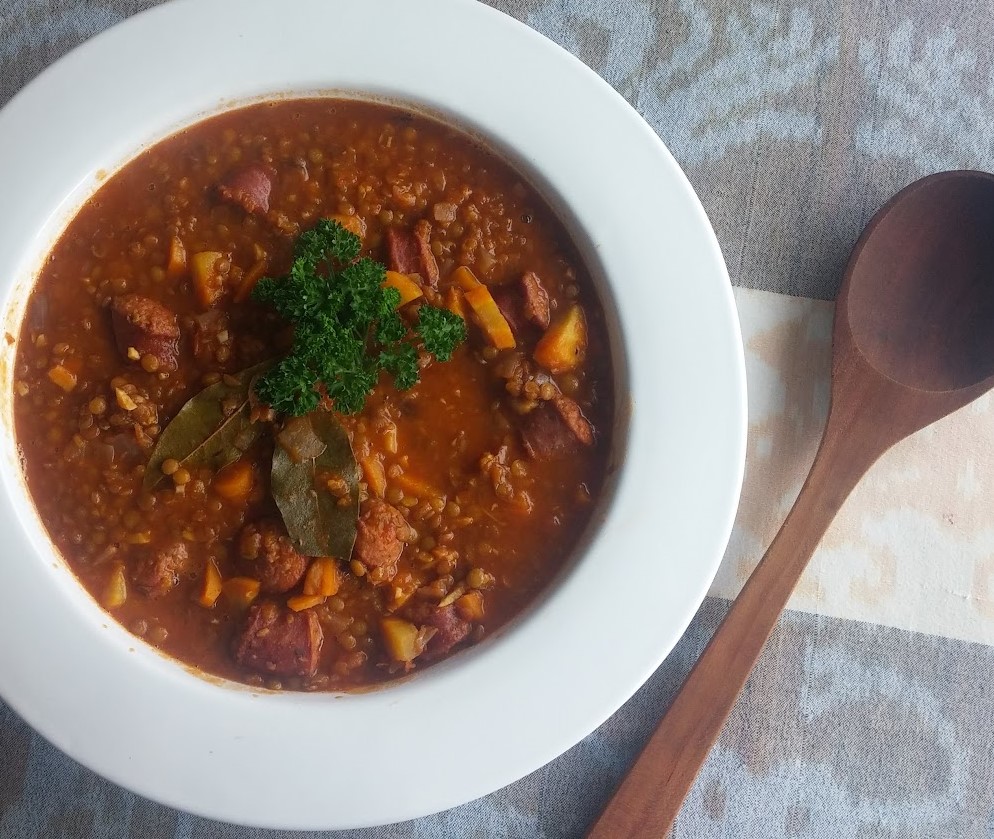
 
Lentils with Smoked Sausage

Prepare the Seasonings:
2 to 4 cloves of garlic
1/2 teaspoon fennel seeds
1/4 teaspoon salt
freshly ground black pepper to taste
1 or 2 bay leaves
1/8 to 1/4 teaspoon crushed red chile (to taste)
 
Before you get started you should put your lentils (see below) into a bowl or pot and pour boiling water over them, and let them soak while you prepare other things. 
 
Peel and mince the garlic. Crush the fennel seeds with the salt. Put all of these into a small bowl and set aside until needed. 
 
Make the Stew:
1 large onion
1 large carrot
500 grams (1 pound) raw smoked pork sausage
a little mild vegetable oil, maybe
1 cup soaked brown OR green lentils
2 cups crushed tomatoes
3 cups water

Peel and chop the onion. Peel and dice the carrot. Cut the sausage into bite-sized pieces. 

Put the sausage into a heavy-bottomed soup pot, heated over medium heat. If it is lean you may want to start it in a very small amount of oil, but that's pretty unlikely. If it seems reasonably fatty, put in a few tablespoons of water to help it get started without sticking. Once it is sizzling and letting off some fat, add the carrots and onions. Cook for about 10 minutes, stirring regularly, until the vegetables are softened and reduced and the sausage is getting some brown spots. 

Add the lentils, and the seasonings from the little bowl. Mix in well and cook for a minute or so, then add the crushed tomatoes and the water. Mix well, and cook for about 45 minutes, until the lentils are tender. Stir regularly, and watch the liquid level. It should cook down some, but the mixture should stay stewy. You may need to add a little more water. Also check the salt - I'm calling for very little, because sausage can be quite salty. It's best to start low and add a little more if needed.

Serve hot, with good crusty bread if you can.


Last year's lucky dish was Roasted Chick Pea & Carrot Salad

Monday, 28 December 2020

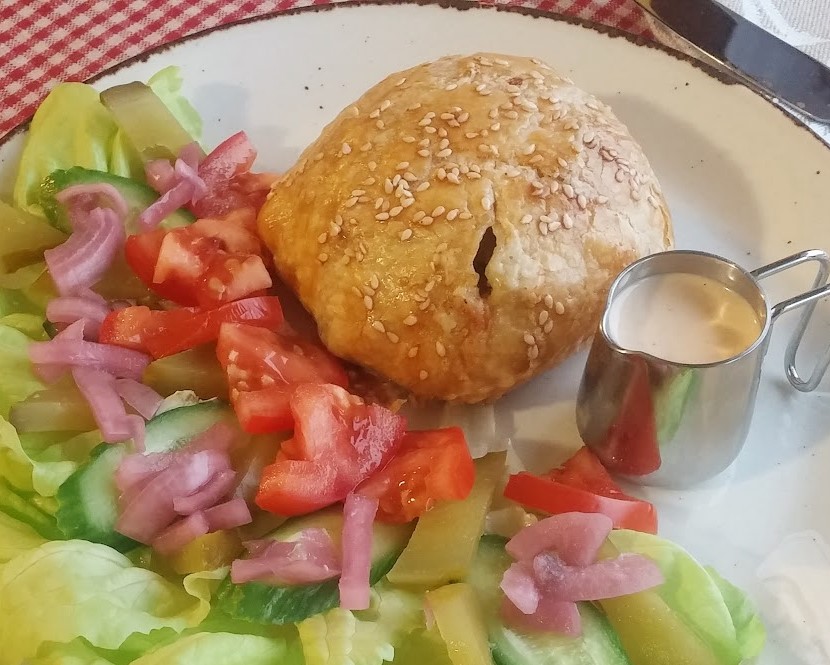
Cheeseburgers Wellington with Burger-Topping Salad

Here's have some fun and festive food to finish the year! A lot of us are perfectly happy to see the back of  2020, although of course it remains to be seen if 2021 will be any better. Let's hope!

I've never been too interested in making a classic Beef Wellington; the proportion of beef to pastry seems unpropitious, and slicing it successfully, never mind gracefully, looks like a thing that will not happen in real life. These on the other hand were just the right size and the bits inside came out perfectly cooked when the bits outside were also perfectly cooked. Phew! And really, who wants to futz around with liver paté and duxelles when you could have a cheeseburger? 

Premade puff pastry makes these really stupidly easy to put together; they are not much trickier to do than a hamburger in a bun. Put in whatever selection of mustard, ketchup and relish seems good to you (but not too much of any of them), and use a good strong cheese to stand up to all the other flavours going on. 

To keep up the cheeseburger theme, I served these with a salad of typical burger toppings, and used Thousand Island dressing on it. I have never been a big fan of Thousand Island dressing, but it seemed appropriate here, and as is so often the case the home-made version is a million times better than anything you can buy, even if it too is made with commercial products from the back of the fridge door. As with the Wellingtons, you can tweak the condiments to reflect your own preference. 

Happy New Year! See you then...
 
4 servings
1 hour prep time 

Cheeseburger Wellington with Burger Topping Salad

Cheeseburger Wellington Cut Open with Burger Topping Salad
 
Make the Wellingtons:
225 grams (1/2 pound) frozen puff pastry
500 grams (1 pound) lean ground beef
salt & freshly ground black pepper to taste
mustard
ketchup 
relish
125 grams (1/4 pound) old Cheddar cheese
1 small egg
2 teaspoons sesame seeds
 
Thaw the pastry according to package instructions - usually 8 hours in the fridge or 2 hours on the counter. 

Season the ground beef with salt and pepper, and divide into 4 equal portions. Form each portion into a patty. I fold the meat over itself several times to distribute the seasonings, but otherwise try not to work it too much. Patties should be fairly flat - about 4" across when done. 

Brown them for 2 minutes on each side in a skillet or griddle over high heat - the goal is to brown them, but not to cook them through. Remove them at once to a plate and let them cool. If not proceeding immediately, cover them and put them in the fridge. 
 
Preheat the oven to 375°F. Line a baking pan with parchment paper. 

Meanwhile, cut the pastry into 4 equal portions and roll each one out to increase its size by an inch or so in each direction. Put a little bit of mustard, ketchup, and relish in the middle of each piece, and top with a 30 gram (1 ounce) slice of cheese. Top with a cooled burger. Fold up 2 opposite corners of the pastry to meet at the middle of the patty. Wet the corners and edges of the pastry with cold water to allow it to stick together. Fold up the other 2 corners and press the edges into the previously folded up, moistened edges. You are likely to get little sharp corners at the bottom; fold and press them in too, to make a neat, roundish, and sealed packet. Turn the encased cheeseburger over and poke a few small holes in the top with a fork. Place it on the prepared pan and repeat with the remaining 3 Wellingtons.

Whisk the egg and brush the Wellingtons with it. Sprinkle them with the sesame seeds. Bake for 30 minutes if going straight into the oven, or for 40 minutes if they were refrigerated. (Still a good idea to take them out of the fridge 10 minutes before baking). Let rest 5 minutes before serving.
 
Make the Thousand Island Dressing:
1/3 cup mayonnaise
1 tablespoon lemon juice
1 tablespoon ketchup
1 tablespoon Dijon mustard
2 tablespoons relish
1 teaspoon Worcestershire sauce
freshly ground black pepper and sweet paprika to taste

Whisk everything together in a small bowl. This can be made up to 24 hours in advance.

Make the Salads:
1 head hydroponic lettuce
1 or 2 hydroponic tomatoes
1 or 2 hydroponic cucumbers
3 or 4 slices of dill pickle
3 or 4 slices of red onion, sprinkled with salt and drained

Core the lettuce, and discard any damaged leaves. Wash and drain the rest. Arrange them divided amongst 4 plates. Core and slice the tomato, and arrange over the lettuce. Wash, trim, and slice the cucumber and arrange over the lettuce. Chop the dill pickle and arrange over the salads. Slice and quarter the onion, sprinkle with salt, and drain in a strainer for 15 minutes before rinsing and and draining well, and arranging it over the salads. Drizzle with the salad dressing. 


Wednesday, 23 December 2020

Banana Gingerbread

Ridiculously easy, and only a little molasses as the sugar (plus natural sugars in the bananas to be sure) and so, so, tasty! The first time I made this I had intended to put an egg into it, but I found the egg on the counter when I was cleaning up while the gingerbread baked; oops. The results were so good anyway that now it's official - no egg. I've made this baked in a tin as a cake, and I've made it as muffins -it's awfully good either way.

How long does this keep? I suspect not more than a few days, given how moist the banana makes it, but who would know for sure? It is very unlikely to last that long.  

And now it's time to take a little break. See you after Christmas, such as it will be, what with no family gathering, etc. Hope you and all of yours stay well.

8 to 12 servings
1 hour - 20 minutes prep time

Banana Gingerbread Muffins
 
Mix the Dry Ingredients:
1 1/2 cups whole spelt flour
1/4 teaspoon salt
1 1/2 teaspoons baking powder
2 teaspoons ground cinnamon
2 teaspoons ground ginger
1/4 teaspoon grated nutmeg (about 1/10 of a medium nutmeg)
1/8 teaspoon ground cloves

Preheat the oven to 350°F and line a 9" x 9" pan with parchment paper.

Measure, and put into a mixing bowl. Stir to combine.

Mix the Wet Ingredients & Finish:
2 cups (4 medium) very ripe bananas
2 to 3 tablespoons fancy molasses
1/3 cup mild vegetable oil

Peel and mash the bananas thoroughly with the molasses.  Add to the dry ingredients, along with the vegetable oil, and mix well. Scrape the batter into the prepared pan and bake for 30 to 35 minutes until firm and springy, or it tests done (no sticking crumbs) when tested with a toothpick.

If you wish to make muffins with this, it will make 9 old fashioned ones (not too huge, in other words), and they should bake in 20 minutes. 

Let cool for at least 10 minutes before removing it from the pan, and let it cool completely before serving. Muffins should be removed from the tin to cool after 5 minutes. 

Monday, 21 December 2020

Braised Oxtail with Apples & Sweet Potatoes

I've been experimenting with cooking oxtail this winter, and my conclusion is that if you have an Instant Pot, use it. The amount of time required otherwise is impressive. I'm saying 3 to 4 hours but really, it's probably 4 hours if stewed on the stove-top. The Instant Pot doesn't reduce the time enormously, but it does make the process easier. I'm also concluding that I don't want to do all the stewing in the Instant Pot because slow cooking really does produce better results. On that note, maybe I should just haul the slow-cooker out of the basement. 
 
Anyway, I love oxtail and this was delightful, however you want to cook it. 
 
4 servings
about 4 1/2 hours - 40 minutes prep time
 
Braised Oxtail with Apples & Sweet Potatoes
 
Start the Stew:
1 medium carrot
2 medium leeks
2 tablespoons mild vegetable oil
1 kilo (2 pounds) oxtail, cut into segments
1/2 teaspoon salt
1/4 teaspoon salt
freshly ground black pepper to taste
1/2 teaspoon allspice berries
2 or 3 bay leaves
473 ml (1 tin) apple cider
2 tablespoons apple cider vinegar
 
Wash, trim, and dice the carrot. Wash, trim, and chop the leeks. Set them aside. 

Heat the oil in a heavy-bottomed soup pot or other large stove-top casserole dish over medium heat. Brown the oxtail pieces on both sides until well browned; about 3 minutes per side. Remove them to a plate. Add the carrot and leeks to the pot and cook gently, stirring occasionally, for about 10 minutes until softened and reduced in volume but not browned. Add the remaining seasonings.

Return the meat to the pot with the vegetables and add the apple cider and the vinegar. Reduce the heat to low and simmer for 3 to 4 hours until the oxtail is very tender and falling off the bones; stir occasionally. Add a little water or beef broth if the liquid cooks down noticeably (likely). This can be done in advance, and the stew cooled and kept in the fridge.
 
Instant Pot Method: Once the oxtail pieces are browned, transfer them to the Instant Pot and add 1 cup of water and a good pinch of salt. Pressure cook for 40 minutes, and use natural release. Then, sweat the carrots and leeks in a spoonful of oil for 10 minutes, add the oxtails and their broth, and continue as described above, noting that about 1 hour of further cooking should be sufficient.

Finish the Stew:
600 grams (1.5 pounds) sweet potatoes
2 large apples

Wash and trim the sweet potatoes, and cut them into chunks. Add them to the stew and simmer for 20 minutes or so until the sweet potatoes are tender. Keep the pot covered.

As soon as they go in, peel, slice, and core the apples, and add them to cook with the sweet potatoes (for 10 to 15 minutes).  Serve hot.


Last year at this time I made Rye Spaetzle with Caraway. SO GOOD and could certainly be eaten with oxtail.

Friday, 18 December 2020

Beet Mousse

This is a very popular French appetizer, and why not? It's easy, it does not call for many ingredients, it's healthy, and it's very tasty too. It's a little on the rich side perhaps, but appetizers mostly are; you are just having a bite or two of them before it's on to other things. Besides all that it can be presented very prettily, mostly in verrines (small glasses) like miniature parfaits, but I think this would also be lovely in tiny bites presented in Belgian endive leaves. The sweet and the bitter; the smooth and the crunchy, would contrast nicely. The cheese should be smooth and soft but does not have to be chevre. Cream cheese or blue cheese could also be used.
 
4 to 8 servings
1 hour to cook the beets
20 minutes prep time
 
Beet & Chevre Mousse

225 grams (1/2 pound) beets
a little extra beet to garnish
1/4 teaspoon salt
freshly ground black pepper to taste
1/4 teaspoon finely grated lemon OR lime zest
1/4 teaspoon finely grated fresh ginger
the juice of 1/2 lemon OR 1 lime
225 grams (1/2 pound) chevre
1 to 3 teaspoons light cream
a little parsley to garnish
AND/OR 1 or 2 heads Belgian Endive

Put the beets into a small pot of water with enough to cover them well. Bring them to a boil and boil them steadily for 45 minutes to an hour, until tender. Keep the beet cooking water. This can be done up to a day ahead, and the beets should be cool when you proceed. 

Peel and slice the beets, and put them in the bowl of a food processor. Keep some aside to garnish the mousses. Add the salt, pepper, lemon zest, and grated ginger, and process until the beets are as smooth as you can get them. Add the lemon juice and process, then a few tablespoons of the beet cooking water if necessary to get a smooth, soft paste. Keep out a couple of tablespoons of the chevre, but add the rest to the food processor and process until very smooth. You will need to stop and scrape down the sides a few times throughout the process. Taste the mixture and adjust the seasonings if necessary.

Divide the mousse amongst individual serving dishes. Mix the remaining cheese with the cream until smooth and soft; add a little salt if you think it needs it. Garnish the mousses with dollops of the cheese, slices of beets, and sprigs of parsley. 
 
Alternatively, put spoonfuls of the mousse into clean, dry Belgian Endive leaves, and garnish with a single small sliver of beet, a tiny dollop of the creamed cheese, and a pinch of parsley if available. 
 
Keep cool until served.


Wednesday, 16 December 2020

Tau Pok & Brussels Sprouts

On one of our trips to Mississauga as part of Mom's never-ending eye saga, we branched out and went to a Chinese grocery. I was very excited to be able to got some fried tofu puffs. They have a lot of names in various Chinese and other Asian languages, and have gotten translated into English in a variety of ways and can be surprisingly hard to chase down on the internet as a result. But whatever you want to call them, they are delicious little things. Frying tofu does not make it greasy so much as it drives out a lot of water and makes them somehow dense-airy-chewy all at once.

Since we had some Brussels sprouts in from the garden I did a stir-fry with them. Next time I would cut the tofu puffs in half; they were a bit too big for the other ingredients, especially our piddly little sprouts. 

You could make this with quite a few different green vegetables in place of the Brussels sprouts, when they are in season. Broccoli, or bok choy, or similar Chinese greens are probably the best choices. 

Like many Chinese (inspired) recipes, this one requires everything to be prepared in advance because once the cooking starts it all goes very quickly. Start your rice in good time before you get going, especially if you are cooking brown rice. (Because of course you are going to serve this with rice.)
 
3 to 4 servings
30 minutes prep time 

Tau

Make the Sauce: 
1 tablespoon oyster sauce
1 tablespoon soy sauce
1 tablespoon fish sauce OR sherry
2 teaspoons arrowroot OR corn starch
1 cup water
 
Mix the oyster sauce, soy sauce, fish sauce, and starch in a small bowl. Slowly mix in the water. Set aside. 

Make the Dish:
2 cloves of garlic
6 slices peeled fresh ginger
1 medium-small onion
1 medium-small carrot
60 - 75 grams (4 - 5 ounces) shiitake OR oyster mushrooms
400 grams (14 ounces) Brussels sprouts
150 grams (5 ounces) tau (fu) pok - fried tofu puffs 
2 tablespoons mild vegetable oil
1 teaspoon toasted sesame oil
 
Peel and mince the garlic, and put it aside in a small bowl. Peel and slice the ginger. Leave it whole to be picked out if it seems fibrous; otherwise cut it in small slivers. Add it to the garlic. 
 
Peel and sliver the onion. Peel, trim, and slice the carrot. Clean the mushrooms, discarding any tough stems and slicing the rest. Wash and trim the Brussels sprouts. If large, cut them in quarters or slices; if small, cut them just in half. Check the tau pok; it should be clean and dry. If the pieces are large (likely) you may wish to cut them in half.
 
Heat the oil in a large skillet over high heat. Add the onion, carrot, and mushrooms and cook, stirring frequently, for 2 or 3 minutes.  Add the Brussels sprouts, along with several tablespoons of water, and continue cooking and stirring for about 5 minutes more, until the water is cooked off and the Brussels sprouts seem well on the way to being done. Add the ginger and garlic and mix in well. Add the tau pok and mix in well. Stir up the sauce and pour it over, then mix in well. Sprinkle with the sesame oil. Continue cooking and stirring until it is all done to your liking, then serve at once. 


Last year at this time I made Broiled Muscovy Duck Breast.

Monday, 14 December 2020

Spiced Boiled Fruit Cake

Of course I should not be eating fruit cake. But if I'm going to be eating fruit cake, this one is a pretty good choice. This is a spice cake as much as a fruit cake. We ate our first piece with a little glass of sherry (yeah, not rum) and were suddenly full of Christmas spirit(s). 
 
I had just the right amount of candied peel and ginger left in the freezer from last year to use them up; otherwise there is no sugar added to the cake. As sugar, that is; it gets a reasonable degree of sweetness from the dried fruits and the rum. (Next time I aim to replace them with other unsweetened dried fruits.) Boiling the fruit extracts some of those natural fruit sugars to sweeten the cake part and make the fruit very moist. I further kept the carbs down by replacing half the flour with almond flour and the rest of the flour with whole spelt flour.
 
Unlike traditional fruit cakes, a boiled fruit cake does not need to be made so far in advance. I would make it at least 4 or 5 days before I wanted to eat it, up to a week ahead. A little aging does help everything settle in together nicely. This one sat for a week before we cut our first slices, and in the meantime I drizzled a little more rum over it. Like traditional fruit cake, it soaked it up perfectly. It doesn't keep as long as typical fruit cake; I would say in a well-sealed tin in a cool place and doused with a good hit of extra rum, that 3 weeks is reasonable.  

17/12/2024: Recipe edited for missed instructions and spelling errors. I'm also noting that all the prunes I can get these days seem to come already steamed to a state of softness. I'm putting in 2/3 cup and not until the last minute of the boiling.

12 servings
1 hour 15 minutes - 15 minutes prep - to boil fruit 
1 hour 20 minutes - to mix and bake the cake
 
Spiced Boiled Fruit Cake
 
Boil the Fruit:
1/2 cup dark raisins
1/2 cup light raisins
1/2 cup candied peel OR other dried fruit
1/2 cup dried apricots
1/2 cup pitted prunes
1/4 cup candied ginger
1 cup apple cider OR water
1/2 cup unsalted butter
1/4 cup rum
Put everything but the rum into a sufficiently large, heavy-bottomed pot and slowly, over medium-low heat, bring it all to the boil. Stir regularly. Boil for 5 minutes, then remove from the heat, add the rum, cover, and let cool for 1 hour. 

Prepare an 8" spring form cake pan by lining the bottom with parchment paper, then buttering the bottom and sides and coating them in flour. Fifteen minutes before the hour is up, preheat the oven to 325°F.
 
Make the Cake:
4 oz whole spelt flour
4 oz almond flour
1 1/2 teaspoons ground cinnamon
1 teaspoon ground ginger 
1/4 teaspoon freshly grated nutmeg
1/4 teaspoon ground allspice
1/8 teaspoon ground cloves
1/2 teaspoon salt
2 teaspoons baking powder
2 large eggs
1/4 cup rum

Mix the spelt and almond flours with all the spices, the salt, and the baking powder in a large mixing bowl. Stir in the cooled boiled fruit mixture. Break in the eggs and mix them in well. 

Scrape the batter into the prepared pan. Bake at 325°F for 1 hour up to 10 minutes more, until a toothpick inserted in the middle comes out clean. Drizzle the remaining rum evenly over the cake. Keep the cooled cake well wrapped in a cake tin until wanted; you could also pour a little more rum over it if it sits for a  while.


Friday, 11 December 2020

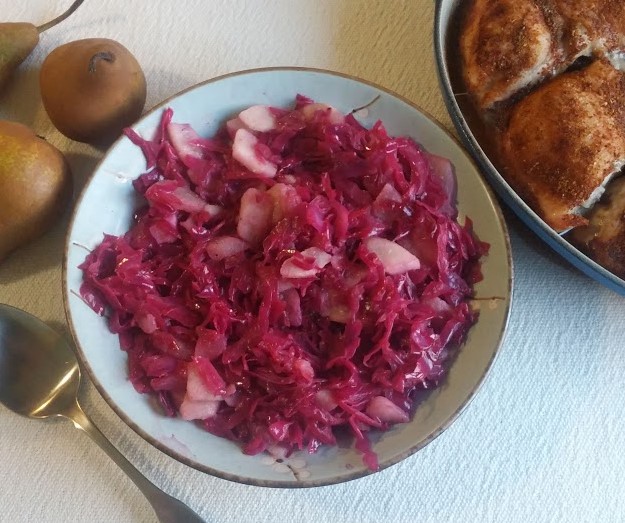
Red Cabbage with Pears

Here's a simple and really delicious way to cook red cabbage. The actual cooking time is quite short, so you could shred the red cabbage in advance for minimal last-minute fuss. I wouldn't peel the pears in advance though; they won't hold up well and should be done just before they go into the pot. If you are quick with them you can work on them while the cabbage gets started.
 
4 servings
30 minutes prep time 

Red Cabbage with Pears

3 or 4 pods green cardamom
1/2 teaspoon anise seed
12 black peppercorns
1/2 teaspoon salt
3 cups shredded red cabbage
3 large bosc pears
2 tablespoons unsalted butter
1/4 unsweetened cranberry juice 

Crush the cardamom and remove and discard the green papery husks. Grind the interior seeds with the anise seed, peppercorns, and salt. Put the aside until wanted. 

Shave the red cabbage into shreds and chop them slightly. Peel and core the pears, and cut them into bite-sized pieces. 

Heat the butter in a large skillet with a lid over medium-high heat. When it is melted and sizzling, add the cabbage and the cranberry juice. Stir well, cover, and cook for 2 or 3 minutes. Stir occasionally. Remove the lid, and cook for another 2 or 3 minutes, stirring occasionally, until the cranberry juice has evaporated and the cabbage is cooking in mostly butter. Sprinkle the seasonings over it, mix in well, and cook for another minute or so. 

Add the pear slices and continue cooking, stirring occasionally, for another 3 or 4 minutes, until they are tender and the whole dish is cooked to your liking. Serve at once. 


Last year at this time I did a pre-Christmas recipe round-up.

Wednesday, 9 December 2020

Farserede Porrer - Danish "Stuffed" Leeks

This "traditional" Danish dish only dates back to the 1960s (as someone born at the beginning of that decade I refuse to consider that to be very long) but it has since become well-established. The simplest versions simply wrap the leeks in prepared sausage and bacon, but most call for home-seasoned ground pork and bread them in crumbs. I've put a little bacon on as a garnish, but it is not really required. (Although how can it even be Danish, if there isn't any bacon?) 
 
A thing I found amusing while researching this dish was the translation of the name. It gave Google Translate a fair bit of indigestion, because "farserede" means stuffed, but it has a literal meaning of "feathered". It took me a while to make the connection. Moreover, these are not leeks that are being stuffed with something, but leeks that are being stuffed into something, which is both linguistically and culinarily a bit peculiar. Results, however, are not peculiar but very tasty. This is a simple recipe that does not require many ingredients, but still manages to look quite sophisticated - always nice. 

Note what I say about cooking those leeks, and I find that even well-cooked whole leeks require steak knives.
 
4 servings
15 minutes initial preparation
45 minutes - 15 minutes prep time
 
Danish Stuffed Leeks - Leeks in Sausage

Prepare the Leeks & Stuffing:
2 large or 4 small leeks 
500 grams (1 pound) lean ground pork (could use turkey)
1 teaspoon salt
freshly ground black pepper to taste
a good scrape or 2 of nutmeg
2 tablespoons barley or other flour
1/3 cup milk
 
Put a pot of salted water on to boil, in which you will cook the prepared leeks. 
 
Trim and wash the leeks, and cut them into 4 logs of about 4" long, discarding the dark green top leaves, roots, and removing any outer leaves that seem tough or damaged. Boil them for 6 to 10 minutes, until tender when pierced with a fork. They will not get cooked much more than this, so they should be done to your liking. 

Meanwhile, put the pork into a mixing bowl with the remaining ingredients and mix, by hand, very well. The mixture should be quite smooth. Cover and keep refrigerated until needed. 

Drain the leeks thoroughly when done, let cool, cover, and keep refrigerated until needed. Both of these tasks can be done up to 24 hours in advance. 

Stuff & Bake the Leeks:
1/2 cup bread crumbs (I used hemp meal)
4 slices bacon
parsley to garnish
 
Preheat the oven to 400°F. Very lightly oil a shallow baking pan which will hold the stuffed leeks (1.5 to 2 quarts).
 
Put a piece of parchment paper large enough to roll the leeks in on a clean, dry countertop. Sprinkle about a tablespoon of crumbs into a square about an inch wider than the leek pieces, and about 4" or 5" long. Take 1/4 of the sausage mixture and pat it into a rectangle about 2" longer than the leek pieces, and wide enough to encircle them; over the crumbs in other words. Place one leek piece on the sausage, and use the parchment paper to roll it up in a neat cylinder. Seal the meat around the ends of the leek; it should now be entirely encased in crumb-covered sausage. Roll it in a few more crumbs if there are bald spots. Place it in the oiled pan, and repeat with the remaining sausage mixture and leek pieces. 
 
Place one strip of bacon lengthwise over each leek. Bake the stuffed leeks for 30 minutes, until lightly browned and sizzling. Let rest 5 minutes before serving, garnished with parsley. 


Last year at this time I made Leek & Oyster Mushroom Lasagne.

Monday, 7 December 2020

Lemon-Mustard Brussels Sprouts

I find myself using lemon and mustard as a seasoning combination quite a bit these days. There's something really refreshing about the teamwork of the acid and the bite. Here it stands up really well with the fairly strong flavour of Brussels sprouts. This is a nice simple, straightforward treatment for them that is quick and easy, and will go well with any kind of fairly plain meat, fish, or poultry. 

Our Brussels sprouts were fairly decent this year, after a long slow struggle of a start, and we have been really enjoying them.

4 servings
15 minutes - 10 minutes prep time

Lemon-Mustard Brussels Sprouts

500 grams (1 pound) Brussels sprouts
2 tablespoons unsalted butter
1 tablespoon Dijon mustard
the juice of 1/4 lemon
salt & freshly ground black pepper to taste

Put a fairly heavy-bottomed pot on to boil with water sufficient to cook the Brussels sprouts. 

Wash and trim the Brussels sprouts. If they are large, cut them in half; otherwise cut a good slice into the bottom. Cook them in the boiling water for about 4 minutes, then drain them very well but keep or return them in to the pot.

Return the pot of sprouts to the stove, and add the butter, mustard, lemon juice, salt, and pepper. Cook, stirring every minute or so, for a further 2 or 3 minutes.

Lift the sprouts into a serving dish with a slotted spoon. Reduce the remaining sauce until fairly thick, then pour it over the sprouts. Serve at once. 


Last year at this time I made the amazing Flourless Sweet Potato & Chocolate Cake.

Friday, 4 December 2020

Three Beets

 
We grew three types of beets this year, along with a few MacGregor's Favourite. They are, from left to right above, Kamuolini 2, Boldor, and Cylindra. While this was a difficult year for many vegetables, the beets did reasonably well. The intense heat and drought during germination season mostly did not faze them - the MacGregor's were a little spotty, but the seed was also quite old - and the rest germinated well. The subsequent cooler and actually very rainy weather that prevailed suited them too, and we have a good crop. We'd have had an even better crop if we'd ever gotten around to thinning them, but we didn't. What else is new? Let's take a look at each one...

Kamuolini 2 is, as far as I know, only available in North America from Adaptive Seeds. This beet is the result of modern breeding (bred by Dr. Rasa Karkleliene in Lithuania). For the first half of the growing season, every time I walked by I thought, "not impressive... not impressive... not impr - WHOA!" Sometime around late mid-summer they went seemingly overnight from spindly little things to very chunky indeed, with suddenly big, sturdy leaves as well. Ours were a bit variable in size, mostly because we really should have thinned them; it would have made them so much happier. 
 
Those big, sturdy leaves are actually quite tender and while strongly flavoured (as usual with beet greens) they were very tasty. As advertised, this is a great beet for lovers of the greens. The root was extremely sweet and good flavoured as well. They cook up a darker red than you would think from the colour of the skins when first picked.

Boldor: My impression as these were growing was that they were also not doing impressively well, and indeed they are the smallest of the beets we grew. However in the end they are big enough, and probably plenty big for most people's uses. The ones in the photo are about average supermarket beet sized, which tells you about the other two. The leaves seem small and sparse, but they are not as sparse as they look - they die down fairly rapidly to be replaced by new ones, so their live leaves are always clean and nice, if few. These were probably the most unhappy about not having been thinned, and we did end up with quite a number too small to use. 
 
Boldor is a fairly recent beet, bred by Bejo, and is marketed as a replacement for Touchstone Gold, which has been the most popular yellow beet grown around here. We've grown Touchstone Gold, and thought it a nice beet, although it's always been an iffier germinater and smaller than most red beets. So, is Boldor actually better? It did seem to have a better germination rate, although we were not doing a side by side comparison so it's hard to say for sure. The skin is an amazing glowing orange, brighter than Touchstone Gold, but the inner flesh is less gold and more of a clear yellow when raw. It did cook up more of a golden shade. Certainly, it's very attractive. Some vendors seem to want to describe it as a hybrid, but it is open pollinated. We tried cooking some of those sparse and delicate-looking leaves, and found they were stronger (more bitter) and tougher than the Kamuolini 2 leaves, so this is not a good variety for greens. We thought the beets themselves tasted very nice; not as sweet as Kamuolini 2 but rich and well-balanced.

And finally, we grew Cylindra, (sometimes known as Cylindrica or Formanova) which is a Danish heirloom, introduced to North America in the 1890s. We've been growing them for a few years, and in many ways they are my favourite beet. I really like the elongated, narrow shape, and they get to a good size. The narrow shape means they still cook in the same amount of time as smaller regular beets. They grow about half in, half out of the soil, so you can always find the ideal one to pull. The leaves are a pretty purple, larger and not quite as dark as the MacGregor's Favourite, but not so large as all that. The leaves are milder than either of the other two beets and noticeably the most tender of the three. Still, they lack the rich flavour of the Kamuolini 2. They are the most tolerant of any beet we have grown of our tendency to leave them un-thinned. Their shape makes them ideal for pickles. They are less sweet than many beets - certainly much less sweet than the other two we grew this year - but I don't consider that a flaw; they are very nice plain and being a little less sweet makes them more versatile for use in recipes, I think. In short, their widespread availability and popularity has been well-earned.

Wednesday, 2 December 2020

Pumpkin or Sweet Potato Baked Oatmeal

Does this look very much like the Spiced Apple Baked Oatmeal Pudding I made early this year? It should; it's basically the same recipe with mashed squash (pumpkin) or sweet potato instead of the apples. As just about always, feel free to add more sweetener than I do! 

And like the Spiced Apple Baked Oatmeal Pudding, I think this is best served with something to moisten it; cream, yogurt, custard, ice cream... it's up to you. We did eat some of this with ice cream, and I actually thought the contrast in sweetness levels was too intense. This is definitely a bit on the oatmeally, stodgy side, and I think it is best as a breakfast dish rather than a dessert, unlike the apple version. We had the leftovers with coffee cream, and that worked very well.
 
6 to 8 servings
45 minutes - 15 minutes prep time 
NOT including cooking the squash OR cooling

Pumpkin Baked Oatmea

Mix the Dry Ingredients:
2 cups rolled oats
1/4 cup maple syrup OR 3 tablespoons sugar
1/2 teaspoon salt
2 teaspoons ground cinnamon
1 1/2 teaspoons ground ginger
1/4 teaspoon grated nutmeg
1/8 teaspoon ground cloves
 
Measure the ingredients into a mixing bowl and mix them. 

Finish the Baked Oatmeal:
1 1/4 cup whole milk OR light cream
2 tablespoons unsalted butter
1 large egg
2 cups cooked mashed pumpkin (squash) OR sweet potato
1 tablespoon unsalted butter

Measure the milk into a microwave-proof measuring cup, and add the 2 tablespoons of butter; heat for 30 seconds to a minute until the butter is melted. Once it has cooled enough not to set the egg, break the egg in and mix well. Mix this into the dry ingredients. 

Be sure the pumpkin, squash, or sweet potato is well mashed and free of any skin or seeds. Mix it in to the other ingredients. The mixture should be a fairly soft batter - if it seems too stiff, mix in a little more milk.

Preheat the oven to 350°F. Butter an 8" x 10" or other shallow 2 quart baking pan with the remaining butter. Scrape the mixture into it and smooth it out evenly. Once the oven is hot, bake the pudding for 30 to 35 minutes, until set. The reason the oven goes on so late is to allow the batter to rest for about 10 minutes before it goes in. 

Serve the pudding warm, at room temperature, or chilled. As ever, a little cream over top would not go amiss. 


Monday, 30 November 2020

Sauce Soubise

Sauce Soubise is one of those recipes that shows up very often in mid-Victorian to Edwardian cook books, at which point it seemed to go thoroughly out of fashion. Instructions to make it varied quite a bit, although the main question seemed to be whether the onion got boiled or not before the pan cooking. I chose not, and I think that was the right choice. Boiling the onions would have made them very mild, but since I am not a delicate Victorian who faints (with horror, not delight) at a whiff of allium, that was exactly what I didn't want. 

That said, it's important to choose good, tasty onions, and to cook them quite thoroughly, even though they are not to brown. Not too surprisingly for a Victorian sauce, this will be best as an accompaniment to fairly plain cooked meats, poultry, and fish. Although, we had a fair bit left over and the next day I tossed it with pasta and vegetables, very successfully. It kept very well so this is something that could be made the day ahead and reheated easily.

So will this dish come back into fashion? Likely not. It was quite tasty, but it's still basically a creamed onion sauce, and one that is fairly slow and finicky to make. It's not a surprise that it went out of style at just the time when middle-class women in large numbers started having to do their own cooking.
 
6 to 8 servings
1 hour prep time
 
Sauce Soubise - French Onion Sauce
 
450 grams (3 large or 4 medium) onions
4 tablespoons unsalted butter
1/4 teaspoon salt
freshly ground black pepper to taste
a few good scrapes of nutmeg
1 tablespoon barley flour OPTIONAL
1 tablespoon sherry
1 1/3 cups whole milk OR light cream

Trim and peel the onions. Reduce them to a purée, either by grating them very finely, or processing them in a food processor. 

Heat the butter in a large, non-reactive skillet over medium heat. Add the onions, along with any juice they have exuded in the puréeing process. Simmer the mixture, stirring regularly, until the onions smell "done". This will be about 30 to 40 minutes. Reduce the heat after the first few minutes; they should cook very slowly and not turn brown at all, although by the time they are cooked the whole mixture may have darkened very slightly. While they cook, season with the salt, pepper, and nutmeg. 

If you wish to have a fairly thick sauce, sprinkle the flour over the onions at this point and mix it in well. Sprinkle over the sherry. Cook for another minute or two, then begin to add the milk or cream slowly, stirring well between each addition to ensure a smooth sauce. The onions will form a thick enough paste that flour may not be necessary; in that case just add the milk or cream in the same way as if the flour had been added. 

When the milk or cream is all in, and the sauce is smooth, transfer it to a serving dish, and serve. 


Last year at this time I made Poppy Seed - Bran Soda Bread.

Friday, 27 November 2020

Baked Sweet Potato Samosas

Traditional samosas are not the worst thing I could eat, since the potatoes get cooked twice, but they aren't the best thing either. They probably still are not; oh well. I love them too much to give them up entirely. They do work deliciously well with sweet potatoes instead of regular potatoes. Although, if you prefer the classic ones it's easy enough to revert to using regular potatoes. In any case, before you get started you need your potatoes of either type cooked, and the peas to have been thawed, since I assume at this time of year they will be from frozen. 

Serve them with the Apple Butter Chutney I made to go with Samosa Pie. You could replace the lime juice in the chutney with apple cider vinegar if you like; I did, since I didn't have a lime. It worked just fine. 

Note that the pastry will feel a bit too wet once the water goes in, and that's okay - it will firm up as it sits.
 
8 to 12 samosas
1 hour 20 minutes - 40 minutes prep time
NOT including time to cook potatoes OR thaw peas

Baked Sweet Potato Samosas
 
Make the Pastry:
2 cups whole spelt flour
1/4 teaspoon baking soda
1 teaspoon salt
6 tablespoons mild vegetable oil
1/2 to 2/3 cup water
1 tablespoon lemon juice 

Mix the flour with the baking soda and salt in a mixing bowl. Mix in the oil, until the mixture is crumbly and there is no dry flour remaining. Mix the lemon juice into a 1/2 cup of water, then stir them in to form a slightly soft dough - if it does not form a soft dough, add a tablespoon or 2 more of water until it does. Turn it out onto a clean surface and knead for a few strokes until it is quite smooth, but don't over-work it - it is pastry, after all. It should not be sticky. Return it to the bowl, cover, and let rest for 20 to 30 minutes. It will firm up a bit as it sits.

Mix the Spices:
1 teaspoon cumin seed
1 teaspoon coriander seed
1 teaspoon mustard seeds
1/4 teaspoon black peppercorns
1/4 teaspoon fenugreek seeds
1/2 teaspoon salt
1 teaspoon amchur powder
1/2 teaspoon ground turmeric
1/2 teaspoon ground ginger
1/8 to 1/4 teaspoon red chile flakes

Grind the cumin, coriander, mustard seed, peppercorns, fenugreek, and salt until fine. Mix in the amchur powder, turmeric, ginger, and red chile flakes to taste.

Make the Filling:
1 1/2 cups (1 large) diced cooked sweet potato
1 cup thawed frozen peas
1 medium onion
1 tablespoon mild vegetable oil
 
Peel and dice the baked sweet potato, and mix with the thawed frozen peas. 
 
Peel and chop the onion. Heat the oil in a small skillet over medium-high heat, and cook the onion until softened and translucent, but not much browned. Add the spice mixture and mix in well for another minute or so, then add it all to the vegetables and mix well. 
 
Preheat the oven to 375°F. Line a large baking tray with parchment paper. 
 
Divide the dough into 4 or 6 even pieces. Roll each one into a ball, then roll a ball into a circle, about 1/8" thick. Dust with a little flour as you roll if necessary to keep it from sticking. Cut the circle in half. 
 
Brush the straight, cut side with a little water, then overlap one half with the other half of the wet edges, and pinch them together to form a little cup. Fill this with 1/8th or 1/12th of the prepared filling. Wet the open edges of the dough, then pinch them together to seal. Put the finished samosa onto the prepared tray. Repeat with the other half of the circle, and then with the remaining pieces of dough until all the samosas are formed. 

Bake them at 375°F for 10 minutes, then turn them over. Bake for a further 10 minutes. Let cool; serve them warm or at room temperature. 


Last year at this time I made Braised Muscovy Duck

Wednesday, 25 November 2020

Squash & Brussels Sprouts Parmigiano

Almost every year I make something with squash and Brussels sprouts around now, because, well, it's squash and Brussels sprouts time. There's a certain amount of slicing and dicing going on here, but overall it's a simple and easy dish without complications, but this may be the best squash and sprouts effort yet. It's hard to argue with the Italians! When it comes to food, they know exactly what to do. I particularly like a friulano (montasio) cheese for this; it's more flavourful than the mozzarella, and probably easier to get than some of the others.  
 
4 to 6 servings 
1 hour 30 minutes - 20 minutes prep time

Squash & Brussels Sprouts Parmigiano

900 grams (2 pounds) butternut squash
450 grams (1 pound) Brussels sprouts
300 grams (10 ounces) unripened firm (not hard) cheese such as
   mozzarella, friulano, scamorza, fontina, or even cheese curds
100 grams (3 to 4 ounces) grated Parmesan cheese
3 tablespoons mild vegetable oil
3 tablespoons barley flour
1 teaspoon rubbed sage OR rosemary
a little grated nutmeg (optional)
salt & freshly ground black pepper to taste
1/2 cup 10% cream

Cut the squash, de-seed it and peel it, and slice it thin, in bite-sized pieces. Trim and slice the Brussels sprouts thinly as well and place them in a colander.

Put a kettle of water on to boil and use it to blanch the Brussels sprouts. Once the boiling water has been evenly poured all over them, let them drain well. 

Slice or dice the chosen cheese, and grate the Parmesan.

 Preheat the oven to 350°F. Lightly oil a shallow 2 quart baking dish (9" x 13" lasagne pan).

Put the squash in the pan and drizzle the oil over it; toss gently to distribute. Sprinkle over the flour and the seasonings; toss gently to distribute them. Add the drained Brussels sprouts and the main cheese and mix gently. Spread everything out evenly, and pour the cream over it.

Bake the Parmigiano for 20 minutes at 350°F. Sprinkle the Parmesan cheese evenly over the top and return to the oven for a further 40 minutes. Let the Parmigiano rest for 5 to 10 minutes before serving.


Last year at this time I made Butternut Squash Roasted with Shallots & Cranberries.

Monday, 23 November 2020

Beets au gratin

We enjoyed this one a lot! We had it with some white fish and a salad, but it would make a perfectly reasonable vegetarian main course. Once the beets are cooked, it assembles quite quickly and it really doesn't take too long to bake either.
 
I used 3 lovely Cylindra beets for this. I don't know why they aren't more popular. They are such a convenient size and shape for cooking, and they taste great and stay tender too. But you can use whatever beets you can get, of course. This would have been a good job for the mandoline but after last time, I just sliced the beets up by hand and saved myself a clean-up job. Besides, my thumbnail is still recovering.
 
Goat cheese would be good instead of the feta cheese, but in that case I would add a bit of salt to the cheese-yogurt mixture. 
 
4 to 6 servings
1 hour to pre-cook beets
1 hour - 20 minutes prep time
 
Beets au gratin
 
500 grams (3 large or 4 medium; 1 pound plus) beets
1 medium red onion
125 grams (4 ounces) feta cheese
freshly ground black pepper to taste
a few scrapes of nutmeg
1 teaspoon rubbed savory OR thyme
1 1/2 cups thick yogurt
1 tablespoon unsalted butter
3 tablespoons coarse bread crumbs
3 tablespoons grated Parmesan cheese

Cook the beets until tender; either by boiling or baking whole for 45 minutes to an hour, or in a pressure cooker, on a rack, with 1 cup water for 25 minutes. This can be done up to a day in advance; at any rate they must be done sufficiently in advance to cool enough to handle. 

Peel the beets and slice them very thinly and evenly. Peel the onion, cut it in half (for stability), and slice it thinly. Chop the slices. 

Mash the feta cheese in a small mixing bowl, then add the yogurt, nutmeg, and savory or thyme. Mix in the yogurt. 

Oil a 1.5 quart (litre) shallow baking pan (8" x 10"). Arrange 1/3 of the beet slices evenly over the bottom of the pan. Arrange 1/2 of the onion slices evenly over the beets. Dollop half the feta-yogurt mixture on, and spread it around evenly. Top with another layer of half the remaining beets, then the remaining onions and feta-yogurt mixture, and finish with the last of the beets. 

Preheat the oven to 350°F. Mix the butter, bread crumbs, and Parmesan with your fingers to make a moist, crumbly mixture, and spread it evenly over the casserole. Bake for 40 minutes and let rest for 5 to 10 minutes before serving. 


Last year at this time I made Brussels Sprouts Purée.

Friday, 20 November 2020

Braised Daikon & Carrots

On one of our numerous trips to Mississauga to deal with Mom's ongoing eye problems, we decided to branch out from our usual shopping haunts and check out an Asian (mostly Chinese) grocery store. I was very happy to see that they are labeling the origin of their fresh vegetables clearly, and promoting local produce. Not a lot at this time of year, but I was able to get a lovely big green radish! 
 
You can use any kind of winter radish (aka lo-bak, mooli, daikon, etc) for this. This is often translated as Braised Turnips, and in fact they are similar enough that you could use turnips if that's what you can get. Likely they will need a few minutes longer simmering but otherwise the recipe would be the same. 

This is often served as a soup, and you could do that easily enough simply by putting in about 2 or 3 cups more of whatever kind of stock you use. Some of the meat that made the stock, too.
 
4 servings
30 minutes - 10 minutes prep time
 
Braised Daikon & Carrots
 
Make the Sauce:
1 teaspoon arrowroot OR corn starch
1 tablespoon soy sauce
2 tablespoons chicken, pork, OR vegetable stock
1 teaspoon toasted sesame oil
2 green onions
 
Mix the starch, soy sauce, stock, and sesame oil in a small bowl. Wash, trim, and chop the onions finely, and mix them in. Set aside. 

Cook the Daikon & Carrots
225 grams (1/2 pound; 1 small or 1/2 large) daikon, lo-bak, OR green radish
225 grams (1 large or 2 small) carrots
2 cloves of garlic
4 slices of fresh ginger
1 tablespoon mild vegetable oil 
1 cup chicken, pork, OR vegetable stock
1/2 teaspoon sugar

Trim and peel the radish(es). Cut them in halves or quarters lengthwise, then into slices to make bite-sized pieces. Peel and slice the carrot. Peel and mince the garlic and ginger. 

Heat the oil in a mid-sized (2 quart) heavy-bottomed pot over medium heat. Cook the ginger and garlic in it for minute, then add the stock and sugar. Add the prepared radish and carrot. Simmer for about 20 minutes, until the vegetables are tender. 

Stir up the bowl of sauce, and mix it in until the sauce has thickened (less than a minute) then serve.


Wednesday, 18 November 2020

Squash Kibbeh

Since I've discovered that bulgur is actually a pretty good carb for me to eat, I've been experimenting with making Kibbeh and things that resemble Kibbeh. When I made that first, meat-based version, I mentioned that there were vegetarian versions, and here is one of them. Squash makes an excellent "cement" to hold the bulgur "gravel" in place. Maybe not the most appetizing metaphor, but try it, you'll like it! Mr Ferdzy was much keener on this than he usually is with squash dishes, perhaps because there is lots of spice and the bulgur changes the texture. 

I am not mentioning in the instructions that you must have your squash and your chick peas cooked in advance, but you must, probably the day before. If you opt to use canned chick peas little will change, but if you opt to use canned pumpkin you should be prepared to add a little liquid to the outer shell paste. It should be soft enough to mold, but neither sloppy nor too stiff and dry. I suppose I should also mention that if your home-cooked squash is very wet, it may need to be drained! Most of the recipes I looked at called for boiling the squash. I baked mine, as I pretty much always do, and it was fine as it was. 

I should note that I have scaled back this recipe to fit a 10" pie plate. I actually ended up with about a kibbeh and a half. The portion in the photo got wrapped and left in the fridge for 2 days before I baked it, and that seemed to work just fine. Probably you could freeze it too. In either case it should be well thawed and/or taken from the fridge to warm up to room temperature before baking, and you should add an extra 10 or 15 minutes to the baking time; the 30 minute baking time assumes it goes into the oven with filling still quite hot.
 
4 to 6 servings
1 hour 15 minutes - 40 minutes prep time 
NOT including cooking the chick peas OR squash
 
 
Mix the Spices:
1/4 teaspoon black pepper 
3/4 teaspoon salt
1/4 teaspoon cumin seeds
1/2 teaspoon coriander seeds
1/4 teaspoon allspice berries
1/2 teaspoon Aleppo pepper
1/4 teaspoon ground cinnamon
1/4 teaspoon ground turmeric

Grind the pepper, salt, cumin, coriander, and allspice together until finely ground. Mix with the Aleppo pepper, cinnamon, and turmeric and set aside.
 
Make the Outer Shell Paste:
2 cups cooked mashed butternut squash
1 1/2 cups fine bulgur
1 small red onion
1 tablespoon mild vegetable oil
 
Mash the butternut squash very thoroughly, measure it, and mix it with the bulgur in a mixing bowl. Peel and mince the onion, and cook it in the oil over medium heat until softened and translucent - don't let it brown. Mix in the spices and cook for a minute longer, then mix it in with the squash and bulgur. 
 
Make the Filling & Finish:
1 small red onion
1 tablespoon mild vegetable oil
2 cups chopped Swiss chard, kale, OR spinach
1 teaspoon sumac
1 tablespoon pomegranate molasses
salt & freshly ground black pepper to taste
1 cup cooked chickpeas 
2 tablespoons roasted pumpkin seeds
2 tablespoons sunflower seeds 
2 tablespoons olive oil

Peel and chop the onion, and prepare the chard or other greens. Heat the oil (you can use the skillet you used to cook the first round of onion) and cook the onion until softened and translucent. Mix in the well-drained, chopped chard and cook, stirring frequently, until well wilted down. Season with the sumac, molasses, salt, and pepper. 

Remove the pan from the heat and mix in the chickpeas, pumpkin seeds, and sunflower seeds. Preheat the oven to 375°F. 

Lightly oil a 10" pie pan or similar shallow baking tray. Press about 40% of the pumpkin-bulgur mixture evenly over the bottom of the pan. Spread the chick pea and chard filling evenly over it. Spread the remainder of the filling evenly over that - it is easiest to divide it into 3 or 4 sections and flatten it in your hands as much as you can, before placing it and working it together with the other sections. Pat the assembled kibbeh out to be perfectly flat, and score it with a knife into diamonds. Brush the olive oil over it, and bake at 375°F for 30 to 40 minutes until golden brown and firm. 


Last year at this time I made Pear & Endive (or Arugula) Salad with Lemon-Cardamom Dressing.

Monday, 16 November 2020

Brussels Sprouts Jackie Lau

I have generally shied away from vegetable dishes smothered in cheese and bacon. Of course it would be tasty! But the goal has always been healthy tasty vegetable dishes. 
 
Well, the world has changed and now cheese and bacon are health foods*, and it's sugar that gets the bad rap, as it should. (Mind you, I've always tried to avoid too much sugar in veggie dishes too). Then when I was reading "Her Big City Neighbour" by Jackie Lau - one of my favourite romance authors - and the main character went to a bar and ate Brussels sprouts smothered in cheese and bacon, I knew I would have to break down and make them.

Jackie Lau's books are a lot of fun, by the way. They are set in Toronto and around southern Ontario, so I get to see places I know moderately to very well through someone else's eyes. The stories have some real depth of emotion without ridiculous over-the-top angst, which is apparently a hard balance to achieve, while still being the light and fluffy escapism that I require so desperately these days in order to keep myself sane and functioning. 

Oh, the Brussels sprouts? As anticipated, very yum indeed. There's a bit of initial prep work, but then they are quickly enough assembled that they could easily be served as bar food.
 
4 servings
45 minutes prep time
 
Brussels Sprouts with Bacon & Cheese
 
500 grams (1 pound) Brussels sprouts
4 shallots
4 cloves of garlic
4 to 8 slices of bacon
1/4 cup light cream or stock
a little pepper and/or flaked red chile
1 cup grated Cheddar cheese
 
Put a kettle of water on to boil. Wash, trim, and slice or roughly chop the Brussels sprouts. Peel and sliver the shallots. Peel and mince the garlic. Cut the bacon into 1/2" pieces. Put the sprouts in a strainer in the sink, and pour the boiling water all over them. Drain well.
 
Cook the bacon over medium heat in an oven-proof skillet or stove-top safe casserole, until crisp. Remove it with a slotted spoon and keep it aside until wanted. 
 
If there is too much fat in the pan to cook the shallots and Brussels sprouts, pour it off, leaving about 2 tablespoons. Add the shallots and drained Brussels sprouts, and cook, stirring regularly, until done to your liking, a certain amount of browning being quite desirable. While they cook, put the broiler on to heat. 

When the sprouts are ready, mix in the garlic and seasoning well. Pour the cream or stock over them, then mix in the bacon. Sprinkle the cheese evenly over them. Put them under the broiler for 2 to 3 minutes, until the cheese is bubbling and lightly browned. Serve at once.


*Tongue, cheek; cheek, tongue.
Last year at this time I made Russian "Lazy" Egg & Cabbage Pie.