Monday, 31 August 2020

Mid Harvest Garden Update


As ever, the garden looks great - majestic, even - from a distance. My birthday has come and gone, however, and I regard my birthday as a seasonal turning point. Summer is not over, but it has rounded the corner towards autumn.


Unlike last year, we are getting an absolutely bumper crop of blackberries. I've made some (thin and amazingly sour) jam and we've been eating them by the bowlful. Soon I will be obliged to add them to the freezer, where we already have more frozen fruit than we need for the next 5 years. Oh, did I say? Mr. Ferdzy is going through the Whiffletree catalogue and wants to buy a bunch more fruit trees/shrubs/canes. Yoikes.


Also in the fruit line, we've been eating watermelons for almost a month now. I'm a little disappointed in the quality this year, but we are getting enough good individuals that the project is fine.


And there are still more coming for trial and assessment.


Peppers are finally ripening. We ended up for various reasons not planting a very good selection in terms of how we use them; there are too many drying and hot peppers and a skimpy amount for the ones that go into sauce. Also doubt we will have many to roast and freeze which is too bad; that's a nice veg to have on hand in the winter.

Eggplants were a cross between Aydin Siyahi (Turkish) and Ping Tung, and they are producing like crazy (f1 hybrid) but we don't think they have quite the good flavour of either and they mostly have the smaller size (but not the melting tenderness) of Ping Tung. Oh well. Back to basics next year. And in the mean time, they are certainly good enough to eat, and we are eating them. 


Looks look excellent. Usual appearance of leek moth, but Mr. Ferdzy got right on them with the diatomaceous earth and they are consequently barely toubhed. Surviving cabbages are heading up. Looks like we will have celeriac. Peanut tops look good; it remains to be seen if there are any peanuts under them.


Those front beds are replantings since the first one of shelling peas. Lettuce and spinach are in the first bed, with beans in the second bed. The beans have had ongoing problems with deer getting in and munching them. It's interesting to note, though, that they only seem interested in phaseolus vulgaris - the cow peas and Lima beans are untouched. A good reason to be happy that we have diversified our bean plantings.


The barley has been harvested, and I have to say while it was interesting to grow it and I look forward to eating it, it is the world's most expensive barley. It may be one of the easier grains to clean by hand that doesn't make it actually easy. It immediately had the attention of the critters and had to be picked immediately on ripening. We'll grow it again next year, but I'm not sure beyond that unless we can resolve some of the issues.


Beans have been one of the things we've been assessing this year. We planted a lot of crossed beans along the outside of the pole pea bed in the hopes that we could keep track of them and assess them individually as plants. Only semi successful; instead of getting indistinguishably lost amongst each other, they got lost amongst the pas until quite recently when the peas have finally died down enough to let the beans take over. Still, we will be able to make some judgements and decide which plants we will save seeds from for further testing.


This one was a new hybrid that showed up for the first time this year - an f1 that I believe is ((Octarora x Cherokee Trail of Tears) x (Blue Lake x Cherokee Trail of Tears)). It looks almost exactly like a Blue Lake plant, and it produced like a Blue Lake plant - that is to say, HUGE numbers of beans - that looked like Blue Lake beans but while extremely tasty were a little milder. How do I know it was not a stray Blue Lake? Because it had pink flowers like the Octarora it came from, and the black seeds of Cherokee Trail of Tears. It also has apparently impressive anthracnose resistance, so we'll be saving seed from this one and growing it next year with great interest. Black seeds are not my first choice but this is otherwise pretty much my ideal bean plant. I hope the offspring continue to be as good.


A view down "bean alley". The visible beans are from the original Blue Lake x Cherokee Trail of Tears cross, which are continuing to be assessed for anthracnose resistance and productivity. In general, they are starting to produce a little later than Blue Lake, which is vexing, but it also looks like they continue producing much longer too, in the face of the advancing anthracnose that really gets going in late August. Our Blue Lake our pretty much finished by it at this point and there is not much left to do but let them dry down and select the cleanest pods for seed.

I think some good beans will come out of this project. They show surprising variation in shape and size, but they have been consistently tasty, stringless and productive, with generally improved anthracnose resistance.


And finally, Lima beans are coming. It is too early to say much about them as I harvested the very first ripe pod yesterday. We planted quite a few new varieties this year, so as they ripen and get harvested I'll be assessing them We've already noted one particular plant that looks like it is going to outstrip every other plant by a factor of at least 5 in terms of quantity, and by several weeks in terms of earliness.

Friday, 28 August 2020

Batter Pizza with Squash Blossoms

Without any sauce or cheese, this is closer to what gets called a focaccia  around here. However, this soft yeasted batter bread seems to be mostly called a pizza in Italy, especially when paired with squash blossoms. Focaccia, I think, is generally thicker. Whatever you want to call it, I was pleased with the results. I used neither anchovies nor cheese, and thought it a bit plain - definitely a thing to eat with other things - but as a fast, simple pizza base I think it has real possibilities and I will be trying it again that way.

Really, I should have been doing this a month ago, when the squash were first producing wildly excessive quantities of male blossoms. Fortunately, despite the changes in the weather since then, the plants still seem stressed enough to be producing a preponderance of male blossoms. I was able to select all my flowers just from the Tatume squash, which is known for production of male blossoms at the best of times. Hot weather and (until recently) drought has meant that a lot of the blossoms produced this year have been the easier-on-the-plant male ones. And it's very frustrating watching them open, and bloom, and close, and fall... and there's nothing to show for it. Well, there wasn't. Now there is.

You need freshly opened, un-wilted blossoms, and that means picking them fairly early in the morning; this is better made for lunch rather than dinner. Maybe even breakfast. I suspect it means growing the squash yourself, too. It's probably not worth trying to buy squash blossoms. They wilt so quickly and they don't provide much more than a mild crunch. But when you are up to your eyebrows in them, this is a nice thing to do with them.

6 to 8 slices
1 hour 40 minutes - 20 minutes prep time

Batter Pizza with Squash Blossoms

1 3/4 cups whole spelt flour
1 teaspoon rapid dry yeast
1/2 teaspoon salt
1 tablespoon olive oil
1 1/4 cups barely warm water
24 male squash or zucchini blossoms
2 to 3 anchovies, finely chopped, OPTIONAL
up to 125 grams (4 ounces) buffalo mozzarella, OPTIONAL
a little more olive oil

Measure the flour into a mixing bowl and stir in the yeast and salt. Add the oil, and some of the water, and start whisking to form a batter, adding more water as the flour is moistened. Once you have a smooth pancake batter-like consistency, cover it and set it aside for an hour at a warm room temperature.

Shortly before it is time to start cooking, preheat the oven to 400°F. Pull the petals from the stems of the blossoms - they should come off in one smooth pull. Discard all the parts but the petals, which should be quickly rinsed in cold water and drained very well. Chop them coarsely. If you are using anchovies or cheese - I do not recommend that you use both - prepare the one you are using; anchovies finely chopped or mozzarella cut in small chips.

Mix about 2/3 of the prepared squash blossoms into the batter and spread it out on an oiled pan  or sheet of parchment over a perforated pizza pan. If using anchovies or cheese, now is the time to sprinkle them evenly over the surface of the pizza. Sprinkle the remaining chopped blossoms over the pizza and press them gently level with the surface.

Bake for 18 to 22 minutes in total, until set and lightly browned. After 15 minutes of cooking, pull it out to check and brush it lightly all over with a bit more olive oil, especially if not using the anchovies or cheese, before returning it to the oven for the last few minutes of cooking. Let rest for just a few minutes before cutting and serving.


Last year at this time I made Broccoli Tabbouleh.

Wednesday, 26 August 2020

Genovese & Caserta Zucchini, & Lazy Housewife Green Beans


On the left we have Genovese zucchini, with Lazy Housewife green beans in the middle, and Caserta zucchini on the right. Three new varieties for us this summer; how did they do?

Genovese Zucchini:

This one is a perfectly nice little zucchini, as far as I can tell, with a perfectly nice little compact but open bush. We have gotten a few zucchini from it, but it has by no means been prolific. As I've noted before this has been a tough, tough summer for the cucurbits in general. This one has struggled along, not an absolute failure but not standing out for having what it takes to succeed in the face of adversity either. Looking for info on it online, I see one grower describing it as a shy bearer, so it may not just be the weather. Other people - people selling seeds, to be sure - describe it as prolific. Mm. Okay.

Supposedly this is an Italian heirloom variety. I don't doubt it originates in Italy, but I don't know how old it actually is. The small open bush habit suggests to me more modern breeding than something with more robust and rangy vines. Overall it is a bit like a smaller and more decorous version of Costata Romanesca, and I'd have to say with a still pleasant but ordinary flavour to go along with the reduced size.

We'll be giving this another try, since we still have seeds, but unless it does a bit better next year I'm not sure it's going into the regular rotation.

Lazy Housewife Green Beans:

In spite of the sparse picking I came up with for the photo op, this bean has done very well for us this year. It didn't get started quite as early as Algarve, but it's still an early bean. We got a very bountiful first few weeks from our plants, after which they slowed down but are still producing beans steadily. We have left quite a few plants to go to seed so we can grow more of them next year, so our harvest has been even more impressive when I consider how few plants are actually being picked.

The beans are long and thin and rather squared off in shape. The skin texture seems a bit rough, even though they are soft to the touch and the beans stay tender until they hit a fairly large size. The flavour is mild but good. Some listings describe them as "greasy", that is to say having a very smooth, shiny skin, but that is not the case with the ones I am growing. Some listings also described them as late, which they absolutely were not. They may be old enough as a variety that there are several fairly different strains out there. Mine came from Annapolis Seeds. I note that Burpee lists a "Lazy Housewife" that they introduced in 1885, that looks very different and is plainly a completely unrelated bean. It appears to have a much shorter, fatter pod with fewer and rounder beans.

If you fail to pick them green, they will go on to produce a good crop of dry white beans. I haven't eaten them as beans yet, but they will probably look a lot like Great Northern beans. There are going to be so many (from one little packet) that there will be plenty to save for seed and still we will be able to have a meal from the leftovers.

They are a pole bean, and will need a good sturdy trellis. Vines can get quite long.

The name comes from the fact that these were one of the first "stringless" string beans, back in the first decade of the nineteenth century. (I've seen introduction dates of both 1802 and 1810.) You probably save up to two minutes every time a batch is prepared for a meal. Wow, that's some slacking off! Don't spend your saved time all in one place. But do grow these beans; they are very rewarding.

Caserta Zucchini:

This is another zucchini from the mid 20th century (it was released by the University of Connecticut and won an All-American Award in 1949) that is modeled as better-behaved Costata Romanesca or Cocozelle type zucchini. Like Genovese, I'm not sure it quite lives up to that promise. It's managed to be a bit more productive than the Genovese (although on reflection I think we planted 1 Genovese and 2 Caserta, so they may be very similar) but still, in this admittedly difficult year, it hasn't been going gangbusters.

The plant is a similar compact bush, good for small gardens. In a side-by-side taste test with Genovese, we all (three of us) preferred the Casterta. It seemed a little sweeter and juicier, somehow; but with a very small sample size it's hard to tell if that was just the luck of the draw so far as perfect ripeness went. They were really not wildly different in flavour and were both highly reminiscent of other zucchini we have eaten.

It's a little too early to know how they deal with the inevitable powdery mildew; that will certainly have an effect on our decision to re-grow or not.

Monday, 24 August 2020

Hungarian Bean Soup

I'm calling this Hungarian - the ingredients are basically correct, but I must admit my technique leans a little to the Canadian. Like Cajuns, Hungarians generally use a thick, dark roux in their soups, and between my open plan kitchen which wafts all cooking odours thoughout the house, and my laziness, I can't be bothered. I like my soups just fine without it.

The beans need not be a mixture; use whichever you can get, although if you can get a mix it adds to the visual appeal. Yellow beans are particularly popular in Hungary, apparently. 

I had ham stock which needed no more salt added - au contraire, I'm going to throw another couple of potatoes into the leftovers to tone it down a bit - so I am not quite sure how much salt should be added if you start with unsalted stock. I'd add 1/2 teaspoon and take it from there. Right after the veg go back into the pot is the time to test.

This is pretty quick to make, for soup. Which is good as it is still summer in spite of this weeks somewhat cooler temperatures. I'm thinking it will be just as good in the winter, made with some of our frozen beans. In spite of the slight tendency towards saltiness, we really enjoyed this - it hit a nice balance between being light and refreshing and yet fairly filling. The yogurt gives it a nice tang.

4 to 6 servings
40 minutes prep time

Hungarian Bean Soup

225 grams (1/2 pound) new potatoes
450 grams (1 pound) mixed green and yellow beans
3 to 4 shallots
3 to 4 cloves of garlic
salt as needed - 1/2 teaspoon? 
freshly ground black pepper to taste
1/2 teaspoon sweet Hungarian paprika
1 teaspoon rubbed summer savory
2 tablespoons barley flour
3 tablespoons unsalted butter
4 cups unsalted chicken or other stock
3/4 cup thick yogurt
1 tablespoon barley flour

Wash and trim the potatoes, and cut them into dice. Put them in a heavy-bottomed soup pot and cover generously with water (the beans are about to join them) and bring them to a boil. Cook for 6 minutes.

Meanwhile, wash and trim the beans, and cut them into dice as well. Add them to the potatoes when the time is up and cook for another 6 minutes. Drain well and keep them standing by as you cook the shallots.

While the beans cook, peel and finely chop the shallots and the garlic. Put the garlic in a small bowl with the salt, pepper, paprika, savory, and the first 2 tablespoons of barley flour.

Put the butter into the drained pot once the vegetables are in the colander, and when the butter is melted and sizzling add the shallots. Cook for 5 minutes or so, until softened and reduced in volume but not browned. Add the bowl of garlic and seasonings and mix in well. Once everything is well amalgamated into the butter and the garlic fragrant, start slowly mixing in the stock to make a smooth paste. Add the rest, mix well, and return the drained vegetables to the soup.

Simmer for another 10 minutes or so, until the soup has thickened slightly. Mix the remaining barley flour into the yogurt, and slowly whisk it into the soup. Barely simmer another few minutes until hot through and thickened that little bit more, but don't let it boil. Serve it up; it's soup.


Last year at this time I made Watermelon Lime-Ginger Slushies

Friday, 21 August 2020

Broccoli Salad with Vaguely Thai Peanut Dressing

We went on a pic-nic! It was an adventure; we had forgotten that not a pic-nic table in the province has been put out, and also it was a midweek day but it was an August midweek day, and the day-trippers were swarming like mosquitos.

I was sure I could take a photo of our pic-nic salad at the actual pic-nic, but just in case I took a few photos at home before we left. Good thing! We ended up eating standing up, out of the back of the car. We were pretty happy though. This salad was made the night before, apart from the onion and parsley being added in the morning, and it stood up to that and to being hauled around in a cooler for half the day just fine. Some cold baked chicken and some muffins rounded out the menu and we came home feeling like we had had a worthwhile trip; traffic, maskless crowds, table-less parks, and all.

4 to 6 servings
45 minutes prep time

Broccoli Salad with a Vaguely Thai Peanut Dressing

Make the Dressing:
1/4 cup peanut butter
2 tablespoons tahini
2 teaspoons toasted sesame oil
2 cloves of garlic
2 tablespoons soy sauce
1 tablespoon fish sauce
1 teaspoon chile-garlic sauce
the juice of 2 to 3 limes
a few tablespoons water to thin

Measure the peanut butter, tahini, and sesame oil into a small mixing bowl.

Peel and finely mince the garlic, and add it. Add the remaining ingredients up to the juice of 2 limes. Mix well and taste the dressing; add the juice of up to another lime if you think it is required. This is also the time to adjust the chile garlic sauce, and anything else, really. Thin the dressing with a little water, mixing well after each spoonful, until it is about the consistency of mayonnaise. Keep in mind that dressing should be pretty sharp in flavour - it has a fair bit of territory to cover once it goes on the salad. This can be made up to a day in advance and refrigerated.

Make the Salad:
4 cups finely chopped broccoli florets
2 stalks of celery
a medium carrot
1/4 orange or red bell pepper
1/2 medium sweet onion
1/3 cup chopped cilantro OR parsley
1/2 cups roasted unsalted peanuts

Put a pot of water on to boil to blanch the broccoli. Wash and trim the broccoli, and cut it into fairly small florets. When the water boils, boil them for 1 to 2 minutes, then drain and rinse in cold water until they are cool. Drain very well, then add it to your salad bowl.

Meanwhile, wash, trim, and chop the celery. Peel and grate or shred the carrot. Trim, de-seed, and dice the pepper finely. Peel the onion, and chop. I like to salt mine and let it drain for a few minutes before rinsing it and adding it to the salad. Wash, dry, and finely chop the cilantro or parsley - I think cilantro is the best choice, but there wasn't a leaf to be found in the garden, so parsley it was - and add that to the salad along with the peanuts. You can toss it with the dressing - although you may not wish to use all of it - or pass the dressing separately.


Last year at this time I made Greek Feta-Stuffed Peppers.

Wednesday, 19 August 2020

Rheinau Gold Zucchini


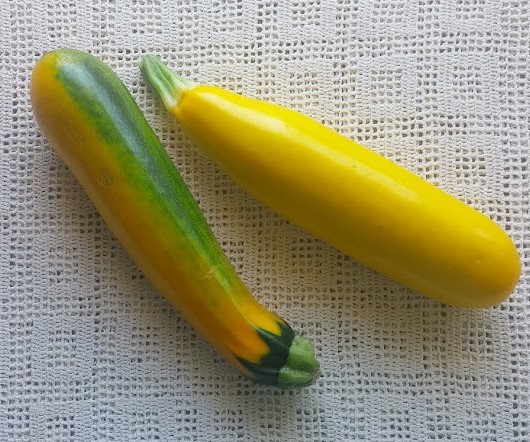
Do you remember Golden Zucchini? Just two years ago I said that much as we liked it, it was not a very reliable producer, but that we continued to grow it in the absence of better versions. Well, that was then. This spring we got some Rheinau Gold open pollinated zucchini from Adaptive Seeds. After only one season of growing it, I have to say, this looks like the open pollinated yellow zucchini we've been dreaming of.

Adaptive Seeds notes that it's still a bit smaller and slower growing than most green zucchini varieties. That's okay. This has been a ridiculously difficult year for growing all cucurbits (except the Sumter cucumbers, which are doing just fine, thank you). The zucchini and butternut squash were put, due to the roll of the rotation dice, into what is currently our worst bed. It is too close to some hazelnut "bushes" which have grown to the size of small trees in the last few years, and provide too much shade in exchange for sucking up too much water and nutrients. On top of that, we had a heat wave and drought for 2 weeks just as everything was getting ready to go. Most of the zucchini is really not doing all that well (and I doubt we will get a single butternut, boo). Rheinau Gold is the one exception. Okay; Tatume is doing pretty well too. Not surprising - it's from Mexico. 

Yes, we can watch the baby squash coming along for several days to a week before we decide to pick them, but they are coming along with placid steadiness in spite of the poor conditions. When it was horrifically hot and dry they were practically the only zucchini producing fruit, although they did slow down a bit. I'm talking close to 35°C for days. Just about everything else was producing nothing but male blossoms.

They seem to be not quite so consistently perfectly yellow as Golden zucchini. You can see a typical one in the picture, with a dark green cap by the stem and blush of green on the sunny side of the fruit. I don't mind that; I think it's distinctive and charming, in fact.

They taste good and they stay tender and delicate even though they are somewhat slow growing. I've picked a few other zucchini this year that weren't all that big, but that turned out to be much more tough, seedy, and mature than expected, again due to the weather and lack of water.

Rheinau Gold is a fairly new zucchini. It comes from Sativa Rheinau, a Swiss biodynamic seed house that also apparently do their own breeding. Looks to me like this one will go far... well, it already has. *Waves from Ontario*

Monday, 17 August 2020

Yogurt Baked Bulgur & Vegetables

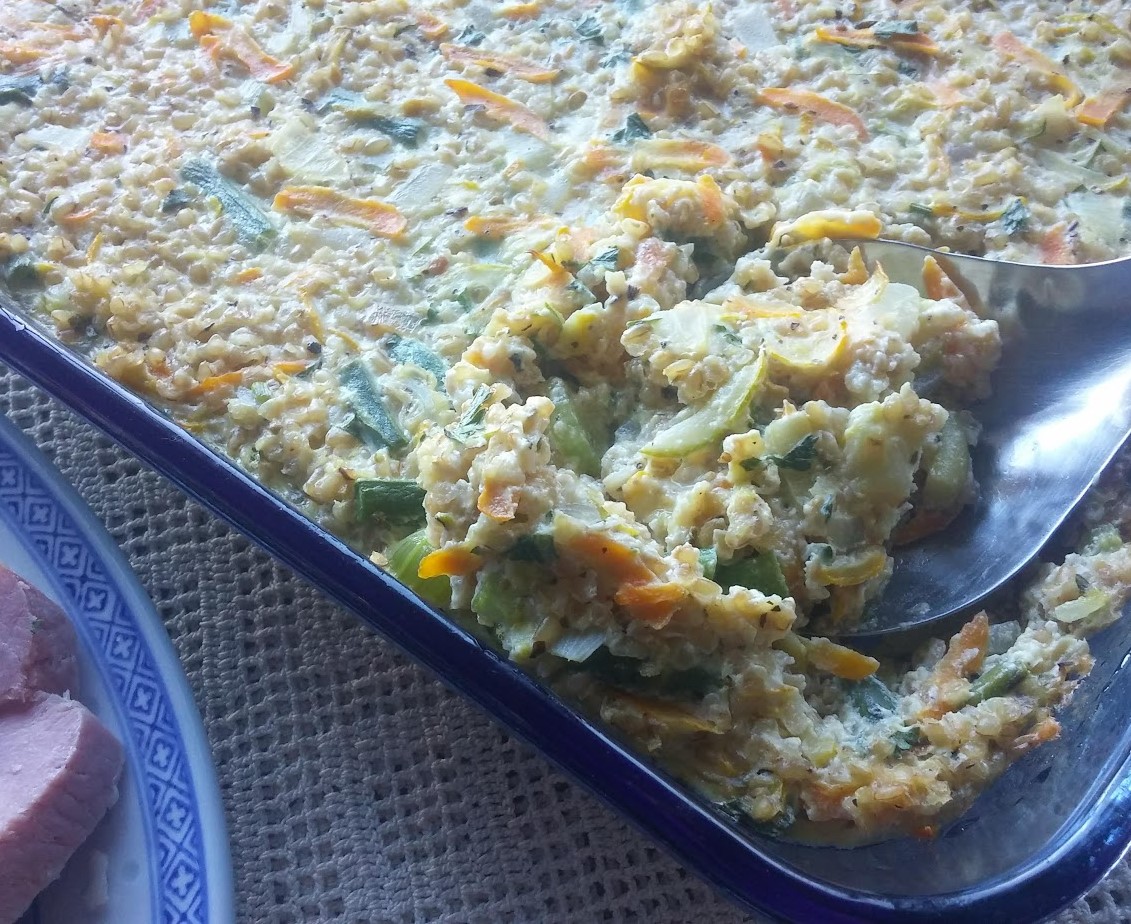
There is a somewhat surprising - to me, anyway - number of recipes for bulgur in Hungarian cuisine. This is one of them. In spite of the yogurt and egg this still seems pretty light, and I would say it needs to be served with some kind of protein. However, it does provide both the starch and the vegetable dish very nicely. There's a fair bit of chopping at the beginning, but once that's done there is no more fussing with this, which is also convenient. I find it too easy to end up with too many dishes that require last-minute work just before serving. We had some ham with this and there was nothing to distract me from carving it.

You could, no doubt, switch around which vegetables you use. I would always be inclined to keep the onion, celery, and carrot, but the beans and zucchini could be swapped out with broccoli or cauliflower, for instance.

We re-heated the leftovers in the microwave, which worked just fine.

4 to 6 servings
1 hour 15 minutes - 45 minutes prep

Yogurt Baked Bulgur & Vegetables

Prepare the Bulgur & Beans:
125 grams (1/4 pound) green beans
1 cup bulgur
1/2 teaspoon salt

Wash and trim the beans, and cut them into bite-sized pieces (an inch or less in length). Put 2 cups of water in a large pot and bring it to a boil. Add the beans and cook them for 1 minute. Add the salt and the bulgur, and boil it for 1 minute more. Then, cover the pot and remove it from the heat. Let it rest for 30 minutes as you prepare the other vegetables.

Make the Casserole:
1 medium onion
1 stalk of celery
1 medium carrot
1 medium zucchini
1/4 cup minced parsley
2 tablespoons mild vegetable oil
1 teaspoon rubbed thyme OR savory
1 teaspoon rubbed basil
1 teaspoon rubbed oregano
1/2 teaspoon salt
2 large eggs
1 cup thick yogurt

Peel and chop the onion. Wash, trim, and chop the celery. Peel and grate the carrot. Wash, trim, and grate the zucchini. Wash and dry the parsley, and trim off any coarse stems. Mince well. Preheat the oven to 350°F.

Heat the oil in a large skillet. Add the onion and celery, and cook for about 5 minutes until softened and reduced in volume, stirring regularly. Add the carrot and zucchini, and cook for another 5 minutes or so, stirring regularly until they, too, are softened and reduced in volume. Sprinkle the seasonings over them for the last few minutes of cooking.

Mix the vegetables into the prepared bulgur. Add the minced parsley. Whisk the eggs, then whisk in the yogurt. Mix this into the bulgur and vegetables. Lightly oil a 9" x 13" shallow baking (lasagne) pan and spread the mixture evenly in it. Bake for 30 minutes until firm and lightly browned at the edges, and serve at once.


Last year at this time I made Tomato Egg-Drop Soup.

Friday, 14 August 2020

Frittata di Pane e Pomodori

Almost every day we have toast with cheese and poached eggs. This is almost that breakfast... with a few additions. The first ripe tomato of the season was the most notable of them. Putting stale bread right in the frittata is surprisingly good, and something I would like to do more often.

The bread should be a good one, but fairly stale is fine, in fact an improvement. I can't say exactly how much milk to use; with the tomato it should be sufficient to dampen and soften the bread, without making it soggy. You'll have to use your judgement. If you can let the mixture sit for a few minutes before cooking, you should have a good idea how it's looking and you could add a little more as needed, so as ever it's better to be conservative to start with.

I'd say the garlic and fresh basil are optional, except that really, they're not. This wouldn't have been half so good without them.

1 to 2 servings
20 minutes prep time

Frittata di Pane e Pomodori

1 medium ripe tomato OR 6 to 8 cherry tomatoes
1 clove of garlic
1 sprig of basil
1 cup diced stale Italian bread, crusts trimmed
1 to 2 tablespoons milk OR cream
salt & freshly ground black pepper to taste
3 to 4 large eggs
2 tablespoons grated or finely diced melty cheese of your choice
1 tablespoon mild vegetable oil OR olive oil

 Blanch the tomato or tomatoes, and peel them. Dice them and put them in a mixing bowl. Peel and mince the garlic. Wash, dry, and shred the basil. Add both to the tomatoes.

Cut or break up the bread, and sprinkle it with the milk to soften it. Add it to the tomatoes and mix in well. Season with salt and pepper. Break in the eggs and mix them into the tomatoes thoroughly. Let the mixture sit for 5 or 10 minutes if possible.

Heat the oil in a large skillet over medium-high heat (usual temperature for cooking eggs). Turn on the broiler. When the pan is hot, scrape in the eggs and tomatoes and spread the mixture out evenly in the pan. Sprinkle the cheese evenly over the frittata. When the bottom of it is well set, place the pan under the broil and cook until the top is set, then serve.


Last year at his time I made Zucchini & Tomato Salad with Basil & Balsamic Vinegar. Apparently mid-August brings out the Italian in me...

Wednesday, 12 August 2020

Macedonian Eggplant Salad

We've been getting some very nice eggplants this year; they are one thing that seem unfazed by the very high temperatures we had earlier in the summer, and in fact even happy about it.

This would have done better - prettier at the very least - with some red pepper and tomatoes, but alas! Neither of ours have achieved a state of redness yet. Soon, I hope. 

 4 to 6 servings
30 minutes prep time

Macedonian Eggplant Salad

500 grams (1 pound; 1 to 3) eggplant
1 tablespoon mild vegetable oil
2 to 3 cloves of garlic
1/3 cup finely chopped parsley
1 tablespoon finely minced fresh oregano
1/4 large red OR yellow pepper
1/4 large green pepper OR 2-3 slices pickled hot peppers
1 or 2 small red tomatoes, optional
1/4 cup olive oil
1/4 cup red wine vinegar
salt to taste

Wash and trim the eggplant, and poke it in a few spots with a knife or fork. Rub it - or them - with the oil. If you have only one large eggplant, or if they are much more than an inch thick, they should be cut into thick slices or halves before they are rubbed with oil.

Put the broiler on, and let the oven heat up for a few minutes, then cook them for 10 to 12 minutes one level away from the closest position to the broiler. Turn them half way through. Let cool enough to handle before proceeding. If you do outdoor grilling, that would be an excellent way to cook your eggplants. They can be cooked at least somewhat in advance, although if you chill them they should be brought back up to at least room temperature before being eaten.

While they cook, peel and mince the garlic. Wash, dry well, and mince the herbs. Wash, trim, and finely dice the peppers and tomato. Mix all these in a salad bowl. When the eggplant is ready and cool enough to handle, chop it finely or mash it coarsely, and mix it in with the oil and vinegar. Season with salt to taste. Serve soonish.


Last year at this time I made Thai Basil Fried Eggplant (huh) which I noted was the first of the year at the time. Wow! I think I picked the first for this year at least a month ago.

Monday, 10 August 2020

Fish & Summer Vegetable Chowder

Well, this was excellent. I thought it would last for 2 meals but we ate it all at once. It's pretty light, being mostly fish and vegetables so that was quite possible. With some good crusty bread and butter on the side, it might stretch to 3 or 4 servings, and if it was served as a first course to a larger meal it should be enough for 6 people.

If you had some corn and corn cooking water left from another meal, that would speed up the making of this soup. This is not a difficult soup to make, but getting the timing for cooking the corn and fish lined up with the cooking of the other vegetables in the butter requires a little attention. The main point, I think, is to not overcook the fish so it should not go into the pot until the vegetables are well under way.

If you do have leftovers, refrigerate them promptly and eat them the next day. I do not believe this soup will keep well for long.

2 to 6 servings
45 minutes prep time

Mix the Seasonings:
1/2 teaspoon fennel seed, ground
1/2 teaspoon salt
2 tablespoons wheat OR barley flour
1/8 to 1/4 teaspoon Aleppo pepper
freshly ground black pepper to taste

Grind the fennel seed with the salt, then mix all the spices and flour in a small bowl. Set aside

Make the Soup:
1 medium onion
1 medium carrot
1 medium zucchini
1 small stalk of celery
300 grams (10 ounces) white fish fillet
4 cups water
2 medium-small cobs of corn
3 tablespoons unsalted butter
1/2 cup rich milk OR light cream
a sprig of basil OR a few sprigs of parsley

Trim, peel, and dice the onion, carrot, and zucchini. Wash and trim the celery, and dice.
Put the water in a heavy-bottomed soup pot and bring it to a boil. Meanwhile, husk the corn. Boil the corn for 2 to 3 minutes, then transfer it to a bowl or the sink, and run cold water over it until it is cool enough to handle. KEEP the pot of water in which the corn was boiled; it is the base for your soup. Leave it on the back of the stove until ready to resume.

Melt the butter in a large skillet over medium heat. Add the onion, carrot, and celery, and cook gently, stirring regularly.

Cut the corn from the cobs while this cooks, and return the scraped cobs to the pot of water. Simmer them while the vegetables in the skillet continue to cook. Add the fillet of fish to the corn cob pot, being sure that it is without any skin or bones, and simmer for 5 to 8 minutes. It should break up into pieces as you cook the soup and stir.

When the vegetables in the skillet have cooked for 5 minutes, add the zucchini and mix in well; let it cook for several minutes, stirring occasionally, then mix in the corn. Continue cooking and stirring regularly for another 5 minutes or so.

Sprinkle the little bowl of seasonings over the vegetables after a few minutes and mix it in well. Once it is well absorbed and no dry white specks can be seen, slowly mix in the milk or cream. Cook gently until thickened, continuing to stir.

Remove the corn cobs from the pot of soup, and discard them. Break the cooked fish into large flakes with a spoon. Mix the skillet of vegetables and cream into the soup. Let the soup sit and steam on the edge of simmering for another 5 minutes or so, but do not let it boil. Sprinkle with the basil or parsley and serve.


Last year at this time I made Green Bean & Cauliflower Salad in Gremolata-Tahini Dressing.

Friday, 7 August 2020

Feta & Goat Cheese Dip

We actually had a family get together last weekend, for the first time since, well, you know. We all pinky-swore we had been self-isolating, and masking, and washing our hands and groceries, and so we agreed we could all be in the same house for a couple of days.

I made a bunch of dips and crackers and salads, which got put out for several meals and kept the cooking during the visit down to a dull roar. I made Turkish Pepper Pate, and Favosalata, and decided I needed a dairy-based dip to round out the trio. This was so quick, so simple, and didn't call for a long list of ingredients, but none the worse for any of that.

8 to 12 servings
15 minutes prep time

Feta & Goat Cheese Dip

2/3 cup thick yogurt
300 grams soft goat cheese
2 to 3 cloves of garlic
1 teaspoon rubbed oregano
1 teaspoon thyme
freshly ground black pepper to taste
the zest of 1/2 lemon
the juice of 1/2 lemon
150 grams drained feta cheese

Put the yogurt and goat cheese into a food processor. Peel and trim the garlic, and cut them in slices, then add them with the herbs and lemon zest. Add the lemon juice. Process until smooth.

Add the feta cheese and process until well blended but still with a fair bit of texture.

Check the thickness; you can add a little more yogurt if you think it should be thinned. Transfer to a serving dish and keep cool until serving time.


Last year at this time I made Spaghetti Nerano.

Wednesday, 5 August 2020

Green Beans in Ginger-Tomato Sauce

Beans are substantial somehow, even as immature green pods. They have what it takes to stand up to a thick and lively sauce, and here's one that's particularly thick and lively. Earlier in the season I had been thinking I would use this sauce on snap peas, but I ultimately decided that they would have been overwhelmed, and it would have been a waste. A little butter and salt is all they need.

I sprinkled this with a few pumpkin seeds before serving, which I think was a mistake. We kept taking them for oddly tough pieces of bean. Next time, I would probably serve it with a dab of Turkish yogurt sauce (thick yogurt with a clove of garlic and a bit of salt) since the yogurt is already out, although they would also be just fine as they are. Rice or noodles are the obvious accompaniment to soak up that rich and tasty sauce, and some plainly grilled chicken or fish will finish the meal.

4 servings
30 minutes prep time

Green Beans in Ginger-Tomato Sauce

450 grams (1 pound) green beans
1 tablespoon fresh ginger, peeled and grated
1 clove garlic
1/4 teaspoon salt
1 teaspoon sweet Hungarian paprika
1 tablespoon unsalted butter
2/3 cup thick yogurt
2/3 cup tomato sauce

Wash and trim the green beans, and cut them into bite-sized pieces. Peel and grate the ginger and the garlic. Set the ginger and garlic aside in a small bowl with the salt and paprika.

Put a pot of water on to boil, for cooking the beans.

Heat the butter in a large skillet, over medium-high heat. When it sizzles, add the bowl of ginger, garlic, etc, and stir in well for about 1 minute. Then quickly add the yogurt and tomato sauce, and reduce the heat to medium. Let the sauce cook for 6 to 8 minutes, until thickened. Stir regularly.

Meanwhile, when the water boils, add the prepared beans and re-cover the pot. Cook for 4 or 5 minutes, until tender. Drain well and add to the sauce. Mix them in well, then let them simmer for just a few minutes, until the beans and sauce are very cosy with each other. Transfer them to a serving dish and serve at once.


Last year at this time I made Blueberry Cucumber Salad with Feta.

Monday, 3 August 2020

Broiled Eggplant with Tahini Dressing and... Red Currants?

Here's a very popular thing to do with eggplant these days. I saw Yotam Ottolenghi's recipe, with buttermilk dressing and pomegranate seeds and like so many others I was very taken by the pretty picture of green herbs and red berries on a creamy white ground.

I think a tahini sauce is perhaps a bit more traditional, and at any rate I try not to feed Mr. Ferdzy too much dairy, as it does not agree with him unless it's slightly elderly cheese. The other thing I did was replace the pomegranate seeds with red currants. Yes! Red currants! They are the right size, the right colour, the right amount of tart and zing, AND unlike pomegranates, they're growing right in my back yard. Which is where the eggplant came from too, and the cilantro, the garlic, and the summer savory. Pretty good!

The size of the eggplants is less a matter of weight and volume, so much as thickness - 2" at the thickest point, or less, and they should cook nicely. Anything thicker and you may want to cook them longer, at a lower temperature.

2 to 4 servings
20 minutes prep time PLUS 10 minutes to cool

Broiled Eggplant with Tahini Dressing and Red Currants

Make the Za'atar:
2 teaspoons rubbed savory
1 teaspoon rubbed oregano
3 teaspoons sumac
1/4 teaspoon (to taste) Aleppo pepper
2 tablespoons sesame seeds

Start broiling the eggplants before you make the za'atar and dressing; then you can make them while it cooks.

Mix the za'atar ingredients together in a small bowl or jar (this is more than you will need, but it's nice to have a little extra in the pantry). 

Make the Tahini Dressing:
1 to 2 cloves of garlic
1/4 teaspoon salt
2 tablespoons tahini
2 to 3 tablespoons lemon juice
2 to 3 tablespoons water

Peel and mince the garlic. Sprinkle the salt over it, and mash them together until they are a paste. Put them in a small bowl, and mix in the tahini. Mix in the lemon juice, then the water. Taste and adjust the amount of water and/or lemon juice if necessary. 

Cook & Dress the Eggplant:
2 medium long thin purple eggplants
1 to 2 tablespoons olive oil
salt
2 to 3 tablespoons minced cilantro, mint OR parsley
2 to 3 tablespoons fresh red currants

Preheat the oven with the broiler. Be sure the rack is not in the highest position, but in the next one down. 

Wash the eggplants and trim off the stems. Cut them in half lengthwise. Cut hatchmarks into them, being sure to cut fairly far down but not to the skin. Rub them all over with the oil, both skin sides and cut sides. Lay them in a single layer in a grilling pan that will get them well-placed under the broiler. Broil for 12 to 16 minutes, until tender and browned.

Just one minute or two before you judge them cooked, sprinkle a teaspoonful - or however much you think you would like - of the za'atar over each half eggplant. Finish broiling, then set them aside on a trivet to cool. If you want them on a more attractive serving dish, now is the time to move them.

When you are ready to serve, drizzle the tahini dressing over them. Sprinkle them with the chopped cilantro, and the red currants which have been washed and stripped from the stems.


Last year at this time I made Tart Mixed Berry Cheesecake Crumble. Got a much better berry harvest this year! Although much of it is already picked and gone.