I used watermelon from last year that was already in the freezer to make this. Since watermelon is about the worst fruit for someone who is avoiding sugar, most of last years crop is still there. I know I have seen Ontario watermelons for sale, though.
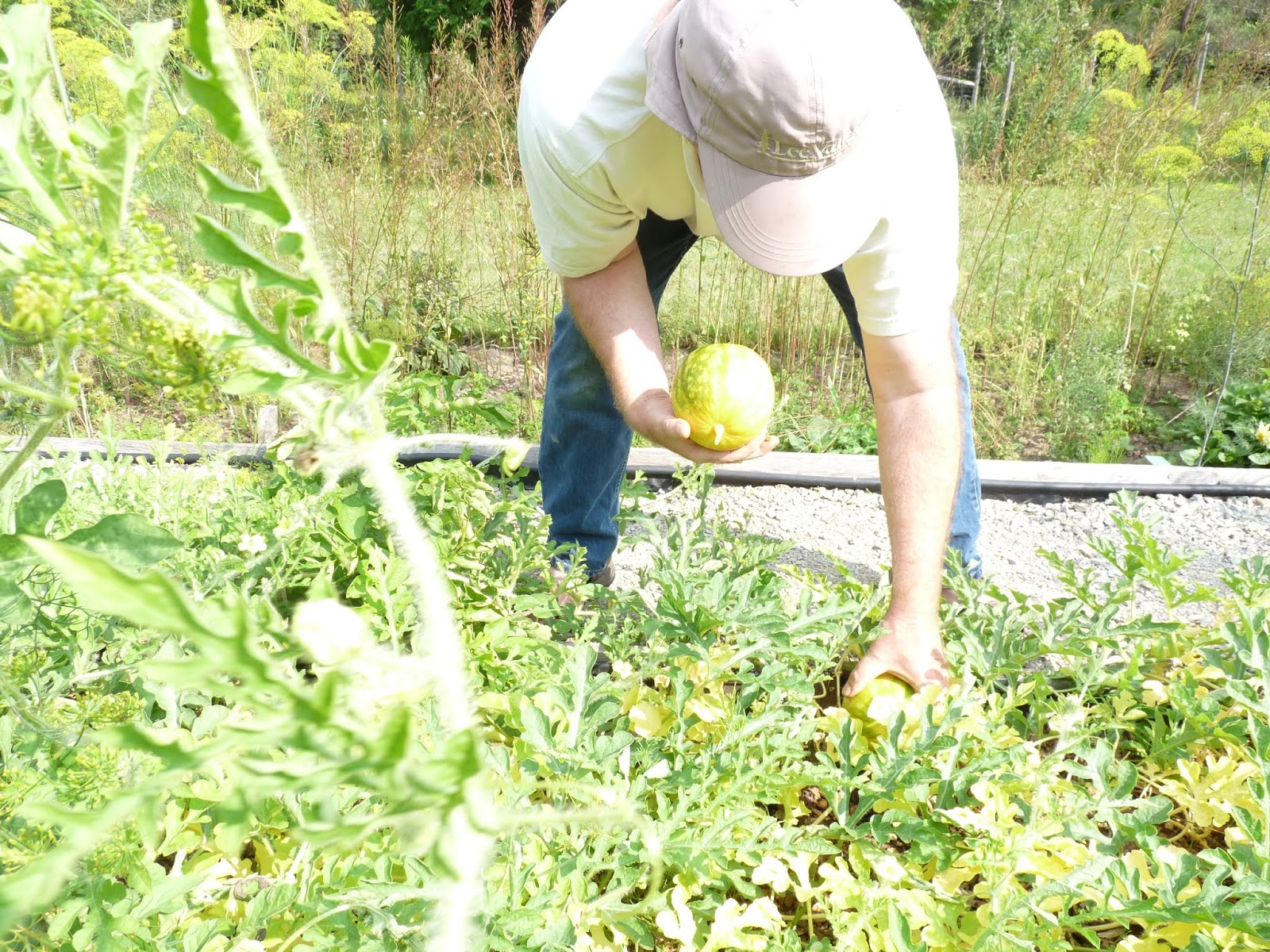
We are only growing the golden-rind watermelons this year, more because we want to finish the breeding project than because we want watermelon. It's been a really terrible year for growing watermelon and we struggled to get a sufficient number germinated and growing early on. Once it finally warmed up they did okay, but they were so behind I worried they wouldn't ripen before it got cold again. However, there are lots of smallish but okay fruits out there, and the vines are starting to yellow, so presumably ripeness is not too far away. Meanwhile, this was a lovely treat on one of the very hot muggy days we've been having.
4 servings
30 minutes advance preparation
chill time in between
10 minutes to make the slushies
4 cups frozen watermelon pieces, without seeds
2 cups water
1/4 cup sliced ginger
the zest of 1 lime
2 tablespoons honey
The watermelon must be frozen at least 2 hours in advance. Cut it from the rind and pick out the seeds. Freeze the watermelon in pieces no larger than an inch thick and which will fit into your blender or food processor.
Meanwhile, put the water, sliced ginger, and lime zest into a pot. Be sure to give the ginger and limes a good scrub before slicing or zesting them, though there is no need to peel the ginger. Bring them up to a simmer and simmer gently for 10 to 15 minutes. While they heat, measure in the honey and stir until dissolved.
Strain the liquid, discarding the solids, and allow it to cool then keep it chilled until you are ready to make the slushies.
Put half the frozen watermelon and half the lime-ginger syrup into the blender or food processor, and process until very smooth. Pour into 2 glasses. Repeat with the remaining frozen watermelon and syrup for another 2 servings, then or at a later time.
Last year at this time I made Beans & Cherry Tomatoes in Mint Vinaigrette.
Showing posts with label Melon. Show all posts
Friday, 23 August 2019
Monday, 24 September 2018
The 4th Annual Watermelon Breeding Post
Time to assess this year in watermelons! As it should surprise no-one to hear, this was an excellent year for watermelons, mostly. It would have been nice to have had what rain we had earlier in the summer while the fruits were forming, rather than later when they were finishing ripening, but whatever. We had a few moments of fear and frustration in the beginning, when many of the seeds failed to germinate. We did a second planting but no further attempts at coaxing them to sprout. Do or die; that's the breeder's motto.
Consequently we got going with fewer plants in the beds than we had planned, but enough to go on with, as it happened. The ones that grew, grew. I'm going to spend less time describing individual watermelons than I have in past seasons, because I think this year has marked a turning point. We are still eliminating at least half the watermelons that we get from next years planting, but we are also seeing a consistency in quality that just didn't used to be there.
You can see the reports for 2015, 2016, and 2017 at the links. It is really encouraging to me to see how much the watermelons have improved over the last 4 years.
I'll start with the Golden Rind project (melons who's rinds turns yellow when they are ready to be picked).
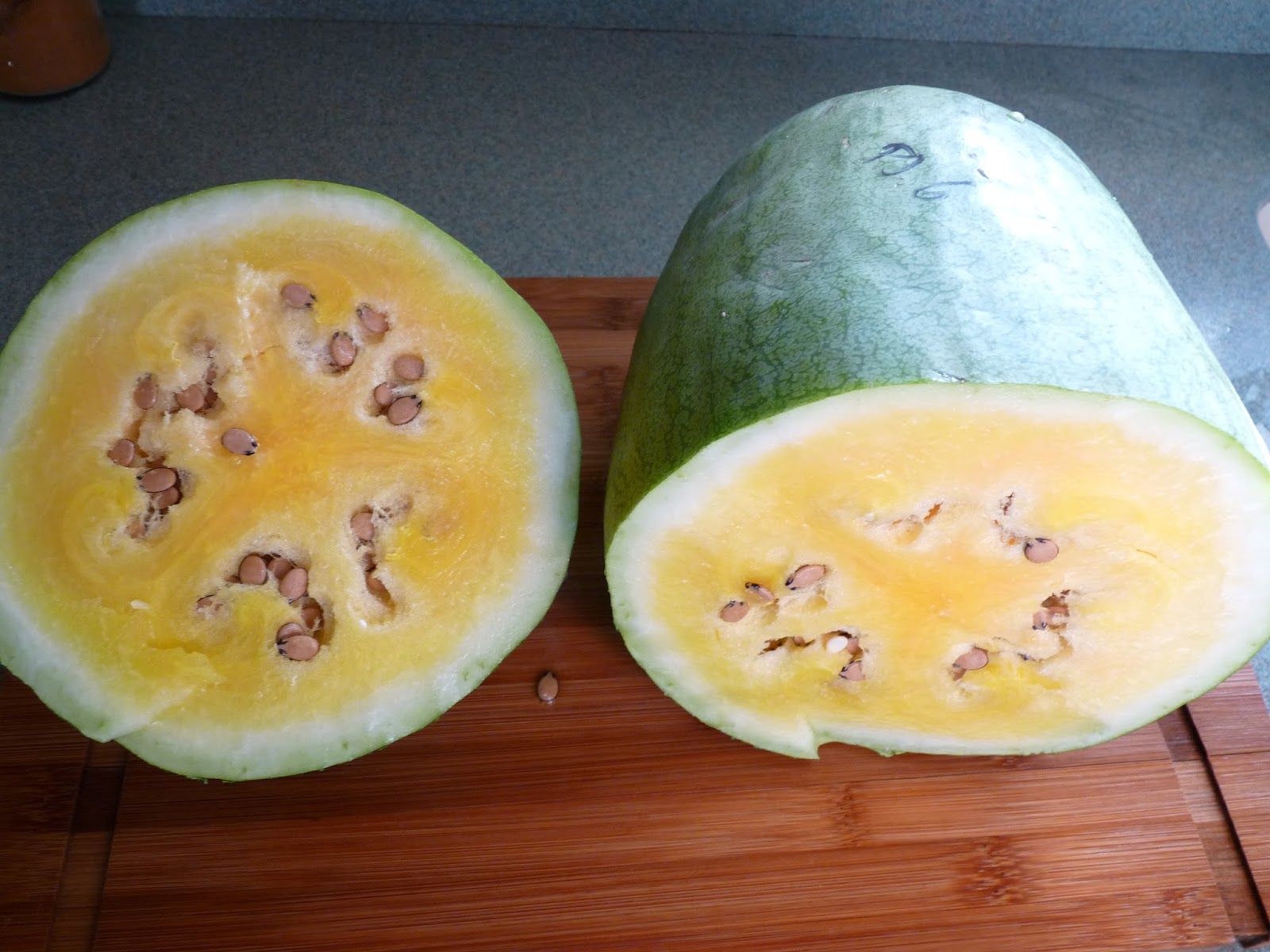
GR02-0815 was the second watermelon we picked, but it would have been ripe at the same time as the first one. At just under a kilo, we would have liked it to be a little larger, but it was a decent size. We scored it a 7 for flavour; a fairly typical score this year and anything that scored lower is not going to make the cut next year. This one is in, though; decent flavour, earliness, adequate size.
This look - oval, with thin stripes, was one of three styles that seemed to predominate in the watermelons which turned yellow when ripe this year.
Here's how it looked when cut. Colour a little pale but okay, a reasonable number of reasonably sized seeds, rind a little thicker than I like but not too thick; again all good enough to go on with.
GR04-0820 shows the second distinctive style we were seeing in this patch. At over 1.5 kilos, it was a much better size than GR02-0815, and only a few days later. In spite of being a little watery (I believe it had just rained the day before we picked it) it scored an 8 for flavour. Most of the others of this type did not score so well. This one is definitely in for planting next year.
Dang! Forgot to photograph this one before we cut it. GR08-0820 was in many ways the best of the Golden Rind project this year. I consider the size (over 2.2 kilos) to be just about perfect, and it scored an 8 for flavour.
The colour is a little pale and the seeds, while small, seem a bit all over the place. However the good flavour and texture, combined with a nice thin rind, desirable size, and earliness (it may be melon number 8, but it was picked the same day as melon number 3, which is not shown as it was not a keeper) mean this is probably the top Golden Rind melon of the year.
Or maybe this was the top Golden Rind watermelon of the year. GR12-0918 was a hair overripe, but sweet and tasty, rating a 7.5 for flavour. The rind was also thin, the seeds seemed a bit better organized, and the colour was a bit stronger. At 2.56 kilos it was the second largest of the year for this set. It was an example of the third style of watermelon in this group - neither quite round or quite oval, but somewhere in between, with little in the way of stripes. Most were much smaller, though.
There were a number of other Golden Rind watermelons besides these, but they were just not that different from those I have already shown. There were still quite a few melons which did not turn yellow when ripe, but most of them were later to ripen and not significantly better in quality than most of the yellow ones. Therefore, next year will be the first year for this project where we do not intend to plant ANY seeds from watermelons that did not turn yellow. This is a real and encouraging turning point.
The other project, for orange-fleshed melons, also had the same frustrations starting out but went on to produce numerous, good quality melons, with more consistency than we have seen until now. In spite of how much larger these melons are in general, they are only a few days later to ripen.
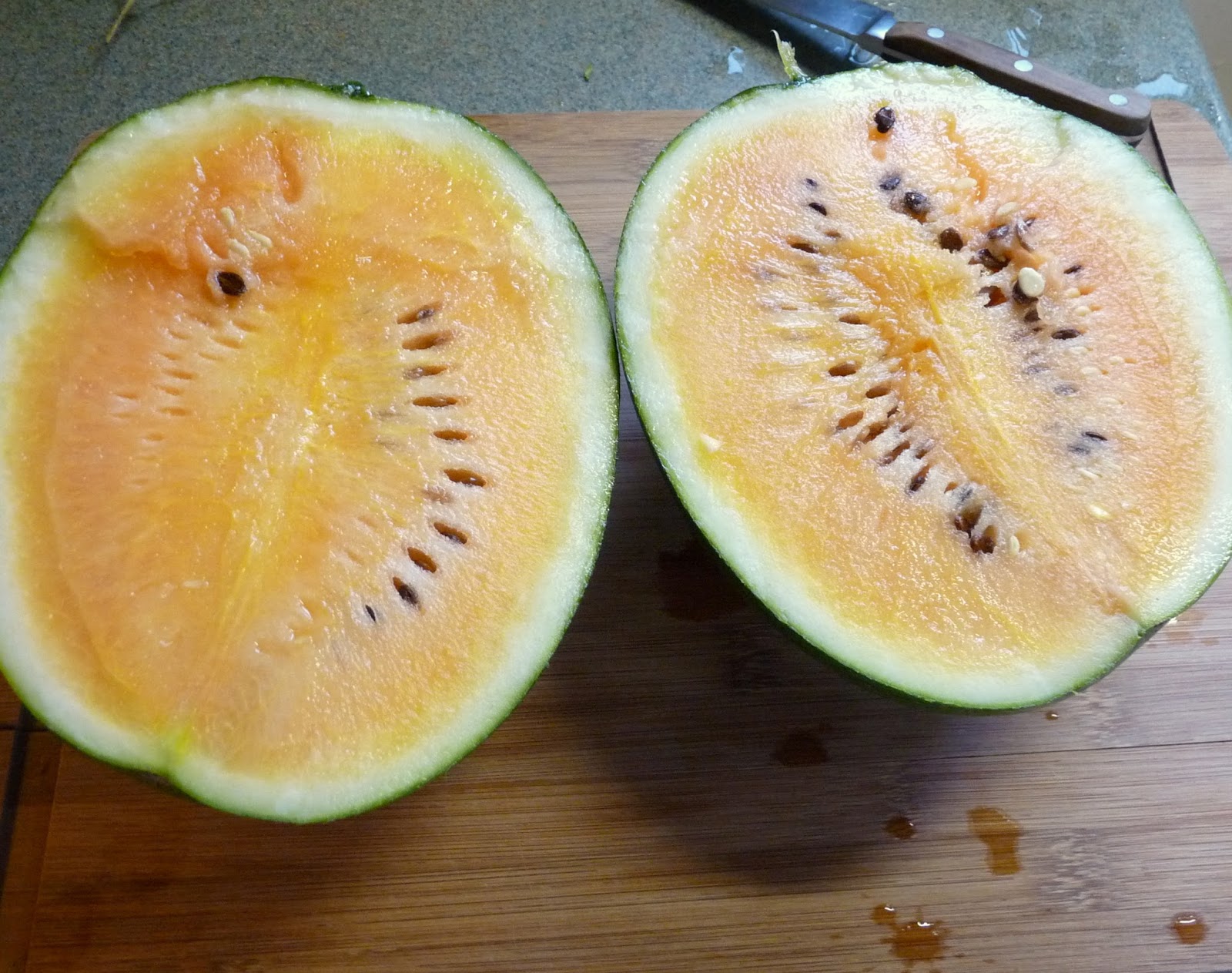
This melon, PJ01-0818, scored a 7 for flavour - pretty typical, the lowest rating for this project this year was 6, and only one managed to score an 8 - and had a slightly pale colour but was within the acceptable range.
PJ03-0827 had a rather thick rind, but good colour and at 5.588 kilos was the largest of the year. Maybe a bit too large, but eh, I'll take it. It held well in the fridge too.
PJ04-0827 was a bit on the red size but again, acceptable as an orange melon, and scored an 8 for flavour in addition to having a nice thin rind. It could have held a bit better but still, it's in for next year.
PJ09-0904 had a thicker rind than I like, but good flavour (7) and excellent colour. It too is in.
There are still a few melons left to be picked in this batch but they have been considerably more consistent than the Golden Rind project, which in addition to more melons scoring 8, also had melons scoring as low as 2, so I am not expecting anything much different from what we have seen thus far.
Mr Ferdzy is chaffing at being restricted to these 2 watermelon projects, so this one may be dropped next year to give him more scope with other watermelons, but it remains to be decided. If we go ahead and replant them, I think we can hope for continuing progress next year.
Monday, 20 August 2018
Melon, Parsley, & Sweet Onion Salad
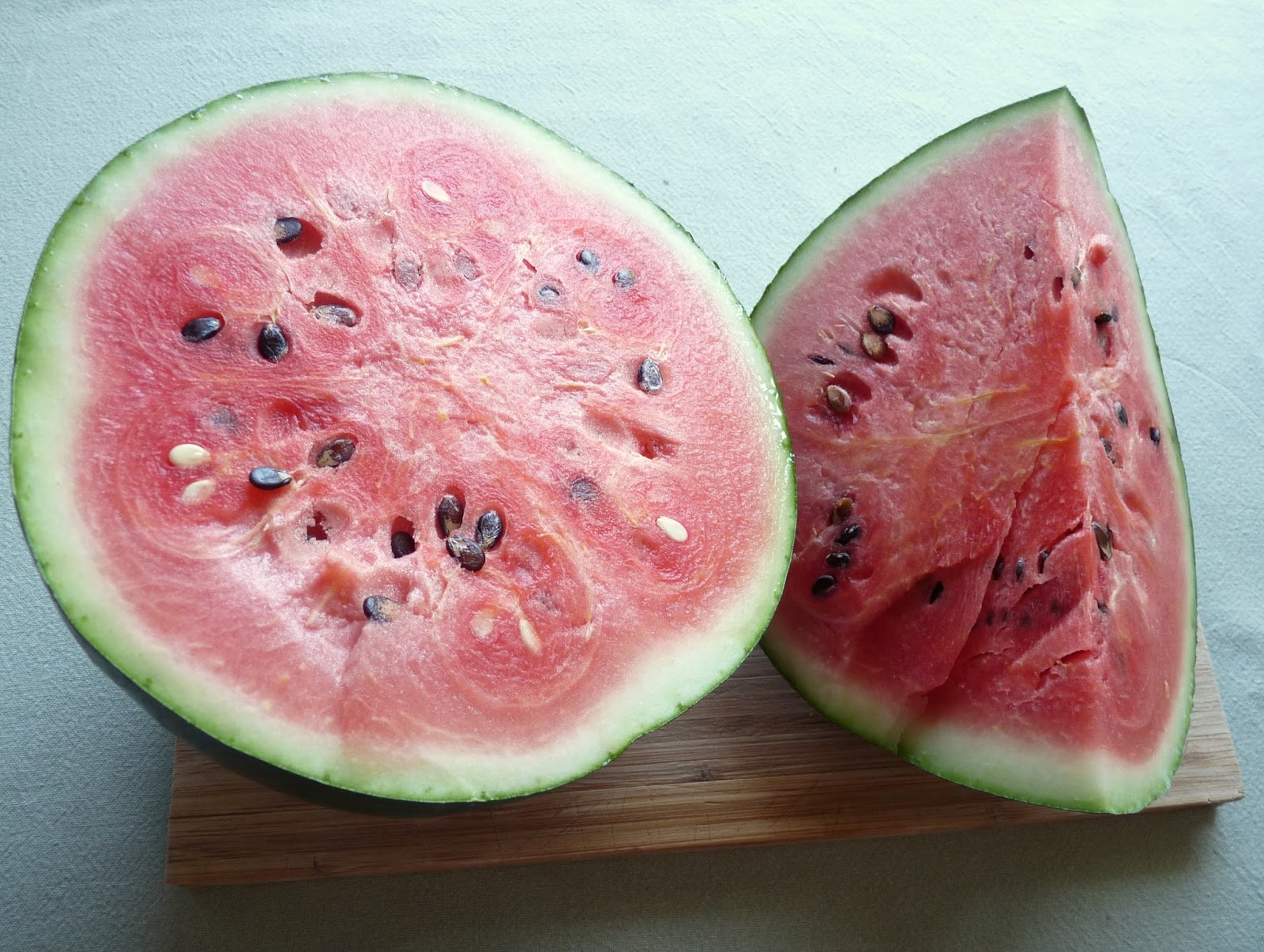
This is a simple little salad, very pleasant and easy, and inspired by the classic starter of melon and prosciutto. I used both orange and green melon, as one of the melons planted in the "orange melon patch" turned out to be green. Such are the hazards of open pollination and home-saved seeds. Both were very tasty though, so no problem. It's nice to use both if you can, just for the subtle difference in flavour and texture, but just one will certainly do.
Mint is a notorious weed, so it is frustrating that we have had a hard time growing it. I had some growing by the tap for the garden hose for a while, but it seems to have been crowded out. However, a bit we planted in a low spot in the garden and which sat and did nothing for at least 5 years finally seems to have taken off. I am enjoying using it. I can see using basil instead, though, if mint is hard to get.
4 servings
30 minutes prep time
1 small (1 cup chopped) sweet onion
1 cup finely chopped parsley
2 to 3 tablespoons finely chopped fresh mint
2 to 3 cups diced, peeled orange or green melon
1/8 to 1/4 teaspoon Aleppo pepper
freshly ground black pepper to taste
salt to taste
the juice of 1/2 lemon
2 tablespoons olive oil
125 grams very thinly sliced prosciutto or similar dry ham (optional)
Peel the onion and chop, a little coarsely. Sprinkle it with salt, and leave it in a strainer to drain for 15 or 20 minutes. Rinse them and drain them well.
Wash and dry the parsley and mint, and chop them finely, discarding any tough stems.
Peel, de-seed, and dice the melon. Toss the melon, herbs, well-drained onion together. Season with Aleppo pepper, pepper, and salt. Drizzle over the lemon juice and olive oil. Toss gently.
If you like, serve garnished with the prosciutto or ham.
Last year at this time I made Green Bean Greek Salad.
Mint is a notorious weed, so it is frustrating that we have had a hard time growing it. I had some growing by the tap for the garden hose for a while, but it seems to have been crowded out. However, a bit we planted in a low spot in the garden and which sat and did nothing for at least 5 years finally seems to have taken off. I am enjoying using it. I can see using basil instead, though, if mint is hard to get.
4 servings
30 minutes prep time
1 small (1 cup chopped) sweet onion
1 cup finely chopped parsley
2 to 3 tablespoons finely chopped fresh mint
2 to 3 cups diced, peeled orange or green melon
1/8 to 1/4 teaspoon Aleppo pepper
freshly ground black pepper to taste
salt to taste
the juice of 1/2 lemon
2 tablespoons olive oil
125 grams very thinly sliced prosciutto or similar dry ham (optional)
Peel the onion and chop, a little coarsely. Sprinkle it with salt, and leave it in a strainer to drain for 15 or 20 minutes. Rinse them and drain them well.
Wash and dry the parsley and mint, and chop them finely, discarding any tough stems.
Peel, de-seed, and dice the melon. Toss the melon, herbs, well-drained onion together. Season with Aleppo pepper, pepper, and salt. Drizzle over the lemon juice and olive oil. Toss gently.
If you like, serve garnished with the prosciutto or ham.
Last year at this time I made Green Bean Greek Salad.
Labels:
08 August,
09 September,
Herbs,
Melon,
Onions Leeks and Other Alliums,
Pork,
Salad
Monday, 9 October 2017
Watermelon Projects Update for the Year
Hey, it's the moment I've been waiting for, and you all get to hear about it. Lucky you! It's time to assess our watermelon breeding projects. So how did things go?
To sum up, the phrase of the year is "Thinning the herd." Yeah. Like that.
On the other hand, if we think we are breeding watermelons for lousy Canadian summers I guess we have to have some lousy Canadian summers in order to test how things are going. And in spite of my griping, I do feel like we continue to make some good progress.
In the picture above, you can see some melons from our golden-when-ripe project. From the picture you would get the impression we got a good number of melons, none very large and few yellow when ripe. That would be accurate.
On the bright side, the first 2 melons to ripen did turn yellow when ripe, and they achieved a very decent size. They are at least half siblings if not siblings (most of our melons are still within the range of second cousins once removed, if not more closely related, but at this point I'm mostly not keeping track).
Melon GR001-0904 came in at 1.181 kg, and melon GR002-0906 weighed .846 kg. I regret to say that melon GR002-0906 tasted a bit better and was a bit less seedy. However they both compare favourably to last year's GR001-0825, which was the largest of the year and weighed .82 kg.
The interior of GR001-0904. We seemed to have some problems with incomplete fertilization but there are enough seeds to go on with.
Last year was a much better year for growing watermelons so I am very happy about the increased size I am seeing in these 2 melons as well as in general this year. Both of these will supply seeds for next year.
We planted a few plants of the original Golden Midget. We only got 3 Golden Midget fruits, of which 2 are seen above in the back row. The third one rotted on the plant and would have been smaller than either of the two I picked. Note the weights: at approximately half a pound each they are very unimpressive. Even our also-rans are coming in larger than that, for the most part.
I don't seem to have that melon at .405 kg recorded. I guess it wasn't great and I didn't bother to keep seeds or number it. The little green one is GR004-0923. Not very big and not golden rinded, but one of only a few melons to score an 8 out of 10 for flavour. I might plant a few seeds from it next year. I don't want tiny melons, but if we are going to have them, I want ones that taste good. But I still have to think about it. There were 3 other larger melons that scored an 8 too and would perhaps be better candidates.
This is GR006-0926. It did not turn yellow when ripe, although the rind is naturally fairly yellow. At 2.05 kg this was our second-largest melon from this project and the only large melon to score an 8 out of 10 for flavour. It's in, for sure.
The next melon of interest was GR010-1002. Again, it didn't turn yellow when ripe, but size was within the desired range.
The seeds were paler than I like and so was the flesh, the rind was not as thin as some, but okay. Flavour scored an 8 though - one of the best, so it is probably in next year too.
This was in some ways the most interesting melon of the year. GR011-1003 came up as a volunteer in what became a strawberry bed this year. It was our only volunteer melon this year and it got started a fair bit later than any of the ones we planted out. As soon as I saw the first female flower I started basting it with pollen from the set of plants that produced GR001-0904 and GR002-0906. Although this one did not turn yellow when ripe, it carries the gene, so I have very high hopes that it will have yellow offspring since it is crossed with yellow ripening melons.
In spite of its late start it became our largest melon of this project for the year. We will be planting lots of seeds from this one.
Alas, it only scored a 6 for flavour. I'm hoping that it had potential for better flavour, but was cut a little short by the vine dying before it was completely ripe. The texture was excellent, the rind was nice and thin, and the small black seeds were plentiful but not ridiculously so.
Overall, my hope is that next year we will get enough large, sweet and tasty, yellow when ripe melons to stop planting ones that turn out to have green rinds. We are definitely getting closer to having the size/colour/flavour we want in individual melons, but for this year we are still in the stage where we have to accept melons that have 2 out of 3 of those characteristics. Progress is definitely happening though!
Our other project, crossing Orangeglo with Sweet Siberian for a larger, tastier, orange fleshed melons did not apparently go so well, but I am reasonably pleased nevertheless.
We only got 4 melons ranging from 2.148 kg to 3.745 kg, which is what I would consider our target size. There are a few other melons at smaller sizes under consideration, but these 4 form the core of what we will be moving forward with. PJ003-0922, shown above, was our second largest of this group and shows a typical shape. They varied from green netted to having various stripes. I prefer the striped rind, but we are not yet to the stage of fussing about that by any means.
PJ001-0916 started off the project looking hopeful. It grew down at the end of the bed where we had left some lettuce to go to seed as well as planting our squash, and it was the only melon produced down there as the watermelon vines got rather smothered. The colour is not exactly what we wanted, but reasonably close. It got very badly fertilized and there are hardly any viable seeds, (but a few) and it did not come out mis-shapen which often happens with incomplete fertilization, so that's good. Again, rind is somewhat annoyingly thick. Scored a solid 7.5 for flavour and we noted it as "very sweet". Size was an acceptable 2.362 kg.
PJ002-0921 was a bit dismaying to open. Seed colour is good, but the flesh is way paler than we want. Flavour was an acceptable but not thrilling 7 out of 10. The seeds were small and the rind was not too thick, although it's hard to tell because it blended in with the flesh so much. At 2.148 kg it was one of the smaller of the big-enough melons. We may decide not to replant from this one.
Well so much for orange flesh. This is PJ003-0922. I might have thought that it picked up some pollen from the other watermelon project given the red flesh, but the size, the shape, the rind pattern and the seed colour all suggest that no, this is the offpring of Orangeglow and Sweet Siberian. Watermelon flesh colour genes are numerous and their interactions are complex. We are not throwing this one out of the project yet, even though it is not the colour we are looking for. For one thing, it was the only one of this group to score an 8 for flavour. At 2.783 kg it was also our second largest melon of this set.
Like most of the melons from this group this year, the rind is sturdy (good) but thicker than I like. Again though, I don't think we are at the stage of worrying about that particularly.
PJ006-0930 came the closest of the large melons to having the colour we want. At 3.745 kg it is also notably the largest melon of this group. Flavour was a just barely acceptable 6 though, and the texture was okay but not great. Still, I think it will get planted next year just for the colour and size.
I broke these 2 runts open in the garden expecting to discard them but curious about them. Imagine my annoyance to discover that they were the orange colour we are looking for. I gave the larger of the two a taste, and it was surprisingly good although I didn't formally rate it. Since one of the problems with Orangeglo is that smaller specimens fail to develop good flavour, I saved seeds from it. The tasty-when-small characteristic is one we definitely want to have. It is now known as PJ005-0928 and its seeds will likely go into the ground next spring. It weighed in at a laughable .645 kg.
There are a few melons from the orange fleshed project still to open and assess. None are as small as PJ005-0928 and if I find one or two that I think just as well flavoured and with the same orange flesh, it may get bumped by them. But in general, we have our candidates. I'd say most of the qualities we are looking for in this project are here, they are just not combined into one melon. Still, we'll stir them up and plant them out, and hope for better luck next year.
Monday, 4 September 2017
Melon, Cucumber & Feta Salad
This is a variation on a salad I made in first few months of this blog, only with apricots instead of melon. It is interesting (to me) to note that while I have never thought of myself as a reckless user of sweeteners, I called for a lot more honey then than I would think appropriate now. In fact, I think you could use less, or even none, although it does help play up the sweet-sour-salty flavour triangle here.
I had intended to put some mint into this but some annoying little critter had beaten me to it, leaving nothing but bare stems and a few very tattered, wilting leaves. Bah humbug.
4 servings
15 minutes prep time
1 cup peeled, diced cucumber
1 cup peeled, diced watermelon, muskmelon, or cantaloupe
1/2 cup drained, diced feta cheese
2 tablespoons finely minced fresh mint or basil, optional
the juice of 1/2 large lime
1 tablespoon honey
freshly ground black pepper to taste
Wash, peel (if you like) the cucumber, and cut it in dice; put it in your salad bowl. Wash, peel (I do recommend) your melon, and cut in similar dice and likewise put it in. Drain and dice the feta cheese; add it to the bowl. Wash, dry, and mince the mint or basil if you would like to add some and have not been visited by egregious pests.
Squeeze the lime juice, and mix it with the honey - I find it helpful to heat them together in the microwave for just a few seconds - then toss this dressing into the salad. Finish with a good, rather coarse, grind of black pepper.
... Aaaaand serve.
Last year at this time I made a Pasta Salade Niçoise.
I had intended to put some mint into this but some annoying little critter had beaten me to it, leaving nothing but bare stems and a few very tattered, wilting leaves. Bah humbug.
4 servings
15 minutes prep time
1 cup peeled, diced cucumber
1 cup peeled, diced watermelon, muskmelon, or cantaloupe
1/2 cup drained, diced feta cheese
2 tablespoons finely minced fresh mint or basil, optional
the juice of 1/2 large lime
1 tablespoon honey
freshly ground black pepper to taste
Wash, peel (if you like) the cucumber, and cut it in dice; put it in your salad bowl. Wash, peel (I do recommend) your melon, and cut in similar dice and likewise put it in. Drain and dice the feta cheese; add it to the bowl. Wash, dry, and mince the mint or basil if you would like to add some and have not been visited by egregious pests.
Squeeze the lime juice, and mix it with the honey - I find it helpful to heat them together in the microwave for just a few seconds - then toss this dressing into the salad. Finish with a good, rather coarse, grind of black pepper.
... Aaaaand serve.
Last year at this time I made a Pasta Salade Niçoise.
Labels:
08 August,
09 September,
Cucumber,
Dairy,
Maple and Honey,
Melon,
Salad
Friday, 11 November 2016
The Watermelon Projects
Long-time blog readers will know that we are working on 2 watermelon breeding projects. Now that the season is over, it's time to assess how
they are doing.
This was a terrific year for growing watermelon. It was a long, hot summer, in fact too dry throughout the middle although as the watermelons were beginning to be harvested it started to rain regularly, and I got to see how they stood up to the pressure to split in the face of a sudden influx of water. On the whole, they didn't do badly.
In spite of the great conditions and the fact that we got excellent quantities of watermelon, I was a little disappointed with the results of this years grow-out, right from the beginning. It is not so bad that we need to give up, but there is going to be more work and more years going into these projects than I had hoped.
I'll start with the Golden-Rind project, as I guess I am now calling it. I am trying to create an improved version of Golden Midget, which turns yellow when ripe and is extremely early, but which also has enormous seeds, is very small, and the flavour tends to be a bit uneven.
Right from the start we had a hard time getting the seeds of our amazing lucky cross to germinate. Eventually, we had enough plants to fill the allotted bed but some of them went in quite late. The late ones were also late to produce fruit, even in such a marvellous year as this, which makes us reluctant to use them for future grow-outs. The late ones were also either green skinned or the size of golf balls. In spite of the earliness of Golden Midget, none of these were any earlier than our other, much larger, melons.
We did get 7 yellow skinned melons of edible size, ranging from 820 grams to 90 grams. (Yeah; 3 ounces to you. I'm taking a very generous view of what constitutes edible size.) The first 2 to ripen are shown in the above photo (GR001-0825 and GR002-0825). They were also the 2 largest yellow ripeners; the 820 gram one and a 600 gram one.
We still have to decide whether we will plant seeds only from the best couple next year or if we will plant from a larger selection. Right now I am leaning towards a larger selection including up to 3 of the ones that didn't turn yellow when ripe. We know they carry the yellow ripening gene on one side, so the odds that they will produce yellow ripening offspring are 50%, provided that they cross with one of the offspring of the yellow watermelons.
The above watermelon (GR007-0906) was interesting; it didn't turn yellow but it did have quite a large spot that did turn yellow. Partial expression of the yellow ripening gene? Or is it another different gene? I don't know, but still if I use a green-rinded watermelon in next years grow-out, this is a candidate. It was a decent size at 735 grams, had excellent texture and good flavour. (Flavour on the whole was weaker than I wanted by a fair bit, so that is a consideration.) On the down side, the seeds were a very nice small black, but more numerous than seemed reasonable to me.
The largest melon (GR010-0918, not shown) was 1.37 kilos, with nice light and dark green stripes, excellent texture, and good if a little mild flavour. Seeds were small, black and relatively few. Other than the fact that not even a spot turned yellow, the only negative point was that the colour was a little weak. I do think this one might make it into next years line-up.
Another candidate is GR004-0906 (above), which was a very decent 990 grams, also with a yellow spot when ripe. It was one of the best for good colour and flavour, but the texture was a little soft and the seeds, while black, were larger and more numerous than I wanted.
One interesting thing about this set of melons was that while the melons were extremely small upon the whole, so were the vines. You could have planted any three of these melons in a half-barrel planter and grown them quite nicely with a minimum of trellising. That may make them very good for many home gardeners.
The Orangeglo-Sweet Siberian project was also not as successful as we had hoped. We got lots of good melons, all grown from last years fabulous PJ09-0923, but none of them was as terrific as mom for flavour, and there were some definite issues with texture and storage qualities.
Interestingly, the vines of all the plants were surprisingly compact; normally they grow all over and we are picking them up and trying to send them back into the bed, or else we let them grow into the lawn and try to avoid mowing them. This year it was easy to keep them corralled. I do regard this as a good feature.
The above melon is PJ001-0822 and it was, in retrospect, one of the best. Very early, very sweet, good texture, with small fairly dark seeds in reasonably low numbers. At 8 to 10 pounds it was a desirable size. The only negatives were its rather pale colouring and slightly too mild flavour. I guess I also thought the rind was a bit thick, but that's something I'm prepared to tolerate if everything else is good. This was the earliest and best of this phenotype, but it was a common type in the patch this year.
Here was a complete surprise. SU001-0829 was a melon that came up in last years mass cross bed, from a tiny handful seeds that survived the winter to sprout. This was the sturdiest and the only one we let grow. From the outside it looked a lot like a large Small Shining Light, but it turned out to be quite a bright yellow inside. It was also in the 8 to 10 pound range. The texture was very good, and it was probably the best tasting melon of the year! It lasted in the fridge for a long time.
We don't quite know what to do with it. We can't start growing out a 3rd set of watermelons; we haven't the room. Growing some elsewhere didn't pan out. We might fold it in with the Orangeglo-Sweet Siberian project; the colour is right, although it will almost certainly be carrying recessive red genes. That may not be a bad thing given that I thought too many of this years melons were too pale. Or we may be weeding out red watermelons for years to come.
Watermelon colour inheritance is very complex, with a number of possible genes that interact in different ways, sometimes within a single fruit. I do know that canary yellow is the most dominant colour; other yellows and oranges are less dominant. It seems fairly clear that this melon got its colour from the canary yellow gene, which surprises me. We were not growing any canary yellow fleshed melons, so if it is that dominant, how could it have been hidden? My guess is that it comes out of one of the orange fleshed melons, where the fact that it was a dominant source of colour was masked by the presence of another gene.
In the above melon (PJ003-0901) you can see some of the problems we were having with texture this year - it's plainly loose and spongy. The colour is attractive and while the weight was only 4 pounds, that's really quite a desirable size. Alas, it was possibly overripe, and definitely a bit bland and quite mushy. Not a candidate for growing on.
This isn't it, but we did get one watermelon that had plainly crossed with something red fleshed. It was good and early ripening, but not good enough for me to contemplate keeping it in the herd. This seems to be a fairly typical rate of crossing between the 2 different projects, and as before I find it a tolerable level (like I have a choice).
PJ004-0902 (above) on the other hand had a super colour, and at just over 5.5 pounds a very nice size. The flavour was a little mild but good, and the texture was acceptable. Like its Orangeglo parent often does, it developed a fairly significant internal crack. The seeds were relatively few, small and black, and in spite of a slightly soft texture it held very well for several days in the fridge. I don't think the texture/cracking problems are sufficiently bad to disqualify it from growing on.
This one (PJ006-0906) was in many ways the best of the year. At 10.5 pounds, it was perhaps a shade on the large side - not the worst problem ever - but it had excellent colour, the best flavour of any from this project, very decent texture, and held up well in the fridge. It was big enough that I think it was in the fridge for close to 2 weeks before we ate it all, so it held up really very well. The only thing I didn't like about it was the seeds - they were pale and spotted like the Orangeglo parent's seeds, and fairly large and more abundant than I like to see.
It seems clear that for the Golden Rind project we will be selecting 6 to 10 melons to grow on. The Orangeglo-Sweet Siberian project is less clear. I don't know whether we will just grow on the one best melon (it will have been fertilized by other melons, after all) or if we should select a few others as well, and if so how many. At any rate, there's lots of time for the way to become clear by planting time.
This was a terrific year for growing watermelon. It was a long, hot summer, in fact too dry throughout the middle although as the watermelons were beginning to be harvested it started to rain regularly, and I got to see how they stood up to the pressure to split in the face of a sudden influx of water. On the whole, they didn't do badly.
In spite of the great conditions and the fact that we got excellent quantities of watermelon, I was a little disappointed with the results of this years grow-out, right from the beginning. It is not so bad that we need to give up, but there is going to be more work and more years going into these projects than I had hoped.
I'll start with the Golden-Rind project, as I guess I am now calling it. I am trying to create an improved version of Golden Midget, which turns yellow when ripe and is extremely early, but which also has enormous seeds, is very small, and the flavour tends to be a bit uneven.
Right from the start we had a hard time getting the seeds of our amazing lucky cross to germinate. Eventually, we had enough plants to fill the allotted bed but some of them went in quite late. The late ones were also late to produce fruit, even in such a marvellous year as this, which makes us reluctant to use them for future grow-outs. The late ones were also either green skinned or the size of golf balls. In spite of the earliness of Golden Midget, none of these were any earlier than our other, much larger, melons.
We did get 7 yellow skinned melons of edible size, ranging from 820 grams to 90 grams. (Yeah; 3 ounces to you. I'm taking a very generous view of what constitutes edible size.) The first 2 to ripen are shown in the above photo (GR001-0825 and GR002-0825). They were also the 2 largest yellow ripeners; the 820 gram one and a 600 gram one.
We still have to decide whether we will plant seeds only from the best couple next year or if we will plant from a larger selection. Right now I am leaning towards a larger selection including up to 3 of the ones that didn't turn yellow when ripe. We know they carry the yellow ripening gene on one side, so the odds that they will produce yellow ripening offspring are 50%, provided that they cross with one of the offspring of the yellow watermelons.
The above watermelon (GR007-0906) was interesting; it didn't turn yellow but it did have quite a large spot that did turn yellow. Partial expression of the yellow ripening gene? Or is it another different gene? I don't know, but still if I use a green-rinded watermelon in next years grow-out, this is a candidate. It was a decent size at 735 grams, had excellent texture and good flavour. (Flavour on the whole was weaker than I wanted by a fair bit, so that is a consideration.) On the down side, the seeds were a very nice small black, but more numerous than seemed reasonable to me.
The largest melon (GR010-0918, not shown) was 1.37 kilos, with nice light and dark green stripes, excellent texture, and good if a little mild flavour. Seeds were small, black and relatively few. Other than the fact that not even a spot turned yellow, the only negative point was that the colour was a little weak. I do think this one might make it into next years line-up.
Another candidate is GR004-0906 (above), which was a very decent 990 grams, also with a yellow spot when ripe. It was one of the best for good colour and flavour, but the texture was a little soft and the seeds, while black, were larger and more numerous than I wanted.
One interesting thing about this set of melons was that while the melons were extremely small upon the whole, so were the vines. You could have planted any three of these melons in a half-barrel planter and grown them quite nicely with a minimum of trellising. That may make them very good for many home gardeners.
The Orangeglo-Sweet Siberian project was also not as successful as we had hoped. We got lots of good melons, all grown from last years fabulous PJ09-0923, but none of them was as terrific as mom for flavour, and there were some definite issues with texture and storage qualities.
Interestingly, the vines of all the plants were surprisingly compact; normally they grow all over and we are picking them up and trying to send them back into the bed, or else we let them grow into the lawn and try to avoid mowing them. This year it was easy to keep them corralled. I do regard this as a good feature.
The above melon is PJ001-0822 and it was, in retrospect, one of the best. Very early, very sweet, good texture, with small fairly dark seeds in reasonably low numbers. At 8 to 10 pounds it was a desirable size. The only negatives were its rather pale colouring and slightly too mild flavour. I guess I also thought the rind was a bit thick, but that's something I'm prepared to tolerate if everything else is good. This was the earliest and best of this phenotype, but it was a common type in the patch this year.
Here was a complete surprise. SU001-0829 was a melon that came up in last years mass cross bed, from a tiny handful seeds that survived the winter to sprout. This was the sturdiest and the only one we let grow. From the outside it looked a lot like a large Small Shining Light, but it turned out to be quite a bright yellow inside. It was also in the 8 to 10 pound range. The texture was very good, and it was probably the best tasting melon of the year! It lasted in the fridge for a long time.
We don't quite know what to do with it. We can't start growing out a 3rd set of watermelons; we haven't the room. Growing some elsewhere didn't pan out. We might fold it in with the Orangeglo-Sweet Siberian project; the colour is right, although it will almost certainly be carrying recessive red genes. That may not be a bad thing given that I thought too many of this years melons were too pale. Or we may be weeding out red watermelons for years to come.
Watermelon colour inheritance is very complex, with a number of possible genes that interact in different ways, sometimes within a single fruit. I do know that canary yellow is the most dominant colour; other yellows and oranges are less dominant. It seems fairly clear that this melon got its colour from the canary yellow gene, which surprises me. We were not growing any canary yellow fleshed melons, so if it is that dominant, how could it have been hidden? My guess is that it comes out of one of the orange fleshed melons, where the fact that it was a dominant source of colour was masked by the presence of another gene.
In the above melon (PJ003-0901) you can see some of the problems we were having with texture this year - it's plainly loose and spongy. The colour is attractive and while the weight was only 4 pounds, that's really quite a desirable size. Alas, it was possibly overripe, and definitely a bit bland and quite mushy. Not a candidate for growing on.
This isn't it, but we did get one watermelon that had plainly crossed with something red fleshed. It was good and early ripening, but not good enough for me to contemplate keeping it in the herd. This seems to be a fairly typical rate of crossing between the 2 different projects, and as before I find it a tolerable level (like I have a choice).
PJ004-0902 (above) on the other hand had a super colour, and at just over 5.5 pounds a very nice size. The flavour was a little mild but good, and the texture was acceptable. Like its Orangeglo parent often does, it developed a fairly significant internal crack. The seeds were relatively few, small and black, and in spite of a slightly soft texture it held very well for several days in the fridge. I don't think the texture/cracking problems are sufficiently bad to disqualify it from growing on.
This one (PJ006-0906) was in many ways the best of the year. At 10.5 pounds, it was perhaps a shade on the large side - not the worst problem ever - but it had excellent colour, the best flavour of any from this project, very decent texture, and held up well in the fridge. It was big enough that I think it was in the fridge for close to 2 weeks before we ate it all, so it held up really very well. The only thing I didn't like about it was the seeds - they were pale and spotted like the Orangeglo parent's seeds, and fairly large and more abundant than I like to see.
It seems clear that for the Golden Rind project we will be selecting 6 to 10 melons to grow on. The Orangeglo-Sweet Siberian project is less clear. I don't know whether we will just grow on the one best melon (it will have been fertilized by other melons, after all) or if we should select a few others as well, and if so how many. At any rate, there's lots of time for the way to become clear by planting time.
Saturday, 24 September 2016
Sweet Freckles Melon
We first grew these in 2013, and since then it has become a regular in the garden. In fact, this year we grew no other melons, as seed for Sweet Freckles can be hard to get and I wanted to assure myself of a good supply of pure seed.
As you may suppose from that sacrifice - and sacrifice it was; no Gnadenfeld, no Collective Farm Woman, no Early Hanover or any other variety of cucumis melo for us this year - we regard this melon very highly. It is not a particularly old variety, since it was bred by Tim Peters of Peters Seed and Research, probably in the 1970s or 80s. Tim Peters aimed to create a variety of Crenshaw melon that was adapted to short, cool growing seasons since most Crenshaw melons require a long, hot season. Very few varieties of Crenshaw melon can reasonably be grown in Ontario.
Crenshaw melons are often described as a hybrid between Casaba (a winter melon type) and Persian melons, which is not strictly accurate. They were very likely developed from them, but there a now a number of varieties which are open pollinated lines in their own right. Unstable hybrids they are not. Eel River is another Crenshaw and perhaps the next most adapted for growing in Ontario, but I have not tried it. It is sometimes known as Crane, after its developer. One parent of that variety is said to have come from Japan, so neither Casaba nor Persian. Cottage Gardener does carry Crane, but it is a hair later then Sweet Freckles at 95 days to maturity.
Sweet Freckles is much smaller than most Crenshaws. My largest weighed in at just a hair under 2 kilos, and since the average size is more like 2 pounds that was a mighty big Sweet Freckles. We had perfect melon growing weather this year, although the first year I grew Sweet Freckles it was cool and rainy non-stop and we still got very good results. It helps to have been bred in Oregon, I guess! Other than getting a couple of massive melons I can't say the hot dry weather made for better tasting melons than we've gotten other years, which is fine since perfect melon weather is definitely not guaranteed and that means that the flavour is reliably excellent.
These are not the earliest melons (90 days to maturity) and I do eye them nervously as the season comes to an end and they are not quite ripe yet. This year the vines were cut short early by powdery mildew, but fortunately these melons will continue to ripen off the vine. Their season is thus pretty short, and I was faced with having over 20 ripe melons standing by in a week. I dealt with this by drying most of them, and I have to say... DRIED MELON! WHO KNEW?! Well, people in Central Asia knew, and once I read this article on Ibn Battuta's melon, I did too... fabulous. So sweet, it's just like candy, with an amazing intensified melon flavour.
The melons start off pale green with dark green splotches - the freckles - and as they ripen a yellow hue infuses the pale green background and the splotches begin to turn what may be quite a bright orange starting from the bottom of the melon and working its way up. The effect makes them look almost translucent or lit from within. The flesh is a typical melon pale salmon colour.
The skin is supposed to be more durable than that of most Crenshaws. That's... good. I find them delicate enough and they want careful handling. Still, the few that have suffered from picks and pecks deteriorated very slowly thereafter. There is a limit though so - careful handling. I don't think their disease resistance is outstanding either. However their cheerful tolerance of highly variable weather and excellent flavour means I will continue to grow these every year, if not in quite such perfect isolation.
Monday, 19 September 2016
Watermelon Jelly & Sicilian Watermelon Pudding
You are not particularly supposed to eat these together! They are two separate things. I was just in compare and contrast mode. We liked them both very much and they were surprisingly different from each other, even though the ingredients and techniques bear a certain resemblance.
Watermelon Jelly
This is your straightforward standard fruit juice jelly; the sugar and lemon or lime juice brighten it and the jelly gives it a different texture, but you know you are eating watermelon. I think it would be fun to cube it up and toss it with some cubes of watermelon.
I didn't think it was all that foamy, but it did settle into 2 layers as it set. Which didn't bother me particularly.
makes 4 servings
10 minutes prep time plus 2 hours to set
2 cups puréed watermelon, divided
2 tablespoons sugar
2 tablespoons lemon or lime juice
1 tablespoon granulated gelatine
Cut the watermelon from the rind, and pick out the seeds. Purée it in a food processor or blender, and measure 2 cups. Put one cup of the purée into a small pot with the sugar and heat it until the sugar is dissolved and the purée is just on the edge of boiling.
Meanwhile, add the lemon or lime juice to the remaining purée and sprinkle it with the gelatine. Stir in the hot purée when it is ready, stirring carefully to make sure the gelatine is completely dissolved. Pour the mixture into a mold and chill until set; at least 2 hours to overnight.
To unmold, dip the mold into a bowl or pot of warm (tap) water for a few seconds, being careful not to get any water on the surface of the jelly. Shake it a little and when it shows signs of loosening, put a plate over it and flip it over. If you can, it's nice to set it back in the fridge for a few minutes so it can regain its composure.
Sicilian Watermelon Pudding (Gelo di Anguria)
I first saw this recipe at Epicurious, although I used basically the version from Food 52 as it looked better. Even so, I cut the sugar way back as usual, and didn't miss it.
I don't use cornstarch very much, but I was sure I had a big jar of it in the back of the cupboard. I'm still convinced I have a big jar of it in the back of the cupboard, but when I went to make this, could I find it? No, of course not. So I ended up using what I usually use when a recipe calls for cornstarch; I used arrowroot. It worked, as far as I'm concerned, just fine, although I can't confirm that it is quite the same as the original cornstarch. I wouldn't be surprised if it wasn't a little boingier, in fact; but I like boingy just fine so no problem. It also unmolded beautifully, which I really wasn't expecting. It did sit in the fridge for a couple of days until I got around to it so that might have helped.
makes 4 servings
15 minutes prep time plus 2 hours to set
2 cups strained watermelon purée
1/3 cup cornstarch or arrowroot
2 tablespoons sugar
1/4 teaspoon ground cinnamon
a pinch of salt
a little chocolate to grate over the top
1/2 cup whipping cream(optional)
1 tablespoon sugar (optional)
Cut the watermelon from the rind, and pick out the seeds. Purée it in a food processor or blender, and pour it through a strainer to measure 2 cups.
Put the purée, cornstarch or arrowroot, sugar, cinnamon, and salt into a heavy-bottomed pot and mix well to be sure the starch is completely dissolved. Heat it over medium heat, stirring constantly, until the mixture thickens and clears. Scrape it into a mold and chill until set; at least 2 hours to overnight.
Unmold the pudding in the same manner as with the jelly, and grate a little chocolate over the top before serving. If you like, you can serve it with a little whipping cream beaten until stiff with the sugar.
Watermelon Jelly
This is your straightforward standard fruit juice jelly; the sugar and lemon or lime juice brighten it and the jelly gives it a different texture, but you know you are eating watermelon. I think it would be fun to cube it up and toss it with some cubes of watermelon.
I didn't think it was all that foamy, but it did settle into 2 layers as it set. Which didn't bother me particularly.
makes 4 servings
10 minutes prep time plus 2 hours to set
2 cups puréed watermelon, divided
2 tablespoons sugar
2 tablespoons lemon or lime juice
1 tablespoon granulated gelatine
Cut the watermelon from the rind, and pick out the seeds. Purée it in a food processor or blender, and measure 2 cups. Put one cup of the purée into a small pot with the sugar and heat it until the sugar is dissolved and the purée is just on the edge of boiling.
Meanwhile, add the lemon or lime juice to the remaining purée and sprinkle it with the gelatine. Stir in the hot purée when it is ready, stirring carefully to make sure the gelatine is completely dissolved. Pour the mixture into a mold and chill until set; at least 2 hours to overnight.
To unmold, dip the mold into a bowl or pot of warm (tap) water for a few seconds, being careful not to get any water on the surface of the jelly. Shake it a little and when it shows signs of loosening, put a plate over it and flip it over. If you can, it's nice to set it back in the fridge for a few minutes so it can regain its composure.
Sicilian Watermelon Pudding (Gelo di Anguria)
I first saw this recipe at Epicurious, although I used basically the version from Food 52 as it looked better. Even so, I cut the sugar way back as usual, and didn't miss it.
I don't use cornstarch very much, but I was sure I had a big jar of it in the back of the cupboard. I'm still convinced I have a big jar of it in the back of the cupboard, but when I went to make this, could I find it? No, of course not. So I ended up using what I usually use when a recipe calls for cornstarch; I used arrowroot. It worked, as far as I'm concerned, just fine, although I can't confirm that it is quite the same as the original cornstarch. I wouldn't be surprised if it wasn't a little boingier, in fact; but I like boingy just fine so no problem. It also unmolded beautifully, which I really wasn't expecting. It did sit in the fridge for a couple of days until I got around to it so that might have helped.
makes 4 servings
15 minutes prep time plus 2 hours to set
2 cups strained watermelon purée
1/3 cup cornstarch or arrowroot
2 tablespoons sugar
1/4 teaspoon ground cinnamon
a pinch of salt
a little chocolate to grate over the top
1/2 cup whipping cream(optional)
1 tablespoon sugar (optional)
Cut the watermelon from the rind, and pick out the seeds. Purée it in a food processor or blender, and pour it through a strainer to measure 2 cups.
Put the purée, cornstarch or arrowroot, sugar, cinnamon, and salt into a heavy-bottomed pot and mix well to be sure the starch is completely dissolved. Heat it over medium heat, stirring constantly, until the mixture thickens and clears. Scrape it into a mold and chill until set; at least 2 hours to overnight.
Unmold the pudding in the same manner as with the jelly, and grate a little chocolate over the top before serving. If you like, you can serve it with a little whipping cream beaten until stiff with the sugar.
Wednesday, 28 October 2015
Crazy About Watermelons
If you are not Crazy About Watermelon, prepare to have your pants bored off.
This was a very good year for growing watermelon in the open, without much use of row covers or irrigation. It could have been hotter, and therefore better, but it was still better than average. This is also, I think, the 3rd year from our deciding to let all (or rather most) of our watermelons cross, and growing out the seed to see what we get. We are now at the point where a few preliminary conclusions can be drawn; so this will be a post about watermelon seed-saving, selection, and breeding as well as a look at my best results of the year.
Watermelon seed saving is easy: eat your melon, putting your seeds aside in a small bowl and discarding any you have bitten. Fill the bowl with water, swish them around, then let them sit a minute. Decant off anything that's floating, then wash the remaining seeds with a little dish detergent. Rinse and drain well. Spread them out on a (labelled) piece of paper towel and dry well for about a week. If you want pure seed, you must plant just one variety, or keep varieties apart by 1/4 to 1/2 mile. Ha ha! Good luck with that. (About 100 feet actually worked passably well for me - but there was a little crossing.)
However, I mostly have not, up until now, wanted to keep my watermelons isolated. In fact, I wanted them to cross. I have had 3 main goals: to just let everything cross with everything else ad lib, and select the results for size, flavour, earliness, and keeping qualities, amongst others; to create an early melon with the golden ripening gene but larger and tastier than Golden Midget; and to cross Sweet Siberian with Orangeglo to produce a larger, tastier melon than Sweet Siberian but one that is adapted to northern growing unlike Orangeglo. This last project required a separate bed, as noted about 100 feet from the mass-cross bed. The mass cross bed contains lots of Golden Midget and Golden Midget crosses, and therefore it has been where I have been looking for my improved Golden Midget offspring to show up. Now that it has, I need to find a way to keep it isolated from here on too.
One of the things that happened this year is we got lots of really fairly small watermelons. Not surprising. I'm looking for the Golden part of Golden Midget, but the Midget part is also well represented. In the next few years I hope to shift melon size up a bit while still pursuing the golden ripening gene. Still, I am not against small watermelons. In a 2-person household, cutting a watermelon in half and eating it all at once has much to be said for it.
The melon above is MC01-0920. MC refers to our mass cross project, 01 means that it was the first mass cross watermelon we cut open and ate, and 0920 is the date upon which this happened. Unfortunately this is only a general indication of how ripe and how early the melon was. Others may have been just as ripe and ready at the same time but we can only eat so much watermelon at once, and so they may sit and end up much further down the list through no fault of their own. I try to select early watermelon seeds for replanting, but this is a point I must keep in mind.
September 20th is a rather late date for watermelon, at least from the point of view of wanting to eat them. Ideally, ripe watermelon would appear from mid-August until the end of September, and here is our first watermelon perilously close to that end date. This is certainly one of the problems with growing watermelon in this climate. We get a lot of ripe watermelons right through October, but it is not necessarily when one would like to have them.
I think I could likely have picked it up to a week earlier. After a number of sad experiences cutting under ripe watermelon, I do now tend to err on the side of caution. I think I only picked one under ripe watermelon this year, other than a couple that got picked because the season was over and there was no point leaving them longer.
Not only was this watermelon early (for us), it was quite large (for us). In general, larger watermelons are likely to be later ripening watermelons at least comparing them variety to variety. In our patch of mixed-up seeds, large watermelons were just as likely to ripen early as smaller ones, because they were often the first melons produced by a vine and therefore they were large because they got a lot of the plants resources, not because they were a variety that naturally produces large watermelons. None of our watermelons were really massive, because all the varieties that have gone into the mix varied from mid-sized to small (midget, in fact).
This watermelon, being our first, is likely to contribute seed to next years planting. However, flavour was fine but not outstanding, and the texture was a little... tough, almost. It won't be as heavily represented as it might have been otherwise.
Here is MC03-0921, and one of my champions of the year. Yeah, I know it looks like a runt. It IS a runt, but a very special one. This watermelon turned yellow (apart from the green stripes) when ripe, like its parent Golden Midget. To get this required saving seeds for 2 years, in order to get Golden Midget - Something Else crosses on both the maternal and paternal side in the first year, then a cross between those that passed the golden ripening gene on from both sides. Odds of that happening were approximately 64 to 1, although I brought those odds down to approximately 4 to 1 by planting multiple plants.
Because this melon will almost certainly have been fertilized by something else yet again, I don't expect it to produce nothing but golden ripening offspring. However, I planted plenty of pure Golden Midget plants in the mass cross melon bed this year, and in general my genetic material may be up to 65% Golden Midget in there, given the rate at which I have been planting Golden Midget, so it is not ridiculous to hope for the golden ripening gene to come in from both sides in many of the seeds next year. What I would like to do is to find a spot where I can grow the offspring of this melon in isolation next year, so that they cross only with each other.
It is interesting to me that this melon has such distinct stripes. I have not grown a lot of striped melons; Crimson Sweet, Orangeglo, and Cream of Saskatchewan being the ones I can think of. Those stripes look like Crimson Sweet to me. I hope so. Crimson Sweet is a very popular watermelon in many places including around here, because it produces decently large, early, tasty, trouble resistant, attractive and adaptive melons - all qualities I would like to have in upcoming generations. But are stripes dominant, or could they too have come from hidden genes in some other variety of watermelon? I just don't know.
Here is the flesh from MC03-0921. I forgot to take a cut-in-half photo until too late. However, while the flesh is a little on the pale side, it was sweet and tasty, and the seeds are interestingly small and black. One of the flaws of Golden Midget is that it has large, coarse seeds and lots of them. So this too is good!
MC11-0930 was a melon I was watching from as soon as the plants went out. We had 6 volunteer watermelon plants come up from seeds left in the garden last year. This is the only large melon produced from one of those plants; I lost track of the rest. It was not the world's greatest melon, and if it had not been from a volunteer plant I would have been a lot less interested in it. That splitting is not unusual in large melons (and this was one of our largest melons) but it's not a quality I want to encourage. It also had ridiculous numbers of seeds. However, it tasted really good in spite of possibly being a tad overripe when picked. (Also not a good thing - I'm looking for melons that hold). Still, this has "survivor" qualities I'd like to keep in the gang.
Sweet Siberian was clearly one of the parents of MC12-1002. We had a lot of good orange fleshed melons this year, and this was one of them. Looks like there are hints of red or at least a different orange in the flesh. Crossed watermelons of different colours can produce almost a marbled effect or so I am told; most of ours were pretty solidly coloured and any internal colour variations were pretty subtle.
Many of our watermelons looked a lot like this one, MC27-1016, and the one below. Pretty small - I didn't weigh these but they were probably just under 3 pounds each - with crisp pale pink or orange flesh, smallish seeds, and very decent keepers. I suspect that many of these had Grover Delaney as a parent. They tended to have that size and configuration, with a fine netted pattern over a more or less green background on the rind.
MC28-1018 wasn't picked on October 18th; that's when we ate it. It was probably picked about 2 weeks earlier. Keeping qualities really tend to show up in the last few watermelons eaten (or not) and so they are just as likely to be selected for seed as earlier melons. This one was great - very small, but nice thin rind, crisp texture not deteriorating in storage, small and few black seeds, and a nice sweet flavour. A winner for sure. Could have had a bit better colour, but life is tough. We'll see what happens with it next year, because it will get planted.
We got quite a lot of melons that looked like this one. From the outside, PJ02-0920 looked a lot like a large Sweet Siberian. That's PJ for project - in addition to the mass cross, I planted a more-or-less separate bed for a planned cross between Sweet Siberian and Orangeglo. I'm pretty sure that's what this is. It's two shades of orange rather than a weak red, and the seeds have the look of Orangeglo - cream with dots on each side of the "pinched" end of the seed, although these are more of a buff, and the dot now extends down around the side of the seed as a stripe. Watermelon seeds are surprisingly diverse, and can be a good clue as to who your parent melons were.
Orangeglo has a reputation as a fantastic watermelon. I obviously grew it out once, but it has problems growing here. Its season is too long, and if the melons are less than 20 pounds, they do not develop their famous good flavour. I got my first grow out of melons ripe enough to save seed, but they were neither large enough nor ripe enough to eat. However, I think it will do good things crossed to Sweet Siberian, a smaller and more northern adapted orange melon.
PJ09-0923 was the best of the Sweet Siberian - Orangeglo crosses. It resembles an Orangeglo more than a Sweet Siberian, but at just over 15 pounds it was not big enough to be a good Orangeglo. Since it wasn't pure Orangeglo, though, it was able to be superb! Five of us tried this watermelon and all of us rated it as fantastic for flavour and texture, including 2 people who don't actually really like watermelon much. I have no trouble describing it as the best watermelon I have ever eaten.
I was worried that my separate Sweet Siberian x Orangeglo bed would not be isolated enough. I did have one red watermelon show up in the patch, but all the rest seemed to be either pure Sweet Siberian, pure Orangeglo, or a cross between the two. So I am concluding it's not great, but good enough to go on with. Now I just have to decide for next year: do I grow a mix of seeds from various successful Sweet Siberian - Orangeglo crosses, or just from this one fab melon?
I'd love to have comments and suggestions from experienced watermelon growers/breeders, if there are any out there reading (and the peanut gallery too, of course).
This was a very good year for growing watermelon in the open, without much use of row covers or irrigation. It could have been hotter, and therefore better, but it was still better than average. This is also, I think, the 3rd year from our deciding to let all (or rather most) of our watermelons cross, and growing out the seed to see what we get. We are now at the point where a few preliminary conclusions can be drawn; so this will be a post about watermelon seed-saving, selection, and breeding as well as a look at my best results of the year.
Watermelon seed saving is easy: eat your melon, putting your seeds aside in a small bowl and discarding any you have bitten. Fill the bowl with water, swish them around, then let them sit a minute. Decant off anything that's floating, then wash the remaining seeds with a little dish detergent. Rinse and drain well. Spread them out on a (labelled) piece of paper towel and dry well for about a week. If you want pure seed, you must plant just one variety, or keep varieties apart by 1/4 to 1/2 mile. Ha ha! Good luck with that. (About 100 feet actually worked passably well for me - but there was a little crossing.)
However, I mostly have not, up until now, wanted to keep my watermelons isolated. In fact, I wanted them to cross. I have had 3 main goals: to just let everything cross with everything else ad lib, and select the results for size, flavour, earliness, and keeping qualities, amongst others; to create an early melon with the golden ripening gene but larger and tastier than Golden Midget; and to cross Sweet Siberian with Orangeglo to produce a larger, tastier melon than Sweet Siberian but one that is adapted to northern growing unlike Orangeglo. This last project required a separate bed, as noted about 100 feet from the mass-cross bed. The mass cross bed contains lots of Golden Midget and Golden Midget crosses, and therefore it has been where I have been looking for my improved Golden Midget offspring to show up. Now that it has, I need to find a way to keep it isolated from here on too.
One of the things that happened this year is we got lots of really fairly small watermelons. Not surprising. I'm looking for the Golden part of Golden Midget, but the Midget part is also well represented. In the next few years I hope to shift melon size up a bit while still pursuing the golden ripening gene. Still, I am not against small watermelons. In a 2-person household, cutting a watermelon in half and eating it all at once has much to be said for it.
The melon above is MC01-0920. MC refers to our mass cross project, 01 means that it was the first mass cross watermelon we cut open and ate, and 0920 is the date upon which this happened. Unfortunately this is only a general indication of how ripe and how early the melon was. Others may have been just as ripe and ready at the same time but we can only eat so much watermelon at once, and so they may sit and end up much further down the list through no fault of their own. I try to select early watermelon seeds for replanting, but this is a point I must keep in mind.
September 20th is a rather late date for watermelon, at least from the point of view of wanting to eat them. Ideally, ripe watermelon would appear from mid-August until the end of September, and here is our first watermelon perilously close to that end date. This is certainly one of the problems with growing watermelon in this climate. We get a lot of ripe watermelons right through October, but it is not necessarily when one would like to have them.
I think I could likely have picked it up to a week earlier. After a number of sad experiences cutting under ripe watermelon, I do now tend to err on the side of caution. I think I only picked one under ripe watermelon this year, other than a couple that got picked because the season was over and there was no point leaving them longer.
Not only was this watermelon early (for us), it was quite large (for us). In general, larger watermelons are likely to be later ripening watermelons at least comparing them variety to variety. In our patch of mixed-up seeds, large watermelons were just as likely to ripen early as smaller ones, because they were often the first melons produced by a vine and therefore they were large because they got a lot of the plants resources, not because they were a variety that naturally produces large watermelons. None of our watermelons were really massive, because all the varieties that have gone into the mix varied from mid-sized to small (midget, in fact).
This watermelon, being our first, is likely to contribute seed to next years planting. However, flavour was fine but not outstanding, and the texture was a little... tough, almost. It won't be as heavily represented as it might have been otherwise.
Here is MC03-0921, and one of my champions of the year. Yeah, I know it looks like a runt. It IS a runt, but a very special one. This watermelon turned yellow (apart from the green stripes) when ripe, like its parent Golden Midget. To get this required saving seeds for 2 years, in order to get Golden Midget - Something Else crosses on both the maternal and paternal side in the first year, then a cross between those that passed the golden ripening gene on from both sides. Odds of that happening were approximately 64 to 1, although I brought those odds down to approximately 4 to 1 by planting multiple plants.
Because this melon will almost certainly have been fertilized by something else yet again, I don't expect it to produce nothing but golden ripening offspring. However, I planted plenty of pure Golden Midget plants in the mass cross melon bed this year, and in general my genetic material may be up to 65% Golden Midget in there, given the rate at which I have been planting Golden Midget, so it is not ridiculous to hope for the golden ripening gene to come in from both sides in many of the seeds next year. What I would like to do is to find a spot where I can grow the offspring of this melon in isolation next year, so that they cross only with each other.
It is interesting to me that this melon has such distinct stripes. I have not grown a lot of striped melons; Crimson Sweet, Orangeglo, and Cream of Saskatchewan being the ones I can think of. Those stripes look like Crimson Sweet to me. I hope so. Crimson Sweet is a very popular watermelon in many places including around here, because it produces decently large, early, tasty, trouble resistant, attractive and adaptive melons - all qualities I would like to have in upcoming generations. But are stripes dominant, or could they too have come from hidden genes in some other variety of watermelon? I just don't know.
Here is the flesh from MC03-0921. I forgot to take a cut-in-half photo until too late. However, while the flesh is a little on the pale side, it was sweet and tasty, and the seeds are interestingly small and black. One of the flaws of Golden Midget is that it has large, coarse seeds and lots of them. So this too is good!
MC11-0930 was a melon I was watching from as soon as the plants went out. We had 6 volunteer watermelon plants come up from seeds left in the garden last year. This is the only large melon produced from one of those plants; I lost track of the rest. It was not the world's greatest melon, and if it had not been from a volunteer plant I would have been a lot less interested in it. That splitting is not unusual in large melons (and this was one of our largest melons) but it's not a quality I want to encourage. It also had ridiculous numbers of seeds. However, it tasted really good in spite of possibly being a tad overripe when picked. (Also not a good thing - I'm looking for melons that hold). Still, this has "survivor" qualities I'd like to keep in the gang.
Sweet Siberian was clearly one of the parents of MC12-1002. We had a lot of good orange fleshed melons this year, and this was one of them. Looks like there are hints of red or at least a different orange in the flesh. Crossed watermelons of different colours can produce almost a marbled effect or so I am told; most of ours were pretty solidly coloured and any internal colour variations were pretty subtle.
Many of our watermelons looked a lot like this one, MC27-1016, and the one below. Pretty small - I didn't weigh these but they were probably just under 3 pounds each - with crisp pale pink or orange flesh, smallish seeds, and very decent keepers. I suspect that many of these had Grover Delaney as a parent. They tended to have that size and configuration, with a fine netted pattern over a more or less green background on the rind.
MC28-1018 wasn't picked on October 18th; that's when we ate it. It was probably picked about 2 weeks earlier. Keeping qualities really tend to show up in the last few watermelons eaten (or not) and so they are just as likely to be selected for seed as earlier melons. This one was great - very small, but nice thin rind, crisp texture not deteriorating in storage, small and few black seeds, and a nice sweet flavour. A winner for sure. Could have had a bit better colour, but life is tough. We'll see what happens with it next year, because it will get planted.
We got quite a lot of melons that looked like this one. From the outside, PJ02-0920 looked a lot like a large Sweet Siberian. That's PJ for project - in addition to the mass cross, I planted a more-or-less separate bed for a planned cross between Sweet Siberian and Orangeglo. I'm pretty sure that's what this is. It's two shades of orange rather than a weak red, and the seeds have the look of Orangeglo - cream with dots on each side of the "pinched" end of the seed, although these are more of a buff, and the dot now extends down around the side of the seed as a stripe. Watermelon seeds are surprisingly diverse, and can be a good clue as to who your parent melons were.
Orangeglo has a reputation as a fantastic watermelon. I obviously grew it out once, but it has problems growing here. Its season is too long, and if the melons are less than 20 pounds, they do not develop their famous good flavour. I got my first grow out of melons ripe enough to save seed, but they were neither large enough nor ripe enough to eat. However, I think it will do good things crossed to Sweet Siberian, a smaller and more northern adapted orange melon.
PJ09-0923 was the best of the Sweet Siberian - Orangeglo crosses. It resembles an Orangeglo more than a Sweet Siberian, but at just over 15 pounds it was not big enough to be a good Orangeglo. Since it wasn't pure Orangeglo, though, it was able to be superb! Five of us tried this watermelon and all of us rated it as fantastic for flavour and texture, including 2 people who don't actually really like watermelon much. I have no trouble describing it as the best watermelon I have ever eaten.
I was worried that my separate Sweet Siberian x Orangeglo bed would not be isolated enough. I did have one red watermelon show up in the patch, but all the rest seemed to be either pure Sweet Siberian, pure Orangeglo, or a cross between the two. So I am concluding it's not great, but good enough to go on with. Now I just have to decide for next year: do I grow a mix of seeds from various successful Sweet Siberian - Orangeglo crosses, or just from this one fab melon?
I'd love to have comments and suggestions from experienced watermelon growers/breeders, if there are any out there reading (and the peanut gallery too, of course).
Subscribe to:
Comments (Atom)