Showing posts with label A Bit About Elsewhere - Turkey. Show all posts

Wednesday, 20 March 2013

Farmers Markets in Turkey


As ever, the first place we want to go to when we travel are the local markets to see what's for sale. This one, I believe, was in Amasra; a small resort town on the Black Sea coast. For a small place it had a very good market. This is just one small bit of it. It seemed rather loose and sprawly, so no one shot of it gave a good idea of its size. We quickly learned that Thursday was the day to look for markets.

I did love all the middle-aged Turkish women in their traditional costume: babushka (wrong word, I know), slightly tatty acrylic cardigan, and baggy trousers or skirt in a dark, small floral print, none of which ever seemed to match. By the way, I was actually very impressed that in the month we were in Turkey I saw more middle-aged women on television than I think I've seen in 40 years of television in North America, and no-one ever seemed to feel that there was any reason to try to spiff them up, either. Excellent!


No idea what these are. (I'm going to be saying that quite a bit in this post.) I do think they are some sort of wild foraged green, but if anyone knows, I'd love to hear.


There were a lot of wild foraged greens. I recognize fennel in the front, but then...? Don't forget to click on the picture for a better view. Most of the remaing pictures were taken in Ayvalik, I believe.


Leeks in the upper right corner - Turkish leeks were spectacular; I've never seen such long white shanks - spinach next to them, fennel back in the lower left, with wild asparagus between it and the leeks. I don't know what's in the lower right. The vendor said it was "hot" and again, it seems to be a foraged vegetable.


Broccoli and cabbages, white turnips and black winter radishes - we saw a surprisingly large number of those - and some sort of cabbagey green. I bought something called "Black Cabbage" seed; I wonder if that's it?


All kinds of great things in this shot. Those show-stopping artichokes again, Romaine lettuce, red cabbage, radishes, green onions, fava beans, radishes, assorted herbs, carrots, tomatoes and lemons. Those roots in the clear plastic bag, lower centre of photo, are Jerusalem artichokes, or as they are called in Turkish, earth-apples. (Only, you know, actually in Turkish.) They were far more common than they are here, and they were fabulous. Large and smooth - Jerusalem artichokes can be awfully small and knobby - with very white, mild flesh. I wished I could have gotten some home.


Another treasure-trove of winter veggies. Look at the length of those leeks! I bought some seeds in the hope of emulating them. Then a large pile of celeriac (celery root). That was another root veggie that was far more common than it is here. The beets intrigued me, being a lighter red than beets here. I got some seed to try both of them too. Brussels sprouts were somewhat uncommon, while spinach seemed to be used a lot. We never got served any fennel though. There's the black radishes and turnips again, along with some lovely watermelon radishes.


The upper right is all foraged greens again. We saw a ton of these in the very large market in Ayvalik. I realized we'd seen people out foraging the day before, as we travelled to Ayvalik by bus. Lots of people out wandering around, eyes to the ground, carrying big plastic bags and a trowel. The white tubs in the foreground are raw olives. Ayvalik was a big olive growing and processing place, and the town was full of shops selling them in every way from bulk olives, to oil, to toiletries made with olives. Wish I could have brought back a big jug of oil, but yeah, that wasn't happening.


More foraged goodies, some home-pressed (?) olive oil, slices of squash, and in the background, a guy selling sausages. In general, not a lot of meat products in the markets. Cheese and dairy, yes. He looks very casual but these were a well-cured type of sausage, and he had some kind of certificate prominantly displayed.


Also there was generally a good selection of dried foods, from beans and grains, fruits, nuts and seeds, to all kinds of candy. We saw carob in pods quite a bit. (It's in a tub pretty much right in the centre there.) Sunflower seeds were a very popular snack, and they have varieties with amazingly huge seeds - and yes, we managed to get some as seed.


Most of this is repeat items, so I'll just talk about the bananas. Yes, they grow bananas in Turkey, along the south coast! They have their own variety, which is smaller and sweeter than the much more common Cavendish. Apparently Cavendish is becoming much more common there though, unfortunately.


Again, mostly repeat items, but I note the fruit in the back just below the cauliflowers. I can't tell if it's pears or quinces. It could be either, we saw them both. There were lots of quinces for sale in the markets, some of them apparently even for eating fresh! Another thing I wish I could have brought back. The man in the front is selecting some "black" carrots. They are used mostly, if not exclusively, for making juice. I was able to get some seed for them so we shall see how they do for us. Carrots are not our best crop. 

Once again, if anyone can identify some of those green veggies, I'd love to hear what they are and how they are used.

Monday, 18 March 2013

We're Back From Turkey

Hello! We're back! Goodness, 35 days is a long time to be gone. Turkey was a wonderful, marvellous place, but thanks to some health problems we had kind of a mixed time, and I'm still feeling very discombobulated even though we've been back almost a week.

But what you want to know is more about Turkish food and what we ate...!


We enjoyed visiting a lot of farmers markets in Turkey. This one is in KaÅŸ, and I really like this photo because it says so much about Turkey. There's the ancient Lycian tomb, just sitting around and getting in the way, there's the new condos going up in the background, there's the damn smoker who is sure to be found stinking up the air everywhere. And to be sure, there's the great selection of Turkish-grown foods, many of them quite local as far as I could tell.


I love this photo too. I love the rich colours, the selection of unfamiliar elmas, er, I mean apples, the delicious fresh oranges and bananas, and the magnificent artichokes being sold on their stems. You could put those in a vase they are so gorgeous.


We saw these pumpkins all over the place. They are usually sliced and cooked in syrup and served as a dessert, and we ate some that way. This market was in Ayvalik, and it was amazingly huge. In addition to the very large central farmers market, the surrounding streets were full of textile vendors of all kinds.


I was a bit amused to discover that corn is a popular street food. I suspect this was grown in greenhouses on the south coast, but it was being sold in Istanbul. It was boiled, then cooked on a grill, and sold for £1.50, or about a dollar a cob. We didn't buy it this way, but a few times when Mr. Ferdzy needed a snack, he bought a little cup of corn kernels. That, I suspect, was purchased by the vendors as frozen corn. It was strangely more expensive, generally selling for £3 for a small cup. I didn't get any good photos, but chestnuts cooked on a charcoal grill were another really popular street food.


All kinds of things get sold in the streets. We saw this candy setup a few times. Each segment of the tray contains soft sweet taffy tinted different colours, and perhaps different flavours (we didn't actually try this) which are swirled together onto a stick and doused with lemon juice. It looked like a lot of fun, actually!


But we saved our calories for this stuff. Lokum, or as it gets called here, Turkish Delight. We tried several brands and this was the one we liked the best. Also the most expensive; funny how that works. The good news is that I like the smooth nutless fruit flavours the best, and being nutless they were the least expensive. That towel in the background, by the way, is what we really spent our money on. Handwoven towels from Jennifer's Hamam; they are amazing!


Here's something we ate quite often. Gözleme are a kind of stuffed pancake, cooked on a griddle. Usually they have cheese with a bit of greenery of some kind, but you can often find them filled with spinach or meat. I also had some with a potato and vegetable puree in them. We got them in fancy restaurants, with some of our breakfasts, in little specialty hole-in-the-wall shops, at the bus stop, and here they are at a farmers market.


Many people roll out the pancakes for gözleme themselves, but it looks like you could buy them ready-made and put your own fillings in them.


Here they are being made in a little shop in Antalya that specialized in savory pastries, along with something else, although I don't know what the something else was, besides being another savory pastry filled with cheese. I ate waaaaaay too much wheat and cheese in Turkey, and it did not entirely agree with me, even though I enjoyed it a lot. It was very hard to avoid as both wheat and dairy products are big, big staples in Turkey.


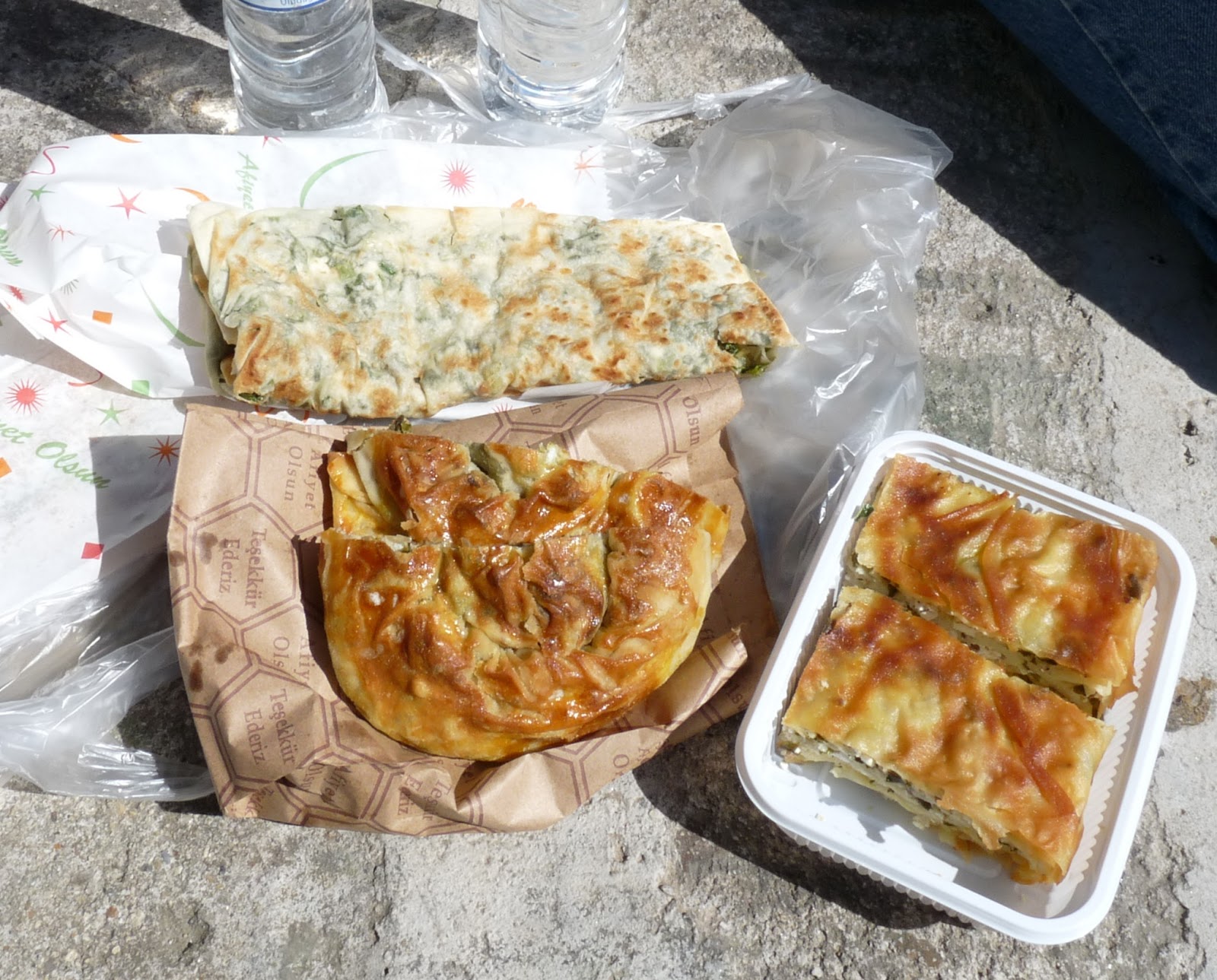
Here's what we bought: a cheese and spinach gözleme, a cheese borek (the snail shaped one although we got ours cut in half for sharing purposes) and another pastry, the name of which escapes me, which contained cheese (surprise!) and mint. The Turks use fresh mint quite a lot as a savory seasoning, and I intend to follow their example more often - it's good! But you see what I mean about too much wheat and cheese...


More wheat, this time in the form of bread. Most of it was light and fluffy and much like what I think of as "French" bread. We did get some whole wheat bread, but it was somewhat unusual. We rarely had bad bread though; most of it was delicious.


One of the ways in which we got too much wheat and cheese was in the customary Turkish breakfast. Bread and cheese were the foundation of them, along with olives, cucumbers and tomatoes. There was generally also butter, jam and honey, fruit if you were in a classy joint, hard boiled eggs and perhaps also some eggs custom cooked in the aforementioned classy joints, juices of varying qualities and tea. Coffee sometimes showed up but oddly enough, given the fame of Turkish coffee, the Turks are not big coffee drinkers. Tea rules completely, flowing from breakfast to bedtime, sold in the street, served on the buses, and given away by shopkeepers because you couldn't possibly get through the shopping negotiations without some çay to keep you going! And it will keep you going, because they make it so strong you practically have to snip it off as it comes out of the spout. They follow the tea making instructions here, pretty much. Wow!


Here's a closer look at this particularly impressive breakfast spread. This one included fresh herbs, lettuce and peppers, as well as a couple of salads and a really wonderful hot pepper paste. This was at the Heybe Hotel in Goreme.


We ordered dolmas several times. Dolmas just means stuffed and the Turks stuff every vegetable stuffable, pretty much, but if it's just dolmas it's grape leaves. The ones we had were all much smaller, more tender leaves than I've ever seen before. It made the dolmas tiny; just a mouthful or two each. I thought they were fabulous, but it must make them very labour-intensive to make. As here, they are usually served with yogurt and some sort of seasoning. This one, I think, was sumac based.


Here's one of our lunches. I want to go on record as saying I did not request that big plate of plain meat; Mr. Ferdzy did that. Then he took a bite and discovered it was Liver Albanian Style. Oops. I did not let him suffer but swapped my chicken in a cream sauce with vegetables for it. In general though, Turkish meals were not too meat heavy and included lots of vegetable dishes. We also ate a lot of çorba, otherwise known as soup. It was usually lentil, or tomato, unless it was lentil and tomato, although a few other types could occasionally be had.


Another typical meal: rice, which came garnished with a few surprise beans, spinach with carrots and garlic and a dollop of yogurt, a stewed eggplant dish and a very typical salad. Usually this came with grilled meat (döner) dishes, but I would eat it whenever I could get it. It's just romaine lettuce topped with grated carrots, grated mild winter radish, and red cabbage marinated in a light dressing then the whole thing dressed with a little lemon juice and olive oil. Loved it.


This was fun too. We got this meal near the Egyptian spice market in Istanbul, but barbecued chicken was quite common. This was a mix of wings and thighs, with a half a barbecued onion, salad, pilaf (which was usually a blend of rice, cracked wheat and barley tinted yellowish-red) and a nice little salad garnished with a (HOT!) pickled pepper. A more mid-range hot dried red pepper served on the side along with an herb mix to sprinkle on your food if you liked. All of this was extremely typical. We had few dishes that were spicy-hot when they arrived at the table (just a few soups) but there was almost always a hot pepper garnish either dry or pickled available.

With the exception of soups, most of the foods we expected to arrive at the table hot (in the sense of temperature) were... not. Tepid to lukewarm was the general range. I can see this being a good idea in the summer, when it hits 40°C, but we found it a bit disconcerting and often would have enjoyed the food more if it had been hotter.

Still, Turkish food in general was very good and I have come home with lots of plans and recipes I want to chase after. Certainly, Turkish street food and fast food was almost always far, far better than anything you will get here if you want to eat on the run. I'll have one more post about Turkey, I think; just some more pictures of the marvellous farmers markets we visited.