Showing posts with label A Varietal Report. Show all posts

Friday, 2 September 2022

Four Fine Blueberries for the Home Garden

Our blueberry harvest is slowing down; but we have been picking berries ever since the beginning of June. This year we have finally had a very respectable harvest - at least twice as much as last year, and last year was a huge leap forward over previous years. I figure we will have picked somewhere between 10 and 12 litres of berries this year by the time they are over. Two years ago we picked only about a single litre.

So, what has changed? The bushes are finally getting fairly mature, and that helps, but also three years ago we changed our growing methods, from stick 'em in the ground and hope for the best, to something more intentional.
 
Everybody knows blueberries need acidic soil. Our soil is pretty acidic, too acidic for most vegetables to be completely happy, but as it turns out not really acidic enough for blueberries. We did two things to fix the situation. Firstly, we dug up and replanted all our bushes (while they were still quite small) after amending the beds with extravagant quantities of peat moss. It doesn't need to be dug more than a foot in; blueberries are very shallow rooted. We spread it out and gave it a half-hearted stir. Side note - don't try growing strawberries or anything else under blueberries for this reason. They will not stand the competition.
 
The peat moss helped, but it was not enough. Next year, we started applying Blueberry Booster (from Whiffletree Nursery, whence came most of these blueberries).  This is sulfur humate, which will acidify the soil. Sulfur products need to be applied with some caution. It is not a straightforward process of "add acidifier, get acidic soil". The sulfur must be broken down by soil microbes which require the soil to be at least 12°C or 13°C and moist. Spring is the best time to apply it. If it is not properly broken down and absorbed it can damage the plants quite badly. However, we were observant of these requirements, and got quite amazing results, that very first year. We then got our up-'til-then best harvest, but mostly the bushes finally grew. 

The other thing that is happening now that we are getting our bushes to grow, is to notice which ones are the best. I have to admit, we rate that mostly on the volume produced. There are slight variations in flavour, but they all taste like blueberries and are delicious. 

Ripening time is something else to take into consideration. There were earlier berries than the varieties I'm about to discuss, but they produced less. If you have space for more bushes I do think they are worthwhile, but I can't suggest names for those because we have lost them. I suspect it's fair to say that early production gets traded off against high production; something has to give and that's what it is. 

Three of the varieties discussed below are modern high-bush hybrids. The exception is Jelly Bean, which is a dwarf plant, but not at all like wild or low-bush berries. Much as I love wild blueberries, even the domesticated "wild" types we have tried have not done particularly well in the garden as plants, never mind producing any significant amount of fruit. I used to think domesticated blueberries were not as good tasting as wild blueberries, but having grown them I would now say it's more that their flavour doesn't last well. They should be eaten or frozen within 2 days of picking. But if you are growing them yourself, that is easily done.

So, what are we growing? Above you see Nelson on the left, and Arlen on the right. These are probably the biggest producers in the garden. They've been pretty picked over already; the photo does not show them at their loaded best. Whiffletree lists Arlen as their latest blueberry to ripen, but for us it is, if anything, just about a week ahead of Nelson. It's not a big difference.

Blueberries start off small and greenish; as the season progresses they become larger and whiter. Then, suddenly, some of them apparently double in size and turn blue. Does that mean they are ripe? Could be, although many of them then need to sit and ripen some more for best flavour. We have discovered that the best way to pick blueberries is to pull them very, very gently - if they don't come right off, they need longer. Nelson in particular wants to sit for quite a while at the blue stage before coming off. Nelson is a sturdy bush with good, upright stems. 

Arlen is a more delicate bush. The stems tend to arch and if they are really loaded they can drag on the ground. You can see we have placed some stakes around it to help hold them up. We are willing to do this, because it is well worth the trouble. Those stems were just loaded with amazing berries. 

While neither Nelson nor Arlen were producing with the earliest berries, they both started in early August, and are still producing.

This one is Jelly Bean. (Actually, it's 2 Jelly Beans.) One is over, the other is about half-picked. We picked this one up in the parking lot of our local grocery store. It is marketed more to urban and casual gardeners than serious growers, perhaps because it is a dwarf bush, maxing out at about 2 feet tall. It's described as being just as much an ornamental plant as a source of fruit, and indeed, it's very pretty and turns red in the fall. Before then, new growth is an attractive lime shade (you can see some) and regular mature leaves are a nice bluish green. However, it produced more berries than any others that were not Nelson or Arlen and they really are extremely tasty. They started to ripen a bit earlier than Nelson or Arlen, but only by a few days.

I understand blueberries can be successfully grown in containers (the shallow roots help, I guess) and while I have not tried it, this is one that I think would work well for that.

And finally, I am recommending this one, who's name I don't remember. I suspect it's either Elliot or Aurora - I think perhaps Elliot, which sounds more familiar - but both are popular late-fruiting blueberries. We got this one at Whiffletree, but they are not carrying either of those at the moment. Whatever it is, like Jelly Bean it's a solid second tier in terms of quantity produced, but unlike Jelly bean it does not really even start ripening until the last few days of August and continues well into September. We are really reluctant to say goodbye to our daily bowl of fresh blueberries and we are so happy to have this one to keep us going a little longer. 

So there you are; four(ish) excellent blueberry varieties. I'm saying for the home garden, because they do all produce over a fairly extended period of time. I suspect this is not a great feature for commercial growers who want to go in like a swarm of locusts and strip the bushes all at once, but for the home grower it is ideal. Twenty minutes of picking every second day kept us well supplied with berries, over a good solid 3 months. I even made a batch of jam and 2 pies to freeze. That helps console us for the fact that the season is coming to an end; that and the hope that next year will be even better.

Wednesday, 17 November 2021

Time for Turnips


We did a bit of a turnip grow-out this year. It's a well-known fact (if you read this blog) that I am taken with occasional fits of inexplicable enthusiasm, and for some reason last year, during seed-catalogue season, I was taken with a fit of enthusiasm for turnips. For one thing, there was a good selection of some unusual varieties. 
 
The prominent long black ones in the front left are Noir Long du Pardailhan. Next to them, in the lower right are Scarlet Ohno Revival. The top right are Aprovecho Hardy, and to the left of them are Goldana and Goldette, which not too surprisingly got a bit confused during harvest. I don't recall ever seeing green shoulders on Goldana, though, so maybe those are the Goldettes; however even if that's the case I'm pretty sure not all the Goldettes had them. 

Noir Long du Pardailhan is a rare survivor of  a very old form of turnip, from the village of Pardailhan in France. The slightly larger size, elongated carrot shape, and rough, grey-black skin make them almost unrecognizable as turnips today. You are looking at pretty much all the harvest we got of them, other than a smaller one which we have already eaten. I think they are certainly capable of doing better; we threw in the seeds mid-summer and left them to their own devices subsequently. We should have at least thinned them. It is fortunate that the voles do not seem too interested in turnips. 

In spite of their seeming coarseness, the flesh was as white, smooth, sweet, and tender as any other, and better than some. Thus far I am not inclined to quite such effusions as the Slow Food page linked above, but it perhaps depends some on soil (ours is about as different from the native clay as possible) and perhaps once we eat the better specimens we will be even more impressed. Already, I think these are very good turnips, and I would certainly grow them again.
 
The Scarlet Ohno Revival is one I have had my eye on since we first started gardening here, but it has been hard to find. Few people carried it, and those who did we ended up not ordering from for lack of other desired choices. However, last year it was suddenly available at a few Canadian seed houses. These are by far the most attractive of the turnips we grew this year, with a rich beety magenta colour to skins, stems, and leaves. Inside they are white, perhaps blushed with pink. They also produced as many good specimens as any of the types we planted. I put one into the stew I made to test out all these turnips (Spanish Beef & Turnip Stew) and it was tasty and smooth, but definitely firmer and slower to cook than any of the others. I'm not sure it was an ideal specimen to test, though; it was a good 4" in diameter and had a certain amount of insect damage, which is why we wanted to eat it and not store it. But size tends to bring toughness to turnips - although even at that size I wouldn't say this was tough - and insect damage doesn't tend to improve flavour, at all. I left the skins on because I wanted to see how it did cooked, and it kept a nice colour and was perfectly edible. Excellent! This is another one I'll want to grow again. 

Scarlet Ohno Revival comes to us through the good work of Frank Morton of Wild Garden Seeds and OSSI. The original Scarlet Ohno was a Japanese variety, apparently once but no longer available in North America, and recreated by Frank Morton from similar and other-named but likely the same turnips. We're glad he did! I'm going to grow THESE again too. Are you detecting a theme yet? 
 
We got Aprovecho Hardy from Adaptive Seeds, and it is another OSSI registered variety. We found these to be one of the slower growing of the turnips this year, but overall their performance was fairly similar to the others. There are a couple of big ones, but most of them stayed fairly small. In spite of their (untested by us yet) hardiness, they were thin-skinned and very tender with a fine flavour. There were a few oddly shaped, off-type ones, but most of them were charming little white-skinned balls, with or without purple or green collars. Same old story! Happy to have them; will grow them again. 
 
These came out of breeding work by Alan Kapuler in Oregon; and it should perhaps be noted that when they say hardy, they mean Oregon hardy and maybe not Ontario hardy. I was about to say I would find out, but I think we've dug them all, so not this year I guess.  

Finally, we have the Goldana and the Goldette. We have been getting Goldana from William Dam for a few years now, and it has been (and maybe continues... don't know... must try a few more...) to be my favourite turnip. I've written about it already. We got Goldette from Annapolis Seeds even though it sounded very similar, and it is. We weren't careful during harvest and they got mixed up, and I can't really tell which are which, apart from the above-mentioned green shoulders, although perhaps it will be clearer if we eat some. But I doubt it. I don't think you can go wrong with either one; golden turnips are truly unique and excellent. They really don't taste as sharp as the white fleshed ones, and if you are not mad about the white ones, give one of the golden ones a try. 

As for me, it will not surprise anyone to hear that I would really like to try crossing the Scarlet Ohno Revival and perhaps Goldette (or Goldana) next year, to see what happens. I may not be able to; we only planted a row or so of each, which we then did not thin, and so most of the harvest is in the photo above. I'm not sure how well they will keep overwinter, always assuming we don't just eat them anyway. But it's something to think about. Perhaps if I started some in a pot indoors, and planted them out while it was still fairly cold in the spring, I could trick them into thinking it was time to go to seed. Hmmm.

Friday, 6 August 2021

Bonus Notes from the Garden; Zucchini Breeding Edition


I haven't cooked anything of note recently, so I'm going to talk about one of our breeding projects. Above, the top zucchini is Tatume, and the bottom 3 are from our interspecies cross. This is the F3, meaning that they are now somewhere between 12.5% cucurbita argyrosperma and 87.5% cucurbita pepo, or - faintly conceivable - the other way around, depending on who has crossed with whom. However, my guess, from the looks of things, is that pepo is prevailing.
 
The two green ones are on long, vining plants - the one on the left in particular shows signs of having Tatume as a parent - and the yellow one is bush plant, albeit a large and robust one. It has also been the most productive individual plant in the garden, cross or named variety, by far. 
 
Between the attractive colour (indicating that the pollen parent was Reinau Gold), robust good health, and productivity, this is the most interesting plant for following up, and I have done my best to cross it to itself for seed next year. The flavour is distinctive; it is less sweet than most zucchini, but very pleasant, almost green beany. We all like it quite a lot. 

The bad news is that we have vine borers in the cucurbits this year. they are playing havoc with the maxima squashes, and apparently ignoring the moschata (butternut) squashes. The silver lining to this plague is that we get to see how our crosses hold up against them. 

In general, they are doing well. Very little damage has been observed thus far, although some has been seen in Mutabile, Costata Romanesca, and Rond de Nice. The only one of our crosses that has shown any sign of infestation is... yeah. The yellow one. 
 
Interestingly, there is no sign of damage at the base of the stem, where vine borers usually do their boring. Instead, I found one in the stem end of one of the fruits. From this I conclude two things: first, that there is something attractive to borers in the scent of flavour of this plant, but secondly, that the stem is hard enough to repel boarders (and borers). I have thought for a while that it is not unusual that the varieties which people consider to be the best tasting are often the ones that are also most appealing to pests. I'm annoyed about having found it, but better to lose the occasional fruit rather than the whole plant, which is the usual outcome. 

As usual, more observation is going to be required, and I'm not even certain that if I have managed a self cross, the offspring will resemble this plant all that closely. Nothing to do but see what happens...

Monday, 22 March 2021

Kahnawake Beans


Kahnawake Beans

We tried a number of new dry pole beans last summer. Most of them turned out to be not that productive or disease resistant, but there was one stand-out: Kahnawake. These are a native bean, from Kahnawake, just outside of Montreal. Consequently there is no reason they should not be well adapted to most of southern Ontario. They certainly did well for us.

In the photo above, the beans spilling from the jar and the beans in the blue teacup are Kahnawake beans. (The other, in the orange jug, is a cross that showed up in the garden, about which I just can't stop yapping, because I am so very excited about it.) But let's stick to Kahnawake for a moment. The beans are well-rounded ovals, of medium size and beige, covered with darker brown swirls. They dried down nicely. Dry is their traditional usage, but I understand that they are quite good eaten as green beans as well. We did not try any that way; we planted them, trellised them, and apart from a little water in dry spells, mostly ignored them until it was harvest time. They had very good, although not perfect, resistance against our endemic anthracnose fungus.

The packet said it contained 20 to 30 seeds, although I forgot to actually count. The result was nearly 4 cups of dried beans. That's pretty impressive, and puts this amongst our top-producing beans. They can grow fairly long as vines, up to 12', so good trellising is required. They were quite fast for a dry pole bean, at about 90 to 100 days to maturity. 

Cooked, they are a large, meaty bean with thin skins, a texture on the softer side but not to the point of falling apart easily, and a pleasant, mild flavour (you know; beans). In general, use them as you would Pinto beans, although they are larger and thicker than Pintos. Baked beans would be fine, and I think these would make excellent refried beans. We will be planting these again, definitely. 

We got ours from Annapolis Seeds, but they are available through a number of Canadian seed sellers. 

I posted about the other beans in the year-end garden report, but I'm still so gleeful about them - about 2/3 of a cup of dried beans from 1 plant that got eaten by deer quite a bit. Impressive. I can hardly wait to see what they do this year. This was the stand out plant from a 4 way cross of ((Desoronto x Blue Lake) x (Anellino Yellow x Cherokee Trail of Tears)) or perhaps ((Desoronto x Blue Lake) x (Blue Lake x Cherokee Trail of Tears)). Haven't tasted them yet, but that will be one of the selection features for next year, along with looking to get them ripening just a smidgen earlier.

Friday, 29 January 2021

11th Annual Seed Catalogue Review

Trend of the year? It's websites with moving pictures. Thanks for the queasy, everybody! Just because something can be done, doesn't mean it should be done, ugh. Other trend of the year (trend of last year too, really): things are selling out F A S T. Don't delay! Order today!

Actual trend of the year - maybe it's where I'm looking, but people like me doing small scale breeding are starting to be less shy about releasing "unfinished" material with a lot of genetic diversity in it, to allow others to do their own selecting. 
 
I wait until the end of January to post this, and it was very frustrating - the places who got set up early were selling out even as I was waiting for the stragglers to come in (and the stragglers have not all come in even now). If you are looking for something specific and having a hard time finding it, as usual you should turn to Seeds of Diversity and check out their list of seeds available in Canada and which companies carry them.
 

Friday, 4 December 2020

Three Beets

 
We grew three types of beets this year, along with a few MacGregor's Favourite. They are, from left to right above, Kamuolini 2, Boldor, and Cylindra. While this was a difficult year for many vegetables, the beets did reasonably well. The intense heat and drought during germination season mostly did not faze them - the MacGregor's were a little spotty, but the seed was also quite old - and the rest germinated well. The subsequent cooler and actually very rainy weather that prevailed suited them too, and we have a good crop. We'd have had an even better crop if we'd ever gotten around to thinning them, but we didn't. What else is new? Let's take a look at each one...

Kamuolini 2 is, as far as I know, only available in North America from Adaptive Seeds. This beet is the result of modern breeding (bred by Dr. Rasa Karkleliene in Lithuania). For the first half of the growing season, every time I walked by I thought, "not impressive... not impressive... not impr - WHOA!" Sometime around late mid-summer they went seemingly overnight from spindly little things to very chunky indeed, with suddenly big, sturdy leaves as well. Ours were a bit variable in size, mostly because we really should have thinned them; it would have made them so much happier. 
 
Those big, sturdy leaves are actually quite tender and while strongly flavoured (as usual with beet greens) they were very tasty. As advertised, this is a great beet for lovers of the greens. The root was extremely sweet and good flavoured as well. They cook up a darker red than you would think from the colour of the skins when first picked.

Boldor: My impression as these were growing was that they were also not doing impressively well, and indeed they are the smallest of the beets we grew. However in the end they are big enough, and probably plenty big for most people's uses. The ones in the photo are about average supermarket beet sized, which tells you about the other two. The leaves seem small and sparse, but they are not as sparse as they look - they die down fairly rapidly to be replaced by new ones, so their live leaves are always clean and nice, if few. These were probably the most unhappy about not having been thinned, and we did end up with quite a number too small to use. 
 
Boldor is a fairly recent beet, bred by Bejo, and is marketed as a replacement for Touchstone Gold, which has been the most popular yellow beet grown around here. We've grown Touchstone Gold, and thought it a nice beet, although it's always been an iffier germinater and smaller than most red beets. So, is Boldor actually better? It did seem to have a better germination rate, although we were not doing a side by side comparison so it's hard to say for sure. The skin is an amazing glowing orange, brighter than Touchstone Gold, but the inner flesh is less gold and more of a clear yellow when raw. It did cook up more of a golden shade. Certainly, it's very attractive. Some vendors seem to want to describe it as a hybrid, but it is open pollinated. We tried cooking some of those sparse and delicate-looking leaves, and found they were stronger (more bitter) and tougher than the Kamuolini 2 leaves, so this is not a good variety for greens. We thought the beets themselves tasted very nice; not as sweet as Kamuolini 2 but rich and well-balanced.

And finally, we grew Cylindra, (sometimes known as Cylindrica or Formanova) which is a Danish heirloom, introduced to North America in the 1890s. We've been growing them for a few years, and in many ways they are my favourite beet. I really like the elongated, narrow shape, and they get to a good size. The narrow shape means they still cook in the same amount of time as smaller regular beets. They grow about half in, half out of the soil, so you can always find the ideal one to pull. The leaves are a pretty purple, larger and not quite as dark as the MacGregor's Favourite, but not so large as all that. The leaves are milder than either of the other two beets and noticeably the most tender of the three. Still, they lack the rich flavour of the Kamuolini 2. They are the most tolerant of any beet we have grown of our tendency to leave them un-thinned. Their shape makes them ideal for pickles. They are less sweet than many beets - certainly much less sweet than the other two we grew this year - but I don't consider that a flaw; they are very nice plain and being a little less sweet makes them more versatile for use in recipes, I think. In short, their widespread availability and popularity has been well-earned.

Wednesday, 21 October 2020

Table Queen (& Gill's Golden Pippin) Acorn Squashes


In the photo above, there are 2 Table Queen and 2 Gill's Golden Pippin acorn squashes, the Table Queen being dark green and the Golden Pippin being, uh, golden. Acorn squash are distinctive, generally vaguely acorn shaped (if you use your imagination) but with distinctive fluting. They are fairly small, running from just one or two servings each, up to about 4 servings per squash. In general, the Table Queen run larger than the Gill's Golden Pippin; the one at the top is an unusually big example. I've written about Golden Pippin before.

Acorn squash are members of the cucurbita pepo group, meaning that they are related to most of the zucchini and summer squashes, and will cross with them. In my experience the resulting crosses are rarely good; they get tough and seedy too fast as summer squash, and lack good flavour and keeping qualities as winter squash. Acorn squash are about the only form of cucurbita pepo that are eaten as storage squash, and they are not particularly long lasting. They will be good from now through the end of the year, but by January they really should be gone or rapidly disappearing, as they are noticeably not as good as they were. 

Table Queen was apparently introduced to widespread commerce in 1913 by the Iowa Seed Company (according to Baker Creek) and became immensely popular. All through my youth and really, up to today, this was the basis for commercially produced acorn squash, if not in fact the exact variety. I confess that when I started gardening I regarded Table Queen with some disdain as a common and not very interesting acorn squash, but it really isn't true, and a good home-grown one is delicious.

There is a Table King, in both bush and vine varieties, which I presume are the result of breeding and selection for more productivity, disease resistance and compactness, but my impression is that they are not hugely different. A Golden Table Queen won the All American Selection in 1939, but it seems to have disappeared. There is also a bush version of Table Queen, but mine was the classic vining version. Vines can get to 20 feet long under ideal conditions, and they are pretty amenable to being piled up on themselves, but trellising is really a good idea. Squash that have been kept off the ground develop better shapes and are less likely to develop mould problems ore be attacked by insects or other pests. I am finding that this year the Table Queen have a very tough skin, and are harder to cut than the Golden Pippin.

The Arikara first nation of North Dakota were skilled and productive gardeners, trading their excess produce over a wide area, and their vegetables have been a prolific source of genetic material for North American vegetables to this day, particularly for corn, squash, and beans. Table Queen was likely developed from one of their squash, and may not even be all that much changed from what they grew. It is certainly a very well adapted squash all over North America, from Texas to eastern Canada, from Florida to British Columbia. It has good resistance to vine-borers, squash bugs and cucumber beetles, the three plagues of squash. It ripens in 80 to 85 days from germination, which will give plenty of time from a late May to June 1st planting date. Under ideal conditions and with good soil (so not me) you can apparently get up to 8 squash per vine.

To some degree Table Queen has been replaced by similar but hybridized versions, but the original is still an excellent plant with great productivity and resiliency, and is fairly widely available.

Wednesday, 26 August 2020

Genovese & Caserta Zucchini, & Lazy Housewife Green Beans


On the left we have Genovese zucchini, with Lazy Housewife green beans in the middle, and Caserta zucchini on the right. Three new varieties for us this summer; how did they do?

Genovese Zucchini:

This one is a perfectly nice little zucchini, as far as I can tell, with a perfectly nice little compact but open bush. We have gotten a few zucchini from it, but it has by no means been prolific. As I've noted before this has been a tough, tough summer for the cucurbits in general. This one has struggled along, not an absolute failure but not standing out for having what it takes to succeed in the face of adversity either. Looking for info on it online, I see one grower describing it as a shy bearer, so it may not just be the weather. Other people - people selling seeds, to be sure - describe it as prolific. Mm. Okay.

Supposedly this is an Italian heirloom variety. I don't doubt it originates in Italy, but I don't know how old it actually is. The small open bush habit suggests to me more modern breeding than something with more robust and rangy vines. Overall it is a bit like a smaller and more decorous version of Costata Romanesca, and I'd have to say with a still pleasant but ordinary flavour to go along with the reduced size.

We'll be giving this another try, since we still have seeds, but unless it does a bit better next year I'm not sure it's going into the regular rotation.

Lazy Housewife Green Beans:

In spite of the sparse picking I came up with for the photo op, this bean has done very well for us this year. It didn't get started quite as early as Algarve, but it's still an early bean. We got a very bountiful first few weeks from our plants, after which they slowed down but are still producing beans steadily. We have left quite a few plants to go to seed so we can grow more of them next year, so our harvest has been even more impressive when I consider how few plants are actually being picked.

The beans are long and thin and rather squared off in shape. The skin texture seems a bit rough, even though they are soft to the touch and the beans stay tender until they hit a fairly large size. The flavour is mild but good. Some listings describe them as "greasy", that is to say having a very smooth, shiny skin, but that is not the case with the ones I am growing. Some listings also described them as late, which they absolutely were not. They may be old enough as a variety that there are several fairly different strains out there. Mine came from Annapolis Seeds. I note that Burpee lists a "Lazy Housewife" that they introduced in 1885, that looks very different and is plainly a completely unrelated bean. It appears to have a much shorter, fatter pod with fewer and rounder beans.

If you fail to pick them green, they will go on to produce a good crop of dry white beans. I haven't eaten them as beans yet, but they will probably look a lot like Great Northern beans. There are going to be so many (from one little packet) that there will be plenty to save for seed and still we will be able to have a meal from the leftovers.

They are a pole bean, and will need a good sturdy trellis. Vines can get quite long.

The name comes from the fact that these were one of the first "stringless" string beans, back in the first decade of the nineteenth century. (I've seen introduction dates of both 1802 and 1810.) You probably save up to two minutes every time a batch is prepared for a meal. Wow, that's some slacking off! Don't spend your saved time all in one place. But do grow these beans; they are very rewarding.

Caserta Zucchini:

This is another zucchini from the mid 20th century (it was released by the University of Connecticut and won an All-American Award in 1949) that is modeled as better-behaved Costata Romanesca or Cocozelle type zucchini. Like Genovese, I'm not sure it quite lives up to that promise. It's managed to be a bit more productive than the Genovese (although on reflection I think we planted 1 Genovese and 2 Caserta, so they may be very similar) but still, in this admittedly difficult year, it hasn't been going gangbusters.

The plant is a similar compact bush, good for small gardens. In a side-by-side taste test with Genovese, we all (three of us) preferred the Casterta. It seemed a little sweeter and juicier, somehow; but with a very small sample size it's hard to tell if that was just the luck of the draw so far as perfect ripeness went. They were really not wildly different in flavour and were both highly reminiscent of other zucchini we have eaten.

It's a little too early to know how they deal with the inevitable powdery mildew; that will certainly have an effect on our decision to re-grow or not.

Wednesday, 19 August 2020

Rheinau Gold Zucchini


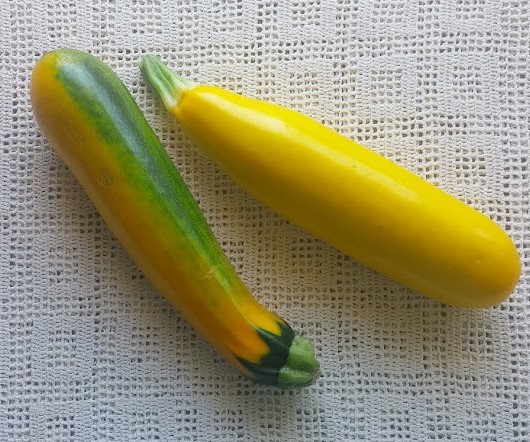
Do you remember Golden Zucchini? Just two years ago I said that much as we liked it, it was not a very reliable producer, but that we continued to grow it in the absence of better versions. Well, that was then. This spring we got some Rheinau Gold open pollinated zucchini from Adaptive Seeds. After only one season of growing it, I have to say, this looks like the open pollinated yellow zucchini we've been dreaming of.

Adaptive Seeds notes that it's still a bit smaller and slower growing than most green zucchini varieties. That's okay. This has been a ridiculously difficult year for growing all cucurbits (except the Sumter cucumbers, which are doing just fine, thank you). The zucchini and butternut squash were put, due to the roll of the rotation dice, into what is currently our worst bed. It is too close to some hazelnut "bushes" which have grown to the size of small trees in the last few years, and provide too much shade in exchange for sucking up too much water and nutrients. On top of that, we had a heat wave and drought for 2 weeks just as everything was getting ready to go. Most of the zucchini is really not doing all that well (and I doubt we will get a single butternut, boo). Rheinau Gold is the one exception. Okay; Tatume is doing pretty well too. Not surprising - it's from Mexico. 

Yes, we can watch the baby squash coming along for several days to a week before we decide to pick them, but they are coming along with placid steadiness in spite of the poor conditions. When it was horrifically hot and dry they were practically the only zucchini producing fruit, although they did slow down a bit. I'm talking close to 35°C for days. Just about everything else was producing nothing but male blossoms.

They seem to be not quite so consistently perfectly yellow as Golden zucchini. You can see a typical one in the picture, with a dark green cap by the stem and blush of green on the sunny side of the fruit. I don't mind that; I think it's distinctive and charming, in fact.

They taste good and they stay tender and delicate even though they are somewhat slow growing. I've picked a few other zucchini this year that weren't all that big, but that turned out to be much more tough, seedy, and mature than expected, again due to the weather and lack of water.

Rheinau Gold is a fairly new zucchini. It comes from Sativa Rheinau, a Swiss biodynamic seed house that also apparently do their own breeding. Looks to me like this one will go far... well, it already has. *Waves from Ontario*

Friday, 10 July 2020

Lancashire Lad Peas

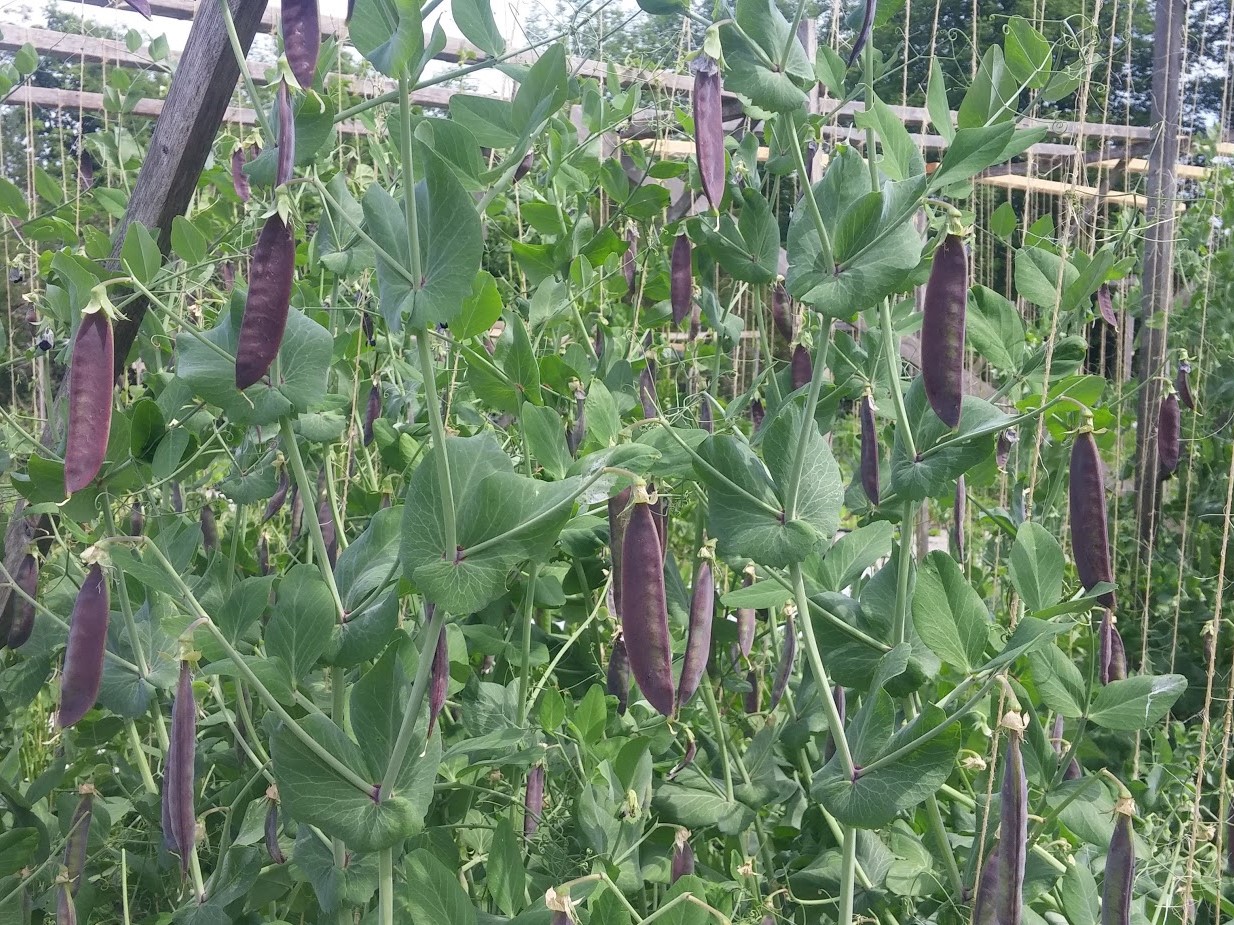
Lancashire Lad Peas Growing

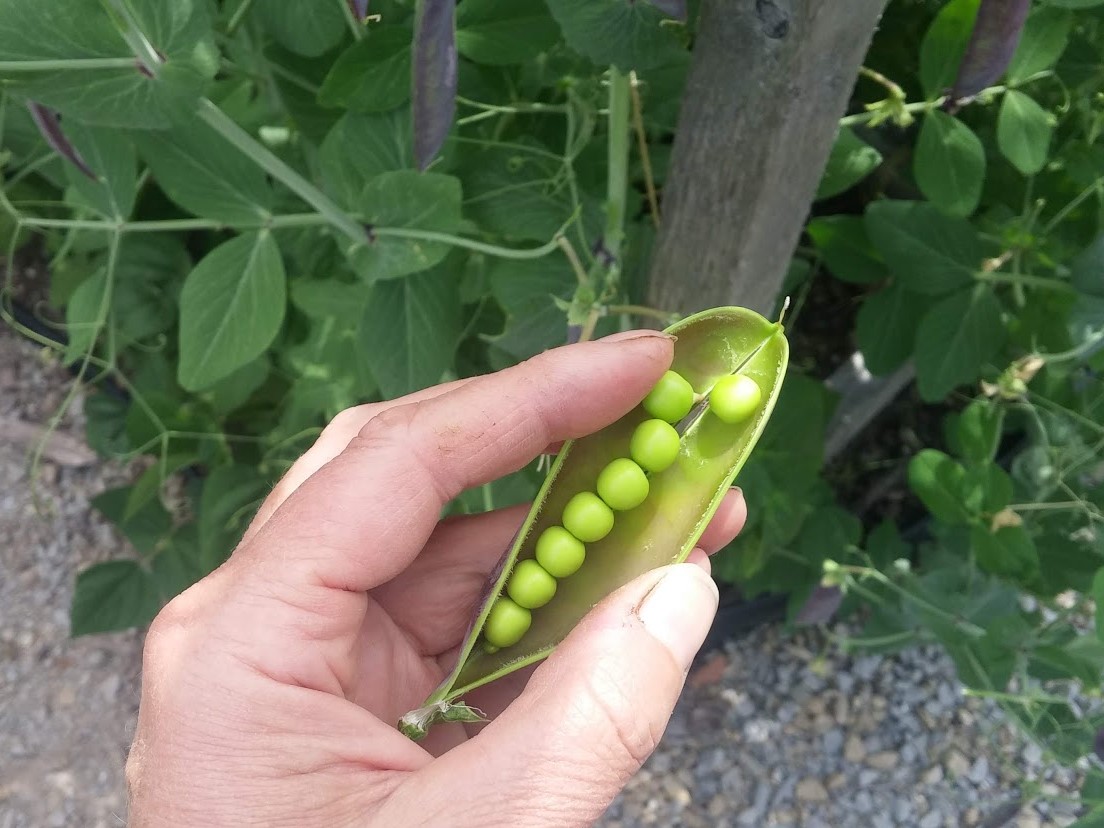
Our new pea trial of the year is the very pretty Lancashire Lad. The purple flowers and pods suggest that this was selected out of field peas. The purple pods make the peas easy to find, although once open the peas are a light olive green. They are smallish, and come 6 to 9 to a pod. We got them from Annapolis Seed, who says that they are also good dried for soup, but we have been eating them fairly steadily, and won't have enough to try that way. Unlike the other purple podded peas we grew, these have only a very faint hint of bitterness to them when raw, and it disappears completely once they are cooked. Their flavour is very good, in fact. It also turns out that they are quite early for a pole pea, and they filled in for a few days when the Knight had stopped and other, later, peas had not really started. They grew to about 6' tall, which makes them a tall pea, but not the tallest by any means. It's a little hard to say what their actual potential is, as the very hot and dry weather we are having is going to make this a short (both in vine length and duration) pea season all across the board. 

We have a bit mixed feelings about these; the number of pods is high, the timing is good, they're really very charming - yes, that counts for something -, they are quite tasty, and on the down-side the pods and peas are a little on the small side. This was once a highly sought-after trait, back in Victorian times when kitchen labour was cheap. Now I don't hold even my own labour that cheap, and tend to prefer something faster to shell and accumulate a pile. Because the timing works so well with our other peas we may continue to plant a few of them just to fill that gap.  

Lancashire Lad Peas Pod

This olive green colour suggests that this is a fairly old pea, as modern varieties are almost always a brighter, stronger green. Now, just to make life more complicated, when I was searching out the history of Lancashire Lad, about all I could find was references to the fact that the pea in circulation as Lancashire Lad is not, in fact, Lancashire Lad, which should be a green-podded pea. Since I don't believe anyone has found the original Lancashire Lad, this pea continues to circulate under that name, and I guess I will continue to call it that until it has another - I'm not holding my breath.

Other than that, it's a pea, and you can expect it to behave as such. Early planting, support for the long vines, plenty of water and weather under 30°C will suit it best, but I have to say for a pea of fairly unsophisticated breeding, it has held up the hot, dry weather this year quite well. Mind you, we have been watering and picking just about every day. Should you lose track of them, though, field peas were originally soup peas and I suspect the claim that they make good pea soup is quite accurate. Maybe next year we will plant enough to find out.

Wednesday, 23 October 2019

Stocky Red Roaster Pepper


The pace at which I do varietal reports is definitely slowing, as we have more and more tried and true varieties and also grow out more of our own crosses. However, we did try a couple of new peppers this year, one of which was this Stocky Red Roaster. A very plain, descriptive name of exactly what it is.

This is an Italian type roasting pepper, selected by Frank Morton of Wild Garden Seed. The plants are reasonably compact but sturdy (stocky, in fact) and bear a plethora of mid to small (quite a useful size in the kitchen) straight-sided, thick-fleshed red peppers. The thick flesh makes them very suitable for roasting, and most of ours ended up roasted, peeled and seeded, and packed into the freezer to go into soups, stews, casseroles, pasta sauce, etc, in the winter.

This wasn't quite what we were aiming for. We were looking for a pepper to go into our Canned Tomato Sauce which is a staple for our winter cooking. The trouble is that while the plant is a compact, sturdy and good grower, the fruits have a very long days to maturity score. We got the seeds from Hawthorn Farm, who says 85 days to maturity. I note Frank Morton says 102 days to maturity, which is quite a spread. I suspect that in a normal Ontario summer, the 85 days to maturity is reasonably correct, but we had what would probably have been a more typical Oregon type summer this year - meaning that the 102 days to maturity was more accurate. Even at 85 days to maturity we would have been pushing it to have the pepper ripening time overlap with our tomato ripening time. We decided not to make very much sauce this year, and were able to use the earliest ripening individual peppers so it worked out okay, but plainly we shouldn't count on it.

Having said that, I would have to conclude that their very long growing season is the one flaw of this pepper (and if you are looking for fresh peppers in October, that's not even a a flaw). They grew very nicely, had a lot of peppers for the size of the plant, the peppers are very well flavoured - I wouldn't say mild, but there are no strong bitter or astringent flavours as peppers sometimes have - that keep on the counter for quite a while and cook up well; tender but with some substance to them. In addition to roasting and freezing them, we dried some and while we haven't tried them yet, they dried quickly and look and smell good. I'm planning to eat a certain amount of Turkish Pepper Paté this winter. We don't have much trouble with pests or diseases in the peppers, but these did not have the few troubles we have, i.e. slugs or moth larvae boring into them and making themselves at home; or sometimes peppers get mouldy spots going on in the membranes around the seeds which left unchecked will spoil the pepper. None of that. These were very healthy and I suspect the thick flesh helps keep the pests out. The plants also have good leafy coverage which prevents sun scald and also helped keep the peppers in good condition once we had to cover them with plastic to protect them from chill.

I love having things like steak or smoked sausage served with a big pile of fried peppers and onions, maybe mushrooms, on top and I've been doing that with the stocky red roasters a lot this last month. We've had a hard killing frost and I've pulled the plants, but it looks like there are enough peppers still ripening on the counter for another few weeks worth of meals. In conclusion, this is not the pepper to go into our tomato sauce but we will definitely continue to grow it anyway - it is an excellent pepper and merits some space.

Monday, 29 April 2019

Growing Mâche, Lamb's Lettuce, Doucette, or Corn Salad


We planted mâche (valerianella locusta*) last spring, and it grew and germinated nicely, and went to flower and then to seed, all before we got around to eating any. It self-seeded very well, and in fact I ripped out large quantities last summer as a weed. I did leave enough for us to make one or two salads.

This is hardly enough experience to render me an expert in growing mâche, but it falls into the same category as many other little greens we have grown. It's small, it's fast growing, and it's at its peak for a very short period of time, all of which makes it something of a pain in the large mixed vegetable garden.

On the other hand, the fact that its peak will fall from the middle of April to early May, depending on the weather, makes it something worth considering. I may continue to let it seed itself around, and leave patches of it to overwinter. It was quite pickable almost as soon as the snow melted, and that makes it a very nice little green indeed.

Like the moderately similar miner's lettuce, mâche is a weed which has begun to be cultivated for it's qualities as a salad green. Unlike miner's lettuce, mâche is not a native of North America. It comes from northern Europe through Asia, where it was a popular foraged spring green, especially in France and England. The name "corn salad" comes from the fact that it was a common weed in grain fields, and the name "lamb's lettuce" suggests it was common in pastures too. They will tolerate a fair bit of shade, although mine grew well enough in the open.

The other thing they have in common is that while you may now be able to buy seed for them, they are hardly cultivated vegetables and really don't behave as such, with their fleeting period of high quality followed by early flowering and copious seeding. I suspect there are 2 main strategies for growing it successfully; the one I intend to follow of just letting it seed itself around the garden, leaving patches to overwinter for early spring picking. This is the low-control option which means it will only be available in the very early spring.

The other way I would consider growing it is in pots or other very controlled growing mediums. Mâche does not so far seem very attractive to slugs, or mice, or other small pests of small plants the way mustards and other Chinese greens do, but the speed at which it grows and its tiny size at maturity should make it suitable for pot culture. It's also a good plant for growing as micro-greens and not uncommonly included in baby salad green mixes. Many people grow it in hoop-houses, or under cover in some way.

I found that pulling up the entire little rosette and pinching off the root left me with very attractive little rosettes. You can shred them and mix them into salads, but they make lovely little garnishes when left whole. The flavour is mild - often described as nutty, which seems to me a bit optimistic - and it will easily blend in with a mix of other salad greens. The texture of the leaves is thin, sturdy but tender, and not succulent like miner's lettuce. They are very nutritious and unlike miner's lettuce contain no oxalic acid.


*Wikipedia suggests that rapunzel is one of the names of mâche. I do not believe this is correct. Every other description of I have seen of rapunzel says it's a form of campanula (bluebells).

Monday, 3 September 2018

Poblano Chiles

Poblano Chiles and one orange Doe Hill pepper

I have been able to find Poblano chiles occasionally even in my very stodgy local grocery for the last few years, and I've posted a couple of recipes calling for them. This year we are growing them ourselves, as the supply is unreliable, but their intermittent presence reminded me that I like them very much.

Poblano means "from Puebla", which is the state in Mexico from whence, presumably, these peppers originate. Puebla is in south-central Mexico (not too far from Mexico City) but they have spread far and wide enough to be very popular well into the southern United States. Speaking of wide, if these peppers are dried they are called "anchos" (meaning "wide") and they are very popular in this way as well as fresh. Looking at the map, I note that Puebla is not too far from Jalapa, the source of another very popular Mexican chile.

They are not the ideal chile for growing in our climate; they did very well this summer but if we had tried them in last year's cool, rainy summer I suspect they would have been much less happy. Still, in a hot year they should do well here. Like pretty much all peppers they need to be started indoors 2 months before planting them out after all danger of frost. That means we start ours from around March 24th to April 1st. Bottom heat is useful. After that, keep them warm and keep them reasonably well watered, and by the end of August you should be picking plenty of peppers; let's call that 75 to 80 days to maturity. We support our plants with a tomato cage; I think that's a good idea. Plants loaded with ripening peppers can get so top-heavy they topple over.

The peppers themselves are unusual, being very dark green, almost black, ripening to very dark red, almost black. They have a unique sweet and smoky quality. Their heat level varies considerably, although I would describe these a hot eating chile rather than a hot seasoning chile. You may find only a few flickers of heat more than your average bell pepper, or they may be very spicy indeed. You may find both conditions on chiles from the same plant, and in fact within a single pepper. Be prepared to be surprised, although they do get hotter as they ripen, and I suspect that like other chiles, they are often hotter when grown in hotter, drier weather. The flesh is fairly thick and substantial, and the peppers are large, so these are commonly stuffed with cheese and fried in an egg batter (I baked mine) although there are lots of other tasty options.

Their skins can be rather tough and papery, and the chiles are usually roasted to allow the skins to be peeled from them before they are incorporated into whatever dish they are destined for. Since I anticipate having lots of peppers I plan to roast and peel many of them, then vacuum-pack and freeze them for use in the winter. I hope you are able to find some because I expect to have a few recipes to post for them!

Thursday, 9 August 2018

Flakkee Carrots


Mr Ferdzy lends a hand with Flakkee Carrots

This is another one that I'm a little surprised to realize I have never written about. On the other hand, carrots are one of the world's most popular vegetables and Flakkee is one of the most common older types of orange carrots out there - in a funny sort of way it is so ubiquitous as to be easily overlooked.

Actually, most of the carrots bought at the grocery store these days are much more likely to be F1 hybrids of some sort. Flakkee is one of the last widely-available open-pollinated carrots, although I have seen some F1 hybrids described as Flakkee types. Beware of carrot hybrids if you want to save your own seed. Carrots were one of the earliest vegetables to be converted by the seed industry to Cytoplasmic Male Sterility and just about every hybrid now has it (meaning no seed can be produced).

Flakkee straddles the line between being a named variety and simply a type of carrot. Their shape is also somewhat intermediate between a Danvers type, and an Imperator type. They are fairly long, longer than most Danvers, but they do end in a blunt tip (unlike the true Imperators). They can get quite large and in fact when the discussion turns to growing giant vegetables, their name tends to turn up. I can find very little about their history. I see a surprising number of seed-sellers claiming they are Italian. They may be popular in Italy, but they are plainly Dutch. The name is a reference to the Dutch island of Goeree-Overflakkee; one has to assume a centre of Dutch carrot culture. Orange carrots did develop in Holland, after all.

Just to make things more confusing, they are known by a number of other names. Autumn King is one you will see often; this is a particular selection of Flakkee. They may also be known as Flak. Flakkese 2 is described as a selection of Autumn King.

We have consistently found them one of our easiest and most productive carrots to grow. As an older type of carrot, they have lush, leafy tops, which perhaps means they can't be quite as crowded as the newer hybrids and varieties bred for minimal foliage. I think this gives them resiliency in the garden though, and in general I associate good foliage with good flavour. They need a relatively long season to fully develop. William Dam (where we get our seeds) says 75 days to maturity. I think that's a bit low. In good growing conditions, you can start harvesting them around then, but for full development and good winter storage you can expect them to need longer. The ones in the photo are probably not much past the 75 day mark, but I also wouldn't consider them particularly impressive specimens.

We often leave half of our carrots in the ground over winter for spring consumption; they keep as well there as anywhere for the home grower. My one caution is that the largest and most impressive carrots don't hold in the ground well. Perhaps water sits on the tops, and rots out the crown. You might as well pick your biggest and best in the fall, in other words. I save my carrots selected to go to seed next spring in our basement fridge, after having lost too many left in the ground. I can supplement them with the best of the spring-dug carrots, but this way I know I will have some, although a few always seem to rot in the fridge too, so check them occasionally through the winter. As for eating the spring-dug carrots, once they are ready to go to seed they will get tough and woody, so don't leave them too long. For fall digging on the other hand, we leave the main harvest as late as we can, which means just before it snows to stay or it looks like the ground will freeze.

So far as growing them goes, the same as for any other carrot. Don't plant them too early; the soil should be at least 10°C - in other words, wait until the dandelions bloom. Don't plant them too deeply, but in good stone-free and well-worked soil. Once they are in the ground they must be watered-watered-watered-watered-watered until they germinate, and after that regular waterings are important, but you can leave off watering twice a day. It is helpful to keep them covered during this time; people use things from row-cover cloth to plywood. Everyone says not to put compost on carrots, and it's true that too much compost will cause luxurious leafy tops but spindly, hairy, and forked roots. On the other hand it is my observation that carrots actually love compost - provided it was applied three years ago.

Wednesday, 8 August 2018

Gravedigger Peas


I seem to have missed the opportunity to photograph these peas close up, as I was too busy shelling them and eating them. There they are a little earlier in the season, setting pods like crazy, along with one lone and solitary Sugar Magnolia which seems to have gotten slightly lost. They are over and done long since, of course.

We grew them last year for the first time. I have wanted to try them ever since I read about them on Rebsie Fairholm's blog, so I was quite excited to see them listed by Annapolis Seeds. We planted a nice little patch last spring, and when we picked the first couple of pods to try, Mr. Ferdzy and I looked at each other in amazement and promptly agreed to eat no more - because we wanted to grow them out for seed, so we could grow masses of them this year.

Their history is not much known. They are English, and probably date back to the 19th century; no earlier. They were donated to the Heritage Seed Library who named them, as is their custom, for the furthest grower back to whom they can be traced; in this case a man who was a gravedigger by trade and pea grower by vocation. Rebsie says pretty much all that is known about them. 

We planted them a bit late this year and so they were not particularly early to produce. I think at any rate they are a mid-to-late-season pea, of a middle height. They are extremely bushy and dense, and produce heavily but somewhat slowly - a nice pea for the home gardener, since they should produce for a few weeks. I think ours were cut a bit short by the very hot dry weather this year but they still went longer than most peas. We will want to grow them in our trellised beds, I think, even though they are not the tallest. Their substance does mean they should get good support.

The pods are fat, and full. I don't think most will have more than 6 peas, but the peas are quite large. They are a lighter green than modern peas tend to be but they are so tender and flavourful. The peas tend to be a bit more ovoid than round. They are really quite distinctive and a little different than any of the other peas we have grown.

These are very obscure and rare, and I am so happy that Annapolis seeds was able to get hold of them. I can see already that these are going to be one of our must-grow favourite varieties.


Tuesday, 7 August 2018

A Bounty of Zucchini

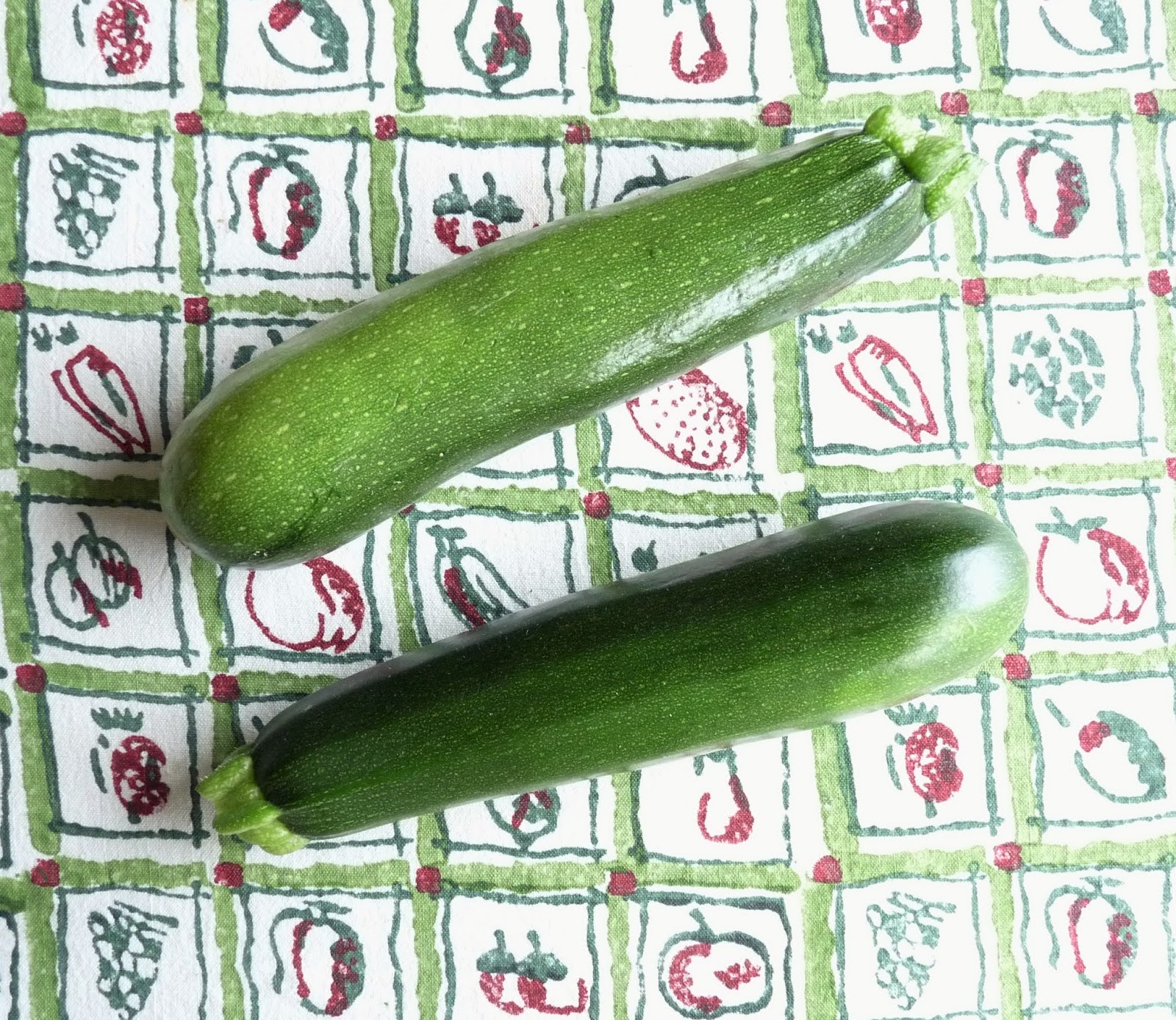
From all my garden writing and various other comments, you might conclude that we grow a lot of zucchini. That would be correct! And yet, somehow, I don't have many varietal reports for zucchini. This should help fix that!

The troubles I refer to below to which zucchini are subject, are squash bugs, cucumber beetles, and powdery mildew. Other people complain of vine-borers but thus far *spits, knocks wood* we have been spared that pest. Pretty much all squash, cucumbers and some melons are prone to these ailments in a greater or lesser degree, and they must be regarded philosophically. 


Golden Zucchini:

In the photo above; do I even have to say which one? Oh, all right - on the left. 

We've grown this every year since almost the beginning, in spite of some frustrations with it. The colour is lovely, and our mothers can be relied on to pounce on them whenever one turns up in the offerings. That's not quite as often as we would like, because this is not the most productive variety, and the fruits tend to run a little on the smaller side.  But golden! And a very pleasant flavour. The other problem is that some plants produce reasonably steadily and others just sit there doing nothing much; we generally plant 2 and between them can expect to get some golden zucchini. They are otherwise no more or less trouble-prone than other varieties, and in keeping with their smaller size as fruits the bushes are fairly compact as well. Should be about 55 days to maturity. In spite of this apparently late date I think our second zucchini of the summer was a Golden one, so not that far off the others.

I'm not aware of another readily available open-pollinated golden variety of zucchini, and even hybrid versions seem a bit sparse. I'd give one a try, given the limitations of this one, but the lack of choices suggest that if you want a yellow zucchini, this is in fact as good as it gets.

It was introduced in 1973 by Burpee, "from material supplied by Dr. Oved Shifress". Burpee used to be a fine old American company producing better things than anthracnose infected beans (grrr, I am pretty sure that's where I picked up my nasty case of bean plague). Some people claim it as an heirloom variety, although that seems to be pushing the meaning of heirloom a bit far to me.

I can't find much information about Dr. Shifress, beyond his association with Burpee and Rutgers University, but that he emigrated to Israel in the 1940s. That suggests Burpee spent up to 30 years working on this variety; a considerable investment of time. It may also explain why no-one has come up with a better version yet.

Black Beauty Zucchini:

Also in the photo above, on the right. It is also prosaically known as "Dark Green" which is a more technically accurate description of the colour, but lacking in that marketing oomph.

This is probably the most widely-available standard open-pollinated zucchini in North America, and has been available as seeds to gardeners since the 1930s, although it finally seems to be being supplanted by newer varieties. This site say introduced by the Jerome B. Rice Seed Co. in 1931, and that it won the All American Selection in 1957. I'm comfortable calling this one an heirloom variety, although given its long history I suspect it has been improved over the years. It is so widely popular because it is quite early to start producing - 50 days to maturity - very productive, and resilient in the garden. The flavour is good - what we expect zucchini to taste like, in fact, given its ubiquity - but there are better tasting varieties out there. (Cocozelle and its selection Costata Romanesco come to mind at once.) Still, we grow it most years and are happy to eat it. Best a little on the smaller side.


Mutabile Zucchini:

This is a new one to us this year; we got the seeds from Hawthorn Farm.  It is the top zucchini in the above photo.

As you can see, this is very much in the style of Black Beauty. It is still an open pollinated variety, although it seems to be of fairly recent origin. I can trace its voyage to Hawthorn Farm back through Adaptive Seeds and Turtle Tree Seed in the U.S. to Sativa-Reinau in Switzerland. It is not clear to me whether they were the breeders of this variety or not; very possibly.

The main advantage of this over Black Beauty is the open structure of the plant which apparently contributes to it being resistant to mildew. Since we have not yet hit mildew season here, I cannot comment. The above mentioned seed companies all seem to be very impressed though. Like Black Beauty, it should start producing in about 50 days. It is on the larger side of average for a zucchini bush. The stems do feel faintly fuzzy rather than prickly, but I'm not sure how that really affects things. I guess if you are a market gardener picking zucchini for hours it makes life more pleasant, but I worry that it makes them less resistant to bugs. Since we haven't had any significant squash pests in the last few years I have no data. So far, they are a good, productive standard zucchini. I'm not even growing Black Beauty this year - we were out of seeds and bought these instead - so I cannot do a direct comparison. My impression is that they are at least as productive and probably more so. We are likely to continue to replace Black Beauty with this variety.

Dunja F1 Hybrid Zucchini:

We got this one from William Dam, and this is the second year we have grown it. It is the bottom zucchini in the above photo.

Mr. Ferdzy had a grump last year about vegetable seeds, and decided he wanted to try a bunch of hybrids. This was one of them. As usual with hybrids, I am just not that impressed. I mean, it's fine. It's a nice compact plant and really quite productive. The zucchini are pretty much indistinguishable from Black Beauty for looks and flavour. It's supposed to have intermediate resistance to powdery mildew, papaya ringspot virus, watermelon mosaic virus, and zucchini yellow mosaic virus. Since we have had none of those diseases in the 2 years we've grown it, I cannot comment except for the powdery mildew. Again, Dunja comes with an open plant habit and lack of spines. My impression last year was that powdery mildew hit hard overnight towards the end of August bringing the production of zucchini by any and all plants to a complete halt simultaneously, including Dunja. So, no on that one. I was quite annoyed as I expect to get zucchini into September. It was, I guess, a bad year for mildew since it was so cool and damp overall. But I can't say that I think slightly improved production on a compact plant justifies the kind of price that gets charged for hybrid seed. 

We'll plant what we have left of this (maybe nothing because there sure weren't a lot of seeds in the packet) and go back to open pollinated varieties. William Dam says 43 days to maturity, which is certainly very early. I think it was the first to produce this year, but I wouldn't say by a week; only a couple of days so that sounds a bit optimistic too. On the other hand a study from Cornell found that Dunja is quite good at setting squash without being pollinated by insects, so if you are struggling with a lack of pollinators you may wish to try this one. Again, this is obviously a newer variety and as far as I can find it comes from a Dutch company called Vitalis


Cocozelle / Costata Romanesca:

I was a bit amazed to realize I don't seem to have ever reviewed this variety. All three zucchini in the above photo are Costata Romanesca. 

Costata Romanesca seems to be a particular selection of an Italian type generally known as Cocozelle. I've grown zucchini labelled Cocozelle in the past, and my impression is that while the two were not completely identical, they were similar enough that either would do. The striped, slightly fluted fruit is quite distinctive. The flesh is a creamier yellow than most other zucchini I have had, and for flavour they leave all the others in the dust. The texture is also extremely superior and these are nicer raw than any other variety I have had.

So why doesn't everyone grow Cocozelle, Cocozelle, and nothing but Cocozelle? Well, as usual, there are trade-offs. First of all, this is not a compact plant. I'd still describe it as bush rather than a vine (like Tatume), but pretty much by the skin of its teeth. By the end of the season you can expect to be picking zucchini at least 6 feet from where the plant first emerged from the soil. It's also doesn't have an open habit, or lack of prickles, or whatever. Some people describe it as positively sticky. For all the space that it takes up, you don't get more squash than with the compact bush varieties; a bit less even. At 52 days to maturity, it's on the late side - although I will note that you are not waiting more than a week from the earliest varieties to start picking these, which isn't that long in the grand scheme of things. Besides the distinctive ribbing, they are likely to be a slightly ungainly shape compared to more modern varieties. 

But really, when all is said and done, this is a variety I recommend to just about everyone. Only a great deal of space pressure would induce me to give it up for another variety. We do plant other varieties, for different colours or earlier production, but I just wouldn't want to be without this one. It is the best.

 It is said to have decent powdery mildew resistance but as usual, not that I've ever noticed.

Monday, 6 August 2018

Algarve Beans


I am away this week, dealing with getting Dad's house (now belonging to his partner, who has moved to Scotland) ready to sell, so I thought I would leave a series of varietal reports to fill the time I am gone. It is August, and you should be eating salads and simply cooked things anyway.

So! We saw these beans listed by William Dam as an early producing bean and decided to give them a try, instead of our usual Early Riser. They seem quite similar to that bean, although I do think they are slightly better. The photo makes them look scraggly, but bear in mind that we have had a most trying summer thus far. We have had one other summer that was as dry as this one in the decade we have been here, but although it was hot it was not consistently around 30°C for weeks on end like this one has been (although it seems to have finally cooled off a bit). Since we didn't grow Early Riser this year I can't compare them directly, but my memory says they too struggle a bit in extreme heat and drought.

In spite of it looking like quite a few beans were aborted due to the above mentioned heat and drought, they are producing really very nicely. They have an excellent, tender texture and flavour from when fairly small through to fairly large. Like other beans of this type, once they start to thicken you have missed them, but they seem to develop a little slowly and even when quite large they are tender and delicious. I saw one site listing them as 52 days to maturity and while that seems a little optimistic I don't think it is too far off; in cooler summers I would probably expect 60 days. My impression is that they may leave off producing a little earlier than Early Riser, but I don't actually mind. Early beans are for early; once the Blue Lake get going we tend to switch our focus to them.

I had visions of these beans growing in southern Portugal in little allotments, and who knows - they might be grown there. All the descriptions describe them as French beans. However they were bred by Holland Select Seeds, presumably fairly recently, and who as their name would suggest are based in Holland.  Algarve beans are supposed to be resistant to bean mosaic, and to do well at being grown under cover for earlier production. So far the bean anthracnose has not started up in the garden - the heat and drought is good for something - but I will be watching nervously (and update).

All in all, these are a lovely bean and we will grow them again as our early bean.

UPDATE Aug 15, 2020: We've been growing these for several years now and continue to be quite happy with them. That tendency to get straggly persists, but is only a minor cosmetic flaw. As for anthracnose resistance, they are a little susceptible to it. Since it tends to hit about two-thirds of the way through the bean season, it does not affect the crop all that much since it is mostly done by then anyway. 

Wednesday, 4 July 2018

See Three Peas, Oh

The last few years, Mr. Ferdzy has gotten mildly annoyed at my propensity to want to try new peas every year. They take up room, they may or may not be productive, they are something else to store and keep track of. So I was prepared to not try any new peas this year.

When we were ordering seeds though, he said "let's pick out 3 new peas to try" and I just exercised the smart spouse's ability to keep their tongue under control; I said "sure" and left it to him to pick some. So! Here we are with some new peas and I have not even had to listen to any grumbling. But the peas - how are they doing?

All these peas came from Prairie Garden, which is where we get our favourite Knight peas from.  I never updated that post! Knight peas do very well for a fast early crop that gets something else planted after it, quite possibly an early dry bean. In spite of selecting varieties from the earliest peas, we did not expect any of these others to be as fast, and we have not been disappointed. Only one of them might do for that technique.

Below, Hatif d'Annonay in the front are just about done, while the Early Onward behind them are just getting started (and flopping all over the path). Behind them, in the next bed in the upper right, you can see the last of the Strike peas, which have distinctive, blue-tinted foliage. 

Hatif d'Annonay and Early Onward Peas in the garden

Hatif d'Annonay is the one that might do for succession planting. The plants were impressively loaded with pods, and they are early enough that we could probably use them in the same way as Strike and Knight. On the other hand, both plants and peas seem a bit pale and insubstantial. The pods are small, and don't contain high numbers of peas. Descriptions say 6 to 8 peas; 6 seems much more typical - at best. I'd say their days to maturity was about 65, which is pushing it - 60 is the number we are aiming for if we are following them with beans. It's close though. There are lots of other things that could be planted after them.

Mr. Ferdzy placed a spine of tomato cages down the centre of the pea beds, and they seem to have been helpful in keeping things upright. The Hatif d'Annonay have flopped badly though, and they look like dying down quite quickly. The dying down would be fine, if they are to be pulled and replaced; the flopping is a bit annoying.

Hatif d'Annonay Peas

Given their die-away looks and small pods and peas, I was a bit surprised to realize that they are on track to produce a noticeable amount more peas per square foot than the Strike. I may have planted them more densely, though, and the Strike definitely had some problems with germination so they are not as densely planted as usual. The Hatif d'Annonay are tender and tasty, but care must be taken to not let them get overripe as they will get starchy fast. It's possible their pale and floppy qualities have somewhat to do with how very hot and dry it has been this summer. They might look better in a more pea-friendly year.

They are said to be very cold-hardy - one source said down to -18°C - and I understand that in France they are planted to essentially overwinter, producing peas up to a month earlier than spring-planted peas. The dry (seed) peas are round and yellow, as is common in cold-hardy peas; these contain less sugars than wrinkled green (when dry) peas, which is why you must be so careful not to let them go too long. Even when picked at their peak though, I don't think they are quite the equal in flavour of the other 2 new peas this year.

Early Onward Peas

Early Onward is an oldish English pea, not nearly as early as you would suppose from the name. Most sellers say they reach 2 feet in height, but ours are much taller. Mind you, we planted them around some parsnips left to go to seed so they are competing for space (water, light, etc). I did find a few people saying up to 5 feet in height, so maybe most people are just wrong... it happens! Also, sellers tend to give you the height at which peas start producing but they often go on for a fair bit beyond that. Ours have toppled the tomato cage put in the middle of them to keep them upright, and they are only just starting to have a few ripe peas, while the Hatif d'Annonay are essentially over. So, 70 to 75 days to maturity would be my estimate. Definitely a "second early" rather than an early pea, and I think they may produce for a while which would be one of the reasons they are popular with home gardeners elsewhere.

A few sellers have mentioned that they are good for eating the fresh tips as greens. I have not tried them, but since I have an outbreak of trying to grow peas for "dau miu" (pea greens) every few years, I may save a few seeds to test them out at some point. I would say, from the few I have eaten so far, that these are the best-tasting of the 3 new peas this year. In spite of the heat, they are rich, sweet, and tender. I do wonder if we are getting some poor setting due to the heat and drought.

I can't find much about their history; the date 1908 gets mentioned, and an origin in East Anglia. Beyond that, everyone simply mentions their extreme popularity. And yet, they are very hard to find here in Canada and the only company carrying them at the moment seems to be Prairie Garden.  Again, they are described as having 6 to 8 peas per pod and this year I'd say the figure of 6 is more accurate.

Aristagreen peas

Aristagreen: about the only reference I can find for these says: "Breeder: WECO. Vendor: Ellis. Characteristics: extensive root system under wide range of soil conditions, same maturity as Dark Skin Perfection, very concentrated pod set normally three, three-four, three and three. Resistance: fusarium wilt race 5; tolerance to fusarium wilt race 6. Similar: DST Maturity. 1983." So there you have it. I don't see them being sold anywhere but by Prairie Garden.

These are nice, but perhaps not quite as tasty as the Early Onward.  The peas are a little smaller and more tightly packed, but volume produced seems pretty similar.

Aristagreen peas concentrated at the top of the plant

What the description above means when it say "very concentrated pod set" is that all pods are produced at the top of the plant. I was enticed by the description at Prairie Garden, which says "Most pea varieties are double-podded, i.e. having two pods growing at each node, but this is one of three of our triple- (and occasionally quadruple-) podded cultivars (number of pods growing at each node)." 

True, but the number of nodes at which peas are produced seems smaller than with other, double-podded varieties. Overall, the amount of peas produced per plant is about on a par with most other varieties. 

These also grew quite tall before they started to produce peas; they are probably 4-footers. I suspect they will also turn out to be quite determinate. If properly trellised, that would make them very good for processing (freezing) and pulling. Unfortunately we really don't want to go to the work of trellising our processing peas, and they are just not quick enough for our 2-crop plan, at a good solid 75 days to maturity. Unless these surprise us and produce a fair bit more than I think they are going to, they are probably out of the picture for future growing.