Friday, 29 October 2021

Veggie Breeding Final Assessment for 2021


This was an exasperating season for just about everything. A hot, dry start followed by wet and if not actually cool, then not particularly warm temperatures from July on made for a trying growing season. Most beans stopped producing by the end of August, overwhelmed with anthracnose. The good news is that the three crosses we've been growing out for the last few years all lasted longer than any of the traditional varieties. 
 
The Blue Lake x Cherokee Trail of Tears cross (not shown) continues to be surprisingly variable, and I'm having a hard time pinning down which plants to use. However, the Anellino Yellow x Cherokee Trail of Tears cross (on the right) is doing really well. It's a late starter though; I keep thinking we should drop it, but then it goes, and goes, and goes, and the beans are so tasty and tender, and it's back on the list for next year.


The ((Octarora x CToT f3 2016) x (Blue Lake x CToT f2 2019)) - on the left in the first photo - was another real winner this year. It only showed up as an F1 last year, so this was the first time we got to eat any. Really good beans, early, productive, and mostly quite resistant to anthracnose, although there was a little variability. The other variability I was pleased to see was that, in spite of the original seed being black, about 1/8 of the offspring had white seeds, which I like better. The final bit of noticeable variability was in the length of the beans - many of them were disconcertingly short. Fortunately, most of the white ones were also long, which again, is my preference. We'll be growing these again next year, in larger numbers. 

EDIT: I forgot to add that we found another cross this year... in the Anellino Yellow. It had smaller, darker, but still mottled seeds, in a curving pod, but green with red streaks. I wonder if the pollen parent was Octarora, but I will know more when we grow it out - and we will grow it out! Anellino Yellow has the best anthracnose resistance of any of the pole beans we've grown.


I don't have any photos of them, other than this blurry one of our earliest and most productive Northstar Lima bean, but the Lima beans did quite well this year. It wasn't that great of a year in terms of overall production, but when we first started growing them, a year like this would have yielded only a few for seed. In fact, we got about 9 cups of dried beans in addition to the ones saved for seed, so let's say about 10 cups overall. Admittedly, we planted a quarter of what we are planting now, but our first attempt to grow out King of the Garden Lima yielded 3 entire seeds.

In addition to the named varieties planted, we are getting a good number of crosses. It seems like Lima beans cross more readily than common beans. I'm sure we planted a fair few of Alabama, yet I have only seen about 6 on-type Alabama beans. I'm most interested though, in the crosses that involve King of the Garden. It's a classic green Lima bean of which I would love to have an earlier, more productive version. I'm thinking it could happen!

Since I'm not supposed to eat a lot of potatoes, we didn't plant any named varieties, only seeds and seedlings. The above beans are about half of the ones we saved from plants grown from seed this year. We'll see how they do at storing over the winter and try them again next year. As usual, most of the seedlings were discarded into the eating potato bin, but these ones seemed to be healthy plants with a respectable volume of potatoes already.

We are continuing to grow older seedlings as well. The one on the right, from 2016, was the only one that showed resistance to a virus that affected most of the others quite badly, stunting and yellowing the leaves. The potatoes were also in the worst bed in the garden, so the overall harvest wasn't great. It's fine! I'm not supposed to eat them anyway.

We were very excited about one of the zucchini crosses this year, from the interspecies cross that happened a few years back. This one plainly involved Reinau Gold (on the left) but produced larger fruits and considerably more of them. I really sad to report that my attempted self cross of this plant failed, and there is no seed. However, we're going to go back and try a planned cross between earlier generations of the interspecies cross and Reinau Gold next year, and hopefully that will work and there will be more plants to work with.

Two zucchinis did manage to get away from us, and we left them to ripen. The golden one is from one of the interspecies crosses, but unfortunately was a more ordinary green-fruited plant in the eating stage. The other one is a new variety we grew this year, called Jewel Green. I had no idea it was a very long, vining plant, and so it was easy to lose track of. No idea what it will have crossed with - usually multiple other plants - but I think I will save some seed and try it out. I'm less interested in the interspecies cross one, because it will be getting pretty diluted by now.
 

The watermelon were very frustrating. I shared them with people for the first time, and while they seemed to do alright in terms of growing - for those other people, at least; mine were fairly slow to get going and I was not impressed at all - we all agreed the flavour is weak. It does seem to have been going down the last few years, so here too we will need to go back a few years and try for better selections. Gah! 
 
That's about it on the breeding front. We still have to clean the leek seed, but they at least continue to look fatter and better every year. I should leave some seed out to overwinter once we have done that and see if it is still as hardy as it started out.

Wednesday, 27 October 2021

Spinach & Pistachio Soup

I made this a couple of times, but the first time I didn't purée it. The result was that we enjoyed it, but it wasn't as exciting as spinach and pistachio soup should be. The next time I made it exactly the same way, but I did purée it, and suddenly everyone was so much more thrilled with it. 

I'm calling for almond butter, but if you could get or make pistachio butter, I think that would be ideal. As usual with spinach, about 20 minutes of the prep time is set aside just for washing and picking it over. If you used frozen spinach, you would cut off quite a lot of time. This is otherwise really a fast and simple soup to make. It's rich and not inexpensive, though, so ideal for entertaining - or maybe just treating yourself.
 
4 servings
1 hour prep time
 
Spinach & Pistachio Soup
 
10 ounces cooked spinach (about 8 cups fresh)
1 large shallot
2 tablespoons unsalted butter
1/2 cup finely chopped shelled pistachios
salt & freshly ground black pepper to taste
2 tablespoons almond butter
3 cups chicken stock
1/4 cup 10% cream
2 tablespoons coarsely chopped shelled pistachios

Wash and pick over the spinach, discarding any damaged leaves or tough stems. Wash and drain well again, then wilt them down in the soup pot, with a cover. Turn them into a strainer and rinse in cold water, then drain them, squeeze to remove as much water as possible, and chop finely. 

Peel and mince the shallot. 

Heat the butter in the bottom a large heavy-bottomed soup pot - there was one around here just a minute ago - and add the shallot. Cook gently over medium heat for about 5 minutes, sizzling gently. Add the chopped pistachios and continue for anther few minutes. Season with salt and pepper. 
 
While they cook, measure the almond butter out into a smallish bowl, and slowly mix in enough of the broth to make it quite loose and lump free. 
 
Add the prepared spinach to the pot, and cook for another few minutes. 
 
Add the almond butter mixture and the rest of the stock to the pan, and mix well. Puree the soup until very smooth, then return it to the pot and simmer for about 5 minutes. Mix in the cream, bring the soup back up to steaming hot, and serve at once, garnished with some coarsely chopped pistachios.


Last year at this time I made Mincemeat Pudding with Custard

Monday, 25 October 2021

Turkish Leek & Lentil Loaf

I'm always interested in a new take on the good old lentil loaf. They are so convenient, being usually straightforward to make (if requiring a certain amount of time) and large enough for several meals, and they usually freeze quite well. (Haven't tried with this one, but I don't see why not.) In addition to good taste, they are entirely healthy. Some leeks, Turkish seasonings, and yogurt sauce make this one very nice indeed. A little salad or green vegetable will round out the meal.
 
4 to 6 servings
1 hour - 20 minutes prep time
NOT including cooking the lentils OR cooling time
 
Turkish Leek & Lentil Loaf
 
Advance Preparation:
1 cup green or brown lentils
1/2 teaspoon salt
2 cups water

Put these into a rice cooker, and cook.

Make the Loaf:
500 grams leeks
1 medium onion
1 tablespoon olive oil
1/2 teaspoon salt
freshly ground black pepper to taste
1/4 to 1 teaspoon Aleppo pepper
2 tablespoons chick pea or lentil flour
1/4 cup tomato sauce OR 1 tablespoon tomato paste
3 large eggs 

Wash and trim the leeks. Cut each one in half lengthwise, then chop into 1/4" slices. Put them in a colander and wash and drain them again. Peel and finely chop the onion. 

Heat the oil in a large skillet over medium heat. Cook the onion for about 5 minutes, until softened, then add the leeks and cook for another 10 minutes or a bit longer, until very soft but not browned. Add the salt, pepper, Aleppo pepper, and chick pea flour, mix in well, and cook for another minute or two. 
 
Add the tomato sauce or paste; if using paste it should be first dissolved in a little water. Mix in well and cook until the mixture is thick and not liquidy. Turn the vegetables into a mixing bowl and mix in the leeks and cooked lentils. When the mixture is cool enough, beat in the eggs. 
 
Meanwhile, preheat the oven to 350°F, and oil a large (10") pie plate. Spread the mixture evenly in the pan, and bake for 40 to 45 minutes until firmly set. Let cool to warm or room-temperature before serving. Keep leftovers covered and refrigerated. 

Yogurt Sauce:
1 cup thick yogurt
1 clove garlic
1/4 teaspoon salt 

Line a strainer with a coffee filter. Place the yogurt in the strainer and strain, over a bowl, until the it is quite thick. Mince the garlic with the salt, then mix them into the yogurt. Keep refrigerated until wanted.


Last year at this time I made Lemon Mayonnaise Broiled Trout.

Wednesday, 20 October 2021

Golden Cauliflower

I love cauliflower, but it can be awfully pale and flabby looking. Just a little spice makes it look so much more appetizing and adds a lovely flavour.  (And nothing calls out for a little parsley over the top like cauliflower.) 

Four cups is an awful lot of cauliflower to have "left over", but it could absolutely be cooked in advance by a day or so, and re-cooked in the spices for about 5 minutes longer than called for in the recipe. In either case, it won't do the cauliflower any harm to get a bit browned in spots, in fact it's an improvement.
 
4 servings
20 minutes prep time

Cauliflower with Saffron

4 cups (1/2 a large) cauliflower florets
2 tablespoons sunflower OR olive oil
1/4 cup chicken OR vegetable broth
1/8 teaspoon salt
freshly ground black pepper to taste
1/8 teaspoon saffron threads
1/16 teaspoon sweet Hungarian paprika
1/16 teaspoon ground turmeric
2 tablespoons chopped parsley
 
Wash, trim, and cut the cauliflower into bite-sized florets. Put a pot of water on to boil for them, and boil them for 5 minutes then drain well. 
 
Meanwhile, mix all the remaining ingredients except the parsley in a small bowl, rubbing the saffron between your fingers as you put it in. Give it a stir until well combined. 
 
When the cauliflower is draining, heat the mixture in a skillet over medium-high heat. Add the drained cauliflower and cook for another 5 minutes or a bit longer, until the liquid is absorbed or evaporated and the cauliflower begins to brown slightly. Sprinkle it with the chopped parsley and serve at once.  


Monday, 18 October 2021

Fennel, Leek, & Potato Soup

This was a simple and tasty soup. I will note that I put the fronds on as a garnish, but I think they actually added a lot to the flavour - so don't do as I did and leave them in big chunks, but chop them finely and sprinkle them over the soup generously.
 
4 servings
45 minutes to 1 hour - 30 minutes prep time 

Fennel, Leek, & Potato Soup
 
2 cups diced (1 medium) fennel bulb 
2 cups diced (2 medium) leeks
2 tablespoons butter OR chicken fat
3 cups diced (4 medium) potatoes
1 teaspoon salt
freshly ground black pepper to taste
1/4 to 1/2 teaspoon red chile flakes
1 teaspoon fennel seed
2 tablespoons barley or wheat flour
4 cups chicken OR vegetable stock
1/4 cup chopped fresh green fennel fronds

Wash, trim, and dice the fennel, discarding the tough stalks and root plate. Save a frond or two to garnish.  Wash, trim, and dice the leeks.

Heat the butter or chicken fat in a large heavy, bottomed soup pot over medium heat. Add the fennel and leeks and cook gently stirring regularly, for 10 to 15 minutes until softened and reduced but not browned. Meanwhile, dice the potatoes. Add them when there is about 5 minutes more for the vegetables to cook.  Add the seasonings and flour, and mix in until no dry flour can be seen. 

Add the chicken stock and simmer for 20 to 30 minutes until the potatoes are tender. You may wish to mash them a bit before serving, or not. Serve each bowl garnished with a tablespoon of the finely chopped fennel fronds. 


Last year at this time I made Graham Muffins.

Friday, 15 October 2021

Macaroni & Blue Cheese

I went and bought some blue cheese on a whim (by which I mean it was on sale) and then I needed something to do with it. A look around the cupboards rounded up the usual suspects and a seasonal cauliflower, so macaroni and cheese it was. It's fairly different from the usual macaroni and cheese, but if you like blue cheese it's very good stuff. I'd have thrown some sautéed mushrooms in if I had had any mushrooms, but I didn't. You could. 

Also, I dare not refer to this as mac and cheese, as my mother screams with horror at the degeneracy of modern manners and morals every time she sees macaroni and cheese disrespected that way. It isn't even macaroni and cheese, really; I used rotini as it seems so hard to find good old elbow macaroni these days. Any small, stubby pasta will work just fine.
 
3 to 6 servings
1 hour 20 minutes - 30 minutes prep time
 

Cook the Macaroni & Cauliflower:
4 cups small cauliflower florets
225 grams to 250 grams (1/2 pound) macaroni or similar pasta
 
Wash, trim, and prepare the cauliflower. Put a large pot of salted water on to boil. Cook the pasta with the cauliflower for half the recommended time for the pasta; usually 5 or 6 minutes. (If for some reason the pasta cooking time is not 5 or 6 minutes, that's still how long to cook the cauliflower.) Drain well.

Make the Sauce:
200 grams (1/2 pound) cream cheese
3/4 cup milk
2 teaspoons barley or other flour
125 grams (1/4 pound) blue cheese
2 cloves of garlic
NO to 1/8 teaspoon salt
freshly ground black pepper to taste
1/4 to 1/2 teaspoon Aleppo pepper
 
Mix the milk slowly into the cream cheese to make a smooth sauce. Mix in the flour, then crumble the blue cheese and mix it in. Peel and mince the garlic and mix it into the sauce with the remaining seasonings. Salt will depend on how salty your particular blue cheese is.

Make the Topping & Finish:
1/3 cup finely grated Parmesan cheese
1/3 cup fine bread crumbs
2 tablespoons unsalted butter

Preheat the oven to 375°F. Lightly oil a shallow 2 quart baking dish (8" x 10" lasagne pan). 

Mix the Parmesan and the bread crumbs, and rub in the butter until they are evenly moistened. 

Mix the drained pasta and cauliflower into the sauce. Spread it all evenly into the prepared pan. Sprinkle the top evenly with the Parmesan bread crumbs. Bake for 40 to 45 minutes, until golden brown and bubbly at the edges. Let rest 5 minutes before serving. 


Last year at this time I made Koresh Karafs - Persian Celery Stew.

Wednesday, 13 October 2021

Italian Tuna-Stuffed Peppers

This Italian dish is usually served at room temperature, as an antipasto, but it is also delicious hot as a main course. You could throw some other things into it, if you liked. Anchovies are a common addition, believe it or not. Good quality Italian tuna must not be quite as salty as what I buy at Costco, although to be fair, once the other ingredients were in it was not as salty as I feared it would be, and it could have absorbed an anchovy or two, especially if it was served as an appetizer. Capers or chopped olives could be used instead - just a few of them. 

I made a double recipe, and with three of us eating it, there was enough left over for another generous serving. The exact quantity of peppers is hard to pin down - it will depend very much on their size and configuration. Use tiny ones for an appetizer and larger ones for a main dish. If you use large peppers such as Red Shepherd, use smaller specimens of them  - they can get large enough that just one could swallow up an entire batch of the filling. 

You could omit the cheese if you don't want it. If you do use it, it should be a somewhat mild and lower salt cheese - aged cheeses tend to have a lot, and I think would be a bit too much with the tuna. I used Friulano, which I really like - it has all the delightful boingy qualities of mozzarella, with a more interesting flavour. I also threw in a few leftover potatoes to fill up the gaps around the peppers; if you want to add potatoes to your pan they should be at least par-cooked to be done in the same amount of time as the peppers.
 
2 to 3 servings
1 hour 15 minutes - 45 minutes prep time
 
Italian Tuna-Stuffed Peppers
 
Prepare the Peppers:
6 to 8 small apple peppers (such as Doe Hill)
OR 3 or 4 medium sized peppers (such as Bell or Cubanelle)
OR 2 larger peppers (such as Red Shepherd) 

Wash the peppers. Cut a slit lengthwise in each pepper, then down and around the stem. Remove the stem and any seeds, etc, from the core of the pepper, leaving a hollow shell. Be careful not to break them. 

Broil them under the broiler until slightly softened and blackened in spots. Turn to broil them evenly. Set them aside to cool while you make the filling, and turn the oven to 375°F.

Make the Filling:
1 tin (133+ g drained) chunk or solid tuna
1 slice stale bread
1 medium egg
1 small tomato (about 3 to 4 tablespoons chopped)
2 to 3 tablespoons finely chopped fresh parsley 
the finely grated zest of 1/2 lemon
freshly ground black pepper to taste
75 grams (3 ounces) Friulano, mozzarella, ricotta or similar mild cheese
1 tablespoon olive oil
 
Drain the tuna and put it in a small mixing bowl. Cut or tear the bread into coarse crumbs, and add them to the tuna. Break in the egg. Peel (if you like) and dice the tomato, and add it to the bowl. Wash, dry and mince the parsley, and add it. Season with pepper, and mix well. If the mixture does not seem moist, you may need to add a little water - just a spoonful. It should be moist, but not wet, and hold its shape. 
 
Grate or finely dice the cheese, and mix 2/3 of it into the stuffing. Divide the stuffing amongst the peppers, and lay them in a shallow baking pan that will hold them fairly snugly, and which has been greased with the olive oil. Divide the remaining cheese over the peppers, and cover the pan, with foil if it hasn't got a lid. Bake for 30 minutes at 375°F for 30 minutes, then remove the lid (or foil) and bake for a further 15 minutes. These can be served hot or at room temperature, as a main dish or, if you have stuffed a number of smaller peppers, as an antipasto or appetizer.  


Last year at this time I made Cauliflower and Pepper Sauté.

Monday, 11 October 2021

Almond, Plum, & Apple Pudding

What, apple and plum pudding again? Yes, there were leftovers, too many to just eat up in reasonable time. This take is closer to classic Apple Batter Pudding, with a Russian influence in the batter.  The yogurt and plums give it a rich, zesty tang that goes so well with the nutty cake. So good! I regret nothing, but I suppose I had better now behave myself until Christmas. 

I don't know about ice cream or whipped cream with this one; it seems a bit too much. Custard? Yes, for sure, or maybe coffee cream. But there's nothing wrong with just eating it slightly warm.
 
6 to 8 servings
1 hour 15 minutes - 30 minutes prep time
allow time to cool
 
Almond, Plum, & Apple Pudding

Mix the Dry Ingredients:
1 cup ground almonds (almond flour)
1/2 cup barley flour
1/4 teaspoon salt
1 teaspoon baking powder
3 tablespoons sugar
 
Measure the ingredients into a mixing bowl and mix well. 
 
Mix the Wet Ingredients:
1/2 cup thick yogurt 
2 large eggs
1/4 cup mild vegetable oil
1/2 teaspoon almond extract
a few good scrapes of nutmeg

Measure the yogurt into a smaller mixing bowl, and break in the eggs. Whisk them in well then mix in the oil, almond extract, and nutmeg. 

Preheat the oven to 375°F.
 
Prepare the Fruit, Finish & Bake: 
2 cups pitted, halved Italian or German purple plums
4 large apples
1/8 teaspoon finely grated nutmeg
2 to 3 tablespoons of sugar, OPTIONAL

Wash, cut, and pit the plums, and put them in an 8" x 10" shallow baking (lasagne) pan or similar. Wash and peel the apples. Slice then thinly and core them, and mix them with the plums. Scrape over the nutmeg. Sweeten them if you like. Scrape the batter over them as evenly as you can (it will be a bit skimpy). Spread it out to cover the fruit. 

Bake at 375°F for 45 minutes. Let cool to warm or room temperature before serving.

Friday, 8 October 2021

Catalan Spinach

It's like all the ingredients for a favourite salad, in a hot vegetable dish. Well, no vinegar. It occurs to me a few drops, or some lemon juice, sprinkled over it would not go amiss.
 
As usual with spinach, most of the work is in cleaning and preparing it. Make sure you have everything ready to go before you start cooking because the cooking goes extremely fast - there's no time to be rummaging for raisins in the back of the cupboard. Everything else should be heading off to the table just after the spinach hits the pan.
 
4 servings
20 minutes to wash and sort the spinach
15 minutes to finish the dish
 
Catalan Spinach with Apples, Raisins, and Nuts

8 cups loosely packed spinach leaves
1 medium tart cooking apple
1 to 3 cloves of garlic
1/4 cup raisins
1/4 cup pine nuts, chopped almonds, OR pumpkin seeds
2 tablespoons olive oil
salt & freshly ground black pepper to taste
 
Wash and pick over the spinach. Drain and wash again. Drain very well. 
 
Peel (or not) and core the apple, and cut it into dice. Peel and mince the garlic. Measure out the raisins and nuts or seeds.
 
Heat the oil and the spinach to the pan, turning it to get it all wilted down. Add the apple and garlic and mix in well. Add the raisins and nuts or seeds, and mix in well. Season with salt and pepper. Cook, stirring, until the spinach is done to your liking - not too long; it's spinach. Serve at once.


Last year at this time I made Spinach & Feta Stuffed Leeks.

Wednesday, 6 October 2021

Stewed Chickpeas & Eggplant

We're cleaning up the garden and gleaning the last few eggplants, peppers, and tomatoes. Hence this dish. Not too much to say about it; it's a tasty dish of chickpeas stewed with vegetables. It takes some time but is not too heavy on the work requirements. Serve it with some rice or bread as a meal in itself, or a little salad on the side would add some greenery and crunch. 
 
3 to 4 servings
1 hour 30 minutes plus - 45 minutes prep time
NOT including cooking the chick peas
 
Stewed Chickpeas & Eggplant

3 cups cooked chick peas
500 grams (2 medium; 1 pound) eggplant 
1 medium onion
1 medium red OR green pepper
3 to 4 cloves of garlic
500 grams (4 medium; 1 pound) tomatoes
3 tablespoons olive oil
1 teaspoon fennel seeds
1/2 teaspoon salt
freshly ground black pepper to taste
1/8 to 1/2 teaspoon red chile flakes
the juice of 1/2 lemon
2 to 3 tablespoons minced parsley

Cook the chick peas - you will need about 1 1/2 cups raw - by soaking them for several hours to overnight, then changing the water and simmering them for 1 to 2 hours until tender. I've been cooking them in the instant pot for 8 minutes, but I soak them in boiling (to start) water for only a couple of hours - 5 or 6 minutes will likely be enough if you soak them overnight. This can be done up to a day ahead.
 
Put a pot of water on to boil. 

Wash, trim, and chop the eggplant into bite-sized pieces. (You could peel it first if you like.) Peel and chop the onion. Wash, trim, core, and chop the pepper. Peel and mince the garlic.

Blanch the tomatoes in the boiling water for 1 minute, then transfer them to a bowl of cold water. When cool enough to handle, peel and chop them. 
 
Preheat the oven to 350°F. 
 
Heat 2 tablespoons of the oil in a shallow 2-quart pan that can go from stove-tip to the oven, over medium-high heat. Fry the eggplant until softened and lightly browned all over, turning as needed to cook all sides. Transfer them out of the pan for the moment. 

Add the remaining oil to the pan, and add the onion and pepper. Cook, stirring regularly, until softened and lightly browned. Add the garlic and spices, and stir in until fragrant; about another minute. Add the tomatoes and mix in well. Remove the pan from the heat. 

Mix in the cooked chick peas and eggplant, adding a little of the cooking water if the tomatoes don't look like they will be juicy enough. There should be just enough liquid to keep the chick peas from drying out as they bake, and you can add more as they cook if necessary, so err a bit on the side of caution. Add the lemon juice. 

Bake the chick peas for 45 minutes to an hour, until moist and saucy, avoiding both soupiness and dryness. Stir several times and check the liquid level as they cook. Garnish with a little chopped parsley and serve. 


Last year at this time I made Melanzane alla Pizzaiolla.

Monday, 4 October 2021

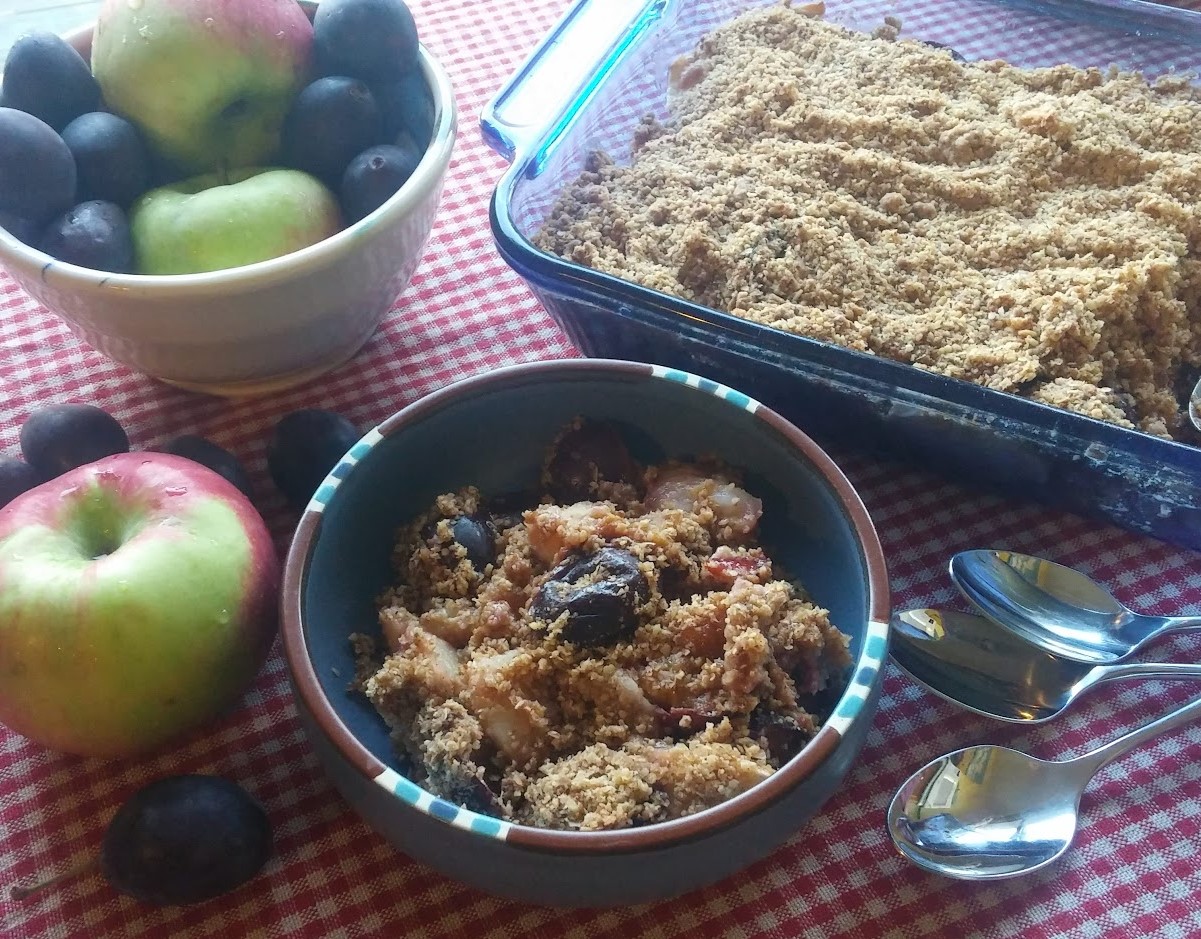
Plum & Apple Crisp with Gingerbread Topping

Ohhhh, look! It's another take on fruit crisp! Best family winter desserts ever? Or best family desserts, ever? So quick, so easy, so tasty, so adaptable to a moderate level of carbohydrates. I splashed out and used real sugar, in modest quantities. You can add more, or change it to at least partly monkfruit-erythritol blend, depending on your personal preferences.

Apples and plums are a seasonal combination that makes both of them better than they are by themselves. I first ran into them as a pair many years ago in a pie made by Michael Stadtlander and I was blown away by it, and I've been combining them in desserts ever since.
 
6 servings
1 hour 30 minutes - 30 minutes prep time
 
Plum & Apple Crisp with Gingerbread Topping

Make the Topping:
1 cup whole spelt flour 
1/2 cup oat bran
1/2 cup almond flour OR ground almonds
3 tablespoons Sucanat OR dark brown sugar
1/4 teaspoon salt
1 1/2 teaspoons ground ginger
1 teaspoon ground cinnamon
1/8 teaspoon ground cloves
a few good grates of nutmeg
1/3 cup cold unsalted butter
 
Measure all the dry ingredients into a mixing bowl, and mix them. Grate in the butter, and rub it in with your fingers until there is no dry mix left, and it forms coarse crumbs. 
 
Preheat the oven to 350°F. 

Finish the Crisp:
2 cups halved Italian (German) plums
4 or 5 medium apples
2 tablespoons sugar
 
Wash the plums, cut them in half and discard the pits. Place them in an 8" x 10" shallow baking (lasagne) pan. Peel, core, and slice the apples and mix them in with the plums, spreading them out into an even layer. Sprinkle them with the sugar. 
 
Sprinkle the topping evenly over the fruit and bake for 1 hour at 350°F, until lightly browned and bubbling. Serve warm, or at room temperature. I wouldn't say no to ice cream, whipped cream or custard. 


Last year at this time I made a Brined Roast Turkey.

Friday, 1 October 2021

Light at the End of the Tunnel Garden Update


Yes, I have reached the point where I am waiting for it all to be over, and it will be over in another 4 to 6 weeks. The cornstalks are drying down - corn is long over - but the sorghum still looks pretty green. I hope it ripens. The brassicas have had a new lease on life now that the swede midge season is over until next spring. I need to nip the tops here; there is a chance there might be Brussels sprouts.

Leeks look okay; the leek moth appear to be somewhat active but they are growing nicely; considerably larger in the fall than the first generation of this cross, apart from just a couple of stragglers. There is Ethiopian kale gone to seed in the upper left; it really is more like mustard and I didn't know what to do with it. Looks like I get to try again. The celeriac in the upper right is the best looking celeriac - above ground, anyway, that I have ever managed to grow, although there are three plants that seem to have some kind of virus.

Out best cabbage, which rates as "okay". The outer leaves show the damage done by the swede midge, but once they quit for the season cabbages have actually started to form. I will leave them as long as possible, in the hopes of getting a few more usable ones.

We've transplanted strawberries into the new bed - they should be moved every three years or so, and it's been more like six - and they are settling in nicely. They should be; there was over 5" of rain right after they went in. The bad news is, a full bed (with room to spread) of strawberry starts doesn't even leave a mark on the old beds. We'll leave them for another year; I don't think we'll get much production from these new ones next year, although you never know.

The nights are cool enough we are keeping the peppers and sweet potatoes covered. In fact, sweet potatoes should come out in the next couple of days. Normally we would nurse them along a little longer, but we clearly have some kind of rodent infestation in the garden and they are targeting them, along with the carrots to a lesser degree.

Tomatoes are winding down. We are going to have green tomatoes like we haven't had in years, thanks to a very late start on them forming, thanks to that awful frost on May 28th. But we have 40 litres of tomato sauce, and there should be enough to have a dozen or so litres of crushed tomatoes too. And lots of Chow Chow, which is fine. Our cukes were bust so there will be no Cucumber Relish.

Amazingly still getting a few zucchini from some of the plants. They grow much slower know but usually the plants are overwhelmed by mildew early in September. There are a couple that got away, but unfortunately, the one I was specifically saving for seed rotted and fell off. I'm very sad about it, but I will try to recreate that cross so far as I am able next year.


Spinach planted in late summer is finally going. It really perked up after that 5" of rain. Can't say we've gotten a lot of use out of the very expensive irrigation system, and it will be a lot of work and inconvenience to get it stashed for the winter. Ho hum.

Got a few maxima squash in spite of the borers, along with a good harvest of expected butternuts and unexpected acorn squash. Unexpected, because one sprouted in the compost pile. We left it, and it looks like it has 10 good fruits on it! Amazing, what you can achieve with good compost.

The last of the watermelons. They are small, and I have pretty much lost interest in them.

Fortunately the rodents seem uninterested in our late planted turnips (planted with the spinach). These ones are my favourite Goldana and they are looking great.

This red one is a new for us; Scarlet Ohno Revival. I'd like to see what happens if crossed with Goldana, but that will have to wait for next year. I haven't even eaten any yet. 

And that takes us to the end of September (*ahem*). I'll write some more about the breeding projects in a week or so. Right now it's garden clean up time - we need to get at least one bed finished for the winter every day from now until mid November, so it's going to busy.