Showing posts with label A Socio-Political Comment. Show all posts

Wednesday, 18 March 2020

More Thoughts on the Current Crisis


I know I alluded to this in my last post on the state of the world, but with nothing to do but sit home and read the internet and think, I've been reading the internet and thinking.

Guys, vegetables are going to be 1) in short supply this summer and 2) bloody expensive when you can get them, as an inevitable consequence of 1). This is going to apply to vegetables both domestic and imported. I think Canada's production of grains, legumes, and meat is both large enough and mechanized enough that while, like just about every industry they will take a hit, they should continue to function reasonably well.

Our local vegetable and fruit farms rely heavily - heavily - on foreign seasonal agricultural workers. Right now, they are not coming in. This is the time of year they arrive, with the blackbirds and the vultures. (Spring! I love it!) I think the government will find some way to get them in, but maybe they won't. They are going to have to assess and balance risks. We're off to a rocky start already; the best-case scenario is that they arrive somewhat late. Obviously, some crops will handle this better than others. The local apple industry, for instance, has a lot of work to be done right about, oh, now.

Imported produce is unlikely to replace local produce. Covid-19 is going to hit poor people particularly hard, and agricultural workers in the US and Mexico, where most of our imported produce comes from, are going to take it in the neck. I don't see how they won't: next to no healthcare access, living and working in crowded conditions, notoriously exposed to unsafe working conditions including pesticide and herbicide exposure which are bad for the lungs in particular along with the rest of the body in general.

Moreover, even if we are getting produce from other countries, the ethical concerns about them are going to be more severe than ever. Countries are going to decide to export produce for vitally-needed cash and leave their own populations short of food. Many do that already; it will only get much, much worse.

I honestly believe that just about everyone should consider growing a few things this year. Even if you live in an apartment and have only a balcony or windowsills. A supply of sprouts and micro-greens, while not supplying much in the way of calories, will really help to fill some gaps and keep meals interesting. Very perishable leafy things are probably going to be the worst hit, so there's that too. NOW is the time to be ordering seeds, pots, soil, etc, and getting set up. Fortunately, much of it can be ordered on-line for shipping. (Well not the pots and soil.)

There is, of course, a learning curve involved in doing anything new, and growing things is no exception. Don't invest large amounts of time and money into this until you both know what you are doing and want to do it. 

I also believe this is going to drag on, and on, and on. This is probably a good year to buy produce when it is a available in season, and can, dry, or freeze it. Again, though, be realistic about your situation.

I've given Covid-19 its own label, as I suspect this is going to be a preoccupation of life for the next several years. I'd also really like to hear other people's thoughts and suggestions.

Tuesday, 17 March 2020

Interesting Times


So.

We were away for 2 weeks in Cuba recently, just getting back very late on Saturday evening. We spent our time mostly in blissful ignorance of developments outside of our sunny little bubble. Sometime around Thursday, though, we checked in, and spent most of the remaining evenings burning up our WiFi allowance and watching the shit hit the fan.

Saturday night was probably the last comfortable time to get home. Our pre-arranged taxi-driver picked us up without qualms. Don't know what she would think now. At any rate, we are now in isolation for the next, oh, 13 days. Along with pretty much everyone else, it seems.

There is a little coronavirus in Cuba, brought in with Italian tourists. I wonder a little uneasily to which resorts they dispersed, but frankly I am more worried about the hours passed at Pearson airport.

We were going to go to Britain in April, but first the person who was at least part of the reason for going (Dad's partner) died, and then Hurricane Coronavirus hit. I spent much of yesterday cancelling hotels. 

It looks like this will be a good spring to put particular emphasis on producing your own food, so I'm likely to start ramping up the gardening posts, as soon as something happens. I can't help but think that supply chains are going to take a hit. Not too late to order some seeds! I don't put it on the list but if you are in an apartment or otherwise can't or won't grow vegetables, you can always do sprouting and microgreens, and Mumm's is probably the best place to get the seeds.

Otherwise, is there anything that people would like to see me working on? We're going to be planting peas with in a week, I hope, as we usually do in early spring, and some barley, which will be a new crop for us.

Stay home and stay safe, everyone.

Wednesday, 15 January 2020

Making Sour Cream

Okay, it is once more RANT TIME in Ferdzy-land. Again, it's about dairy products. Again, the big companies that have a killer grip on the production and supply lines around here, have stopped producing an actual dairy product and are now purveyors of complete and utter CRAP.

I've raved before about how hard it is to get actual whipping cream anymore, but thanks to Miller's Dairy at least I can. However, they don't make sour cream (I'm pretty sure) and the stuff at the grocery store is now essentially inedible. I, at least, refuse to eat it anymore. Here's the ingredient list from the last batch I bought, and it seems to be entirely typical: cream, milk, skim milk powder, modified corn starch, guar gum, carrageenan, carob bean gum, sodium citrate, sodium phosphate, bacterial culture.

Just in case you didn't get that the first time:

Cream, milk, skim milk powder, modified corn starch, guar gum, carrageenan, carob bean gum, sodium citrate, sodium phosphate, bacterial culture.

People, that is not sour cream, and it is criminal that this country allows anyone to sell that slimy glop with the label sour cream.

So I got on line to see if one can make sour cream at home, and as it turns out, yes; one can. I saw recipes that said, "mix 2 ingredients and leave on the counter overnight" and I saw recipes that wanted you to heat your cream to a very precise temperature, and hold it there, and cool it, and then mix your 2 ingredients and leave it on the counter overnight.

After some thought I decided to believe the people who say, mix 2 ingredients, etc. If you are not using raw cream - and hardly anyone will be, certainly not me - that heating and cooling process has already been done; it's called pasteurization.

There are 2 main variables in this recipe. The first will be the cream you use. I used whipping cream, as that is what will be easiest for me to get. It does need to be real whipping cream, not some industrial CRAP full of gums and starches, or why are we even here? The lower in fat the cream you use, the thinner the ultimate sour cream, and this will - even with whipping cream - be thinner than purchased sour cream ever was. Next time I might try mixing equal parts 10% cream with the whipping cream, though, for something a little more restrained. (If Miller's makes an 18% cream, I've never seen it).

The second variable is the souring agent. I used commercial buttermilk, which is okay but not exciting, and my finished whipping cream tasted very much like the buttermilk; no big surprise. I've seen vinegar recommended by some people, but useful as I think vinegar is, I'm not convinced it would bring the right flavour profile. Lemon juice is also suggested, and I will try that next time, provided I am using it somewhere that a slight lemon flavour will be an asset. Yogurt is basically thicker buttermilk, but again perhaps with a different flavour and it can definitely be used. You can also look on-line and find sour cream starter cultures for sale, but I can't see myself using sour cream at a frequency and volume that would make that useful to me.

As ever with dairy products, cleanliness may or may not be next to godliness, but it is most definitely next to success. 

1 to 1 1/4 cups; scale as needed 
25 hours 10 minutes - 10 minutes prep time


1 cup pure, high quality cream; 10% on up to 35%
1/4 cup buttermilk OR 2 tablespoons good yogurt OR 2 teaspoons lemon juice

Make your sour cream in a very clean or sterilized canning jar; pick one the right size for the quantity you intend to make. Either sterilize the jar, or run it through the dishwasher at a hot temperature and start the sour cream as soon as the dishwasher is done. I would also only do this if I expect to use my sour cream promptly - otherwise, it's into the canner, cover by an inch, and boil for 10 minutes. Also you may wish to run through: the lid and rim, a funnel, a large spoon, and a spatula.

Put the cream into your very clean jar. Add the starter agent and stir it in. Wipe the rim with a bit of clean wet paper towel. Pop on your very clean lid and rim, although not too tight. Set on the back of the counter and leave it for 24 hours at room temperature, assuming room temperature is not far off 20°C. It won't thicken up until close to the end of the time. At any rate, put it in the fridge after 24 hours. Congratulations! You now have sour cream.


Last year at this time I made One Pot Mashed Parsnips & Pears.

Thursday, 17 January 2019

Oppose Bill 66

I have received a few reminders this week that the window is closing to object to the execrable Bill 66 put forth by the Ford government. This link from EFAO is succinct and has several possibilities for response. Please go and make a comment on the official site, and sign a petition or two. If you can get your friends and relations to do likewise, so much the better.

There are only 3 days left - comments close Jan 20th.


Help Protect Ontario's Farmland

Wednesday, 3 January 2018

Coconut Creamed Cabbage

Here is a rich and creamy dish full of sprightly flavours. As usual with this kind of thing it is probably best with something a little on the plain side to allow it to shine without argument.

If you can't get the makrut lime leaves, leave them out - they are good but not vital to the dish. You may know them better by the term kaffir lime leaves; I do. But the name is quite offensive in many places, so there is a campaign on to change it. Makrut is the name of it in Thailand and seems to be the popular alternative choice.

Speaking of getting rid of offensive terms I do wish we in Ontario could have a campaign against the use of the term Huron (as in, Huron Indians). It's a lot more ingrained and will be harder to get rid of, but it needs to go. I always thought it was a native term until about 15 years ago when I discovered it is in fact French, and means a dirty person. Quite apart from the fact that 17th century Frenchmen had one hell of a nerve calling anyone else dirty, their actual name was the Wendat people. Let's use that.

Digression over - let's have some tasty cabbage! 

30 minutes - 20 minutes prep time
4 to 6 servings

Coconut Creamed Cabbage

2 cloves of garlic
1 large shallot
1 tablespoon finely grated fresh ginger
4 to 6 cups finely shredded green or Savoy cabbage
1 medium carrot
1 teaspoon mild vegetable oil
1/4 teaspoon salt
freshly ground black pepper to taste
2 or 3 makrut lime leaves, dry or fresh
200 ml (1/2 tin) coconut milk

Peel and mince the garlic. Peel and mince the shallot. Peel and grate the ginger. Set them aside together in a small bowl.

Wash, trim, and shred the cabbage. Peel and grate the carrot.

 Heat the oil in a shallow, heavy-bottomed pot. Add the garlic, shallot, and ginger and cook, stirring for just a minute or so. Add the cabbage and carrot and mix in well. Pour over 3 or 4 tablespoons of water and cook, stirring regularly, until it is evaporated. While it is cooking, add the salt, pepper, and makrut lime leaves.

When the water is gone - the cabbage should be done about halfway to your liking at this point - add the coconut milk. Continue to simmer and stir the cabbage for another 6 to 8 minutes until the coconut milk has thickened sufficiently to coat the cabbage.Serve at once.

Sunday, 11 June 2017

10th Blogaversary! - Best Outings & Rants

Today is Seasonal Ontario Food's 10th Blogaversary! Seasonal Ontario Food is 10 years old today!

It all started when repairs were being made to the stairs in our apartment building and I had to make a choice to go out all day, or to stay in all day. I opted to stay in, got bored, and the rest is history. Little did I know what I was getting into.

I went back and perused my earliest recipes in a fit of nostalgia; some of them were awfully simple. Simple is a theme of this blog but I posted things then I wouldn't post now. On the other hand, my very first recipe was a salad I really enjoyed then and still regard as very fine (and it's in season at the moment!) There are also some recipes from the early years that have not been noticed as much as they should have been, as I had next to no readers in those days. Today and tomorrow I am going to highlight some of my favourites from over the years, including some of those early ones.

In keeping with the idea of simplicity I have tried to avoid buying new dishes or gadgets just to have new props for the blog. Consequently people will recognize the dishes and table cloths that show up again and again. I also don't make food just to "pose" it. You see it; we ate it. Sometimes it's hard to get the light right and set things up nicely when everybody is already sitting at the table, forks in hand, waiting, waiting...  I also went with the plainest blog design and have kept photos a very similar size/proportion to keep a simple and unified look. Too plain? Maybe, but it's my style, and I was and remain an amateur in both senses of the word.

Still, right from the beginning I wanted to get out of my own kitchen and post about what other people were doing with Ontario food. The last few years I have struggled to be able to do that, as family obligations have kept me close to home. I still hope that I will be able to do more jaunting about and sticking my nose in other people's business in the future. So today I am going to revisit 10 of my favourite outings. I'm also going to link to a few of the rants I've gone on, which I think help illuminate my philosophy of food. As for the future... well, I hope there will be one. I admit that I don't find myself too wildly optimistic about much at the moment, including the future of local food.

Monday, 13 February 2017

Now What?

So now that all your most childish adolescent fantasies are coming true, and it's up to YOU to save Civilization As We Know It... well, uh, how exactly?

I expect to be wrestling with this question for some time to come myself, but the ideas I'm coming up with so far seem to fall under three general headings.

I'm also giving another plug for Bob Altemeyer's The authoritarians, and Jane Jacob's Systems of Survival. Long reading, but those two books have really clarified and directed my views of society for at least the last decade, and are both highly pertinent to the situation we find ourselves in. Like, seriously, written for it. If you do nothing else, please read those two books.

Continue to Educate Yourself:

No Time to be Nice  Naomi Shulman

On Being Good The Belle Jar

These times require a new language... William J. Barber II (NOTE: contains religious language)

Intolerant Liberals Tucker FitzGerald

Fight Fascists with Mockery not Violence David Neiwert

All of the above and the first 2 links in particular are important, it seems to me, to understanding the reality of being a resister. The point that every-day fascist followers are frequently nice people (as opposed to the political leaders who clearly aren't) is vital to understand. The mere fact of being a nice person may, in fact, lead you to behave in ways that support fascism. It is really hard to stop being a nice person when you have been trained to be one for your whole life. This is particularly true, I think, for women.Making the decision to stop being nice and start being a fascist resister requires working some mental muscles that most of us have not exercised too well.

In my experiences as a landlord, I found pretty much everybody, without exception, was absolutely frightened of any conflict and would go out of their way to avoid any interaction with others that could be interpreted as even mildly critical or confrontational. People would come to me, of course; full of complaints and wanting me to deal with it, whatever it was. So I've had a certain amount of training in telling people things they don't necessarily want to hear. Admittedly I was approaching people from a position of power, but it's notable that nobody ever responded to me with violence, and rarely with threats or insults. It can happen, of course, especially in these times when the nasty are emboldened. But people are generally much less prone to such responses than seems to be the general idea. Stand up for yourself; stand up for others. The more you do it the easier it will become, and it is a genuine contribution to a better world.

Take Actions:

Does going to demonstrations and public meetings actually do any good? YES, IT DOES. Go to demonstrations and public meetings:
 
Rise Up: This is not complicated

It may take only 3.5% of the population to topple a dictator...

We Can't Let Trump Go Down Putin's Path

Contact your government and engage in public discourse. As Canadians, we don't have much input into the American situation, but there is plenty going on here that is wrong and dangerous; now is the time to keep on top of that stuff and contact your MPs and MPPs as appropriate. Give 'em an inch; they'll take a mile. Fight back now.

This one is for Americans, but Canadians should read it too, and consider the equivalent possibilities:

Indivisible: A Practical Guide for Resisting the Trump Agenda

Next up, don't buy products made or sold by companies that are damaging the world, as much as that is possible. In a way, that's always the central message of this blog. And as with local food, I try to be in it for the long haul and don't worry about being perfect or complete in my avoidance of products made by suspect companies. A million people eliminating 80% of their purchases of products produced by companies of ill-will would likely be a lot more effective than 10,000 who achieve perfect avoidance - if such a thing is even possible, and I'm not sure it is in the modern world.

We are so much more than consumers, but there are an awful lot of powerful people who regard us as nothing but that... the least we can do is be mindful and careful consumers.

Grab Your Wallet Boycott Tool

In particular the above focuses on companies dealing with the Trumps and so many of them aren't here in Canada. But I do note some that Canadians may have dealings with: Amazon, Bed Bath and Beyond, Hudson's Bay, Walmart, and a fair few others as well. Check it out.

Cultivate Connections:

Don't Be a Bystander  BCRW Videos

Here is a short little video about responding to the public bullying that happens more often when fascists are emboldened. People are often paralyzed by the fact that they have no mental preparation for dealing with shocking breaches of usual public behaviour. Having an idea about how you might act in advance really helps you deal with it if you are there when it happens. (If you prefer, there is a transcript here at Shakesville where I first saw it.)

Other possibilities; look for your local interfaith group and check out what they are doing.

Volunteer for something, somewhere. It's not enough to fight back against what is wrong; it's important to be building what is right as well. It doesn't have to be "political". When Mr Ferdzy got horribly distressed and depressed about the state of the world a few years back, I told him to stop complaining and do something. To my surprise, the thing he chose to do was to go volunteer at a programme that helped autistic and other developmentally delayed children get ready for school, and so once a week he would go off and wrangle 3 and 4 year olds for an afternoon. It was not just a socially useful thing to do, it also really helped cut his feelings of powerlessness and isolation, even though in the greater scheme of things it was a very small action and had nothing to do with the things that originally were distressing him so much. 

***

This doesn't seem very well organized or well written to me, but it's what I have at the moment. I have some more ideas that are still percolating; we'll see if I manage to do anything with them.

Monday, 30 January 2017

We Interrupt This Regularly Scheduled Programme...

...to talk about fascism. Yes, fascism. Why, you may ask? (Ha, ha; no, I'm pretty sure you know why.)

I was hoping to check out (at the usual age) before the dreadful day arrived, because frankly I am a coward but no; here we are. We've watched this time come barrelling down the pike for many years, as everyone said no, no, It Can't Happen Here. After all, we fought a mighty big war against it! As it turns out, there are plenty of people who like fascism just fine when it is them doing it to other people and not other people doing it to them.

By the way, I'm seeing lots of people - politically motivated and presumably attention-paying people - commenting about how what the Trump administration is doing is "Crazy", "Disorganized" or "Impulsive". NO IT IS NOT.

It is the bog-standard method of transitioning a democracy to a fascist regime.

There are a lot of people out there with smarter things to say about all this than me; I hope I can be helpful by collating a useful conglomeration of history, information, ways to think about things, and things to do. Most of this is reasonably short and "easy" reading.

This is a very preliminary list. I will add more as I find it; please leave your suggestions for reading material in the comments. I hope to put up another post in a week or so with more concrete action suggestions.

For an Overview on Fascism/Authoritarianism in General:

Umberto Eco Makes a List of the Fourteen Common Features of Fascism.

Ur-Fascism (Umberto Eco again). 

The Authoritarians. Bob Altemeyer. Book is free pdf file at site. It's long (it's a book) but READ IT.

Systems of Survival: A Dialogue on the Moral Foundations of Commerce & Politics. Jane Jacobs You will actually have to buy the book somehow (or check it out from the library if you can) if you want to read this, but I highly recommend it. It makes terrific companion reading to the The Authoritarians. Altemeyer is more about the psychology of authoritarians; Jane Jacobs talks about the moral structures (and therefore the social and political structures arising from 2 modes of interacting with the world, and what happens when those 2 modes are not upheld as they should be).

ADDED 17/01/31 12:05 pm: and, on a more ominous note, Major-General Smedley Butlers's War is a Racket

ADDED  17/01/31 3:00 pm Excerpt from They Thought They Were Free. Milton Mayer.

For Information About the American Situation Specifically:

Everything You Need to Know About Steve Bannon, Breitbart, & Russia. Daily Kos.

Is Donald Trump a Fascist? (Spoiler: yes. From fucking Newsweek no kidding.)

I was trained for the culture wars...  Kieran Darkwater

ADDED 17/01/30 9:19 am: A Realistic but Hopeful Assessment from Eliot A. Cohen at The Atlantic.

ADDED 17/01/30 10:07 am: Trial Balloon for a Coup? Yonatan Zunger. 

Now What?

How to Survive an Authoritarian Government. Larwunia at ExtraNewsfeed.

The Complete 4-Page Guide to Surviving an Authoritarian Regime. from your Eastern European friends. 

Autocracy: Rules for Survival. Masha Gessen at New York Review of Books.

Here's What You Can Do to Beat Trump. Student Activism, but pretty universally applicable.

ADDED 17/01/31 8:48 am: Carl Sagan's Baloney Detection Kit

Saturday, 23 January 2016

A Meditation on $8 Cauliflower

I know I live in a little bubble, but I have only been very vaguely aware that the prices of many commonly-purchased vegetables have been going up (up, up!) recently. Well, they would be, wouldn't they; what with the low dollar and environmental changes happening now. Suddenly this week though, I've been seeing lots of articles about cauliflower at $6 or $8 a head.

I had no idea. I haven't even glanced at a cauliflower since November, when they were last in season. With the exception of a few lemons and limes, and the odd banana or other fruit, I don't really look at, never mind buy, anything imported. The price of citrus has been brutal for a while, but it doesn't exactly make or break our budget, or our menu.

Of course this is very hard on many people. I'm in a rare position, in that about 80% of our vegetable and fruit intake is grown and preserved by ourselves*. The whole point of this blog, though, is that long before we had a garden, we were eating well, eating relatively cheaply, and eating in a way to mitigate human and environmental harm, by eating mostly food produced locally, and you can too, with just a little re-jigging. And yeah, that means no cauliflower in January (mostly because I can't freeze it well enough at home to suit my fussy tastes). Tant pis. We really aren't suffering. We're eating cabbage (and carrots, and onions, and rutabaga, and beets, and, oh, look at the list)**, and liking it. And in July, when the first locally grown cauliflower shows up again, I'll be ecstatic to see it.

Cauliflower is a special vegetable, as I've remarked before. It deserves an ecstatic greeting at least once a year. Of all the vegetables, it is probably the most refined and luxurious flowering of the plant breeders' and growers' art. It has been thousands of years in the making and perfecting, and still requires expert knowledge, skill, and precision to grow. The idea that it ought to be a cheap staple is laughable. What makes me sad is not that out-of-season cauliflower is expensive, but that so little of that increased price is going to the people actually out in the field growing it. Indeed, even as I type I'm sure people are working on how to get even more out of the hides of farm workers, rather than let international finance and big ag take the hits from increased prices.

I have noted that as imported produce has been increasing in price, so has locally grown produce, though not to the same degree. I think there are 2 reasons for this; the first being that since other things are more expensive, the prices can be raised. I try not to resent this too much; produce growing is one of the most precarious and labour intensive forms of making a living that there is, especially for the small or medium sized grower***. The other is that, as people have come to regard food grown and shipped from thousands of miles away as perpetually cheap, perpetually available, and in fact that they have a positive right to have it, the number of local growers and the variety of what they grow has shrunk, and shrunk a lot. The survivors inevitably can charge more, and have to, because the distribution chain also shrinks and gets more expensive and difficult to manoeuvre.

So until July and local cauliflower, please look around and buy other locally grown vegetables, hopefully at more reasonable prices. Even if you are not familiar with them. Then locate them on the index at the right hand side of this blog. I'm pretty sure you will find a simple and delicious way to prepare those vegetables, and you will not feel deprived. (And you can read this paeon to the potato from Carol Deppe - let's not forget the wonderful potato!)


*That actually probably takes more money and definitely a whole lot more time than if we were just buying it, by the way - but we have both, and want to do it. The point is you can eat like we do for less money and effort than we expend.

**Not even including our own frozen, dried, or canned goods.

***Although again, I have to wonder how much is actually going to the grower - good reason to go to a farmers market if you can.

Tuesday, 9 December 2014

Los Angeles Times Article - "Product of Mexico"

One of the main reasons we eat as much of our food locally grown as we can, is the fact that the only labour laws we can have any impact upon are our own. Not that agricultural labour in Ontario is without it's own problems, but we're a long way from the world descibed in this must-read Los Angeles Times article, "Product of Mexico".

Except, of course, we aren't. Our grocery shelves are just as full of products produced by what might as well be slave labour as the grocery shelves of the United States.

The triumph of modern capitalism is how everthing arrives in stores completely divorced from any indication that it is a product of nature or industry; instead, its appearance is almost magical, and it arrives as a kind of manna from heaven. Yes, yes; we know it came on a truck and not literally falling from the sky. But we take one thing, and the next day if we return to the store it has magically reappeared on the shelf, and there is sits, as though it just sprang up like a kind of mushroom. But like most magic, this is a mirage and the result of immense amounts of labour and energy which have been carefully hidden lest they spoil the effect. Thanks to journalists like Richard Marosi and Don Bartletti, the curtain is pulled back and the reality is shown.

I will be looking forward to the next three installments of this series.

Friday, 7 February 2014

... And Another Thing

I was amused to read this article in theGuardian:


Fake-food scandal revealed as tests show third of products mislabelled

It's not amusing, it's horrifying, but I guess I'm kind of past that. What got me, though, is this statement:

"The substitution of cheaper vegetable fat for the dairy fat with which cheese must legally be made was common. Samples of mozzarella turned out in one case to be only 40% dairy fat, and in another only 75%.

Several samples of cheese on pizzas were not in fact cheese as claimed but cheese analogue, made with vegetable oil and additives. It is not illegal to use cheese analogue but it should be properly identified as such."

Ha! Ha! Canadians, the joke's on you. I'd say 95% percent of what is sitting in my local grocery stores coolers is what the Brits (should) call "cheese analogue". But apparently we have no law against it being called "cheese" here.  So "cheese" is what it's called. Yikes. (See my post on Pine River Cheese for more about this.)

More About Cytoplasmic Male Sterility in Vegetables

I would like to draw your attention to this article about Cell Fusion CMS in vegetables; it should, in my opinion, be read by every grower and eater of vegetables out there.

Editted to Add 10/02/2014: What particularly got my knickers in a knot is the revelation that just about all broccoli sold in the U.S (and by implication Canada) is genetically modified, certainly by international organic standards. That American (and by implication Canadian) organic standards are ignoring this is really distressing to me, and seems completely antithetical to everything organic is supposed to mean. 

The great struggle of the last few millenia of human history has been over who owns what, with more and more of what was once our common birthright becoming the possessions of the wealthy, to be bought back by everyone else at the cost of excess toil, deprivation, oppression, illness and shortened lifespans. There have been some victories, but the struggle is never ending and has moved to the level of the genetic make-up of the food we eat and our own bodies.

Read, mark, learn, and dare I say, inwardly digest the words of Andrew Still, who is fighting the good fight here. This is still fairly new information to me, so I am still in that process myself, but would be very interested in hearing peoples' thoughts on this.

Ultimately, the parasitism of the wealthy must fail, if only by its own bloated overreaching, but its failure will be staggeringly painful for everyone. Better not to go there in the first place. 

Hat tip to Joseph and Trixtrax at Homegrown Goodness, who first brought the whole issue to my attention. Editted to add: See also this article by Joseph at Mother Earth News: Genetic Engineering and Cell Fusion CMS.

Wednesday, 21 November 2012

Hurray!

The Highland Companies have withdrawn their application to blast southern Ontario to smithereens:
'Mega-quarry' in southern Ontario won't be built. 

It sure is nice to get some good news for a change.

Monday, 4 June 2012

Black Out Speak Out


Since I'm using Blogger, it's apparently a bit difficult to actually black out my blog, so I'm making a symbolic gesture here.

I'll just add that there can be no food without environmental protection. Ultimately, farming and protection of the environment must be one and the same. Nor are the pleasures of the table truly pleasures if they depend on the gross exploitation of the labourers who produce it. Nothing exists in a vacuum. We are all an interconnected web and we need a government that understands that.

Go to Black Out Speak Out for more info.

Monday, 17 October 2011

FOODSTOCK


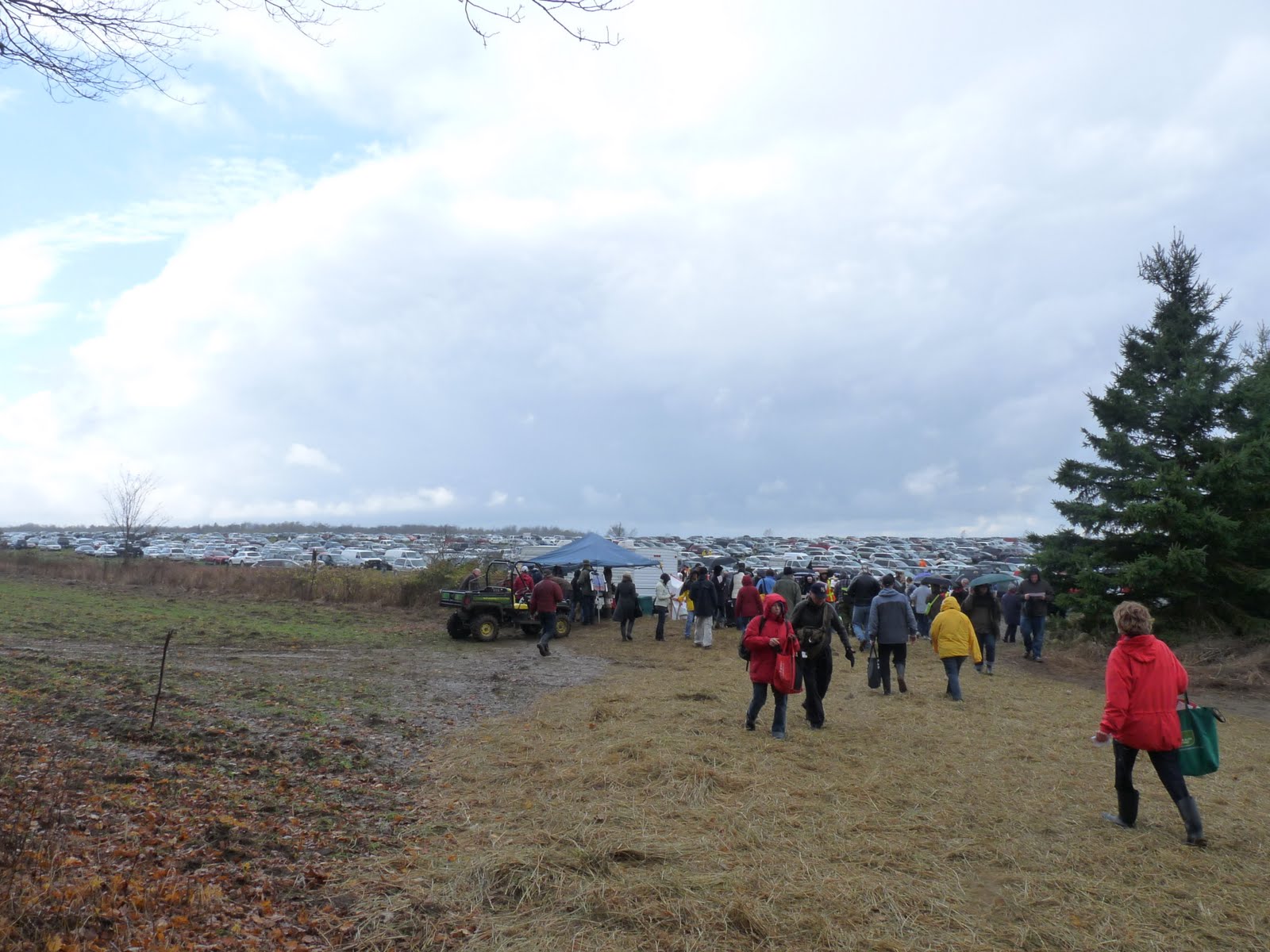
We arrived at Foodstock at about a quarter after eleven, just after it officially started. This is where we got a parking spot. You can see more-or-less where the entrance is, off to the right of the porta-potties in the distance. We took this for a good sign.


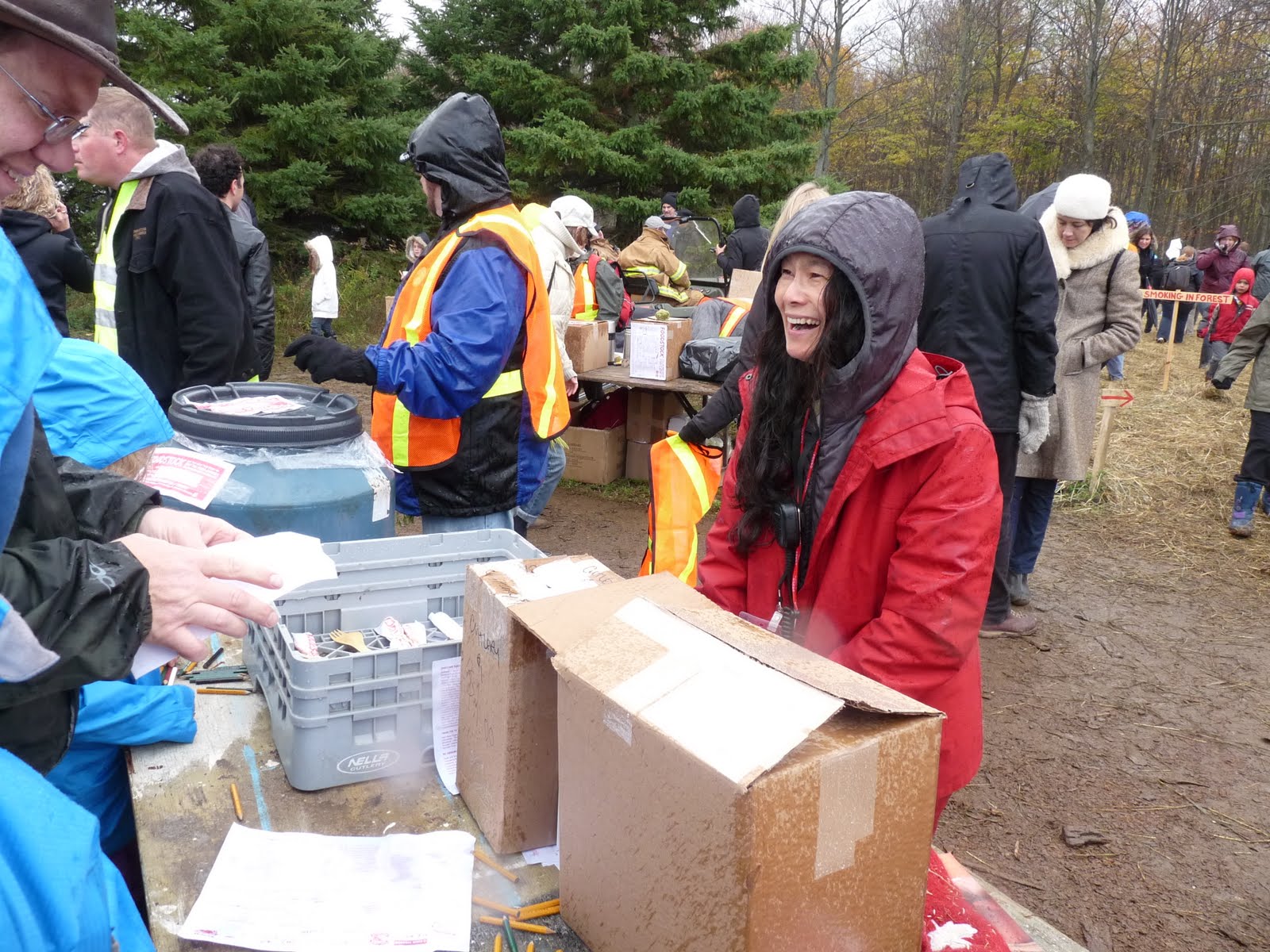
Foodstock, in case anyone has missed hearing about it, was an event put on by the Canadian Chef's Congress and the Stop the Quarry group, to raise funds to fight the proposed 2300 acre quarry in Melancthon township. They had asked for a $10 donation from attenders, and I would say they did well. I saw people passing in multiple envelopes - I think quite a few people gathered up donations from friends who couldn't come, and I heard someone comment that a number of people had come up to drop off donations without coming in.


The event itself was held in and about a large maple bush. Some straw had been put down to fight the mud - not enough, as it turned out, but it did help.


We started lining up to sample the offerings of the chefs. I'm a bad reporter; I didn't get the name of this restaurant (actually, I'm pretty sure it was a golf club) but the dish was rabbit and chicken stewed with chocolate, with cherry preserves and a profiterole. It was very rich, and very good.


On the other hand we knew these folks! They're from Simplicity Bistro in Thornbury, close to home. They made a lovely browned butter and Jerusalem artichoke soup.


The place was not too crowded yet, and so we could see that the woods was full of rather rustic and organic sculptures.


Oysters, from Oyster Boys, in Toronto.


A smoked fish paté on a kale leaf, with chips. A number of the chefs had made chips, as the threatened farmland is known for producing most of Ontario's potatoes.


Smoked fish on raw daikon, with raw garlic - much better than it sounds - from Sakura, in Toronto.


This was a welcome dish - a chopped salad from, I think, Bruce Wine Bar in Thornbury.


Janice Suarez, a pastry chef from Niagara on the Lake, served this deceptively plain looking apple-pumpkin loaf, which I thought was one of the best things I ate.


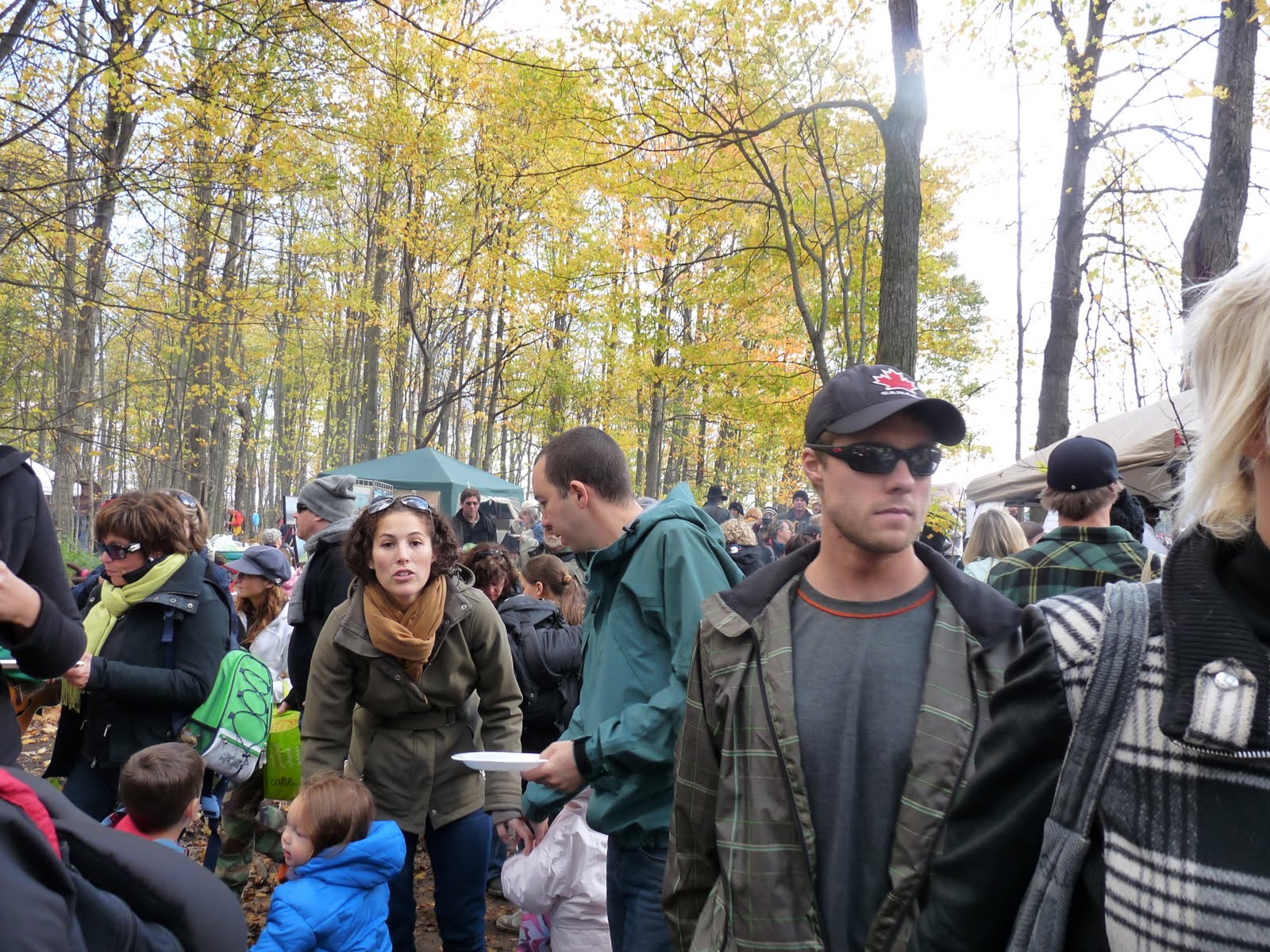
By now the place was filling up. It was a very large space, but there were plainly a lot of people there.


A display of some of the potatoes grown in the area.


A map shows the outline of the proposed quarry superimposed over a map of Toronto. Yes, it's truly huge. Worse, it's at the headwaters of 5 major southern Ontario rivers. As one of the people I chatted with in line said, this is all about the groundwater.


When we first arrived line-ups were not more than a minute or two long, but they soon got to be quite long! Fortunately most of them moved fairly briskly.


Haisai Restaurant and Bakery in Singhampton made what I thought was pizza, until I got right up to it. It turned out to be a grilled apple tart that was lovely, not too sweet and swimming in cinnamon.


Eiginsinn Farm had the next spot (they are both Michael Stadlander projects) and they were serving a vegetable soup with pickled squash on a raw cabbage leaf. I admit that so many chefs were serving rich meaty things on white bready things that I greeted that cabbage leaf with great enthusiasm. Soup wasn't half bad either.


And I believe that's chef Stadtlander there, hacking cabbage with the best of them. I also believe that Foodstock was originally his idea.


The folks from Lennox farm were there too, giving away bags of Brussels sprouts.


Another familiar face - Ruth Klahsen from Monforte Dairy.


Poutini's, serving poutine, naturally. I admit I didn't have any. I had pretty much reached the point of not being able to eat anything more at least half an hour previously.


Oh, and another familiar face! Chef Robin Pradhan from Rocky Raccoon in Owen Sound with a lovely vegetable curry that was a welcome change of pace from all the rich food.


No longer sure who this was or what they had, but the display was interesting... love the necklace.


Last call at Buca (Toronto). Like a lot of the chefs, they had brought thousands of portions, but still ran out in the face of the huge numbers of people attending.


Click on the above picture to see some of the cars parked at the sides of the roads all around, even though the space allotted to parking was huge.


Chefs and their tables filled the paths through the woods, and all around the outsides on three sides too.


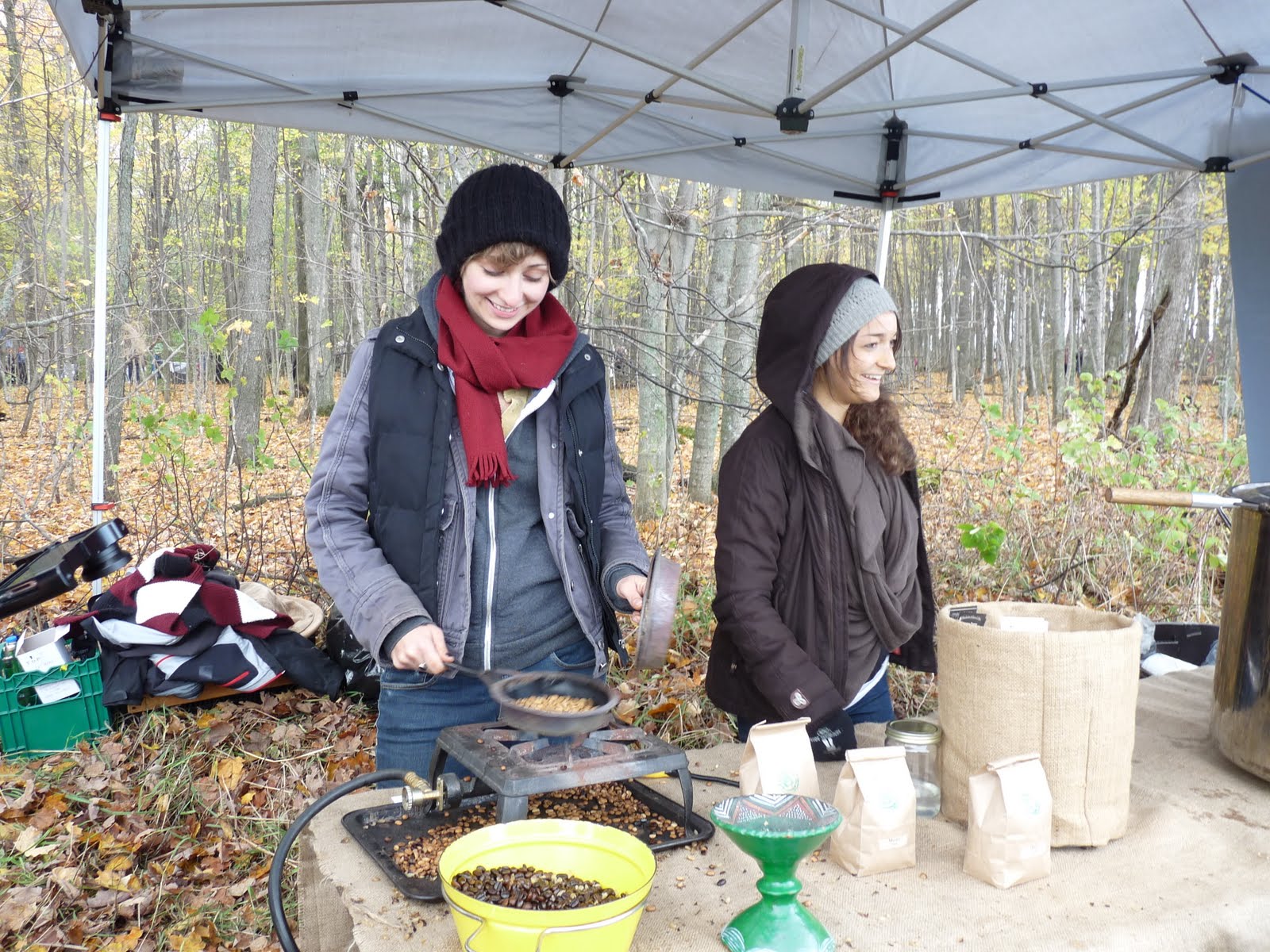
There were a few people there with coffee - and on a cool, windy afternoon (with a few showers as time went on) it was gratefully received. Was this Alternative Grounds, from Toronto? I think so.


As the afternoon went on, music started up at the stage. I have to admit I didn't stay for the music or the speeches to follow - never my favourite part of political events. Yeah, I'm bad.


There were a number of artists and musicians who had spots throughout the site as well as the chefs.


But by 2:30, we were pretty pooped. We decided to head home. A number of other people were leaving, but more were still coming in. I asked on the way out, and they told me that the last count as of 2:00 pm was that 18,000 people had been there, so I'm sure they made the expected 20,000 easily before the day was done.

I haven't seen anything about this on the CBC site, or the Globe and Mail. There were a few photos (kind of hard to find) at the Star. NOTE: and an article too, but also hard to find. On the other hand, I hope and believe that this event raised a lot of money for the fight against the mega-quarry. And it's not too late to donate. This will be a long and protracted fight, so please consider what you can do to support it. There will be more info at Stop the Quarry.

(And if I've made any errors in identifying people in this post, I'm sorry - and happy to get corrections.) EDITED TO ADD: Final count apparently a bit over 28,000 people! WOW!

Tuesday, 11 October 2011

Foodstock

Just in case you haven't heard about it yet - although it seems to be quite well publicized - there is going to be an event called Foodstock next Sunday, October 16th from 11:00 am to 5:00 pm, in Honeywood, Ontario. This is an event in support of the movement to stop the proposed mega-quarry in Melancthon township. I've written about this before; it's a cause well worth supporting.

The CBC had an interesting interview with the principals of the proposed quarry yesterday; and a right pair of whinging 1%ers they sound too. They are sooo misunderstood. Aw, diddums.

If you can't get out there to help kick this egregious plan to the curb, please consider making a donation. And give deeper consideration to the evils of NAFTA, which works hard to destroy local community control over the activities of multi-national corporations. The Stop the Quarry movement is getting a lot of attention and momentum, but I really hope it can connect to the big picture and get a movement going to repeal NAFTA.

Wednesday, 6 July 2011

Please Call Your Member of Provincial Parliament AS SOON AS POSSIBLE

I have been remiss in posting about this, but I have been aware for some time that there is a proposal to create the second-largest gravel pit in North America in Melancthon township, around Shelbourne.

This would be a disaster on all kinds of fronts. It will destroy 2,316 acres of some of the best farmland in Ontario, which is to say some of the best farmland in Canada. (In fact 1/4 of the potatoes grown in Ontario are grown in the area.) It will destroy the local water table, which is near to the surface and part of the reason the farmland is so good. It will damage the headwaters of 5 major rivers, including the Grand River, and threaten the drinking water of up to a million people. And to add insult to injury, it will destroy the rural character and beauty of the area. The traffic will be phenomenal - thousands of trucks will pour out of the quarry each day.

The review period for this quarry is about to end, on July 11th. It's vital to have as many people as possible register their objections to this gross and wanton destruction of Ontario's agricultural treasures before then.

By this late date, you will need to phone, fax or email. You can find your MPP's contact information here: MPP List. You can also sign a petition but don't forget, contacting your MPP directly will be more effective.

Edited to add: and also please contact Linda Jeffrey, Minister of the Environment.

UPDATE: Most effective way to comment on this matter is to click here: Environmental Registry, then fill out the comment form. Deadline is Monday, July 11th!

You can read more about the Melancthon pit here:

Stop the Melancthon Quarry


Council of Candians

Toronto Star

Toronto Star Again

Guelph Mercury


PLEASE ACT NOW!

Friday, 24 June 2011

Local Updates

Things have been changing in the local food scene around here!

First of all, Barb Kay has sold the 100 Mile Market. The new owners will keep it in the old location on Trowbridge Street in downtown Meaford, and move it down the road to the edge of town on Highway 26 in the fall once renovations have been completed in the new location, which will be downstairs from EcoInhabit. It's a beautiful - and larger - space in an old barn which will give some scope for a much needed, or at least much wanted, expansion.

On a much sadder note, about a month ago Around the Sound in Owen Sound was destroyed in a fire. There is some hope it may rise from the ashes, but if it does it will be a long, slow and difficult process. There is still the wonderful Farmers Market in Owen Sound but this is a real loss to local eaters in the area.

The other major change that I have heard of is that Grass Roots Organics (Saugeen Specialty Grains) will be phasing out their retail distribution (if they haven't already) and will be selling their grains to the wholesale market. It's sad to hear this, as it will make it that much harder for Ontarian's to get local, organic grains, but I certainly understand how much work it is to run a retail distribution company compared to just selling all your grain to one or more large customers. Sad but true.

Wednesday, 18 August 2010

Chocolate Icebox Cake with Raspberries and Homemade Chocolate Wafers (Biscuits)

I've made this before. You've probably made it before too, or at least had it when someone made it for you. This has been a popular, classic cake for a long time. Usually it's made with bought biscuits but it's even better if you make the biscuits yourself, which is a little time-consuming but easy. Plus you get to have a beautiful, neatly finished dessert that actually looks like a cake, and not like a bunch of cookies glued together; not that there's anything really wrong with that. But sometimes - and for me that includes any time I'm serving more than (ulp!) half a litre of whipping cream at once - you want something more formal, more spectacular.

I was really happy with these biscuits, and I'll definitely make them again and for other purposes. I'm pretty certain that they will make fine ice-cream sandwiches, for instance. The recipe would cut in half very nicely, which is good because I suspect you could make at least 24 quite large ice-cream sandwiches with the full recipe, if not 36.

Now, I hate to interrupt this happy occasion (it was our annual family birthday party) with a RANT. But a RANT is required, because I went to both the local grocery stores to buy whipping cream to make this, AND NEITHER OF THEM CARRY WHIPPING CREAM ANY MORE!

Oh, they SAY they have whipping cream. It's right there on the large-print label of every dairy represented in this town's store refrigerators, which is 3 or 4 different dairies. 35% cream, it says. BUT THEY LIE - IT ISN'T WHIPPING CREAM. It's cream, plus skim milk, plus carrageenan, plus, plus, plus. Plus a bunch of CRAP, that's what.

Fortunately, I was able to call one of the guest/celebrants in Toronto before they left, and they brought me some organic whipping cream, and the day was saved. But make sure you read the label before you buy whipping cream from here on in. Accept, as they say, no substitutes. And that probably means that the cream MUST be organic.

Make 12 servings as a cake.
In addition to the time spent making the biscuits, allow
1 hour to assemble the cake and 12 to 24 hours for it to rest.


Makes 6 8" round biscuits or 72 to 96 individual biscuits.
Allow 2 1/2 hours if baking one tray at once.
Allow 1 1/2 hours if baking two trays at once.

Make the Biscuits:
2 cups soft unbleached flour
2 cups cocoa powder
1/2 teaspoon salt
1 teaspoon baking soda
1 cup soft unsalted butter
1 1/2 cups sugar
2 tsps vanilla extract
2 extra-large eggs

Sift the flour, cocoa powder, salt and baking soda into a small mixing bowl and set them aside.

Cream the butter well, and beat in the sugar. When very smooth and soft, beat in the vanilla extract and the eggs, one at a time.

Stir the flour and cocoa mixture into the butter and sugar mixture half at a time, until you have a smooth, well blended dough. You may need to scrape down the sides of the bowl. Once the dough is mixed, cover it and set it aside to rest for about 20 minutes.

Preheat the oven to 325°F. Line 2 or 3 cookie sheets with parchment paper. Divide the dough into 6 equal parts.

Roll one part of the dough out into a circle a little larger than 8". Use the bottom of an 8" springform pan to mark a circle on the dough. Cut around the outside edge and remove the excess dough. Do not press the springform pan bottom down too hard, or you will have a difficult time removing it from the resulting circular biscuit. Prick the biscuit all over with a fork. Bake it for 15 to 18 minutes, until firm. Let cool on a rack, then stack on a plate until all the dough has been baked.

Repeat with each remaining piece of dough. Keep a piece of parchment paper between them as you stack the finished biscuits.

You can do this a day or two in advance, and you probably should. These are pretty basic cut-out cookies, really, but they do take some time to bake. You may also, of course, cut them out as individual biscuits if you prefer, using cookie cutters. They may take a minute or two less to bake if they are much smaller, and you won't need to prick them with the fork.

Prepare the Cream & Raspberry Filling:
1/4 cup sugar
2 tablespoons water AND 2 teaspoons plain gelatine IF using frozen berries
2 cups frozen raspberries
OR 2 cups fresh fresh raspberries
300 ml (1 1/4 cups) whipping cream

If using frozen berries, put the sugar and water into a small pot. Bring to aboil and cook until the sugar is dissolved. Remove from the heat and sprinkle over the gelatine. Stir until the gelatine dissolves. Set aside to cool completely.

If using fresh berries, put the sugar and cream into a mixing bowl, and omit the water and gelatine. Beat the cream and sugar until very stiff. Fold in the clean, ready raspberries. Otherwise, pour the sugar and gelatine over the raspberries. Beat the cream stiff, then fold in the sweetened berries and their syrup.

Lay a biscuit on your serving plate, and put about 1/5th of the raspberry cream in the middle. Spread it out carefully and evenly to the edges. Top with another biscuit, and repeat until all the biscuits and cream are stacked, finishing with the final biscuit.


Finish the Cake:
300 ml (1 1/4 cups) whipping cream
2 or 3 tablespoons sugar
1 teaspon vanilla extract
raspberries to garnish

Beat the cream with the sugar and vanilla until very stiff. Use it to cover the top and sides of the cake. Cover the cake with a cake cover or other cover - a large bowl, for instance, that will keep out off-flavours. Put the cake into the fridge to rest for 12 to 24 hours. The biscuits should be fairly soft and the whole amalgamated into a melt-in-your-mouth pudding by the time it comes out. Serve garnished with fresh raspberries.


p.s. I did not bake the first couple of biscuits long enough, so I stuck them back in the oven for a few minutes more to bake longer, after they had been out long enough to cool substantially. That worked. They firmed up quite sufficiently. HOOOOray! I do like a nice, forgiving recipe like that.

p.p.s. If you want to cut the amount of whipping cream down to 500 ml in total - and you might, since that is a standard packaging size for it - you might also only want to make 5 biscuit circles to be stacked, and use the rest of the dough for something else. Biscuits for ice-cream sandwiches for example, as I keep saying. But nothing wrong with having them plain with a cup of tea or coffee either. I did actually use 500 ml cream for my 6 layers, and it worked okay, I just would have liked that little bit more cream in proportion to the biscuits.

Sunday, 14 March 2010

An Open Letter to the Ontario Government

Dear Social Services Minister Madeleine Meilleur;

I have been following the situation in Ontario regarding the Special Diet Allowance for people on various forms of social assistance in this province with interest for some time now.

According to this article in the Star,the province is considering doing away with the Special Diet Allowance and replacing it with a general increase of 3 or 4 percent.

I have a much better idea: give the Special Diet Allowance to everyone on social assistance.

Current levels of social assistance are absurdly low.

I'm retired now, but when I was a landlord I saw a lot of people on social assistance, and got an unusually intimate look into how they were coping in their day-to-day lives. When I first started out, someone on social assistance could keep a roof over their head and eat. There wasn't any extra money, but it covered the basics. That was over 15 years ago. By the time I retired about a year ago, it was clear that the social assistance was no longer sufficient to do the job. And this was in a city with very affordable rents by provincial standards (Cambridge).

"No longer sufficient to do the job." By this I mean that people had to start trying to double up in apartments not meant to be doubled up in, with people they didn't have anything in common with but poverty. You can imagine how well this works. By this I mean the quality of people's possessions dropped as constant moving without any money to move with obliged them to leave things behind for me to discard. It was heartbreaking to throw away people's photos and other life mementos. By this I mean that people's health, and that of their children, suffered as they cracked under the stress of having no money.

I've been a business person for much of my life. I have nothing against the argument that we should provide people with an adequate amount of money to live when we give them social assistance because it is the decent thing to do. Indeed, I don't want to live in a society where people think doing the decent thing isn't necessary.

But I also see that failing to provide the necessities of life to people on social assistance is very expensive in the long run, and even in the medium to short run. Sure, you will save millions by giving out less social assistance money. But you will pay billions more in increased health costs, in increased education costs, in increased policing and justice system costs, in decreased productivity as people fail to thrive sufficiently to return to employment in an effective manner.

Please don't waste my tax money. Please give social assistance recipients the money they need to live healthy, dignified lives, and to return to fully productive lives if and when that's possible. Please provide the money now available only as a Special Diet Allowance to everyone on social assistance in Ontario.


Yours Truly,


Ferdzy


Please contact Madeleine Meilleur to express your views on this topic.