Showing posts with label A Bit About Elsewhere - Cuba. Show all posts

Friday, 10 February 2012

A Visit to a Cuban Farm and an Organipónico


Of course, you know us; we wondered where food came from in Cuba. We knew that there had been a lot of trade with the Soviet Union prior to their collapse in the '90's; sugar in exchange for, well, just about everything. That meant that after the collapse, Cuba was in a difficult position. But now, there is plenty of food. Here is some of it on the move. We were determined to track it down.


To that end, we asked our hosts at our casa particular if they knew anyone who was growing food, and could arrange to visit. Their nephew lived out in the country, not far from Havana, and he had a friend who was a farmer, so it was arranged that we could go and visit. This is Jorge Feliz Abreo (y?) Malcharde, but everybody calls him Felongo. He has been farming ever since he was young, and he is now a very successful man, especially by Cuban standards.


The soil near Havana - and this farm, near Caimito, is I believe about 20 kilometres out - is very rich and very red, which to me suggests a high iron content. This field has been recently planted with alternating rows of tomatoes and plantains. The tomatoes will produce this year, while the plantains get established. Next year, the plantains will be large, and start to produce. This kind of time-based interplanting seems to be fairly common.


Felongo was quite exasperated about the age of his equipment, and was surprised when I told him a lot of Canadian farmers don't necessarily have anything much newer. In Cuba it is not available at any price, but in Canada the price is out of reach of many.


This is our old buddy malanga. What a beautiful plant it is! And it seems to grow everywhere and at every season. Cubans are not always as enthusiastic about it as I was, no doubt in part because of these qualities. It's a bland, starchy root, and one of the first solid foods given to babies. I suspect people saw an awful lot of it during the special period.

This patch is growing in one of the hedgerows, which were also full of various fruiting trees, although almost all of them were not fruiting or flowering at the moment, it being the driest and coolest part of the year.


This is Emilio, one of the farmhands. Felongo was too busy to walk out to the bean field we wanted to see, as it was about 700 metres away from the farm-house, so he asked Emilio to take us.


And these are the beans. They were a standard Cuban variety of black beans, the kind seen at just about every meal in the form of beans and rice, or Christians and Moors as it is also known.
They were expected to be ready and drying out by the end of February (this was early January) at which point the plants would be pulled up, piled in a heap and either threshed by hand or run over with equipment of some kind, if it was available, and then the beans gathered up. This process would take 5 or 6 men 3 or 4 days.


Emilio shows us a seed malanga root. The field to his side had been planted until recently in malangas, but it had been harvested about a week ago. The largest malangas had been sold, and the smallest roots saved for re-planting. They were stored in loosely woven nylon bags in an airy shed to keep them sound. They will, of course, be planted in a different field next time.


Here are some of the bags of malangas in the shed, carefully placed for good air circulation.


In the complex of sheds there were a number of rabbits in cages. I though suspending them was a clever idea - it makes cleaning up after them a lot easier. There were a lot of small meat animals in Cuba that we saw. Rabbits were slightly unusual, but only slightly. Chickens and turkeys were common. Goats were everywhere. None of these things (except chicken) showed up on any tourist menus that I saw; it was always pork, chicken, pork, shrimp, pork, pork, fish, and a small amount of beef. And pork, did I say?


Here's some of that pork. Like the rabbits, these piglets were in a raised pen to allow for better sanitation and easy cleaning. The pigs themselves were an interesting and attractive landrace rather than a specific breed. Felongo mentioned that he had had Canadian pork. He started off by saying it looked so good - and then he added, and it tastes of nothing. What could I say? He has it nailed, unless you go directly to a farmer who is raising it properly.


I was amazed and excited to see this as we drove back and forth between Havana and Cienfuegos. Yes! It's rice! There seemed to be a few Vietnamese names near the rice fields, so I suspect this is a joint international project. Rice is a huge staple in Cuban cuisine, but I don't think much is grown in Cuba. We didn't see a lot of rice being grown, although on the trip back I realized there was more than I thought - about three-quarters of the rice fields were dry and fallow at the moment, and often had cattle in them, eating the stubble. This makes sense; as I've said it was the dry season. But you could tell the fields by the stubble, and the embankments around them. I guess people were just starting to replant for a new season.


We had heard much about the small urban vegetable gardens which provide a lot of food for Cubans nowadays. We also saw number of people growing vegetables in their yards, but only in the more suburban areas, of course, as the older denser parts of the cities really don't have any yards. Patios, yes, but they are usually paved and designed to be shady anyway. But here was somebody quite serious about their tomatoes.


After spending an afternoon in Havana looking for Organipónicos and not finding any we were a bit crestfallen. But once we were back in Cienfuegos we took a stroll from our new casa particular and were thrilled to find we were walking right by one! We chatted with someone there, and arranged to come back first thing in the morning for a tour. This is a large organipónico, with 1600 square metres of fixed beds, and an additional 1 1/2 hectares of fields.

La Calzada was a neighbourhood on the outskirts of the north-east of downtown Cienfuegos, and the further out you went along this road, the more organipónicos there were. I believe this was on Calle 60; a busy road serviced by a constant stream of horse-drawn taxis. I also noticed that all those taxis had by-product containment systems (aka shitcatchers) and I imagine that the contents get put to good use.


A couple of the workers were harvesting lettuce, and tieing it in bundles with short bits of telephone wire. We were told there are a large number of varieties of lettuce, but all we saw was a fairly straightforward mid-green softish leaf lettuce. It made a good foil to the ubiquitous cabbage which was the other half of the foundation of every salad we were served.

These kind of vegetables - mostly ones we are quite familiar with here - need to be kept relatively cool and well watered, and so are shaded with a plastic mesh, and grown in fixed beds. Garlic chives are planted along the edges of most of the beds, and clipped regularly and sold, but they also double as insect repellants.


Cubans use large numbers of chiles (peppers) in their cooking, but I would say 99% of them or more are very mild and sweet. The taste for spicy food so prevalent in the rest of the Caribbean and Central America has completely passed them by. I was very much reminded of the food we had in Spain, although with the addition of tropical produce, especially the excellent fruit.


In addition to malanga, another thing I really loved was fried plantains (tostones). I could eat them all night and all day. Happily, they showed up regularly. Here are some nearing maturity, planted in a hedgerow between the more pampered organipónico crops and the field crops.
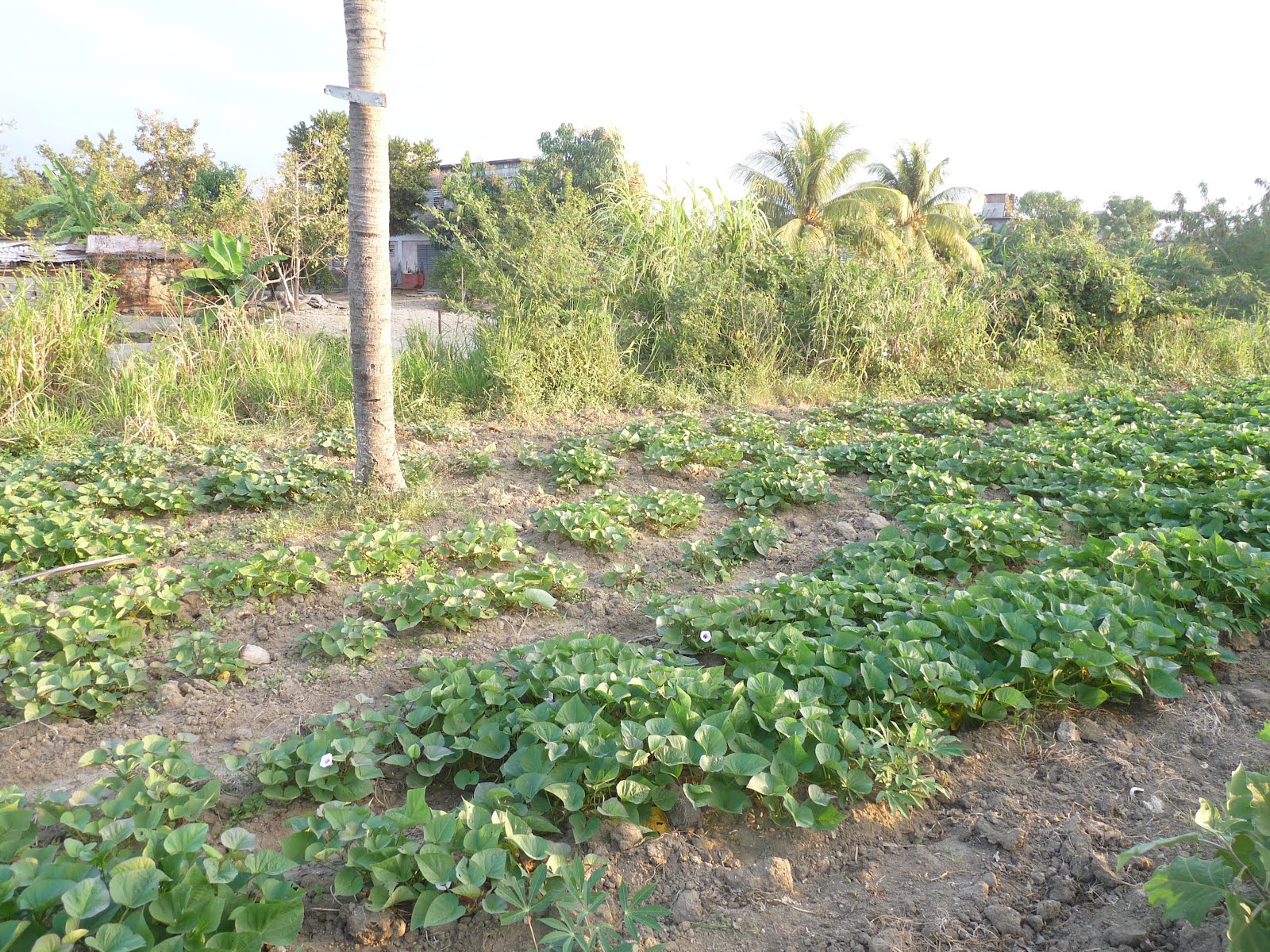

These are sweet potatoes. We only had sweet potatoes once while we were in Cuba, which I regret very much because the ones we had were absolutely superb. Of course we had them in the form of french-fries, which only adds to my enthusiasm, but they were a pale straw yellow and a bit starchier than most we get here, and just beautifully flavoured in addition to being great for fries.


A fallow field, and more sweet potatoes. It was still quite early in the morning, as you can see by the shadows, but getting warm quickly. This farm had originally been run by Chinese people, but had been abandoned during or after the revolution. (I was not quite able to put together what happened to the Chinese in Cuba. There were once very many, now there are very few. They left, is the official story. It may even be true, who knows?)


Carlos Telles Machado, who gave us the tour and who is the boss of this particular organipónico, and I had a little mutual enthuse over malanga, and then he showed us one of his other favourite things; a kind of bean that grows on large bushes in the hedgerows. Excellent dried in rice as well as fresh and green, he assured us, and gave me a handful of them. Ready in 5 months, he said. I brought them home, so we will see if I can manage to grow them by starting them early indoors. A little research told me that they are, in fact, pigeon peas.


By the end of the tour, the little market booth at the front was being opened, and we bought a few veggies to eat in our little apartment. I was going to buy some vinegar too, but it turned out it wasn't vinegar in those bottles - it was homemade wine. Controls on alcohol sales seem to be pretty much nil in Cuba, but it seems like it's mostly just the tourists who make idiots of themselves.


This was at a farm we stopped at out in the country to ask for some directions. As usual there was poultry running around, including these multi-coloured turkeys which interested me very much, as turkeys here in Canada tend to be highly overbred, and consequently not at all self-sufficient.


The other thing I was amazed to discover, is that most of the shrimp (and langosta, usually called lobster) we had been offered on various menus was farmed! I think of farmed shrimp as being terrible; bland and soggy. Certainly all the stuff we get here from Asia is very bad, not to mention notoriously unenvironmentally sound. But the Cuban shrimp tasted wild; firm, sweet and flavourful. I ate it almost at every opportunity. You can't tell from a roadside view, but this farm also did not seem to have done much if any environmental damage, being located on a rocky sea-side as it was.


The main building had this very cute and stylish shrimp sculpture out front, about which I have nothing to say except that it, like just about all the food I ate in Cuba, put a big smile on my face. I left very impressed by the hard work and ingenuity that has gone into solving Cuba's food situation, and I hope to go back soon.

Thursday, 2 February 2012

Buying Food in Cuba


As anyone who knows us will suppose, everytime we found a market we went into it. This was the first one, in Cinefuegos. It was the largest market in town, the one we were directed to when we asked about it. We actually only found one other large market in Cienfuegos, out in the eastern suburbs on Calle 60.

I was still a bit shy about taking pictures of people at this point, but do you see the 2 people in Tilley hats in the middle of the photo? It turned out they were Canadians from Edmonton, there with a class full of agriculture students who were all snapping away, so we blended in quite well! We chatted about their itinerary with them and were green with envy.


In Havana, there were smaller markets all over the place. Many of them seemed to operate on a communal basis, with what appeared to be the produce of 4 or 5 farms set up each on their own table. The actual produce didn't vary a huge amount from place to place.


This was one of the larger markets we found in Havana, actually in El Vedado. (The main part of Havana is divided into 3 main sections, from east to west; Old Havana, Central Havana, and El Vedado. Miramar is further to the west, and then it's all surrounded by lots of small suburbs.)

Look at those eggplants! We never actually saw a one cooked while we were there. I think perhaps people think tourists don't like them, and I'm afraid that's probably a fairly safe assumption. People complain about the food being very plain in Cuba, but I suspect after a few bad experiences people feeding tourists also stick to the tried and true.


Next to the main market was a government food depot, where people picked up food using their ration cards. Rice, beans, sugar, oil, vinegar, salt, milk and so forth were sold at very cheap prices here.


There wasn't any vegetables or fruit in the government market; for that you needed the regular market. There was a great selection: plantains, bananas, papaya and guava, onions and garlic, cabbage, lettuce, tomatoes, malanga, yucca, sweet potatoes and more. No mango, it wasn't mango season. I don't know what else wasn't in season. This is the cool and dry part of the year, and so winter in so far as there is one.


Another, smaller market in Havana. We bought a pineapple for 5 pesos (about 20 cents) and 5 pesos seemed to be a typical price for units of vegetables (ie. one pineapple, a can full of peppers, one pound of malanga, etc.) In general I'd say that equates to about 1/10th of the price we pay for vegetables here; very roughly of course. You have to remember though, that Cuban incomes are generally no where near 1/10th of what they are here, so for Cubans these prices are high. Not high enough to stop people from buying though; all the markets we saw of any size seem to do a pretty brisk business.


I was surprised to see how many people were selling already cut up vegetables. I had always supposed them to be a sign of effete western capitalist decadence, but I have to admit they were a good thing in Cuba. Kitchen utensils are very hard to get, and most kitchens pretty basic. They were certainly popular.


Yet another little market. I see some stacks of yummy guava jam in there. I have to say I loved all the fruit in Cuba, and it was so nice to be able to eat it and other raw produce without untoward repercussions.


Some produce heads in from an organiponico in the suburbs to restock one of those little town markets. By motorized vehicle? Not a chance. Hey look! Carrots and beets. We didn't actually see them a lot, apart from a little carrot in salads occasionally. We got served radishes once, to my surprise. No surprise, they weren't any good. Not a vegetable adapted to growing in Cuba, I wouldn't think.


The markets ranged in size from quite large to little booths like this one. You could also often buy produce from people walking around selling it out of a small cart or bag, as with this woman. She was somewhat unusual; most of the mobile sellers were male.


When my father was in Cuba at the end of the special period, he came back commenting on how skinny everyone was. Not so much any more. People were rarely fat, and the lack of motorized vehicles keep them generally pretty fit as well. However, people seemed mostly well feed and even occasionally well padded. The organiponico system and other farm reforms seem to be making a difference, along with increased tourism.

Tuesday, 31 January 2012

General Comments About Food in Cuba


So we had a great time in Cuba. We both loved it a lot, especially the people. I hardly met a one who wasn't awfully nice, even the ones who tried to scam us. (It is definitely a bit trying to be a tourist in a third world country. We were obviously foreign, and so obviously rich, and therefore we were targets for constant sales pitches and scam attempts.) In spite of that, as I said, we loved it. It was so warm, so sunny, and the architecture was beautiful.

We had been told by a lot of people before we left that the food in Cuba is bad. Not true! We were told the food is plain, and repetitive. That is true. Of course it varied a bit from place to place depending on who was cooking and what they were charging, but in general we ate well. My sister-in-law described Cuban food to us before we left as "very food-like". She was right.

We started off every breakfast, as above with plates of fresh fruit, peeled and sliced and presented without further embelishment. Why would it need it? It was lovely fruit.


In addition to fruit breakfast included hot coffee with hot milk, and toast or pastries. This casa particular, in Havana, (en el Vedado) provided some pretty fancy little pastries, different ones every day from a bakery. As far as I could see, there was next to no home baking in Cuba. Very few people have ovens. On this day there was also guava paste. The other places we were at just supplied toast and jam. Then, everyone offered eggs, usually as an omelet but your choice. After a few days Mom and I had to drop the eggs. They were just too much.


Something I had never had before is Malanga. It is more commonly known as eddoes in English, and it is very much like taro. Here Mr. Ferdzy is about to eat some malanga fritters in one of the fancier restaurants we went to. But most Cubans don't do anything fancy with malanga, and don't regard it as anything special. It's pretty common, and I suspect it's always relatively cheap and available, meaning it gets eaten a lot regardless of how you feel about it. A bit like Canadians used to be with rutabaga.


This is an absolutely typical Cuban meal, as served to tourists, anyway. It starts with fried meat (top right corner), rice and beans, boiled malanga, tostones (fried plantain), more rice and beans, and sliced tomatoes and peppers. Lightly marinated onions are used as a garnish. All of these items came up again and again, with minor variations. I loved the tostones, and this was one of the best malanga dishes we had. It had been cut in pieces and simply boiled, but in salted water which gave it a better flavour than most we had.


This was an absolutely typical salad. There was always shredded cabbage and leaf lettuce, and tomatoes. Then there was often onions, cucumber and/or carrots. This one also had canned beans, which we got a few times in salads. Dressing was always oil and vinegar, salt and pepper. I have read a number of comments claiming there isn't any pepper in Cuba. In fact there was always ground pepper at every table I ate at, but it wasn't black pepper, it was white pepper, so I think a lot of people are simply failing to recognize it. Salads were consistently fresh and good, and it was a pleasure to be able to eat them, and all the fruits, without fear of danger due to bad water quality.


The seafood was fantastic. This was grilled shrimp and lobster tails, along with a few tostones. The shrimp were superb. The lobsters were more like giant shrimp than like Canadian lobsters, and my Mom and Mr. Ferdzy both liked them better than Canadian lobsters. Heretics! Ingrates! Traitors! Although I admit I'd be very happy to eat either.


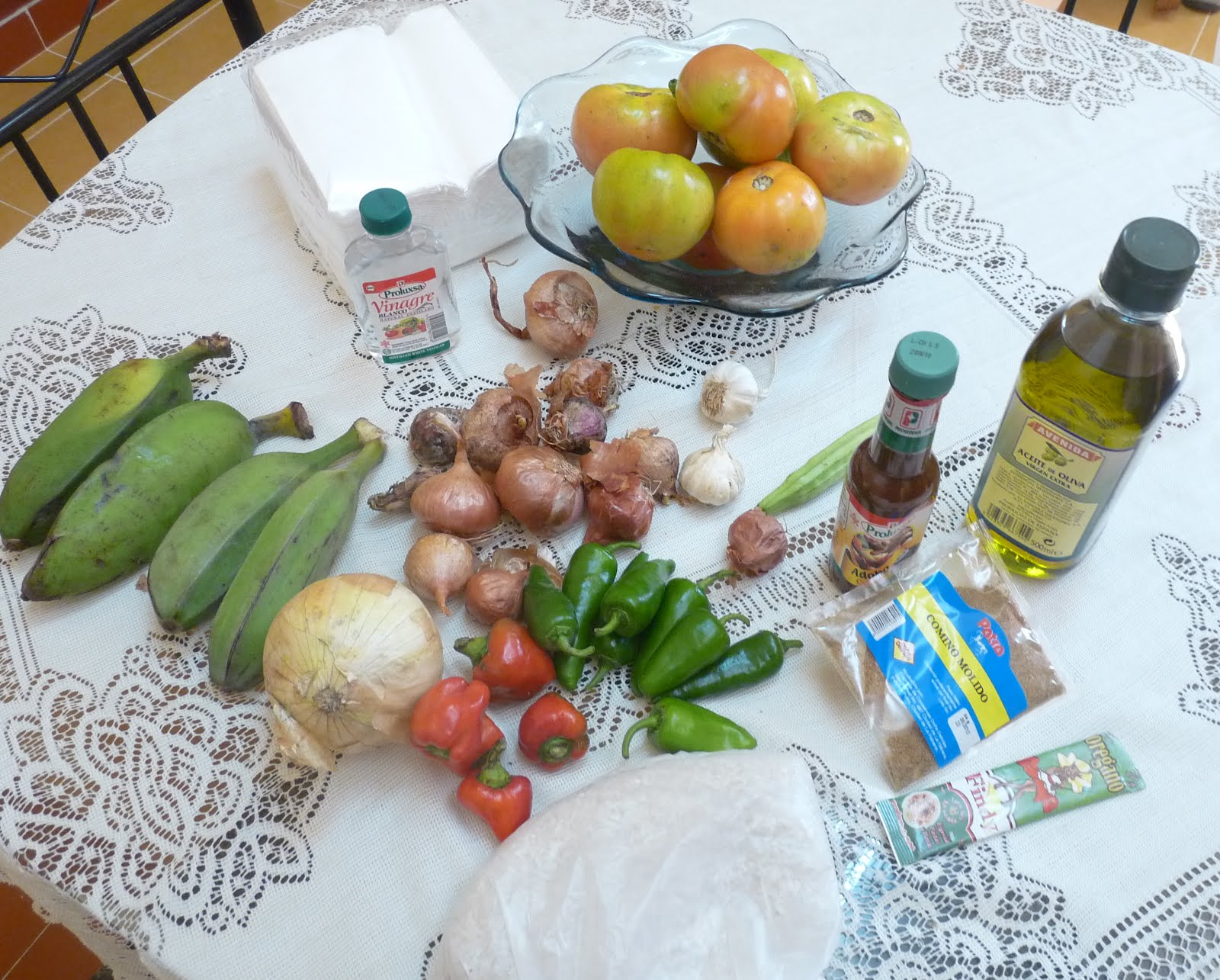
At one point we stayed in a small apartment that had a "kitchen" and I had a go at doing some cooking myself. There was a single burner hot-plate, with a choice of hot, hotter and hottest, so my efforts at cooking rice with vegetables were a bit fraught. I did manage to produce something edible and even tasty, but it was touch and go. The above is a really typical market selection. There were large white onion, small red onions, and garlic everywhere. Perhaps half a dozen common peppers, almost all sweet. And those tomatoes were really quite ripe. For some reason the Cuban tomatoes we got were generally redder on the inside than on the outside. We confirmed there are a number of varieties of tomato grown in Cuba, but the ones we had were all very similar in flavour; acidic and juicy but not seedy. Very nice, actually.


In addition to buying almost all their baked goods - and I can't tell you how many times I saw people walking down the street carrying a cake - on a plate, not wrapped - there were food vendors all over the place. This guy is selling a selection of small pastries I believe.

We talked about what kind of business we would have if we were Cubans. (Yes, we are weird.) We decided that home-made potato chips would be the way to go. We did see ONE guy in Havana selling home-made chips and popcorn, but only the one, and after we had come to our conclusion. But we saw people roaming the streets selling all kinds of things, from yucca, beans, strings of onions and garlics, to breads and pastries.


The national dish of Cuba seems to be pizza. There are little shops all over the place, many of them out of what is someones front living room. This one was near our apartment in Cienfuegos, and had exceptionally good pizza. Also a common item to sell out of your front room was ice-cream. We got some for 4 pesos a scoop. Yes, it was a small scoop. But dudes... that's 14 cents. (I wont' get into the money here, but there's 2 kinds of money in Cuba: real pesos, used by the locals, and soak-us-we're-tourists money, known as C.U.C.s. Hijinks and hilarity ensues.)


A peek inside. Unfortunately I was at the wrong time to get them coming out of the oven. Very plain; little sauce, no seasoning, just a sprinkling of cheese. And yet, very tasty somehow! And the price was hard to beat. I believe these might have been about 12 pesos - about 48 cents. A bit more expensive than average - they seemed to run from 7 pesos to about 12.


More shrimp! I ate them at every opportunity. I was surprised to discover they were likely farmed. They were firm, sweet and flavourful, everything I associate with wild shrimp. Definitely not like the farmed shrimp which we get here in Canada, which are always bland and soggy. I have given up getting shrimp here at all, they are always such a disappointment. These ones were in a lovely sauce, with sour orange juice and tomato sauce. They were described as "camarones enchiladas" meaning shrimp in chile sauce. The chiles are plainly very sweet mild ones; and this is nothing like a Mexican enchilada sauce.


And there were are, eating the shrimp. We went out for a day trip towards the end, and Jorge, our taxi driver, took the picture. He brought us to this restaurant because he and his family had stayed at a nearby resort, and he had eaten here before. An excellent choice! Many thanks to Jorge, Cesar, Janila, Acelo, Felongo, Emilio, Carlos, Jorbel, Eduardo, Tania and Adrian, and all the many other Cubans whos names have escaped me, who's kindness and generosity made our trip such a pleasure.