Two years ago we planted some Jerusalem artichokes, and they have been growing in the garden ever since. After the first summer we poked around and were underwhelmed by the number of apparent tubers, so we left them along for another year. Last fall we were too distracted to try to dig any up. However, we expected we could dig some in the spring.
We obviously left them a little too long as they are starting to sprout. Common sense says they would be, by now, but I think we were lulled into a false sense of their dormancy by how chilly it has been. They were quite useable, though! On the other hand, I have to say we were still underwhelmed by the quantity of tubers, and also impressed by how deep they were. They were quite hard to dig up!
4 servings
40 minutes prep time
Once they were up, it was quite quick and easy to fry them up and eat them for lunch...
2 cups sliced Jerusalem artichokes
1 medium onion
3 cloves of garlic
6 slices of bacon
6 large button mushrooms
1 cup water
1/4 cup finely chopped parsley
Wash, trim and slice the Jerusalem artichokes. Peel and chop the onion. Peel and mince the garlic. Chop the bacon (cut it into 1" strips). Clean and slice the mushrooms.
Start the bacon cooking in a large skillet. Once it has rendered some fat and is about half cooked, remove it to a plate, leaving the fat in the pan. Add the Jerusalem artichokes and the water, and cook over medium-high heat, stirring frequently, until the water is gone and the Jerusalem artichokes are about half cooked; about 5 to 8 minutes. Add the bacon back into the pan, along with the onion and mushrooms. Cook, stirring frequently, for about another 10 minutes, until everything is tender and slightly browned. Add the garlic and cook for just another minute or so.
Turn it into a serving dish and garnish it with the chopped parsley.
Last year at this time I made Stewed Rhubarb & Figs.
Showing posts with label Jerusalem Artichokes. Show all posts
Wednesday, 11 May 2016
Friday, 27 March 2015
Lion's Head Cabbage Rolls
Can't finish winter if I haven't made any cabbage rolls! This is a (slight) variation on a classic Chinese dish. It's usually made with nappa cabbage or bok choy, but Savoy cabbage works very well, and will be available right now. Shiitake mushrooms are more traditional than the button mushrooms, but yeah, button mushrooms were the ones I had. Jerusalem artichokes make a great stand in for water chestnuts, but if you can't find them just omit them; like water chestnuts they add more texture than flavour.
4 servings
1 hour - 40 minutes prep time
Make the Filling:
2 or 3 green onions, finely chopped
1 tablespoon finely minced peeled fresh ginger
4 to 6 large Jerusalem artichokes
500 grams (1 pound) lean ground pork
2 large eggs
1 tablespoon sherry
2 tablespoons soy sauce
1 teaspoon toasted sesame oil
freshly ground black pepper to taste
3 tablespoon tapioca starch or arrowroot starch
Put a large pot of water on to boil.
Wash, trim and chop the green onions. Peel and mince the ginger. Peel and finely chop the Jerusalem artichokes, if you are using them. Put them all in a mixing bowl with the ground pork, eggs, sherry, soy sauce, sesame oil, pepper, and starch, and mix until evenly blended.
Finish the Dish:
8 outer leaves from a medium Savoy cabbage
250 grams (1/2 pound) shiitake or button mushrooms
2 tablespoons bacon fat or vegetable oil
4 cups chicken or pork stock
a slice of ginger
1/2 teaspoon toasted sesame oil
1 tablespoon soy sauce
1 tablespoon tapioca starch or arrowroot starch
Separate the outer leaves from the cabbage carefully, keeping them whole and undamaged. Trim out the tough lower stems. Drop them, a few at a time, into the boiling water, and boil them for a minute or two. Remove them with tongs or a large slotted spoon, and rinse them under cold water until they are cool enough to handle. Drain them well.
Put 1/8 of the meat mixture in the middle of each leaf, and fold it up into a neat roll. Repeat with the remaining leaves and meat mixture.
Clean and trim the mushrooms, removing the stems entirely if you are using shiitake mushrooms. Cut them into strips or quarters.
Heat the fat or oil in a large skillet. Add the mushrooms, and cook them until softened and slightly browned, then remove them from the pan. Add the cabbage rolls in a single layer, then pour about a cup of chicken stock into the pan. Add a slice of ginger to the pan, and return the mushrooms to it as well. Cover the pan and simmer for 10 minutes.
Turn the cabbage rolls over. add the sesame oil and soy sauce, and all of the remaining chicken stock except for about 1 cup. Cover and simmer the cabbage rolls for another 10 minutes.
Mix the remaining chicken stock with the tapioca or arrowroot starch. Remove the cabbage rolls to a serving dish, leaving the broth in the pan. Stir the last of the chicken stock and starch into the pan of broth, and simmer until thickened (just a minute or two). Pour the sauce over the cabbage rolls.
Last year at this time I made Parsnips with Prunes & Lemon, and Mock Chicken Stock.
4 servings
1 hour - 40 minutes prep time
Make the Filling:
2 or 3 green onions, finely chopped
1 tablespoon finely minced peeled fresh ginger
4 to 6 large Jerusalem artichokes
500 grams (1 pound) lean ground pork
2 large eggs
1 tablespoon sherry
2 tablespoons soy sauce
1 teaspoon toasted sesame oil
freshly ground black pepper to taste
3 tablespoon tapioca starch or arrowroot starch
Put a large pot of water on to boil.
Wash, trim and chop the green onions. Peel and mince the ginger. Peel and finely chop the Jerusalem artichokes, if you are using them. Put them all in a mixing bowl with the ground pork, eggs, sherry, soy sauce, sesame oil, pepper, and starch, and mix until evenly blended.
Finish the Dish:
8 outer leaves from a medium Savoy cabbage
250 grams (1/2 pound) shiitake or button mushrooms
2 tablespoons bacon fat or vegetable oil
4 cups chicken or pork stock
a slice of ginger
1/2 teaspoon toasted sesame oil
1 tablespoon soy sauce
1 tablespoon tapioca starch or arrowroot starch
Separate the outer leaves from the cabbage carefully, keeping them whole and undamaged. Trim out the tough lower stems. Drop them, a few at a time, into the boiling water, and boil them for a minute or two. Remove them with tongs or a large slotted spoon, and rinse them under cold water until they are cool enough to handle. Drain them well.
Put 1/8 of the meat mixture in the middle of each leaf, and fold it up into a neat roll. Repeat with the remaining leaves and meat mixture.
Clean and trim the mushrooms, removing the stems entirely if you are using shiitake mushrooms. Cut them into strips or quarters.
Heat the fat or oil in a large skillet. Add the mushrooms, and cook them until softened and slightly browned, then remove them from the pan. Add the cabbage rolls in a single layer, then pour about a cup of chicken stock into the pan. Add a slice of ginger to the pan, and return the mushrooms to it as well. Cover the pan and simmer for 10 minutes.
Turn the cabbage rolls over. add the sesame oil and soy sauce, and all of the remaining chicken stock except for about 1 cup. Cover and simmer the cabbage rolls for another 10 minutes.
Mix the remaining chicken stock with the tapioca or arrowroot starch. Remove the cabbage rolls to a serving dish, leaving the broth in the pan. Stir the last of the chicken stock and starch into the pan of broth, and simmer until thickened (just a minute or two). Pour the sauce over the cabbage rolls.
Last year at this time I made Parsnips with Prunes & Lemon, and Mock Chicken Stock.
Monday, 12 November 2012
Pan Fried Jerusalem Artichokes with Ginger & Garlic
Look what has turned up at the local store! It's Jerusalem artichoke time. The more I eat these, the better I like them. Since they remind me a bit of water chestnuts I decided to cook them with Asian flavours, which I would say works well.
Be sure to have everything ready and standing by before you start cooking the Jerusalem artichokes. They should still have a bit of crunch left in them if possible.
2 servings
30 minutes - 25 minutes prep time
500 grams (1 pound) Jerusalem artichokes
2 to 3 cloves of garlic
1 tablespoon finely minced fresh ginger
2 tablespoons soy sauce
1 tablespoon apple cider vinegar
2 tablespoons water
1 teaspoon toasted sesame oil
1 teaspoon arrowroot or cornstarch
2 tablespoons mild vegetable oil
Wash the Jerusalem artichokes. They don't need to be well peeled, but pare off any tough or scabby bits. Cut them in 1/4" slices.
Peel and mince the garlic. Peel and mince the ginger. Set them aside together.
Mix the soy sauce, vinegar, water, sesame oil, and arrowroot in a small bowl.
Heat the oil in a mid-sized heavy skillet. Sauté the Jerusalem artichoke slices until evenly browned, about 4 minutes. Add the garlic and ginger and mix in well. Stir up the sauce and mix it in well. As soon as it is thick and evenly distributed - under a minute - serve up the dish.
Last year at this time I made Brussels Sprouts & Jerusalem Artichokes - how bout that - and Light Christmas Fruitcake. This years' is already sitting in the cold room, marinating. I made three smaller loaves this year, and should go update the baking info.
Be sure to have everything ready and standing by before you start cooking the Jerusalem artichokes. They should still have a bit of crunch left in them if possible.
2 servings
30 minutes - 25 minutes prep time
500 grams (1 pound) Jerusalem artichokes
2 to 3 cloves of garlic
1 tablespoon finely minced fresh ginger
2 tablespoons soy sauce
1 tablespoon apple cider vinegar
2 tablespoons water
1 teaspoon toasted sesame oil
1 teaspoon arrowroot or cornstarch
2 tablespoons mild vegetable oil
Wash the Jerusalem artichokes. They don't need to be well peeled, but pare off any tough or scabby bits. Cut them in 1/4" slices.
Peel and mince the garlic. Peel and mince the ginger. Set them aside together.
Mix the soy sauce, vinegar, water, sesame oil, and arrowroot in a small bowl.
Heat the oil in a mid-sized heavy skillet. Sauté the Jerusalem artichoke slices until evenly browned, about 4 minutes. Add the garlic and ginger and mix in well. Stir up the sauce and mix it in well. As soon as it is thick and evenly distributed - under a minute - serve up the dish.
Last year at this time I made Brussels Sprouts & Jerusalem Artichokes - how bout that - and Light Christmas Fruitcake. This years' is already sitting in the cold room, marinating. I made three smaller loaves this year, and should go update the baking info.
Labels:
10 October,
11 November,
12 December,
Jerusalem Artichokes,
Side Dish
Monday, 21 November 2011
Jerusalem Artichoke Caponata
We had a gathering of the clan this weekend, and I experimented on them. (What else are relatives for?) I had had the thought, a while back, that perhaps the classic artichoke caponata could be made with Jerusalem artichokes - there really is a similarity of flavour, after all - and so I did. Yes, it works! Although the distinct flavour of the Jerusalem artichokes did come through; especially right after I made the caponata. Leftovers the next day actually tasted quite a lot like caponata made with actual artichokes.
I did not put olives in mine, I only garnished it with a few, as I knew I was serving some olive-haters. If you are not labouring under this handicap, I think it is not a bad idea to toss a few in. I've said 2 tablespoons, but since I didn't actually do it, I'm not sure. If anyone makes this and adds olives, please let me know what you think.
30 minutes prep time
8 to 16 servings

450 grams (1 pound) Jerusalem artichokes
1/4 cup dried tomatoes
1 clove of garlic
50 grams (2 ounces) Parmesan cheese, finely grated
2 tablespoons green olives (optional)
2 to 3 tablespoons mayonnaise (light is fine)
Peel the Jerusalem artichokes, cut them in half, and put them into cold water as you work. Put a small pot of water on to boil, and snip the tomatoes into bits.
When the water boils, add the Jerusalem artichokes and tomato bits and boil for 5 minutes. Drain well and let cool.
Peel the garlic, and chop it a bit. Grate the cheese. Put the Jerusalem artichokes, tomatoes, garlic, cheese and olives (if using) into a food processor and chop finely. Add the mayonnaise and pulse in briefly. Remove the caponata to a serving dish. You can serve it at once, but it's best to let it rest in the fridge for a couple of hours to allow the flavours to blend. Let it sit out for a few minutes before serving to come up closer to room temperature.
Last year at this time I made Stir Fried Brussels Sprouts & Mushrooms.
I did not put olives in mine, I only garnished it with a few, as I knew I was serving some olive-haters. If you are not labouring under this handicap, I think it is not a bad idea to toss a few in. I've said 2 tablespoons, but since I didn't actually do it, I'm not sure. If anyone makes this and adds olives, please let me know what you think.
30 minutes prep time
8 to 16 servings
450 grams (1 pound) Jerusalem artichokes
1/4 cup dried tomatoes
1 clove of garlic
50 grams (2 ounces) Parmesan cheese, finely grated
2 tablespoons green olives (optional)
2 to 3 tablespoons mayonnaise (light is fine)
Peel the Jerusalem artichokes, cut them in half, and put them into cold water as you work. Put a small pot of water on to boil, and snip the tomatoes into bits.
When the water boils, add the Jerusalem artichokes and tomato bits and boil for 5 minutes. Drain well and let cool.
Peel the garlic, and chop it a bit. Grate the cheese. Put the Jerusalem artichokes, tomatoes, garlic, cheese and olives (if using) into a food processor and chop finely. Add the mayonnaise and pulse in briefly. Remove the caponata to a serving dish. You can serve it at once, but it's best to let it rest in the fridge for a couple of hours to allow the flavours to blend. Let it sit out for a few minutes before serving to come up closer to room temperature.
Last year at this time I made Stir Fried Brussels Sprouts & Mushrooms.
Tuesday, 8 November 2011
Brussels Sprouts & Jerusalem Artichokes
Finally! We got some more-or-less edible Brussels sprouts from the garden. Gosh, they are hard to grow. Ours are very loose and also, er, highly organic or is the phrase high in protein? At any rate I gave them a good soak in very salty cold water before I cooked them. Now if we can just figure out how to get them to form denser heads next time.
I hoped this combo would be good and I have to say, it really was. I'll be making this again, for sure.
30 minutes - 20 minutes prep time

Prepare the Vegetables:
12 to 16 Brussels sprouts
8 to 10 Jerusalem artichokes
4 large shallots
Wash and trim the Brussels sprouts, and cut an "x" in the bottom of each if they are large. Peel the Jerusalem artichokes, and slice them in fairly large slices. Put them in a dish of cold water as you go. Peel the shallots, and cut them in halves or quarters lengthwise.
Finish the Dish:
1 tablespoon mild vegetable oil
1 or 2 tablespoons soy sauce, low sodium is fine
1 teaspoon toasted sesame oil
Heat the oil in a large skillet. Add the Brussels sprouts, with a few tablespoons of water, and cook over medium heat until they turn a bright green and the water evaporates. Add the shallots and the Jerusalem artichokes, and continue cooking until the shallots are browned in spots and look cooked through. Season with the soy sauce and sesame oil, and as soon as they seem to be absorbed by the vegetables, remove them to their serving dish.
Last year at this time I made Swiss Chard Rolls.
I hoped this combo would be good and I have to say, it really was. I'll be making this again, for sure.
30 minutes - 20 minutes prep time
Prepare the Vegetables:
12 to 16 Brussels sprouts
8 to 10 Jerusalem artichokes
4 large shallots
Wash and trim the Brussels sprouts, and cut an "x" in the bottom of each if they are large. Peel the Jerusalem artichokes, and slice them in fairly large slices. Put them in a dish of cold water as you go. Peel the shallots, and cut them in halves or quarters lengthwise.
Finish the Dish:
1 tablespoon mild vegetable oil
1 or 2 tablespoons soy sauce, low sodium is fine
1 teaspoon toasted sesame oil
Heat the oil in a large skillet. Add the Brussels sprouts, with a few tablespoons of water, and cook over medium heat until they turn a bright green and the water evaporates. Add the shallots and the Jerusalem artichokes, and continue cooking until the shallots are browned in spots and look cooked through. Season with the soy sauce and sesame oil, and as soon as they seem to be absorbed by the vegetables, remove them to their serving dish.
Last year at this time I made Swiss Chard Rolls.
Monday, 21 March 2011
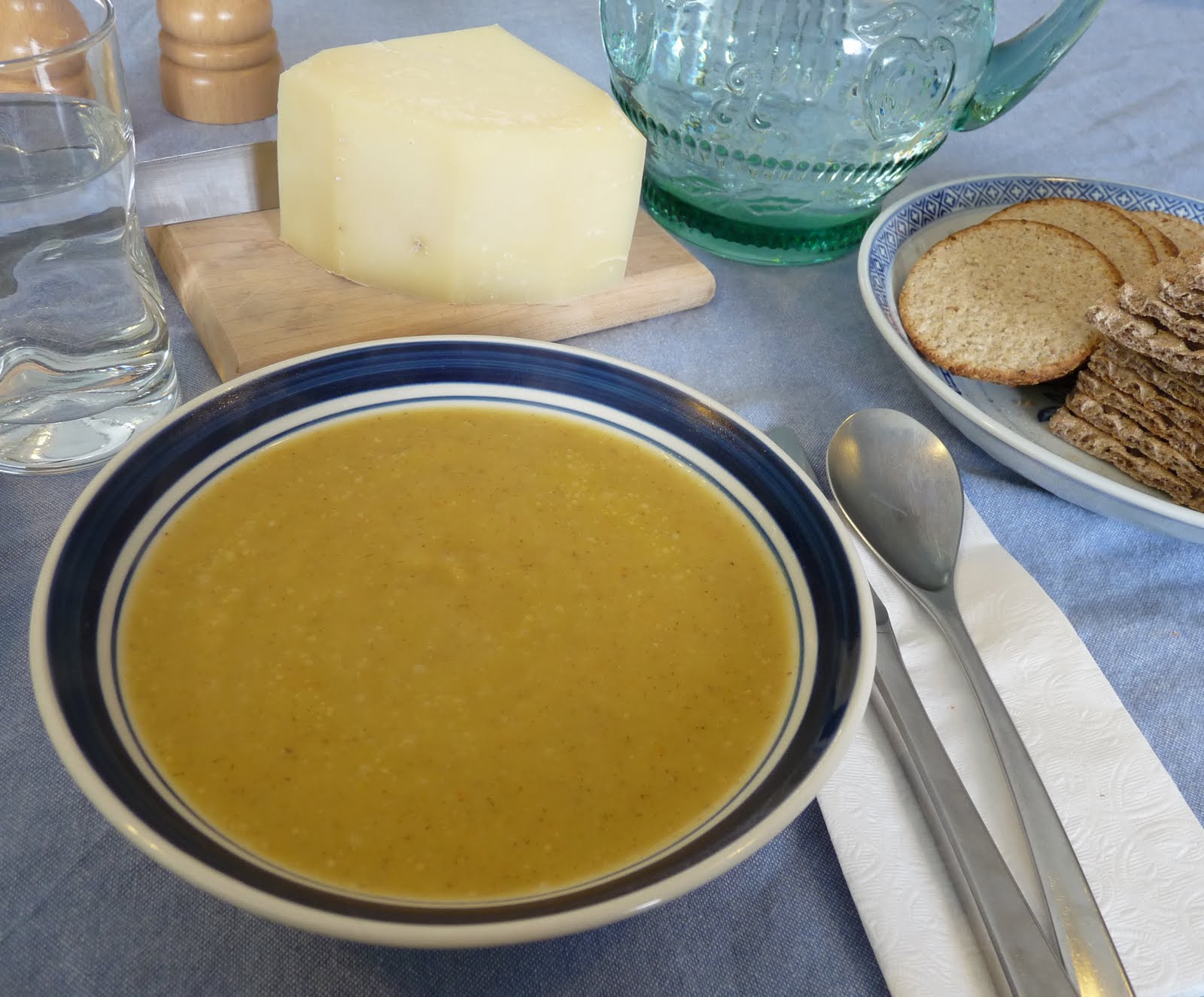
Palestine Soup (Jerusalem Artichoke Soup)
Well I'm ba-aaack, I guess. It was an odd week on the computer front. I have not yet really been disconnected from the internet, but as it turns out our old accounting program is so old that the new computer won't run it. We have been obliged to come up with another one (we're trying Gnucash, which is a free program and looks very good) and so have been busy re-entering 2 1/2 years of accounting entries. Oh joy. Still, it's an interesting exercise. I always thought we were fairly budget conscious, but even a year ago we were much more likely to take a "we NEED it - we have to buy it" attitude than we are now. Partly when we moved into a new house there was a bunch of things we did need, I guess, but I think we are also just much more likely to think twice now. Anyway, food...
This is a traditional British soup made with Jerusalem artichokes. There is of course no connection with Palestine beyond their name, which comes through an odd quirk of history - they are from the great lakes region of North America, and are not artichokes.
It's a lovely, mild but full-flavoured soup. I served mine without any topping and did not really miss it. Croutons and bacon bits were another recommended topping which would add a nice bit of crunch to the very smooth soup. (And the soup should be very smooth - as smooth as you can get it. Don't be afraid to cook the vegetables quite soft, and a blender is probably better than a food processor if you have one.)
4 to 6 servings
1 hour 20 minutes - 40 minutes prep time

500 grams (1 pound) Jerusalem artichokes
3 shallots
1 cup grated celeriac, or 1 celery stalk
1 cup grated carrot (1 smallish)
1 tablespoon butter or other fat
2 cups good stock or broth
salt & pepper
yogurt or sour cream, if desired
Scrub the artichokes well, and trim off any bad spots. Chop them roughty, and put them on to boil in a large soup pot with about 4 cups of water.
Meanwhile, peel and chop the shallots, and peel and grate the celeriac and carrots. (Trim and chop the celery if using.)
Heat the butter or fat - I had some fat on top of my stock, and used that - and cook down the shallots, celeriac and carrot until quite soft but not browned. Set them aside until the artichokes are ready.
When the artichokes are tender, drain them but keep the cooking water. Purée them very well with the cooked down vegetables in a blender or food processor, adding some of the cooking water as needed to keep them fluid. You will quite certainly need to do this in more than one batch.
Return the puréed soup to the soup pot. Swish out the blender or food processor with any remaining cooking liquid, and add it to the soup. Add the stock.
Reheat the soup and season to taste with salt and pepper. Serve as-is, or with a dollop of sour cream or yogurt.
Last year at this time I made Chick Pea & Potato Curry #2 and Sweet Breakfast Buns.
This is a traditional British soup made with Jerusalem artichokes. There is of course no connection with Palestine beyond their name, which comes through an odd quirk of history - they are from the great lakes region of North America, and are not artichokes.
It's a lovely, mild but full-flavoured soup. I served mine without any topping and did not really miss it. Croutons and bacon bits were another recommended topping which would add a nice bit of crunch to the very smooth soup. (And the soup should be very smooth - as smooth as you can get it. Don't be afraid to cook the vegetables quite soft, and a blender is probably better than a food processor if you have one.)
4 to 6 servings
1 hour 20 minutes - 40 minutes prep time
500 grams (1 pound) Jerusalem artichokes
3 shallots
1 cup grated celeriac, or 1 celery stalk
1 cup grated carrot (1 smallish)
1 tablespoon butter or other fat
2 cups good stock or broth
salt & pepper
yogurt or sour cream, if desired
Scrub the artichokes well, and trim off any bad spots. Chop them roughty, and put them on to boil in a large soup pot with about 4 cups of water.
Meanwhile, peel and chop the shallots, and peel and grate the celeriac and carrots. (Trim and chop the celery if using.)
Heat the butter or fat - I had some fat on top of my stock, and used that - and cook down the shallots, celeriac and carrot until quite soft but not browned. Set them aside until the artichokes are ready.
When the artichokes are tender, drain them but keep the cooking water. Purée them very well with the cooked down vegetables in a blender or food processor, adding some of the cooking water as needed to keep them fluid. You will quite certainly need to do this in more than one batch.
Return the puréed soup to the soup pot. Swish out the blender or food processor with any remaining cooking liquid, and add it to the soup. Add the stock.
Reheat the soup and season to taste with salt and pepper. Serve as-is, or with a dollop of sour cream or yogurt.
Last year at this time I made Chick Pea & Potato Curry #2 and Sweet Breakfast Buns.
Labels:
01 January,
02 February,
03 March,
10 October,
11 November,
12 December,
Jerusalem Artichokes,
Soup
Thursday, 5 November 2009
Pork & Jerusalem Artichoke Won-Tons
Jerusalem artichokes, if cooked only briefly, have nice mild crunch to them, much like water-chestnuts, so unlike my other won-tons these ones seem fairly traditional.
If you don't want so many won-tons, either cut the recipe in half, or form the leftover filling into little meatballs. Brown them, then add them to broth to simmer for about 10 minutes. You can add any leftover won-ton wrappers, cut in strips like noodles as well if you like. Much less work, and very tasty.
72 won-tons, at least
1 hour prep time, also at least

450 grams (1 pound) lean ground pork
6 to 10 large Jerusalem artichokes
1 small leek
2 to 3 cloves of garlic
2 to 3 tablespoons finely minced or grated fresh ginger
1 teaspoon toasted sesame oil
1 teaspoon salt
1 package won-ton wrappers
Peel the Jerusalem artichokes, putting them in icy cold water to soak as you work. When they are all peeled, chop them fairly finely and put them in a mixing bowl. Trim the leek, discarding any tough dark green parts and the roots. Mince the leek very, very finely, and add it to the bowl. Peel and mince the garlic, and peel and mince or grate the ginger. Into the bowl they go along with the pork, the sesame oil and salt. Using your clean hands, mix the filling thoroughly.
Have a small bowl of cold water standing by, and also a plate or tray to put the finished won-tons. Put a teaspoon of the filling - no more - onto a wonton wrapper. Dip a finger in the water, and wet 2 sides of the wrapper along the edge. Fold the wrapper in half, dry sides to wet sides, and pinch sealed. Dampen the three corners slightly, and fold the outside corners in and up, pinching them against the top corner. Set the finished won-ton on the plate or tray, and do it again. And again... until you have finished all of the filling or the wrappers, you have made enough, or you just can't stand it any more.
Cook the won-tons the same way as pot-stickers; by cooking them in a heavily oiled pan on one side for 1 or 2 minutes, until nicely browned. Turn them over, and add about half a cup of water. Cook steadily until the water has evaporated, and the dumplings are firm. Add a little more water if needed. Lift them out carefully, and serve them with a dipping sauce of 1 teaspoon soy sauce to 2 teaspoons rice vinegar, if you like.
You can also put them in chicken broth and cook them for 10 minutes for soup, or deep fry them.
Last year at this time I made Swedish Meatballs.
If you don't want so many won-tons, either cut the recipe in half, or form the leftover filling into little meatballs. Brown them, then add them to broth to simmer for about 10 minutes. You can add any leftover won-ton wrappers, cut in strips like noodles as well if you like. Much less work, and very tasty.
72 won-tons, at least
1 hour prep time, also at least
450 grams (1 pound) lean ground pork
6 to 10 large Jerusalem artichokes
1 small leek
2 to 3 cloves of garlic
2 to 3 tablespoons finely minced or grated fresh ginger
1 teaspoon toasted sesame oil
1 teaspoon salt
1 package won-ton wrappers
Peel the Jerusalem artichokes, putting them in icy cold water to soak as you work. When they are all peeled, chop them fairly finely and put them in a mixing bowl. Trim the leek, discarding any tough dark green parts and the roots. Mince the leek very, very finely, and add it to the bowl. Peel and mince the garlic, and peel and mince or grate the ginger. Into the bowl they go along with the pork, the sesame oil and salt. Using your clean hands, mix the filling thoroughly.
Have a small bowl of cold water standing by, and also a plate or tray to put the finished won-tons. Put a teaspoon of the filling - no more - onto a wonton wrapper. Dip a finger in the water, and wet 2 sides of the wrapper along the edge. Fold the wrapper in half, dry sides to wet sides, and pinch sealed. Dampen the three corners slightly, and fold the outside corners in and up, pinching them against the top corner. Set the finished won-ton on the plate or tray, and do it again. And again... until you have finished all of the filling or the wrappers, you have made enough, or you just can't stand it any more.
Cook the won-tons the same way as pot-stickers; by cooking them in a heavily oiled pan on one side for 1 or 2 minutes, until nicely browned. Turn them over, and add about half a cup of water. Cook steadily until the water has evaporated, and the dumplings are firm. Add a little more water if needed. Lift them out carefully, and serve them with a dipping sauce of 1 teaspoon soy sauce to 2 teaspoons rice vinegar, if you like.
You can also put them in chicken broth and cook them for 10 minutes for soup, or deep fry them.
Last year at this time I made Swedish Meatballs.
Thursday, 29 October 2009
Braised White Beans & Root Vegetables
For some reason, I don't make this very often. Then I make it, and realize I'm missing out. Sure, it seems rather plain and basic, but it's so very, very good in its plain and basic way, like Shaker furniture. Mild - at least as mild as something with that much garlic can be - but richly and subtly flavoured by the Jerusalem artichokes, and it sits easily on the stomach. You could serve it with any kind of roast or chops, but it is perfectly capable of holding its own as a vegetarian main dish, which is how I generally serve it. Leftovers reheat very nicely, should you actually manage to have any. I always think it should make two meals, but we always both go back for seconds and what is left is more of a snack.
I'm pretty sure I got this recipe, or at least its progenitor, from The Mediterranean Diet Cookbook, by Nancy Harmon Jenkins.
4 to 6 servings
1 1/2 to 2 hours - 30 minutes prep time;
overnight if including preparing the beans.

Prepare the Beans:
2 cups white pea (navy) beans
OR white kidney beans
Put the beans in a pot with water to cover, and bring to a boil. Turn off the heat and let them soak overnight (best) or 3 or 4 hours at least. Change the water, and bring them to a boil. Simmer until barely tender. This can be done in advance and the beans kept in the fridge for up to three days before finishing the dish.
Prepare the Vegetables and Bake:
6 to 8 large Jerusalem artichokes
1 fist-sized piece of celeriac,
OR 2 or 3 stalks of celery
1 large carrot
1 large potato
1 medium kohlrabi (optional)
1 large onion OR leek
3 or 4 cloves of garlic
2 or 3 tablespoons sunflower seed oil
the juice of 1 large lemon
salt & pepper; plenty of both
Preheat the oven to 450°F.
Put the beans and their cooking water in a large baking dish with a cover. Add the Jerusalem artichokes, peeled (if you like) and cut into largish bean-sized dice, the celeriac, peeled (definitely) and cut into bean-sized dice, the carrot, peeled and cut into bean-sized dice, the potato, scrubbed and ditto, the kohlrabi, peeled and diced, the onion or leek, peeled and chopped. Just for a change, peel and mince the garlic. All these go into the pot.
Drizzle over the oil and lemon juice, and season generously with salt and freshly ground black pepper. Give it a stir, and put on the cover. Bake for an hour, or a bit longer if necessary, until the vegetables are tender.
Last year at this time I made Tea-Poached Pears with Honey.
I'm pretty sure I got this recipe, or at least its progenitor, from The Mediterranean Diet Cookbook, by Nancy Harmon Jenkins.
4 to 6 servings
1 1/2 to 2 hours - 30 minutes prep time;
overnight if including preparing the beans.
Prepare the Beans:
2 cups white pea (navy) beans
OR white kidney beans
Put the beans in a pot with water to cover, and bring to a boil. Turn off the heat and let them soak overnight (best) or 3 or 4 hours at least. Change the water, and bring them to a boil. Simmer until barely tender. This can be done in advance and the beans kept in the fridge for up to three days before finishing the dish.
Prepare the Vegetables and Bake:
6 to 8 large Jerusalem artichokes
1 fist-sized piece of celeriac,
OR 2 or 3 stalks of celery
1 large carrot
1 large potato
1 medium kohlrabi (optional)
1 large onion OR leek
3 or 4 cloves of garlic
2 or 3 tablespoons sunflower seed oil
the juice of 1 large lemon
salt & pepper; plenty of both
Preheat the oven to 450°F.
Put the beans and their cooking water in a large baking dish with a cover. Add the Jerusalem artichokes, peeled (if you like) and cut into largish bean-sized dice, the celeriac, peeled (definitely) and cut into bean-sized dice, the carrot, peeled and cut into bean-sized dice, the potato, scrubbed and ditto, the kohlrabi, peeled and diced, the onion or leek, peeled and chopped. Just for a change, peel and mince the garlic. All these go into the pot.
Drizzle over the oil and lemon juice, and season generously with salt and freshly ground black pepper. Give it a stir, and put on the cover. Bake for an hour, or a bit longer if necessary, until the vegetables are tender.
Last year at this time I made Tea-Poached Pears with Honey.
Wednesday, 28 October 2009
Jerusalem Artichokes
Not from Jerusalem, nor are they artichokes. These are in fact the roots of helianthus tuberosus, which translates as the tuber-rooted sunflower. It is believed that the "Jerusalem" part of the name derives from "girasol", meaning to turn with the sun; as many flowers do. The artichoke part comes from a perceived similarity of flavour.
These are a very interesting vegetable, although not widely known. They are one of only two garden vegetables known to have originated in the Great Lakes region (the other is acorn squash) , so they are truly local in a way nothing else is. Also, because they store carbohydrates as inulin, they have a very unusual nutritional profile, and are often considered very appropriate for people with diabetes. However, the same inulin content makes them very prone to cause flatulence; they should be introduced to the diet fairly slowly if you are not accustomed to them.
If you look closely at the picture, you can see that there are two different colours of Jerusalem artichokes on the plate. Jerusalem artichokes, like potatoes, are grown from tubers which are clones, although in the Jerusalem artichokes the differences are very subtle and more of interest to the gardener than the chef. Once they are peeled, the remaining pale, creamy flesh is pretty much indistinguishable between varieties. Some varieties may be a bit rounder and smoother than others, making them easier to peel. I had a choice of two colours and I noticed that the darker red ones seemed more popular than the gold ones; there weren't many left for me to choose from when I bought them.
Unlike potatoes, they can be eaten raw, although I find them a tad starchy. They are crisp and juicy though, and would be a good source of crunch in salads or crudité plates. Quickly stir-fried, they make a good substitute for water chestnuts. In Victorian England, they became the basis of a popular soup called, inevitably, Palestine soup. They can be be steamed, boiled, fried or baked. Their flavour is subtle, but appealing. My mom says they remind her of jicama, and I can see the resemblance although they are not as delicately scented, I don't believe (it's been a good while since I've had a jicama!) Most people do peel them, but it isn't necessary; a good scrub will do.
I have not tried growing them, but I gather that they are both easy and difficult to grow, or rather, the difficulty lies in getting them to stop growing. They benefit from being dug and moved to new, enriched ground each year - they will produce larger, less knobby tubers this way - but if any bit of root is left behind in the old bed it will sprout and soon replace itself, so care must be taken when harvesting them. Even with care, you are likely to end up with permanent Jerusalem artichoke beds, so while I am interested in growing them I am going to think twice about where to put them. People describe them using words like "thug" and "bully", so be warned.
They should be planted in the spring, according to William Woys Weaver, and in mid-summer pruned to 18" in height then earthed up with rotted manure and mulch. I imagine this must delay the lovely golden blooms, but it should ensure good, big tubers. (Relatively speaking. Jerusalem artichokes are not so large as your average potato; golf ball size is typical, I would say.) Once the plant has been nipped by frost, the tubers can be dug up and enjoyed, or stored for later use.
Subscribe to:
Comments (Atom)