I've actually been making these all winter. Last summer, at the exact moment that the peas were ripe and we should have been home shelling and freezing them, one of Mr. Ferdzy's cousins in Toronto was having her Bat Mitzvah, and we went down and spent an entire weekend celebrating. When we got home the state of the peas was fairly dire, and we needed to perform triage. Literally; there was about one third that was still high quality, one third that was starchy but maybe edible, and one third that we didn't even pick, and left to go to seed. Well, at least we have lots of peas for seed now.
I labelled the starchy peas "soup" when we froze them, because that was what I expected to do with them. But then I remembered this recipe for Vegetable Patties and thought they would do well in it. They did indeed, and so that's how we ate them, about once a week all winter. We've gotten quite addicted to them although I think deliberately leaving our peas to go starchy is probably not a good plan. However, it's awfully easy to end up with peas that are just a hair too ripe to be ideal, and this is a great thing to do with them.
I keep being tempted to put the patties in a bun or sandwich, but of course I'm making them in the first place in part because when I want a quick meal, sandwiches and pasta are no longer reasonable choices. But I'm sure they'd be so good that way! I don't see them with ketchup or mustard or pickles, but relish, chutney, mayonnaise, tartar sauce, etc all sound like they would work well with them. Anything you think would go well with peas. Lettuce, certainly, and maybe a slice of tomato.
We just plonk them on a plate, and eat them with a dab of the sauce, and find them very enjoyable.
2 to 4 servings - 8 patties
30 minutes prep time
Make the Patties:
1 cup chick pea flour
1/4 teaspoon salt
1 teaspoon dry mint OR 1 tablespoon finely minced fresh mint
1 green onion
2/3 cup water
2 cups blanched fresh shelled peas or thawed frozen peas
2 to 3 tablespoons mild vegetable oil
Measure the chick pea flour into a small bowl and add the seasonings. Wash, trim, and finely chop the green onion and add it. Mix in the water and let the mixture rest for a few minutes while you make the sauce and mash the peas.
Mash the peas rather coarsely and mix them into the batter.
Heat half of the oil in a large skillet over medium-high heat; about the usual temperature for cooking eggs or pancakes. Spoon half the batter into the pan in the form of 4 equal pancakes. Spread them out to about half an inch thick, and cook until set and lightly browned on each side; about 2 or 3 minutes per side. Transfer them to a serving plate, add the remaining oil to the pan, and cook the remaining batter in the same way. Serve at once with the sauce.
Make the Sauce:
1/2 cup mayonnaise OR thick yogurt
1 clove garlic
1/8 teaspoon salt
finely minced mint OR other herbs to taste
Measure the mayonnaise or yogurt into a small bowl. Peel and mince the garlic and add it, with the salt and a few teaspoons of finely minced herbs, if you like. Serve this with the finished patties.
Last year at this time I made Ham & Snap Pea Pasta Salad with Honey Mustard Dressing.
Monday, 29 June 2020
Friday, 26 June 2020
Post Solstice Garden Update
Hey, look at that! That liquid is water, and it fell! from! the! sky! Did you even know water could do that!? We were seriously starting to wonder if rain was only an ancient legend, but at last it has been proven to be a real thing. In good time too, because all our plants were starting to look very dry and floppy, in spite of us spending hours every day at the end of a hose. We had even started to implement the emergency tree watering plan, which means it was an emergency. So, WHOO! This was good.
Our garlic looks magnificent this year. I'll soon be pulling some extremely nice looking rutabaga greens to thin them, and the carrots are doing very well. In the third bed over, the onions are... okay, I guess. We had serious problems with germination followed by serious problems with transplanting, but the survivors are starting to look like they will do. Beyond them, the potatoes are mixed bag. Actual potatoes are doing well, but transplanted seedling looked very promising for about a week before they started to dwindle. Something eating them, and it's not even potato bugs. I don't know.
There's been some windy times lately, and the tall peas show the prevailing direction. We're starting to pick snap peas, and other mid-season peas are flowering and forming pods. Good, because the early pea beds are in full production and we hope to actually pull them out and replant beans in their spot within a week. Speaking of beans, the full-season pole beans are just starting to climb, but in general they look fine. They usually do, for about another month before the anthracnose really starts to bite.
Immediately after our big rain, the watermelons went from "doing okay but sitting there" to sending out vines. This is the 5th - I think - year of growing out the golden rind cross and we will be watching these with interest.
Zucchini, up to the post, with butternut squash beyond that first post. That monstrous large one is an interspecies cross, we are pretty sure, and as such we don't know what to expect, beyond monstrous large. Should be
Over in the leaf section, the spinach is way over and the lettuce is getting bitter and bolting. I'm hoping some cooler weather following the big rain will keep it usable for another week, but it's time to thin and replant, leaving a bit to go to seed. Brassicas are doing terribly. They went out looking small but nice, but some critter has been eating the hell out of them. Snails? Chipmunks? We do not even know, but popping half a pop bottle over them seems to be keeping them safe for the moment, so we are reseeding where they have been destroyed and covering the survivors.
Leeks are still in their original trenches but they seem to have doubled in size after the rain, and within a week or two we should be able to do their final plant out, in deeper holes to keep them long and pale. Celeriac is surviving, but it sure was iffy for quite a while.
Another view back at the root beds - potatoes and beets in the first bed, along with a little (hah) self-seeded lettuce, which will need thinning, hopefully this afternoon. Then the onions, carrots and rutabaga, garlic, and since the rain brought in some chillier temperatures, the sweet potatoes got covered until it warms up again.
The barley is starting to form seed heads! This is the Dango Mugi barley. It is probably doing the best of the 4 types we planted, which is mildly a pity as I wanted tall barley straw and it is somewhat short. I will be watching the barley carefully because I suspect it will be a tug-of-war to keep it from the critters.
Down at the other end of the bed the Valsergerste (which is tall!) is doing very well, with the mixed types and Lawina being slow to start. I've got a bunch of herbs in there as well as some pea breeding experiments, but those got put into available spaces; it's not that they crowded the barley out.
In the background you can see a huge pile of wood chips. We had a tree service come in and cut down at least a dozen trees, including some of our old apple trees, which were starting to drop limbs all over. I'm counting a couple of big downed limbs from our willow trees, because they were certainly the size of any medium tree. However, most of them were ash trees. We don't, as it turns out, seem to have ash borer, but they are all somewhere between ill health and dead anyway.
It makes the garden seem strange and unfamiliar, but I hope the greater openness will help some spots in the garden have less shade and tree root infiltration, and the wood chips are already being deployed as mulch - we go through massive amounts of mulch, so that's a bonus.
So far this has been a quite different summer from last year. Like last year, the rain has thus far been pretty intermittant at best but unlike last year there has been a LOT of heat. It's been odd, though: the swings between high and low temperatures have been extreme and a recurring feature. It seems to still be happening even as we get well away from spring. I'm noticing a few plants like strawberries and peonies are not doing well this year, and I think it is because they flower and fruit so early in the season that they must do a great deal of preparatory growth the year before. I'm hoping both will be better next year, thanks to higher heat levels and what has so far been J-I-T watering.
Wednesday, 24 June 2020
Basic Very Low Sugar Ice Cream
I started fooling around with this recipe last summer, after reading this recipe at The Guardian. As it stood, it was of no use to me as it called for condensed milk, which is sweetened (very sweetened). I decided, though, to see what I could do with evaporated milk, which isn't. The trouble with evaporated milk is that it is much thinner, and freezes differently. How would it work if made into a custard with an egg, I wondered?
The answer is, fairly well. The chocolate version of this is really quite excellent. So far, the berry version is not quite so good, being prone to large ice crystals forming in it. It also freezes much harder than commercial ice cream and must be tempered. However, it is ice cream, and ice cream that doesn't have large amounts of sugar in it, meaning that I can eat it.
I will, no doubt, continue to play around with this - especially if the weather continues at some of the temperatures we've been seeing so far - and I will probably post specific flavours separately.
I started off using an erythritol-monkfruit artificial sweetener (available at Bulk Barn). It's supposedly an all-natural artificial sweetener, and it is not supposed to raise your insulin levels, unlike other artificial sweeteners. It gets recommended a lot because of that, but I am a little dubious about it, and it still has a slightly odd aftertaste. I also found the sweetening effect to be a bit unpredictable when used alone so I tend to either just use real sugar or other regular sweeteners, or use half sugar and half of the erythritol-monkfruit blend.
Note that The Guardian's recipe calls for adding a little alcohol to keep it soft. You can do that if you like, but be aware that alcohol is basically sugar.
8 to 12 servings
about 25 minutes total prep time
allow at least 3 hours for cooling and freezing
Make the Base:
1 354 ml tin evaporated milk
1 large egg
1/8 teaspoon salt
2 to 3 tablespoons sweetener of choice
1 1/3 cup whipping cream
Open (puncture in two spots) the tin of evaporated milk and pour it all into the top of a double boiler. Whisk in the egg and salt, and sweetener of your choice, the amount and type being up to you and depending on other flavourings and ingredients to be added. Also depending on the flavour of ice cream desired, other ingredients may be added now; for instance if making chocolate ice cream the cocoa powder and chocolate should go in with the sweetener.
Heat the mixture over simmering water, whisking regularly at the beginning, moving into whisking constantly as the mixture begins to thicken. Once it has thickened - and it's a thin custard, so the effect will be fairly subtle - remove it from the heat at once and let cool to room temperature before proceeding. There are some flavourings (for example the mashed berries) which may need to be added once the base is cool.
Beat the whipping cream until very stiff, and fold it into the cooled ice cream base. Transfer the mixture to a freezable container with a lid, and freeze until solid.
It will likely need to be tempered before it is served - leave it on the counter for 30 minutes or in the fridge for about an hour before serving. These times may vary slightly depending on other ingredients added and how cold your freezer and fridge are, so check on it regularly until you have an idea of how long it will generally take.
For Chocolate Ice Cream:
2 tablespoons cocoa powder
60 grams (2 ounces) unsweetened or very bittersweet chocolate
use sugar OR erythritol-monkfruit sweetener
While the ingredients in the double boiler are still cold, mix in the cocoa powder and chocolate, broken into small pieces. Use sugar as your sweetener, to taste, or erythrito-monkfruit sweetener, or a mixture of the two. Otherwise proceed as directed above.
For Fruit (Berry) Ice Cream:
3 cups prepared frozen fruit
1 to 2 teaspoons appropriate flavouring extract, eg. vanilla, almond, lemon, etc
use honey, sugar, OR erythritol-monkfruit sweetener
Before you begin, remove the fruit from the freezer and spread it out on a plate in a single layer to partially thaw.
Proceed as above to make the base, using honey, sugar, or erythritol-monkfruit sweetener, or a combination. Add a teaspoon of compatible flavouring extract to the custard just as it thickens, if you like. Let it cool, as above.
When the fruit is thawed ONLY JUST enough to be mashed with a fork, do so, and fold it into the custard. Then fold in the whipped cream, and freeze immediately.
For Rum & Raisin Ice Cream:
1/4 cup raisins
1/4 cup rum
1 or 2 tablespoons honey
Before you make the ice cream, soak the raisins in the rum and honey for at least an hour. Make the custard without other sweetener added, then fold in the raisins with the soaking liquid when the custard is cool, and proceed as usual.
Last year at this time I made Sour Cream Pancakes with Strawberry Maple Syrup.
The answer is, fairly well. The chocolate version of this is really quite excellent. So far, the berry version is not quite so good, being prone to large ice crystals forming in it. It also freezes much harder than commercial ice cream and must be tempered. However, it is ice cream, and ice cream that doesn't have large amounts of sugar in it, meaning that I can eat it.
I will, no doubt, continue to play around with this - especially if the weather continues at some of the temperatures we've been seeing so far - and I will probably post specific flavours separately.
I started off using an erythritol-monkfruit artificial sweetener (available at Bulk Barn). It's supposedly an all-natural artificial sweetener, and it is not supposed to raise your insulin levels, unlike other artificial sweeteners. It gets recommended a lot because of that, but I am a little dubious about it, and it still has a slightly odd aftertaste. I also found the sweetening effect to be a bit unpredictable when used alone so I tend to either just use real sugar or other regular sweeteners, or use half sugar and half of the erythritol-monkfruit blend.
Note that The Guardian's recipe calls for adding a little alcohol to keep it soft. You can do that if you like, but be aware that alcohol is basically sugar.
8 to 12 servings
about 25 minutes total prep time
allow at least 3 hours for cooling and freezing
Make the Base:
1 354 ml tin evaporated milk
1 large egg
1/8 teaspoon salt
2 to 3 tablespoons sweetener of choice
1 1/3 cup whipping cream
Open (puncture in two spots) the tin of evaporated milk and pour it all into the top of a double boiler. Whisk in the egg and salt, and sweetener of your choice, the amount and type being up to you and depending on other flavourings and ingredients to be added. Also depending on the flavour of ice cream desired, other ingredients may be added now; for instance if making chocolate ice cream the cocoa powder and chocolate should go in with the sweetener.
Heat the mixture over simmering water, whisking regularly at the beginning, moving into whisking constantly as the mixture begins to thicken. Once it has thickened - and it's a thin custard, so the effect will be fairly subtle - remove it from the heat at once and let cool to room temperature before proceeding. There are some flavourings (for example the mashed berries) which may need to be added once the base is cool.
Beat the whipping cream until very stiff, and fold it into the cooled ice cream base. Transfer the mixture to a freezable container with a lid, and freeze until solid.
It will likely need to be tempered before it is served - leave it on the counter for 30 minutes or in the fridge for about an hour before serving. These times may vary slightly depending on other ingredients added and how cold your freezer and fridge are, so check on it regularly until you have an idea of how long it will generally take.
For Chocolate Ice Cream:
2 tablespoons cocoa powder
60 grams (2 ounces) unsweetened or very bittersweet chocolate
use sugar OR erythritol-monkfruit sweetener
While the ingredients in the double boiler are still cold, mix in the cocoa powder and chocolate, broken into small pieces. Use sugar as your sweetener, to taste, or erythrito-monkfruit sweetener, or a mixture of the two. Otherwise proceed as directed above.
For Fruit (Berry) Ice Cream:
3 cups prepared frozen fruit
1 to 2 teaspoons appropriate flavouring extract, eg. vanilla, almond, lemon, etc
use honey, sugar, OR erythritol-monkfruit sweetener
Before you begin, remove the fruit from the freezer and spread it out on a plate in a single layer to partially thaw.
Proceed as above to make the base, using honey, sugar, or erythritol-monkfruit sweetener, or a combination. Add a teaspoon of compatible flavouring extract to the custard just as it thickens, if you like. Let it cool, as above.
When the fruit is thawed ONLY JUST enough to be mashed with a fork, do so, and fold it into the custard. Then fold in the whipped cream, and freeze immediately.
For Rum & Raisin Ice Cream:
1/4 cup raisins
1/4 cup rum
1 or 2 tablespoons honey
Before you make the ice cream, soak the raisins in the rum and honey for at least an hour. Make the custard without other sweetener added, then fold in the raisins with the soaking liquid when the custard is cool, and proceed as usual.
Last year at this time I made Sour Cream Pancakes with Strawberry Maple Syrup.
Labels:
00 All Year,
Berries,
Cherries,
Dairy,
Dessert,
Eggs,
Maple and Honey,
Peaches Plums and Apricots
Monday, 22 June 2020
Peas in Butter Sauce
Well yes; just a little rich!
But peas are special, and when they come fresh from the garden they deserve a special treatment that doesn't overwhelm them, and now that I'm cutting way back on the carbohydrates, I am eating more in the way of fat. Butter is good for you, they now say.
You could put this sauce on all kinds of vegetables besides peas; asparagus, cauliflower, broccoli, zucchini, green beans, even cabbage or carrots. Even if you stick to peas, snap and snow peas would work very well in this sauce too. Adjust the herb and stock according to which vegetable you are using, or replace the lemon juice with a good vinegar. Use more or less of the vegetables depending on what you have, how many people you are serving, and how prominent you would like the sauce to be. It's not outstandingly assertive, in spite of all that butter. I suspect this would also work just fine in the winter, with frozen vegetables.
Classic butter sauce is made with no starch, but I'm a belt-and-suspenders kind of a cook, and took no chances of it failing to emulsify. This requires fairly precise timing but is otherwise very quick and easy to make. The butter should be cold, not at room temperature or it won't emulsify properly.
2 to 6 servings
15 minutes prep time, not including shelling the peas
3 cups shelled peas (OR use 2 to 4 cups other vegetable)
1/2 teaspoon potato starch
1/4 teaspoon salt
freshly ground black pepper to taste
1/4 to 1/2 teaspoon rubbed dry mint (OR other herb)
1/4 cup vegetable OR chicken stock
2 tablespoons 10% cream
3 tablespoons cold unsalted butter, cubed
1 tablespoon lemon juice
Have the peas shelled and ready to go. Cook the peas (or other vegetable) by steaming or boiling them in the usual way, expecting them to take 2 to 4 minutes. (Other vegerables may take up to 6 minutes.) Because vegetables cook very quickly, you should have all the sauce ingredients standing by ready before you start cooking them.
Put the starch, salt, pepper, herb, stock, and cream into a small bowl and mix. When the peas or other vegetables have about 2 minutes left to cook (which is to say you have just dropped the peas in boiling water, or put them in a steamer a minute or two ago) heat a broad, shallow pan - I used my stainless steel skillet - over medium-high heat. Add the ingredients you mixed in the little bowl and whisk steadily, until the sauce thickens - about 1 minute. Reduce the heat to low and add the butter, whisking it in until melted and amalgamated. Add the lemon juice and whisk it in.
Immediately pour the sauce over the WELL DRAINED peas in their serving dish, or you can add the well drained, did I say? peas to the pan and toss them in the sauce there before transferring it all to a serving dish. Serve at once.
But peas are special, and when they come fresh from the garden they deserve a special treatment that doesn't overwhelm them, and now that I'm cutting way back on the carbohydrates, I am eating more in the way of fat. Butter is good for you, they now say.
You could put this sauce on all kinds of vegetables besides peas; asparagus, cauliflower, broccoli, zucchini, green beans, even cabbage or carrots. Even if you stick to peas, snap and snow peas would work very well in this sauce too. Adjust the herb and stock according to which vegetable you are using, or replace the lemon juice with a good vinegar. Use more or less of the vegetables depending on what you have, how many people you are serving, and how prominent you would like the sauce to be. It's not outstandingly assertive, in spite of all that butter. I suspect this would also work just fine in the winter, with frozen vegetables.
Classic butter sauce is made with no starch, but I'm a belt-and-suspenders kind of a cook, and took no chances of it failing to emulsify. This requires fairly precise timing but is otherwise very quick and easy to make. The butter should be cold, not at room temperature or it won't emulsify properly.
2 to 6 servings
15 minutes prep time, not including shelling the peas
3 cups shelled peas (OR use 2 to 4 cups other vegetable)
1/2 teaspoon potato starch
1/4 teaspoon salt
freshly ground black pepper to taste
1/4 to 1/2 teaspoon rubbed dry mint (OR other herb)
1/4 cup vegetable OR chicken stock
2 tablespoons 10% cream
3 tablespoons cold unsalted butter, cubed
1 tablespoon lemon juice
Have the peas shelled and ready to go. Cook the peas (or other vegetable) by steaming or boiling them in the usual way, expecting them to take 2 to 4 minutes. (Other vegerables may take up to 6 minutes.) Because vegetables cook very quickly, you should have all the sauce ingredients standing by ready before you start cooking them.
Put the starch, salt, pepper, herb, stock, and cream into a small bowl and mix. When the peas or other vegetables have about 2 minutes left to cook (which is to say you have just dropped the peas in boiling water, or put them in a steamer a minute or two ago) heat a broad, shallow pan - I used my stainless steel skillet - over medium-high heat. Add the ingredients you mixed in the little bowl and whisk steadily, until the sauce thickens - about 1 minute. Reduce the heat to low and add the butter, whisking it in until melted and amalgamated. Add the lemon juice and whisk it in.
Immediately pour the sauce over the WELL DRAINED peas in their serving dish, or you can add the well drained, did I say? peas to the pan and toss them in the sauce there before transferring it all to a serving dish. Serve at once.
Friday, 19 June 2020
Herby Peas & Bulgur Salad
Almost every June, when the peas first start, it seems I make some sort of salad with them, some kind of grain, and plenty of herbs. This year it was bulgur, heavy on the parsley, and I'm sorry I waited so long - it's really good. Quicker than grains that need to be cooked, too. The whole thing is delicious and yet you can somehow feel how healthy it is as you eat it; a very happy combination.
You could add feta or goat cheese to this - it's pretty close to a meal in itself now, and that would take you there - but I served it with some cold sliced ham and that was enough to round it out nicely.
4 to 6 servings
1 hour prep time
Prepare the Peas & Bulgur:
1 1/2 cup shelled peas
1 1/2 cup snow OR snap peas
1 1/2 cups bulgur
1/4 teaspoon salt
Shell the peas, and trim the snow or snap peas, also slice them in half if they are large.
Put a pan of water on to boil. Measure the bulgur and salt into a bowl (or leave them in the measuring cup, if it is big enough). Pour boiling water over the bulgur to cover it by at least an inch and leave it to soak for 5 or 10 minutes. Meanwhile, use the remaining water in the pan to cook the peas (all of them) for 2 minutes.
Rinse the peas in cold water until cool, then drain well. Drain the bulgur well then allow to cool as well.
Make the Dressing:
the juice of 1/2 lemon
1/4 cup olive oil
1/4 teaspoon salt
freshly ground black pepper to taste
Measure it all into a small bowl or jam jar and stir or shake to combine.
Finish the Salad:
1 small head leaf lettuce
1/2 cup finely chopped parsley
1/2 cup (2) finely chopped green onions
2 to 4 tablespoons dill, mint, or cilantro, finely chopped
Wash, trim, and chop the lettuce (or use the leaves whole under the rest of the salad). Wash, trim, dry, and finely chop the remaining herbs.
Mix the peas, bulgur, herbs, lettuce (if chopped) in a salad bowl and toss with the dressing. Transfer onto a platter of the whole leaves if that is how you are serving it.
Last year at this time I made Sour Cream Pancakes with Strawberry Maple Syrup.
You could add feta or goat cheese to this - it's pretty close to a meal in itself now, and that would take you there - but I served it with some cold sliced ham and that was enough to round it out nicely.
4 to 6 servings
1 hour prep time
Prepare the Peas & Bulgur:
1 1/2 cup shelled peas
1 1/2 cup snow OR snap peas
1 1/2 cups bulgur
1/4 teaspoon salt
Shell the peas, and trim the snow or snap peas, also slice them in half if they are large.
Put a pan of water on to boil. Measure the bulgur and salt into a bowl (or leave them in the measuring cup, if it is big enough). Pour boiling water over the bulgur to cover it by at least an inch and leave it to soak for 5 or 10 minutes. Meanwhile, use the remaining water in the pan to cook the peas (all of them) for 2 minutes.
Rinse the peas in cold water until cool, then drain well. Drain the bulgur well then allow to cool as well.
Make the Dressing:
the juice of 1/2 lemon
1/4 cup olive oil
1/4 teaspoon salt
freshly ground black pepper to taste
Measure it all into a small bowl or jam jar and stir or shake to combine.
Finish the Salad:
1 small head leaf lettuce
1/2 cup finely chopped parsley
1/2 cup (2) finely chopped green onions
2 to 4 tablespoons dill, mint, or cilantro, finely chopped
Wash, trim, and chop the lettuce (or use the leaves whole under the rest of the salad). Wash, trim, dry, and finely chop the remaining herbs.
Mix the peas, bulgur, herbs, lettuce (if chopped) in a salad bowl and toss with the dressing. Transfer onto a platter of the whole leaves if that is how you are serving it.
Last year at this time I made Sour Cream Pancakes with Strawberry Maple Syrup.
Wednesday, 17 June 2020
Haskap-Hazelnut Crunch
More hazelnuts... they're neither local (alas; they used to be, before diseases destroyed them in the 1970s) nor in season, but I do have a fairly large bag of them in the freezer, and since shopping has been a challenge, shall we say, I have been digging into the freezer lately.
Haskaps (aka honeyberries) on the other hand are very much in season. We started picking them a couple of days ago, and must now pick them every day until they are over, which will not be in much more than a week or so. Short but, uh, no. Not sweet. That makes them a challenge for someone who wants to add as little sugar as possible. They are very much on a par with that other "fruit" of early summer: rhubarb. As I so often do these days, I decided the optimum way to use them would be in a crisp. With the amount of nuts I put in I decided it would be better called a "crunch".
Haskaps are a lot of work to pick and then to clean, and nuts are expensive, so this is a bit of a luxurious treat. Go ahead and serve it with cream or ice cream, and serve small portions because it's also very rich.
I put in the lower quantity of sugar in the topping, and only the honey in the fruit filling. The general consensus was that this was delicious, but would really have benefited from more sugar. So unless you are really avoiding the sugar like I am, I suggest you put it in.
Makes 6 to 8 servings
1 hour - 30 minutes prep time
Make the Topping:
2/3 cup chopped toasted hazelnuts
2/3 cup large flake rolled oats
2/3 cup ground almonds
2 to 3 tablespoons Sucanat, coconut sugar, or dark brown sugar
1/4 teaspoon salt
1/4 cup cold unsalted butter
1/2 teaspoon almond OR vanilla extract
Toast the hazelnuts in a heavy skillet over medium heat. Transfer them to a plate to cool, then rub off the skins and crush or chop them coarsely. Put them in a mixing bowl with the rolled oats and ground almonds. Add the sweetener and salt, and mix.
Grate in the butter, stopping to turn it into the nuts, etc, every so often. When it is all in, mix the topping by hand until the butter is well distributed throughout - there should be no dry bits left - and forming small clumps. Sprinkle the flavouring extract over and mix it in.
Make the Filling & Finish:
4 cups haskap berries
1 tablespoon unsalted butter
1/4 cup honey
1/4 cup sugar
1/4 cup water
2 tablespoons minute tapioca
Wash the haskaps and pick them over, discarding any bad berries, leaves, or prominent stems. Butter the baking dish (9" x 9" or 8" x 10" or other 1 1/2 litre shallow baking pan), leaving any excess butter in the bottom. Preheat the oven to 350°F.
Measure the honey and water and heat together (the microwave, for about 20 seconds works well) until warm and liquid and easily blended. Mix in the tapioca and sugar, and toss the berries with the this mixture. Spread it all out evenly in the prepared pan.
Spread the topping evenly over the berries and bake for 30 to 40 minutes at 350°, until lightly browned and bubbling. Let cool to just warm or room temperature before serving.
Haskaps (aka honeyberries) on the other hand are very much in season. We started picking them a couple of days ago, and must now pick them every day until they are over, which will not be in much more than a week or so. Short but, uh, no. Not sweet. That makes them a challenge for someone who wants to add as little sugar as possible. They are very much on a par with that other "fruit" of early summer: rhubarb. As I so often do these days, I decided the optimum way to use them would be in a crisp. With the amount of nuts I put in I decided it would be better called a "crunch".
Haskaps are a lot of work to pick and then to clean, and nuts are expensive, so this is a bit of a luxurious treat. Go ahead and serve it with cream or ice cream, and serve small portions because it's also very rich.
I put in the lower quantity of sugar in the topping, and only the honey in the fruit filling. The general consensus was that this was delicious, but would really have benefited from more sugar. So unless you are really avoiding the sugar like I am, I suggest you put it in.
Makes 6 to 8 servings
1 hour - 30 minutes prep time
Make the Topping:
2/3 cup chopped toasted hazelnuts
2/3 cup large flake rolled oats
2/3 cup ground almonds
2 to 3 tablespoons Sucanat, coconut sugar, or dark brown sugar
1/4 teaspoon salt
1/4 cup cold unsalted butter
1/2 teaspoon almond OR vanilla extract
Toast the hazelnuts in a heavy skillet over medium heat. Transfer them to a plate to cool, then rub off the skins and crush or chop them coarsely. Put them in a mixing bowl with the rolled oats and ground almonds. Add the sweetener and salt, and mix.
Grate in the butter, stopping to turn it into the nuts, etc, every so often. When it is all in, mix the topping by hand until the butter is well distributed throughout - there should be no dry bits left - and forming small clumps. Sprinkle the flavouring extract over and mix it in.
Make the Filling & Finish:
4 cups haskap berries
1 tablespoon unsalted butter
1/4 cup honey
1/4 cup sugar
1/4 cup water
2 tablespoons minute tapioca
Wash the haskaps and pick them over, discarding any bad berries, leaves, or prominent stems. Butter the baking dish (9" x 9" or 8" x 10" or other 1 1/2 litre shallow baking pan), leaving any excess butter in the bottom. Preheat the oven to 350°F.
Measure the honey and water and heat together (the microwave, for about 20 seconds works well) until warm and liquid and easily blended. Mix in the tapioca and sugar, and toss the berries with the this mixture. Spread it all out evenly in the prepared pan.
Spread the topping evenly over the berries and bake for 30 to 40 minutes at 350°, until lightly browned and bubbling. Let cool to just warm or room temperature before serving.
Labels:
06 June,
Berries,
Dairy,
Dessert,
Grains,
Maple and Honey,
Nuts and Seeds
Monday, 15 June 2020
Chicken & Asparagus Salad with Hazelnuts & Miso-Ginger Mayonnaise Dressing
Oh look; more chicken. Had to buy a fairly large package, so there it was. Oh look; more asparagus. It's early June; of course there's asparagus. And lettuce. So it's salad again, is what it is.
This basic little Japanese-inspired salad dressing really went over well. Like a lot of Japanese dishes, it relies on a simple ensemble of not-too-strong flavours that really worked well with the chicken and asparagus. I'll be using it again on other salads quite often, I think. I actually used Kewpie (Japanese) mayonnaise for this, as it's one of the few commercial mayonnaises out there that does not contain any sugar.
I regret to say that our stupid weather this year has been very hard on the lettuce. It all LOOKS absolutely perfect, but it's starting to go bitter already, even though I've been watering it daily in fear of just this outcome. Phooey.
4 servings
45 minutes prep time
Cook the Chicken & Asparagus
450 grams (1 pound) skinless, boneless chicken pieces
2 tablespoons mild vegetable oil
salt & freshly ground pepper to taste
450 grams (1 pound) asparagus
Grill or sauté the chicken with salt and pepper to taste, in the oil, until cooked but not dry; about 4 to 6 minutes per side depending on thickness. I prefer chicken thighs for this, but then I always prefer chicken thighs. Set aside and cool completely once done.
Of course, you could use leftover cooked chicken, including from a purchased rotisserie chicken, if you like and have it.
Wash, trim, and cook the asparagus. Cut it into bite sized pieces, before or after you cook it; I don't care much but tend to think cutting it first is more convenient. It too should be well drained and cooled completely. Both the chicken and asparagus can be prepared up to a day ahead and kept refrigerated until wanted.
Make the Dressing:
1 tablespoon very finely grated fresh ginger
1 to 2 tablespoons miso
2 tablespoons apple cider OR rice vinegar
1/2 teaspoon toasted sesame oil
1/2 cup mayonnaise
Peel the ginger and grate it to a pulp, and put it in a small mixing bowl. Add 1 tablespoon miso, the vinegar, and sesame oil and mix well. Taste and add a little more miso if you think it needs it - keeping in mind that this both an unfinished dressing and that the finished dressing must be fairly intensely flavoured to provide coverage to the other ingredients - and so it should be fairly strong. I did use 2 tablespoons and was completely happy about it, but in addition to the fluctuations in personal taste, miso can also vary quite a bit in strength so it's worth being a little cautious. You can also add more after the mayonnaise is in; it will be easier to tell if needs it but harder to mix smoothly.
Mix in the mayonnaise until the dressing is smooth.
Make the Salad:
6 cups chopped lettuce OR mix of lettuce, spinach and other salad greens
8 to 12 small red radishes
1 cup peeled and grated celeriac OR chopped celery
1/2 cup whole hazelnuts
Wash, dry, and chop the salad greens. Wash, trim and slice or chop the radishes and celery or celeriac.
Toast the hazelnuts in a dry skillet until browned in spots. Transfer them to a cutting board or plate to cool. Chop them roughly; or I found that bashing them with the base of the vinegar bottle did a good job in breaking them up. A fair bit of the skins will come off and that's all to the good - discard them.
The chicken pieces should now be cut up into bite-sized strips.
You can toss everything together in the dressing at this point; I spread out the greens and other raw salad ingredients (minus hazelnuts) in the serving dish, then mixed half the dressing into the chicken and asparagus which were then spread over the salad and sprinkled with hazelnuts. The remaining dressing got passed for more to be added if people wanted. I thought there was a fair bit of dressing but apparently people did want all of it, so this was a bit of a wasted effort, although it probably did look a little nicer than the just-mix-it option.
Last year at this time I made Greek-Style Pork Loin Medallions.
This basic little Japanese-inspired salad dressing really went over well. Like a lot of Japanese dishes, it relies on a simple ensemble of not-too-strong flavours that really worked well with the chicken and asparagus. I'll be using it again on other salads quite often, I think. I actually used Kewpie (Japanese) mayonnaise for this, as it's one of the few commercial mayonnaises out there that does not contain any sugar.
I regret to say that our stupid weather this year has been very hard on the lettuce. It all LOOKS absolutely perfect, but it's starting to go bitter already, even though I've been watering it daily in fear of just this outcome. Phooey.
4 servings
45 minutes prep time
Cook the Chicken & Asparagus
450 grams (1 pound) skinless, boneless chicken pieces
2 tablespoons mild vegetable oil
salt & freshly ground pepper to taste
450 grams (1 pound) asparagus
Grill or sauté the chicken with salt and pepper to taste, in the oil, until cooked but not dry; about 4 to 6 minutes per side depending on thickness. I prefer chicken thighs for this, but then I always prefer chicken thighs. Set aside and cool completely once done.
Of course, you could use leftover cooked chicken, including from a purchased rotisserie chicken, if you like and have it.
Wash, trim, and cook the asparagus. Cut it into bite sized pieces, before or after you cook it; I don't care much but tend to think cutting it first is more convenient. It too should be well drained and cooled completely. Both the chicken and asparagus can be prepared up to a day ahead and kept refrigerated until wanted.
Make the Dressing:
1 tablespoon very finely grated fresh ginger
1 to 2 tablespoons miso
2 tablespoons apple cider OR rice vinegar
1/2 teaspoon toasted sesame oil
1/2 cup mayonnaise
Peel the ginger and grate it to a pulp, and put it in a small mixing bowl. Add 1 tablespoon miso, the vinegar, and sesame oil and mix well. Taste and add a little more miso if you think it needs it - keeping in mind that this both an unfinished dressing and that the finished dressing must be fairly intensely flavoured to provide coverage to the other ingredients - and so it should be fairly strong. I did use 2 tablespoons and was completely happy about it, but in addition to the fluctuations in personal taste, miso can also vary quite a bit in strength so it's worth being a little cautious. You can also add more after the mayonnaise is in; it will be easier to tell if needs it but harder to mix smoothly.
Mix in the mayonnaise until the dressing is smooth.
Make the Salad:
6 cups chopped lettuce OR mix of lettuce, spinach and other salad greens
8 to 12 small red radishes
1 cup peeled and grated celeriac OR chopped celery
1/2 cup whole hazelnuts
Wash, dry, and chop the salad greens. Wash, trim and slice or chop the radishes and celery or celeriac.
Toast the hazelnuts in a dry skillet until browned in spots. Transfer them to a cutting board or plate to cool. Chop them roughly; or I found that bashing them with the base of the vinegar bottle did a good job in breaking them up. A fair bit of the skins will come off and that's all to the good - discard them.
The chicken pieces should now be cut up into bite-sized strips.
You can toss everything together in the dressing at this point; I spread out the greens and other raw salad ingredients (minus hazelnuts) in the serving dish, then mixed half the dressing into the chicken and asparagus which were then spread over the salad and sprinkled with hazelnuts. The remaining dressing got passed for more to be added if people wanted. I thought there was a fair bit of dressing but apparently people did want all of it, so this was a bit of a wasted effort, although it probably did look a little nicer than the just-mix-it option.
Last year at this time I made Greek-Style Pork Loin Medallions.
Friday, 12 June 2020
Vaguely Thai Chicken Salad Cups
Really, this is more than vaguely Thai - it's Laab (or Larb) Gai, only I've removed the traditional roasted and ground Thai sticky rice - which I didn't have - and replaced it with bulgur, which I did have. I'm sure it changes both the flavour and the texture, but that's just how it goes sometimes, especially when you live in the boonies and are avoiding rice. I'd also say that made it faster and easier to make, and I never complain about that. If you are even more driven to avoid carbs than I am, you could replace even the bulgur with some very finely chopped/ground nuts or seeds.
Not sure this is traditionally served in lettuce cups as a Thai dish either, but it seems to have become a popular way to present it in North America, and since I didn't want to eat it with rice, it's a very convenient way to have it. I thought it needed a touch of colour so I wedged up a tomato which did the job and added a nice element to it.
Served by itself, the two of us ate all of this and still wanted some dessert, but as ever with different eaters and more dishes served with it, it would go further.
2 to 4 servings
1 hour - 30 minutes prep time
1/4 cup bulgur
450 grams (1 pound) ground chicken OR skinless boneless chicken thighs
the juice of 1 large lime
2 tablespoons fish sauce
1 or 2 fresh OR 6 dry makrut lime leaves
2 cloves of garlic
2 shallots
1/2 teaspoon red chile flakes
2 tablespoons mild vegetable oil
1/3 cup finely chopped fresh mint leaves
1/3 cup finely chopped cilantro
1/3 cup finely chopped green onions
1 small greenhouse cucumber
OR 3 or 4 red radishes
12 or 16 large, slightly cupped lettuce leaves
Boil some water to cover and soak the bulgur. Meanwhile, chop the chicken very finely, or if it is already ground, jut put it in a mixing bowl. Add the lime juice, fish sauce, and makrut lime leaves - whole if they are dry, very finely shredded if they are fresh. Mix well and set aside to marinate as you proceed.
Peel and mince the garlic and shallots, and set them aside with the chile flakes.
Heat the oil in a large skillet and add the chicken, with the marinade. Drain the bulgur well and it as as well. Cook over medium heat, stirring regularly, until the marinade has evaporated and the chicken is sizzling, lightly browned, and cooked through. Add the garlic, shallots, and chile flakes and mix in well; cook for another minute or so longer. Remove the mixture from the pan to cool, if you think it is hot enough that it will keep it cooking for too long; but the main point is that it should be cooled to room temperature or near it. Remove and discard the dry makrut lime leaves, if used.
Wash, trim, and mince the herbs and green onions. Trim and chop the cucumber or radishes finely. Wash the lettuce leaves and drain and dry them well. They should be as even in size as you can manage, which means it's best to have 2 heads of lettuce at hand and put the remains away for a more conventional chopped salad.
Mix the herbs, onions, and cucumber or radishes into the chicken once it is cool. Divide it evenly in little mounds amongst the prepared lettuce leaves, and pick 'em up and eat them like little tacos, which is to say that it's a good idea to have plenty of serviettes on hand.
Last year at this time I made Rhubarb Ile Flottante.
Not sure this is traditionally served in lettuce cups as a Thai dish either, but it seems to have become a popular way to present it in North America, and since I didn't want to eat it with rice, it's a very convenient way to have it. I thought it needed a touch of colour so I wedged up a tomato which did the job and added a nice element to it.
Served by itself, the two of us ate all of this and still wanted some dessert, but as ever with different eaters and more dishes served with it, it would go further.
2 to 4 servings
1 hour - 30 minutes prep time
1/4 cup bulgur
450 grams (1 pound) ground chicken OR skinless boneless chicken thighs
the juice of 1 large lime
2 tablespoons fish sauce
1 or 2 fresh OR 6 dry makrut lime leaves
2 cloves of garlic
2 shallots
1/2 teaspoon red chile flakes
2 tablespoons mild vegetable oil
1/3 cup finely chopped fresh mint leaves
1/3 cup finely chopped cilantro
1/3 cup finely chopped green onions
1 small greenhouse cucumber
OR 3 or 4 red radishes
12 or 16 large, slightly cupped lettuce leaves
Boil some water to cover and soak the bulgur. Meanwhile, chop the chicken very finely, or if it is already ground, jut put it in a mixing bowl. Add the lime juice, fish sauce, and makrut lime leaves - whole if they are dry, very finely shredded if they are fresh. Mix well and set aside to marinate as you proceed.
Peel and mince the garlic and shallots, and set them aside with the chile flakes.
Heat the oil in a large skillet and add the chicken, with the marinade. Drain the bulgur well and it as as well. Cook over medium heat, stirring regularly, until the marinade has evaporated and the chicken is sizzling, lightly browned, and cooked through. Add the garlic, shallots, and chile flakes and mix in well; cook for another minute or so longer. Remove the mixture from the pan to cool, if you think it is hot enough that it will keep it cooking for too long; but the main point is that it should be cooled to room temperature or near it. Remove and discard the dry makrut lime leaves, if used.
Wash, trim, and mince the herbs and green onions. Trim and chop the cucumber or radishes finely. Wash the lettuce leaves and drain and dry them well. They should be as even in size as you can manage, which means it's best to have 2 heads of lettuce at hand and put the remains away for a more conventional chopped salad.
Mix the herbs, onions, and cucumber or radishes into the chicken once it is cool. Divide it evenly in little mounds amongst the prepared lettuce leaves, and pick 'em up and eat them like little tacos, which is to say that it's a good idea to have plenty of serviettes on hand.
Last year at this time I made Rhubarb Ile Flottante.
Wednesday, 10 June 2020
Balkan Yogurt Soda Flatbreads
Versions of this have been showing up all over the internet for a while as Two-Ingredient Flatbread, which it could be if you used self-raising flour and omitted the oil. However, even as 5 ingredient flatbread, it's quick, easy, and excellent.
As ever, I changed the flour to be whole spelt. The proportions of flour to yogurt have varied wildly in the recipes I've seen, but this is the version that works for me. If you want to scale it up or down, note that basically you are using 2 parts flour to 1 part yogurt. I found the dough a little soft and sticky, but I didn't want to put in more flour because flour is the stuff I'm trying to keep down to a dull roar. I did need to use a certain amount to coat the dough as I patted it out; maybe close to another quarter cup in total. In theory, it could be rolled out, but it's soft and easy to pat thin so I just did that. Parchment helped keep it moveable. Once it hits the pan it cooks up very quickly.
I made it into 4 breads this time, as seen in the picture, and they were the right size to add some sliced turkey with mayonnaise and greens, and eat it as a - I want to say wrap, but it was too small to wrap - giant taco is perhaps the right description. Smaller breads will probably not work quite so well for that.
4 to 6 flatbreads
45 minutes - 25 minutes prep time
1 1/2 cups whole spelt flour
1/2 teaspoon baking soda
1/4 teaspoon salt
3/4 cup thick yogurt
1 tablespoon olive oil
mild vegetable oil to cook
a little more whole spelt flour to roll out
Measure the flour and mix in the baking soda and salt.
Put the yogurt and olive oil in a smallish mixing bowl, and mix. Stir in the flour to make a soft dough. It should form a ball. Set it aside and let it rest for 20 minutes to half an hour.
Oil a cast iron griddle or skillet and heat it over medium heat - a bit lower than you would use to cook pancakes or eggs, but not too much lower.
Sprinkle a little flour on a clean counter or sheet of parchment paper. Divide the dough into 4 or 6 evenly sized pieces. Pat or roll each one out as thin as you can reasonably get it; about 1/4" thick. Transfer them to the griddle as there is room for them, and cook for about 2 minutes on each side, until set and lightly browned. Stack them on a plate as they are cooked.
You should be able to keep up a fairly smooth operation of rolling or patting each flatbread out while the previous one cooks. You may need to add a little oil in between flatbreads. It's best just to wipe it on with a paper towel to avoid using too much.
They are lovely when warm and fresh, and if they have gotten cold they can be quickly reheated by another quick pass over the griddle.
Last year at this time I made Rhubarb Ile Flottante.
As ever, I changed the flour to be whole spelt. The proportions of flour to yogurt have varied wildly in the recipes I've seen, but this is the version that works for me. If you want to scale it up or down, note that basically you are using 2 parts flour to 1 part yogurt. I found the dough a little soft and sticky, but I didn't want to put in more flour because flour is the stuff I'm trying to keep down to a dull roar. I did need to use a certain amount to coat the dough as I patted it out; maybe close to another quarter cup in total. In theory, it could be rolled out, but it's soft and easy to pat thin so I just did that. Parchment helped keep it moveable. Once it hits the pan it cooks up very quickly.
I made it into 4 breads this time, as seen in the picture, and they were the right size to add some sliced turkey with mayonnaise and greens, and eat it as a - I want to say wrap, but it was too small to wrap - giant taco is perhaps the right description. Smaller breads will probably not work quite so well for that.
4 to 6 flatbreads
45 minutes - 25 minutes prep time
1 1/2 cups whole spelt flour
1/2 teaspoon baking soda
1/4 teaspoon salt
3/4 cup thick yogurt
1 tablespoon olive oil
mild vegetable oil to cook
a little more whole spelt flour to roll out
Measure the flour and mix in the baking soda and salt.
Put the yogurt and olive oil in a smallish mixing bowl, and mix. Stir in the flour to make a soft dough. It should form a ball. Set it aside and let it rest for 20 minutes to half an hour.
Oil a cast iron griddle or skillet and heat it over medium heat - a bit lower than you would use to cook pancakes or eggs, but not too much lower.
Sprinkle a little flour on a clean counter or sheet of parchment paper. Divide the dough into 4 or 6 evenly sized pieces. Pat or roll each one out as thin as you can reasonably get it; about 1/4" thick. Transfer them to the griddle as there is room for them, and cook for about 2 minutes on each side, until set and lightly browned. Stack them on a plate as they are cooked.
You should be able to keep up a fairly smooth operation of rolling or patting each flatbread out while the previous one cooks. You may need to add a little oil in between flatbreads. It's best just to wipe it on with a paper towel to avoid using too much.
They are lovely when warm and fresh, and if they have gotten cold they can be quickly reheated by another quick pass over the griddle.
Last year at this time I made Rhubarb Ile Flottante.
Monday, 8 June 2020
Rhubarb Soup
I found this recipe in Great Grandmother's Recipe Book, (page 26) published in England in 1900. The implication is that it is a considerably older recipe. Oddly enough, this is probably the only rhubarb soup recipe I've ever seen in an old cookbook. It caught my eye because we have a big thriving patch of rhubarb and I wanted to use some without having to add sugar.
The soup was really quite tasty, I thought. It's definitely sour! I'm not sure I would have been able to identify it as rhubarb if I hadn't known that it was, even though the soup turned out to be a pretty shade of rhubarb pink. I used the reddest stalks I could find, most of which were red right through. If they are green in the centre I'm sure the colour will not turn out so well.
The recipe called for a small piece of ham. Old recipes seem quite convinced that all soup must taste of meat. I didn't have any, and I was serving this with pork chops, so ham seemed redundant anyway. You could try putting in a little if you liked, but it was fine without it. More unusually for an old recipe, it called for seasoning with Cayenne. I decided to just use a generous amount of black pepper, but I think Cayenne might have balanced out the sourness of the soup better. As usual, I changed the recipe a fair bit, but I think it still gives the feeling of the original. They did serve it with croutons, and if you had some I think they could be quite nice. This is a starter soup though, best in quite small portions to introduce another course. I wouldn't try to serve it as the basis of a meal
4 to 6 servings
30 minutes prep time
3 cups finely diced red rhubarb stems
1 small onion, preferably red
1 small carrot
3 tablespoons unsalted butter
1/4 teaspoon salt
freshly ground black pepper OR ground Cayenne chile to taste
3 cups unsalted chicken OR vegetable stock
2 teaspoons arrowroot or corn starch
Wash, trim, and dice the rhubarb. Peel and dice the onion. Peel and finely dice or grate the carrot.
Heat the butter in a heavy-bottomed soup pot over medium heat. Add the rhubarb, onion, and carrot and cook, cover on, for about 10 minutes, until very soft. Stir occasionally. Season with the salt and pepper.
Add 2 cups of the stock - holding back 1 cup - and simmer for a few minutes, then transfer it all to a blender or food processor and blend until very smooth. Return it to the soup pot. Mix the starch into the remaining cold stock, and use it to swish out the blender before pouring it into the soup. Simmer until the soup thickens; just a few minutes. Serve at once.
The soup was really quite tasty, I thought. It's definitely sour! I'm not sure I would have been able to identify it as rhubarb if I hadn't known that it was, even though the soup turned out to be a pretty shade of rhubarb pink. I used the reddest stalks I could find, most of which were red right through. If they are green in the centre I'm sure the colour will not turn out so well.
The recipe called for a small piece of ham. Old recipes seem quite convinced that all soup must taste of meat. I didn't have any, and I was serving this with pork chops, so ham seemed redundant anyway. You could try putting in a little if you liked, but it was fine without it. More unusually for an old recipe, it called for seasoning with Cayenne. I decided to just use a generous amount of black pepper, but I think Cayenne might have balanced out the sourness of the soup better. As usual, I changed the recipe a fair bit, but I think it still gives the feeling of the original. They did serve it with croutons, and if you had some I think they could be quite nice. This is a starter soup though, best in quite small portions to introduce another course. I wouldn't try to serve it as the basis of a meal
4 to 6 servings
30 minutes prep time
3 cups finely diced red rhubarb stems
1 small onion, preferably red
1 small carrot
3 tablespoons unsalted butter
1/4 teaspoon salt
freshly ground black pepper OR ground Cayenne chile to taste
3 cups unsalted chicken OR vegetable stock
2 teaspoons arrowroot or corn starch
Wash, trim, and dice the rhubarb. Peel and dice the onion. Peel and finely dice or grate the carrot.
Heat the butter in a heavy-bottomed soup pot over medium heat. Add the rhubarb, onion, and carrot and cook, cover on, for about 10 minutes, until very soft. Stir occasionally. Season with the salt and pepper.
Add 2 cups of the stock - holding back 1 cup - and simmer for a few minutes, then transfer it all to a blender or food processor and blend until very smooth. Return it to the soup pot. Mix the starch into the remaining cold stock, and use it to swish out the blender before pouring it into the soup. Simmer until the soup thickens; just a few minutes. Serve at once.
Friday, 5 June 2020
Tofu & Mushroom Patties
I wanted to make these for a couple of weeks, but it has been hard to get tofu. We're ordering groceries on-line for pick-up these days, and certainly not wandering randomly around to see what's in stock. Apparently tofu is in high demand at the moment. However, we did get some eventually, and even mushrooms at the same time.
These are mild and delicate; the ingredients are Asian but the method makes me think of Russian "cutlets". Sprinkle them with a little soy sauce and vinegar, or maybe with chile-garlic sauce when you eat them. Rice would be ideal, and perhaps another time I will try making them a little stiffer, with more barley four, and try eating them in a bun like hamburgers.
4 servings - 16 patties
45 minutes prep time
420 grams firm tofu
225 grams (1/2 pound) fresh shiitake mushrooms
1 medium carrot
1/4 cup finely minced green onions OR chives
1/4 cup finely minced fresh cilantro
1 or 2 cloves of garlic
2 teaspoons finely grated fresh ginger
2 tablespoons mild vegetable oil
2 teaspoons toasted sesame oil
salt & freshly ground black pepper to taste
1 large egg
1/4 cup barley flour
mild vegetable oil to fry
Crumble the tofu into a sieve and sprinkle with a little salt; set it aside to drain while the other ingredients are prepared.
Remove and discard the stems from the mushrooms, and dice them finely. Peel and grate the carrot. Wash, trim, and mince the green onions and cilantro. Peel and mince the garlic and ginger.
Heat the vegetable oil in a large skillet and cook the mushrooms in it over medium heat, stirring frequently, until softened and reduced in volume. Add the green onions and garlic, mix in well and cook another minute, then transfer to a mixing bowl. Add the prepared carrot, cilantro, ginger, sesame oil, salt, and pepper, and mix well. Break in the egg, and add the drained tofu and the barley flour. Mix well.
Heat enough oil to cover the bottom of the pan generously in a large skillet (you can wipe out the one you used for the mushrooms). When the oil is hot, spoon in the mixture to form little patties or pancakes. They should not be too large as they are fairly delicate and will hold together better if they are small; in fact, if they seem too delicate you could add a little more flour. Try not to add too much as their delicate texture what makes them so nice.
Cook for a minute or two on each side until golden brown, then transfer to a serving dish. They can be kept warm in the oven if you like, although they do cook fairly quickly and should not have cooled off appreciably by the time they are all cooked. Add fresh oil as needed to the pan as cooked ones are removed and new ones put in.
These are mild and delicate; the ingredients are Asian but the method makes me think of Russian "cutlets". Sprinkle them with a little soy sauce and vinegar, or maybe with chile-garlic sauce when you eat them. Rice would be ideal, and perhaps another time I will try making them a little stiffer, with more barley four, and try eating them in a bun like hamburgers.
4 servings - 16 patties
45 minutes prep time
420 grams firm tofu
225 grams (1/2 pound) fresh shiitake mushrooms
1 medium carrot
1/4 cup finely minced green onions OR chives
1/4 cup finely minced fresh cilantro
1 or 2 cloves of garlic
2 teaspoons finely grated fresh ginger
2 tablespoons mild vegetable oil
2 teaspoons toasted sesame oil
salt & freshly ground black pepper to taste
1 large egg
1/4 cup barley flour
mild vegetable oil to fry
Crumble the tofu into a sieve and sprinkle with a little salt; set it aside to drain while the other ingredients are prepared.
Remove and discard the stems from the mushrooms, and dice them finely. Peel and grate the carrot. Wash, trim, and mince the green onions and cilantro. Peel and mince the garlic and ginger.
Heat the vegetable oil in a large skillet and cook the mushrooms in it over medium heat, stirring frequently, until softened and reduced in volume. Add the green onions and garlic, mix in well and cook another minute, then transfer to a mixing bowl. Add the prepared carrot, cilantro, ginger, sesame oil, salt, and pepper, and mix well. Break in the egg, and add the drained tofu and the barley flour. Mix well.
Heat enough oil to cover the bottom of the pan generously in a large skillet (you can wipe out the one you used for the mushrooms). When the oil is hot, spoon in the mixture to form little patties or pancakes. They should not be too large as they are fairly delicate and will hold together better if they are small; in fact, if they seem too delicate you could add a little more flour. Try not to add too much as their delicate texture what makes them so nice.
Cook for a minute or two on each side until golden brown, then transfer to a serving dish. They can be kept warm in the oven if you like, although they do cook fairly quickly and should not have cooled off appreciably by the time they are all cooked. Add fresh oil as needed to the pan as cooked ones are removed and new ones put in.
Wednesday, 3 June 2020
Smoked Trout, Asparagus, & Chick Pea Salad
Our asparagus is actually slowing down a little bit; we spent a week pulling out over a pound of it every day, but it seems to have dropped below that. Cooler temperatures again, coupled with very little rain - not enough, at any rate, to really soak the warm, dried out soil. Still, we are getting some.
The heat seems to have been enough to get the lettuce to size up without making it bitter so the month of Salad, I mean June, has begun. This one was very tasty and if you used a tin of chick peas as quick and easy as any.
I don't often use tomatoes with asparagus, because I feel like they are the vegetables of different seasons and as such have nothing much to say to each other, but I had a few I ordered for putting in sandwiches without thinking that I practically never eat sandwiches anymore, so I tossed one in. I have to say I do think it added good things to the salad, so there.
2 to 6 servings
45 minutes prep time, NOT including cooking the chick peas
Cook the Chick Peas & Asparagus:
1 cup dry chick peas
1 teaspoon salt
450 grams (1 pound) asparagus
Rinse and pick over the chick peas. Put them in a pot with water to cover well, and bring to a boil. Let boil for a minute, then cover the pot and turn it off. Let the peas soak for several hours.
To cook them, drain them and return them to the pot or Instant-Pot. Add the salt and cover well with water. Simmer them steadily until tender; 1 to 2 hours, stirring regularly in the pot, or cook on high (regular) pressure in the Instant Pot for 12 to 14 minutes. Let the pot de-pressurize for about 1/2 hour before opening. In any case, cool the cooked chick peas completely. You could also avoid all this by using a 540-ml (19 ounce) can of chick peas.
Wash and trim the asparagus. Cut it into small (chick pea sized) pieces, except for the tips which should be left whole. Bring a pot of water to a boil and boil them for 3 to 4 minutes before rinsing them in cold water until completely cool, then draining well.
Make the Dressing:
1/3 cup mayonnaise
2 teaspoons Dijon mustard
2 tablespoons finely minced fresh dill weed
salt & freshly ground black pepper to taste
the juice of 1/2 large lemon
Mix the mayonnaise, mustard, dill, salt, and pepper in a mixing bowl. Mix the lemon juice in a bit at a time in order to keep the dressing smooth and lump-free. Add the chick peas and asparagus, and then the other salad ingredients listed below as you prepare them.
Assemble the Salad:
2 to 3 cups finely torn or chopped fresh lettuce and/or spinach
1/4 cup finely chopped parsley
1 large or 2 medium greenhouse tomatoes
225 grams (1/2 pound) smoked trout
Wash, trim, and chop the lettuce or spinach and drain it very well. Wash, trim, and mince the parsley. Wash, core, and chop the tomato(es). Remove and discard the skin and any bones from the trout, and flake it into small bite-sized pieces. Add it to the salad and toss well.
Last year at this time I made Sorrel Pakoras.
The heat seems to have been enough to get the lettuce to size up without making it bitter so the month of Salad, I mean June, has begun. This one was very tasty and if you used a tin of chick peas as quick and easy as any.
I don't often use tomatoes with asparagus, because I feel like they are the vegetables of different seasons and as such have nothing much to say to each other, but I had a few I ordered for putting in sandwiches without thinking that I practically never eat sandwiches anymore, so I tossed one in. I have to say I do think it added good things to the salad, so there.
2 to 6 servings
45 minutes prep time, NOT including cooking the chick peas
Cook the Chick Peas & Asparagus:
1 cup dry chick peas
1 teaspoon salt
450 grams (1 pound) asparagus
Rinse and pick over the chick peas. Put them in a pot with water to cover well, and bring to a boil. Let boil for a minute, then cover the pot and turn it off. Let the peas soak for several hours.
To cook them, drain them and return them to the pot or Instant-Pot. Add the salt and cover well with water. Simmer them steadily until tender; 1 to 2 hours, stirring regularly in the pot, or cook on high (regular) pressure in the Instant Pot for 12 to 14 minutes. Let the pot de-pressurize for about 1/2 hour before opening. In any case, cool the cooked chick peas completely. You could also avoid all this by using a 540-ml (19 ounce) can of chick peas.
Wash and trim the asparagus. Cut it into small (chick pea sized) pieces, except for the tips which should be left whole. Bring a pot of water to a boil and boil them for 3 to 4 minutes before rinsing them in cold water until completely cool, then draining well.
Make the Dressing:
1/3 cup mayonnaise
2 teaspoons Dijon mustard
2 tablespoons finely minced fresh dill weed
salt & freshly ground black pepper to taste
the juice of 1/2 large lemon
Mix the mayonnaise, mustard, dill, salt, and pepper in a mixing bowl. Mix the lemon juice in a bit at a time in order to keep the dressing smooth and lump-free. Add the chick peas and asparagus, and then the other salad ingredients listed below as you prepare them.
Assemble the Salad:
2 to 3 cups finely torn or chopped fresh lettuce and/or spinach
1/4 cup finely chopped parsley
1 large or 2 medium greenhouse tomatoes
225 grams (1/2 pound) smoked trout
Wash, trim, and chop the lettuce or spinach and drain it very well. Wash, trim, and mince the parsley. Wash, core, and chop the tomato(es). Remove and discard the skin and any bones from the trout, and flake it into small bite-sized pieces. Add it to the salad and toss well.
Last year at this time I made Sorrel Pakoras.
Monday, 1 June 2020
Just about Finished with the Planting
What a strange end to May! The weather has gone from snow, to August heat-wave temperatures, back down to risk of frost in a little less than three weeks. However, we have taken advantage of the heatwave to get a lot of planting done, and now we have many of the more tender plants covered to get them through this current chilly period.
All those beds are now planted, although the cabbages are about the size of dimes, so they don't show up from here. They may not show up at all; the snails are at them. I expect to have to do some re-planting.
Under the covers here, are beans (vulgaris) and Lima beans. The Lima beans are the reason for the cover; regular beans should be able to take these chilly temperatures, if not actually like them. To the right, our early peas are in full flower - can hardly wait - and to the left, the first of three bean beds needing trellises has been trellised. The other two, including the currently covered Lima beans are still to be done.
The garlic really liked the heat, and has grown very tall and robust. Hopefully to also be reflected in good robust bulbs when the time comes. We've had a couple of years of poor to so-so garlic and a good garlic year would be appreciated.
Behind them, we are keeping row-cover over the carrots, and also the rutabagas since they happen to be in the same bed. Onions and potatoes in the two beds beyond are still pretty much invisible to the naked eye.
This is the best carrot germination we have ever had. Two factors come into it; the aforementioned heat-wave, and also these are seeds which we saved ourselves. In the interest of science, I sifted our carrot seeds into two batches; the larger seeds and the smaller seeds. I wanted to know if the larger seeds would germinate earlier or more reliably. The answer, on a single attempt, seems to be a resounding YES. The smaller seed seedlings (not shown) are nowhere near this good. Even our purchased seed is nowhere near this good or even as good as the smaller seed, so there may be some epigenetic adaptation to our soil showing up in our own seeds.
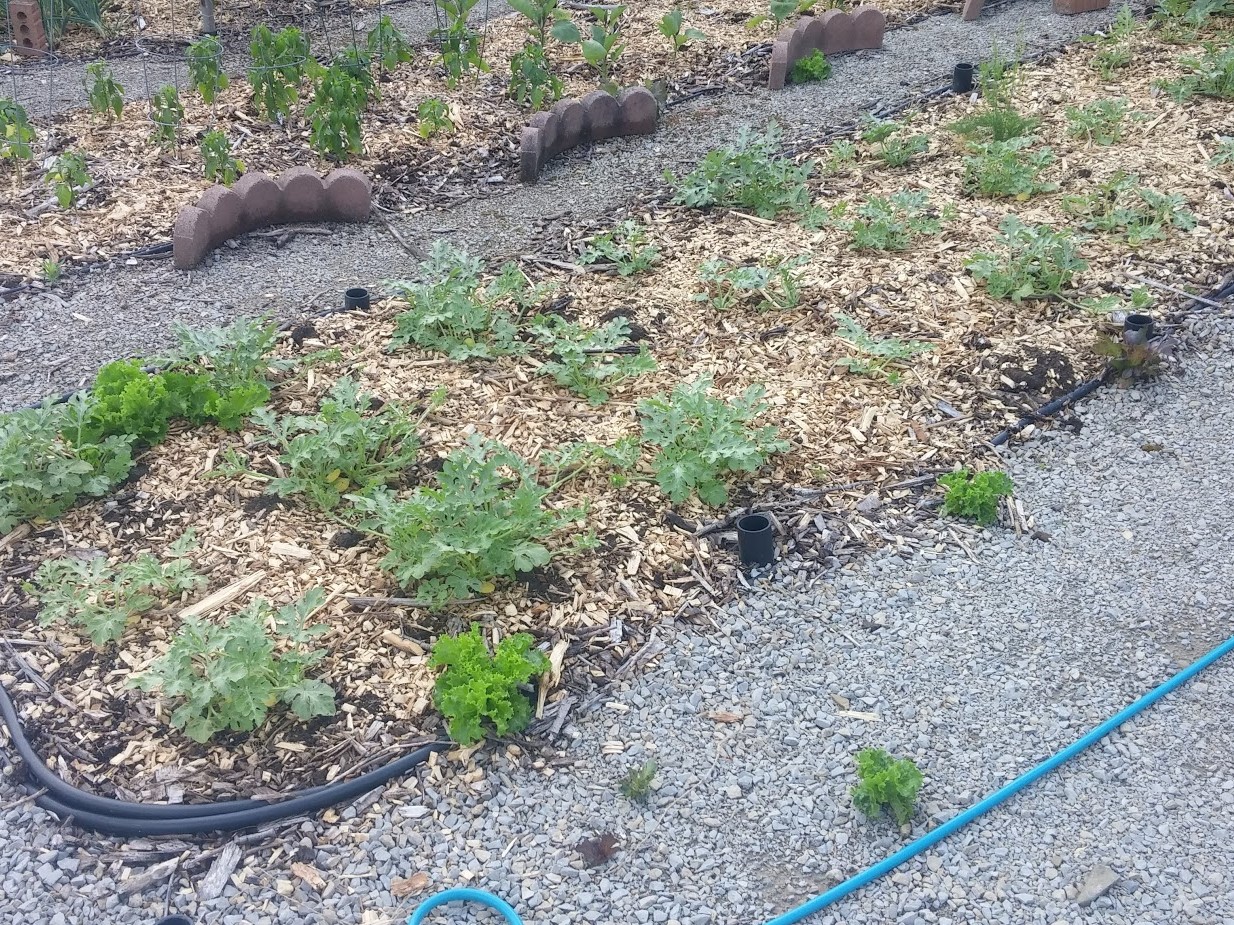
These are the Golden Rind watermelon seedlings, planted and up already in the heat, as are all the other melons, squash, and cucumbers. Hopefully this will be a boost to them this season, even if we appear to be moving back into more typical early summer temperatures.
This is by far the earliest we have ever gotten sweet potatoes in. They were ready to go, and the weather was extremely amenable... for a few days. Now they are covered up, but they seem to be settled in and handling it like champs, so all good there.
Peppers and eggplants (and tomatoes in two other beds) are also planted and covered for the moment. Mostly all looking pretty good, although the eggplants are struggling a bit with aphids. Seems early, but no doubt they are also a manifestation of this early heat. We've dusted everything in here with diatomaceous earth, which we hope will keep them down to a dull roar.
We started some lettuce inside and planted it out at the same time as the early peas, back at the end of March. We kept them covered, and they settled in well and are looking excellent. Salad ahoy!
This one interests me, as it looks like a cross. That light green, slightly crinkled leaf form, brushed with a bit of a blush around the edges suggests May King. However, it's got little red spots, like several unnamed (well I imagine they're named, but I don't know what they are) types that we got in some mixed lettuce seed. I like the spotted types; they are often quite heat resistant.
Holy crow! Look at all those strawberry blossoms. We still have an entire fridge freezer full of last years strawberries. Better get cracking on them, because it looks like another bumper year for strawberries. Haskaps bloomed last week, and tiny green berries are starting to form, so I'll have to think of something to do with them, too. A couple of the blueberry bushes died, but the rest are flowering fairly profusely so with luck there will be a decent quantity of blueberries too.
So now we are in the stage of weeding, whacking, and watering. At least that's what I expect to be up to for the next while. Mr. Ferdzy has trellises to erect and compost to turn. Some guy is supposed to show up late last week (*snerk*) and give us a quote on chopping down a bunch of our dead and dying trees (ashes to ashes, no surprise) and if that happens it will keep us pretty busy even with someone else doing most of the work.
It's nice to get outside after an anxious spring spent mostly inside. I hope everybody is staying well and safe, and continuing to wear your masks, and wash your hands, and avoid people as if they could be strange dogs who might bite if not treated with respect.
Subscribe to:
Comments (Atom)