Showing posts with label A Seed Saving Series. Show all posts

Sunday, 19 January 2025

Review of Breeding Projects in 2024


Well so much for my plan to post regularly about our breeding projects here. However, while I still have some memory of the last season, I will try to make a few notes. 

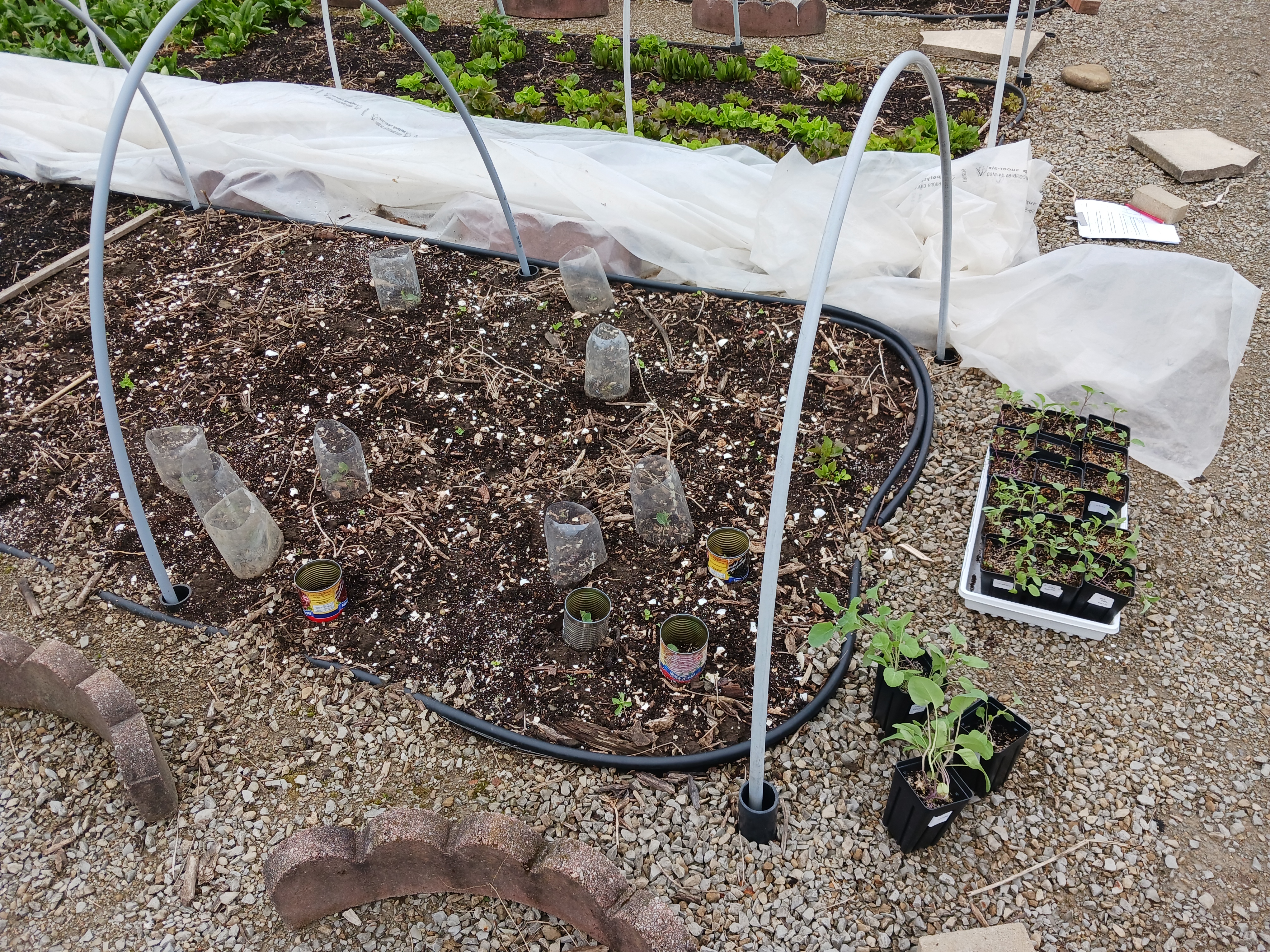
The above photo shows the cauliflower bed at the end of April. Of the 72 plants that went in in the middle of March, the dozen survivors have been collared with tin cans or plastic pop bottles to allow me to keep track of them. The second batch of seedlings went in right after I took the photo. 

My plan to have them go through a "winter" after a "summer" indoors in order to stimulate bolting did not really work out. Firstly, I don't have enough light and warmth to really fool them, I don't think. And secondly, I did not expect my mini-winter to include a week of -10°C, 4" of snow, and howling wind that ripped the cloth cover we put over them to shreds. Hence the abysmal survival rate.
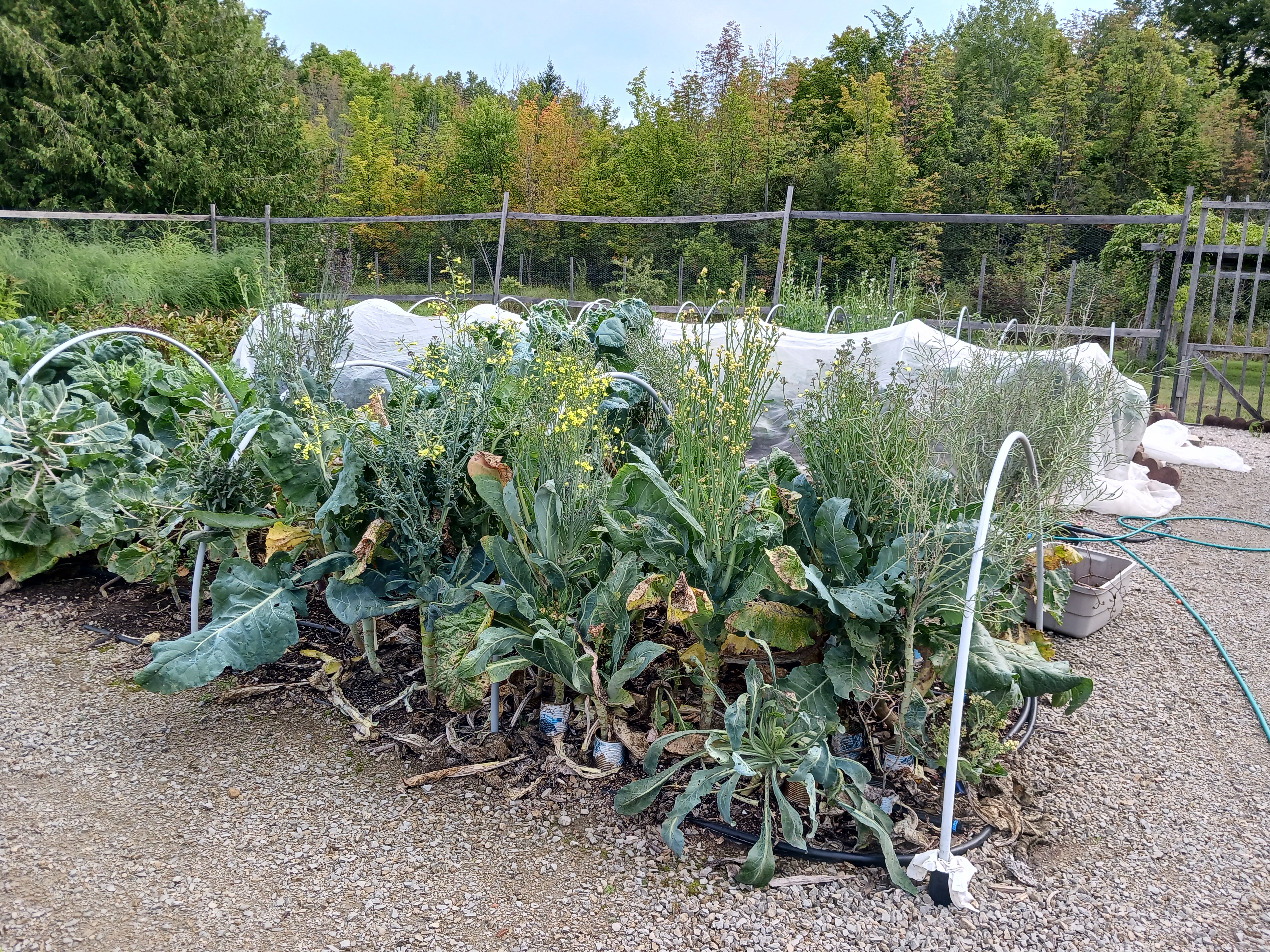
Here are the cauliflowers in mid-September. I was able to collect a decent quantity of seed from 4 plants. Three of them were winter survivors. However, I do not conclude that being a winter survivor increased the chances of producing seeds. They were all from seedlings of the variety Pusa Meghna, the only cauliflower we have previously been able to save seed from. The last plant we got seed from was neither a winter survivor nor Pusa Meghna - it was either Goodman or Early Snowball. I jammed then in so closely together in order to maximize the number of potential parents that I was unable to keep track of the rows once they started flopping around. 

I say seedlings of Pusa Meghna; at least one if not two of them showed signs of being crossed with broccoli. I don't remember broccoli being in bloom when we saved that seed, but plainly there was.

There were a large number of other plants which flowered, although few of them early enough to contribute to the seeds collected. There were 4 more plants from which I collected seed pods at the end of the season, but very little of that seems mature enough to be viable. It is quite dismaying to me how very, very slow cauliflowers generally are to go through the flowering and seed maturing process. Most of these started forming heads in July and were not mature by early December. 

As expected collecting cauliflower in this climate is a tough nut to crack. However, we will try again this year and have plenty of seed including more variety in our own saved seed. Quality of plants is likely to be an issue, although cauliflower and broccoli have plainly met before so I am not too worried about that aspect of things. All of this years cauliflowers have been left in the ground in the hope that some may survive the winter and flower next season, but so far that is a thing that has never happened so counts more as procrastination than an actual plan. 
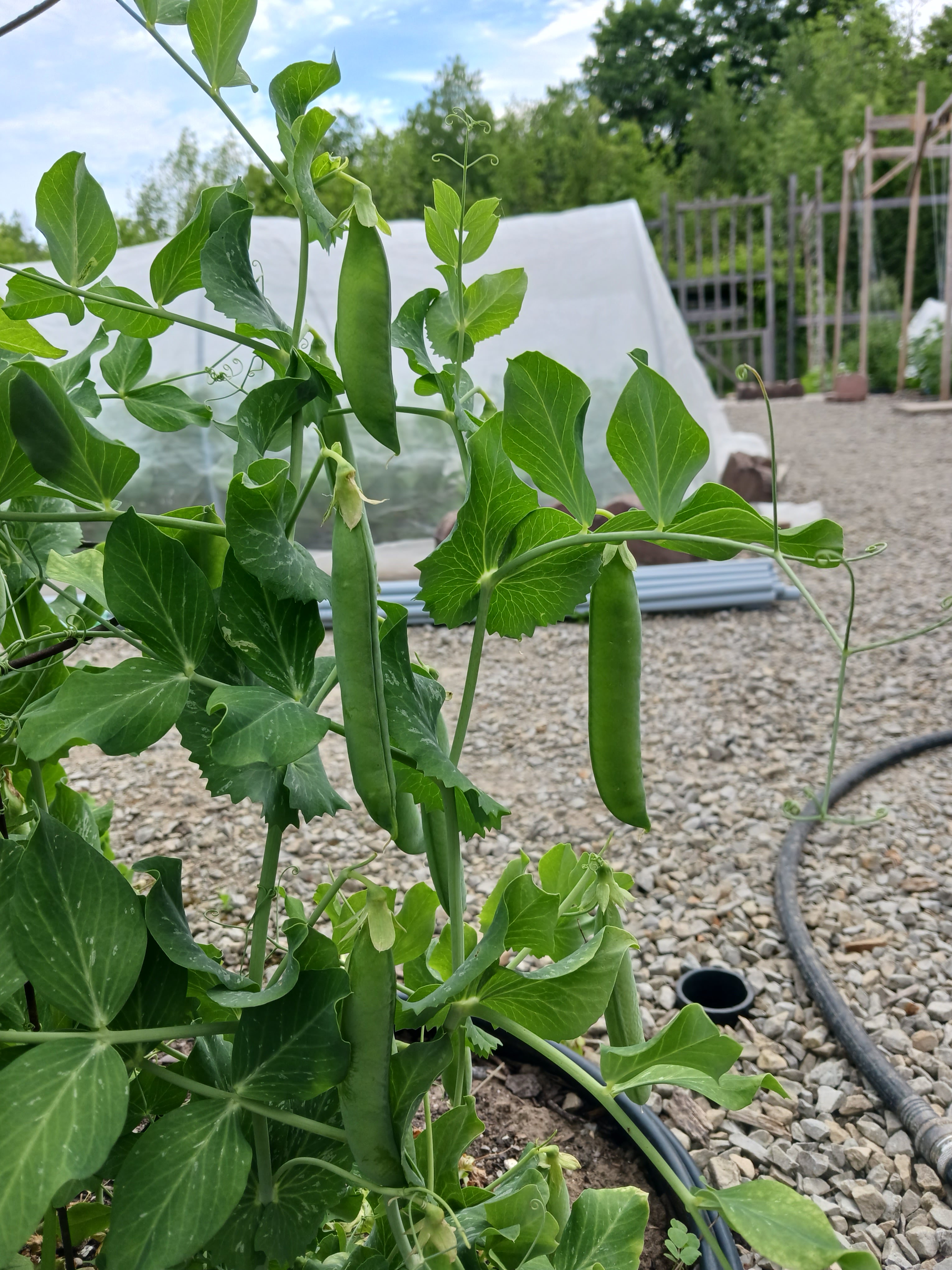
This is a cross between Knight and Strike peas, both very early fairly determinate pea varies. It resembles Knight more than Strike, but it seems even more determinate than Knight, like Strike, and possibly a few days earlier, like Strike. This is important because we want to get our determinate peas in and out of the garden as quickly as possible, so we can follow them with short-season dry bush beans. We have just long enough of a season to make this possible, although we get some bean failure many years if the season is cool or we have an early frost. Every day earlier helps, believe it or not.

We are selecting plants for best production and it may become our main early pea if it continues to do well. These early peas are frozen for use in the winter, so the more the merrier!
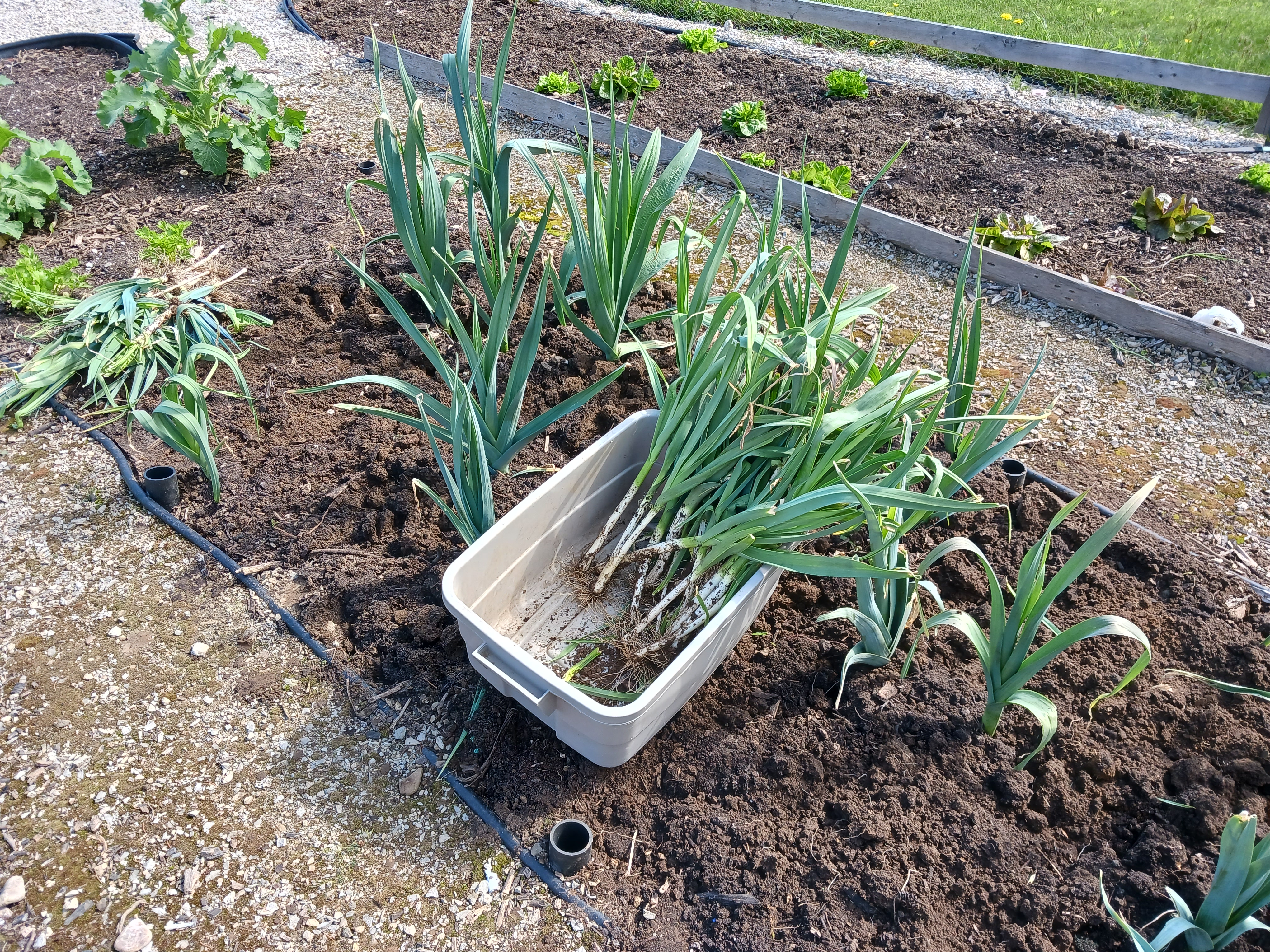
The leek project is not going so well. Here I am removing the least impressive leeks to allow the rest to go to seed. It all looks very promising right now. Things went downhill, though. We collected very little seed because the remaining leeks did not overlap well in their flowering time and at any rate I think I have cut the number going to seed down below their tolerance. I need a bigger space for this project where I can grow about 10 times as many. 

To recap, these are leeks where we are planting the seed in the fall, allowing them to come up and grow at their own pace, then replanting the best deeply to produce the long white stalks that leeks are known for. Usually they are started indoors and planted out in the spring before being replanted in early July. They are quite a lot of work and our method reduces it a lot. However, we have only ever found one variety that will overwinter outside as seed, and the subsequent plants are extremely variable. We have crossed them with 3 other varieties, and are attempting to select for the largest and best overwintering plants. However we plainly need to allot them more space if we are to get the number of plants needed for good genetic stability. Leeks are very, very out-crossing. 

We have older seed, and will have to go back to it. We have not allotted extra space for them this year but we will plainly need to consider it. This year is already a bust for producing seed as leek moths got into our leeks last fall and laid waste to them. They were covered and we did not check them often enough. Oops!

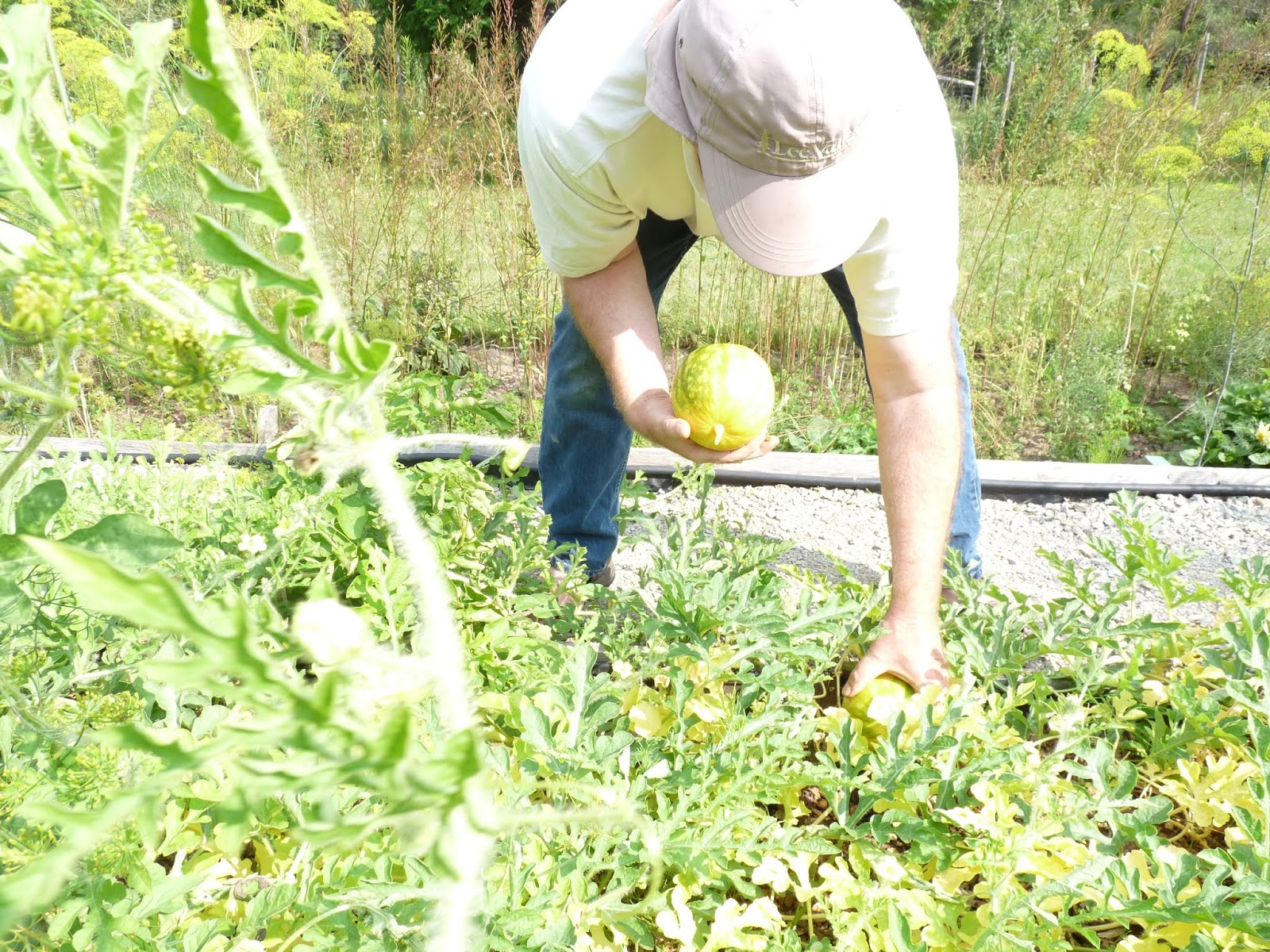
Watermelons are another one that have been very frustrating. We've given up on trying to breed a better yellow-when-ripe watermelon than Golden Midget. While I think we did breed a better one - larger melon, smaller seeds, thinner rind, better texture - the taste continued to be only so-so. However, the project kept throwing green melons with much better flavour. We decided to grow out the ones we had saved of those green ones (usually for exceptionally good taste) and look for a small, early watermelon with the all the qualities we wanted except the golden rind. Because the golden rind gene is recessive, we expect to be filtering that out now for a few years to come.

In mid August we had a night where it got down to 9°C overnight. We were really dismayed to see that most of the melons could not handle this. Within a week, all but a handful had wilted and died down. They were far enough along that most of the melons continued to ripen, but I don't think they were as good as they could have been. We have saved some seeds and will persevere, and of course the ones that didn't wilt and die are heavily represented in our selections for this year.

I don't think we kept seeds from this one but it gives the idea of what we are looking at. I like the ones with a tiger-striped rind better, but I think this one did not meet our flavour requirements. We'll take whatever rinds do that.

None of the beans in this photo are our crosses; I really didn't take any photos of them this year. We grew out most of our bean crosses but I don't have too much to say about them except that we continue to select them for various qualities including flavour, configuration, and disease resistance. No; this picture is about the lettuce, protected by the plastic pop bottles. 

This is the f3, I believe, of our May King - Tom Thumb cross. It is settling into a few distinct phenotypes, any of which we are happy with. There is much more variability in this generation as to whether they stay sweet as they bolt, so that is plainly what we will need to be selecting for over the next few years. I continue to be quite excited about this project though, since I rarely seem to be able to pick a lettuce before it starts to bolt.We ate quite a few of these but there should be some left in the spring to allow to go to seed - providing they stay sweet and tender.
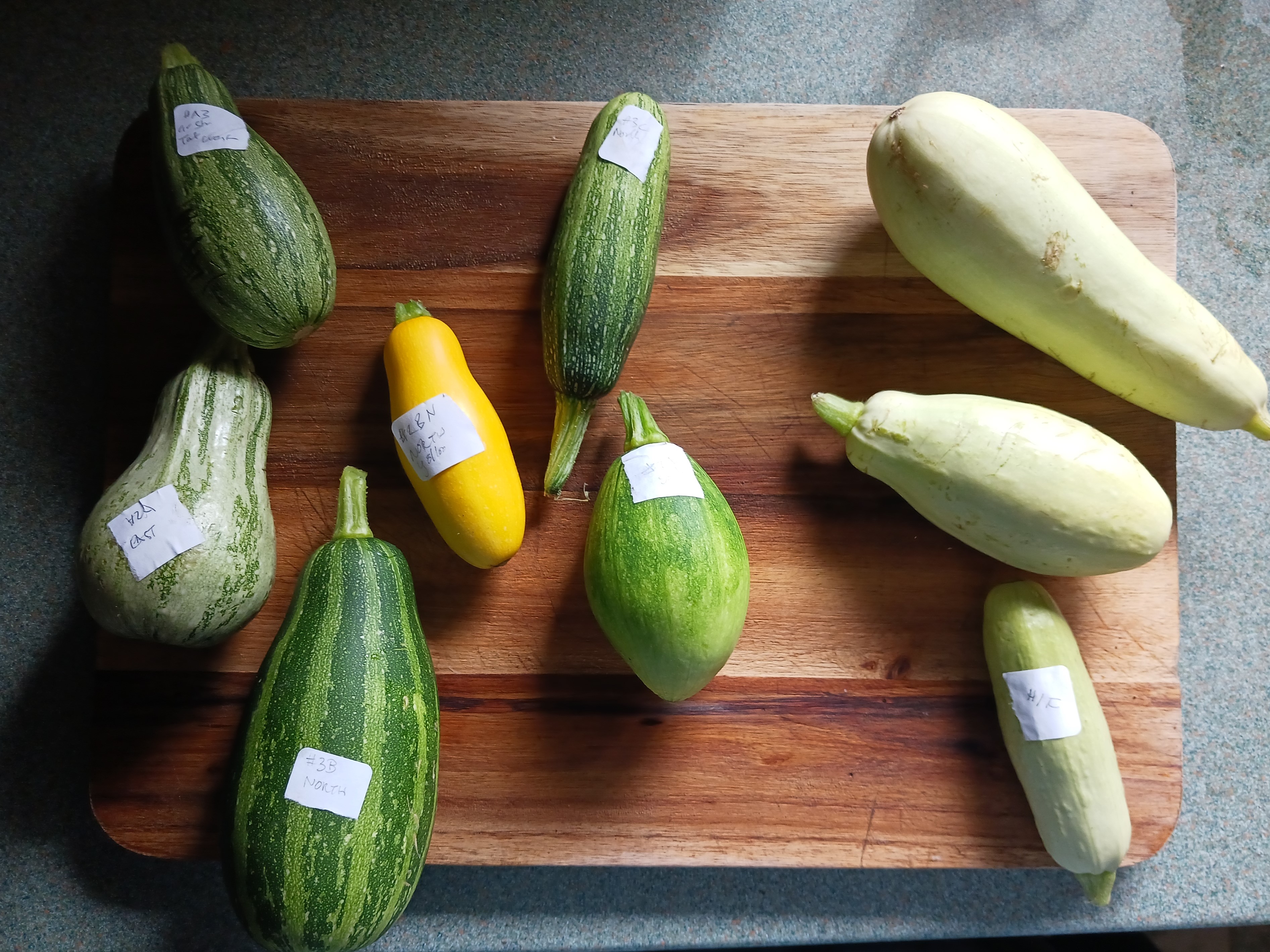
The interspecies squash project (pepo x argyrosperma) is also trundling along. Here are a number of fruits which we ate, or at least tasted, while they were green. You can see there is still a lot of variation and the Reinau Gold zucchini we crossed into it last year was not as prominently visible as I expected. 

I think we want to cross one more round of straight pepo zucchini into these; the flavour is much improved but still on the mild (bland) side. They were all quite eatable though. Goldini was the open pollinated yellow zucchini I was able to get seed for, so that's what we will be adding this year.


Here's what we eventually left to ripen for seeds, minus one long, large, green-striped one which was harvested quite late. The yellow definitely shows up more strongly in the ripe fruit. 

We keep the rest of our zucchini, grown just to eat, covered against vine-borers. These ones were left exposed as we want to select for resistance. Unfortunately, my observation is that the yellow zucchini are more attractive to vine borers than green ones so my desire for a yellow zucchini is at odds with my desire for insect resistance. However, while quite a lot of them eventually succumbed to vine borers, several plants did not (and their offspring have been noted). Since we didn't let them into the other zucchini I have no real comparison, but I do have a vague impression that they lasted better (longer) than other times when zucchini have been afflicted with borers. But it is absolutely something I will have continue to watch carefully.

This warty pattern has been a feature since the first plants grown from the cross. It's not as pervasive as it was, but it still showing up. I rather like it though I don't think it has any particular utility. 

The sibling of this squash, seen in the group photo at mid lower left, turned out to have a vine borer that attempted to get in just below the stem. This is a thing I've only seen happen in this cross. I think it is actually a sign of their resistance to them - when they can't get in at the base of the plant, they try by the fruits. Interestingly, it didn't make it in very far there either.

So that's it for 2024; at least that I have photos for. I'm looking forward to this year with some excitement. Less than a month until we start on indoor seedlings.

Saturday, 3 February 2024

Cauliflower Seed Production & Breeding Attempt 2024

I see I didn't post much last year; this year I intend to keep our records of various breeding projects here, and since I intend for us to make some serious progress, let's get started.

Feb 2 2024 - we planted 2 pots Pusa Meghna original seed, 2 pots Pusa Meghna our own saved seed, 3 pots di Jesi, 4 pots Goodman, 3 pots All-the-Year-Round, 3 pots White Snowball, 3 pots Macerata (green), and 2 pots Romanesco (green). This is about 2/3 of intended early spring plants but remaining seeds are still in the mail. 

The hope is that by planting them indoors, very early (I do wonder if this is early enough) we can get good sturdy plants to be planted out mid-March, into still cold and snowy weather (I do wonder if that is early enough, this year) and less light than they were getting inside, and so be induced to believe they have been through the winter and produce some seed once spring actually arrives. We shall see. 

Feb 6 2024 - remaining expected seeds arrived, planted 3 pots Wallaby, 2 pots di Bassano Bonorivo, 2 pots Romanesco Precoce, 3 pots Violetto di Sicilia, and 3 pots Paco's Coloured/Mallorcan cross. All seeds from first batch up by today except Early Snowball and di Jesi. (Some signs of both on Feb 7th.)

Feb 10 2024 - All of first batch up save 2 pots White Snowball; Macerata poor. Reseeded some of both. First of 2nd planting up - 1 di Bassano. (Ferdzy's Fave tomato from first batch also up.) 

Feb 17 2024 - All up save for 1 Wallaby. Fertilized yesterday for the first time. Starting to fear we have definitely started too late. Hoping for a cold spring, sorry everybody.


Sunday, 18 June 2023

Notes on Spring 2023 Garden, Mostly Breeding Projects


I took these photos almost 2 weeks ago and they already look so completely out of date. These zucchini are at least twice as large now, and are starting to look like they will form some buds shortly. They are from the interspecies cross that I have been mentioning off and on for a few years now. In particular, they are from 2 plants grown last year, both of which were probably f2s of the original Lebanese White Bush x Tennessee Sweet Potato squash crossed with another zucchini, in both cases probably Caserta. I thought they were the best of nearly a dozen grown out. I crossed them both with Reinau Gold last year and am looking forward with considerable excitement to see what develops this year. There are 6 batches of 3 seeds from one squash and 9 batches of 3 seeds from the second squash. At least, that's how many were planted. A few did not come up. The plant is, as they develop fruit, to remove the ones that seem the least interesting and see what is left. 

This photo is actually considerably older; we dug up these leeks early in May. In spite of the fact that last year was a pretty bad year for a lot of things, and that I don't consider the leeks to have done very well, they were not that awful. Those second-best ones on the left were actually quite superb, and the middle ones were very decent. The runts on the end were usable. Of course, the very best are still in the garden, going to seed. Speaking of which, few of the ones we dug were bolting and the ones left in the garden did not start to flower at all early, meaning that my hope to be able to leave this strain in the garden over the winter for early spring use seems quite feasible.

Those leeks and these are part of our experiment in growing leeks a different way. After having leek seeds from a mass cross overwinter in the garden, we are now sowing the seeds of their descendants in the fall purposefully. Those scratchy little lines of green are them. They look most unimpressive but I am quite pleased - they have grown a lot since I took this photo and are better than the ones planted in a tray for insurance. (Which to be fair have been somewhat neglected of late.) We expect to dig them up and replant them deeply at the usual time to dig up and replant leeks, without having had to plant them first, so that's good. First year of not planting any leeks started indoors.

Attempting to cross Goldana turnips with Scarlet Ono turnips. Last year did not seem to work. I planted half and half from a few of each left to hopefully cross, and got half and half, no signs of crossing. I am a little more hopeful that they might cross this year since the flowering time seemed to overlap better, but we'll see. Next year, as usual. 

Brassicas behind them kept under cover as much as possible these days due to the vile Swede midge.

Tomatoes in; onions, parsley, leeks, and carrots going to seed in the middle of the bed between them. Again, looking much further along in real life. Mr. Ferdzy is currently attempting to get them strung up, and tearing out his hair over how hard it is to find decent string that will do the job, yet compost in the fall.

 
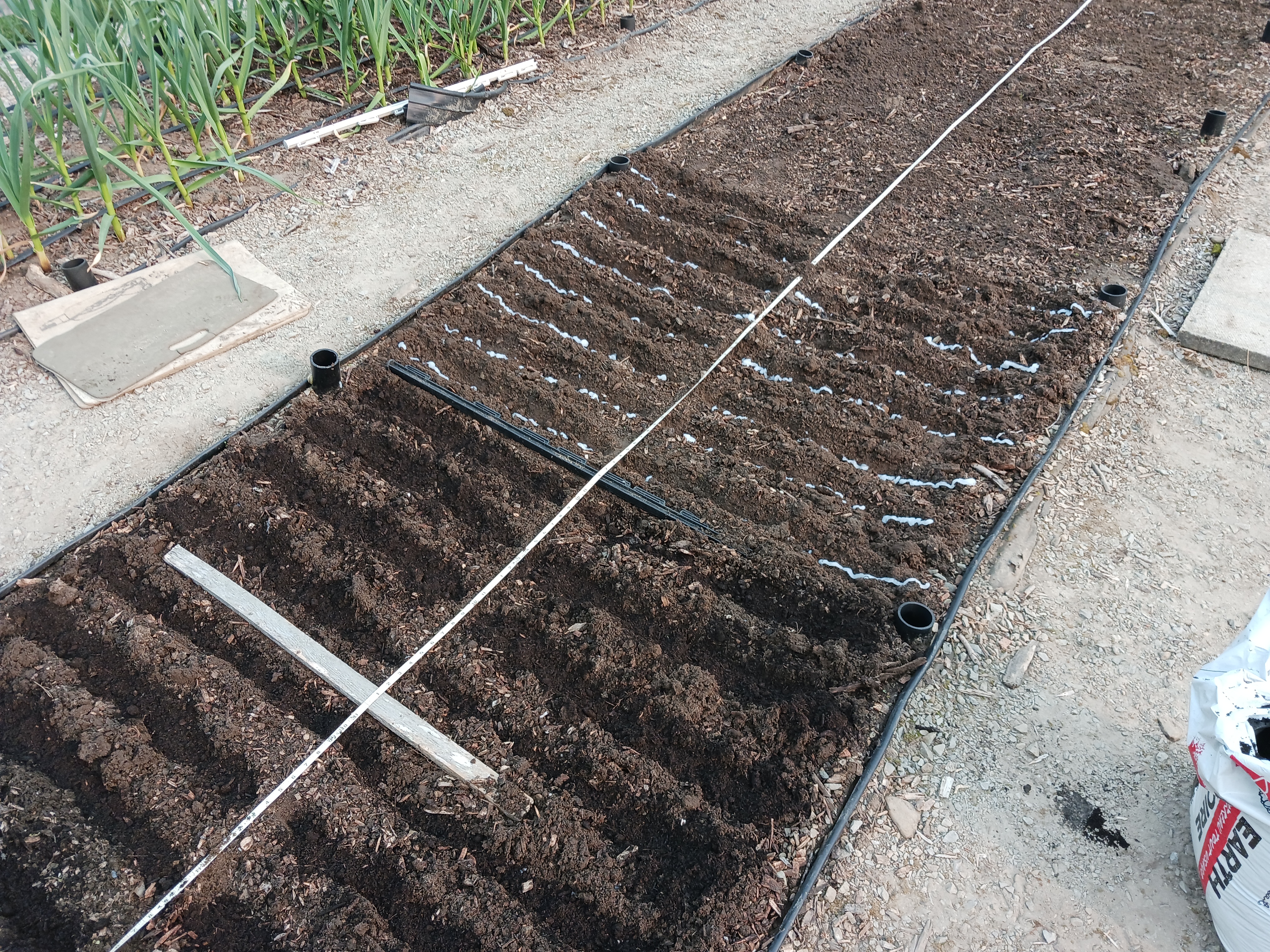
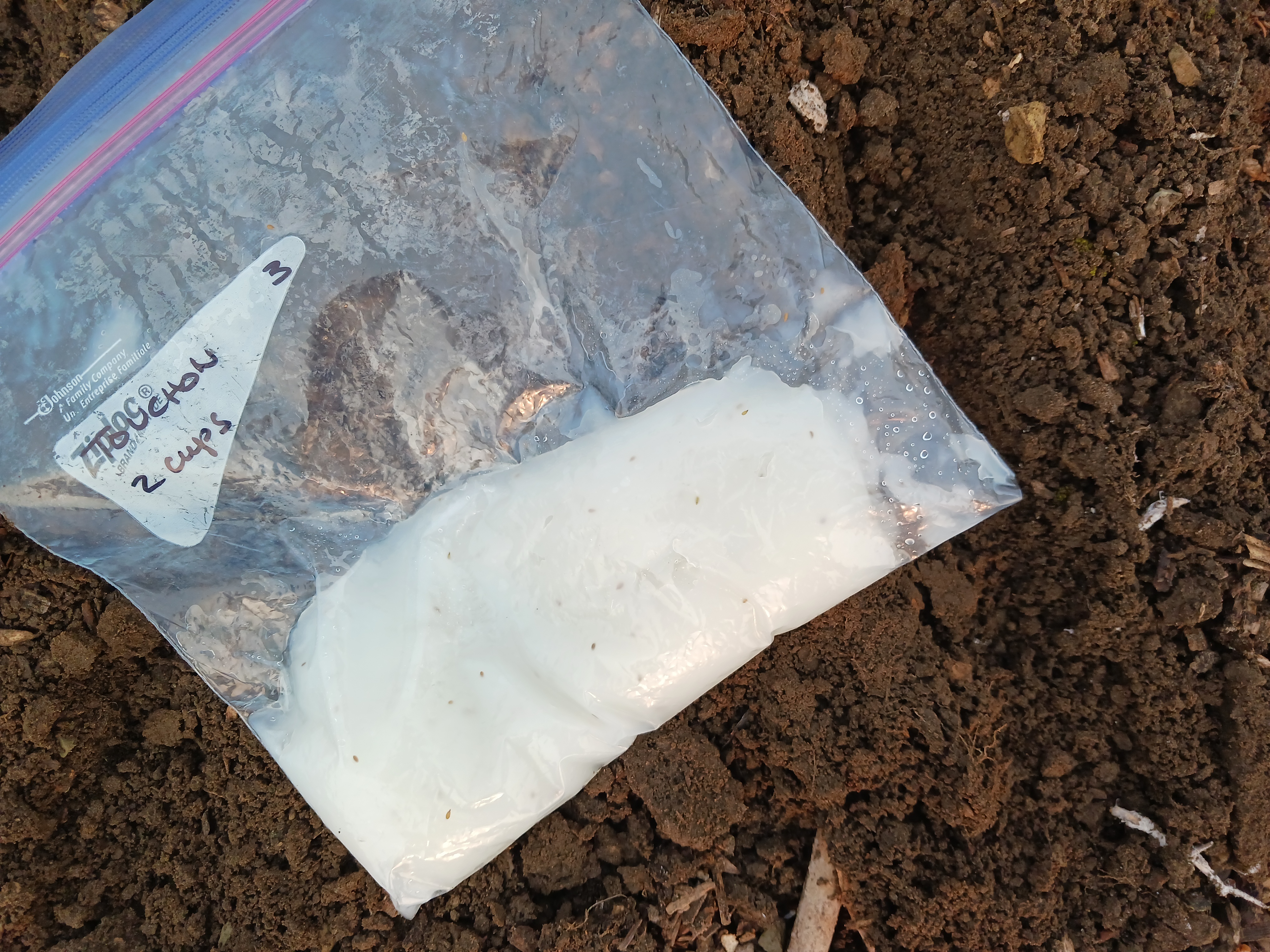
This was an experiment in a new way to plant carrots. It looks like it is not going to work, not because I think there is anything wrong with the idea, but because when it comes to getting Mr. Ferdzy to choose between mathematical precision and common sense, he will chose mathematical precision far too many times. We calculated that a packet of seeds, given the weight stated on the package, should be 1/8 teaspoon of seeds. We did not have a "package" of seeds however; we had bulk packages and our own saved seeds. So this equivalent amount should go into a foul pudding made of 1/4 cup cornstarch to 2 cups water, cooked and cooled. I really cannot argue with his math but it was by far not enough seeds. I suspect that seed companies greatly understate just how much they put in their packages. Add that we have a bumper crop of snails, slugs, and cut worms this year and we are seeing very very few carrots. We will have to try again in a few days I guess.
 

There's the bag of seeds in the cornstarch slurry; you can see they are much further and fewer between than the ones shown in the video. I could not convince Mr. Ferdzy to put in any more than we did, but I hope he will be more willing when we have to do it again. Next time, I believe 3/4 teaspoon will be about the correct amount. This will do one of our 4' by 5' sections; or 40 linear feet. 

Not shown in photos; we are continuing to grow out our green bean crosses. This year we are growing only Algarve and Anellino Yellow as existing varieties; all the rest will be from our crosses. We'll see how they do. They are looking good so far. I planted some seed that I hoped was from a cross of May King (aka May Queen) and Tom Thumb lettuce, and it seems to be. We are marking and keeping the best looking (and tasting!) of those to go to seed. They seem to be quite varied, but a nice butterhead type that forms early and holds reasonably well. Light to mid green, with or without some blushing; smooth to slightly crinkled leaves.

Monday, 23 May 2022

Early Spring Greens Bonus Plant Breeder's Garden Report

I'll be doing a longer, more general garden report at the end of the week, but I want to talk about one of the things we've been thinking about for the last few years - early spring greens. Really, we've been thinking about them since before we decided to try overwintering spinach, and that was a good few years ago. By early, I mean we want to eat them as soon as possible. March sounds nice but gooooood luck with that. Mid to late April is not completely unrealistic, though.
 
Spinach is an obvious green to overwinter. It bolts as the summer solstice approaches, if not several weeks earlier, no matter what size it is. If you can get it to overwinter, you have a fighting chance of harvesting large but tender spinach leaves any time from April through mid-May (after which the bolting causes it to rapidly diminish in quality, if not size). Our problem is that the mice quickly discovered that a bed filled with spinach and maybe lettuce and covered by an arch of plastic sheeting is a fine, fine place to spend the winter. This is a problem we have yet to solve, so we are looking at other greens to grow instead. 
 
Asparagus is the green vegetable most Ontarians associate with spring, and with some reason. Ours is doing very well; we have been picking 2 or 3 pounds every day for the last week at least and for the first time have more than we can eat. I don't regard the idea of frozen asparagus with wild enthusiasm but we are going to find out if it is good, okay, or yuck because we now have some. But really, excellent as it is, asparagus is not even quite early enough for the purposes of this post.
 
Late April through early May is the time for wild leeks (ramps) and fiddleheads, but both of these are wild foraged and have associated limitations. 

However, there are other spring greens that could be developed for a wider variety of tasty spring greens. The one I've been going on about the most here is sorrel. Like asparagus, it's a perennial and that helps give it a head-start on the things that have to sprout from a seed. Apart from cutting off the seed heads to prevent it from becoming a self-inflicted weed, it's easy to grow and quite attractive in addition to being tasty. Spring sprouting green onions are another great one, although their strong flavour means few people will want to eat them as their main veg. 

But so far none of that is about breeding. It's just setting up the situation, which is that it would be great to have a wider variety of early spring greens. Through happenstance (and some planning) we've actually been getting a wider range of spring greens from overwintering plants that weren't supposed to overwinter. They are not perennials, but usually biennials which also have the advantage of starting from already established roots rather than seeds.

The first up for consideration are turnips and rutabagas. I've gone on before about how much I like rutabaga greens, usually eaten as thinnings in mid-summer. But we have taken to not digging out the skinnier, less useable rutabagas and leaving them to overwinter, then picking greens in the spring. We also let a bunch go to seed last fall, and I was not on top of picking them, so there are now baby rutabaga plants all over. Right now they really aren't getting going as early as I would like. That's where the breeding comes in. I've selected about a dozen of the largest, earliest seedlings to save, and I'm hoping their offspring will continue in the large and early direction. 
 
Dietrichs-Wild-Broccoli-Raab

There are already a bunch of turnips selected for greens. We tried one called Deitrich's Wild Broccoli Raab, planted last year and eaten this spring. It was nice, but it definitely has a bitter tinge to it that just doesn't appeal much to anyone in this household. But it certainly makes me narrow my eyes and consider turnips for greens that much more. I should also note that while it was early enough to be in the very early range, it was not as early as described at the link. I assume our winters are still just that bit colder and harder than in New Jersey. On the plus side, it was much more tender than I expected. Definitely nice for that. We do have a few turnips that overwintered. I'm saving them for seed for the purposes of turnips, but we will consider their possibilities for greens too. 
 
Radish Greens
 
Our big surprise on the overwintering front were radishes. We had some overwinter in 2020/21, which was the first time ever for us with radishes. Indeed, it's a local organic farm practice to plant fields with radishes in the late summer to grow until they are reliably winter-killed, leaving a clear field in the spring with minerals brought up by the deep roots and composting matter from the dead radishes to improve the soil. I let them go to seed last summer as well, and as with the rutabagas I was not on top of them and quite a few fell and sprouted. These did even better at overwintering than the original batch, and although we pulled all of these out (they were not in a convenient spot) they produced bushy tender bunches of greens very early. 
 
We tried some of them, and they were tender and surprisingly mild. They had a tiny bit of radish-bite raw, but not really when cooked. They are better cooked anyway because the leaves are a bit hairy when raw. I'm actually kind of excited about these, and want to plant some later in the summer to overwinter for next spring. Again, we'll be looking for the intersection of earliness, size, flavour, and tenderness. I'd like to select these for smoother leaves but possibly that will leave them more open to insect damage. We're not selecting these for the roots at all; good thing as you can see that they are unimpressive. I think these were mostly from China Rose but with some White Icicle or possibly a white winter radish (lo bak) in there too. 

And finally, I pulled out our overwintered Swiss chard - which are beets, really; selected for their leaves - but not before we got a good crop of very nice greens. As usual, Lucullus was the best, most tender one, but Bionda di Lyon was probably a better grower, with neater, more robust leaves. Spring broccoli and cauliflower are things in milder climates than this one; we keep trying if only to get seeds but so far with very little luck there. However, there are plenty of other interesting spring greens to pursue.

Monday, 31 January 2022

12th Annual Seed Catalogue Review

Wow! I find it hard to believe I've been reviewing the seed catalogues for 12 years now, but here we are. So, what seems to be new this year? 

Fenugreek grown for greens suddenly seem to be a bit of a thing, (and fenugreek as a seasoning is having a moment too, I notice). There continues to be high interest in colourful vegetables. For most of my life, the vegetables grown around here have been dominated by traditional British and German varieties; but that hold continues to weaken. Tomatonians and Beaniacs have long dominated in the seed world, but the Chileheads are picking up steam (!). 

The last obvious trend I see is prices going up. Not too surprising, since they've been pretty stable all the time I've been posting this, and as noted that's getting to be a while. Given inflation it's also no surprise. And finally, I'm concentrating on small seed producers who grow, clean, package, market, and mail their own. It's a lot of work, and prices need to reflect that, much as I'm sad to be paying more.
 
When I went to check the list of seed suppliers at Seeds of Diversity, I saw there are a lot of new-to-me companies. I'm concentrating on vegetable seeds, but there are are more garlic growers, more fruit and nut tree and shrub suppliers as both seeds and plants, more seed potato suppliers, and more suppliers of herbs and wild plants. (Still short on sweet potato slips, but they are easy to grow yourself.) The numbers amaze and delight me, even though it seems likely that most of these newer companies may not last for long. I hope, though, that this is a new wave of Canadian supplied garden material that will change and improve the gardening situation in Canada considerably. On which note; buckle up, people! This is going to be looooong, even though if you are looking for non-veg seed items, you should click through below because I don't get into them here.

The in-stock (or not) situation seems to have settled down some from the last 2 years; however, it looks like things are still moving pretty briskly - think about ordering as soon as you reasonably can. If you are looking for something specific and having a hard time finding it, as usual you should turn to Seeds of Diversity and check out their list of seeds available in Canada and which companies carry them. 
 
And finally, while the point of this post is to dream about the new, I was reminded as I found so many old, familiar seeds listed, that there is no deficiency in companies who do not change their lists from year to year. As a gardener and cook I have formed relationships with certain varieties; knowing their individual quirks for growing and eating allows me to get the best from them, and I'm sure the same applies to growers of seeds.
 

Friday, 29 October 2021

Veggie Breeding Final Assessment for 2021


This was an exasperating season for just about everything. A hot, dry start followed by wet and if not actually cool, then not particularly warm temperatures from July on made for a trying growing season. Most beans stopped producing by the end of August, overwhelmed with anthracnose. The good news is that the three crosses we've been growing out for the last few years all lasted longer than any of the traditional varieties. 
 
The Blue Lake x Cherokee Trail of Tears cross (not shown) continues to be surprisingly variable, and I'm having a hard time pinning down which plants to use. However, the Anellino Yellow x Cherokee Trail of Tears cross (on the right) is doing really well. It's a late starter though; I keep thinking we should drop it, but then it goes, and goes, and goes, and the beans are so tasty and tender, and it's back on the list for next year.


The ((Octarora x CToT f3 2016) x (Blue Lake x CToT f2 2019)) - on the left in the first photo - was another real winner this year. It only showed up as an F1 last year, so this was the first time we got to eat any. Really good beans, early, productive, and mostly quite resistant to anthracnose, although there was a little variability. The other variability I was pleased to see was that, in spite of the original seed being black, about 1/8 of the offspring had white seeds, which I like better. The final bit of noticeable variability was in the length of the beans - many of them were disconcertingly short. Fortunately, most of the white ones were also long, which again, is my preference. We'll be growing these again next year, in larger numbers. 

EDIT: I forgot to add that we found another cross this year... in the Anellino Yellow. It had smaller, darker, but still mottled seeds, in a curving pod, but green with red streaks. I wonder if the pollen parent was Octarora, but I will know more when we grow it out - and we will grow it out! Anellino Yellow has the best anthracnose resistance of any of the pole beans we've grown.


I don't have any photos of them, other than this blurry one of our earliest and most productive Northstar Lima bean, but the Lima beans did quite well this year. It wasn't that great of a year in terms of overall production, but when we first started growing them, a year like this would have yielded only a few for seed. In fact, we got about 9 cups of dried beans in addition to the ones saved for seed, so let's say about 10 cups overall. Admittedly, we planted a quarter of what we are planting now, but our first attempt to grow out King of the Garden Lima yielded 3 entire seeds.

In addition to the named varieties planted, we are getting a good number of crosses. It seems like Lima beans cross more readily than common beans. I'm sure we planted a fair few of Alabama, yet I have only seen about 6 on-type Alabama beans. I'm most interested though, in the crosses that involve King of the Garden. It's a classic green Lima bean of which I would love to have an earlier, more productive version. I'm thinking it could happen!

Since I'm not supposed to eat a lot of potatoes, we didn't plant any named varieties, only seeds and seedlings. The above beans are about half of the ones we saved from plants grown from seed this year. We'll see how they do at storing over the winter and try them again next year. As usual, most of the seedlings were discarded into the eating potato bin, but these ones seemed to be healthy plants with a respectable volume of potatoes already.

We are continuing to grow older seedlings as well. The one on the right, from 2016, was the only one that showed resistance to a virus that affected most of the others quite badly, stunting and yellowing the leaves. The potatoes were also in the worst bed in the garden, so the overall harvest wasn't great. It's fine! I'm not supposed to eat them anyway.

We were very excited about one of the zucchini crosses this year, from the interspecies cross that happened a few years back. This one plainly involved Reinau Gold (on the left) but produced larger fruits and considerably more of them. I really sad to report that my attempted self cross of this plant failed, and there is no seed. However, we're going to go back and try a planned cross between earlier generations of the interspecies cross and Reinau Gold next year, and hopefully that will work and there will be more plants to work with.

Two zucchinis did manage to get away from us, and we left them to ripen. The golden one is from one of the interspecies crosses, but unfortunately was a more ordinary green-fruited plant in the eating stage. The other one is a new variety we grew this year, called Jewel Green. I had no idea it was a very long, vining plant, and so it was easy to lose track of. No idea what it will have crossed with - usually multiple other plants - but I think I will save some seed and try it out. I'm less interested in the interspecies cross one, because it will be getting pretty diluted by now.
 

The watermelon were very frustrating. I shared them with people for the first time, and while they seemed to do alright in terms of growing - for those other people, at least; mine were fairly slow to get going and I was not impressed at all - we all agreed the flavour is weak. It does seem to have been going down the last few years, so here too we will need to go back a few years and try for better selections. Gah! 
 
That's about it on the breeding front. We still have to clean the leek seed, but they at least continue to look fatter and better every year. I should leave some seed out to overwinter once we have done that and see if it is still as hardy as it started out.

Friday, 9 October 2020

Garden Breeding Projects Annual Assessment

Here it is, close to the end of the garden season. (Agh, already!) It's time to assess how our breeding projects have worked out this year, both the planned and unplanned ones. To get started, here's our (cucurbita pepo x cucurbita argyrosperma) F2:


I thought I had posted about this last year, but I can't find that I did. This was an amazing cross that turned up in the garden last year from some seeds we had saved from Lebanese White Bush zucchini a few years earlier. We knew they would be crossed... we didn't know it would apparently be an interspecies cross with Tennessee Sweet Potato squash! The resulting squash were pretty horrid, frankly, but they were not bitter which has frequently been a problem on the seemingly very rare occasions when these two species (pepo and argyrosperma) cross. Argyrosperma is a squash grown mostly in the southern USA and Mexico, and freqently just for the seeds. We only grew it one year, and weren't too impressed. The flesh is bland, and the squash rapidly get a a very hard shell. If they are like the few of the cross that we tried as zucchini, they also develop their seeds very early. However, they are heat tolerant, drought tolerant, and bug and disease resistant. Getting some of those qualities into summer squash struck us as very desirable, and here we were with the means to work on that.

We planted 4 seeds, of which 3 germinated. One produced squash that appeared to have crossed again with an acorn squash; this was not a happy combination and got pulled pretty promptly. The other two plants appeared very similar, apart from the fact that one of them had a bush habit and the other was a bit more rambunctious, although I wouldn't call it a full-on vine. The fruit the produced was extremely similar, but that's a squash from the vining plant above and below. 


Here it is cut open. We found the stems attaching the fruit to the plant extremely tough, and the skin hardened fairly quickly too. This is no doubt the influence of the argyrosperma. That's a bit dismaying; if the plants are resistant to bugs and disease because they are physically hard that won't make for good eating. Still, these little squash were much better than last year in terms of tastiness and edibility. I won't say they were particularly great, but there is a big improvement.

We saved one fruit from each of the remaining plants. You can see how similar they are. Obviously, we intend to save seeds and continue next year. These are going to be very hard to cut open; they are still hard when ripe like the argyrosperma squash. I did manage it last year so I presume I can do it again.


We planted a bunch of potatoes from seeds in the spring, all of which got munched by flea beetles and leap hoppers, and generally didn't make it apart from a few stragglers that got left in a pot and which we have not examined yet. However, we replanted a number of seed potatoes from seed-grown plants. Here are three of the best four; one of them seems to have disappeared. I need to check the potato boxes to see if I can find a few to plant again next year. It was a dark purple skinned one, with a nice mauve and white interior. 

The others are all offspring of Pink Fir Apple. I wonder about that dark mauve skinned one; it looks like the other parent could be Purple Viking, which is known for producing some real lunkers. But maybe not; who knows what genetics are lurking beneath the surface in potatoes? The one at the top retains a hint of the waxiness of Pink Fir Apple, but the other two are quite light and fluffy in texture. They are all reasonably productive. These are the last remaining few selected from quite a few seed-grown potatoes. We discarded one I was quite interested in. It only grew about 6 or 8 inches high. It also produced about 6 very small potatoes per plant too, and that just wasn't going to cut it, unfortunately. Still! I'm pleased with the ones that remain.


Our watermelon project continues. I appear not to have posted an update last year; bad me! I feel like we've made a lot of progress, but we just aren't there yet. We planted only seeds from yellow-when-ripe watermelon this year, but we got some green skinned ones too. It's just a matter of time to sift them out, since the green skins are dominant, and once there are none, it will mean that gene is out. However, since we can't tell until the fruit ripens, they are still casting out their pollen. It sure slows us down on getting them out. 

Flavour-wise, we were a little disappointed in them this year. In spite of all the heat, they were good, but not great. Very sweet, but we thought a little on the mild side. So, we will have to see what we get next year. Right now they are moderately consistent; most of them are round to slightly oval, with either solid green turning to yellow rinds, or faintly striped green turning to yellow rinds, or "tiger" stripes in two tones of green turning to yellow and yellowish-green. And the ones that don't turn at all, of course.

As for beans, I thought it was kind of an exciting year. Our project of growing out the Blue Lake - Cherokee Trail of Tears for a more anthracnose-resistant Blue Lake type bean continues. Our anthracnose is as bad as ever, I would say, but the Blue Lake seemed especially unresistant this year. They are not really any worse than they have ever been; it's that our crosses that are growing out next to them really are more resistant and it's starting to show! 

I've sorted the crosses into 4 groups: the one I wanted the most was a pink-flowered, white-seeded, round (in cross-section) bean - there was exactly ONE. I have saved the seeds from that plant, up at the top right. Below it are the best from the much more common pink-flowered, black seeded, round bean. The beige seeds produce plants with purple pods; that's been the case since the cross first happened. I'd be more excited about them, because they are productive, tasty, and disease resistant, but for the fact that there are already quite a few purple-podded pole beans out there, and I don't know that mine are any improvement on them. Finally there are a lot of white-flowered, white-seeded plants and I saved seeds from the best of them. The seeds tend to be larger than those of the original Blue Lake, and the pods even more variable from round to really quite flat. There's also a lot of variability on the anthracnose resistance front, so we will be continuing to winnow out the disease-prone ones for a few years, I expect. But over all, they really are looking quite good.


It's some other beans that have me really full of glee, though; two in particular. The two top sets are from a cross that turned up in the garden last year, and dried down to an amazing marbled mauve. It was in a patch that was a cross between Deseronto Potato and Blue Lake; I made the decision to discard that cross because it had turned out to be extremely lack-lustre but I kept the beans from the one plant. I determined that it was most likely ((Deseronto x Blue Lake) x (Anellino Yellow x Cherokee Trail of Tears)) OR ((Deseronto x Blue Lake) x (Blue Lake x Cherokee Trail of Tears)). Yes, I've mis-labelled that seed bag - must fix it.

On the top left are the seeds I'm keeping to try again, from a number of plants. These were the most disease resistant and reasonably productive ones, and they are mostly small and round like navy beans. I did keep one larger, flatter one just because it had such an unusual slate-blue colour. It looks black in the photo but it really is not. The ones in the tub were the rejects, which will be eaten this winter. 

There was one bean in this set that was truly amazing. That's the taupe seeds from it in the bottom right of the photo. All those seeds come from one plant. There would have been even more, except that the deer made a bee-line for it every time they broke into the garden and ate a bunch of it. I've never seen such a large, robust, branching bean plant. It was also quite disease-resistant. It has big, fat purple pods, and the seeds are a reasonably large size in addition to being numerous. Its sole flaw is that it was rather late to dry down, but we'll see how its offspring do - because you can be very sure those seeds are getting planted. 

The final bean in this set was another one that stood out as extremely productive. I wrote about spotting this one in the Octarora beans earlier this summer. The pile of seeds is about half the size of the other primo cross, but they are smaller generally and more dried down at this point. That's still an impressive amount of beans from one plant, and if the offspring are anywhere near as good as this plant was, they may actually replace the entire Blue Lake - Cherokee Trail of Tears project, even though it did so well this year, as being better. Amazing! A dark horse, so to speak. On which note, I'd like to ask how people feel about green beans with black seeds. They have not been admired in modern agriculture particularly, I know that, but they do seem to be what I am getting to some degree.

The final beans are the Lima beans. The photo is a bit of a mess, but the original seed I got for Alabama is in the packet at the top. I was trying to determine how much, if any, they have crossed with other Limas. I think the answer is; they have. Immediately below them are what I believe to be uncrossed Alabamas. They have just not darkened as much as the older ones, but they have the distinctive black eye. The ones immediately to their right, I believe to be a cross between Alabama and Potawatomi, otherwise seen in an un-crossed state in the lower left. These look like Alabama but with a pinker tint and brown to pinkish eye, and one of them had some darker mottling like Potawatomi which was what convinced me that these are a cross. 

Then there are a good number that are very pale when shelled, although they dry to a standard colour, and have no eye, or only a very faint one. I have concluded that these may be a cross between King of the Garden (those green seeds in the middle bottom) and Alabama. We planted a lot of seeds from a single plant of King of the Garden this spring, that last year was the only plant of any variety that did well, which was startling because King of the Garden is usually our latest and least productive Lima bean. It was a terrible year for Lima beans generally. However, we're just not getting very many King of the Garden beans this year, and I have to conclude that it is because it was an F1 hybrid, and the subsequent plants don't resemble it particularly. None of them are that spectacularly productive, nor do they have the green colour. However, if I'm right, I'll be interested to see how they develop next year, especially if we get any back-crosses.

Finally, our selected line of extra-hardy leeks is doing well, apart from the leek moth which now appear to be a fixture. They still look quite variable but we have a good selection of medium to large sized leeks in the bed, so it looks like we are making progress in selecting them to size up a bit earlier. Unfortunately, I left about 8 to 10 leeks from last year to go to seed, and although I haven't cleaned it yet, it looks like there will be next to no seed. Not only is that pushing it on the number of leeks to let go to seed, they did very badly at blooming at overlapping times. However, there's lots of seed left from the year before, and this years, as said, are looking good. Onward to next year...

Monday, 8 October 2018

Crazy About Potato Seedlings


As you know by now, if you are a regular reader, Mr. Ferdzy and I have all kinds of bees buzzing around in our bonnets. One of them is the idea of growing potatoes from seeds. Actual seeds, from an an actual potato fruit, not seed potatoes. Up above, you see us - okay the bottom half of Mr Ferdzy - about to dig up the little section allotted to this project this year.

We tried a different technique this year for starting our seeds. Normally we have started them in pots inside very early in the winter, let them die down, refrigerated the resulting mini-tubers to simulate winter, then planted them out to grow in the summer. Most potato breeders do this; they figure it cuts out a year of the long process of assessing new potatoes. We have come to the conclusion, however, that we lose too many little mini-tubers in this method.

So, this year we started them indoors in pots, but later in the winter to go out into the ground with everything else in the spring. Most of them died down and formed mini tubers - but not quite so mini as in the more usual technique, but there were 3 in particular that grew, and grew, and grew. Eventually we got fed up with them and decided to dig them anyway.


And there they are, with a brick for scale. We thiiiiink 2 of them are from Duane Falk and the Latvian potato seed he gave us, but we are not certain. One of them is not; it was mauve with a white edge to it. It looked a bit like ham. It tasted very good (but not, alas, anything like ham) when we boiled one of them, so it will be replanted. Unfortunately, of the other 2, one tasted "okay" and one tasted downright bad and so has already been eliminated from replanting. We will plant the "okay" one - it may do for future breeding even if the flavour is a bit blah, if it continues to produce like it did this year. And if it has fertile flowers, of course. Always a question, with potatoes.


Of the remaining, more typical potato-lets, we eliminated a number of these little piles - each pile representing a single plant - on the grounds that we were already not impressed by their productive capacities. Many of them, though, went into a paper lunch bag, again one for each plant. From there they go into the house, and a sacrificial victim is selected and boiled for 15 minutes. We then assess it for flavour and texture. If it gets a thumbs up, it will be planted next spring. If it gets a thumbs down, it goes into the compost.


We got about halfway through testing all the new types of potatoes that are under consideration for replanting in the spring before we started suffering from serious potato fatigue. We'll finish testing them on another day, then see how they survive the winter in the cold room... next year we will plant them out and see how they do.

We were a little surprised to eliminate some of the potatoes we had grown from seed last year. They had all been tested for flavour already, but there were a couple that just didn't impress us the second time around. Different growing conditions? We were in a different mood? Who knows?

One of the potatoes we eliminated made me a bit sad. The potatoes it made were not very large, but it made lots and lots of them, and the foliage only grew about 6" or 8" high! But while it rated quite well for flavour last year, this year we didn't think it tasted good at all. Too bad. 

There is something about very little potatoes; they are slightly bitter compared to even medium sized potatoes from the very same plant. We try to keep that in mind when we are testing these tiny potatoes.  However, there is a limit!

Over all, we are quite pleased and excited with the results of our potato seed trials this year, and we are looking forward to even bigger and better things next year - we hope! 


Monday, 24 September 2018

The 4th Annual Watermelon Breeding Post


Time to assess this year in watermelons! As it should surprise no-one to hear, this was an excellent year for watermelons, mostly. It would have been nice to have had what rain we had earlier in the summer while the fruits were forming, rather than later when they were finishing ripening, but whatever. We had a few moments of fear and frustration in the beginning, when many of the seeds failed to germinate. We did a second planting but no further attempts at coaxing them to sprout. Do or die; that's the breeder's motto.

Consequently we got going with fewer plants in the beds than we had planned, but enough to go on with, as it happened. The ones that grew, grew. I'm going to spend less time describing individual watermelons than I have in past seasons, because I think this year has marked a turning point. We are still eliminating at least half the watermelons that we get from next years planting, but we are also seeing a consistency in quality that just didn't used to be there.

You can see the reports for 2015, 2016, and 2017 at the links. It is really encouraging to me to see how much the watermelons have improved over the last 4 years.

I'll start with the Golden Rind project (melons who's rinds turns yellow when they are ready to be picked).


GR02-0815 was the second watermelon we picked, but it would have been ripe at the same time as the first one. At just under a kilo, we would have liked it to be a little larger, but it was a decent size. We scored it a 7 for flavour; a fairly typical score this year and anything that scored lower is not going to make the cut next year. This one is in, though; decent flavour, earliness, adequate size.

This look - oval, with thin stripes, was one of three styles that seemed to predominate in the watermelons which turned yellow when ripe this year.


Here's how it looked when cut. Colour a little pale but okay, a reasonable number of reasonably sized seeds, rind a little thicker than I like but not too thick; again all good enough to go on with.


GR04-0820 shows the second distinctive style we were seeing in this patch. At over 1.5 kilos, it was a much better size than GR02-0815, and only a few days later. In spite of being a little watery (I believe it had just rained the day before we picked it) it scored an 8 for flavour. Most of the others of this type did not score so well. This one is definitely in for planting next year.


Dang! Forgot to photograph this one before we cut it. GR08-0820 was in many ways the best of the Golden Rind project this year. I consider the size (over 2.2 kilos) to be just about perfect, and it scored an 8 for flavour.


The colour is a little pale and the seeds, while small, seem a bit all over the place. However the good flavour and texture, combined with a nice thin rind, desirable size, and earliness (it may be melon number 8, but it was picked the same day as melon number 3, which is not shown as it was not a keeper) mean this is probably the top Golden Rind melon of the year. 


Or maybe this was the top Golden Rind watermelon of the year. GR12-0918 was a hair overripe, but sweet and tasty, rating a 7.5 for flavour. The rind was also thin, the seeds seemed a bit better organized, and the colour was a bit stronger. At 2.56 kilos it was the second largest of the year for this set. It was an example of the third style of watermelon in this group - neither quite round or quite oval, but somewhere in between, with little in the way of stripes. Most were much smaller, though.

There were a number of other Golden Rind watermelons besides these, but they were just not that different from those I have already shown. There were still quite a few melons which did not turn yellow when ripe, but most of them were later to ripen and not significantly better in quality than most of the yellow ones. Therefore, next year will be the first year for this project where we do not intend to plant ANY seeds from watermelons that did not turn yellow. This is a real and encouraging turning point. 


The other project, for orange-fleshed melons, also had the same frustrations starting out but went on to produce numerous, good quality melons, with more consistency than we have seen until now. In spite of how much larger these melons are in general, they are only a few days later to ripen.


This melon, PJ01-0818, scored a 7 for flavour - pretty typical, the lowest rating for this project this year was 6, and only one managed to score an 8 - and had a slightly pale colour but was within the acceptable range.

PJ03-0827 had a rather thick rind, but good colour and at 5.588 kilos was the largest of the year. Maybe a bit too large, but eh, I'll take it. It held well in the fridge too.


PJ04-0827 was a bit on the red size but again, acceptable as an orange melon, and scored an 8 for flavour in addition to having a nice thin rind. It could have held a bit better but still, it's in for next year.


PJ09-0904 had a thicker rind than I like, but good flavour (7) and excellent colour. It too is in.

There are still a few melons left to be picked in this batch but they have been considerably more consistent than the Golden Rind project, which in addition to more melons scoring 8, also had melons scoring as low as 2, so I am not expecting anything much different from what we have seen thus far.

Mr Ferdzy is chaffing at being restricted to these 2 watermelon projects, so this one may be dropped next year to give him more scope with other watermelons, but it remains to be decided. If we go ahead and replant them, I think we can hope for continuing progress next year.